
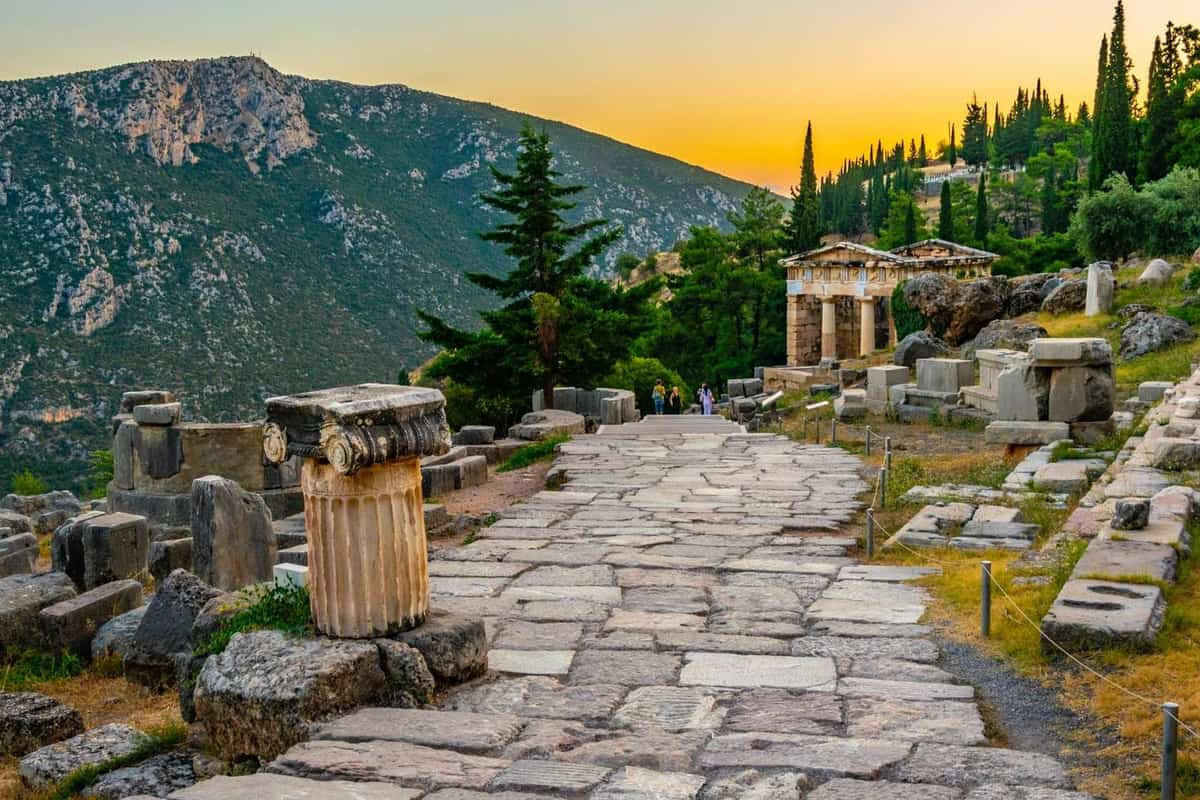
Delphi tickets open the sanctuary of Apollo and its museum on the slopes of Mount Parnassus, home of the ancient oracle. They sit beside the other Greek tours and sites listed on Greece VIP.
This post covers what the tickets include, ticket types, reduced and free entry, where to buy, skip-the-line and transport options, the site and museum, and the season. Common questions come last.
What are delphi tickets?
Delphi tickets are the entry passes for the Archaeological Site of Delphi and the Archaeological Museum of Delphi in central Greece. The museum page of the Ministry of Culture says its ticket also includes a visit to the archaeological site, so one pass opens both places.
A visit to Delphi has two parts. The archaeological site holds the ruins of an ancient sacred precinct in central Greece. A small modern town of the same name stands beside it. The museum holds the finds from those ruins. Delphi tickets pair the site and the museum, and the Greek Ministry of Culture operates the museum.
The ruins sit on the southwestern slope of Mount Parnassus. In antiquity the precinct was the seat of the Pythia, the major oracle that cities consulted about important decisions. The ancient Greeks placed the centre of the world here, and a stone monument, the Omphalos, marked the spot. Delphi tickets open that ground.
The museum tells the same story through objects. The Ministry says it presents the history of the Delphic sanctuary and its oracle. The collection runs from the second millennium BC, before the sanctuary was founded, to Late Antiquity, when a small Christian community lived at Delphi. Tickets for the museum open that whole span.
The museum page lists an e-ticket among its services. A Purchase link sits next to the ticket line, so the Ministry itself points buyers to its online route. Delphi tickets can therefore be bought online through the official page, and that page is the first place travellers check.
The same page tells visitors to check ticket prices, dates and opening hours before the visit. Changes to opening days are announced on the website of the Ministry of Culture and Sports. Rules change, so travellers check the official page before travel. Delphi tickets follow what that page states.
The Ministry splits the museum entry into a winter season, from November to March, and a summer season, from April to October. Both entries repeat the same note about the site. Delphi tickets therefore carry the same site-and-museum cover in both seasons, while the opening hours change with the season.
Listings on travel platforms sell entry in other forms. The entry-ticket page for Delphi shows a ticket with optional audio, a walking tour with admission, a ticket with a virtual-reality audio tour, and day trips with pickup. Each form adds extras to the same basic entry, and listings differ on what comes with it.
- Site: Ruins on Parnassus
- Museum: Finds from site
- Cover: Site and museum
- Check: Official page
Delphi tickets work as one entry pass for the ruins and the museum, and the official page confirms the rules.


What do delphi tickets cover at the archaeological site?
Delphi tickets admit visitors to the archaeological site, which the Ministry describes as the Sanctuary of Apollo with its Sacred Way, treasuries and temple, the theatre above them, and outer buildings such as the Western Portico and the Stadium.
The site climbs the southwestern slope of Mount Parnassus, so the layout works as a route uphill. The Sacred Way rises toward the Temple of Apollo. The theatre lies farther up the hill from the temple, and the stadium lies farther still. Delphi tickets therefore open a climb, with the main monuments in order along it.
The Ministry overview of the site describes the Sacred Way that ran along the Sanctuary of Apollo. Greek cities built their treasuries on both sides of the road over time. They also set up ex-votos and monumental sculpted complexes there. Delphi tickets let visitors walk past the places where those offerings stood.
The Sacred Way ends at the Temple of Apollo, which housed the Oracle of Delphi in antiquity. The columns standing now come from a Doric temple built in the fourth century BC. In its cella stood the statue of the god and the omphalos, the navel of the earth. Delphi tickets lead to the centre of the sanctuary.
The site has an inner part and an outer part. The sanctuary of Apollo had precinct walls, called the peribolos. The Ministry adds that public buildings rose outside the sacred precinct, among them the Western Portico and the Stadium. Delphi tickets therefore reach past the precinct walls to these outer buildings.
Tour operators sell the same ground as a day trip from Athens. Listing titles differ: one names tickets, another names the museum visit, and another names only the pickup. Travellers check what a listing includes before booking. Delphi tickets bought alone leave out the road trip and the pickup.
The site is not only classical. The Great Excavation found parts of a fifth-century Christian basilica from the time when Delphi was a bishopric. It also found Late Roman buildings: the Eastern Baths, a house with a peristyle, the Roman Agora and a large cistern. Delphi tickets open ground that holds more than temple ruins.
The Ministry Delphi website sorts the archaeological site under three headings: history of Delphi, monuments and excavations. Travellers can read those pages before the visit. The museum menu adds selected exhibits and 3D objects. The museum page adds that the last admission comes before closing time, so a late arrival cuts the visit short.
- Route: Sacred Way uphill
- Temple: Home of oracle
- Above: Theatre and stadium
- Outside: Western Portico
Delphi tickets open the Sacred Way, the temple terrace, the theatre and the outer buildings on the slope of Parnassus.
What do delphi tickets cover at the Archaeological Museum of Delphi?
Delphi tickets cover entry to the Archaeological Museum of Delphi, where fourteen rooms show the finds from the sanctuary in date order. The Ministry page for the museum adds that its ticket also includes the visit to the archaeological site, so one ticket opens both places.
The Ministry page for the museum shows a single ticket, not a menu of choices. The page says the ticket also includes the visit to the archaeological site of Delphi. A purchase link on the page leads to the official ticket store. Delphi tickets for the museum are therefore also tickets for the ruins.
Museum entry needs a chosen slot. The official ticket store marks the museum ticket as timed entry, valid for one entry on the selected date and time. One listing adds that the ruins can be entered at any time on the selected date. Only the museum visit is tied to a slot.
Date order shapes the visit. Rooms 1 and 2 hold bronze offerings from the 8th and 7th centuries BCE, among them tripods and cauldrons decorated with creatures such as griffins, and bronze figurines of warriors. Delphi tickets open these early pieces first, and later rooms run on to the final years of the sanctuary.
Room 3 holds four metopes from the Treasury of the Sicyonians. They show the Argonaut expedition, a boar hunt and the abduction of Europe by Zeus as a bull. Room 4 resembles a safe. It holds the silver bull and a set of statues thought to show Apollo, Artemis and their mother Leto.
Room 10 holds parts of the Tholos, the round building in the sanctuary of Athena Pronaia. Lion-head gutters and two rows of metopes were found. A room indoors thus links to a building in the sanctuary, and Rooms 9 and 10 together show sculptures from the Treasury of the Massaliots and other pieces from that sanctuary.
Room 12 holds Roman objects and parts of the Roman frieze that decorated the theatre. The frieze shows deeds of Heracles, such as the lion of Nemea and Cerberus. Delphi tickets also open the ground floor gallery, which holds finds from the burial ground of Delphi, from houses and from the Corycian cave.
Beyond the rooms, the museum building has an entrance hall, a cafeteria and a gift shop. The Ministry page lists a ramp, a lift, braille signs, tactile material and a toilet for disabled visitors. The official ticket store lists limits for delphi tickets: no large luggage, food, professional photo shoots or filming.
- Rooms: Fourteen, chronological
- Site: Included in ticket
- Entry: Timed museum slot
- Facilities: Cafeteria, shop, ramp
Delphi tickets give one entry to the museum and the site, so rooms and ruins form one visit.
Which types of delphi tickets can travellers book?
Delphi tickets come as the Ministry combined entry for the museum and the site, as listings that add an audio tour or a skip-the-line label, and as day trips that bundle entry with pickup from Athens. Reduced entry is a separate type with an ID check.
The base type is the combined entry sold through the official ticket store that the Ministry page links to. One ticket covers the museum and the site. The store page adds that access to a digital app is included. Delphi tickets from other sellers in the listings build on this base entry with extras.
The Ministry museum page names one ticket, so a museum-only or site-only choice does not show there. Listings sell the same pair under one name, and one title names both places together. One listing describes the pair as a ticket to the site and the museum. Rules change, check the official page before travel.
Audio tickets add commentary on a smartphone. One listing offers an audio tour for the museum and, if chosen, for the site, in seven languages, from English to Japanese. Instructions arrive with the voucher after booking. Delphi tickets of this type ask visitors to bring a charged smartphone and headphones.
Skip-the-line is a label, not a ticket type. Listings attach it to admission tickets and to escorted tours. One audio ticket listing explains the idea: visitors scan the ticket at the entrance machines and avoid the queue at the booth. Other formats add a virtual reality audio tour or a 3D audiovisual tour.
Transport types start in Athens. Listings mark them with the words pickup available and offer small-group or private versions. One title says the day trip is sold with tickets, and another adds an Arachova village stop. Delphi tickets of this kind sit inside a booking that also covers the drive.
Combined tours pair Delphi with another sight. Listings for a Delphi and Meteora tour name tickets and hotel pickup in the title. A Corycian Cave and Thermopylae day trip also appears, as a small-group listing. Delphi tickets in these listings come bundled with the extra stops and the transfers.
Reduced entry is a separate type. One listing says reduced-price tickets are not sold online and asks for ID at the ticket booth, while the official ticket store says holders of reduced or free tickets show ID or documents at entry. For reduced delphi tickets, listings differ, so the Ministry rules decide who qualifies.
- Base: Museum plus site
- Add-on: Audio or skip-the-line
- Bundle: Pickup from Athens
- Reduced: ID at entry
Delphi tickets differ in what they add to the base entry, so the listing text decides the choice.
Who gets reduced or free delphi tickets?
Delphi tickets follow one Ministry list. Reduced rates go to EU seniors over 65 from 1 October until the start of June and to escorts on school visits. Free entry goes to young EU visitors, non-EU children, people with disabilities, journalists and pass holders.
The Ministry page for the site shows a full rate and a reduced rate for delphi tickets. It does not name the groups itself. Instead, it links to one document on free and reduced admission to state archaeological sites, monuments and museums. Every group named below comes from that document.
Reduced delphi tickets go to seniors over 65 from Greece or other EU states, from 1 October until the start of June, with an ID card or passport. Parents who accompany primary-school visits from the EU and the European Economic Area also pay it, as do teachers escorting school visits from non-EU countries.
Free delphi tickets follow age and origin. Visitors aged up to 25 from EU states enter free with an ID card or passport. Non-EU visitors aged 18 and under enter free when they show a passport. Evening, second-chance and vocational learners over 25 in EU and European Economic Area countries enter free with an attendance certificate.
Delphi tickets are free for people with disabilities. One escort joins free only when the disability reaches 67 percent. Proof is the Disability Card, or an ID card or passport with a disability certificate. Journalists enter free with a valid press ID. Refugees show an international protection applicant card, a travel document or a residence permit.
Holders of a three-year Free Entry Pass enter free by showing it. The Ministry issues the pass after a simple application, two photographs and the supporting papers. Groups that qualify include teachers in Greek schools, active or retired, and graduates of history, archaeology, architecture and fine arts departments.
The same page names the free days for delphi tickets. They are 6 March, 18 April for International Monuments Day, International Museums Day, the last weekend of September for European Heritage Days, and 28 October. Winter Sundays join the list as well, running from 1 November to 31 March.
The site page lists every first and third Sunday in that winter period. The museum page lists only the first Sunday of each month in that period. Rules change, so check the official page before travel. The same Ministry terms apply across state sites, as the page on Knossos tickets also shows.
- Reduced: Older EU citizens
- Free: Young EU visitors
- Pass: Three-year free entry
- Days: Set free-entry dates
Delphi tickets depend on age, origin and status, and a valid ID or certificate settles the rate at the gate.
Where can travellers buy delphi tickets?
Delphi tickets are sold online in the official ticket store, at the ticket offices of the museum and the site, and in reseller listings that add an audio tour. Online tickets name a date and a time, and each works for one entry.
The Ministry page for the site says delphi tickets are available at ticket offices on site as well as online. The museum page lists an e-ticket service and a purchase link to the official ticket store. It also states that the museum ticket includes the visit to the archaeological site.
The official store sells delphi tickets as timed entry. Each ticket is valid for single entry on the selected date and time. The store allows changes up to a set time before the visit and caps the number of changes per ticket. Tickets are non-refundable, so a change is the only option when plans shift.
A notice on the Ministry page describes works at the site for a new ticket office and shop. During them, tickets are issued at the museum ticket office and at a temporary kiosk in the museum courtyard, not at the site. Notices change, so travellers read the current one before the visit.
The store asks visitors to have the ticket in digital or printed form, so a phone screen works. Reduced and free tickets need one more step. Visitors show valid ID or documentation at entry, which matches the proof lists above. A reseller listing sends the ticket and audio instructions by email.
Reseller listings bundle delphi tickets with extras. One listing sells an entry ticket with a smartphone audio tour in English, French, German, Italian and Spanish. It is valid on the selected date, entry follows the selected time, and a smartphone is required for the audio. Visitors download the app before the visit.
The same listing sets the order of the visit: the museum first at the selected time slot, then the archaeological site. Inside, visitors explore at their own pace. The official store allows changes before entry, while this listing is non-refundable, so seller terms differ. Travellers read the cancellation line of each seller before paying.
Delphi tickets come with gate limits. The official store bars large luggage, food and professional photo shooting or filming. The listing adds a ban on oversize luggage and large bags. The Ministry page says pets are not permitted, with cages at the site entrance, while assistance dogs are welcome across the site.
- Online: Official e-ticket store
- Offices: Museum and site
- Phone: Digital or printed
- Listings: Chosen date, time
Travellers who buy delphi tickets online carry a digital or printed copy, and reduced rates need valid proof at entry.
How do skip-the-line delphi tickets work?
Delphi tickets with a skip-the-line label carry a feature tag about the ticket line at the gate. Listings place the tag beside the tour-leader languages and the audio option, and the start time still comes from the availability check on the booking page.
Skip-the-line delphi tickets appear as a label on seller listings. One coach day-trip page shows the line Skip the ticket line beside the tour-leader languages and the optional audio commentary. The label is a feature of the product page, in the same way as the group type or the audio option.
The label sits on different kinds of product. A coach day trip from Athens carries it, a private day trip carries it, and so does a short walking tour sold with an admission ticket. An admission ticket sold with audio tours shows an optional audio tag on its card instead, and no skip-the-line tag.
The label does not fix a start time. The coach page and the walking-tour page both tell travellers to check availability to see starting times. On the walking tour, travellers name the time of day they want, and the tour leader replies by email. Delphi tickets with the label therefore describe the ticket line, not the hour.
On the walking-tour product, skip-the-line delphi tickets come with a tour leader for the ruins: the Temple of Apollo, the treasuries and the ancient theatre. The stadium and the museum are visited alone afterwards. The page adds that the tour leader does not cover the stadium or the museum.
The coach trip ties entry to an option. Its page lists entrance fees only if the option is selected. It warns that travellers on the option without entrance tickets must buy them before the activity, within a stated window, so the group can enter together. Delphi tickets under that label depend on the option picked.
A small-group listing works the other way. It pre-books entry tickets and pays for them when travellers select that option, yet its card shows tags for a private option and pickup, and none for skip-the-line. Listings differ, so pre-booked delphi tickets and the label are not the same thing.
Travellers who add Athens to the trip read the entry rules for the Acropolis in the post on Acropolis tickets. At Delphi, the label stays a seller feature that names the ticket line only. The product page shows what the entry includes, who pays for it and which options exist.
- Label: Seller feature tag
- Start: Set after availability
- Entry: Depends on option
- Walking tour: Stadium visited alone
Skip-the-line delphi tickets name the ticket line only, so travellers read each listing for entry and start time.
What do delphi tickets with transport from Athens include?
Delphi tickets with transport from Athens bundle a round trip by air-conditioned coach or minibus with a driver, and entry to the site and museum comes as an option. Tour leaders, headsets or audio commentary and onboard Wi-Fi are added, depending on the listing.
Delphi tickets with transport from Athens start with the vehicle. Coach listings state round-trip travel in an air-conditioned bus, and one names a professional driver. A small-group listing names an air-conditioned vehicle and says the minibus with the driver takes travellers back to Athens, while a private option lets one party travel alone.
Group size follows the option picked. One listing states a private party of up to 19 people and a standard group of up to 50 people, and says the size depends on the option chosen. A private option keeps the vehicle for one party and a standard option shares it.
The meeting point differs by listing. One coach page gives a single starting address in Athens and returns to it. A small-group page offers nine pickup points and nine drop-off points, and a third page uses one central meeting point. Travellers read the point on each page before booking.
Entry is the part that varies between bundles. One coach listing lists entrance fees only if the option is selected, and another lists them as optional. A small-group listing says entry tickets are pre-booked and paid for travellers who choose that option. Delphi tickets in these bundles are a choice made at booking.
The commentary comes in three forms. One coach listing hands out headsets so travellers hear the tour leader clearly. A small-group listing adds a virtual reality device and multilingual commentary. A third lists an archaeologist as trip attendant and an audio app. Delphi tickets with transport differ here, so each page needs a read.
The bundle also carries comforts and breaks. Two coach listings state Wi-Fi on board, and a small-group listing seats a tour leader on the bus. Stops outside the gate are a coffee break and a mountain-town stop with lunch and free time. One listing tags the museum visit and the lunch with an extra fee.
Other costs stay outside the bundle. One listing leaves meals and personal expenses to travellers and leaves tips to the traveller. The same pages offer free cancellation up to a stated time before the start and a reserve-now, pay-later booking. Delphi tickets with transport are sold on those terms, and each page states them.
- Vehicle: Coach or minibus
- Entry: Chosen at booking
- Commentary: Headsets or VR
- Extras: Wi-Fi on board
Delphi tickets with transport from Athens bundle the road, the driver and a choice of entry.
What do delphi tickets show at the Temple of Apollo?
Delphi tickets show the ruins of the Temple of Apollo, a Doric building raised on a platform of the mountain slope. Visitors see the terrace, the altar in front and the place of the oracle, while the inner rooms are known only from ancient writers.
The temple stood on a platform situated on a sloping hillside with a north to south incline. Large walls of polygonal masonry enclose the platform, and evidence of rows of small stone chambers lies underneath. Delphi tickets lead visitors up to this terrace, where the ruins of the temple can be seen.
Greek tradition counts five temples at this spot. The first was a hut of laurel from the Vale of Tempe. The ruins that visitors see belong to a temple of the fourth century BC. A Roman emperor ordered the destruction of pagan temples in AD 390, and little remained afterwards.
Delphi tickets show ruins, not rooms, so the inner plan comes from ancient writers. They name a porch called the pronaos, a main room called the cella and, behind it, an inner room called the adyton. Pilgrims who came to consult the Pythia waited in the cella. Only priests of Apollo entered the adyton.
Scholars list what the adyton held at one time or another. The list names a golden statue of Apollo, the omphalos, sacred armour unlawful for mortals to touch, and an altar with a pine-wood fire. Researchers place the vault of the Pythia, with her tripod, under the temple itself.
Accounts place the omphalos, the stone called the navel of the world, in the adyton near the Pythia. Its carved surface shows a knotted net, and its centre is hollow. The stone represents the one that Rhea wrapped in swaddling clothes to deceive Cronus. Delphi tickets lead to the temple where it stood.
Three maxims were inscribed at the entrance of the temple: know thyself, nothing in excess and surety brings ruin. Sources do not agree on the exact spot. They place the words on a wall of the porch, a column, a doorpost, the temple front or the gateway. A large letter E was also recorded.
Delphi tickets reach the altar where inquirers left gifts for the oracle. Gifts included sacrificial animals such as goats, sheep or bulls. If the Pythia accepted the gift, she went down into a chamber below the sanctuary ground. A priest above heard her voice through an opening in the floor and explained the answer.
- Platform: Terrace on slope
- Wall: Polygonal stone masonry
- Altar: Black marble
- Omphalos: Navel stone
Delphi tickets give access to the temple ruins, the altar and the terrace where the oracle once answered travellers.
What do delphi tickets show along the Sacred Way and the treasuries?
Delphi tickets show the Sacred Way, the winding ancient road that climbs from the entrance of the upper site almost to the Temple of Apollo. Along it stand the treasuries of Greek city-states, the Athenian Treasury, the Siphnian Treasury and the Sibyl’s Rock.
The Sacred Way is the processional route of the sanctuary. It starts at the entrance of the upper site and winds up the slope past votive statues and treasuries. Ancient consultants walked it carrying laurel branches sacred to Apollo. Delphi tickets let travellers follow the same line to the temple terrace.
A treasury was a building that housed the votive offerings of one city-state. The gifts belonged to Apollo and were not allowed to leave the sanctuary. Offerings that were no longer practical to display were buried in votive pits within the sacred ground. Delphi tickets show where these buildings line the road.
The Athenian Treasury stands directly below the Temple of Apollo, so Delphi tickets lead every visitor past it on the climb. On the front, two columns stand between two antae, the forward ends of the side walls. Its thirty metopes run nine along each long side and six along each short side.
Scholars still debate the date of the treasury, but the Battle of Marathon against the Persians is tied to it. The building was a statement of power as well as a gift, built by a city that had turned from tyranny to democracy. Travellers who follow the Persian wars can read on in the Thermopylae tour post.
The Siphnian Treasury was the first religious structure made entirely of marble. Two carved maidens, called korai, stood on its front in place of columns, and the north frieze was visible from the Sacred Way. The sculpture and a reconstruction are now in the Delphi Archaeological Museum, which Delphi tickets can add to the visit.
The Sibyl’s Rock is a pulpit-like outcrop on the Sacred Way, between the Athenian Treasury and the Stoa of the Athenians. One claim says a prehistoric Sibyl, older than the Pythia, sat here to give prophecies. Other ideas put the Pythia on the rock, or an acolyte who gave the final prophecy.
The Bouleuterion and the Sibyl’s Rock frame a narrow pass to the fountain that the dragon Python was said to guard. In front of the pass lies the Halos, a round open space whose name means threshing floor. Rituals took place there. In 1939, repair work on the Sacred Way found a repository of buried offerings.
- Path: Winding Sacred Way
- Athenian: Doric marble porch
- Siphnian: All-marble treasury
- Sibyl: Pulpit-like rock
Delphi tickets open the Sacred Way, with its treasuries, the Sibyl’s Rock and the climb to the temple.
What do delphi tickets show at the theatre and the stadium?
Delphi tickets show the ancient theatre in the north-west corner of the sanctuary of Apollo and the stadium on the highest spot of the site. A listing of the combined ticket names both, and the Pythian Games used them for music, poetry and running races.

Delphi tickets lead to the theatre in the north-west corner of the sanctuary of Apollo. The Ministry site calls it the largest building of the site. Its seats lean on the hill slope on the west side. On the east side it passes over a torrent that led the water of the Cassotis fountain under the temple.
The seating has 35 rows of stone benches, split into a lower zone and an upper zone by a broad corridor. Six stairs cut the lower zone into seven tiers. Its capacity was 4,200 to 4,500 spectators. The first three rows reuse stone from a destroyed building, possibly a treasury.
Delphi tickets admit visitors to a theatre that was once hidden. By 1438 earth and rocks covered it, though it was still partly visible. Later the houses of the village of Kastri were built over it. Restoration followed after 1910, and the main building material is local limestone.
The stadium stands at the highest spot of the area, just above the theatre, between the Phaedriades and the hill of Agios Ilias. It lies north-west of the Temple of Apollo. The Ministry site calls it the best preserved stadium in Greece, and a listing of Delphi tickets names it among the sights.
The north side of the stadium rests on the slope, while a terrace supports the banks on the south side. On the north side 12 rows of seats survive, split by stairs into 12 tiers. The curved west end, called the sling, has six rows in four tiers. The southern tiers have collapsed.
The track began 178 metres long, with up to 20 tracks for runners. Later the tracks were cut to 17. The starting line survives almost intact on the east side, with two rows of slabs cut with grooves for the runners’ feet. An inscription on the support wall forbids taking out the wine meant for sacrifices.
The Pythian Games ranked second in importance behind the games at Olympia, and Delphi tickets show the stadium where the athletic contests took place. The Games came every four years, two years after the Olympics. Athletic events included the stade, the diaulos, the dolichos, a race in armour, wrestling, boxing, the pankration and the pentathlon.
- Theatre: Largest site building.
- Seats: 35 stone rows.
- Stadium: Highest spot.
- Track: Surviving starting line.
Delphi tickets reach the theatre and the stadium, the two upper stops where the Pythian Games took place.
What do delphi tickets show at the Castalian Spring and the Athena Pronaia sanctuary?
Delphi tickets are listed as showing the Castalian Spring, a stone fountain beside the road to the sanctuary, and the sanctuary of Athena Pronaia with its Tholos. The Ministry site counts both among the monuments of the archaeological site.
A listing says travellers scan Delphi tickets at validating machines at the entrance. The archaeological site lies 400 metres from the village of Delphi, on the road between Arachova, Amphissa and Itea. That modern road divides the two ancient sanctuaries: Athena Pronaia to the south and Apollo to the north.
A listing of combined Delphi tickets names the sanctuary of Athena Pronaia with the Tholos and the Kastalia Spring among the sights. The Ministry site lists the Tholos, the temple of Athena Pronaia, the gymnasium and the Kastalian Spring as monuments. Entry rules do change, so travellers read the official page before booking.
The spring water gushed from the slopes of the Phaedriades, called Hyampeia in antiquity, into a narrow gorge. It served for the purification of priests and of the faithful who entered the sanctuary. Cold, clean water still flows from a smaller fountain and refreshes visitors on their way to the sanctuary.
Delphi tickets for the spring lead to two surviving fountains. The Archaic stone fountain went up beside the road to the precinct of Apollo in the early sixth century BC. Its rectangular basin has a central chamber and two side chambers, and a paved courtyard with stone benches lay in front.
In the first century BC a second fountain replaced the Archaic one, cut into the rock about 50 metres away. Its basin is 10 metres long, with seven metal spouts. Eight rock-cut steps lead down to the paved courtyard. Niches above held figurines for the water nymph, and one later became a church apse.
Delphi tickets name the sanctuary of Athena Pronaia, which the Ministry site says holds the Tholos, the temples of Athena and at least two treasuries. The temple had three phases: two earlier ones of poros stone in the seventh and sixth centuries BC, and a limestone one of the fourth century BC with six front columns.
The Tholos that Delphi tickets name is a round building with twenty Doric columns outside. The gymnasium next to the sanctuary had two levels: an open stoa above, and a palaestra, pool and baths below. Later a monastery was built above it, among the first buildings of the early modern era.
- Spring: Archaic and rock fountains.
- Road: Divides two sanctuaries.
- Tholos: Round Doric building.
- Temple: Three building phases.
Delphi tickets name the Castalian Spring and the Athena Pronaia sanctuary, and the official page confirms each stop.
Which museum pieces do delphi tickets let travellers see?
Delphi tickets that include the museum let travellers see the Charioteer, the Sphinx of Naxos, the paired kouros statues from Argos, the Siphnian Treasury friezes and an omphalos stone. The rooms follow date order, so the early statues come first and the bronze Charioteer comes late.
The two kouros statues stand in Room 3, near the start of the route. Excavators found them close to the Treasury of the Athenians. Both figures are nude youths with the left foot forward and tightly closed fists. Spiral curls frame the forehead, and the face wears an Archaic smile.
Museum notes give the pair two identities. An older reading links them with two brothers from an ancient story. A newer reading of an inscription that means the Kings points to other figures. Either way, delphi tickets show a statue pair in the sturdy style of a workshop at Argos.
Delphi tickets include the Sphinx of Naxos, which shares Room 5 with the Siphnian pieces. The face has an enigmatic smile, and careful carving marks the hair, chest and wings. An inscription on the column base renewed the right of Naxos to ask the oracle first. The Greek name for that right is promanteia.
The Siphnian Treasury was the first religious building made entirely of marble. Delphi tickets for the museum show parts of its frieze, one capital and one of the two maiden figures that held up the porch. The east frieze shows an assembly of gods during the Trojan War.
The north frieze shows the Giants attacking the gods, and pilgrims on the Sacred Way saw it as they climbed. Paint once covered the reliefs in green, blue, red and gold, but red is now the only colour easy to see. Names were cut into the background and can still be read in certain light.
With delphi tickets, travellers find an omphalos stone in Room 11, beside the column of the Dancers of Delphi. Its carved marble form troubled the excavators, who found it hard to tell an original from a Hellenistic or Roman copy. French studies link the stone to the bronze tripod held up by the three dancers.
The Charioteer stands in a room of its own, with eyes of white enamel and dark stone, copper lips and silver teeth. A separate case holds the hand of a stable boy and part of a bridle. Travellers who also plan the Heraklion Archaeological Museum can compare its museum tickets.
- Charioteer: Bronze, own room
- Sphinx: Naxian marble figure
- Kouroi: Archaic marble pair
- Friezes: Siphnian Treasury reliefs
Delphi tickets with museum entry show the sanctuary’s story in order, from early bronze to the Charioteer.
How hard is the walk with delphi tickets?
Delphi tickets lead up a mountain slope, so the site is a steady climb on the Sacred Way, steepest just before the Temple of Apollo. The museum has a lift, a ramp and a specially designed route, as the Ministry lists.
The sacred precinct lies on the southwestern slope of Mount Parnassus. Past the entrance of the upper site, the Sacred Way keeps climbing almost to the Temple of Apollo, and treasuries and statues line it. Delphi tickets therefore start a walk that rises with the mountain from the gate.
The Ministry also points out a steep part. A bronze chariot group once stood on the right side of the Sacred Way, where the road is particularly steep, just before the Temple of Apollo. The theatre and the stadium lie higher still, and the stadium marks the top of the site.
The Ministry puts the archaeological site 400 metres from the village of Delphi, on the road between Arachova, Amphissa and Itea. That modern road divides two ancient sanctuaries, with Athena Pronaia to the south and Apollo to the north. The Sacred Way, the Temple of Apollo and the theatre belong to the northern one.
The Ministry calls the Archaeological Museum of Delphi fully accessible to people with physical impairment. Delphi tickets for the museum lead to a lift, a ramp and a specially designed route through the permanent exhibition. Braille signs, tactile material and a restroom for visitors with disabilities in the forecourt are also listed.
For visitors with limited mobility, a special vehicle goes up to the Temple of Apollo when the Ephorate of Antiquities of Phocis gets advance notice. Parking spaces for disabled visitors lie along the National Highway between Arachova and Delphi. Travellers with delphi tickets who need that vehicle contact the Ephorate before the visit.
Listings differ from the Ministry on access. One listing for site and museum entry marks the visit as unsuitable for wheelchair users and does not allow baby strollers or large bags. The Ministry describes a lift and a special vehicle instead. Rules change, so check the official page before travel with delphi tickets.
The same listing asks visitors to bring comfortable shoes, a sun hat, sunglasses and water. The museum has a cafeteria and a gift shop, and Braille panels mark points of interest on the site. At each room entrance, a QR code leads to a free app with a virtual tour for visitors with mobility or hearing impairments.
- Climb: Sacred Way slope
- Museum: Lift and ramp
- Site: Special vehicle ride
- Bring: Shoes, hat, water
Delphi tickets mean a climb on the slope and a lift-served museum route, so travellers plan shoes and water.
Which months suit delphi tickets?
Delphi tickets suit every month, because the site keeps a schedule in winter, in summer and in the months between. Winter brings cold and snow, summer brings heat and the biggest crowds, and spring and autumn sit between. The ticket date decides which a traveller meets.
Delphi tickets in one listing hold for a single date, and that listing says the date and the entry slot cannot be changed. Site entry works at any point on the chosen date, while the museum entry needs a fixed slot. The month is therefore a choice made before the weather is known.
The opening schedule of the site and the museum shifts with the season. A listing groups November to March as one schedule and June to August as another. The months between change step by step with the length of the day. The official page shows the current schedule for delphi tickets.
Winter is the cold season. The sanctuary stands on the southern slopes of Parnassus, a mountain with very cold winters. The plain of Thebes, on the road from Athens, has cool, wet winters, and the Aegean sea effect sometimes brings snow there. Delphi tickets for winter dates meet the coldest weather of the year.
Snow depths in Thebes have passed 50 centimetres, and the inland position can bring very low minimum temperatures. The road to the gate crosses that plain first. Travellers with delphi tickets for a winter date therefore check the forecast for the road as well as the forecast for the gate.
Summer is the warm season. Thebes has hot, dry summers, and in heat waves the city has reached 44.5 degrees Celsius. The high mountain keeps cool summers. Delphi tickets for a summer date therefore cover a route where the air changes with the height, not only with the month.
Summer also brings the crowds. In the summer months the population of Phocis, the regional unit that holds Delphi, nearly doubles with the influx of tourists. Delphi also draws visitors who come for the ski centre on Parnassus and the popular coastal towns nearby. Summer therefore draws more visitors than the other seasons.
The two shoulder seasons, spring and autumn, fall between the extremes. Parnassus keeps its hiking trails open in all three warm seasons, and the summer jump in visitors falls away. Site entry in that listing has no slot, so a traveller with delphi tickets can enter early or late, while only the museum visit needs a fixed slot.
- Winter: Cold, with snow.
- Spring: Hiking trails open.
- Summer: Warm, with crowds.
- Autumn: Last warm season.
The month for delphi tickets depends on how much cold, heat and crowd a traveller accepts.
How do travellers reach the gate with delphi tickets?
Delphi tickets lead to a gate on Greek National Road 48, which reaches the site from Arachova in the east and from Itea on the coast. The gate lies 400 m from the village of Delphi, and travellers arrive by car or on a tour with transport.
Greek National Road 48 is the road to the gate. The official site page places the archaeological site 400 m from the present-day village of Delphi, on the road between Arachova, Amfissa and Itea. Travellers with delphi tickets arrive from the east through Arachova or from the coast through Itea.
Tour listings with transport remove the driving. They show a pickup option, a private option or a small group, with the entry ticket in the bundle. A ticket-only listing names two meeting points, the chosen option decides which one applies, and listings differ. Travellers who plan Meteora instead can read the Meteora day trip page.
Road 48 passes through the mountain town of Arachova, which lies 8 km east of Delphi. The village of Delphi stands immediately west of the archaeological site. Travellers from Arachova therefore meet the site and the museum before the village, so the gate for delphi tickets comes first on arrival.
Itea stands on the north coast of the Gulf of Itea, a northward arm of the Gulf of Corinth, and lies 8 km south-west of Delphi. Greek National Road 48 connects Itea with Delphi, Livadeia and Naupactus. Travellers who stay on the coast use this road to reach the gate for delphi tickets.
Galaxidi lies on a natural double harbour on the west coast of the Gulf of Itea, 7 km south-west of Itea and 15 km south-west of Delphi. Greek National Road 48 connects it with both. Amfissa lies 11 km north of Itea, and Greek National Road 27 joins Itea with Amfissa and Lamia.
The modern village of Delphi climbs the slope in terraces, much like the ancient precinct beside it. Its streets are narrow and one-way in places. The village has extensive facilities for the tourist trade at the site, so travellers with delphi tickets find services next to the gate.
The official accessibility page names parking spaces for visitors with disabilities at the site and the museum, along the national highway between Arachova and Delphi. It gives no further car-park detail, so rules change and the official page is the check before travel. At the entrance, listing tickets are scanned at validating machines.
- East: Arachova, 8 km
- Coast: Itea, 8 km
- Harbour: Galaxidi, 15 km
- Village: 400 m away
Every route to the gate with delphi tickets ends on National Road 48, from Athens or from the coast.
What do travellers carry with delphi tickets?
Delphi tickets travel as a phone screen or a printout, next to valid ID for reduced or free entry. A listing adds comfortable shoes, a hat and sunscreen. Large luggage stays out, because the official ticket page and the listing both ban it.
The official ticket page asks visitors to have the ticket in digital or printed form. A phone screen works, and so does paper. The same page calls the entry timed, and each of the Delphi tickets it sells is valid for a single entry on the chosen date and time.
One listing sends the e-ticket by email. It tells buyers to download the app and the audio tour before the visit, and its bring list names headphones and a charged smartphone. An email from the local supplier adds the ticket instructions, so the phone carries the ticket and the audio commentary together.
Reduced and free tickets need proof. The official page states that visitors holding them must show valid ID or documentation at entry, and a free ticket does not skip that step. The proof stays in a pocket or a small bag, so it is at hand when entry is checked, not packed away with the luggage.
The Ministry list names the document for each free group. Children and young people up to 25 from EU member states show an ID card or passport. Children up to 18 from non-EU countries show a passport. The papers differ by group, so the group decides what is carried.
A listing for a site and museum ticket gives a bring list. It names comfortable shoes, a hat, sunscreen, headphones and a charged smartphone. The same listing notes that the ruins are spread up the side of a mountain, with rough tracks. Each item then has a job on the slope.
Bag rules appear in two sources. The official museum ticket page lists large luggage, food, and professional photo shooting or filming as not permitted. The listing bans oversize luggage and large bags. The wording differs, but both sources point the same way. Travellers keep the bag small, and a professional camera setup stays at home.
The museum page lists a café or restaurant, a shop, toilets and parking. The ticket page bans food but does not mention drinks, so travellers read its notes box before they pack water. A second ancient site sells its own entry, and the page on Mycenae tickets shows how that works there.
- Entry: Phone or paper
- Proof: Valid ID
- Gear: Shoes, hat, sunscreen
- Banned: Large luggage, food
Delphi tickets need three things ready at the entrance: the ticket, valid ID where it applies, and a small bag.
What do travellers ask about delphi tickets?
Delphi tickets raise five common questions: booking ahead, one ticket for site and museum, free days, children, and closures. The answers below follow the official ticket pages, the Ministry list and the listings, and they say so when a source stays silent.
Do travellers need to book delphi tickets ahead?
Delphi tickets on the official page carry timed entry, so each ticket belongs to a chosen date and time. Changes are allowed up to a set time before the visit, with a limit of two changes per ticket. The page calls tickets non-refundable, and listings show their own terms.
Does one of the delphi tickets cover both the site and the museum?
The official museum page lists its ticket with access to the Archaeological Site and the Archaeological Museum of Delphi. Listings also sell site and museum tickets as one product. One listing tells buyers to visit the museum first, in the selected time slot, and the site afterwards.
Are delphi tickets free on set days, and how busy are those days?
The official museum page lists free admission on four fixed dates, among them March 6 and October 28, on the last weekend of September, and on the first and third Sunday of each month from November to March. No source gives crowd figures for those days. Ministry rules do change, so the official page is the place to check before travel.
Can children use free or reduced delphi tickets?
The Ministry list gives free admission to children and young people up to 25 from EU member states, and to children up to 18 from non-EU countries. Both groups show the documents named above. The official ticket page adds that reduced and free delphi tickets both need valid ID or documentation at entry.
What happens to delphi tickets when the site is closed?
The official ticket page gives no rule for a strike or a storm closure. It calls tickets non-refundable, and one listing says the same about its activity. The ticket service links an announcements page in its help menu, so travellers read it before the trip and again before they leave for the site.