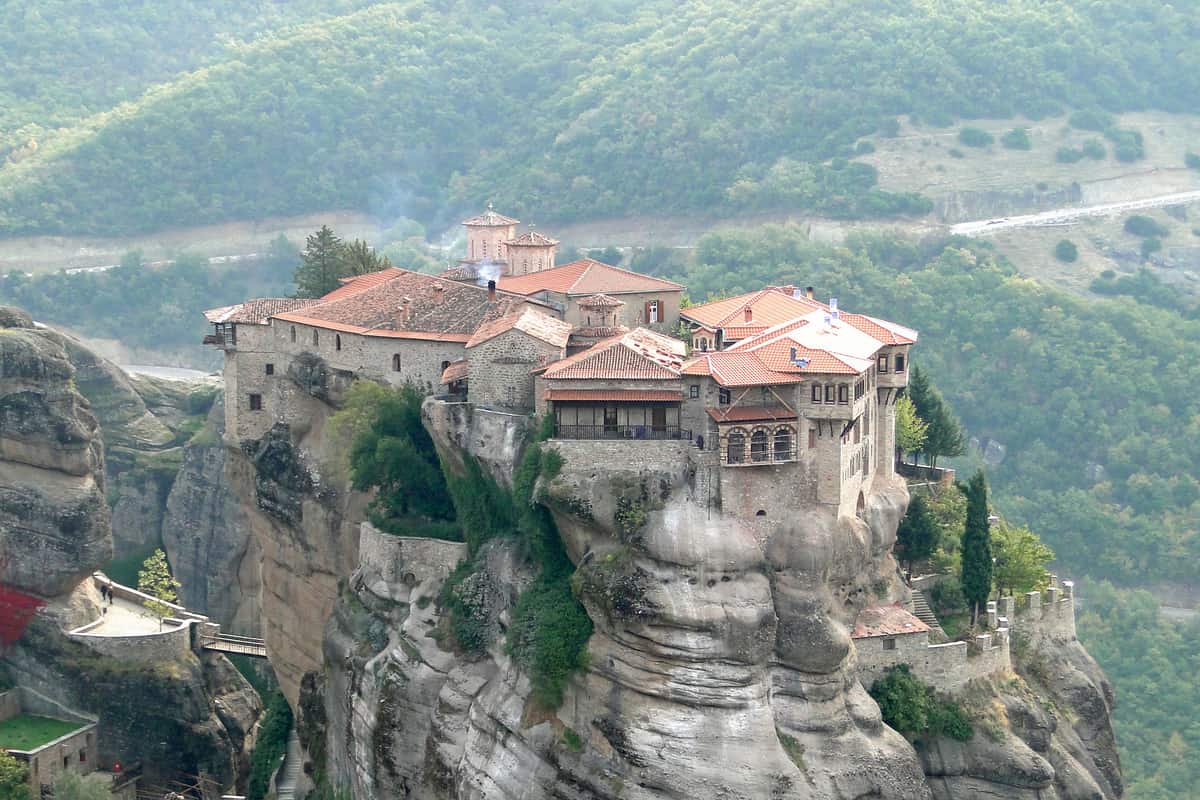
A Meteora day trip from Athens heads north into Thessaly to the rock pillars of Meteora, where monasteries stand on the summits above Kalambaka and Kastraki. This post covers what a Meteora day trip from Athens includes, the monasteries, how the rocks formed, the history, the journey by train or road, what to wear and the best season. It is one of the best tours in Greece on Greece VIP.
Each section ends with a Meteora tour that can be booked online.
What does a Meteora day trip from Athens cover?
A Meteora day trip from Athens covers a rock formation in Thessaly, central Greece, where six monasteries stand on top of sandstone and conglomerate pillars. The route links the capital with Kalabaka, the town at the foot of the rocks, and the village of Kastraki.
The name Meteora means “lofty” or “elevated”, and it shares its root with the word meteor. Giant natural pillars and rounded, hill-like boulders dominate the area, and the cliffs rise more than 400 metres. The formation lies between the town of Kalabaka and the village of Kastraki, in the regional unit of Trikala. A Meteora day trip from Athens moves between these rocks and the monasteries on their summits.
Twenty-four monasteries rose on the pillars and boulders, mainly from the second half of the 14th century. Six of them still stand and still function: four for monks and two for nuns. Locally, the complex ranks second in importance only to Mount Athos among Eastern Orthodox sites. A Meteora day trip from Athens enters these working monasteries, with their churches, frescoes and manuscript collections, on top of the rocks.
Kalabaka, also spelled Kalambaka, is the town at the foot of the Meteora massif and the seat of the municipality of Meteora. Its name is of Turkish origin and means “powerful fortress”. The village of Kastraki lies to the north-west, in a small valley that opens into the south-west side of the massif. Two rock columns, Holy Spirit Rock and Surloti, flank the valley entrance. A network of trails links Kastraki with the rocks and monasteries of a Meteora day trip from Athens.
- World Heritage: UNESCO added the six monasteries to the World Heritage List in 1988 for their architecture and their religious and cultural value.
- Population: The 2021 census counted 8,573 people in the town of Kalabaka and 1,023 in Kastraki.
- Kastraki name: The village takes its name from kastro, a Byzantine castle that stood until 1362.
A Meteora day trip from Athens joins the capital and largest city of Greece, a coastal city in the Attica region, with Thessaly in central Greece. The rocks rise at the north-western edge of the Plain of Thessaly, near the Pineios river and the Pindus Mountains. Kalabaka is also the north-western end of the old Thessaly Railways, now part of OSE.


Which monasteries does a Meteora day trip from Athens visit?
A Meteora day trip from Athens visits the six monasteries that form the UNESCO World Heritage Site: Great Meteoron, Varlaam, Rousanou, St Stephen, Holy Trinity and St Nicholas Anapausas. Each stands at the top of a rocky precipice, and two, Rousanou and St Stephen, house nuns.

Great Meteoron, also called the Monastery of the Transfiguration of the Saviour, is the oldest and largest of the six. It sits 613 metres above sea level and over 415 metres above the floor of the Pineios valley. Athanasios the Meteorite, a monk from Mount Athos, founded it on the Broad Rock in 1356. Its katholikon, the first church of the monastery, honours the Transfiguration of Jesus. The library holds 610 of the 1,124 codices that N. Veis catalogued at the six monasteries.
Varlaam, also known as All Saints, is the second largest monastery. It stands 595 metres above sea level, on a cliff 373 metres above the valley floor. A monk named Varlaam climbed the rock in 1350 and built three churches. After his death, the site lay empty for two hundred years. In October 1517, the brothers Theophanes and Nektarios Apsarades from Ioannina began to rebuild it. On a Meteora day trip from Athens, its museum shows relics and church treasures.
Rousanou, also called Arsanou, is believed to date from the 14th century, and its cathedral was decorated in 1540. The name is said to come from its first monks, who came from Russia. Now used as a convent, it stands 484 metres above sea level, in the middle of the site. St Nicholas Anapausas, founded in the late 14th century, sits on a small, narrow rock. Its name means “resting”, as it served pilgrims as a resting place. 14th-century frescoes decorate its third floor.
Holy Trinity stands 570 metres above sea level. Local legend names the monk Dometius as its founder, arriving in 1438, while other accounts date it to 1475–1476. Tunnels and 130 stone steps lead up to it. St Stephen, at 575 metres, and Holy Trinity stand apart, south of the main group. St Stephen’s new katholikon, built in 1798, is the newest structure at Meteora. On a Meteora day trip from Athens, St Stephen is also the house with the largest community, a nunnery since 1961.
- First on the road: St Nicholas Anapausas is the first monastery that pilgrims meet on the way to Meteora.
- Relics: Varlaam was reputed to house the finger of St John and the shoulder blade of St Andrew.
- Garden: Holy Trinity keeps a garden of 0.8 hectares at the summit of its rock.
St Stephen keeps its old refectory as a museum, beside the hestia, or kitchen, and rooms for painting, embroidery, incense-making and needlework. Great Meteoron has a dome-shaped kitchen near its refectory and a hospital with a brick roof on four columns. Holy Trinity once housed fifty monks, but only five remained by the early 20th century. A Meteora day trip from Athens finds these working spaces beside the churches.
How did the rocks seen on a Meteora day trip from Athens form?
A Meteora day trip from Athens reaches towers of sandstone and conglomerate, not volcanic rock. Streams laid down stone, sand and mud in a delta. Earth movements raised these beds, and water, wind and extremes of temperature then wore them down along vertical faults.
The pillars seen on a Meteora day trip from Athens rise steeply from the ground beside the Pindus Mountains, in western Thessaly. Their shape is hard to explain in geological terms. They are not volcanic plugs of igneous rock, as found elsewhere, but a mix of sandstone and conglomerate. Conglomerate is a sedimentary rock made of rounded, gravel-sized pieces set in finer sand, silt or clay. Its larger fragments are called clasts, and the finer material around them is the matrix.
The conglomerate formed from stone, sand and mud that streams carried into a delta at the edge of a lake, over millions of years. About 60 million years ago, in the Paleogene period, a series of earth movements pushed the seabed upward. This created a high plateau and opened vertical fault lines in the thick layer of sandstone. The Paleogene ran from 66 million to 23.04 million years ago and is the first period of the Cenozoic Era.
Water, wind and extremes of temperature then weathered the rock along the vertical faults and carved out the huge pillars. Weathering along criss-cross faults shaped these sandstone outcrops in the foothills of the Chasia Mountains, between Thessaly and Macedonia. Drainage from the old delta ran into the Pineios valley. A Meteora day trip from Athens sees the result: steep rock columns known as the “heavenly columns”.
Rock of this kind, worn down in this way, also appears elsewhere in the region and across the world. What sets Meteora apart is the even make-up of the sediments, laid down over millions of years with little sign of vertical layering, and the abrupt vertical weathering in one small area. Chemical analysis dates the cliffs to 60 million years, and river erosion shaped their sandstone and conglomerate forms.
- Earthquake: A magnitude 7 earthquake shook the rocks in 1954, yet the thin pillars still stand.
- Rockfall: In 2005, a massive rock fell and closed the access road to Meteora for days.
- Plants: Vegetation grows thickly out of the vertical walls, fed by water held in cracks and crevices.
The Pindus, beside which the pillars rise, runs north to south along much of mainland Greece and is known as the spine of Greece. In geological terms, it extends the Dinaric Alps. The Pineios, which drains the area, flows 205 kilometres from the Pindus through the Thessalian plain to the Aegean Sea. A Meteora day trip from Athens reaches the rocks along this river valley.
What is the history behind a Meteora day trip from Athens?
A Meteora day trip from Athens follows a story that starts with hermit monks in the 800s CE. Monasteries rose on the rock pillars in the 14th century, when Athanasios the Meteorite founded the Great Meteoron, and UNESCO listed the complex in 1988.
A Meteora day trip from Athens visits a place that classical Greek myths and ancient Greek literature never mention. The first people recorded there after the Neolithic era were hermit monks, who moved up to the pinnacles in the 800s CE. They lived in hollows and cracks in the rock towers, up to 550 metres above the plain, and met only on Sundays and special days to pray in a chapel below a rock called Dupiani.
Monks already occupied the caverns of Meteora by the 11th century. By the late 11th and early 12th centuries, a simple monastic state called the Skete of Stagoi had formed around the church of Theotokos, the Mother of God, which still stands. Building on the summits began in the 1300s, when monks looked for a hiding place as Turkish attacks on Greece increased. Access to the top was by removable ladders or hoisting ropes.
The central figure in the history behind a Meteora day trip from Athens is Athanasios Koinovitis, a monk from Mount Athos later known as Athanasios the Meteorite. In 1344 he brought a group of followers to Meteora, and between 1356 and 1372 he founded the Monastery of Great Meteoron on the Broad Rock. The local lord Simeon Uroš, based in nearby Trikala, protected and sponsored the community. His son John Uroš later retired there as a monk.
At the end of the 14th century, Turkish raiders sought control of the fertile plain of Thessaly, and hermit monks found the rock pillars a safe refuge from the growing Ottoman Empire. More than 20 monasteries rose, with 24 at their peak in the 16th century. Until the 1600s, baskets, ropes and large nets carried goods and people up the cliffs, and the ropes were changed, the story goes, only “when the Lord let them break”.
- 1881: The Convention of Constantinople brings Thessaly, with Meteora, into the Kingdom of Greece.
- 1920s: Steps cut into the rock, with a bridge from the nearby plateau, make the climb far simpler.
- 1921: Queen Marie of Romania becomes the first woman ever allowed into the Great Meteoron monastery.
UNESCO added the Meteora complex, made up of the six surviving monasteries, to the World Heritage List in 1988. The listing rests on the architecture and beauty of the site, joined to its religious and cultural significance. A Meteora day trip from Athens therefore visits a working religious site and a protected heritage site at once, shaped by monks who chose the inaccessible pillars as a refuge.
How does a Meteora day trip from Athens travel to Kalambaka?
A Meteora day trip from Athens travels north into Thessaly by road or rail. The road route follows the A1 motorway to Lamia and the A3 to Kalambaka. The rail route uses the 80.44 km branch line from Palaiofarsalos, now served by a replacement bus.
Thessaly lies in northern central Greece and borders Macedonia to the north, Epirus to the west, Central Greece to the south and the Aegean Sea to the east. Its Trikala and Larissa lowlands form a central plain ringed by mountains. Kalabaka, also written Kalambaka or Kalampaka, sits in the Trikala regional unit at the foot of the Meteora massif. Both the road and the rail routes of a Meteora day trip from Athens lead to this town.
By road, a Meteora day trip from Athens leaves the city on the A1 motorway, part of the E75, which runs north through Lamia towards Larissa and Thessaloniki. Near Lamia, the A3 branches off. Known as the Central Greece motorway or the E65 motorway, it crosses the Othrys mountains and the plains of western Thessaly, then passes Karditsa, Trikala and Kalambaka on its way to the A2 near Grevena. The A3 runs for 174 km in total.
By rail, the route follows the main line from Athens towards Thessaloniki as far as Palaiofarsalos, near Farsala. There, a branch of 80.44 km leaves the main line, runs through Karditsa and Trikala, and turns north-northwest to Kalambaka. The branch opened on 16 June 1886 as a metre-gauge line of the Thessaly Railways. In 2001 it was converted to standard gauge and joined to the main line, which allowed direct InterCity services between Kalambaka and Athens.
Trains do not reach Kalambaka at present. Storm Daniel brought large-scale flooding to Thessaly on 5 September 2023, and 50 km of track was destroyed. Services between Palaiofarsalos and Kalambaka were suspended, track renewal work is under way, and a rail-replacement bus links the two stations, with onward trains at Palaiofarsalos. Kalambaka station keeps waiting rooms on platform 1, a footbridge with stairs or a lift, and staffed ticket sales.
- Rail stops: The branch has stations at Palaiofarsalos, Sofades, Karditsa, Fanari, Magoula, Trikala and Kalambaka.
- Old network: Kalabaka is the northwestern terminal of the old Thessaly Railways, now part of OSE.
- Station design: Evaristo de Chirico, father of Giorgio de Chirico, designed the original station building and the line.
For a Meteora day trip from Athens, the motorway is the simpler choice while trains stay off the branch line. Rail travellers confirm the replacement bus between Palaiofarsalos and Kalambaka before setting out. Both routes arrive in Kalabaka, where the rocks of Meteora border the north side of the town and an access road leads up to Meteora.
What do visitors wear and bring on a Meteora day trip from Athens?
A Meteora day trip from Athens calls for modest clothing, since the monasteries are working religious houses open to visitors. Comfortable shoes suit the staircases and rock-cut paths, and a small bag holds water, sun cover and a light layer for the day.
The monasteries of Meteora were created for monks and nuns who follow the teachings of the Eastern Orthodox Church, and the houses still in use stay open to visitors. A Meteora day trip from Athens therefore enters working places of worship. Modest dress shows respect there: tops that cover the shoulders, and skirts or trousers that reach below the knee. Quiet voices and calm movement suit the churches.
Steps are part of a Meteora day trip from Athens. The monasteries sit on high cliffs and are reached today by staircases and pathways cut into the rock. At Holy Trinity, a road reaches the back of the cliff, and the way in uses tunnels and 130 steps of stone. Before the twentieth century, reaching that monastery meant crossing a valley and climbing through the rock outcrop to the entrance.
Closed shoes with a firm grip suit the staircases and rock-cut paths better than sandals or heels. Meteora also draws hikers, trail runners, mountain bikers and rock climbers, and a mapped network of 14 interconnected trails covers the area. Walkers on a Meteora day trip from Athens keep to marked paths, because falling rock is a constant risk for pilgrims and tourists there. Trousers and sleeves that suit the churches also protect the skin on dusty trails.
- Scarf or shawl: A light wrap in the bag covers bare arms or shoulders before entering a church.
- Water: A refillable bottle suits the open climbs between the monasteries.
- Sun cover: A hat and sun cream help on exposed steps and paths.
- Day bag: A small backpack works best, since Kalambaka station no longer offers luggage storage.
Packing for a Meteora day trip from Athens stays simple: modest clothes, firm shoes, water, sun cover and a light bag. One outfit then serves the churches, the stone steps and the trails alike. Clothing that covers the shoulders and knees, worn with shoes that grip, lets visitors move from a monastery chapel to a hillside path without a change.
Which views and stops add to a Meteora day trip from Athens?
A Meteora day trip from Athens can add three stops beyond the monasteries: the village of Kastraki, the cave hermitages in the rocks around it, and the high points where the monasteries look down on the valley and the Pineios River.
Kastraki is a village in the Kalabaka municipal unit of Trikala. It fills a small valley that opens into the southwest side of the Meteora massif. Cliffs close it in on every side except the west. There, two rock columns frame the entrance: Holy Spirit Rock on the north flank and Surloti on the south flank. A slender pillar named Spindle Rock rises at the far end of the valley. The village lies 275 metres above sea level and had 1,023 residents in 2021.
The name Kastraki comes from kastro, meaning a Byzantine castle. Andronikos Palaiologos built that castle, which stood until 1362 and is now in ruins. The village took shape in the early 1700s from four hamlets, Rouxiori, Agia Paraskevi, Rigilavo and Triskiano, settled by migrants from northern Epirus who fled the Ottomans. Today Kastraki has a central plaza, a church, hotels and tavernas for international visitors. A Meteora day trip from Athens can pause here for a meal, and Kalabaka is a 20-minute walk away along the main road.
The rocks around Kastraki hold old cave hermitages. Dupiani, a rock inside the village, carries the Skete of the Holy Virgin of Dupiani, founded in 1347 by Hieromonk Nil. Its ascetics lived in the nearby caves and came down every Sunday for the liturgy. The main church still stands, with part of its frescoes. On Holy Spirit Rock, kerchiefs hang by tradition at the mouth of the Cave of St. George of Mandila. The base is easy to reach from Kastraki, but the cave needs rock climbing.
For views, the valley east of Kastraki climbs into the part of the massif with the highest density of monasteries. From a single monastery, one or two others are in sight, and all of them look down into the valley and on Kastraki. Beyond the village, the Pineios River runs from north to south. Rousanou stands 484 metres above sea level, in the middle of the site, with a view of the other monasteries. UNESCO describes Varlaam dominating the valley from a 373-metre cliff.
- Monks’ Prison: This site sits in a long vertical crevice on the east side of Holy Spirit Rock and is reached from Kastraki by an unmarked trail.
- Pyxari: This rock at the southwestern edge of the complex has cave hermitages set high on its cliffs, once home to Christian ascetics.
- Ambaria: About 10 small caves here, now used as sheep stables, are a direct climb from the main asphalt road on the west side of the rock.
- Ypapantis Monastery: This restored former monastery is built into the side of Dimitrios Rock, and a stairway climbs to it from the main road.
Trails link Kastraki with the rocks and monasteries above it, including a network around Holy Spirit Rock. This lets a Meteora day trip from Athens pair a monastery visit with a walk to a cave or a high point over the valley. The trail to the Monks’ Prison has no markings, so a small-group walk with a licensed tour leader suits it better than a solo attempt.
When is the best season for a Meteora day trip from Athens?
A Meteora day trip from Athens works in every season, but spring and autumn bring the mildest weather to the Meteora area. Summer in nearby Trikala is very hot, while winter brings cold nights, sporadic frost and only minor snowfall.
Meteora rises beside the Pindus Mountains, in the western part of Thessaly. Wikipedia places the bulk of Thessaly in a hot-summer Mediterranean climate, Köppen type Csa. A cold semi-arid type, BSk, also occurs, including at Larissa, the regional capital. Nearby Trikala counts as Csa as well, yet its continental side shows in a wide gap between day and night temperatures. On a Meteora day trip from Athens, this can mean cool early hours and much warmer middays.
Summer is the hottest season. In Trikala, the average high in August is 34.5 °C (94.1 °F). In Larissa, days near or above 40 °C (104 °F) arrive every year, and summer thunderstorms there can be heavy enough to damage crops. Thessaly lies east of the Pindus range, the side of Greece that is drier and windier in summer. Even so, Meteora draws hikers, trail runners, mountain bikers and rock climbers from around the world, above all in the summer months.
Spring and autumn are the mild seasons. In Trikala, both stay clear of extreme heat and extreme cold. These months suit a Meteora day trip from Athens that adds a walk on the trails around Kastraki or a climb to the cave hermitages. Autumn can still bring hard weather, though. On 5 September 2023, Storm Daniel set off large-scale flooding across Thessaly and badly damaged the rail network of the region. A check of the forecast before an autumn departure is a sensible step.
Winter is the cold season. Trikala sees freezing temperatures at times, above all on winter nights, while its snowfall is not significant. Larissa has cold winters with snow at times, though heavy falls are rare. Higher up, the Pindus peaks to the west have an alpine climate, with harsh winters and abundant snow. A winter Meteora day trip from Athens reaches the same rocks and villages, only with cold air in place of heat.
- Spring: Mild days in Trikala suit trail walks between Kastraki, the caves and the monasteries.
- Summer: Very hot days call for an early start and shade breaks between the stops.
- Autumn: Mild weather returns, though Storm Daniel showed that hard storms can hit Thessaly in September.
- Winter: Cold nights bring sporadic frost, and the high Pindus peaks to the west get abundant snow.
The right season depends on the plan for the day. A Meteora day trip from Athens built around the monasteries and the viewpoints works in any month of the year. A trip that adds trail walks to the hermit caves suits spring and autumn better than the August heat. In winter, a flexible plan helps, since frost can form on cold nights.
What do travelers ask about a Meteora day trip from Athens?
A Meteora day trip from Athens raises four practical questions: whether it suits children, whether trains still reach Kalabaka, whether a night in Kastraki is the better plan, and what the town of Kalabaka adds at the foot of the rocks.
Does a Meteora day trip from Athens suit children?
Yes, for children who can manage stairs. The monasteries are reached by staircases and paths cut into the rock, so a baby carrier works better than a stroller. At cliff edges, adults keep small children within reach. A break in Kastraki, with its plaza and tavernas, gives younger travelers a rest between visits.
Is a Meteora day trip from Athens possible by train?
Not at present. Kalabaka lies at the end of a branch line from Palaiofarsalos, which links to Athens and Thessaloniki. Storm Daniel damaged that branch, and no trains now call at Kalabaka due to track renewal work. A rail-replacement bus covers the branch, so a road transfer is the simpler choice.
Is an overnight stay better than a Meteora day trip from Athens?
It depends on the plan. A day trip suits travelers with one free day. A night in Kastraki leaves time for the trails. An effort to map them began in 2021, and the network now counts 14 interconnected trails across the whole area. An extra night serves hikers and photographers best.
What does Kalabaka add to a Meteora day trip from Athens?
Kalabaka is the town at the foot of the Meteora massif. In the 10th century it was Stagoi, a Byzantine fortress and bishopric. Its cathedral, the Church of the Dormition, dates from the late 11th or early 12th century. The town is also home to the Natural History Museum of Meteora and Mushroom Museum.
Featured photo: Bernard Gagnon, CC BY-SA 4.0, via Wikimedia Commons.