Knossos tickets open the Minoan palace near Heraklion on Crete. This post covers what Knossos tickets cover, what visitors see, the ticket types, the Heraklion Archaeological Museum, how to get there, the best time, the history and the nearby sites. It is one of the best tours in Greece on Greece VIP.
Each section ends with a ticket or a tour that can be booked online.
What do Knossos tickets cover?
Knossos tickets cover entry to the archaeological site of Knossos on Kephala hill, about 5 km south of the historic centre of Heraklion. The main monument is the Palace of Minos, at the largest and best-known centre of the Minoan civilisation on Crete.
Knossos sits within the southern outskirts of Heraklion and belongs to the modern municipality of the city. The ancient settlement stood on Kephala hill, in the valley of the Kairatos river. From there it reached the north coast of Crete, its harbour and the roads leading into the interior of the island. Knossos tickets give entry to the palace that occupies the top of this hill.
Knossos is widely seen as the oldest city in Europe, and it now belongs to the UNESCO World Heritage Site of the Minoan Palatial Centres, with five other Cretan palatial sites. People lived here from the Neolithic period into the first millennium AD. A survey of the valley mapped an urban site of about 1.5 square kilometres. Knossos tickets centre on the palace, which was one part of this town.
The Palace of Minos is the main feature. Its multi-storey complex covered about 20,000 square metres. Like other Minoan palaces, it is read as a centre for administration, the economy, religion and ceremony, though its role as a royal home is debated. A large rectangular Central Court organised the rooms around it. In later Greek memory, the complex plan became the Labyrinth, and Knossos tickets lead into its courts and corridors.
Around the palace stand the remains of the Small Palace, the Royal Villa, the South House, the Caravanserai and the Temple Tomb. All of them belonged to the town and its ceremonial areas. Greek and Roman buildings later took over parts of the same ground, among them houses, sanctuaries, tombs and the Roman Villa of Dionysos, known for its mosaics. Knossos tickets therefore cover a site with layers from Minoan to Roman times.
- Name: In Linear B the name reads Ko-no-so, and the Latin form was Cnossus.
- Setting: The palace on Kephala hill caught the sea breezes of summer.
- Materials: Minoan builders worked with limestone, gypsum, timber, rubble masonry and plaster.
Knossos tickets cover a hill site where Minoan, Greek and Roman remains share one valley. The site owes its fame to the scale of the palace, its myths, its rebuilt architecture and its place in the study of European prehistory. Survey work in the valley has also moved scholars away from a palace-centred view and toward Knossos as a long-lived urban landscape.


What do visitors see with Knossos tickets?
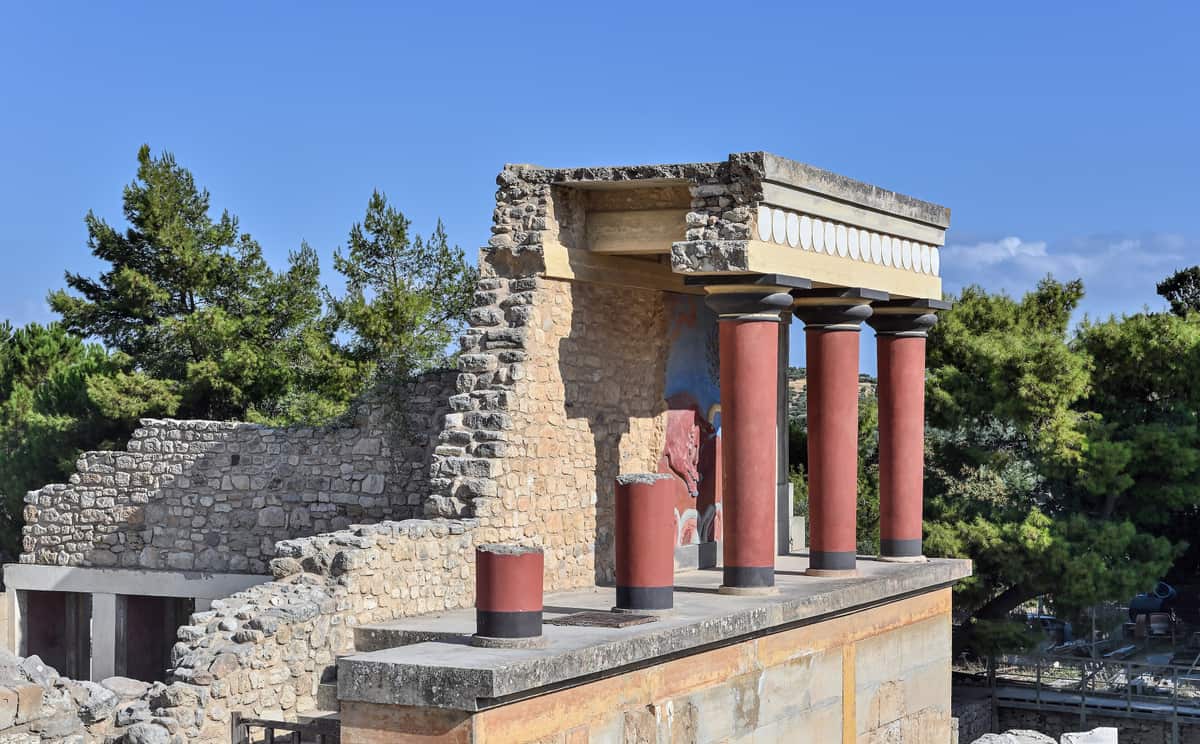
Knossos tickets show visitors the Throne Room, the north entrance, the frescoes and the wings of the Palace of Minos. The palace on view today also reflects the reconstructions of Arthur Evans, which shape the look of its rooms, frescoes and columns.
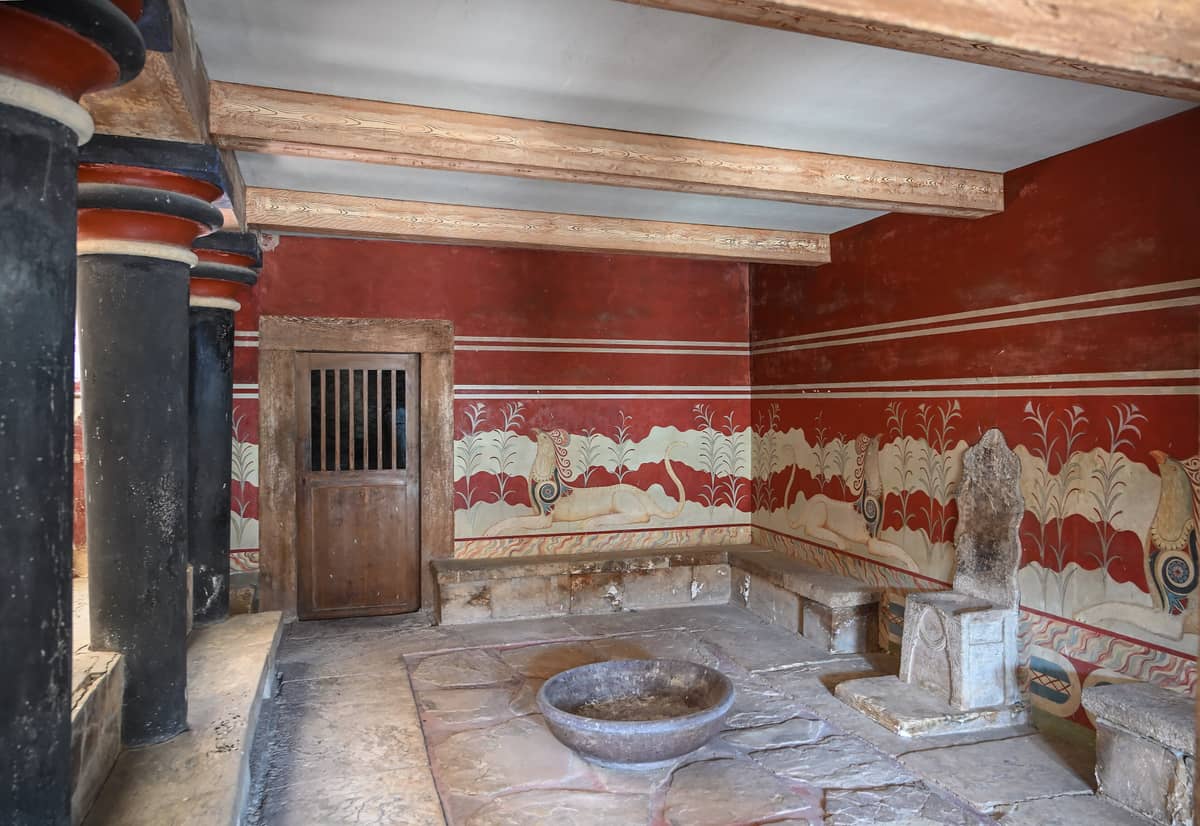
In the west wing lies the Throne Room complex. Inside are a gypsum seat placed against the wall, benches, a lustral basin and wall paintings of griffins. Arthur Evans saw it as the throne room of King Minos. Later research has offered other readings, among them ritual or priestly use, and the true purpose of the room is still debated. For holders of Knossos tickets, this room ranks among the busiest stops in the whole palace.
The palace had a north entrance and a south entrance. Both tied the building to processional routes and to the town around it. A route known as the Royal Road led from the palace area into parts of that town. In the east wing, elaborate rooms were set into the hillside, among them the Hall of the Double Axes and the Queen’s Hall. Knossos tickets cover both wings, from the west magazines to these eastern halls.
Knossos is well known for its frescoes, among them the Bull-Leaping Fresco, the Procession Fresco, the Cup-Bearer, the Dolphin Fresco, the Sacred Grove fresco and the Prince of the Lilies. They show processions, animals, plants, sea life, rituals and people. A large share of the originals survives only as fragments, and fresco fragments are among the finds kept in the Heraklion Archaeological Museum. The frescoes that holders of Knossos tickets see on the palace walls are reconstructions.
Arthur Evans, who led large-scale excavations at the site, also rebuilt parts of the palace with reinforced concrete, colour and his own reading of the architecture. The work made the ruins easier to grasp, yet critics note that it at times goes further than the evidence allows. The rebuilt Minoan columns show the approach. Unlike later Greek columns, they tend to narrow toward the base, and they are now among the features people recognise first at Knossos.
- West magazines: Long storage rooms held pithoi, large ceramic jars for oil, grain and wine.
- Light wells: Open shafts brought daylight and air into the inner rooms of the multi-storey building.
- Minoan columns: The columns were made of timber as a rule, set on stone bases and topped with rounded capitals.
- Fresco replicas: Reconstructed scenes on the walls can join surviving ancient fragments with modern additions.
What holders of Knossos tickets see is a blend of ancient remains and twentieth-century interpretation. The reconstructions by Evans now belong to the history of the site, and they need steady monitoring and upkeep. Because they do not always mark a clear line between excavated remains and modern work, the palace calls for careful explanation of which parts are ancient and which are new.
Which kinds of Knossos tickets exist?
Knossos tickets, as the official page of the Hellenic Ministry of Culture and Sports lists them, come as a full or a reduced ticket for the archaeological site and as a special ticket package with full and reduced rates. Set days bring free admission.
The basic form is the ticket for the archaeological site of Knossos. The official page splits it into two rates, full and reduced. It does not itself list who qualifies for the reduced rate. Instead, it points to a Ministry document on free and reduced admission to Greek State archaeological sites, monuments and museums. Reduced Knossos tickets therefore follow the same terms that apply across these state sites.
Next to the site ticket, the official page lists a special ticket package, again with a full and a reduced rate. The page does not say which sites or museums the package joins. Travellers hoping to pair Knossos tickets with the Heraklion Archaeological Museum find no combined ticket by that name. The museum appears on the page only in a list of other museums and sites in the same prefecture.
For Knossos tickets bought online, the page points to the official e-ticketing service of the Hellenic Ministry of Culture and Sports. The page also names the days of free admission. They are 6 March, in memory of Melina Mercouri, 18 April for International Monuments Day, the last weekend of September for the European Heritage Days, and 28 October. International Museums Day is on the list as well.
Ticket-and-tour formats do not appear in the official listing. The page names no tour leader, no expert-led visit and no package that joins entry with a tour. Its special ticket package carries no mention of a tour either. A tour added to Knossos tickets therefore sits outside the official page, which sets out only the admission rates, the free days and the online channel.
- Site ticket: The official page gives the site a full rate and a reduced rate.
- Special ticket package: The page gives full and reduced rates but does not list its contents.
- Free admission days: Fixed days such as 6 March and 28 October bring free entry to the site.
- Ticket-and-tour formats: The official page lists none, as it covers admission only.
The official page remains the reference for Knossos tickets of every kind. The Ephorate of Antiquities of Heraklion also posts notices there, such as a closure due to weather. A check of the page before a visit therefore shows the current rates, the next free day and any closure that affects entry to the archaeological site.
How do Knossos tickets work with the Heraklion Archaeological Museum?
Knossos tickets cover the archaeological site only. The Heraklion Archaeological Museum, in the town centre, has its own separate entry, and the combined ticket for the museum and the Knossos site is no longer valid, so each visit needs its own ticket.
The Heraklion Archaeological Museum ranks among the largest museums in Greece. The bulk of the finds from the Minoan palace at Knossos, and from other Minoan sites on Crete, are kept here. The galleries span over 5,500 years, from the Neolithic period to Roman times. The Ministry of Culture calls it the leading museum of Minoan culture in the world. For holders of Knossos tickets, it shows the objects that excavators lifted from the palace.
The collection began in 1883 as a simple group of antiquities. The present building went up between 1937 and 1940 to designs by the architect Patroklos Karantinos, on the site of the Roman Catholic monastery of Saint Francis, which an earthquake destroyed in 1856. The two-storey building resists earthquakes, holds 27 galleries and received a Bauhaus commendation. Large parts of the museum closed for renovation in 2006 and reopened in 2013.
The frescoes show the tie between the museum and Knossos tickets in the clearest way. At the palace, the frescoes on view include reconstructions from the twentieth century. The original fresco fragments from Knossos and Hagia Triada are displayed in Room XIV, the Hall of the Frescoes, beside the Hagia Triada sarcophagus. Rooms XV and XVI hold further frescoes, including the figure known as “La Parisienne”.
Room III holds the Phaistos Disc, a disc of fired clay that the Italian archaeologist Luigi Pernier found in 1908 while excavating the Minoan palace of Phaistos. The disc measures about 16 cm across. Each face carries a spiral text, and together they hold 242 signs of 45 distinct types, pressed into the soft clay with stamps before firing. The script and language remain unknown, and the purpose of the disc is still disputed.
- Museum tickets: The museum sells tickets at its own booth and on its only official website.
- Time slots: A museum ticket is valid only on its scheduled day and time slot.
- Site tickets: Knossos tickets are sold online through the official e-ticketing service of the Ministry of Culture.
- Photography: Parts of the collection cannot be photographed, and signs mark the restricted items.
A full Minoan visit therefore needs two purchases: Knossos tickets for the hill site south of the centre, and a museum ticket for the galleries in the town centre. The site shows the architecture, while the museum keeps the frescoes, the Phaistos Disc, the Snake Goddess, the Arkalochori Axe and the Malia Pendant. The building also has a café and a shop that sells museum copies, books and postcards.
How do visitors reach the site with Knossos tickets?
Knossos tickets are used at a site on the southern edge of Heraklion, about 5 km south of the historic centre. Visitors reach it from Heraklion, the largest city on Crete, which has an international airport, a ferry port, the E75 road and urban buses.
Knossos lies on Kephala hill, in the valley of the Kairatos river, inside the modern municipality of Heraklion, about 5 km south of the historic centre. Heraklion is the largest city and the administrative capital of Crete. The city takes its name from Heracleium, the ancient harbour of Knossos, which lay about 20 stadia, or 3.7 km, from the palace. A trip with Knossos tickets therefore starts in the island’s capital.
Heraklion receives arrivals by air and by sea. Heraklion International Airport, named after the writer Nikos Kazantzakis, lies about 5 km east of the city and is the second busiest airport in Greece after Athens. The port is an important ferry dock, with daily ferries to Piraeus, the port of Athens, and boats to Santorini, Ios, Paros, Mykonos and Rhodes. Holders of Knossos tickets who arrive by plane or ship begin the final stretch in the same city.
On land, the European route E75 runs through Heraklion and links it with Agios Nikolaos, Chania and Rethymno, the three other major cities of Crete. The A90 highway along the north coast connects these four cities, and its section from Heraklion to Malia is at motorway standard. Urban buses serve the city on 39 routes, and intercity buses connect Heraklion with major destinations across Crete from two regional bus stations.
- Distance: The site named on Knossos tickets lies about 5 km south of the historic centre of Heraklion.
- Airport: Heraklion International Airport sits about 5 km east of the city.
- Ferries: Daily ferries link the port of Heraklion with Piraeus, the port of Athens.
- Bus network: Regular buses run across the north of Crete and from north to south.
Heraklion acts as the base for Knossos tickets. The airport, the ferry port, the coastal highway and the two regional bus stations all serve the city, and the site lies on its southern edge. The regional bus operator publishes its routes and timetables online, which helps visitors plan the final stretch and reach the gate with Knossos tickets ready.
When is the best time to use Knossos tickets?
Knossos tickets suit spring and autumn best, judging by the climate data. At Heraklion airport, average highs reach 20.1 °C in April and 24.0 °C in October, against 30.3 °C in July, while winter brings the heaviest rain and the least sunshine.
Heraklion has a hot-summer Mediterranean climate, classed as Csa in the Köppen system. Summer days are dry and warm to hot under clear skies, and seasonal breezes ease the hot spells. Winter is mild and brings moderate rain. The city’s southern position gives it warmer winters than Athens, while the Aegean Sea keeps its summers cooler. In normal years the summer maximum stays at or below 28 to 30 °C, about 5 °C under the normal maximum in Athens.
Summer is the hot peak. At the airport station, average highs reach 30.3 °C in July and 30.2 °C in August, and rain falls on 0.2 days in July. Spring and autumn are milder: April averages 20.1 °C with rain on 5.8 days, September 27.5 °C with rain on 2.4 days, and October 24.0 °C with rain on 6.7 days. Knossos tickets in these shoulder months avoid the strongest heat.
Winter is mild but wet. Average highs sit at 15.2 °C in January and 16.7 °C in December, with rain on 13.6 days in January and 13.0 days in December, while December gets only 105.4 hours of sunshine. Snow is common on the mountains of Crete between November and April, but snowfalls in Heraklion are rare. Knossos tickets in winter call for rain gear rather than sun protection.
Crowds are part of the picture. Among archaeological sites in Greece, Knossos is second only to the Parthenon in visitor numbers, and the Throne Room complex ranks among the busiest areas of the palace. Heraklion was the second-busiest region in Greece for visitors in 2017, with 3.2 million, and drew 3.4 million in 2018. Crete welcomed 6.3 million visitors in 2023. Holders of Knossos tickets share the site with this large flow.
- Peak heat: Knossos tickets in July and August meet average highs above 30 °C at Heraklion airport.
- Driest months: July and August each see rain on less than one day.
- Wettest months: December and January each bring rain on 13 or more days.
- Weather closures: The site has closed due to weather conditions, with notices posted on the official Ministry page.
On the climate figures, April, September and October give Knossos tickets the best balance of mild heat, low rain and plenty of sunshine. July and August bring the peak heat, while December and January bring the heaviest rain. With visitor numbers at Knossos this high, the choice of season shapes the visit as much as the ticket itself.
What is the history behind Knossos tickets?
Knossos tickets open a site settled since around 7000 BC, the leading centre of the Bronze Age Minoan civilisation of Crete, the seat of King Minos in Greek myth, and the hill where Arthur Evans began large excavations in 1900.
Holders of Knossos tickets walk on ground that farmers first settled around 7000 BC, on the summit of Kephala hill. That early village makes Knossos one of the earliest Neolithic settlements on Crete, and scholars widely call it the oldest city in Europe. The Minoan civilisation grew out of this local culture around 3100 BC. Minoan traders sent farm produce and luxury crafts abroad for raw metals. They wrote in Cretan hieroglyphs and Linear A, two scripts that nobody has fully deciphered.
The palace seen with Knossos tickets today belongs largely to its second phase. The first palace rose around 1900 BC and fell around 1700 BC, in damage that scholars link to earthquakes. A larger palace replaced it, and the years from about 1700 to 1450 BC were the high point of Knossos. The Thera eruption around 1600 BC wiped out Akrotiri on Santorini, yet Knossos kept prospering. From about 1450 BC, a Mycenaean Greek elite ruled the palace.
In Greek myth, Knossos was the seat of King Minos, a son of Zeus and Europa, remembered as a ruler, lawgiver and judge. Minos had the craftsman Daedalus design the Labyrinth as a prison for the Minotaur, which had a man’s body and a bull’s head. Athens paid a tribute of young men and women to the beast. The hero Theseus ended it: with help from Minos’s daughter Ariadne, he entered the maze, killed the Minotaur and found the exit by following a thread.
The first known modern dig came in 1878 and 1879, when Minos Kalokairinos, a merchant and antiquarian from Heraklion, exposed parts of the west wing and storage rooms holding large pithoi. Arthur Evans began large-scale work in 1900. With a team that included Duncan Mackenzie, he uncovered the bulk of the palace and large parts of the town around it. Evans also rebuilt sections in reinforced concrete and colour, work that has drawn criticism for going beyond the excavated evidence.
- The name Minoan: Evans took the label from the myth of King Minos; the name the Minoans gave themselves is unknown.
- The word labyrinth: It comes from a pre-Greek word whose origin and meaning remain uncertain.
- Linear B: Michael Ventris and John Chadwick deciphered it in 1952, helped by the Knossos tablets, which record an early form of Greek.
- Coins: Ancient Knossos struck coins with a Labyrinth motif, keeping the city tied to Minos, Theseus and the Minotaur.
- The Palace of Minos: Evans set out his results in a work of that title, published from 1921 to 1935.
This long record explains why Knossos tickets cover more than one story: Neolithic layers, two Minoan palaces, Mycenaean records and the modern rebuilding by Evans share one hill. Knowing the timeline helps, because the rebuilt columns and frescoes do not always show where ancient remains end and modern work begins. Scholars also link the palace plan, with its courts, corridors and stairs, to the Greek image of Knossos as the home of the Labyrinth.
Which nearby sites pair with Knossos tickets?
Knossos tickets pair well with the Venetian old town of Heraklion and its Koules fortress, about 5 km north of the site, and with the Minoan palaces of Phaistos and Malia, which share a UNESCO World Heritage listing with Knossos.
The closest pairing for Knossos tickets is the historic centre of Heraklion, about 5 km north of the palace. The city, then called Candia, came under Venetian rule in the early 13th century. New walls began in 1462. The land front still has seven bastions, and two of the four main gates survive. The walls held out for 21 years in the Siege of Candia before the city fell to the Ottomans in 1669.
At the entrance of the old port stands the Koules, or Castello a Mare. Builders demolished a Byzantine tower on the spot in 1523, sank old ships filled with stone to enlarge the platform, and completed the fortress in 1540. Its walls reach 8.7 m thick in places. Two floors hold 26 rooms that once served as barracks, a prison, stores, a water reservoir, a church, a mill and a bakery. The restored fort is open to the public.
Phaistos lies in south central Crete, 62 km south of Heraklion. It ranked with Knossos and Malia among the three largest cities of Minoan Crete, and a road system linked it with Knossos. For holders of Knossos tickets, it offers a direct comparison: its palace was about two thirds the size of the Knossos palace, yet its theatre was larger. In 1908, excavators found the Phaistos Disc in a basement room on the north side of the palace.
Malia sits on the north coast, about 35 km east of Knossos and 40 km east of Heraklion. People lived there from the middle of the 3rd millennium BC until about 1250 BC. Between about 1700 and 1470 BC, it had the third largest Minoan palace, built around three courts and measuring about 80 by 100 metres. The French School of Athens has excavated the site for over a century. Finds include the Malia Pendant, known as the honeybees pendant.
- Lions Square: The Morosini fountain has stood there since 1628, beside a Venetian Renaissance loggia built from 1626 to 1628.
- Saint Titus Cathedral: The church was built in 1869 as the Yeni Cami, or New Mosque.
- Koules lighthouse: A lighthouse was first built on the fort during Egyptian rule in Crete, from 1830 to 1840.
- Hagia Triada: This Minoan site with a smaller palace lies about 3 km from Phaistos.
- Quartier Mu: This town area of Malia, also called the Seals Workshop, lies 200 m northwest of the palace.
The old town of Heraklion is the simplest add-on to Knossos tickets, since the palace and the historic centre lie about 5 km apart. Phaistos and Malia, farther out, suit a separate day. Families who want a break from ruins can add the Cretaquarium near Gournes, 15 km east of Heraklion, home to more than 2,500 animals, and tickets for the Cretaquarium can be booked as a separate visit.
What do visitors ask about Knossos tickets?
Knossos tickets raise four common questions: whether the site suits children, whether a ticket includes a licensed tour leader, how to add the Heraklion museum on the same day, and whether visitors walk into the real Labyrinth of the myth.
Do Knossos tickets suit children?
Knossos tickets work for families who prepare a little. The palace rises on more than one level, with staircases, corridors and open courts, so firm shoes, water and a hat make the walk easier. Telling children the myth of King Minos, the Minotaur and Theseus before the visit gives them a story to follow through the ruins.
Do Knossos tickets include a tour leader?
Entry-only Knossos tickets and expert-led visits are separate products, so buyers check the booking details to see whether a licensed tour leader is included. The difference matters at Knossos, where the rebuilt columns and frescoes from the Evans era need careful explanation to separate excavated remains from modern reconstruction.
Can Knossos tickets be combined with a museum visit on the same day?
Yes. Knossos tickets and a museum visit fit into one day, since the palace lies about 5 km south of the historic centre of Heraklion. In the city, the Heraklion Archaeological Museum keeps leading finds from Knossos, such as fresco fragments, figurines and Linear B tablets. Seeing the palace first lets the objects connect to rooms already walked through.
Do Knossos tickets lead visitors into the real Labyrinth?
Not in a literal sense. Evans suggested that the palace itself was the Labyrinth of Daedalus, pointing to its complex plan and the double axe signs carved on its walls. Oxford geographer Nicholas Howarth urged caution about that idea. His team searched the Skotino cave and judged it natural, while tunnels at Gortyn, partly human-made, remain another candidate.
Featured photo: Cayambe, CC BY-SA 4.0, via Wikimedia Commons.