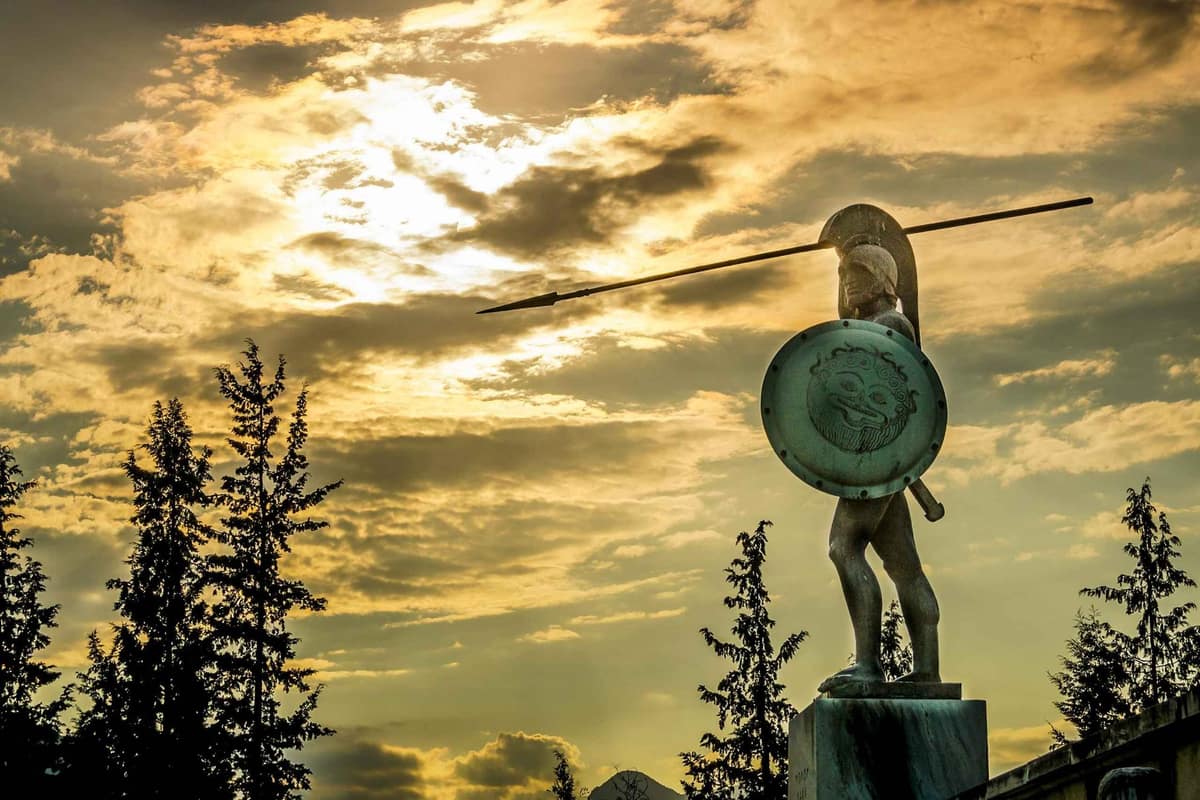
A Thermopylae tour follows the story of Leonidas and the 300 Spartans. It also covers hot springs, a mountain path, later battles and ancient writers. It is one of the history tours in Greece on Greece VIP.
Each section ends with a Thermopylae tour or day trip to book online.
What does a Thermopylae tour include?
A Thermopylae tour is a day trip from Athens to an ancient battlefield. Greek and Persian armies met there in 480 BC. The route stops at the Leonidas monument, the visitor centre and Kolonos Hill. It can also join a Delphi or Meteora itinerary.
Thermopylae is a narrow pass and a modern town in the municipality of Lamia. A pass is a low, narrow way through hills or mountains. Lamia is the capital of Phthiotis, a regional unit in the Greek system of local government.
The battlefield itself is the main subject of the visit. The visit centres on open ground: a road, a hillside and the memorials beside them. At each stop, a Thermopylae tour shows how the ground shaped the fighting.
The battle is among the best-known in the ancient history of Europe. Ancient, recent and modern culture refer to it again and again. Writers have used it as the standard example of an army defending its home soil.
Its fame comes less from its effect on the war than from the example of the rearguard. A rearguard is the group of soldiers at the back who protect an army as it moves. For this reason, a Thermopylae tour is built around remembrance.
Greece announced two commemorative coins to mark 2,500 years since the battle. These are special coins made in memory of an event. A Thermopylae tour visits the ground that those coins honour.
- Monument: A Thermopylae tour finds the Leonidas monument on the east side of the highway.
- Visitor centre: A Thermopylae tour uses the centre to set the monuments outside against the wider war.
- Kolonos Hill: On a Thermopylae tour, the hill faces the Leonidas monument directly across the road.
The Oracle at Delphi enters the story too. It reportedly gave the Spartans a prophecy, a message about the future, before the march north. A Delphi day trip from Athens adds the shrine that the story names.
Meteora is a rock formation, and its rocks carry a large complex of Eastern Orthodox monasteries. A monastery is a home where monks live, work and pray together. A Thermopylae tour that adds Meteora pairs a battlefield with these religious houses.


What happened at the Battle of Thermopylae on a Thermopylae tour?
A Thermopylae tour retells how an alliance of Greek city-states held a narrow pass for three days. The Greeks beat back every frontal attack by the invading Persian army. Then the Persians turned the Greek position by going around it. The Greek rearguard was wiped out.
The invasion was a delayed answer to the Athenian victory at Marathon in 490 BC. Xerxes, the son of King Darius, gathered an army and a navy. The Persian king wanted to conquer all of Greece.
Xerxes had two pontoon bridges built across the Hellespont, a narrow strip of sea. Pontoon bridges rest on rows of floating boats. These bridges carried his troops into Europe.
The Greek reply came from an alliance that met at Corinth in late autumn of 481 BC. About a tenth of the Greek city-states, small states built around one city, joined it. Athens and Sparta led the alliance.
Modern scholars estimate the Persian army at between 120,000 and 300,000 soldiers. The Greek force that marched north to meet it numbered more than 7,000. It camped at the middle gate, the narrowest part of the pass.
The Phocians had built a defensive wall at this gate. When the Persian army was sighted across the Malian Gulf, Xerxes waited four days. He hoped for the Greeks to scatter and go home.
A Thermopylae tour explains that the narrow front reduced the Persian advantage in numbers. Only a small part of a large army can fight at once in a tight space.
A Thermopylae tour dates the first attack to the fifth day after the Persian arrival. Xerxes sent 5,000 archers first. Greek shields and bronze helmets turned the arrows aside.
Medes and Cissians, troops from the Persian empire, attacked next. Then came the Immortals, an elite unit of 10,000 soldiers. Neither force made headway against the phalanx, the tight Greek line of shields and spears.
The second day brought no better result for the Persians. A Thermopylae tour treats these two days as the military lesson of the battle. Training, equipment and terrain worked together.
On the third day, the Spartan king dismissed the bulk of the army. He stayed with the rearguard. The Greeks charged out from the wall to meet the Persians in the wider part of the pass.
They fought with spears until every spear broke, then with short swords. The Persians tore down part of the wall and surrounded the hill. They shot arrows until the last Greek was dead.
- Strategy: Themistocles proposed that the allies block the pass and the Persian navy at the straits of Artemisium.
- Losses: A Thermopylae tour cites reports that the Persians lost up to 20,000 men to open the pass.
- Fleet: When news of the fall of the pass arrived, the Greek fleet withdrew to Salamis.
- Outcome: Athens was captured and burned, yet the Greeks won at Salamis, then Plataea a year later.
Modern academic works stress that Thermopylae was a Greek defeat. Xerxes broke through a strong position and went on to conquer the majority of Greece. Still, a Thermopylae tour shows how the stand became one of the best-known last stands in history.
Who were Leonidas and the 300 on a Thermopylae tour?
A Thermopylae tour presents Leonidas as the Spartan king who commanded the allied Greeks. The 300 were picked Spartan soldiers. They stayed with him to the end. Thespians and other Greek contingents, or groups of troops, also held the pass beside them.
Leonidas, born around 540 BC, was the 17th king of the Agiad dynasty. This Spartan royal family claimed descent from the hero Heracles. His name means descendant of Leon, after his grandfather, and can also mean son of a lion.
A son of King Anaxandridas, he took the throne around 489 BC after his half-brother Cleomenes. He shared the throne with Leotychidas. A Thermopylae tour presents him as a product of the agoge, the Spartan training system.
The 300 were the men of the royal bodyguard, known as the Hippeis. At the time, Sparta was holding the festival of Carneia. Spartan law banned military action during this festival.
The Olympic Games and their truce, a pause in all fighting, were under way as well. The ephors, the senior officials of Sparta, judged the danger great enough to act. They sent an advance force under the king instead of the whole army.
According to the ancient account, the king chose only Spartans with living sons. He was convinced that he was going to certain death. A Thermopylae tour treats the 300 as a vanguard, a force sent ahead of the main army.
The Thespians were hoplites, heavily armed foot soldiers, from Thespiae in Boeotia. The general Demophilus led them. When the rest of the army left, the 700 Thespians refused to go.
These 700 men were the full hoplite force of their city. Their stand was a voluntary act of self-sacrifice. A Thermopylae tour therefore gives the Thespians their own place in the story.
A Thermopylae tour also counts four hundred Thebans who stayed, though the Thebans reportedly surrendered. Troops from cities such as Tegea, Mantinea, Corinth and Phlius had marched to the pass. Helots, the attendants of the Spartans, were reported there too.
- Death: Persian archers shot down the king early on the third day. The Greeks won the fight over his body.
- Return: His bones reached Sparta 40 years later and were buried again with full honours.
- Honours: Yearly funeral games were held in his memory. His hero cult survived in Sparta until the Antonine era, in the 2nd century AD.
The later honours show how quickly the stand became a story. A Thermopylae tour keeps the Spartans at the centre. Still, it names every group that stayed, from the king to the volunteers of Thespiae.
What does a Thermopylae tour see at the Leonidas monument?
A Thermopylae tour sees a bronze statue of King Leonidas at the Leonidas monument. The words “Molon labe” stand beneath it. Marble figures of a river and a mountain stand on either side. A separate monument honours the Thespians.
The memorial dates from 1955 and is the work of the sculptor Vasos Falireas. On a Thermopylae tour, the bronze king holds a spear and a shield. Bronze is a hard metal made from copper and tin.
The Municipality of Lamia calls the memorial a sculptural composition, meaning a group of carved figures. It records that Greeks living in America paid for it. A Thermopylae tour also finds a metope below the statue, a carved panel with scenes of battle.
Both marble figures stand lower than the king, one on each side. One shows Taygetos, the highest mountain in the Peloponnese, in human form. The Peloponnese is the large peninsula of southern Greece.
The other figure shows the Evrotas, also spelled Eurotas, a river that flows through Laconia. Laconia is the region in the south of Greece where Sparta lies.
A Thermopylae tour takes in the river, the mountain and the metope as parts of one composition. The bronze king stands at the centre of it. So the monument works as a carved story as well as a portrait.
The sign under the statue gives the phrase in Greek letters as Μολὼν λαβέ. It means “Come and take them”. The word them stands for the weapons of the Spartans.
The Persian king had offered to spare the Spartans if they gave up their arms. Leonidas sent back this laconic reply, short and blunt in the Spartan way.
The same words stand under a second statue of Leonidas in Sparta, put up in 1969. A Thermopylae tour reads the line at the place of the battle itself.
The monument to the Thespians belongs to the same stop of a Thermopylae tour. The Greek government unveiled and dedicated it in 1997. It is made of marble.
A Thermopylae tour sees a bronze statue of Eros on top of it. Eros, the Greek god of love, was the chief god of the ancient Thespians, the people of Thespiae.
The inscription reads “In memory of the seven hundred Thespians”. Each part of the bronze figure carries a meaning. A Thermopylae tour reads each part in turn, from the head to the wings.
- Head: The headless figure stands for the anonymous sacrifice of the Thespians to their country.
- Chest: The outstretched chest stands for struggle, gallantry, strength, bravery and courage.
- Open wing: The open wing stands for victory, glory, spirit and freedom.
- Broken wing: The broken wing stands for voluntary sacrifice and death.
The modern monument has an ancient forerunner in the pass. A forerunner is an earlier work with the same purpose. After the battle, the ancient Greeks built a stone lion at the site for the fallen king.
The Municipality of Lamia records that this lion no longer survives. A Thermopylae tour therefore finds the bronze statue as the latest memorial to the king at Thermopylae. It stands in a place that already had one long ago.
What does a Thermopylae tour show at the Thermopylae Historical Center?
A Thermopylae tour shows a modern visitor centre run by the Municipality of Lamia. It has three exhibition halls. They offer an introductory video, a virtual reality film and touch-screen tables. These tell the story of the battle in an understandable way.

The building is called the Centre of Historical Information of Thermopylae. It stands in the Local Community of Thermopylae, the smallest unit of local government. Its shorter name is the Thermopylae Historical Center.
The national tourism body of Greece calls it an interactive centre on the Persian Wars. These were the wars between the Persian empire and the Greek cities. Interactive means that visitors work the displays themselves.
The film in the first hall explains how the centre works. It also shows what visitors will see in the other halls. A Thermopylae tour starts the indoor part of the visit here.
In the second hall, visitors put on special glasses and watch a virtual reality film about the battle. Virtual reality uses three-dimensional images to place viewers inside a scene. The glasses create that sense of depth.
The film shows the Greek armour, the climb up the mountain path and the end of the fighting. A Thermopylae tour spends this part of the visit inside the events, not beside the monuments.
The third hall holds special interactive tables. Visitors wake the screens with a touch and read about the battle and the period around it. Each visitor opens the screen that suits a question.
The Municipality of Lamia states that the whole collection rests on the account of the ancient historian. It also rests on archaeological research, the study of finds dug from the ground. A Thermopylae tour finds the written account and the excavation record side by side.
- Leonides: The first hall carries this name, and its film runs seven minutes.
- Diinekis: The second hall carries this name, and its virtual reality film runs fifteen minutes.
- Thermopylae: The third hall carries the name of the pass itself.
- Access: A Thermopylae tour finds parking at the centre.
The three halls follow a clear order: plan, then scenes of battle, then background. Visitors read the background at their own pace. A Thermopylae tour then heads back outside to the monuments and the hill.
Why does a Thermopylae tour climb Kolonos Hill?
A Thermopylae tour climbs Kolonos Hill because it is the site of the final stand. Persian bronze arrowheads were found there in 1939. A stone at the top carries an epigram. This short poem honours the Spartans who fell there.
Kolonos Hill is a modest rise in the narrow coastal passage of Thermopylae, near the city of Lamia. On a Thermopylae tour, the statue shows the king, while the hill shows where the last fighters fell.
The archaeologist Spyridon Marinatos made the 1939 dig at Thermopylae. An archaeologist studies the past through the objects that people left behind. He found large numbers of the arrowheads on the hill that a Thermopylae tour climbs.
At the time, Marinatos led the Greek Archaeological Service as Director General of Antiquities and Historic Monuments. This state service looks after the ancient sites of Greece. Antiquities are objects and buildings from ancient times.
The arrowheads are linked to the Greeks who fell there, killed by Persian arrows. A Thermopylae tour treats the hill as an excavation site as well as a memorial.
A digital exhibition by the Greek Ministry of Culture backs this point. It notes the large number of arrowheads, spearheads and javelins found at Thermopylae. Javelins are light spears made for throwing.
The finds came especially from around the hill where the last warriors fell. The exhibition says they support the descriptions in the historical texts. It also shows bronze arrowheads labelled as coming from Kolonos Hill.
A Thermopylae tour walks over ground that has given physical evidence for the written accounts. Physical evidence means real objects, not only words on a page.
A memorial stone stood at the site in ancient times, but the original did not survive. A new stone later received the lines, and the Municipality of Lamia describes this copy above the memorial. A Thermopylae tour reads the lines on the hill where, by tradition, the fallen were buried.
- Author: Tradition credits the poet Simonides with the epigram.
- Message: The lines ask a passer-by to tell the Spartans their dead lie here, obeying their laws.
- Shape: Defensive works built after ancient times reshaped the hill.
The arrowheads changed the accepted picture of the battlefield. Before the dig, experts thought the Greeks died on a smaller hill nearer the wall. The find moved that identification to Kolonos Hill, and Greek authorities now supervise the site.
How has the coastline changed since the battle on a Thermopylae tour?
A Thermopylae tour crosses a wide plain. A narrow shore road once ran there between mountain and sea. Silt from the Spercheios river filled the Malian Gulf. The water that reached the pass at the time of the battle now lies kilometres away.
On a Thermopylae tour, the road runs across a flat coastal floodplain. A floodplain is low land that a river floods from time to time. Sloping limestone mountains covered in forest surround the plain.
Core samples show that the pass measured only 100 metres across. Core samples are long tubes of earth that experts drill out of the ground.
Mount Kallidromo, which rises to 1,399 metres, closed the south side. In 480 BC, the water of the gulf closed the north side. A Thermopylae tour therefore sees how little room the defenders had.
The Spercheios is 80 km long and enters the gulf 13 kilometres southeast of the city of Lamia. Its drainage area, the land whose rain flows into it, covers 1,830 square kilometres.
Silt is fine soil that a river carries and drops. Smaller streams add silt to the gulf, which is very shallow, with a maximum depth of 27 metres. A Thermopylae tour therefore walks over ground that the river laid down and the sea left behind.
Between 2500 BC and the battle, the shoreline advanced by up to 2 kilometres. Even so, narrow passages between sea and mountain remained. After the battle, it advanced by as much as 9 km in places.
That later advance removed the narrowest points of the pass. The ground of the fighting now lies buried under 20 metres of soil. A Thermopylae tour therefore passes above the ancient battlefield, not on it.
The old coast still leaves clues. The A1 motorway follows the ancient shoreline and splits the pass in two. A Thermopylae tour can trace the lost coast along this road.
Lamia itself stood closer to the sea in ancient times. That explains the temple of Poseidon, god of the sea, close by. Each clue helps a Thermopylae tour read a coast that has moved.
- Prehistory: In prehistoric times the gulf stood significantly higher and the river ran significantly shorter.
- Harbour: The only harbour on the gulf is Stylida, which serves the city.
- Extent: The gulf stretches from 15 to 22 kilometres from east to west, depending on the definition.
The hills have not moved, and the old track still runs at their foot beside a modern road. Following the foot of the slope means following the line where the water once stood. That line shows a Thermopylae tour where the ancient gate lay.
Why does a Thermopylae tour stop at the hot springs?
A Thermopylae tour stops at the hot springs because they gave the pass its name. Thermopylae means hot gates in Greek. The sulphur springs still flow at the entrance of the narrow pass. Natural thermal troughs lie inside the archaeological site.
Greek myth tied the water to the underworld, the land of the dead. The Hot Gates counted as one of the entrances to Hades, another name for that world. A Thermopylae tour therefore stops at a place that Greek myth linked with the dead.
On a Thermopylae tour, one version of the Labours of Heracles explains the heat. The water turned hot when the hero tried to wash off the poison of the Hydra there. Ancient sources also place a sanctuary of Heracles at the site.
The local authority describes a complex of springs at the pass. The warmest has a temperature of 42°C and a flow of about 400 cubic metres an hour. The three main springs together deliver more than 700 cubic metres an hour at 36 to 42°C.
The national tourism organisation calls the water acidic and rich in sodium chloride and hydrogen sulfide. Sodium chloride is common salt, and hydrogen sulfide gives the smell of rotten eggs. A Thermopylae tour therefore meets a spring system, not a single pool.
Bathing is part of how Greece presents the area today. The Greek National Tourism Organisation describes swimming in the hot springs of Central Greece. It names Thermopylae, Kamena Vourla and Ypati as the best-known places for it.
The local authority puts the baths 15 km from the city of Lamia. A Thermopylae tour can therefore pair the history of the pass with the hot water that named it.
The springs also shaped the ground that a Thermopylae tour crosses. Travertine, a rock that forms from the minerals in hot water, built up here. Together with river silt, it altered the landscape across thousands of years.
An ancient account says the defenders channelled the stream from the springs into a marsh. The causeway through it was wide enough for only a single chariot. A causeway is a raised road across wet ground.
A Thermopylae tour at the hot springs thus touches both the geology and the defences of the pass. Geology is the study of rocks and how land takes shape.
- Assembly: The first known religious league of tribes centred on Demeter at Anthela, near the pass. Its delegates were called Pylagorai, meaning gate-assemblers.
- Salts: The water carries about 8 grams of dissolved salts per litre.
- Psoroneria: The springs at Psoroneria, near the village of Koutseki, reach up to 35°C.
The water that named the pass is still there, and it is still hot. A Thermopylae tour that pauses here links the name of the gates with the myths about them.
What is the Anopaia path on a Thermopylae tour?
A Thermopylae tour presents the Anopaia path as an obscure goat track. It ran over the mountain ridge behind the pass. Ephialtes, a local man, showed it to the Persians. They used it to reach the rear of the Greek position.
The path ran over the mountains south of the pass and joined the main road. It led from east of the Persian camp along the ridge of Mount Anopaia. That ridge lies behind the cliffs that flanked the pass.
The path then split in two. One track led to Phocis, a region of central Greece. The other ran down to the gulf at Alpenus, the first town of Locris.
A Thermopylae tour treats the path as the weak point of the whole position. Herodotus records that local people knew the trail well. They had used it to raid their neighbours, the Phocians.
Ephialtes was the son of Eurydemus of Malis. Greek memory gave him a lasting mark of shame and made him the classic example of a traitor.
In the Greek language, his name came to mean nightmare. A Thermopylae tour therefore links the path to a man, not only to a place.
Leonidas learned of the track from local people of Trachis. He placed 1,000 Phocians on the heights to block it. The Phocians came from a state close to the pass.
They had urged the allies to hold the line instead of pulling back. The track crossed the highland parallel to the pass and was easy going for Persian infantry. Infantry means soldiers who fight on foot.
A Thermopylae tour names the Phocians because they guarded the one route around the position. The fate of the whole pass rested on their watch.
At daybreak on the third day, the Phocians heard the Persian column in the rustling of oak leaves. They jumped up in amazement. They then pulled back to a nearby hill, expecting an attack on themselves.
The Persians shot a volley of arrows at them and then marched past to finish the encirclement. Encirclement means surrounding an enemy on all sides. A runner then told Leonidas that the Phocians had not held the path.
- Accused: Onetas of Carystus and Corydallus of Anticyra were also accused. Yet the Greek deputies put the price on the head of Ephialtes.
- Force: Xerxes sent Hydarnes and the Immortals along the path that evening. Diodorus gives Hydarnes a force of 20,000.
- Reward: Ephialtes expected a reward, received none and fled to Thessaly.
- End: Athenades killed Ephialtes around 470 BC, apparently for an unrelated reason. The Spartans paid Athenades all the same.
A Thermopylae tour counts the runner’s report as the moment the path decided the outcome. A strong gate fails when a back route stays open. Keeping the ridge in view shows why the gate alone did not decide the battle.
Which later battles does a Thermopylae tour recall?
A Thermopylae tour recalls four later fights over the pass. The first two were a Gallic invasion and a Roman victory over a Seleucid king. Then came a Greek stand in the war of independence. The last was an Allied rearguard action in the Second World War.
A Thermopylae tour recalls the Gallic invasion of 279 BC. A great army of about 85,000 warriors came from Pannonia and split into three divisions. Brennus led the force that reached the pass.
An Athenian contingent under Kalippos stood among the Greek commanders there. Brennus found a way around the position. Yet the Greeks escaped by sea thanks to the Athenian fleet.
The Gauls, a Celtic people, then pushed on to Delphi. There Brennus was defeated, and he later died of his wounds. A Thermopylae tour links this fight to the sanctuary further west.
A Thermopylae tour also recalls the Roman consul Manius Acilius Glabrio. A consul was one of the two top officials of Rome. He crossed from Brundisium to Illyria with 20,000 infantry, 2,000 cavalry and 15 war elephants.
Antiochus III the Great held the pass against him. The battle took place on 24 April 191 BC. Antiochus ruled the Seleucid empire, a large kingdom in western Asia.
That night, Marcus Porcius Cato and Lucius Valerius Flaccus led detachments against the forts of the Aetolians. Cato then outflanked the Seleucids by striking their camp, and the army broke ranks. To outflank means to go around the side of an enemy.
A Thermopylae tour passes close to the ground of the Battle of Alamana. It was fought on 22 April 1821, in the Greek War of Independence. The Ottoman empire ruled Greece at that time, and the war aimed to end that rule.
A Greek force of 1,500 men held three positions. Dyovouniotis held the bridge at Gorgopotamos, and Panourgias held the heights of Halkomata. Athanasios Diakos held the bridge at Alamana.
An Ottoman army of 8,000 men, sent from Thessaly, overran the other two positions first. Then it turned on Diakos. Omer Vrioni and Köse Mehmed commanded the Ottoman side.
A Thermopylae tour recalls April 1941, when the German invasion of Greece began on 6 April. The British commander withdrew his forces to the Haliacmon river and then to the pass.
On 23 April, the ANZAC Corps, the Australian and New Zealand Army Corps, was ordered to retreat. The New Zealand 6th Brigade under Brigadier Harold Barrowclough held the passes as a rearguard. The Australian 19th Brigade held them beside it.
A battlegroup of the German 6th Mountain Division under Generalmajor Ferdinand Schörner attacked at 1130 hours. The defenders destroyed 15 tanks. A battlegroup is a mixed force put together for one task.
- Gallic aftermath: Pausanias says only half the Gauls who marched on Aetolia returned. Survivors founded Tylis in Thrace.
- Seleucid army: Antiochus fielded 12,000 infantry, 500 cavalry and 16 war elephants.
- Diakos: Diakos fought on with 48 men, and after his sword broke he was captured and impaled.
- Midnight: The last Allied vehicles left by midnight. The Germans took the position three hours later.
Two of the four fights turned on a force that went around the defenders, as in 480 BC. A Thermopylae tour treats each fight as a chapter in the long record of the pass.
Which ancient writers tell the story on a Thermopylae tour?
A Thermopylae tour draws on three ancient voices. Herodotus wrote the Histories, which give the main account. The poet Simonides wrote epitaphs and a song for the fallen. The historian Diodorus later retold the story from an earlier writer’s work.
A Thermopylae tour follows Herodotus first. He was born around 484 BC in Halicarnassus, which is modern Bodrum. His Histories give a detailed account of the Greco-Persian Wars.
Book VII covers the invasion of Xerxes and the stand at the pass. One scholar, Paul Cartledge, judged it this way. A history of Thermopylae must be written with Herodotus or not at all.
The Histories that a Thermopylae tour draws on run to nine books. Scholars of the Alexandrian period named them after the nine Muses, the goddesses of the arts. Book VII carries the name Polymnia.
The Greek word historia means research. Herodotus claims to have travelled widely, talking to people and collecting stories. Cicero called him the Father of History.
Plutarch, by contrast, wrote an essay titled On the Malice of Herodotus. Malice means a wish to do harm. A Thermopylae tour therefore hears the main source together with its critics.
Simonides lived from about 556 to 468 BC and was born at Ioulis on Ceos. He rose to fame during the Persian Wars for commemorative verse, poems that honour the dead. He worked in Athens, Thessaly and Sicily.
He composed epitaphs for Athenians, Spartans and Corinthians. An epitaph is a short text in honour of a dead person. He also wrote a song for Leonidas and his men, and poems on Artemisium, Salamis and Plataea.
A Thermopylae tour thus meets in Simonides a poet of the war years, not a later historian. Diodorus Siculus, by contrast, was born in Agyrium in Sicily and wrote in the first century BC.
He chose the title Bibliotheca historica, meaning historical library. It shows that he built one large work from the books of other writers. It ran to 40 books, and books 1 to 5 and 11 to 20 survive.
For Greek history between the Persian invasion and 340 BC, his main source was Ephorus of Cyme. A Thermopylae tour reads Diodorus as a later account that stays fairly close to Herodotus.
- Authenticity: Modern scholars accept only one attributed epigram without doubt, an inscription for the seer Megistias.
- Pausanias: This traveller of the second century AD recorded memorials at the pass.
- Ephorus: Ephorus lived from about 400 to 330 BC, and only fragments of his 29-book universal history survive.
The three sources stand at different distances from the event. A Thermopylae tour keeps them apart. That way it can tell what a poet of the time recorded from what later writers repeated.
How does a Thermopylae tour combine with Delphi and Meteora?
A Thermopylae tour combines with Delphi and Meteora along one northward line through central Greece. Delphi needs a separate road, Greek National Road 48. Meteora rises further north in Thessaly. It lies beyond the narrow coastal plain above the pass.
Drivers on the A1 motorway reach the pass at the Thermopyles exit. In ancient times, the coastal plain above the pass linked southern Greece with Thessaly. A Thermopylae tour therefore stands at the old threshold between the south and the north.
This road runs between Amfissa in the west and Livadeia in the east. Delphi itself is a sanctuary, a holy place set apart for a god.
Livadeia lies 90 km north-west of Athens and 63 km south-east of Lamia. It lies 44 km east-south-east of Amfissa. National Road 48 links it to National Road 3, five kilometres to the east.
The two places were joined long before any motorway. The Anthelian League became known as the Delphic Amphictyony. An amphictyony was a league of neighbouring peoples around a shared shrine.
It acted as the official overseer and military defender of the Delphic cult. Its twelve members sent representatives called hieromnemones. They met at Thermopylae in spring and at Delphi in autumn.
A Thermopylae tour that continues to Delphi follows the order of that council year. The pass comes first in spring, and the sanctuary comes second in autumn.
Meteora lies in the Trikala regional unit, between the town of Kalabaka and the village of Kastraki. It sits at the north-western edge of the Plain of Thessaly.
Trikala, the capital of the regional unit, stands next to the A3 motorway. The A3 branches off the A1 near Anthili. So a Thermopylae tour bound for Meteora leaves central Greece, while one bound for Delphi stays inside it.
- One-day itinerary: A one-day Thermopylae tour pairs the pass with a single further stop, either Delphi or Meteora.
- Two-day itinerary: A two-day Thermopylae tour links all three, with a night in Kalabaka beside the Meteora massif.
- Delphi region: Delphi lies in Phocis, and the sacred precinct occupies the south-western slope of Mount Parnassus.
The Delphi and Meteora tour covers the sanctuary and the monasteries in full. A Thermopylae tour adds the pass and the full story of its battles to that longer journey.
How does a Thermopylae tour reach the battlefield from Athens?
A Thermopylae tour reaches the battlefield from Athens along the A1 motorway. This motorway runs 200 km north to the city of Lamia. The battlefield comes first, and the city comes next. The whole route stays on the main road north.
A Thermopylae tour by road from Athens follows the A1, the main north-south road in Greece. The motorway starts at Neo Faliro in Attica. It runs 557 km to Evzonoi, on the border with North Macedonia.
It joins the capital with Thessaly, Macedonia and Thessaloniki, the second largest city in the country. The whole road is part of European route E75, a numbered road that crosses Europe. Lamia is one of the urban centres that it passes near.
Before the motorway, Greek National Road 1 carried the traffic north. On that road, a Thermopylae tour met Kamena Vourla, Thermopylae and Lamia in that order.
The A1 has taken over the bulk of that old route. The national road still runs alongside it for traffic that avoids the motorway. The Athens to Lamia section of the new road opened in 1962.
The bypass of Thermopylae and Bralos was delivered in 2008. A bypass is a road that goes around a place instead of straight through it.
Lamia has 47,529 inhabitants in the 2021 census, and the wider municipality has 66,657. A census is an official count of the people in a country.
The city stands on the slopes of Mount Othrys, near the river Spercheios. It serves as the farming centre of a fertile area of crops and livestock.
In ancient times, Lamia controlled the narrow coastal plain above Thermopylae. Its castle was the fortified acropolis, the high, walled part of an ancient city.
Phthiotis covers 4,440 square kilometres and has 137,793 residents in seven municipalities. A municipality is a town or group of towns with its own council. Two motorways cross it, the A1 and the A3.
Phthiotis belongs to Central Greece, one of the thirteen administrative regions of Greece. Lamia is the capital of this region too, and Chalcis is its largest city. An administrative region is a large area with its own regional government.
Attica, the region around Athens, borders Central Greece to the south. Thessaly borders it to the north. So a Thermopylae tour from Athens leaves Attica for Central Greece.
- Exit: Drivers from Athens turn right after the Agia Triada toll post. This leads to the local community of Thermopylae.
- Bus and taxi: The Municipality of Lamia lists intercity bus, car and taxi as the ways in.
- Rail: Lamia has a railway station called Lamta, with regional services to Leianokladi and Stylida.
- Air: Lamia Airport belongs to the Air Force and has no commercial passenger traffic.
Around the pass, the A1 forms part of the horseshoe of Maliakos, a curve around the gulf. Maliakos is the Greek name of the Malian Gulf. The last section of the horseshoe, between Stylida and Raches, was handed over in 2015.
A Thermopylae tour by road drives through the narrowest part of the highway between north and south. This section has frequent turns and a record of vehicle accidents.
When is the best season for a Thermopylae tour?
A Thermopylae tour in Central Greece follows a split between wet and dry months. The cold, wet period lasts from late October to mid April. The warm, moderately dry period runs from mid April to late October. The warm period suits the open plain.
The pass lies near the Malian Gulf, an inlet of the Aegean Sea. An inlet is an arm of the sea that reaches into the land. Greece has eleven climates under the Köppen classification, a system that sorts the climates of the world.
That is the highest count in Europe for a country of its size. Yet the climate is mainly Mediterranean. The mountainous mainland produces a wide range of micro-climates, small areas with their own local weather.
The nearby city of Lamia has four distinct seasons: winter, spring, summer and autumn. A Thermopylae tour in January therefore meets very different weather from a trip in July.
Summer in the Mediterranean zone of Greece is frequently sunny and dry. Any rain falls as showers or thunderstorms from cumuliform clouds, the tall, puffy clouds of warm days.
Daytime air is hot, and the nights are pleasantly warm. Heatwaves are possible, although they are mild where the sea breeze cools the coast. Mainland Greece also records a very high number of tropical nights.
A tropical night is a night when the air never drops below 20 °C. A Thermopylae tour in summer meets that heat on an open plain.
Spring and autumn are the transitional phases between the two main seasons. In these phases, the weather shifts from one pattern to the other. Both lie outside the summer heat and outside the cold months.
A Thermopylae tour in either phase suits travelers who want cooler air than summer brings. It also suits those who want drier ground than winter offers.
Winters in the Mediterranean zone of Greece are wet. Any snow that falls does not last long, especially on slopes that face south. Winter rain is persistent, and the west of the zone receives more of it.
The high mountains differ. In the Pindus range, the long mountain chain of western Greece, winters are harsh with abundant snowfall. A Thermopylae tour in the cold months meets low temperatures as well as rain.
- Climate class: The Köppen system places Lamia in the hot-summer Mediterranean class, written Csa.
- Summer record: Lamia recorded 46.5 °C in the summer of 1973.
- Winter record: The lowest temperature in Lamia was -12.6 °C, recorded in December 2001.
- Etesian winds: Also called meltemia, they blow from late spring to October and peak in July and August. They keep Aegean temperatures lower than those of the mainland.
The choice of season comes down to three conditions: dry ground, mild air and wind. Travelers match the Thermopylae tour to the weather that they want to meet.
What do travelers ask about a Thermopylae tour?
A Thermopylae tour raises five practical questions. Is the site worth a visit? How do children respond to the history, and how much walking is involved? Travelers also ask what remains of the battle and how the stop fits other day trips from Athens.
Is a Thermopylae tour worth a visit?
A Thermopylae tour carries official recognition. The national tourism site Visit Greece lists Thermopylae among the archaeological sites and monuments of the country. The Ministry of Culture and Sports also runs an exhibition called 2500 Years.
This exhibition gives The Battle of Thermopylae a chapter of its own. The chapter builds its story on texts, inscriptions, excavations and finds. Inscriptions are words cut into stone.
Is a Thermopylae tour suitable for children?
A Thermopylae tour suits children who enjoy stories from Greek history and myth. The region links a historic battlefield with a hero from Homer. Phthiotis takes its name from Phthia, the home of Achilles in his poems.
The Iliad is the poem of Homer about the Trojan War. Its Catalogue of Ships names Achilles as leader of fifty ships. Homer calls their crews Myrmidons, Hellenes and Achaeans.
How much walking does a Thermopylae tour involve?
The Municipality of Lamia marks its Thermopylae sites as accessible to visitors with disabilities. The amount of walking on a Thermopylae tour depends on the stops that travelers choose.
What is left to see of the battle on a Thermopylae tour?
Visit Greece notes that the narrow pass itself is no longer visible. A Thermopylae tour therefore reads the battle through the monument and the historical information centre. The tourism site names both of these sights.
Can a Thermopylae tour combine with other day trips from Athens?
A Thermopylae tour fits beside other trips that follow the A1 north from the capital. Along the way, the motorway passes Thebes first, then Lamia, then Larissa.
The A1 distance table puts Larissa 146 km beyond Lamia. Travelers who weigh the options can browse other day trips from Athens next to the Thermopylae tour.
Featured photo: Delphi and Thermopylae full day experience, via GetYourGuide.