A Delphi day trip from Athens leads to the sanctuary of Apollo on the slopes of Mount Parnassus, the seat of the ancient oracle. This post covers what a Delphi day trip from Athens includes, the sanctuary, the museum, the history of the oracle, the sites nearby, Arachova, the route and the best season. It is one of the best tours in Greece on Greece VIP.
Each section ends with a Delphi tour that can be booked online.
What does a Delphi day trip from Athens cover?
A Delphi day trip from Athens covers the sanctuary of Apollo on the southwestern slope of Mount Parnassus, the Delphi Archaeological Museum and its finds, the sacred Castalian Spring, and the mountain town of Arachova, which lies 8 km east of Delphi.
The heart of a Delphi day trip from Athens is an ancient sacred precinct in central Greece. It was the seat of the Pythia, the oracle consulted about important decisions across the ancient world, and the Greeks placed the centre of the world here. Legend gives the site an older name, Pytho. A small modern town of the same name, built after buildings were cleared from the precinct for excavation, stands beside the ruins.
The sanctuary of Apollo is the main stop on a Delphi day trip from Athens. Its surviving ruins date chiefly from the sixth century BC, the period of greatest activity at the site. The first remains seen on entering are those of the Roman Agora, a large paved square just outside the sanctuary walls. The Delphi Archaeological Museum is one of the principal museums of Greece. It holds the finds from the sanctuary, which range from the Late Helladic period to the early Byzantine era.
The Castalian Spring lies in the ravine between the Phaedriades. Pythian Games athletes and pilgrims bound for the oracle stopped there to wash and drink. The Pythia and the priests also cleansed themselves at the spring before the oracle gave answers. Every stop on a Delphi day trip from Athens lies on Mount Parnassus, a mountain range in Central Greece. Its highest peak, Liakoura, reaches 2,457 meters. The ancient Greeks held the mountain sacred to Apollo and Dionysus and called it the home of the Muses.
- World Heritage: UNESCO lists the precinct as a World Heritage Site.
- National park: The site has been part of Parnassos National Park since 1938.
- Museum operator: The Greek Ministry of Culture runs the museum through the Ephorate of Antiquities of Phocis.
- Arachova: The town stands at about 970 meters on the southern slope of Mount Parnassus.
In antiquity the spring and the sanctuary formed one route. Visitors purified themselves at the Castalian Spring, and from there the Sacred Way led up past the treasuries to the Temple of Apollo. A Delphi day trip from Athens covers the same ground, then adds the museum, where the finds from that route are kept, and the mountain town of Arachova.


What does a Delphi day trip from Athens see at the sanctuary?
A Delphi day trip from Athens sees the Sacred Way, the restored Athenian Treasury, the Temple of Apollo, the theatre above the temple, the stadium on the highest spot, and the omphalos, the stone that marked the centre of the world.
Greek city-states lined the Sacred Way with votive statues and buildings called treasuries. They built them to mark victories and to thank the oracle for its advice. The offerings inside were frequently a tenth of the spoils of a battle. Siphnos gave a tithe of the yield from its silver mines. The Argives, Sicyonians, Thebans, Boeotians and Massaliots also built treasuries here. A Delphi day trip from Athens follows this path uphill from the entrance of the upper site.
The Athenian Treasury stands directly below the Temple of Apollo on the Sacred Way. The whole building, sculpture included, is made of Parian marble. Pausanias wrote that Athens paid for it from the spoils of the Battle of Marathon, fought against the Persians in 490 BC. An inscription on the south face of its platform records that dedication. The French School at Athens rebuilt the treasury from 1903 to 1906, and the metopes on it today are copies.
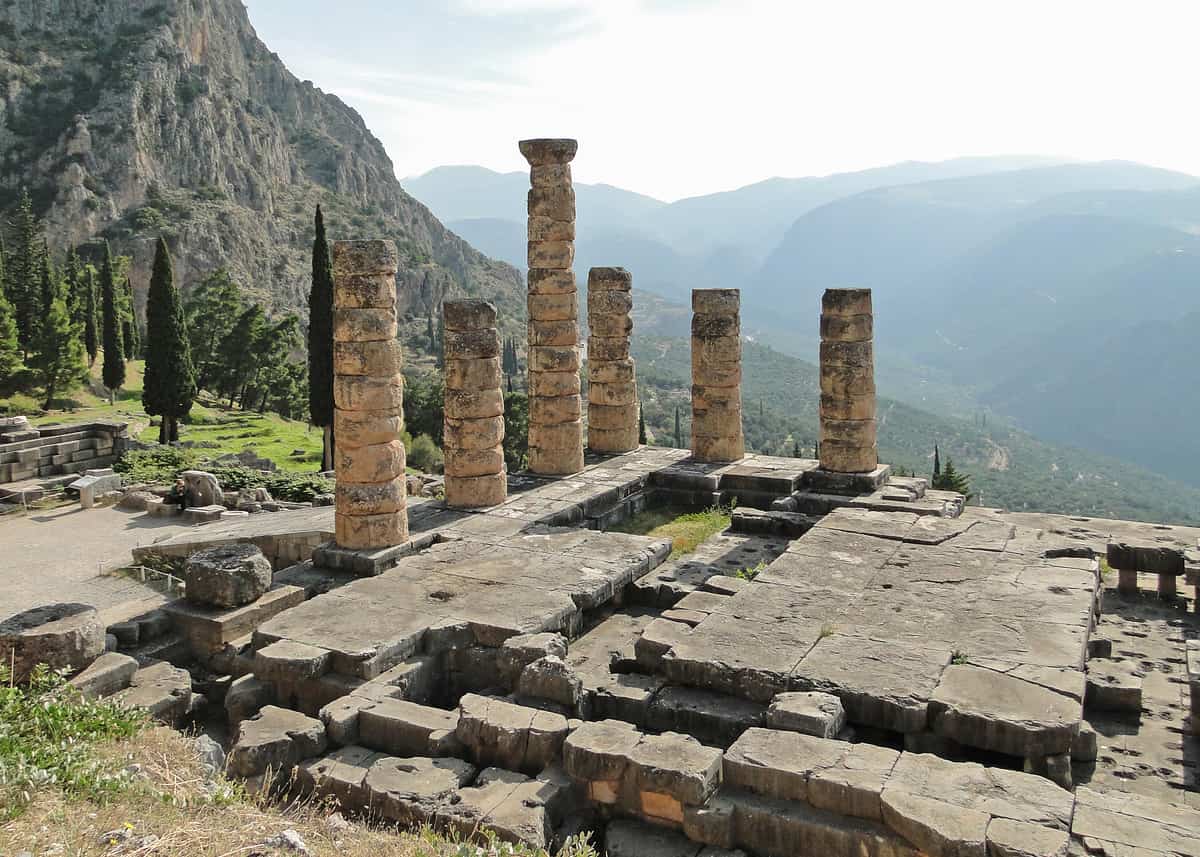
The Temple of Apollo, the centre of a Delphi day trip from Athens, sits on a terrace held up by the polygonal wall. Its visible ruins belong to a Doric temple of the fourth century BC; an older stone temple on the same spot burned down in 548 BC. In front of it stands the main altar, which the people of Chios paid for and built of black marble. About a thousand inscriptions on the polygonal wall record the freeing of slaves dedicated to Apollo.
A Delphi day trip from Athens climbs on to the theatre, farther up the hill, which looks over the sanctuary and the valley below. It was built in the fourth century BC and remodelled in 160/159 BC at the cost of King Eumenes II of Pergamon. Its lower zone has 27 rows of seats and its upper zone eight, for about 4,500 spectators. The stadium above it is the best preserved ancient stadium in Greece, with seats for about 6,500 spectators.
- Delphic maxims: A column in the temple porch carried the maxims “know thyself” and “nothing in excess”.
- Stoa of the Athenians: Seven fluted columns, each cut from one stone, face the Sacred Way.
- Sibyl rock: Tradition seats an early Sibyl, older than the Pythia, on this outcrop beside the stoa.
- Stadium track: The track measures 177.55 by 25.50 meters, with its starting line on the east.
Myth says Zeus released two eagles from opposite ends of the world, and their paths crossed above Delphi. The Greeks marked that point with the omphalos, the navel of the Earth. A Delphi day trip from Athens sees a simplified copy at the place where the stone was found, while a version once used in the temple is held in the museum.
What does a Delphi day trip from Athens see in the museum?
A Delphi day trip from Athens sees fourteen rooms of finds in the Delphi Archaeological Museum, including the bronze Charioteer of Delphi, the marble Sphinx of Naxos, the twin kouros statues of Kleobis and Biton, and the original metopes of the Athenian Treasury.
The Delphi Archaeological Museum shows its collection in date order across fourteen rooms on two levels, with more than 2,270 square meters of exhibition space. The first museum opened in 1903 in a building by the French architect Albert Tournaire. Between 1999 and 2003 the architect Alexandros Tombazis renewed it and added a new hall for the Charioteer. The rooms run from Mycenaean finds to the final years of the sanctuary, so a Delphi day trip from Athens follows the story of the site in order.
The Charioteer of Delphi is a life-size bronze statue from around 470 BC, 1.8 meters tall. It once formed part of a group with a chariot, horses and attendants. Polyzalus, tyrant of Gela in Sicily, dedicated it after a chariot victory at the Pythian Games. The statue survived because debris from the earthquake of 373 BC buried it. Excavators found it in 1896 in three pieces. It keeps its inlaid glass eyes and lacks only its left forearm and details on the head.
A Delphi day trip from Athens finds the Sphinx of Naxos in Room 5, which also holds the friezes of the Siphnian Treasury. The marble figure is 2.22 meters tall and has the head of a woman, the wings of a bird of prey and the body of a lioness. The island of Naxos dedicated it around 560 BC. It once topped a 10-meter column with one of the first Ionic capitals, next to the Temple of Apollo. Statue, column and base together reached 12.45 meters.
The two kouros statues of Kleobis and Biton dominate Room 3. Carved from Parian marble around 610 BC, they stand side by side on a shared base. A partial inscription names the sculptor, Polymedes of Argos. Herodotus tells their story. When the oxen of their mother Cydippe, a priestess of Hera at Argos, failed to arrive for a festival, the brothers pulled her cart six miles to the temple. She asked Hera to reward her sons, and the brothers fell asleep in the temple and never woke.
- Room 4: A silver bull and chryselephantine statues from a pit on the Sacred Way are shown here.
- Room 7: Twenty-seven of the thirty Athenian Treasury metopes, with deeds of Theseus and Heracles, are kept here.
- Room 8: Fragments of the Delphic Hymns share the room with an Attic cup showing Apollo playing the lyre.
- Room 11: The Dancers of Delphi, three female figures rising from acanthus leaves on a column, stand here.
The rooms that a Delphi day trip from Athens walks through today have a history of their own. At the outbreak of the Second World War the antiquities went into storage, and the Charioteer travelled to Athens for safekeeping in the vaults of the Bank of Greece. The museum reopened in 1952 and, after rebuilding, again in 1961.
What is the history behind a Delphi day trip from Athens?
A Delphi day trip from Athens visits the seat of the Pythia, the priestess who spoke for Apollo as the Oracle of Delphi. The site also hosted the Pythian Games, and UNESCO lists the sacred precinct in central Greece as a World Heritage Site.
The ancient Greeks placed the center of the world at Delphi. In myth, Zeus sent two eagles from the eastern and western ends of the earth, and their paths crossed here, at the stone called the Omphalos, or navel. The old name Pytho is tied to the Pythia and to Python, a serpent said to have lived there. The Pythia held office from the 8th century BC at the latest.
The Pythia was the high priestess of the Temple of Apollo, whose 4th century BC ruins remain visible on a Delphi day trip from Athens. She sat on a tripod seat in the adyton, a closed inner room, and spoke for the god. Priests set her words into hexameter verse. The oracle spoke during the nine warmest months, since Apollo was said to leave in winter, when Dionysus took his place. By tradition, Phemonoe was the first Pythia.
No Greek oracle carried more weight. Cities consulted the Pythia before wars and before founding colonies, and Rome’s last king, Lucius Tarquinius Superbus, sent two of his sons to ask her advice. Between 535 and 615 of her statements survive from classical times. A Delphi day trip from Athens visits the site known as the hearth of Greece: after the battle of Plataea, Greek cities put out their fires and relit them from the eternal flame at Delphi.
The Pythian Games were one of the four Panhellenic Games and honored Apollo. They began as a music contest built around a hymn to the god, and athletic events came later. From 586 BC the games ran every four years, two years after the Olympic Games, and ranked second behind them. Winners took a wreath of bay laurel from the Vale of Tempe in Thessaly, not money. Women also competed, and Tryphosa won the girls’ stadion race.
- Pythia: Up to three women served as Pythia at the oracle’s peak, with one kept in reserve.
- Venues: Athletes competed in the Stadium, and horse races ran in a hippodrome on the plain of Krisa.
- Pindar: The Theban poet wrote 12 odes for Pythian winners, known as the Pythionikoi.
- UNESCO: The sacred precinct entered the World Heritage List in 1987 for its influence on the ancient world.
The oracle lost ground after a Celtic raid in 278 BC, revived under the emperor Hadrian in the 2nd century AD, and fell silent when the Christian emperor Theodosius destroyed the Temple of Apollo. The monuments seen on a Delphi day trip from Athens are the ones UNESCO cites, raised by the leading Greek city-states as proof of their shared Hellenic unity.
What else does a Delphi day trip from Athens see nearby?
A Delphi day trip from Athens also covers three nearby sights: the Tholos in the sanctuary of Athena Pronaia, the Castalian Spring in the ravine of the Phaedriades, and Mount Parnassus, the mountain range whose southwestern slope holds the sacred precinct of Apollo.
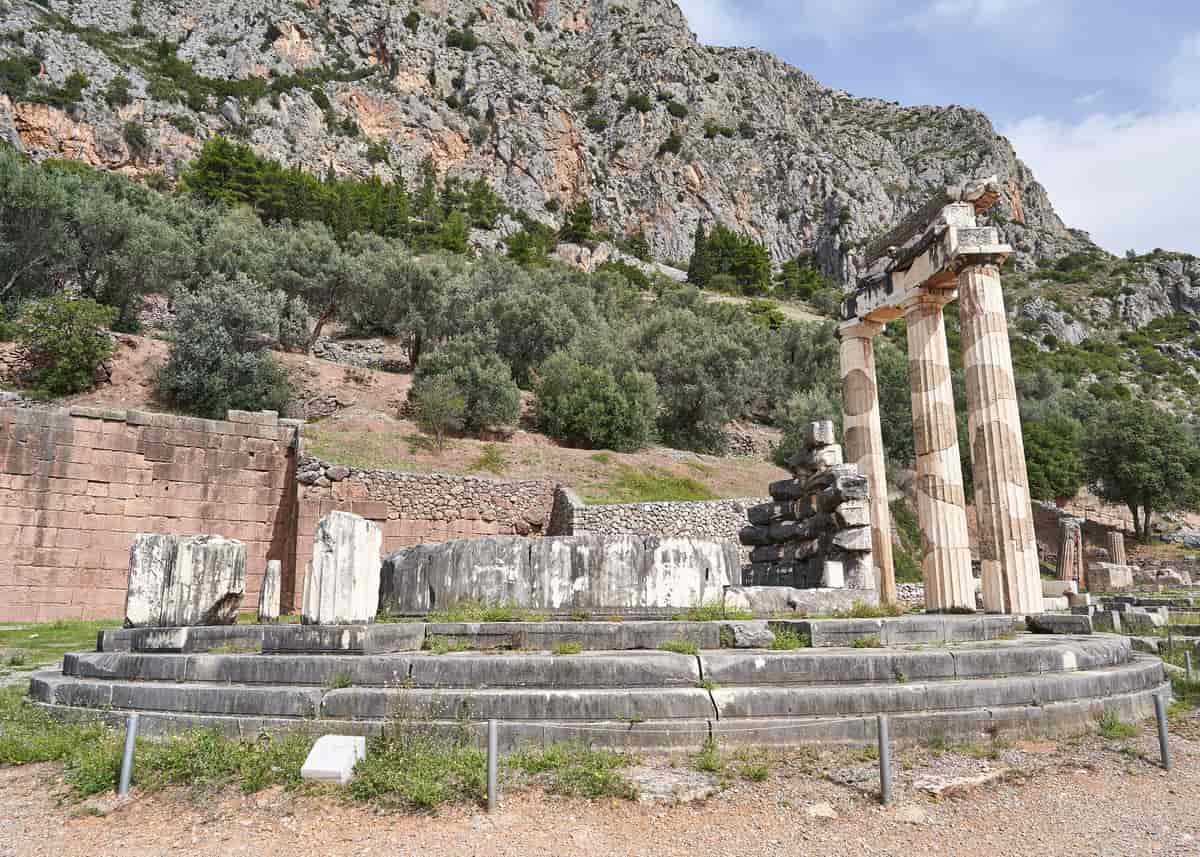
The Tholos stands in the sanctuary of Athena Pronaia, less than a mile east of the main ruins. Athena Pronaia means Athena of forethought. The circular building went up between 380 and 360 BC, with twenty Doric columns outside and ten Corinthian pilasters on a stone bench inside. Its exterior diameter is 14.76 meters. Three of its Doric columns now stand restored, and tourists photograph the Tholos more than any other site at Delphi.
Vitruvius names the architect as Theodorus Phoceus. The builders combined thin Eleusinian slabs and Pentelic marble above with limestone in the platform. The outer metopes showed battles with Amazons and Centaurs, carved in high relief between 380 and 370 BC, and the inner frieze is thought to have shown labors of Hercules or Theseus. Specialists worked to join the fragments, so visitors on a Delphi day trip from Athens see only an incomplete picture of the original form.
The Castalian Spring rises in the gorge that splits the two Phaedriades cliffs. Every visitor in antiquity stopped here to wash and drink, from Pythian Games contestants to pilgrims who came to consult the oracle. One myth says Apollo killed the serpent Python while it guarded the spring, which made the water sacred. Roman poets later looked to the spring for poetic inspiration. Today a modern fountain near the street to the archaeological site offers a rest point for travelers on a Delphi day trip from Athens.
Mount Parnassus rises to 2,457 meters at Liakoura, its highest peak, and covers parts of Boeotia, Phthiotis and Phocis. The oracle stood on its southern slopes, and Arachova, another stop on a Delphi day trip from Athens, sits on the same side. Ancient Greeks held the mountain sacred to Apollo and Dionysus and called it the home of the Muses. The Corycian Cave on its slopes was linked with Hermes and later with Pan.
- Archaic fountain: A 6th century BC fountain house keeps its marble-lined basin and benches, and its water once flowed out through lion-headed spouts.
- Roman fountain: Cut into the rock about 50 meters higher, the 1st century BC fountain had seven bronze spouts.
- National park: Parnassos National Park, founded in 1938, includes the Delphi precinct and protects the Cephalonian fir and the Parnassian peony.
On the seventh day of each month, the Pythia bathed in the Castalian Spring and then drank from the Cassotis, a spring closer to the temple. Euripides described the priest Ion dancing on the highest point of Parnassus as part of this purification. A stop at the spring on a Delphi day trip from Athens puts visitors where the Pythia prepared for each session.
Why does a Delphi day trip from Athens stop in Arachova?
A Delphi day trip from Athens stops in Arachova because this mountain town of western Boeotia lies on Greek National Road 48 close to Delphi and draws visitors for its mountain setting, its local traditions and the Parnassos Ski Centre to its north.
Arachova sits on the southern slope of Mount Parnassus at an elevation of about 970 meters, above the Pleistos river valley. Greek National Road 48, which links Naupactus, Delphi and Livadeia, crosses the town. Arachova lies 26 km west of Livadeia and 8 km east of Delphi, so a Delphi day trip from Athens that comes along Road 48 from Livadeia passes through the town before the ruins.
In the center of town, the Bell Tower, thick with ivy, stands on a steep cliff, with a large clock at the top. Small houses climb uphill along cobbled streets. Arachova is known for its black wine, colorful textiles, carpets, rugs and woodcut crafts. Formaela, a cheese from Arachova, holds protected designation of origin status. On 23 April the town honors its patron, Saint George, with celebrations of local customs.
Arachova was once a municipality of its own, and the 2011 local government reform made it a municipal unit within Distomo-Arachova-Antikyra. In 1826, Georgios Karaiskakis led Greek rebels to victory over the Ottomans at the Battle of Arachova. The town also draws day and weekend visitors from Attica in its own right, not only as a stop on a Delphi day trip from Athens, and the rich and famous gather here.
Kellaria and Fterolakka, the two ski sections on Mount Parnassus, combine into the largest ski center in Greece. Construction began in 1975, and the first two drag lifts opened at Fterolakka in 1976, followed by a new ski area at Kellaria in 1981. Today the center operates 16 lifts and offers 25 marked ski runs plus about 15 ski routes, 36 km in total length, with a longest run of 4 km.
- Hermes lift: In the 1987–1988 winter season, the Hermes chair lift began running and joined the Kellaria and Fterolakka areas.
- Hercules lift: In 1993 the resort added Hercules, the first high-speed quad lift in Greece.
- Gerontovrahos: Across a ridge from Kellaria, this smaller ski center runs just two drag lifts.
- Water: Melting snow on Parnassus supplies municipal water to the communities around the mountain.
Arachova adds a living town to the day, with its own crafts, cheese, wine and history. In winter the whole range opens to skiing, with Arachova as a leading base, and in the three warm seasons hiking trails cross the mountain. A Delphi day trip from Athens that includes Arachova sees both the ancient sanctuary and present-day life on the slopes of Parnassus.
How does a Delphi day trip from Athens travel?
A Delphi day trip from Athens travels north-west through Boeotia. National Road 3 runs from Elefsina past Thebes toward Livadeia, and National Road 48 continues west from Livadeia through Arachova to Delphi. A detour south to Distomo leads to Hosios Loukas monastery.
The first leg of a Delphi day trip from Athens crosses into Boeotia, a regional unit of Central Greece. Its capital is Livadeia, and its largest city is Thebes. Two main roads serve this stretch. The A1 motorway links Athens with Thebes, while National Road 3 starts at Elefsina, near Athens, and passes through Thebes and Livadeia on its way north. Between Elefsina and Thebes, the same road also carries European route E962. Thebes lies about 50 km north-west of Athens.
Thebes stands on a plain 215 m above sea level, between Lake Yliki to the north and the Cithaeron mountains to the south, which divide Boeotia from Attica. It counts among the oldest continuously inhabited cities in the world. Greek myth set the stories of Cadmus, Oedipus, Dionysus and Heracles here, and Heracles was said to be born in the city. The modern town holds an archaeological museum, the remains of the Cadmea citadel and the tomb of Luke the Evangelist.
Livadeia, the capital of Boeotia, lies 90 km north-west of Athens and about 5 km west of National Road 3. National Road 48 links the town to that road and then runs west through Arachova and Delphi toward Amfissa. In antiquity, Livadeia held the oracle of Trophonius, which Croesus and Mardonius both consulted. Shallow grottos at the springs of the Herkyna river are said to mark the oracle site. On the hill above stands a small castle, largely the work of the Catalan Company in the 14th century.
The monastery of Hosios Loukas offers a stop on the way for a Delphi day trip from Athens. The walled complex stands on the slopes of Mount Helicon near Distomo, a town that National Road 48 passes on its north side. Distomo lies 18 km west of Livadeia and 16 km south-east of Delphi. The hermit Luke of Steiris, a different Luke from the Evangelist, founded the monastery in the 10th century, and his relics remain there. UNESCO listed it as a World Heritage Site in 1990.
- Katholikon: The main church of Hosios Loukas, tentatively dated to 1011–12, is the earliest surviving domed-octagon church and holds the best preserved mosaics of the Macedonian Renaissance.
- Older church: The smaller, 10th-century church of the complex is the earliest example of the cross-in-square plan in Greece.
- Crypt: A stairwell on the south side leads down to a burial crypt beneath the Katholikon, with frescoes of the Passion and Resurrection of Christ.
- Arachova tunnel: East of Arachova, National Road 48 passes through a 200 m tunnel on the way to Delphi.
- Pleistos pass: At Delphi, the road follows the northern slope of the Pleistos river pass, with Mount Parnassus to the north.
The same road network serves trips further north. Beyond Livadeia, National Road 3 continues to Lamia and Larissa, while the rock monasteries of Meteora stand in Thessaly, near Kalabaka. Travelers who want both sites can treat a Meteora day trip from Athens as a separate outing. On the return leg of a Delphi day trip from Athens, the road can retrace National Road 48 east to Livadeia and then follow National Road 3 back through Thebes toward Athens.
When is the best season for a Delphi day trip from Athens?
A Delphi day trip from Athens works in every season. Parnassus offers hiking trails through spring, summer and autumn, while winter opens the whole range to skiing. Lowland summers are sunny, dry and hot, so walkers who dislike heat favor spring or autumn.
The weather on a Delphi day trip from Athens changes with height. The sacred precinct sits on the southwestern slope of Mount Parnassus, a range that rises to 2,457 m at Liakoura, its highest peak. Data from a World Meteorological Organization station in the Vathistalos doline show very cold winters and cool summers on the mountain. Across Greece, winter averages in mountain areas drop below −3.0 °C. South of Delphi, the national climate atlas places areas of the Gulf of Corinth in a hot semi-arid zone.
Spring opens the walking season on Parnassus, whose trails serve hikers through all three warm seasons. As the snow melts, it feeds the town water supplies of nearby communities. In antiquity, the season mattered at Delphi as well. The oracle took no questions during the winter months, a time when Apollo was said to live among the Hyperboreans. An annual spring festival, the Theophania, then celebrated his return, and its high point was the display of an image of the deities normally hidden in the sanctuary.
Summer brings heat to a Delphi day trip from Athens, as the trip starts in Attica. In the Mediterranean climate zone, which covers low-lying parts of Attica, summer days are mainly sunny and dry, and rain falls as showers or thunderstorms. Afternoons run hot, nights stay warm, and heatwaves strike from time to time. Elefsina, where National Road 3 begins, shares the highest temperature ever recorded in Greece, 48.0 °C, with Tatoi. Higher up, Parnassus keeps its cool summers, and its trails stay open to hikers.
Autumn is the last of the three warm seasons that Parnassus offers to walkers. Winter changes the mountain, and the entire range opens to skiing, above all from the resorts of Arachova. Kellaria and Fterolakka, two ski sections on the slopes, together form the largest ski center in Greece, with 16 lifts and 25 marked runs. In the lowland Mediterranean zone, winters are wet, winter rain tends to persist, and any snow fades fast, in particular on south-facing slopes.
- Spring: Hiking trails on Parnassus come back into use, and melting snow feeds local water supplies.
- Summer: Lowland days turn hot and dry, while the mountain itself keeps cool summers.
- Autumn: The last warm season on Parnassus keeps the trails open to walkers.
- Winter: Snow covers the range, and skiers reach Kellaria and Fterolakka from the resorts of Arachova.
Picking a season for a Delphi day trip from Athens comes down to the kind of day travelers want. Spring and autumn suit walkers who want warm weather without the summer heat of the lowlands. Summer suits travelers who start early and carry water and hats. Winter adds snow on Parnassus, so warm layers and firm shoes help on the sloping paths of the sanctuary.
What do travelers ask about a Delphi day trip from Athens?
A Delphi day trip from Athens raises practical questions. Travelers ask whether it suits children, whether Meteora fits in, whether a private trip is worth it and what to pack. The answers below rest on the site layout, the road map and plain planning sense.
Does a Delphi day trip from Athens suit children?
Children who enjoy Greek myths find plenty to see at Delphi. The sacred precinct climbs the southwestern slope of Parnassus, and the stadium sits farther up the hill, past the Sacred Way and the theatre, with a track 177 m long. Families with small children can bring water, hats and a light carrier, since the paths run uphill.
Can a Delphi day trip from Athens include Meteora?
Meteora lies in Thessaly, between the town of Kalabaka and the village of Kastraki, at the north-western edge of the Plain of Thessaly. Delphi stands north of the Gulf of Corinth in central Greece, so the two sites work best as separate trips. UNESCO added the six surviving Meteora monasteries to its World Heritage List in 1988.
Is a private Delphi day trip from Athens worth it?
A private trip lets a small group set its own pace and choose its stops, such as Thebes, Livadeia, Hosios Loukas or Arachova. Families with children, slow walkers and photographers gain the greatest benefit. A licensed tour leader can match the time at each site to the group’s interests, while shared trips keep to a fixed plan.
What to pack for a Delphi day trip from Athens?
Firm walking shoes come first, since the Sacred Way climbs the slope from the entrance toward the Temple of Apollo. Water, a hat and sun cream help in the warm months. In winter, warm layers matter on the cold slopes of Parnassus. A small bag with snacks and a camera completes the kit for the road through Boeotia.
Featured photo: George E. Koronaios, CC BY-SA 4.0, via Wikimedia Commons.