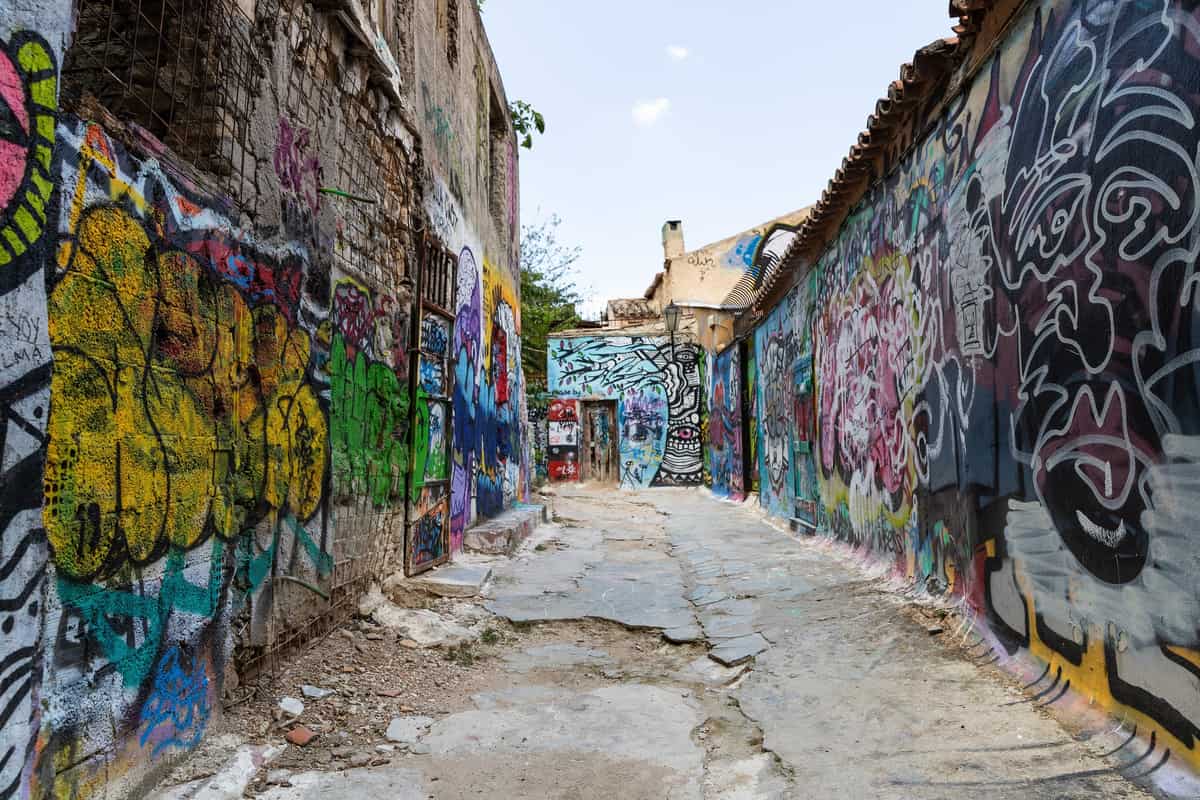
An Athens street art tour walks the districts where the walls of the Greek capital have become an open-air gallery, from the murals and stencils of Psyrri and Exarchia to the old houses of Metaxourgeio, the gasworks of Gazi and the side streets of the centre. This post covers what an Athens street art tour includes, how the scene grew, the crisis years, each district, the artists, the big murals, the techniques, the law, the museums, transport, photography and the best season. It is one of the alternative city tours in Greece on Greece VIP.
Each section ends with an Athens street art tour or city walk that can be booked online.
What does an Athens street art tour include?
An Athens street art tour is a walk through central districts of the Greek capital where walls carry murals, stencils, tags and sticker art, and where a small group learns how each layer of paint records the mood of a city.
The route crosses neighbourhoods of the municipality of Athens that sit inside the centre. Exarcheia, Psyri, Metaxourgeio, Gazi, Kerameikos and Monastiraki lie close to each other, so a walk on an Athens street art tour links a student square, old commercial lanes, workshop districts and the archaeological core. Travellers look at whole walls rather than single works, and a group reads a stencil beside a throw-up, a painted portrait above a shopfront, a slogan sprayed across a roller shutter and a paste-up that has curled in the sun.
Graffiti is writing or drawings made on a wall or other surface without permission and within public view, and it ranges from simple monikers to elaborate wall paintings. Street art grew out of that defiant writing into a form that is made with agreement or even a commission. Murals are painted or applied directly to a wall or another permanent substrate, so legal pictures and illegal marks belong to one family of images, and an Athens street art tour points out the difference on the spot.
Techniques appear side by side on the same street. A tag is a stylised signature, frequently three to five letters long, written with spray paint or a marker in one quick stroke. Stencil work uses paper, cardboard or another medium cut into a shape and sprayed with aerosol paint, and extra layers add colour or depth. A planned walking tour of Athens keeps an Athens street art tour on streets where new work appears, because walls change faster than printed maps. Colour fades, and the newest marks stay brightest.
- Forms: murals, stencils, tags, throw-ups and sticker art share the same facades, so comparison happens on the spot.
- Route: an Athens street art tour moves on foot between Exarcheia, Psyri, Metaxourgeio, Gazi, Kerameikos and Monastiraki.
- Reading: a group learns to date a wall by its layers and to separate a commission from an illegal piece.
- Pace: walking allows stops for detail that a bus window never gives.
A first look at the centre of Athens explains the appeal of the topic. Painted walls stand beside ancient stone, shopfronts and apartment blocks, and every surface carries a rough date in its paint. A visitor who learns the vocabulary behind an Athens street art tour sees more than decoration: the arguments, jokes and memories of a city, sprayed, pasted and brushed in public view, layer over layer.


How did the Athens street art tour scene grow from early graffiti?
An Athens street art tour walks past the result of a long import: modern graffiti began in New York City and Philadelphia in the early 1970s, and Greek teenagers took up the spray can in the decade that followed.
Modern graffiti started with young people in the 1960s and 1970s in New York City and Philadelphia, and it moved into the wider city once subway cars were repainted and writers turned to walls. Tags came first, as a stylised name written in one quick stroke with spray paint or a marker. Stencil work, cut from paper or cardboard and sprayed through the opening, began as an art form in the 1960s and later joined the street culture that an Athens street art tour explains. The paint was cheap.
Rap and hip hop first reached Greece in the 1970s through broadcasts from an American military base. In the early 1980s graffiti and breakdancing arrived in the country and set the base of Greek hip hop, a culture built on four elements: DJing, MCing, graffiti and breakdancing. An Athens street art tour therefore looks at writing that arrived through music and record shops rather than through an art school, and the first writers worked on walls close to home, with names repeated until a district knew them.
Punk subcultures and alternative media spread anarchist messages among Greek youth in the 1980s and 1990s, and squats opened in the late 1980s. Walls became a cheap newspaper for opinions that no printed page carried. In recent years Athens has grown more dynamic, with a rising presence of street art and graffiti that adds options beside archaeological sites and museums, and the walls shown on an Athens street art tour follow that shift from a subculture to a subject for visitors.
- 1970s: the first rap and hip hop sounds arrive in Greece through broadcasts from a military base.
- Early 1980s: graffiti and breakdancing take hold and become part of a local hip hop culture.
- 1990s: punk networks and squats turn walls into a public noticeboard for protest.
- Recent years: an Athens street art tour finds a city where painted walls rank beside ruins as a reason to walk.
Growth came in waves rather than in a single moment. A name written in one decade became a layered picture in the next, and the tools changed with the message. What an Athens street art tour reads now is a record of youth culture, politics and trade, written onto the buildings that survived the hardest years of the modern city, and fresh paint keeps arriving on those walls.
How did the financial crisis shape an Athens street art tour?
An Athens street art tour that reads walls from the crisis years sees anger turned into paint: the Greek government-debt crisis began in late 2009, and the decade that followed produced slogans, portraits and whole facades of political writing.
The Greek government-debt crisis started in late 2009, triggered by the turmoil of the worldwide Great Recession, structural weaknesses in the economy and the loss of monetary policy flexibility inside the eurozone. The government carried out twelve rounds of tax increases, spending cuts and reforms between 2010 and 2016, which at times triggered local riots and nationwide protests. An Athens street art tour that passes closed shopfronts in the centre walks through the area where those measures were felt at street level. Empty shops became a subject for painters.
Bailout loans followed in 2010, 2012 and 2015, and in 2011 private banks accepted a fifty per cent cut on the Greek debt. Unemployment reached nearly twenty-five per cent, up from below ten per cent in 2003. In February 2012 it was reported that twenty thousand Greeks had been made homeless during the preceding year and that twenty per cent of shops in the historic city centre stood empty. An Athens street art tour that follows those streets still reads the loss in the paint on the shutters.
The unrest did not begin with the bailouts. On 6 December 2008 a fifteen-year-old student, Alexandros Grigoropoulos, was killed by a special officer in Exarcheia, and the rioting that followed lasted until 17 January 2009. The unrest was called the worst Greece had seen since the restoration of democracy in 1974. On 5 June 2011 more than two hundred thousand people gathered at Syntagma Square, the largest crowd there since the 1980s. An Athens street art tour that reaches those squares sees where the anger was written down.
- Debt: the crisis began in late 2009 and required rescue loans in 2010, 2012 and 2015.
- Work: unemployment rose to nearly twenty-five per cent and wages fell by nearly twenty per cent.
- Streets: twenty per cent of shops in the historic centre of Athens stood empty in February 2012.
- Protest: an Athens street art tour traces squares that filled with crowds between 2008 and 2012.
The paint of that period is not only political. Faces, animals, jokes and abstract shapes went up beside the slogans, and new layers covered the old ones as the mood changed. A wall that carried a demand in 2010 became a portrait in a later year, and an Athens street art tour that notices the order of the layers follows the temper of a whole decade of argument.
What does an Athens street art tour see in Exarcheia?
An Athens street art tour in Exarcheia follows a central neighbourhood close to the historic building of the National Technical University of Athens, where student politics, small shops and dense housing have kept the walls covered with slogans for decades.
The neighbourhood was created between 1870 and 1880 at the edge of the city and took its name from a nineteenth-century businessman called Exarchos, who opened a large general store there. Exarcheia is framed by Patission Street, Panepistimiou Street and Alexandras Avenue, and it is bordered on the east by Kolonaki. The National Archaeological Museum of Athens and Strefi Hill stand inside the same district. An Athens street art tour stops where the old retail streets meet student housing, because those corners hold the densest writing.
The Athens Polytechnic uprising began on 14 November 1973 as a student protest against the military junta and ended in bloodshed in the early morning of 17 November, after a tank crashed through the gates of the polytechnic. A detailed study published by the National Hellenic Research Foundation in 2004 concluded that at least twenty-four people died that day. The events led to the Academic Asylum Law, which keeps university grounds off limits to police and soldiers, and an Athens street art tour passes walls that answer that history.
Exarcheia holds examples of anti-capitalist graffiti and works as an art hub, with theatrical shows and concerts around the central square. Retail computer shops line Stournari street, which is called the Greek Silicon Valley. Strefi Hill is a limestone park opened to the public in 1938 and given to the city of Athens in 1963, and it rises about one hundred and fifty metres above sea level at the northern edge, with paths that look back over the painted blocks crossed by an Athens street art tour.
- Name: the district took its title from a nineteenth-century shopkeeper called Exarchos.
- Ground: an Athens street art tour crosses a neighbourhood laid out between 1870 and 1880.
- Campus: the polytechnic uprising of November 1973 began on 14 November and ended on 17 November.
- Hill: Strefi Hill opened to the public in 1938 and was passed to the city of Athens in 1963.
Exarcheia mixes a book trade, cheap food and university buildings with a political tradition that has never left the streets. Posters, tags and large painted letters answer each other across the same facades, and new work appears over old work within weeks. What an Athens street art tour meets here is a neighbourhood where the wall serves as the town square of an argument that runs all year.
What does an Athens street art tour see in Psyri?
An Athens street art tour in Psyri enters one of the oldest quarters of Athens, a gentrified district of restaurants, bars and live music tavernas where narrow lanes keep painters and viewers close to each other on the pavement.
Until the early 1990s Psyri had an ill reputation, and it now counts among the fashionable choices in the centre of Athens for food and entertainment. The central square is called Heroes square, because the streets that lead to it carry the names of heroes of the Greek War of Independence. In the late nineteenth century the same nickname mocked the koutsavakides, who gathered on the square. An Athens street art tour reads that change of reputation in the paint on shutters and side walls.
Lord Byron stayed in the neighbourhood during his time in Athens and wrote the poem Maid of Athens there, and Alexandros Papadiamantis, its best known Greek inhabitant, lived in the area for more than twenty years. Psyri sits beside Omonoia, Kerameikos, Akadimia and Monastiraki, so a route through it joins the old commercial lanes to the archaeological centre of the city. Walls beside tavernas, small workshops and painted side streets carry the marks of a quarter that rebuilt its name, and an Athens street art tour crosses them on foot.
- Reputation: Psyri was one of the oldest quarters of Athens and had an ill reputation until the early 1990s.
- Square: Heroes square takes its nickname from the streets named after fighters of the War of Independence.
- Writers: Lord Byron wrote Maid of Athens while staying in the neighbourhood.
- Setting: an Athens street art tour crosses Psyri beside Omonoia, Kerameikos, Akadimia and Monastiraki.
A quarter of this age keeps a short memory of its own past in the paint that covers it. A painted sign from one decade sits under a portrait from the next, and the lanes stay narrow enough for a passer-by to read both. An Athens street art tour that walks Psyri sees a district where the evening crowd and the art share the same strip of pavement.
What does an Athens street art tour see in Metaxourgeio?
An Athens street art tour in Metaxourgeio visits a working-class quarter whose name means silk mill, a district north of the historic centre that has turned towards galleries, studios and painted walls in recent decades, while older houses wait for repair.
Metaxourgeio lies north of the historical centre of Athens and north of Kerameikos. The district is built on the Dimosio Sima, the ancient cemetery of eminent Athenians, and the construction of the silk factory in the early nineteenth century brought the area into the growing urban plan. In the late nineteenth century it became a working-class neighbourhood of craftsmen and small-business owners. An Athens street art tour walks streets where that industrial past is still visible, and the metro now brings visitors to the workshops and warehouses.
By 2001 the population had stabilised, helped by an influx of immigrants and middle-class residents drawn by low rents. The area has gained a reputation as an artistic neighbourhood of galleries, museums and cafes, and it has been linked to line 2 of the Athens metro since January 2000. Avdi Square was renovated by the City of Athens in 2008, and anonymous artwork, guerrilla gardening and street festivals followed there. The mix of residents keeps changing. An Athens street art tour reads that revival in the paint around the square.
- Name: Metaxourgeio means silk mill, after the factory that shaped the district.
- Ground: the quarter stands on the Dimosio Sima, the ancient burial place of eminent Athenians.
- Decline: a long period of abandonment began in the 1970s and the population recovered by 2001.
- Square: Avdi Square was renewed in 2008 with thirty-nine trees, one hundred and twelve bushes and one thousand square metres of grass.
The streets here pass from derelict to busy within one block, and the paint follows the same rhythm. Fresh work appears on a smartened facade while older pieces survive on the walls of buildings still waiting for repair. An Athens street art tour that walks Metaxourgeio sees a neighbourhood in the middle of that change, with the two states of the district visible side by side.
What does an Athens street art tour see in Gazi and Kerameikos?
An Athens street art tour in Gazi and Kerameikos moves from an industrial quarter built around an old gasworks to the ancient cemetery and potters’ quarter beside it, where painted warehouses face stone graves and the metro runs above the old sheds.
Gazi surrounds the old Athens gasworks, which is now the industrial museum and exhibition space known as Technopolis. The gasworks was founded in 1857, and the neighbourhood was known earlier as Gazochori and Fotaerio. Around 1910 brothels opened in the area, and by the middle of the twentieth century small dwellings with large gardens had appeared around the works, lived in mainly by crate makers. In 1967 families of the Muslim minority moved here to work at the gasworks, and an Athens street art tour crosses their streets today.
Technopolis has operated since 1999, occupies about thirty thousand square metres, is dedicated to the memory of the composer Manos Hatzidakis, and names eight of its buildings after Greek poets. The Kerameikos metro station stands next to it, and workshops, paint shops and small garages still occupy the district, where shutters, gates and long walls carry paint that an Athens street art tour reads against the brickwork of the old plant. Concerts and exhibitions fill the grounds through the year.
- Gasworks: an Athens street art tour passes a gasworks founded in 1857 and listed as a building in July 1986.
- Venue: Technopolis has run since 1999 and covers about thirty thousand square metres.
- Cemetery: the Kerameikos cemetery was used as a burial place from the third millennium BC.
- Gates: the Sacred Way left the city through the Sacred Gate on its road to Eleusis.
Kerameikos was the potters’ quarter of ancient Athens, and the English word ceramic comes from its name. It lies northwest of the Acropolis, on both sides of the Dipylon Gate and along the banks of the Eridanos river. Burials there reach back to the third millennium BC, and an Athens street art tour crosses ground that became an organised cemetery from about 1200 BC.
What does an Athens street art tour see in Monastiraki and the centre?
An Athens street art tour in Monastiraki and the centre works between a flea market square, a Roman library and the modern squares where the city settles its arguments, so painted panels stand beside marble ruins and busy roads.
Monastiraki is a flea market neighbourhood in the old town of Athens and one of the main shopping districts of the city. The name means little monastery, and the area takes it from Monastiraki Square, which is named after the Church of the Pantanassa inside the square. The main streets of the district are Pandrossou Street and Adrianou Street, and the metro station under the square serves line 1 and line 3, so an Athens street art tour passes shopfronts, awnings and shutters that change with the trading season.
Hadrian’s Library stands on the north side of the Acropolis, a monumental building created by the Roman emperor Hadrian in AD 132. It was seriously damaged in the Herulian invasion of 267 and repaired by the prefect Herculius between 407 and 412, and its walls, columns and courtyards are among the oldest surfaces in the area, while churches later rose on the site. Around this ruin the modern city has pressed close, so an Athens street art tour moves between ancient marble and fresh paint within a short distance.
Nearby, Omonoia Square was built in 1846 as Palace Square, was renamed for King Otto, and took the name Omonoia in 1862, when rival political leaders swore an oath of peace there. Six main streets meet around it. Syntagma Square is named after the constitution that King Otto granted after the uprising of 3 September 1843, and the Old Royal Palace behind it has housed the Greek Parliament since 1934. An Athens street art tour ends between those two squares.
- Market: Monastiraki is a flea market district named after the little monastery of the square.
- Streets: Pandrossou Street and Adrianou Street are the main trading lanes of the quarter.
- Library: an Athens street art tour passes Hadrian’s Library, built in AD 132 and repaired between 407 and 412.
- Squares: an Athens street art tour ends among squares that gave the modern city its shape.
The centre of Athens stacks centuries of building within one walk, and the paint on its walls answers that depth with images of the present day. An Athens street art tour that ends in these squares sees the pattern of the whole city: an ancient surface, a modern argument, and a fresh layer of colour on top of both. Old stone holds its place.
Which Greek artists does an Athens street art tour show?
An Athens street art tour shows Greek artists whose work stands on city walls, including INO, Woozy and Stelios Faitakis, together with SAME84, Cacao Rocks, Leonidas Giannakopoulos and Bilos. Their pieces range from quick signatures to painted school yards and commissioned façades.

INO is a visual artist from Piraeus who studied painting at a fine arts school in Athens and is known for large-scale murals. He works under a pseudonym and keeps his identity private, so attention stays on the message rather than the name. From at least 2015 his murals have combined photorealistic elements, gray tones and a light blue spot colour that draws the eye to key points. His early work in Greece carried critiques of the debt crisis, with motifs such as eyes, gas masks and the female form.
Woozy is the tag of Vaggelis Hoursoglou, a Greek street artist and muralist born in Athens in 1979. He has painted large-scale murals for nearly twenty years in countries that include Denmark, Switzerland, China and Brazil. He is a co-founder of the Carpe Diem collective, set up informally in 1995 to give artists legal chances to express themselves, and the group published books and a quarterly magazine about the Greek scene.
Stelios Faitakis (1976-2023) was a Greek painter and graffiti artist who signed early work as Bizare and became known in the capital during the 1990s. He studied hagiography and graduated in 2003, and his mural Socrates drinking the hemlock brought him to the attention of critics. Gold and silver colours borrowed from Byzantine icon painting shape his canvases, and he is described as one of the pioneers of the Greek street art movement.
- SAME84: painted a school-yard mural in Mets titled The young drummer of Messolonghi, inspired by a nineteenth-century painting.
- Cacao Rocks: created a portrait of Lord Byron on a building wall as part of a series linked to the 1821 War of Independence.
- Leonidas Giannakopoulos: produced a mural on a high-school wall in Patissia using lines by the poet Andreas Kalvos.
- Bilos: filled a school wall in Gyzi with imaginary figures taken from the natural world, working with pupils on a second wall.
Commissions have taken Greek wall painters indoors as well: a piece by Woozy was shown at the Athens Concert Hall in 2011, and his work featured in the Chromopolis festival in the city. Two further names on Athens walls, Pavlos Tsakonas and SimpleG, studied at a fine arts school in the city. The Athens street art tour leader uses these names to trace how illegal writing grew into a profession.
Which international artists have painted on an Athens street art tour?
An Athens street art tour shows foreign artists who have painted in the city, among them Demetrio Di Grado from Italy, Adi Ioshpe from Israel, Fio Silva and Sisa Soldati from Argentina, and the Brazilian twins known as OSGEMEOS.
Demetrio Di Grado comes from Sicily and combines collage with mural painting, a mixture that has made him a recognisable figure in the Italian scene. His work in a park on Thessalonikis Street, opposite Technopolis, belongs to a series called Starting from the End, and it was created through the municipality’s programme with the Italian Cultural Institute of Athens. The work places architectural landscapes and people against contemporary social themes.
Adi Ioshpe, a painter from Israel, covered the façade of an old building on Lekka Street with a work called Waves, a cooperation between the Embassy of Israel and the Municipality of Athens. Fio Silva, an Argentine muralist and illustrator, won a competition open to young artists from forty countries and painted an owl on an Athenian school wall. Sisa Soldati, from Buenos Aires, produced Natural Memory, a field beside an aquatic landscape, at a nursery on Thermopylon Street.
OSGEMEOS are the identical twins Otavio Pandolfo and Gustavo Pandolfo, born in 1974 and painting graffiti since 1987; they covered a wall in Athens in 2005 with Woozy as part of a collaboration project. The crew 1UP, formed in Berlin and active since 2003, is known for bombing, rooftop paintings and whole-train work, and its tags have appeared in Athens as well as in other cities. Alex Martinez, born in the United States, has worked as an illustrator and muralist in Greece and the United Kingdom.
- From the roots to the sky: the second part of the public murals programme put works by Greek and foreign artists on school walls in the city.
- Pen name: Alex Martinez writes about graffiti and street art under the name SHINE.
- Anonymity: 1UP members come from different European countries, keep their names secret and have faced more than 300 criminal charges.
Guests arrive through embassies, competitions and festivals, and their work keeps travelling: Alex Martinez maintains a studio in London, where his mural of Samuel Beckett has appeared on book jackets and postcards. The Athens street art tour leader explains how each project was arranged, which body approved the wall and how the guest’s style sits beside local writing.
Which large murals does an Athens street art tour see?
An Athens street art tour sees large commissioned works, among them a wall of 1,100 square metres painted by eight artists, two murals by Woozy measuring 25 by 15 metres and 20 by 12 metres, and a 90-metre-long commission by INO divided into four parts.
The largest mural realised by the Municipality of Athens covers 1,100 square metres of an external wall at a historic sports club on Evelpidon Street. Eight artists, among them Soteur, Tzomakas, Bassment Rats, Cacao Rocks, Kez, Volkov, Giannakopoulos and Gospel, painted sections that together celebrate sporting ideals, on the corners of Mavromataion and Evelpidon streets. A cultural office of the municipality supervised the project.
Woozy painted The Colorful Warrior, a wall of 25 by 15 metres, as part of a reconstruction pilot programme, and Colorful Tsunami, 20 by 12 metres, in central Athens. INO’s Leonardo da Vinci: 500 Years of Genius, a commission of 90 metres, was divided into four sections devoted to the artist, the Mona Lisa, the Vitruvian Man and The Last Supper.
Ilias Papailiakis turned his painting The Kiss into a mural 22 metres high on the wall of an apartment building, the first in a series of large-scale works curated by an art historian at the City of Athens culture department. The series was commissioned and produced by the Onassis Foundation with the culture organisation of the Municipality of Athens, and the work carries a message about human contact in a city built for meeting.
- Creasing: INO wrapped the Onassis Stegi building in 2014 for an exhibition, covering the façade with a drawing of crumpled paper and a face.
- Snow-blind: his 2016 mural in Athens, made for a campaign about hepatitis C, shows a gray figure with a blue liver.
- Painted from ropes: INO painted the surface of a building at the junction of Lenorman Street and Constantinoupoleos Avenue while suspended on ropes.
Big walls demand material and planning: the eight-artist work used 812 litres of paint, and the finished surface was covered with anti-graffiti material to prevent later damage. Works at this scale are commissioned before the first mark is made, and the Athens street art tour leader explains how the size of a wall and the width of the street shape what a passer-by can see.
What techniques does an Athens street art tour explain?
An Athens street art tour explains the main techniques of wall writing: tags, throw-ups, pieces, stencils, paste-ups and murals. Each form has its own speed, tools and level of finish, from a one-colour signature to a painted wall that takes weeks to complete.
A tag is a stylized signature, normally done in one colour, and it remains the simplest type of graffiti and the one that appears everywhere. A throw-up sits between a tag and a bomb in complexity: it carries a one-colour outline and a single layer of fill colour, in bubble shapes, and it is designed for quick execution. A piece is a large, complex and labour-intensive painting that can include three-dimensional effects, arrows and colour transitions, and the glossary treats the word mural as a synonym for piece.
Stencil graffiti uses stencils cut from paper, cardboard or other material, and the design is transferred with spray paint or roll-on paint. Layers of stencils add colour or the illusion of depth, and the short time needed to paint a single stencil is a key attraction. A paste-up is a drawing or stencil on paper fixed to a wall with wheatpaste or wallpaper paste; wheatpaste is made from wheat flour or starch and water and holds well on concrete and metal.
Street art itself is visual art created in public locations for public visibility, and it reaches beyond spray cans to include mosaic tiling, sticker art, reverse graffiti, lock-on sculptures, woodblocking, yarn bombing and rock balancing. Graffiti is writing or drawings made on a wall or other surface, in public view, from simple monikers to elaborate wall paintings, and the word comes from the Greek verb graphein, which means to write.
- Wildstyle: lettering so stylized that it becomes difficult to read, with interlocking and three-dimensional forms.
- Stickers: labels carrying a writer’s tag, placed on signs, dispensers and street furniture where a can attracts attention.
- Burners: large and elaborate pieces that, in busy areas, tend to be legal works painted with the owner’s consent.
- Buffing: removal with chemicals or flat paint, which leaves a pale ghost where the writing used to be.
Rollers allow lettering larger than spray paint can produce, and the biggest examples of graffiti are almost all made with a roller. The nozzle of a can, called a cap, sets the width of the line, and different caps suit fills, outlines and fine detail. A tour leader traces the sequence from a name in one colour to a composed wall.
Is street art legal on an Athens street art tour?
An Athens street art tour explains that painting a wall without permission is treated as vandalism, while commissioned murals, designated walls and legal pieces are permitted. In Athens the municipality has opened public spaces and issued permits for large works, so legality depends on the wall.
Graffiti is writing or drawings made on a wall or another surface, in public view and, in the usual case, without permission. Graffiti has existed since ancient times, with examples dating back to ancient Egypt, ancient Greece and the Roman Empire. In a large number of countries, marking or painting property without permission is considered vandalism, and the term vandalism covers deliberate damage to public or private property, including defacement. Graffiti is distinguished from murals, a form of street art that is permitted in a large number of cases.
Street art can be the product of an agreement or a commission, and in the glossary of graffiti a legal piece is one made with permission. The local government in Athens began issuing permits for commissioned murals, turning areas into outdoor galleries and countering illicit work. The municipality also provides designated public spaces where Greek and foreign artists can paint, and the mayor has described the policy as a yes to colour and art and a no to scribbling and abuse of public space.
Legal walls, also called open walls, are public spaces where graffiti is allowed by any member of the public. They differ from commissioned murals, because artists keep relative freedom in what they paint, although hateful messages are disallowed. Legal walls began in Scandinavia, where a scribble board opened in Stockholm in 1968, and they can be state-designated or privately owned; privately owned walls need council permission in certain jurisdictions.
- Ancient sites: the Acropolis is protected under Law No 3028/2002 on the protection of antiquities and cultural heritage.
- Festivals: the Athens Street Art Festival and Petit Paris have added to the country’s mural scene.
- Research: a project on artistic interventions in public space runs under the auspices of a Greek centre for the study of crime.
- Repainting: a mural by Gospel on a school wall was recreated after vandals damaged it.
Permission, therefore, decides what a visitor sees. Works near the archaeological sites fall under heritage rules, while walls offered by the municipality or by private owners follow different terms. The Acropolis site has operated as an archaeological site since 1833, and a presidential decree has declared the area around it a no-fly zone.
Which museums and galleries does an Athens street art tour pass?
An Athens street art tour passes the National Museum of Contemporary Art in the former Fix brewery, the Onassis Stegi on Syngrou Avenue and the Benaki Museum, whose Pireos Street annex stands at number 138 and whose main building faces the National Garden.
The National Museum of Contemporary Art was established in October 2000 and opened on the ground floor of the old Fix brewery with around 1,800 square metres of space. The building had belonged to the subway authority before its transfer to the museum foundation, and an architecture practice won an international competition to complete the renovation. The Greek government had spent 40 million euros on the museum by 2020, and the Stavros Niarchos Foundation added 3 million euros.
The Onassis Stegi occupies 18,000 square metres on Syngrou Avenue, and its construction began in 2004 to a design by a French architecture firm. It holds two main halls, with 900 and 200 seats, and it opened on 7 December 2010; around 300,000 people visit each year. With the Municipality of Athens, the venue has placed artworks by Greek artists in sites that include Omonia Square and Neos Kosmos.
The Benaki Museum was established and endowed in 1930 by Antonis Benakis and occupies the family mansion opposite the National Garden. It holds more than 100,000 artefacts, and its collections spread across a number of locations, among them the Pireos Street annex at 138 Pireos Street and a museum of Islamic art that opened in the Kerameikos district in 2004 in more than 1,000 square metres of remodelled space.
- Collections: the museum’s acquisitions include works by Ilya Kabakov, Nan Goldin and Bill Viola, and a gift in 2022 added 140 contemporary pieces.
- Two strands: the permanent collection is structured in two parts, one historical and one contemporary.
- Direction: Anna Kafetsi was the founding director, and Katerina Gregos has led the museum since 2021.
- Satellites: the Benaki group also runs a toy museum in a seaside mansion at Palaio Phaliro and a gallery in downtown Athens.
While renovation continues, the National Museum of Contemporary Art has shown exhibitions in parts of the Athens Conservatory, and the building programme is intended to provide space for the permanent collection, periodic exhibitions, educational programmes and workshops. The museum stands close to the Acropolis and the Acropolis Museum, so the walk between the three sites covers archaeology and contemporary art in one stretch.
What does an Athens street art tour see in Kypseli and Pangrati?
An Athens street art tour in Kypseli and Pangrati shows two residential districts built around long apartment walls. Kypseli holds around 50,000 residents and a market street, while Pangrati has an estimated 35,173 residents, a stadium, a cemetery and galleries.
Kypseli is a neighbourhood in central Athens that occupies much of the sixth municipal department, with boundaries set by Patission Street in the west, Tourkovounia hill in the east, the municipality of Galatsi in the north and Pedion Areos park in the south. Urban development began in the 1930s with family houses and the first modern apartment buildings, and the municipal market on Fokionos Negri Street, designed by Alexandros Metaxas, was inaugurated in 1937.
Pangrati takes its name from the ancient sanctuary of Hercules Pancrates and its frontage runs from Vasilissis Sofias Avenue along to Vasileos Konstantinou Avenue and Vassileos Alexandrou Avenue, close to the National Gardens. The Panathinaiko Stadium, which hosted the first modern Olympic Games in 1896, is its best-known landmark, the First Cemetery of Athens lies inside its limits, and the National Gallery of Athens holds the largest collection of Greek paintings.
Kypseli’s apartment buildings, raised from the 1930s onward, present long flat walls above shop fronts, and Pangrati’s interwar extension left a similar fabric of low blocks and narrow streets. The city’s public murals programme, part of a three-year cultural project, places commissioned art on school yards and buildings, and the Athens street art tour leader explains how painters treat these surfaces differently from a wall in the historic centre. Line 4 of the metro is planned to reach Kypseli, and bus lines serve both districts.
- Squares: Kypseli’s shopping streets include Kypselis Square, Amerikis Square and Patission Street, while Pangrati holds Plastira, Proskopon, Varnava and Pangratiou squares.
- Nightlife: Kypseli had a busy nightlife in the 1960s with theatres, cinemas, restaurants, bars and clubs, and it is still known for its theatres.
- Population change: from the 1980s residents moved to the northern suburbs and immigrants rented basements and small flats, lowering property values.
- Renaissance: Pangrati has drawn newcomers since the second decade of the century, with gentrification and rising house prices.
Pangrati’s cultural life grew around its galleries, the National Gallery and the museum that opened beside the church of Agios Spyridon in October 2019, and its squares fill with people in the evening. Kypseli’s mix of old apartment blocks, theatres and shops gives the district a different rhythm, and the Athens street art tour leader explains why wall writing gathers on certain corners rather than others.
What does an Athens street art tour see in Koukaki?
An Athens street art tour in Koukaki shows a district below Philopappos Hill, between the Acropolis slopes and Andrea Syngrou Avenue. Its walls stand above a weekly market street, pedestrian lanes and two metro stations, in a quarter that borders Plaka and Neos Kosmos.
Koukaki is a south-eastern neighbourhood of Athens. It borders Makrygianni and Plaka in the north, Kallithea and Petralona in the south, Neos Kosmos in the east and Filopappou and Thisio in the west, with Andrea Syngrou Avenue forming the line towards Neos Kosmos. Veikou Street runs north to south and Dimitrakopoulou Street south to north, and a large vegetable market is held every Friday. Two metro stations serve the district, and the tram connects it with the coast.
Philopappou Hill, also called Mouson Hill, stands opposite and south-west of the Acropolis and is joined to the hills of Asteroskopeio and Pnyka. At its top is the monument of Philopappos, erected by a prince of the Kingdom of Commagene in the Roman period, and the Dora Stratou theatre occupies the south side. The districts around the hill are Koukaki, Asyrmatos, Petralona and Acropolis.
The Acropolis above the district is a World Heritage site inscribed in 1987 under five criteria, with a protected area of 3.04 hectares and a buffer zone of 116.71 hectares. The hill rises to an average height of 156 metres, and the complex measures about 170 by 350 metres. The Acropolis Museum, inaugurated in 2009, conserves the greater part of the original sculptural and architectural pieces of the monuments.
- Kallirois Street: a large mural below the Acropolis sets out one of the seventeen United Nations Sustainable Development Goals, on sustainable cities and communities.
- Drakou: the pedestrian zone that begins at Gargaretta Square is lined with cafés and small shops.
- Agios Ioannis: a church of that name stands within the neighbourhood.
A large number of bus routes run along Andrea Syngrou Avenue, and trolleybus lines cross the district on Veikou and Dimitrakopoulou streets. The composer Mikis Theodorakis, who lived in Koukaki, is among its best-known residents. The Athens street art tour leader ends the walk where the walls of a residential quarter face the Acropolis across a single avenue.
How does an Athens street art tour use public transport?
An Athens street art tour moves through the city on the Athens Metro, a network of three lines, 66 stations and 91.7 kilometres of track. Line 1 serves Thiseio and Omonia, Line 2 serves Metaxourgeio and Omonia, and Line 3 serves Kerameikos and Monastiraki.
The Athens Metro carries an Athens street art tour between the painted quarters. Line 1, the green line, opened on 27 February 1869 and runs 25.7 kilometres between Piraeus and Kifissia, with 24 stations. Line 2, the red line, and Line 3, the blue line, both opened on 28 January 2000. Line 2 covers 18.7 kilometres and 20 stations, while Line 3 covers 47.3 kilometres and 24 stations, and its latest extension opened on 10 October 2022.
Five interchanges, at Attiki, Monastiraki, Omonia, Piraeus and Syntagma, let passengers change lines without leaving the system. Thiseio station on Line 1 opened on 27 February 1869, was rebuilt in 2004 and sits at ground level, 8.603 kilometres from Piraeus. Kerameikos station on Line 3 opened in 2007 and stands underground in Gazi. Metaxourgeio station on Line 2 opened with its line, and Omonia station, used by Lines 1 and 2, opened in 1895 and was resited in 1930.
The tram adds a second option for an Athens street art tour. It runs two lines and 60 stops across a system of 31.3 kilometres, with its northern terminal beside Syntagma Square, where metro Lines 2 and 3 meet. The metro and the tram share one operator, which keeps a journey simple. Trains arrive through the day, and the tram line continues to the coast, which matters if a walk extends south.
- Thiseio: Line 1 stops at ground level here, a short walk from the streets of the district.
- Kerameikos: Line 3 stops here, within reach of the archaeological site and Gazi.
- Metaxourgeio: Line 2 stops here, north of the historical centre of Athens.
- Omonia: Lines 1 and 2 cross here, which makes it a useful hinge for an Athens street art tour in the north of the centre.
Because Lines 1 and 3 meet at Monastiraki and Lines 1 and 2 meet at Omonia, an Athens street art tour can join two lines in a single outing. The stations at Thiseio, Kerameikos, Metaxourgeio and Omonia each place walkers inside the quarters where the paint is. Rides between stops stay short, and the walking sections of an Athens street art tour follow the streets that connect them.
Which festivals can an Athens street art tour catch?
An Athens street art tour can catch the Athens Biennale, an international contemporary art event founded in November 2005, and the Athens Digital Arts Festival, which takes place each spring in Athens. The Athens Epidaurus Festival adds theatre and music from late spring to October.
The Athens Biennale holds a large exhibition with performances, workshops and lectures. Its first edition, Destroy Athens, ran from 10 September to 2 December 2007 inside Technopolis, the former gasworks in Gazi, with 110 artists. Later editions carry the titles Heaven, Monodrome, Agora, Omonoia, Anti and Eclipse. Across six editions the event has presented more than 800 artists and theorists, commissioned or premiered 127 new productions, and received the Princess Margriet Award for Culture in 2015. The event founded the European Biennial Network in 2007.
The Athens Digital Arts Festival began in 2005 under the name Athens Video Art Festival and took its present title in January 2015. It covers video art, installations, animation, web art and digital images, and it works with 46 partner festivals abroad. Screens, projections and live performances give an Athens street art tour a reason to time a walk with the festival week, and the programme reaches into public space around the city centre.
The Athens Epidaurus Festival has run since 1955 and fills venues from late spring to October, among them the Odeon of Herodes Atticus and Technopolis in Gazi. Its ancient theatre at Epidaurus holds 10,000 people. Technopolis has operated since 1999 across about 30,000 square metres, and eight of its buildings carry the names of Greek poets. A museum devoted to Maria Callas occupies the second floor of one of them, and an Athens street art tour that ends in Gazi can step inside.
- Biennale: the Athens Biennale shows contemporary art every two years in Athens.
- Digital arts: the Athens Digital Arts Festival gathers video art, animation and workshops each spring.
- Summer stage: the Athens Epidaurus Festival uses the Odeon of Herodes Atticus and Technopolis.
- Industrial venue: Technopolis hosts exhibitions, seminars and concerts in Gazi.
Festival dates decide the shape of an Athens street art tour, since the programme of a biennale or a digital arts week adds indoor stops to a walk. Editions change their concepts and their venues, so the walls of one year sit beside the screens of another. An Athens street art tour that catches a festival mixes paint with performance, and the same squares serve both.
How do photographers shoot an Athens street art tour?
An Athens street art tour rewards patience with light, because Athens receives 362.7 hours of sunshine in July and 127.1 hours in December. Photographers shoot walls straight on, keep people in the frame only with consent, and respect residents and property.
The spread between 362.7 hours of sunshine in July and 127.1 hours in December shapes the working day for an Athens street art tour. Summer light arrives early and lasts long, so the edges of the day carry the softest tones. Winter light rakes across facades at a low angle for a large part of the afternoon. Photographers check the direction of the sun before choosing a wall, and a camera pointed down a narrow street catches that difference in a single frame.
Thiseio is known for its views of the Acropolis, its archaeological neighbours and its open terraces, so a camera can work there at a slow pace. Kerameikos sets ancient tombs beside modern surfaces, and Metaxourgeio offers squares where the paint meets old facades. A straight frame keeps a mural rectangular, while a view from an angle shows how a work meets the street. An Athens street art tour that walks the same wall twice sees two different pictures.
Respect matters as much as light. Thiseio holds two synagogues, the Holocaust Memorial of Athens and a set of historic churches, and Exarcheia is home to residents, migrants and self-organised social structures. A lens pointed at a doorway, a courtyard or a face enters private life. Framing a wall from the pavement keeps people out of the shot, and a question before a portrait settles the matter. An Athens street art tour that asks first stays welcome in the quarter.
- Angles: a straight frame keeps a mural square, while a side view shows its depth.
- Detail: close work records lettering, stencils and paste-ups that a wide frame loses.
- People: residents, worshippers and shopkeepers hold the right to refuse a photograph.
- Timing: the light of December differs from the light of July, so each season offers another look.
Equipment choices stay simple on an Athens street art tour, because narrow streets, kerbs and crowds punish long lenses and heavy bags. Weather protection matters in the wet months, and a spare battery covers a long afternoon. The strongest photographs come from a full walk of one quarter, not from a single wall, and an Athens street art tour that returns on a second day finds new work.
How does an Athens street art tour fit with food and nightlife?
An Athens street art tour fits easily with food and nightlife, because the painted quarters share their streets with tavernas, bars and coffee shops. Psyri is known for its restaurants, bars and live music tavernas, Gazi for its night clubs, and Metaxourgeio for its cafés.
Psyri, an old quarter of Athens, carried an ill reputation until the early 1990s and now draws crowds to its restaurants, bars and live music tavernas. Its central square is called Heroes Square, because the streets that lead to it carry the names of leaders of the Greek War of Independence. The writer Alexandros Papadiamantis lived in the quarter for more than two decades, and Lord Byron stayed there. A coffee before an Athens street art tour and a meal after it keep the day inside the same blocks.
Exarcheia, beside the National Technical University of Athens, holds cafés, bars, night clubs and comic book shops, along with one of the oldest summer cinemas of Athens. Street food fills the gaps. In Athens the word souvlaki covers pita wraps, while kalamaki names the skewer itself, and the dish spread widely as fast food from the 1960s, after vendors from Boeotia introduced it. The pita adds tomato, onions and fried potatoes to the skewer, and an Athens street art tour can eat standing up and keep moving.
Metaxourgeio turns Avdi Square into a stage for festivals and gatherings. Gazi turned from an industrial quarter into an entertainment district with clubs, cafés, restaurants and gay and lesbian bars as the 21st century opened. Music spills from the doorways as the evening begins, and the same streets carry walkers between tables. Together these quarters cover eating, drinking and dancing within a short walk. For a structured version of the same circuit, see the Athens food tour.
- Tavernas: Psyri holds live music tavernas beside its restaurants and bars.
- Street food: souvlaki and kalamaki sell from small counters through the evening.
- Squares: Avdi Square in Metaxourgeio carries theatres and an art gallery.
- Late hours: bars in Exarcheia and Gazi stay busy long after the museums close.
Food and nightlife also decide the pace of an Athens street art tour, because a long lunch or a late bar shortens the walking time. Street food solves that problem, since souvlaki and kalamaki need no table. An Athens street art tour that plans one sit-down meal and grazing stops elsewhere covers both the walls and the kitchens of the same quarter, and the kitchens sit beside the walls.
How does an Athens street art tour compare with a classic Athens tour?
An Athens street art tour looks at the living city, while a classic Athens tour climbs to the Acropolis, a UNESCO World Heritage Site inscribed in 1987 that holds the Parthenon. Both fit one visit, because the metro links the ancient hill to the painted quarters.
The Acropolis holds the Parthenon, the Propylaea, the Erechtheion and the Temple of Athena Nike, built under Pericles in the fifth century BC, and it covers 3.04 hectares with a buffer zone of 116.71 hectares. A Venetian bombardment damaged the buildings in 1687. An Athens street art tour reaches the same area from Akropoli station on Line 2, and the two routes share the first stretch of the same avenue.
The Acropolis Museum on Dionysiou Areopagitou Street opened on 20 June 2009 and shows more than 4,250 objects across 14,000 square metres. It stands 280 metres from the Parthenon, and its top floor repeats the orientation of the temple with 48 columns. The museum was founded in 2003 and spreads its collection over three exhibition levels. An Athens street art tour trades that order for changing walls, and the two outings sit close together, since the museum entrance stands beside a metro station.
Other museums carry the same contrast. The National Archaeological Museum stands in Exarcheia, the quarter of bookshops and fair trade shops. The National Museum of Contemporary Art was established in October 2000 in the old Fix Brewery and received a gift of 140 contemporary works in 2022. The Benaki Museum opened in 1930 and holds more than 100,000 artifacts, and its Islamic art collection moved into Kerameikos in 2004. For a structured visit to the ancient hill, see the Acropolis tour.
- Ancient: the Acropolis covers the classical city, with the Parthenon at its centre.
- Contemporary: the National Museum of Contemporary Art covers Greek and international work.
- Collections: the Benaki Museum follows Greek art from prehistory to the present.
- Combining: an Athens street art tour and a climb to the hill need no extra day.
A comparison of the two outings comes down to subject and mood. Ancient marble asks for study, and a painted wall asks for a walk. Athens holds both within the same square kilometre, so an Athens street art tour and a classical route can share one day without a long transfer. Travelers who plan one of each see the city as it was built and as it is used.
Is an Athens street art tour safe and accessible?
An Athens street art tour is safe and accessible for walkers, because Thiseio and Kerameikos stations are step-free and the city has rebuilt pavements with non-slip tiles, ramps and tactile paving. Omonoia records drug dealing, prostitution and theft, especially in its western part.
Walking distances inside the centre stay short, and the pedestrian streets of Thiseio connect the archaeological sites of the Agora, Kerameikos and the Pnyx on foot. The Acropolis Museum stands a 400-metre walk from the Parthenon. The municipality has replaced 410 pavements with non-slip tiles, ramps for wheelchairs and tactile paving for blind pedestrians, which helps an Athens street art tour that crosses the same squares.
City figures list four accessible routes for people with visual disabilities and four for people with mobility disabilities, along with 830 smart sensors that watch crossings and disabled ramps, 400 marked ramp positions and 22 parking spaces for disabled drivers. Thiseio and Kerameikos metro stations are marked as accessible. An Athens street art tour that uses steps and kerbs therefore stays manageable, and the reconstruction tackles pavements that until recently lacked basic infrastructure.
Safety changes from street to street. Exarcheia sees protests and specialised policing, and its residents include migrants and long-standing Athenians who share the same pavements. Omonoia Square has been rebuilt, which improved the look of the junction and the feeling of security in the wider area. Gazi was a deprived area for much of the twentieth century and carried no associated high crime rate. A group that stays on the main streets and keeps together avoids the trouble spots of the centre.
- Pavements: non-slip tiles, ramps and tactile paving have replaced old sidewalks.
- Sensors: smart sensors watch crossings and disabled ramps for illegal parking.
- Routes: accessible routes for visual and mobility disabilities are mapped in Greek and English.
- Lighting: renewed street lighting across the centre improves safety after dark.
Accessibility also depends on the hour. Daytime walking keeps an Athens street art tour inside the accessible routes and away from the worst of the traffic, while a wet winter pavement slows any group. The metro stations at both ends of the centre remove the longest stretches, and the pedestrian streets around Thiseio, Monastiraki and Psyri give an Athens street art tour a surface free of cars.
When is the best season for an Athens street art tour?
Spring and autumn suit an Athens street art tour best. Athens has a hot-summer Mediterranean climate, and the mean daily maximum reaches 34.3 °C in July and August against 13.3 °C in January.
Athens is classed as Csa, a hot-summer Mediterranean climate, and its city-centre station records a mean annual temperature of 19.2 °C. August brings 5.4 millimetres of rain, so walls stay dry and paint keeps its colour. The city has been called the hottest in mainland Europe and was the first in Europe to appoint a chief heat officer, a measure of how hard a summer afternoon presses on walkers. Relative humidity climbs to 73 percent in December, which makes the winter air feel heavier than the numbers suggest.
Records underline the point. Elefsina, west of Athens, held the World Meteorological Organization record for the highest temperature in Europe at 48.0 °C, recorded on 10 July 1977, until 2021. An Athens street art tour in summer therefore moves in the early morning or waits for the evening. Winter stays mild but wetter, and snowfall rarely disrupts daily life, although snowstorms covered the urban area on 16 February 2021 and 24 January 2022.
Spring fills the weeks before the heat and autumn follows it, and both leave the streets usable from morning to evening. October brings 38.6 millimetres of rain and November 70.8 millimetres, so an Athens street art tour in late autumn carries a jacket. Spring and autumn sit between the two extremes, which suits a long walk with a camera, and the quarters of Gazi and Kerameikos hold their squares and sidewalks in every season.
- Dry months: July averages 10.7 millimetres of rain and June 11.6 millimetres.
- Wet months: December brings 76.3 millimetres of rain.
- Mild winter: the daily mean temperature in January is 10.2 °C.
- Humidity: relative humidity falls to 42 percent in July.
Season also decides what an Athens street art tour sees, because new paint appears after festivals and weather wears the old layers. Spring and autumn give the longest comfortable walking days, while summer rewards early starts and winter shortens the usable light. An Athens street art tour in any month finds walls, and the choice of season shapes the comfort of the day more than the content of the walls.
What do travelers ask about an Athens street art tour?
An Athens street art tour fits children, cameras and evening plans. Families join a digital arts festival programme, walkers cover the 6.8 kilometres of the Great Walk of Athens, and Gazi keeps its clubs and restaurants open late into the night.
Can children join an Athens street art tour?
Children can join an Athens street art tour, and the city offers family material. The Athens Digital Arts Festival launched ADAF Kids in 2016, a programme for children and their parents, and the Hellenic Children’s Museum, established in 1987, sits in Plaka and is served by Syntagma station. Metro stations at Thiseio and Kerameikos are step-free, which helps with buggies.
How long is the walk in kilometres on an Athens street art tour?
The city’s own figure for its pedestrian corridor is 6.8 kilometres, the length of the Great Walk of Athens, which delivered 50,000 square metres of public space across the historic centre. An Athens street art tour can cover less ground, because the metro joins Thiseio, Kerameikos and Metaxourgeio, and the walk between painted streets stays inside a compact central area.
Is photography allowed on an Athens street art tour?
Photography on an Athens street art tour works best with the care a public place asks for. Murals stay visible from the pavement, while doorways and courtyards belong to residents. Exarcheia holds the Antonopoulos apartment building, known as the Blue Building, and Strefi Hill rises beside it. Frames that stay on the wall keep an Athens street art tour welcome.
Where can art be bought on an Athens street art tour?
Art can be bought in the same quarters. Monastiraki is a flea market neighbourhood and one of the main shopping districts of Athens, with stalls that trade in antiques and collectible coins, and its main streets are Pandrossou Street and Adrianou Street. The National Museum of Contemporary Art has enlarged its collection through purchases and gifts.
Can an Athens street art tour combine with a night tour?
An Athens street art tour can end in the evening. Gazi has become an entertainment district with night clubs, cafés, restaurants and gay and lesbian bars since the start of the 21st century, and the Areopagus, near Thiseio, gives panoramic views of the city and its hills that hold after dark. For an evening route, see the Athens night tour.
Featured photo: dronepicr, CC BY 2.0, via Wikimedia Commons.