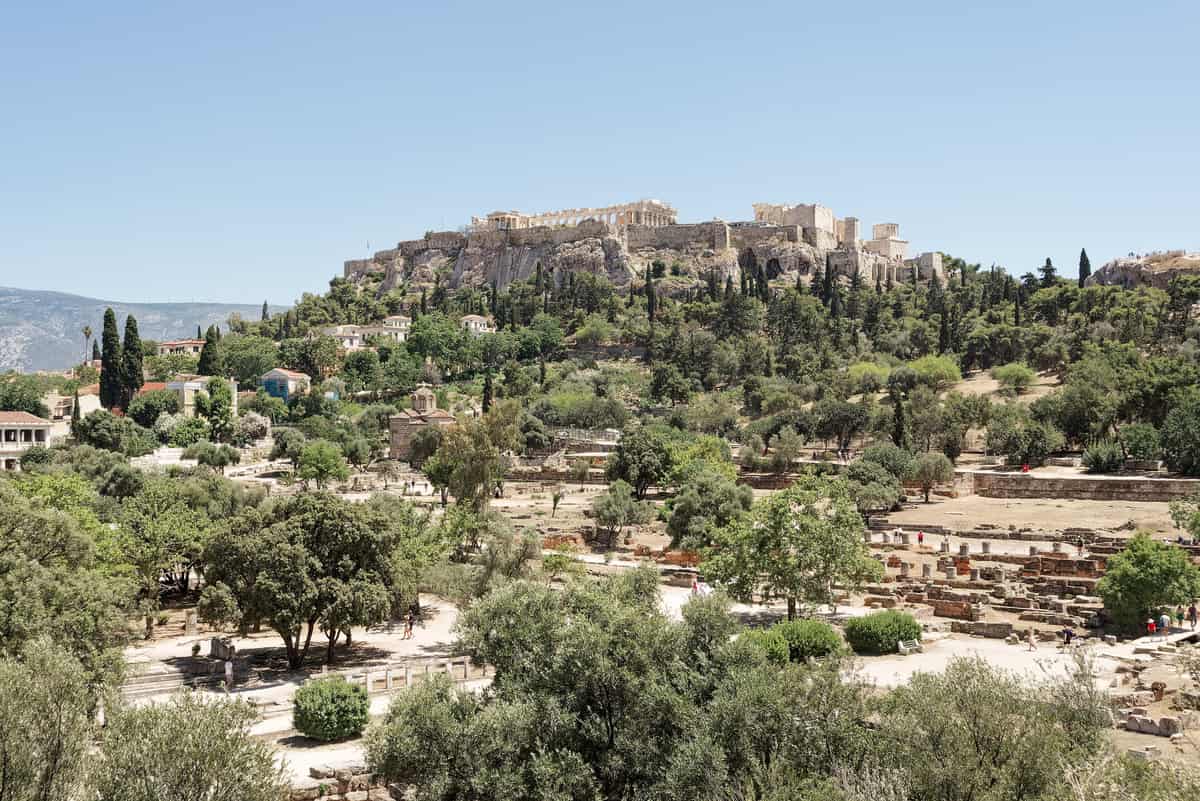
An Acropolis tour crosses the rock above Athens, from the Propylaea to the Parthenon, the Erechtheion and the Temple of Athena Nike, and goes down to the theatres on the slopes. This page covers what an Acropolis tour shows, the story of each monument, the Acropolis Museum, the tour formats and the sites that combine with an Acropolis tour. More Greece tours are listed on the Greece VIP homepage.
Each section ends with an Acropolis tour that can be booked online.
What does an Acropolis tour show?
An Acropolis tour shows the flat-topped rock above central Athens and the buildings raised there under Pericles in the 5th century BC: the Parthenon, the Propylaea, the Erechtheion and the Temple of Athena Nike. UNESCO listed the site as World Heritage in 1987.
The rock rises 150 metres above sea level in the city of Athens, and its flat top covers about 3 hectares. In geological terms it is a klippe: a block of Acropolis limestone resting on the soft, reddish Athens schist. Springs and karst caves appear where the two rock types meet. The marble for the buildings came from the quarries of Mount Pentelicus, northeast of the city. Each Acropolis tour climbs to this walled plateau from its western end.
People lived on the hill as early as the 4th millennium BC. A Mycenaean palace stood on the summit in the late Bronze Age, and a Cyclopean wall 760 metres long ringed the top. Between 570 and 550 BC, a limestone temple to Athena Polias, the patron of the city, rose on the rock. The Persians sacked the Acropolis in 480 BC. Parts of the unfinished Older Parthenon then went into the new north wall, where an Acropolis tour can still point them out.
In the mid-5th century BC, the Acropolis became the seat of the Delian League, and Pericles began a building programme that lasted the entire second half of the century. Athenians and foreigners worked on it for one drachma a day. Behind the Propylaea stood a 9-metre bronze statue of Athena Promachos by Phidias; crews rounding Cape Sounion saw the reflection of her gilt lance tip. The programme’s four main buildings form the core of an Acropolis tour.
- Propylaea: The monumental gateway at the western end forms the entrance.
- Temple of Athena Nike: The small Ionic temple stands south of the entrance.
- Parthenon: The temple of Athena Parthenos at the centre is the main stop on an Acropolis tour.
- Erechtheion: The temple stands east of the entrance and north of the Parthenon.
Athens has two World Heritage Sites recognised by UNESCO: the Acropolis and the medieval Daphni Monastery. An Acropolis tour reads the rock in layers, from the Mycenaean wall and the temple pieces in the north wall to the buildings of Pericles, which later served as Christian churches and as the fortress of the medieval city.
What is the story of the Parthenon on an Acropolis tour?
An Acropolis tour tells the Parthenon story from its start in 447 BC as a temple of Athena, through its years as a church and a mosque, to the explosion of 1687 and the removal of about half of its surviving sculptures to London.

On an Acropolis tour, the Parthenon story begins with Athena, the goddess to whom the temple was dedicated. Athens built it to give thanks for the Greek victory over the Persian invaders, and it also served as the city treasury. Construction started in 447 BC, the building was complete in 438 BC, and work on its decoration went on until 432 BC. Phidias supervised the project and its sculpture, while the architects Ictinus and Callicrates directed the building work.
An Acropolis tour reaches the temple along the Panathenaic Way, after passing through the Propylaea, and a low fence now protects the building from damage. The Parthenon is a Doric temple with eight columns at each end and seventeen along each side. Its sculpture filled the metopes above the outer columns, an Ionic frieze around the walls of the inner chamber and the pediments at both ends. The decorative stonework was originally coloured. Inside stood a giant statue of Athena Parthenos by Phidias, now lost.
The Parthenon remained a temple of Athena for nearly 1,000 years. In the 6th century AD it became a church of the Virgin Mary, and in the 11th century it served as the cathedral of Athens. During the Latin occupation it was a Catholic church for about 250 years, and a tower rose at the southwest corner of the cella. After the Ottoman conquest in the mid-15th century, the building became a mosque, and that tower grew into a minaret.
During the Morean War, a Venetian force under Francesco Morosini attacked the Acropolis, where the Ottomans kept gunpowder inside the Parthenon. On 26 September 1687, a Venetian mortar round fired from the Hill of Philopappos blew up the magazine. The blast tore out the centre of the building, three of the four cella walls nearly collapsed, and three-fifths of the frieze sculptures fell. About 300 people died. The roofless shell seen on an Acropolis tour dates from that explosion.
- Jacques Carrey: The French artist sketched the sculptures in 1674, before the explosion of 1687.
- Minaret: Only the base and spiral staircase of the Ottoman minaret survive inside the ruin.
- Returns: Four pieces of the sculptures have gone back to Greece, 3 from the Vatican and 1 from a museum in Sicily.
From 1801 to 1812, agents of Thomas Bruce, 7th Earl of Elgin, removed about half of the surviving Parthenon sculptures and shipped them to Britain. Parliament bought the collection in 1816, and it passed to the British Museum in London. Greece formally asked for their return in 1983, and talks between the two governments continue. On an Acropolis tour, this dispute closes the story of the Parthenon.
Which other monuments does an Acropolis tour visit?
An Acropolis tour also visits three other buildings from the 5th century BC: the Propylaea, the monumental gateway designed by Mnesicles; the small Temple of Athena Nike beside it; and the Erechtheion, with its porch of six sculpted maidens, the Caryatids.
The Propylaea is the ceremonial gateway at the western end of the rock. Mnesicles began it in 437 BC as part of the building programme of Pericles, using Doric columns of Pentelic marble. The plan called for five halls, but only the central hall, the north-east hall and a shortened south-east hall were finished. Work stopped in 432 BC with the building incomplete. Every Acropolis tour passes through its central hall, under a double row of Ionic columns.
The Temple of Athena Nike stands on a steep bastion at the southwest corner, to the right of the Propylaea, so an Acropolis tour passes it at the entrance. It is the smallest temple on the Acropolis, dedicated to Athena and Nike, the goddess of victory. Callicrates designed it as an Ionic temple with four columns on each porch, finished around 420 BC. Its friezes show an assembly of Athena, Zeus and Poseidon and the Greek victory over the Persians at Plataea.
The Erechtheion is an Ionic temple on the north side of the rock, dedicated mainly to Athena. It was built in Pentelic marble with a frieze of blue Eleusinian limestone, and its construction is traditionally dated to 421–406 BC. Its plan is asymmetrical and works around uneven ground and older shrines. The eastern part served Athena Polias, and the western part the cult of Poseidon-Erechtheus. On an Acropolis tour, the north porch covers indentations once taken for the marks of Poseidon’s trident.
On an Acropolis tour, the Porch of the Maidens stands on the south side of the Erechtheion. Six sculpted female figures, the Caryatids, support it from a low wall, and all face south. The building accounts call the figures korai, or maidens, and each differs in small details. All six have lost their lower arms. Elgin’s agents removed one Caryatid, now in the British Museum, and cannon fire felled the porch during the siege of 1826–1827.
- Pinakotheke: Pausanias called a room in the north-east wing of the Propylaea a chamber with paintings.
- Nike Parapet: Around 410 BC, a parapet with reliefs of Nike went up around the bastion to stop people from falling.
- Restoration: The Ottomans took the Temple of Athena Nike apart in the 17th century, and its latest restoration ended in 2010.
Together with the Parthenon, these three buildings are the main works of the Periclean programme. Elgin’s agents also took four slabs of the Nike parapet frieze, and copies of the Nike frieze now sit in place on the temple. An Acropolis tour links the four buildings in one walk, from the Propylaea up the Panathenaic Way to the Parthenon and the Erechtheion.
What does an Acropolis tour see on the slopes?
An Acropolis tour on the south slope passes the Theatre of Dionysus, the Asclepieion, the Stoa of Eumenes and the Odeon of Herodes Atticus. These ruins show where Athenians watched plays, sought healing and sheltered from bad weather, with the Hill of Ares to the northwest.
The Theatre of Dionysus began as part of the sanctuary of Dionysus Eleuthereus. Its first orchestra terrace dates from the mid- to late-sixth century BC and hosted the City Dionysia. Plays by Aeschylus, Sophocles, Euripides and Aristophanes were staged here. Under Lycurgus, in the fourth century BC, it took its stone form, with room estimated at up to 25,000. An Acropolis tour stops at the front rows, where stone thrones bear the names of priests and officials.
West of the theatre, an Acropolis tour reaches the Asclepieion, a sanctuary of Asclepius and Hygieia founded in 419–18 BCE by Telemachos Acharneas. Its two-storey Doric stoa, with 17 columns on the front, housed visitors seeking a cure, who slept there hoping to see the god in their dreams. A rock-cut cave behind the stoa holds the sacred spring. In the early sixth century AD, the shrine gave way to a Christian basilica.
Between the theatre and the Odeon runs the Stoa of Eumenes, a gift from Eumenes II, king of Pergamon, around 160 BC. The two-storey colonnade was 163 m long, with 64 Doric columns on its lower front. Vitruvius wrote that stoas beside theatres sheltered spectators in bad weather and stored stage props. Its arched retaining wall still dominates the site, and its island marble matches Pergamon’s buildings, not those of Athens.
On the southwest slope, an Acropolis tour reaches the Odeon of Herodes Atticus. The orator Herodes Atticus built it in AD 161 in memory of his Roman wife, Aspasia Annia Regilla. It had 33 rows of marble seats, a cedar roof and room for 5,000 people. The Heruli left it in ruins in AD 267. Restored in Pentelic marble in the 1950s, it has since served as the main venue of the Athens Festival.
- Areopagus: The Hill of Ares is a rocky outcrop northwest of the Acropolis.
- Myth: Legend says the other gods tried Ares there for killing Halirrhothius, a son of Poseidon.
- Court: The council that met on the hill later judged cases of homicide, wounding and certain religious offences.
- Sermon: Acts 17 names the Areopagus as the setting of the Apostle Paul’s sermon in Athens.
Together, the slope ruins show city life below the temples: drama, healing, shelter and music. An Acropolis tour that walks from the Theatre of Dionysus past the Asclepieion and the Stoa of Eumenes to the Odeon covers all four on one path. Near the west end of the rock, the same Acropolis tour looks across to the Areopagus.
How does an Acropolis Museum visit add to an Acropolis tour?
An Acropolis tour gains context in the Acropolis Museum, which opened on 20 June 2009, 280 metres from the Parthenon. The museum was built to hold every artifact found on the rock and its slopes, from the Bronze Age to Roman and Byzantine times.
The museum stands by the southeastern slope, on the classical road up to the sacred rock, so an Acropolis tour reaches it after a 400-metre walk from the Parthenon. In its first two months, 523,540 people visited, 60 percent of them from abroad. The artifacts were moved from the rock with three tower cranes, starting in October 2007. More than 4,250 objects are on show across 14,000 square metres.
The New York–based architect Bernard Tschumi won the final design competition with the Greek architect Michael Photiadis. The building stands on pillars above an excavated site, and the pillars rest on roller bearings built to withstand a magnitude 10 earthquake. Tschumi’s design turns on three ideas: light, movement, and a tectonic and programmatic element. Three levels hold the collections, and a middle level holds the shop, the café and the offices.
The top level holds the Parthenon gallery, turned on the floors below to match the temple’s orientation. Its 48 columns trace the outline of the Parthenon, and glass walls let daylight fall on the marbles. The pediments, metopes and frieze face outwards, as on the temple, with two metopes per column and the frieze in a band behind them. From its north side, an Acropolis tour group sees the temple on the rock above.
A long hall with a sloping floor shows finds from the slopes and echoes the climb to the rock. Beyond it, a large trapezoidal hall holds the archaic finds. Photos and video are not allowed in the Archaic Acropolis Gallery, to protect sculptures that keep traces of their ancient colours. In 2012 the museum won the Keck Award for conserving and restoring the Caryatids, the female figures that held up the Erechtheion’s southwest porch.
- Glass floors: Glass panels in the ground floor show the excavation below, where digging continues.
- Two layers: The dig has revealed roadside houses and workshops from the classical and early Byzantine eras.
- Walk-through: Since 21 June 2019, visitors can walk through this ancient neighbourhood from the entrance courtyard.
- Reading Lounge: The second-floor Reading Lounge looks out on the Caryatids and the Hekatompedon pediment.
The museum turns the walk on the rock into a close look. An Acropolis tour sees the temples in place, while the galleries set their sculpture lower and closer for ease of viewing. Together, the site and the museum match each building with its carved marble, so an Acropolis tour that continues into the galleries completes the story.
Which formats suit an Acropolis tour?
An Acropolis tour comes in four common formats: private, small-group, family and self-led audio. Each format follows the same monuments but changes the pace, the group size and the depth of the stories, so the choice depends on age, interest and comfort with crowds.
A private Acropolis tour serves one party alone. The tour leader matches the pace to that group, lingers where interest runs high and answers every question in full. The format also suits travellers with mobility needs. At the museum, ramps serve all entrances, lifts reach every floor and wheelchairs can be borrowed at the Visitor Services Desk, so a private tour leader can plan each stop around them.
A small-group Acropolis tour shares one tour leader among a small number of travellers. A smaller group hears the stories clearly on a busy path and moves through narrow spots with less delay. The museum draws a firm line on size: it treats 16 to 40 people as a group visit, and such groups must reserve ahead. Even booked groups can face a wait at busy times.
A family Acropolis tour keeps stories short and stops frequent. The museum lends family backpacks at the Visitor Services Desk and offers family trails and a family audio tour, all free of charge. A Kids Corner with digital games sits on the second floor, next to the restaurant. Strollers can be borrowed at the ground-floor cloakroom, and a parents’ room for babies is on the first floor.
A self-led audio Acropolis tour plays on a phone or headset, so each visitor picks the start, the order and the pace. The museum adds its own digital tour, touch screens at the Multimedia Center on the second-floor balcony, and gallery talks led by its Department of Educational Programs. The trade-off is plain: no tour leader is on hand for questions, so the format suits visitors who already know the main stories.
- First visit: A private or small-group format gives live context at every monument.
- Young children: A family format sets a slower rhythm with more breaks.
- Mixed interests: A private format lets one party split its time between the rock and the museum.
- Repeat visit: A self-led audio format leaves each visitor free to linger.
All four formats reach the same monuments; the difference lies in pace, company and depth. Formats also combine. An Acropolis tour with a tour leader on the rock can hand over to a self-led audio visit in the museum, or a family can join a gallery talk after a private walk on the slopes.


Which Athens sites combine with an Acropolis tour?
An Acropolis tour combines with the Ancient Agora and the Temple of Hephaestus to the northwest, Plaka and Anafiotika on the northern and eastern slopes, the rocky Areopagus, and Philopappos Hill to the southwest. Each stop adds a new part of the city’s story.
The Ancient Agora lies northwest of the Acropolis. The Areopagus bounds it on the south, and the Agoraios Kolonos, also called Market Hill, bounds it on the west. Its first role was as a gathering place for trade, assembly and housing. The American School of Classical Studies at Athens began digging in 1931, and the work grew into one of the largest archaeological projects in Greece. An Acropolis tour that continues here moves from the temples on the rock to the public life of the ancient city.
The Temple of Hephaestus stands on the north-west side of the Agora, on top of the Agoraios Kolonos hill. It is a well-preserved Doric temple for the god of metal working, craftsmanship and fire. Work on it began in 449 BC, using marble from nearby Mount Penteli. In modern times it was wrongly called the Theseion, after the hero Theseus. It worked as the Greek Orthodox church of Saint George Akamates from the 7th century until 1834, and this long, varied use kept the building largely intact.
Plaka, the old quarter of Athens, wraps around the northern and eastern slopes of the Acropolis. Its nickname is the “Neighborhood of the Gods”, and people have lived there from the Neolithic to the present day. Anafiotika, a tiny quarter of Plaka, lies on the northeast side of the hill. Settlers from the Aegean island of Anafi built it in the era of King Otto, in the Cycladic style with white walls. Only 45 houses remain today.
The Areopagus, the “Hill of Ares”, is a rocky outcrop northwest of the Acropolis. A leading council of ancient Athens met on it and later worked mainly as a court for homicide cases. In myth, the other gods tried the war god Ares on this hill, and Acts 17 names it as the setting of the Apostle Paul’s sermon in Athens. To the southwest, Philopappos Hill holds the marble tomb of Philopappos, a prince from the Kingdom of Commagene who died in 116 AD.
- Dionysiou Areopagitou Street: This pedestrian route links the stops of an Acropolis tour, running from the Temple of Olympian Zeus, under the southern slopes of the Acropolis, to just past the Temple of Hephaestus in Thiseio.
- Stoa of Attalos: Rebuilt on the east side of the Agora in the 1950s, it now houses a museum whose exhibits connect to Athenian democracy.
- Temple metopes: Only 18 of the 68 metopes on the Temple of Hephaestus were carved, and the ten on the east side show the Labours of Heracles.
- Philopappos Hill: Pines and other trees cover the hill and its surroundings, which have the character of a small forest.
An Acropolis tour that adds these stops follows one connected story: worship on the rock, trade and politics in the Agora, trials on the Areopagus and Roman-era memory on Philopappos Hill. Plaka and Anafiotika then show the homes and lanes that grew around the ancient core. A licensed tour leader sets the order of stops to match the group’s pace and the season.
How do travelers prepare for an Acropolis tour?
An Acropolis tour calls for planning around heat, sun and stone. Athens sits in a hot-summer Mediterranean climate, the monuments stand on a rocky outcrop above the city, and decades of restoration work shape what visitors see on the summit.
The city falls in the hot-summer Mediterranean climate group, coded Csa in the Köppen system. The weather station near the city centre, run by the National Observatory of Athens, gives a mean annual temperature of 19.2 °C. A strong urban heat island effect adds to the summer heat. Athens has been called the hottest city in mainland Europe, and it became the first European city to name a chief heat officer for severe heat waves.
The Athens basin is drier than a typical Mediterranean area, because the Pindus range and the Dirfys and Parnitha mountains cast a rain shadow over it. On the hottest summer days, air pollution is still a problem in the city. For a summer Acropolis tour, this means strong sun, dry air and heat that builds through the day. Travelers with heat or breathing concerns check the forecast first and plan regular breaks in the shade.
Work under the Acropolis Restoration Project started in 1975, aimed at undoing centuries of damage from attrition, pollution and war. The project collected and identified every stone fragment, even small ones, from the rock and its slopes. It then rebuilt with original pieces wherever possible, a method called anastylosis, and used new marble from Mount Pentelicus sparingly. Every repair uses titanium dowels and can be fully reversed if future experts decide to change it.
Visitors on an Acropolis tour see the results across the summit. Venetian bombardment in the 17th century wrecked large parts of the Parthenon colonnades; restorers rebuilt them and moved wrongly assembled columns to their proper places. Parts of the Propylaea roof were remade in new marble with blue and gold inserts, as in the original. Work on the Temple of Athena Nike was completed in 2010. In total, the work restored 2,675 tons of architectural members and used 530 cubic meters of new Pentelic marble.
- Footwear: Closed, flat shoes with a firm grip suit a walk over ancient stone and up the slopes.
- Sun cover: A wide hat, sunglasses and sunscreen protect skin and eyes during a summer visit.
- Water: A full bottle for each traveler matters in a city known for severe summer heat.
- Clothing: Light, loose clothes in breathable fabric suit the hot months.
- Timing: In July and August, an early start keeps the climb ahead of the hottest part of the day.
An Acropolis tour that starts with the right shoes, water and sun cover leaves more attention for the monuments. Knowing the restoration story also helps on the summit: new Pentelic marble beside original stone shows where decades of work have filled gaps left by war and pollution. A licensed tour leader points out these repairs and explains how each piece found its place.
What do travelers ask about an Acropolis tour?
An Acropolis tour raises practical questions before the day: whether it suits children, which format fits a first visit to Athens, what it adds to an entry ticket, and how the site serves travelers with limited mobility. The answers below cover each one.
Does an Acropolis tour suit children?
An Acropolis tour suits children when the pace and the stories match their age. A private or small-group format lets the tour leader shorten stops and tell the myths of the gods in simple words. Summer visits with children work best with an early start, water, hats and breaks in the shade between the summit and the slopes.
Which Acropolis tour suits a first visit to Athens?
Athens holds two UNESCO World Heritage Sites, the Acropolis and the medieval Daphni Monastery, and a first visit starts on the Acropolis. An expert-led small-group Acropolis tour of the summit and its slopes gives a clear picture of the ancient city, and a stop in the Ancient Agora or Plaka carries the story into daily life.
What does an Acropolis tour cover that a ticket alone does not?
A ticket alone gives entry to the site. An Acropolis tour adds a licensed tour leader who explains the myths, the building phases and the restoration work at each stop, answers questions and keeps a clear route between the monuments. Ticket types and entry details sit on a separate page about tickets for the Acropolis.
Does an Acropolis tour suit travelers with limited mobility?
An Acropolis tour for travelers with limited mobility needs planning. Reinforced concrete paths were laid on the site in 2021 to improve access, a step that drew controversy among archaeologists. The monuments still stand on a rock that rises 150 m above sea level, so travelers agree the route, pace and rest stops with the tour leader beforehand.
Featured photo: Jakub Hałun, CC BY 4.0, via Wikimedia Commons.