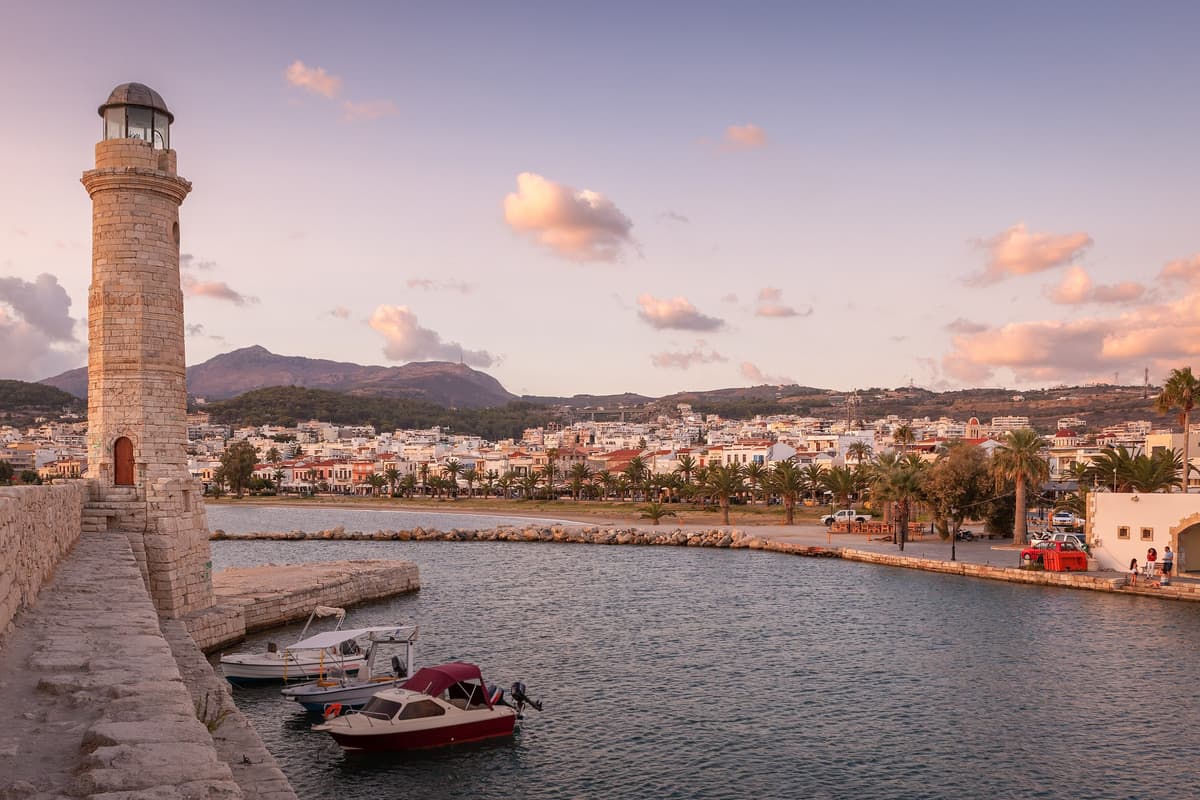
A Rethymno food tour walks the Venetian and Ottoman lanes of the old town on the north coast of Crete, tasting Cretan cheeses, pies baked with handmade filo, olive oil, meze, honey sweets and a glass of raki or local wine. This post covers what a Rethymno food tour includes, the old town walk, the cheeses, pies, olive oil, meze, sweets and drinks, the Cretan diet, the markets, the history behind the food, the herbs, the villages, how Rethymno compares with Chania and Heraklion and the best season. It is one of the food tours in Crete and Greece on Greece VIP.
Each section ends with a Rethymno food tour or Crete experience that can be booked online.
What does a Rethymno food tour include?
A Rethymno food tour includes a walk through the old town with tastings of cheese, pies, olive oil, meze, sweets and raki. A Rethymno food tour follows the small Venetian harbour and the narrow streets of a city on the north coast of Crete.
Rethymno is a city on the island of Crete and the capital of the Rethymno regional unit, with more than 35,000 inhabitants. The regional unit covers 1,496 square kilometres. Tourism is the main source of income in the town, and agriculture brings in olive oil and Mediterranean products. A Rethymno food tour walks a compact old town that grew as a Venetian commercial station between Heraklion and Chania.
A Rethymno food tour moves through dairy, bakery, olive press and still. Cheeses come from the flocks of sheep and goats. Pies use thin dough or filo. Olive oil is poured over bread, salads and cooked dishes. Plates are shared, and the order runs from the mild to the sharp. A Rethymno food tour closes the meal with sweets and a glass of raki, and each portion stays small.
Rethymno sits on the north coast of Crete, beside the Sea of Crete, and its old town, called palia poli, was almost entirely built by the Republic of Venice. Arched doorways, stone staircases, Byzantine remains and narrow streets give the quarter its shape. Tasting stops sit close to one another, so the walking between them stays short. A Rethymno food tour stays inside the old town beside the Venetian harbour.
- Old town: The old town of Rethymno is one of the best-preserved old towns in Crete.
- Harbour: Under Venetian rule a small harbour was built at Rethymno, and the town became the third city of Crete in importance, after Heraklion and Chania.
- Dairy: Dairy products are important to the Cretan economy, and Crete has specialty cheeses such as mizithra, anthotyros and kefalotyri.
- Meze: In Greece meze means small dishes, hot or cold, spicy or savoury.
The idea is simple. Cheese, pies, olive oil, meze, sweets and raki are tasted in the places where people in Rethymno eat them, and each stop adds one piece of the town’s food story. A Rethymno food tour can be booked as a small-group walk with an expert-led route, and the Rethymno tour page sets out the options.


Where does a Rethymno food tour walk in the old town?
A Rethymno food tour walks through the Venetian and Ottoman old town, past the Rimondi fountain, the Neradje Mosque, the Great Gate and the Loggia. A Rethymno food tour keeps to the main streets of the old town and the lanes that join them.
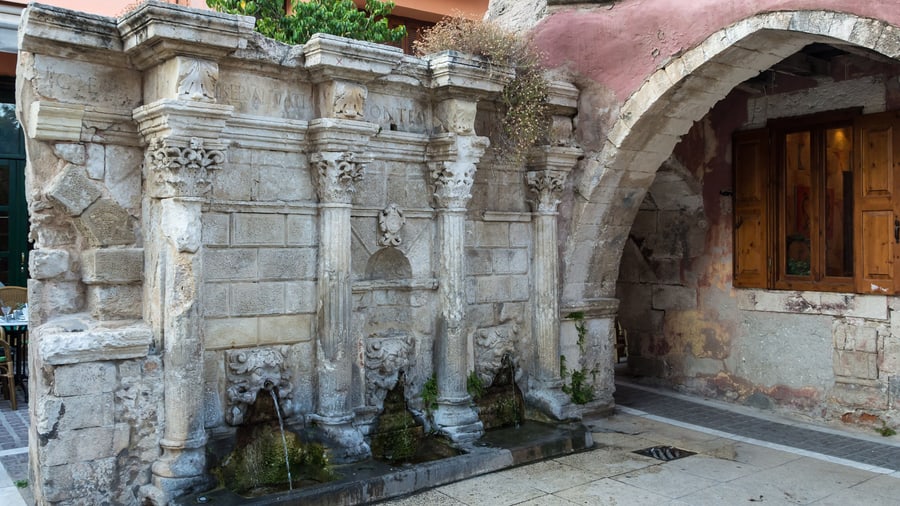
The quarter keeps its aristocratic appearance. Buildings date from the 16th century and stand beside arched doorways, stone staircases and Byzantine remains. The streets are narrow, and the sea closes the side of the town. Rethymno was conquered by the Ottoman Empire in 1646 and became the centre of a sanjak. A Rethymno food tour moves between the squares and the side lanes of this old town.
The Venetian citadel, the Fortezza, stands on the hill called Paleokastro, the site of the acropolis of ancient Rhithymna, and it counts among the best-preserved castles in Crete. Ottoman troops captured it in the same campaign that took the town. Houses once filled the ground inside its walls. They were demolished after World War II, and the citadel is open to the public today. A Rethymno food tour passes below those walls on the way to the centre.
The Neradje Mosque began as a Catholic monastery of the Augustinian Order named Santa Maria. After the Ottoman conquest it became a mosque named for Gazi Hüseyin Pasha. Its minaret was added in 1890 by the engineer Georgios Daskalakis, and that minaret with two balconies is the tallest structure in the town. The building, topped by three semicircular domes, was abandoned as a mosque in 1924 and turned into a music school.
- Rimondi fountain: The Rimondi fountain in Rethymno belongs to the Venetian period.
- Loggia:
- Great Gate: The Great Gate carries the name Porta Guora and is one of the monuments of the old town.
- Festival: A wine festival is held in Rethymno every year at the beginning of July.
The old town is compact, so a route works street by street. A Rethymno food tour passes monuments that date from Venetian and Ottoman times, and the tasting stops follow the same line. Shops and kitchens sit in the ground floors of old houses, which puts food and architecture on one walk.
Which Cretan cheeses does a Rethymno food tour taste?
A Rethymno food tour tastes graviera of Crete, mizithra, anthotyros, staka and xynomizithra, with the PDO cheeses of the island marked on the table. A Rethymno food tour sets hard, ripened cheeses beside fresh whey cheeses so that the difference in texture is clear.
Graviera is the hard cheese of the Cretan table. Graviera of Crete is made from sheep’s milk and ripened for at least five months, and it finishes with a slightly sweet, burnt caramel flavour. The cheese is registered in the European Union as Graviera Kritis. It can be sliced, fried as saganaki or grated over pasta. A Rethymno food tour serves it as the first stop of the cheese board.
Mizithra is a whey cheese made from sheep or goat milk, and it is produced mainly on Crete. Fresh mizithra is soft, snow-white and mild. Salted and aged mizithra turns drier, denser and more sour, and it is grated over hot pasta. The ratio of milk to whey in the pot is seven to three. A Rethymno food tour sets the fresh cheese and the aged cheese side by side.
Xynomyzithra Kritis carries protected designation of origin status. It is made from strained ewe or goat whey, with up to 15 per cent full-cream milk added, and it ripens for at least two months, which leaves it dry and sour. Anthotyros is the fresh relative, made from sheep or goat milk and whey in a ratio of nine to one, and it is eaten with honey, or with oil, tomato and wild herbs.
- Staka: Staka is a Cretan preparation in which sheep’s milk cream is cooked with wheat flour or starch and served hot.
- Staka butter: The fatty part separates as stakovoutyro, or staka butter, which is kept for later use in Cretan pilaf.
- Graviera Kritis: Three Greek graviera cheeses hold protected designation of origin status, and Graviera Kritis is the Cretan one.
- Fresh mizithra: Fresh mizithra keeps the shape of the cloth bag in which it drains, with a rounded bottom and a wrinkly top.
Cheese in Crete comes from flocks of sheep and goats, so the table leans on whey cheeses, hard cheeses and cream. A Rethymno food tour compares them in one sitting, and the order runs from the mildest cheese to the sharpest, with a slice of graviera between the two and a spoon of fresh mizithra at the close.
Which Cretan pies and breads does a Rethymno food tour serve?
A Rethymno food tour serves kalitsounia, Sfakian pies, dakos on barley rusk and paximadi. A Rethymno food tour sets the warm small pies of Crete beside the hard dried breads that once kept farmers fed in the fields.
Paximadi, also written paximathia, is a hard bread close to rusk, prepared with whole wheat, chickpea or barley flour. Bakers slice the loaves thickly into wedges and dry them again in the oven, which preserves the bread for storage. Paximadi was a staple food in Crete. Farmers softened it with water and olive oil before eating it in the fields, and homemade cheese and olives went with it.
Dakos is the plate built on that bread. A slice of soaked paximadi carries chopped tomatoes, crumbled feta or mizithra cheese, dried oregano and olive oil. Garlic rubbed on the rusk and sea salt belong to the older method. The same dish travels under the name koukouvagia, which means owl, and under the name kouloukopsomo. A Rethymno food tour puts dakos on the table before the pies arrive.
Kalitsounia are small cheese or herb snacks that a Rethymno food tour finds across Crete. In the Chania region the savoury version is filled with mizithra or wild herbs, and the sweet version takes mizithra with honey poured on top. In Lasithi the pies are sweet, made with dough and filled with mizithra, cinnamon and lemon zest. Sfakian pies come from Sfakia and take a thin, pan-fried crust with mizithra and honey.
- Kalitsounia dough: Kalitsounia are baked when they are made with dough and fried when they are made with filo.
- Sfakian pie: A Rethymno food tour meets Sfakian pie as a savoury pie that doubles as a dessert.
- Dakos toppings: Olives, capers and caper berries join the tomato on a plate of dakos.
- Rusk for soldiers: Paximadia fed the Byzantine military and thrifty priests as well as farmers.
Bread and pies carry the older half of Cretan eating. Paximadi is dried so that it stores, and the pies are made fresh and eaten warm. A Rethymno food tour puts the two together, with a barley rusk on one plate and a folded cheese pie on the next, still warm from the pan.
What olive oil does a Rethymno food tour taste?
A Rethymno food tour tastes Cretan olive oil pressed from Koroneiki olives, the olive variety behind much of the Greek oil industry and the base of the local kitchen. A Rethymno food tour explains how PGI zones mark the best oil of the island.
Koroneiki is an olive cultivar from Greece, used mainly for olive oil. Its fruits are small, and the oil that comes from them is high in quality. The variety holds 50 to 60 per cent of the olive acreage in Greece. In parts of Crete the same tree is also called Kritikia, and in other districts it answers to Ladolia. A Rethymno food tour opens the oil tasting with it.
A Rethymno food tour can taste oil from a named zone. Chania Kritis PGI is an extra virgin olive oil from western Crete with a protected geographical indication. It is produced from Koroneiki and Tsounati olives. The indication covers the Chania prefecture, with the areas of Kydonia, Kissamos, Selino, Sfakia and Apokoronas. The oil shows a bright green-yellow colour, a fruity aroma, and a balanced, bittersweet taste.
Olive trees were cultivated in Crete by the Late Minoan period, and olives were already grown on the island as long ago as 2500 BC. Cultivation became intense in the post-palatial period. The Minoans used olive oil in religious ceremonies, and the oil became a principal product of their civilisation. The oldest surviving olive oil amphorae date to 3500 BC, and a Rethymno food tour traces that line to the bottle on the table.
- Rethymno: Agriculture in the town of Rethymno is notable, especially olive oil and other Mediterranean products.
- Groves: Olive groves and vineyards cover a significant part of the Cretan landscape.
- Egyptian trade: Dynastic Egyptians imported olive oil from Crete before 2000 BC.
- Synonym: Koroneiki olives are known as Koroni in Kefallinia and as Psilolia in parts of the Peloponnese.
Oil in Crete is a farm product, not a dressing alone. It carries the flavour of the tomatoes, the rusk and the cheese that stand beside it on the table. A Rethymno food tour tastes the oil on its own, then on bread, and then inside the cooked dishes of the old town.
Which meze does a Rethymno food tour order?
A Rethymno food tour orders dakos, staka with eggs, snails, apaki and gamopilafo, the small plates that open a Cretan meal. A Rethymno food tour keeps the plates small and shared, and the spirits stay on the table beside them.
Meze in Greece means small dishes, hot or cold, spicy or savoury, served as appetisers, and the custom began in the Byzantine Empire before it developed in Ottoman Greek houses and tavernas. Meze comes with spirits such as ouzo or raki at the meyhane and the ouzeri. The Cretan list of appetisers runs long, from salads and charcuterie to pickled bulbs and stuffed flowers.
Staka with eggs is a Cretan dish of poached or fried eggs and local staka, a buttery cream mixed with flour. Snails reach the table in two ways. Hohlioi boubouristoi are fried with rosemary and vinegar, and snails also come cooked with tomato. Pikti, also called tsiladia, is a pork charcuterie that belongs to the same opening round. A Rethymno food tour works through these plates in order.
Apaki is smoked pork meat, which a Rethymno food tour finds sliced and cold. Gamopilafo is rice cooked in goat and rooster broth, and it stands among the specialities of the island. The meat dishes come after the vegetable and cheese plates, and the broth rice closes the round before the sweets arrive.
- Askordoulakoi: Askordoulakoi, also called volvoi, are pickled bulbs of the tassel hyacinth that a Rethymno food tour meets among the appetisers.
- Stafidota: Stafidota are Cretan cookies with a stuffing based on raisins.
- Sykoti savore: Sykoti savore is liver cooked in vinegar, listed among the appetisers of the island.
- Mizithropita: Mizithropita is a flatbread stuffed with mizithra cheese.
Meze eating runs on rhythm: a plate arrives, a glass is filled, and the plate is finished before the next one lands. A Rethymno food tour follows that rhythm and holds the main courses back until the small plates have had their turn, with the wine and the spirit poured between the plates.
Which sweets does a Rethymno food tour taste?
A Rethymno food tour tastes sweets built on filo pastry, kataifi, xerotigana and loukoumades, and honey runs through them all. A Rethymno food tour ends the walk with fried pastry that has been dipped in syrup or in honey.
Greek cooks wrap food in filo pastry, either in bite-size triangles or in large sheets, and the pastry takes cheese, greens, meat or pumpkin as a filling. In the sweet kitchen the thin dough comes as fine shredded strands. A Rethymno food tour watches the kitchen work before the tasting begins, because the handling of the dough decides the texture of the finished sweet.
Kadaifi, also written kataifi, is a family of pastry products made from very fine shredded dough. The strands cook on a heated, rotating griddle into hair-like threads. A finished dessert from those strands is baked or fried and then soaked in sugar syrup. The shredded dough goes into desserts such as knafeh and tel kadayif, and Greek cooking counts kadaifi among the dishes it received from Ottoman cuisine.
Xerotigana is listed among the sweet specialities of the Cretan table, and a Rethymno food tour finds it in the long list of island dishes that closes a meal. Loukoumades are a mainstay of Greek cooking and a street food served with honey, cinnamon, walnuts and chocolate sauce. The dish goes back to enkrides, a dough fried in oil and eaten with honey in Ancient Greece.
- Honey pastry: In the older Cretan cuisine, pastry based on honey formed a regular part of the sweet table.
- Lent food: Loukoumades were eaten during Lent, because flour, yeast and water met the rules of Orthodox fasting.
- Walnuts: Crushed walnuts and cinnamon top the loukoumades that come out of the pan.
- Sweet pies: Sweet kalitsounia take mizithra and a pour of honey, a pairing that a Rethymno food tour meets across the island.
Sugar, honey and nuts close a Cretan meal, and the sweets arrive in small pieces after the meat and the cheese. A Rethymno food tour keeps the last course light, with one or two fried pastries on a small plate, a spoon of honey, crushed walnuts and a glass of cold water.
What does a Rethymno food tour drink?
A Rethymno food tour drinks tsikoudia, called raki in eastern Crete, and Cretan wines from grapes such as Vidiano, Liatiko and Kotsifali. A Rethymno food tour pairs the spirit of the island with the wines of its wine zones.
A Rethymno food tour starts with the spirit of the island. Tsikoudia is a grape-based pomace brandy of Cretan origin that holds 40 to 65 per cent alcohol by volume. The pomace left after grapes are pressed ferments for about six weeks in a tightly sealed barrel, and the spirit takes a single distillation. Villages distil it on licence in late October and early November, and it is served chilled from a freezer.
Wine has been made in Crete since the Bronze Age, when the Minoans produced it, and Cretan exports fetched high prices in northern Europe in the medieval period. Today 20 per cent of Greek wine is produced in Crete, chiefly in the region of Peza. A Rethymno food tour tastes the dry wines first and the sweet ones after the cheese.
Vidiano is a white grape indigenous to Crete, grown chiefly around Rethymno and Heraklion, with moderate acidity and aromas of peach, apricot, melon, honey and herbs. Liatiko is an old red variety from the island, and it is deemed at its best as a sweet wine. Kotsifali is a red grape indigenous to Crete, grown mainly in the Heraklion regional unit, where growers blend it with Mandilaria.
- Tsikoudia: A Rethymno food tour meets tsikoudia at the end of the meal, when Cretan restaurants bring it as a complimentary digestif.
- Rakomelo: Rakomelo combines raki or tsipouro with honey and spices, and it is produced in Crete.
- Wine zones: Cretan wine appellations include Peza, Archanes, Dafnes and Sitia.
- Malvasia: Liatiko was blended with Mandilaria and Kotsifali to make Malvasia, a sweet red wine that Venetian traders exported in the Middle Ages.
The drink list of the island is short and strong: one grape spirit, a handful of native grapes, and the wines that come from them. A dry white, a dry red and a sweet red each take a place at the table. A Rethymno food tour finishes with a chilled tsikoudia, and the Crete wine tour page continues with the cellars of the island.
How does the Cretan diet shape a Rethymno food tour?
A Rethymno food tour follows the plant-based pattern that Cretan households have kept for generations. The Seven Countries Study, begun in 1958, enrolled 12,763 men aged 40 to 59 in 16 cohorts across seven countries, and two of those cohorts were Greek.
The Mediterranean diet was proposed in 1975 by the biologist Ancel Keys and the chemist Margaret Keys, who worked from eating habits seen in Greece, Italy and the Mediterranean coasts of France and Spain. Data on its effects came from studies in southern Italy and Crete. A Rethymno food tour rebuilds that framework on a plate: cereals, legumes, vegetables, moderate fish and wine with meals.
UNESCO added the Mediterranean diet to the Representative List of the Intangible Cultural Heritage of Humanity in 2010, with Cyprus, Croatia, Spain, Greece, Italy, Morocco and Portugal behind the entry. The listing covers skills, knowledge and rituals around crops, harvesting, fishing, animal husbandry, conservation, processing and cooking. A Rethymno food tour therefore looks at growers and kitchens as much as at finished dishes.
On Crete the pattern was ordinary life long before researchers measured it. Plant foods held the centre of the traditional cuisine, animal foods stayed at the edge of the plate, and seasonal produce arrived with little processing. A Rethymno food tour shows how that inheritance survives in daily cooking, where vegetables, pulses and wild greens still decide the shape of a meal.
- Study design: The Seven Countries Study linked diet and lifestyle to heart disease in populations on different continents.
- Plant foods first: Cereals, legumes, vegetables and fruit carry the Mediterranean pattern, with fish and dairy in moderation.
- Shared table: UNESCO describes eating together as the foundation of cultural identity and continuity around the Mediterranean basin.
- Everyday habit: A Rethymno food tour shows a diet that was never a rulebook but a daily habit.
A Rethymno food tour treats the Cretan table as a living record. Measurements from a long population study sit behind it, and international recognition followed later. On the ground the diet shows in the way a household plates vegetables, keeps jars of pulses in the cupboard and pours wine with the meal. That background explains why the island eats as it does.
What does a Rethymno food tour see at the markets?
A Rethymno food tour visits the weekly people’s market, where farmers and beekeepers sell what they grow and produce. People’s markets were founded by Eleutherios Venizelos to cut out the middleman, and any settlement with at least 500 residents can hold one.
Greek people’s markets open once a week and keep the same weekday for a given neighbourhood. Downtown Athens alone has 44 of them, which shows how ordinary the format is. A Rethymno food tour uses that rhythm: tables appear in the morning, producers unload crates, and stallholders move between neighbouring towns to sell straight to households, and their goods come from family farms in the same region.
Two kinds of seller stand behind the tables. Producers are farmers or beekeepers from nearby towns and villages who sell their own fruit, vegetables and honey, while professionals buy stock and resell it. Every seller displays a card with a name and a category word. A Rethymno food tour reads those cards, which show whether the tomatoes and greens came from a family farm nearby.
Stock changes with the month. Oranges, apples, melons and strawberries arrive at different points of the year, while cucumbers, tomatoes, onions, potatoes, broccoli and carrots fill other weeks, and lettuce, spinach and rocket come from leaf beds. Eggs and fish landed the same day also appear. The UNESCO entry for the Mediterranean diet notes that markets work as places where eating traditions pass through daily exchange.
- Weekly rhythm: Each market opens on one weekday and returns to the same street in that week.
- Seller cards: A card near every table gives a name and states whether the seller farms the land or only trades in goods.
- Seasonal stock: Fruit, leaf vegetables, honey, eggs and fish appear according to the month.
- Direct sales: A Rethymno food tour meets growers who sell to neighbours without a wholesaler in between.
The market is the plainest introduction to Cretan cooking, because the food is still in the crate. Tables hold the ingredients that later reach a pan: fruit, greens, honey and fish. A Rethymno food tour explains the rules that keep the system honest, including permits, seller cards and fixed weekly slots, while cash in euros remains the normal way to pay.
How does Venetian and Ottoman history flavour a Rethymno food tour?
A Rethymno food tour crosses a town that the Republic of Venice shaped and the Ottoman Empire later ruled. Venetian builders raised the old town and its citadel, and Ottoman rule left mosques, public baths and new names on the map.
The old town was almost entirely built by the Republic of Venice and counts among the best-preserved old quarters on Crete. Buildings from the 16th century, arched doorways and stone staircases still frame the lanes. An estimated 10,000 Venetians moved to Crete in the first century of Venetian rule. A Rethymno food tour starts from that stonework.
The Fortezza, the Venetian citadel above the town, is one of the best-preserved castles on the island. The Ottoman army took Rethymno in 1646 during the Cretan War of 1645 to 1669, and the town, called Resmo in Turkish, became the seat of a sanjak. A Rethymno food tour passes the Neratje Mosque, now an arts centre, and the Great Gate known as Porta Guora.
Kitchens carried the same layers. Dishes borrowed from Italian cooking entered Greek homes with modified names: pastitsio from pasticcio, pastitsada from pasticciata and stifado from stufato. Ottoman cooking, itself a blend of Persian, Levantine, Arabian, Turkish and Byzantine traditions, left syrup-soaked sweets and sesame halva in the repertoire. A Rethymno food tour explains how a trading port absorbed both currents and kept a Cretan core.
- Venetian stone: The old town, its loggia, the Venetian harbour and the Fortezza citadel date from the Venetian centuries.
- Ottoman layer: Ottoman rule added mosques, public baths and the Turkish name Resmo to the town.
- Borrowed names: Pasta bakes and stews arrived with Italian names that shifted into Greek forms.
- Cretan core: A Rethymno food tour shows a kitchen that took in imports without losing its own base.
History here is not only architecture. The citadel, the harbour and the mosque on the square are settings, while the food shows the same sequence of arrivals. Venetian traders brought tastes from the Italian peninsula, and Ottoman households added their own. A Rethymno food tour puts those layers in order during one walk.
Which herbs does a Rethymno food tour taste?
A Rethymno food tour tastes dittany of Crete, malotira mountain tea, oregano and thyme honey. Dittany grows wild only on Cretan mountainsides and gorges, malotira prefers high pastures, oregano seasons salads and grilled fish, and thyme gives the island its best-known honey.
Dittany of Crete, Origanum dictamnus, is a small perennial reaching 20 to 30 centimetres in height, with leaves of 13 to 25 millimetres. It grows wild only on the mountainsides and gorges of Crete and sits on the IUCN Red List as a vulnerable species. Carvacrol makes up 68.96 per cent of its essential oil, so a Rethymno food tour treats it as a rare guest.
Hippocrates prescribed dittany for stomach aches and digestive complaints, and Aristotle and Theophrastus wrote that wild goats on Crete seek the plant after arrows wound them. Malotira, known to botanists as Sideritis syriaca, grows above 1,500 metres on high, wet pastures and is brewed as mountain tea in the Balkans. A Rethymno food tour serves that infusion after a heavy meal.
Dried oregano leaves finish the Greek salad and the lemon and olive oil sauce poured over grilled fish. Thyme works differently: every thyme species supplies nectar to bees, and wild thyme covers wide stretches of dry, rocky ground across southern Europe, where Greece and Malta are known for wild thyme honey. A Rethymno food tour closes a tasting with a spoon of that honey.
- Dittany: A protected Cretan herb with woolly grey leaves and an oil rich in carvacrol.
- Malotira: A plant of high pastures, brewed as mountain tea and served warm.
- Oregano: The dried leaf that finishes salads, grilled fish and oven dishes.
- Thyme honey: A Rethymno food tour pairs it with cheese and fruit at the end of a tasting.
Herbs tie a plate to the ground it came from. Dittany belongs to cliff faces and gorges, malotira to mountain pasture, oregano to kitchen gardens and thyme to dry hillsides where bees work through the flowering weeks. A Rethymno food tour uses those four flavours to show how closely Cretan cooking follows altitude, terrain and season.
Which villages near Rethymno does a Rethymno food tour reach?
A Rethymno food tour leaves the city for lanes of stone and farmland. Four villages stand within easy reach, each with a different craft or monument: Maroulas on its hill, Chromonastiri beside a Byzantine church, Argyroupoli on the site of ancient Lappa, and Margarites, where potters work.
Maroulas is a local community of the Rethymno municipality, 10 kilometres from the city at an altitude of 240 metres. Its buildings date largely from the Venetian period, and two Venetian towers still stand beside a mill and arched doors. Two cemeteries of the palatial Minoan period have been found there, and in 1630 Turks settled in the village, whose name a tradition links to a shepherdess called Maroula.
Chromonastiri lies 11 kilometres southeast of Rethymno at 360 metres, and its name joins the words for colour and monastery. The settlement grew around the 12th and 13th centuries, and the church of Panayía Kerá carries 14th-century frescoes. Its old oil mill, once the Prinari factory, has been restored with its original equipment and receives visitors at a learning centre about the olive and the milling process.
Argyroupoli stands at 260 metres with 313 residents recorded in 2021, on the site of the ancient city of Lappa, and was known as Stimboli and Polis before the modern name returned. Margarites, just outside Rethymno at the foot of Mount Psiloritis, has been a ceramics centre since the Minoan era, and its workshops sell vessels for the table. A Rethymno food tour ends where clay, wine and olive work continue side by side.
- Maroulas: Venetian towers, a mill and a hilltop temple with wide views towards the Cretan Sea.
- Chromonastiri: A painted Byzantine church, a Venetian mansion and a restored oil mill used as a learning centre.
- Argyroupoli: A village on the site of ancient Lappa, once called Stimboli and Polis.
- Margarites: A pottery village where a Rethymno food tour watches clay shaped as earlier generations shaped it.
Travel out of town shows where the ingredients begin. Clay vessels for the table and oil from family groves come from places that grew around water, pasture and stone. The Rethymno regional unit covers 1,496 square kilometres and holds 84,866 residents across five municipalities. A Rethymno food tour uses that geography as its map.
How does a Rethymno food tour compare with Chania and Heraklion?
A Rethymno food tour belongs to a town of more than 35,000 residents and the third largest city on Crete. Chania keeps a market from 1913 in its old town, and Heraklion, the island capital, is the larger of the two cities and keeps a harbour fortress.
Chania lies on the northwest coast, 70 kilometres west of Rethymno and 145 kilometres west of Heraklion, and its municipality records 111,375 inhabitants. The old town is bounded by a partly ruined Venetian wall around the Kasteli hill, settled since Neolithic times, and the Splantzia and Topanas quarters keep narrow lanes. Travellers can weigh the two towns through a Chania food tour.
Heraklion is the largest city and administrative capital of Crete, and the fourth largest city in Greece, with 179,302 residents in the municipality. Venetian engineers built a wall that reaches 40 metres in thickness, with seven bastions, and Ottoman forces besieged the city from 1648 to 1669, a span of 21 years. A Heraklion food tour works through a larger, busier grid than a Rethymno food tour.
Rethymno sits between the two towns on the northern coast, and its old town was almost entirely built by the Republic of Venice, which leaves one of the best-preserved old quarters on the island. A wine festival opens at the start of July each year, and the walk between the Venetian harbour and the Fortezza stays short. A Rethymno food tour covers a small area on foot.
- Harbours: Chania keeps Venetian shipyards at the water, while Rethymno keeps a small Venetian harbour with a lighthouse.
- Wine: The Vidiano grape grows chiefly around Rethymno and Heraklion, and Cretan appellations include Archanes, Dafnes, Peza and Sitia.
- Old quarters: Chania pairs its wall with the Kasteli, Splantzia and Topanas districts, and Heraklion keeps Lions Square at its centre.
- Choice: A Rethymno food tour stays inside one compact town, while the larger cities spread stops across wider districts.
Each town gives the same cuisine a different setting. Chania leans on a harbour and a walled hill, Heraklion on a large urban grid and a long siege history, and Rethymno on a small, intact old town beside the sea. A Rethymno food tour suits travellers who prefer a short route, while the other two cities reward longer stays.
Which festivals can a Rethymno food tour catch?
A Rethymno food tour can catch the Carnival season, with its town-wide treasure hunt and its meat and cheese feasts, and the Easter season, with red eggs, lamb and braided bread. Great Lent sits between the two, so the table follows the church calendar.
Festivals, parades and balls fill the Carnival season across Greece. Rethymno belongs to the towns that host festivities of smaller extent, built on the reenactment of traditional carnival customs. The town also plays a treasure hunt two weeks before Carnival. The whole town joins in, and groups run on foot, by bike or by car while they solve quiz games. A Rethymno food tour in those weeks crosses a town at play.
Greek Carnival is called Apokries, a name that means goodbye to meat. It opens with the Triodion, the liturgical book of the Orthodox Church, and runs in three themed weeks: Prophoni, Kreatini and Tirini. Roast meat fills the meat week, and the ritual repeats on the Sunday after which meat is forbidden until Easter. Tirini turns to cheese, eggs and dairy, so a Rethymno food tour in that week meets the dairy side of the calendar.
The traditional Greek Easter meal is mageiritsa, a stew of chopped lamb liver and wild greens in egg-and-lemon sauce. Eggs dyed bright red are cracked together to mark the opening of the Tomb of Christ, and women dye them with onion skins and vinegar on Thursday. Tsoureki, a braided loaf of bread, is baked for the Sunday feast. These customs are recorded for Greece as a whole, not for Crete alone.
- Treasure hunt: An outsider can watch a group in action.
- Tsiknopempti: Smoky Thursday brings large outdoor parties with roast meat.
- Cheese Sunday: Great Lent begins the next day, on Clean Monday.
- Red eggs: Dark red eggs represent the blood of Christ shed on the cross.
Two stretches of the Orthodox year give a Rethymno food tour a festival setting: the Carnival weeks before Great Lent and the Easter table that ends it. The Cretan cuisine page lists lamb dishes among the island specialities, such as antikristo, but ties none of them to Easter. Travelers check the dates of the year before booking a Rethymno food tour.
When is the best season for a Rethymno food tour?
A Rethymno food tour works from spring to late autumn, and autumn is the strongest season. Pressing follows the olive crop, wine follows the grape harvest, and village stills run after the pomace has fermented, so the agricultural timetable itself becomes part of the programme.
Crete sits between the Mediterranean and semi-arid climatic zones, mainly in the first, with a hot-summer Mediterranean climate. Snow settles on the mountains between November and April but stays away from low-lying ground, and humidity rises with proximity to the sea. In Rethymno the mean daily minimum falls to 7 degrees Celsius in January and February, so winter days in town stay mild.
Harvest time sets the calendar. Olives are gathered in the autumn, from October onwards, and on mountainous ground in Greece, Italy and Croatia the work is done by hand because machines cannot reach the trees. Olive trees bear heavily in alternate years. Greece also leads the world in olive oil consumption per person, at around 24 litres a year, which keeps pressing close to daily life.
Grapes are picked in the northern hemisphere between late August and early October, and the leftover pomace ferments for about six weeks before distilling. Tsikoudia, called raki in eastern Crete, is then produced continuously for two to three weeks in late October and early November, at 40 to 65 per cent alcohol by volume, and served chilled as a digestif. A Rethymno food tour meets that season in village yards.
- Olive harvest: The Mediterranean crop is taken in autumn, by hand on steep ground where machines cannot work.
- Grape harvest: Vineyards in the northern hemisphere pick in late summer and early autumn.
- Raki season: Village stills work in late autumn, once the pomace has fermented in sealed barrels.
- Summer heat: Mean daily highs in Rethymno reach 30 degrees Celsius in July and August.
Timing decides what a kitchen can show. High summer brings heat, dry hillsides and a crowded waterfront, while late autumn brings fresh oil, new wine and distilling in the villages. Winter keeps the lowlands mild and the mountains white. A Rethymno food tour fits the season, so travellers choosing a date weigh a lively beach town against a working harvest.
What do travelers ask about a Rethymno food tour?
Travelers ask a Rethymno food tour about vegetarian options, children, portion sizes and pairing the walk with a cooking class or a beach. The traditional Cretan table is built on plants, takes place in company, and leaves room for both activities on the same day.
Is there vegetarian food on a Rethymno food tour?
The traditional cuisine of Crete grew out of plant food, with animal produce at the edge of the plate. Fresh and dried fruit, pulses, wild herbs, aromatic plants and rough cereals formed the base of daily cooking, and dairy arrived daily in low to moderate quantities. A Rethymno food tour shapes tastings around that plant core.
Is a Rethymno food tour suitable for children?
UNESCO describes the Mediterranean diet as a set of traditions in which eating together affirms family, group and community identity, and it notes that festivals bring together people of all ages. A Rethymno food tour can follow that pattern, with short walking sections, shared plates and stops in open market streets. Yogurt with fruit and honey pastry suit younger guests.
How much food is served on a Rethymno food tour?
The traditional pattern gives a sense of scale. Dairy products were part of daily eating in low to moderate quantities, poultry and fish came weekly in moderate amounts, and red meat stayed rare. Dessert was yogurt with fresh fruit, and honey pastry appeared during the week without becoming a daily habit. A Rethymno food tour spreads tastings across that range.
Can a Rethymno food tour be combined with a cooking class?
A Crete cooking class pairs well with a walking route, because market stops and kitchen work use the same ingredients. Olive oil production starts with grinding the fruit to a paste, continues with stirring and pressing, and ends with separation in a centrifuge, and cold pressing keeps temperatures below 25 degrees Celsius.
Can a Rethymno food tour be combined with a beach day?
The town makes the pairing simple. Rethymno is built between Mount Psiloritis and the Cretan Sea, and the seafront holds a vast beach with hotels, cafes and restaurants. A small Venetian harbour with an Egyptian lighthouse closes the old town. A Rethymno food tour in the morning leaves the afternoon free for the sand.
Featured photo: Anton Z, CC BY-SA 4.0, via Wikimedia Commons.