
A Corfu jeep safari drives four-wheel-drive vehicles off the coast roads and into the hills of the island, up the tracks of Mount Pantokrator, through the olive groves and abandoned villages of the north, down to hidden beaches and around the lagoon of Lake Korission in the south. This post covers what a Corfu jeep safari includes, the mountain, Old Perithia, the beaches, the olive groves, the villages, the lagoon, safety and the best season. It is one of the off-road tours in Greece on Greece VIP.
Each section ends with a Corfu jeep safari or island tour that can be booked online.
What does a Corfu jeep safari include?
Corfu jeep safari trips use four-wheel-drive vehicles on off-road tracks, through mountain villages, to viewpoints and beaches. Convoys travel with a tour leader, and guests drive or ride as passengers. Corfu covers 592.9 square kilometres, and the north is mountainous.
Four-wheel drive sends engine power to all four wheels, which helps a vehicle keep traction where the asphalt ends. Corfu measures 64 kilometres from north to south and 32 kilometres at its widest point. A Corfu jeep safari mixes paved lanes with gravel surfaces between the fields, and the pace stays slow enough for photographs, with stops at short intervals.
Two formats exist. In a self-drive convoy each vehicle carries a driver and passengers, and the group follows a lead car. In an expert-led tour the vehicle comes with a driver, so guests watch the landscape instead of the road. Both formats stop at villages, at viewpoints above the coast and at beaches, and the route is planned around the northern mountains.
- Vehicles: four-wheel-drive cars with high clearance handle gravel tracks and steep gradients.
- Routes: a Corfu jeep safari links the mountains, the villages and the coast.
- Group size: convoys stay compact, and a tour leader keeps the vehicles together.
Driving is the point of the day. The island is small, the roads are quiet away from the resorts, and the view changes with every ridge. A Corfu jeep safari reaches places that a coach cannot, and the Corfu tour routes set out the options for self-drive convoys and expert-led tours.

Why does a Corfu jeep safari climb Mount Pantokrator?
Corfu jeep safari routes climb Mount Pantokrator because the summit is the highest point of the island at 906 metres. The road rises in bends from the coast to a monastery. Albania lies in view, and Italy appears about 130 kilometres away.
The Pantokrator range divides northern Corfu and runs east and west between Cape Falacro and Cape Psaromita. Its summit holds a telecommunications station, and the second range reaches 849 metres. Winding asphalt gives way to narrower surfaces near the top, so a Corfu jeep safari moves slowly and keeps space between the vehicles. The straits toward Albania measure between 3 and 23 kilometres across.
The first monastery on the summit was built in 1347 and destroyed around 1537. The church that stands there dates from about 1689 and is dedicated to the Transfiguration of Christ. A facade was added during the 19th century. The Corfu Trail, a walking route of about 200 kilometres from South to North Corfu, crosses the slopes below the summit.
- Height: 906 metres makes the peak the highest point of the island.
- View: the whole island and the coast of Albania are visible from the summit.
- Access: a surfaced road climbs from the coast in a series of bends.
A summit stop explains the shape of the island. From the top the northern mountains, the central farmland and the southern plains sit in one frame, with the Albanian coast across the water. A Corfu jeep safari shows how small the island looks from above, and how close Albania lies.
What does a Corfu jeep safari see at Old Perithia?
Corfu jeep safari routes reach Old Perithia, an abandoned mountain village at 450 metres on the foothills of Mount Pantokrator. The settlement holds about 130 houses and eight churches, and the village was declared a monument in 1996.
In its heyday Old Perithia counted up to 1,200 inhabitants and ranked among the wealthiest places on the island. The site sits high enough to give protection from pirate raids and from the malaria that was common on the coast at the time. Livestock farming was the main industry, and agriculture was possible only in fields in the lower coastal region.
People left the village during the 1960s, after the risk of malaria on the Greek islands had been averted and tourism provided work on the coast. The 2021 census counted six permanent inhabitants. The settlement is promoted as the abandoned place Palea Perithia, and the site was assumed to have been inhabited for much longer than its first records show.
- Location: the village sits in the north-east of Corfu, below the mountain peak.
- Church: the church of Agios Iakovos o Persis keeps frescoes restored in 2013 and 2014.
- Visitors: tavernas and restored houses receive day visitors to the abandoned lanes.
Old Perithia is the high point of the route. The houses stand in rows along stone lanes, and the churches sit inside the village rather than around it. A Corfu jeep safari brings travelers to a place that emptied within living memory, and the contrast with the coast keeps the village in mind.
Which beaches does a Corfu jeep safari reach?
Corfu jeep safari routes reach the west and north coasts, where beaches lie at Palaiokastritsa, Agios Georgios, Sidari and Agios Gordis. Palaiokastritsa is known for its cliffs and bays, and the Canal d’Amour takes its name from a channel in the rock.
The monastery at Palaiokastritsa dates from 1225 and houses a museum. Agios Georgios spreads across a bay in the north-west, and Sidari is a resort village on the northern coast with a population of 506 in the 2021 census. Beaches also appear at Marathia and Kassiopi, and the southern resort of Kavos provides tourist facilities at the other end of the island.
A Corfu jeep safari ends near the water on the main routes, because surfaced lanes run close to the shore on the north and west coasts. The water stays shallow near the bays, which suits families with young swimmers. A towel and a change of clothes belong in the vehicle, since dust from the tracks settles on the seats and on every bag.
- Sandy beaches: St George South holds the largest sandy beach on the island.
- Coves: Palaiokastritsa groups small beaches below its headland.
- Channels: the Canal d’Amour cuts through rock at the bay in Sidari.
The day closes where the road meets the water. A boat trip along the same coast shows caves and cliffs from the sea, and the two outings fit into one holiday. A Corfu jeep safari covers the interior and the mountain roads, while the water covers the rest of the day.
What does a Corfu jeep safari see in the olive groves?
Corfu jeep safari tracks cross olive groves across the island. Olive oil and wine have been produced here since antiquity, and the island keeps a trade in olive oil. Venetian rulers subsidised olive cultivation for four centuries, from 1386 to 1797.
Groves line the routes between the villages, and the olive trees of Corfu stand among the older vineyards. Production rose after the 17th century, when olive oil making on the island became industrialised and Venetian merchants exported the oil. Trade made the harbour important, and the Old Town of Corfu was inscribed on the UNESCO World Heritage List in 2007.
A Corfu jeep safari moves through the farmland on tracks too narrow for coaches. Vineyards share the ground, and the local grapes include the white Kakotrygis and the red Petrokoritho. Growers use the same lanes with small trucks, so drivers watch for farm vehicles on blind bends and keep a safe distance when a farm truck turns into a field.
- Kitchen: olive oil carries Venetian-era dishes such as sofrito and bourdetto.
- Other crops: kumquat and bergamot grow on the island for spoon sweets and liqueurs.
- Dairy: graviera and Corfu cheese come from local herds.
The groves are the thread that runs through a day in the interior. Small presses and storage buildings mark the work of centuries, and the shade of the trees keeps the tracks cooler than the coast road. A Corfu jeep safari shows why the olive trade shaped the towns as much as the fields.
Which villages does a Corfu jeep safari visit?
Corfu jeep safari routes pass through inland villages such as Lakones, Makrades, Chlomos, Doukades and Pelekas. Lakones was the seat of the former Palaiokastritsa municipality, and Makrades belongs to the same municipal unit. Chlomos lies in the Meliteieis unit of South Corfu.
Villages on the west side sit above the coast, on slopes that look across the Ionian Sea. Krini, Liapades and Skripero belong to the same municipal unit as Lakones and Makrades, and Spartylas, Sokraki and Zygos form part of the Faiakes unit in the centre of the island. Stone houses and small squares give the interior a different character from the resort strips.
In the north-west the villages of Afionas and Pagoi stand above bays and terraced slopes, and the municipal unit of Agios Georgios counted 2,992 residents in the 2021 census. Farther south, Argyrades, Perivoli and Petriti belong to the Korissia unit, and Lefkimmi lies at the southern end of the island. A Corfu jeep safari links the interior with the coastal road.
- Architecture: stone houses, bell towers and small squares shape the inland settlements.
- Farming: livestock and olive work remain part of village life in the hills.
- Roads: one main road links the mountain villages, with narrower lanes branching off.
Village stops break up the driving. Coffee houses, shops and squares offer shade and cold water, and the interior feels far from the coastal resorts. The island is long and narrow, so drives between the villages stay short. A Corfu jeep safari ends where the day began, on the coastal road.
What does a Corfu jeep safari see at Lake Korission?
Corfu jeep safari routes reach Lake Korission in the south, where a coastal lagoon covers 427 hectares. Chalikouna Beach separates the water from the sea. Sand dunes formed that barrier between 140,000 and 250,000 years ago, and the area holds Natura 2000 protection.
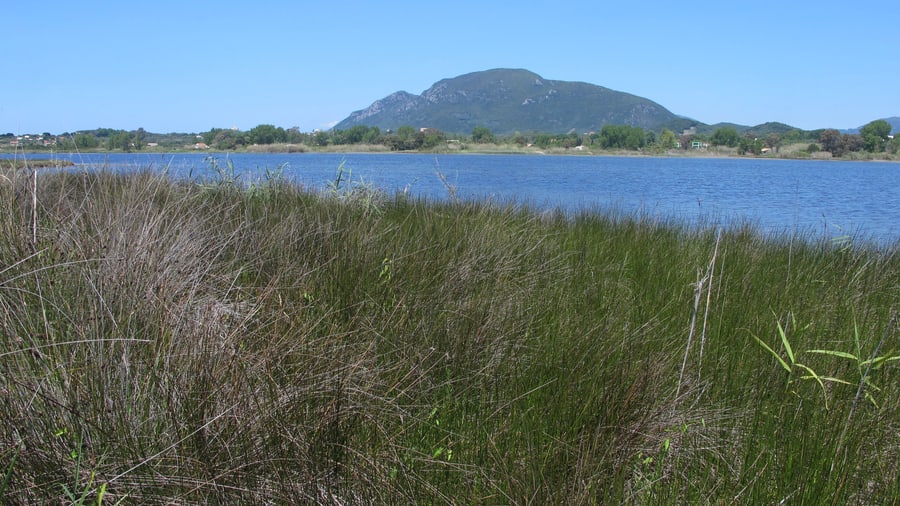
Behind the dunes stands an unusual forest of prickly juniper, known locally as cedar, and the sand hills reach more than 15 metres in height. Reed beds, tamarisk groves and white water lilies grow around the lagoon, and 14 species of orchid appear among the dunes. The lagoon drains to the sea through a channel that cuts across the beach.
Birds use the water on migration, and more than 126 species have been recorded, among them great cormorants, Eurasian wigeons, great egrets and greater flamingos. The Corfu dwarf goby lives only in the lagoon and its springs. The water lies near the village of Agios Mattheos, and the reserve gives a stopover to European birds that travel south along the coast.
- Reptiles: Hermann’s tortoise and the Balkan pond turtle live around the water.
- Fish: the Mediterranean killifish and the Epiros minnow swim in the lagoon.
- Finds: excavations uncovered a hippopotamus jaw and a Paleolithic stone tool.
The lagoon is the quietest stop of the day. Wind moves sand across the track, and the surface turns loose where the dunes open toward the beach. A Corfu jeep safari reaches the water from the south, and the reserve rewards travelers who bring binoculars, water and a sun hat.
How does a Corfu jeep safari stay safe?
Corfu jeep safari safety begins with the licence rules of Greece: a category B licence is issued from the age of 18, and drivers from outside the European Union need an International Driving Permit. Seat belts and child restraints are mandatory.
Greece recognises licences from Switzerland, Serbia, Albania, the United States, Canada, Australia, Japan, South Africa and South Korea, so holders can drive on their home licence. Mountain roads rise in tight bends, and the surface changes where the asphalt ends. A Corfu jeep safari checks brakes and tyres before the convoy sets off, and passengers keep belts fastened on gravel.
Sun and dust belong to the day in summer, when the island is hot and dry. Drivers carry extra water, wear closed shoes and keep arms covered, and the middle of the day brings the strongest heat. Village stops offer shade, and the summit stays cooler than the coast because of the altitude, so a jacket helps at the top.
- Exemptions: the seat belt rule does not cover taxi drivers, postal drivers or pregnant women.
- Mountain roads: the climb to Mount Pantokrator runs in bends from the coast.
- Heat: summer days are hot and dry, so water and sun cover belong in every vehicle.
A briefing before departure covers the route, the signals and the meeting points. Drivers leave space on gradients and slow down for livestock, bicycles and pedestrians. A Corfu jeep safari stays safe when the convoy moves as one group and the vehicles keep their distance on the tracks, so nobody loses the group.
When is the best season for a Corfu jeep safari?
Corfu jeep safari travel suits late spring, summer and early autumn, when the island is dry and warm. Corfu has a hot-summer Mediterranean climate with hot, dry summers and mild, very rainy winters. Annual rainfall reaches 1,111.3 millimetres.
Winter is the wettest period: December brings 189.9 millimetres of rain, while July brings 8.7 millimetres. January days average 9.8 degrees Celsius, and August days average 31.5 degrees Celsius. The heat peaks in July and August, when the highest temperature recorded on Corfu reached 42.8 degrees Celsius. Rain falls mainly between late autumn and early spring, in short, heavy spells.
Dry weather keeps the tracks firm, and spring brings green hillsides while autumn follows the grape and olive work. The mountains stay cooler than the coast, so a light layer helps at the summit. Recorded winter temperatures on Corfu have dropped to minus 6 degrees Celsius, so warm clothing belongs in the vehicle between November and March, and rain gear earns its place in the boot.
- Spring: from April the surfaces dry out and the hills turn green.
- Summer: long dry days leave room for swimming stops and a boat trip.
- Autumn: September and October stay warm, and the rain returns in November.
- Winter: heavy rain and cool days make the mountain tracks less suitable.
Planning around the weather matters. Dry tracks, clear summits and warm water rarely line up in winter, and the island receives nearly all of its rain in a single season. A Corfu jeep safari works best from spring through early autumn, when the roads are dry and the days are long.
What do travelers ask about a Corfu jeep safari?
Corfu jeep safari questions cover driving licences, children, passengers in a vehicle, arrival by cruise ship and the option of adding a beach day. The points below set out the rules and the practical details of a day on the island.
Which driving licence suits a Corfu jeep safari?
Drivers need a valid licence for the vehicle, and a category B licence covers cars of up to 3,500 kilograms. Visitors from outside the European Union carry an International Driving Permit as well. A Corfu jeep safari uses public roads, so police checks occur at any point and papers stay in the vehicle.
Can children join a Corfu jeep safari?
Children travel as passengers, and child restraint systems are mandatory under the road rules of Greece. Vehicles used on a jeep route carry a fixed number of seats, so families declare ages at the time of booking. A Corfu jeep safari over rough ground tires small children, and a shorter coastal route suits a young family.
How does a Corfu jeep safari split passengers between vehicles?
The number depends on the model, and category B licence rules set a limit of eight passengers besides the driver. Convoys split larger groups across vehicles to keep weight low on steep gradients. A Corfu jeep safari therefore carries a family in one or two cars, and the lead vehicle stays in contact.
Do cruise passengers fit a Corfu jeep safari into a port call?
Cruise ships call at Corfu, an important port of call in the Ionian Sea. Vehicles collect passengers near the port, and a northern route fits a port day because the island is compact. A Corfu jeep safari combines with a shorter shore programme, and the shore excursion options set out the choices.
Can a Corfu jeep safari be combined with a beach day?
Yes. Routes in the west and north finish near the coast, where the sand and shallow water suit an afternoon swim. Travelers keep a towel, a change of clothes and sun cover in the vehicle. A Corfu jeep safari that ends near Palaiokastritsa or Sidari leaves time for the beach before the drive back.
Featured photo: Kubajdaa22cz, CC BY-SA 4.0, via Wikimedia Commons.