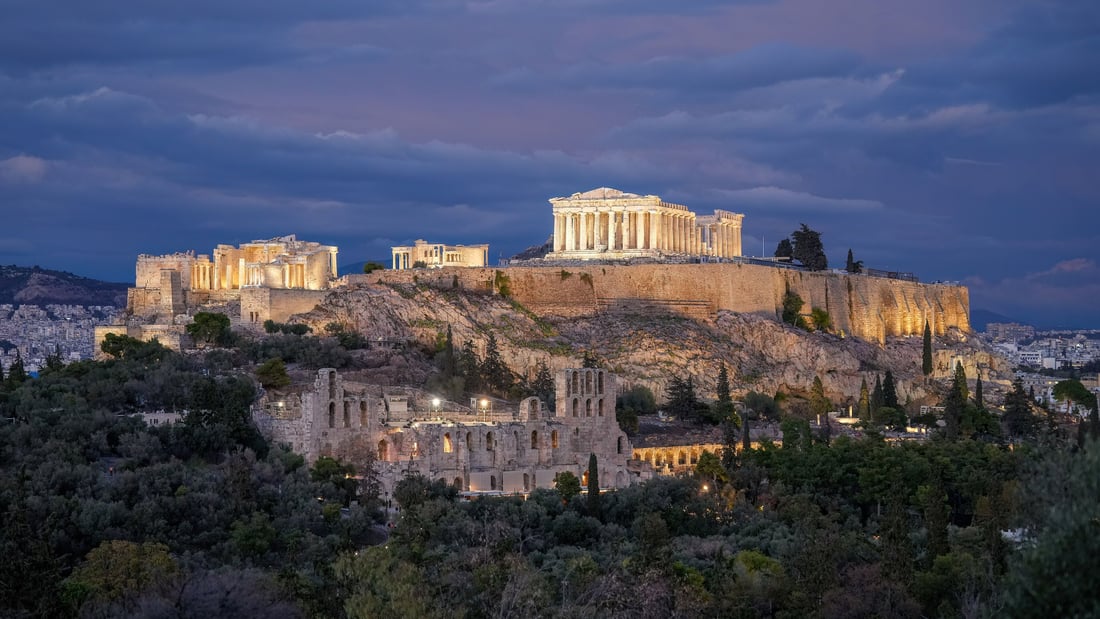
An Athens night tour sees the Greek capital after dark, when floodlights pick out the Parthenon above the city and the old lanes of Plaka and Monastiraki fill with diners, from open-top bus rides past the lit monuments to walks up to the viewpoints and evenings in the Acropolis Museum. This post covers what an Athens night tour includes, the lit monuments, the museum, the old quarter, the viewpoints, the food, how tours travel and the best season. It is one of the evening tours in Greece on Greece VIP.
Each section ends with an Athens night tour that can be booked online.
What does an Athens night tour include?
An Athens night tour includes open-top bus rides along the wide avenues, walks through the historic centre, food stops in the old quarters, evening visits to the Acropolis Museum, and the lit monuments of the Acropolis rock and its walls.
The historic centre of Athens is compact, and the route through it begins at the Temple of Olympian Zeus, passes below the southern slopes of the Acropolis beside Plaka, and ends at Thiseio. An Athens night tour uses these streets after the daytime crowds have left, so the distance between one stop and the next stays short and the ground is level.
Above the route stands the Acropolis, an ancient citadel on a rocky outcrop 150 metres above sea level. The word acropolis comes from the Greek words for highest point and city. UNESCO inscribed the site on the World Heritage List in 1987, and a Mycenaean palace stood on the hill in the late Bronze Age. Its temples date from the fifth century BC.
- Bus: An open-top bus covers the long avenues of the centre.
- Walks: The lanes of Plaka are covered on foot after dark.
- Food: Meze and grilled skewers are served late.
The evening stays inside a compact area, and the stops follow one another closely. An Athens night tour ends with the monuments, the food and the museum. Visitors who arrive in Athens for a short stay find the whole route within reach on foot, and nothing on the route needs a car.


Which monuments does an Athens night tour see lit up?
An Athens night tour sees the Acropolis and the Parthenon lit up by a new lighting scheme, with nine points on the Sacred Rock, the Temple of Olympian Zeus and the marble Panathenaic Stadium in Pangrati all included.
Nine monuments are lit, among them the Parthenon and the Propylaia. The installation is built to run for more than 20 years, and the fittings cut light pollution over the city.
The Temple of Olympian Zeus stands 500 metres south-east of the Acropolis, 700 metres south of Syntagma Square, and an Athens night tour reaches it on foot. Its builders planned 104 columns in the Corinthian order, and 15 of them are still standing. Hadrian dedicated the finished temple in 132 AD, 638 years after the work began. The precinct was paved in marble.
- Parthenon: The temple of Athena was completed in 432 BC.
- Olympic Games: The Panathenaic Stadium held the first modern Olympics in 1896.
- Marathon: The stadium is the finishing point for the Athens Classic Marathon.
The lit rock is visible from much of the city, and the monuments below it are passed. Darkness hides the modern skyline that surrounds the ancient centre, so the columns and the marble tiers stand out against the sky. An Athens night tour keeps its widest view for the end.
Does an Athens night tour visit the Acropolis Museum after dark?
An Athens night tour visits the Acropolis Museum after dark on the nights when the galleries stay open late, and the building stands 300 metres from the southern slopes of the Sacred Rock. Its glass floors hang over an excavation.
The museum opened to the public on 20 June 2009 and holds more than 4,250 objects across 14,000 square metres. It was built over Roman and Byzantine ruins, and parts of the floor are glass, so the excavation below stays visible. On the August full moon and on the European Night of Museums the museum stays open into the night.
The top floor holds the Parthenon Gallery, where 48 columns repeat the spacing and the orientation of the temple on the rock. Glass walls stand on all four sides, and the frieze runs as a continuous band around the room. From the north side the columns of the Parthenon are visible above, which is where an Athens night tour ends.
- Excavation: Glass panels reveal the ancient neighbourhood below.
- Collections: Finds from the rock and its slopes fill three levels.
- Location: The entrance faces the southern slope of the Acropolis.
Evening visits to the Acropolis Museum are quieter than the middle of the day, and the galleries above the excavation reward a late start. The walk from the rock to the entrance is short, and the metro stops nearby. An Athens night tour ends here, with the lit Acropolis in the gallery windows.
What does an Athens night tour see in Plaka and Monastiraki?
An Athens night tour sees Plaka, the oldest district of Athens, and Monastiraki, the flea market quarter, where the old lanes, the squares and the rooftops face the Acropolis. Both quarters sit on the slopes below the rock.
Plaka is clustered around the northern and eastern slopes of the Acropolis and is known as the Neighbourhood of the Gods. Its lanes are narrow and its houses neoclassical, and the district sits over the residential areas of the ancient town. Adrianou Street divides the upper part, Ano Plaka, from Kato Plaka, and an Athens night tour follows it between the two.
Monastiraki is one of the main shopping districts of Athens, and its square takes its name from the Church of the Pantanassa. Pandrossou Street is the busiest lane around the square. Hadrian’s Library stands at the edge of the quarter, and the metro station on the square serves two lines. The quarter grew up around the ancient ruins of the old town.
- Lanes: The streets of Plaka follow a labyrinthine plan from the ancient town.
- Anafiotika: The village-like quarter sits at the highest point of Plaka.
- Flea market: Stalls for clothing, souvenirs and antiques fill Monastiraki.
The two quarters stand at the foot of the rock, and the walk between them is short. Plaka holds monuments from every period of the city’s history, and the streets of Adrianou and Tripodon date from the ancient era. An Athens night tour crosses both districts on foot, because the lanes are narrow.
Which viewpoints does an Athens night tour reach?
An Athens night tour reaches three viewpoints above the city: Lycabettus, the highest point in central Athens, Philopappos Hill opposite the Acropolis, and the rocky Areopagus. Each one looks down on the lit rock from a different side.
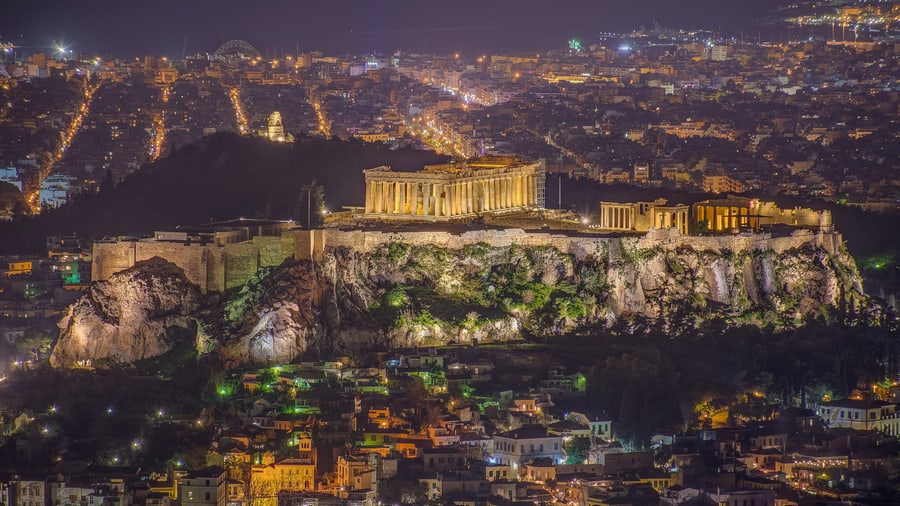
Lycabettus is a limestone hill that stands 277 metres above the streets of the city. Pine trees cover its base, and a chapel dedicated to Saint George stands on the top. A funicular railway climbs the hill, and an open-air amphitheatre sits near the summit. From the top the whole Attica basin is visible, from the coast to the mountains.
Philopappos Hill, also called the Hill of the Muses, faces the Acropolis from the south-west. The marble monument on its summit was raised after Philopappos died in 116 AD, and the two-storey structure measures 9.8 by 9.3 metres. It stands on a socle 3.08 metres high, where an Athens night tour looks back at the rock. The hill is planted with pines.
- Areopagus: The Hill of Ares, north-west of the Acropolis, held an ancient council.
- Lycabettus: The chapel on the summit dates from the nineteenth century.
- Philopappos Hill: The hill joins the Pnyx.
Each viewpoint gives a different outline of the lit rock, and the walk between them passes the court of the Areopagus, where the Apostle Paul spoke. The hilltops are open ground rather than fenced sites, so no ticket is needed. An Athens night tour ends above the city, looking down at the rock.
What does an Athens night tour taste?
An Athens night tour tastes meze, grilled skewers, ouzo and Greek wine in the tavernas of Psyrri and Gazi, the two quarters where the kitchens stay busy late into the evening. Plates are shared and the tables are small.
Meze is a selection of small dishes served as appetizers, and in Greece it comes to the table with ouzo or tsipouro. Ouzo is an anise-flavoured spirit that turns cloudy white when water is added and comes with ice in a small glass. Wine has been made in Greece for 6,500 years, and the country is among the oldest wine-producing regions.
Souvlaki consists of small pieces of meat grilled on a skewer, eaten straight off the stick or rolled inside pita bread with tomato and onion. Pork is the usual meat, and around Athens the skewer is known as kalamaki. Souvlaki is eaten hot, straight from the grill, with lemon, and an Athens night tour stops at the grill. The grill sits at the front.
- Meze: Small plates of fish, olives and feta cheese come with the drinks.
- Ouzo: Since 2006 the European Union protects the name.
- Psyrri: The old quarter fills with restaurants, bars and live music tavernas.
The Athens food tour covers the same ground on foot and can be joined at any stop. An Athens night tour that includes food runs longer than one that does not, because the plates arrive slowly. Psyrri and Gazi sit below the Acropolis, so the rock stays in view between courses.
How does an Athens night tour travel?
An Athens night tour travels by open-top bus, on foot, by metro and by taxi, mixing the wide avenues with the narrow streets of the historic centre of the city. Each mode covers a different part of the evening.
Line 1 opened on 27 February 1869 as a steam railway and runs mostly at ground level. Lines 2 and 3 opened in January 2000. Trains run underground through the centre, and an Athens night tour uses them for the longest hops between districts. The metro is the fastest link.
Walking covers the middle of the route, where the monuments stand within a short distance of one another. The public transport network adds buses, trolleybuses and a coastal tram. Sea services reach the islands from Piraeus, and taxis take the uphill streets that the walking route leaves out. The centre is small enough to cross on foot in a single evening.
- Metro: Line 1 runs from Piraeus to Kifissia and has 24 stations.
- Tram: The coastal tram serves the southern suburbs.
- Taxi: Cars wait at stands around the squares.
Buses and the metro divide the work of the evening: the metro covers the long hops, and the hop-on hop-off bus reaches the sights that sit far apart. An Athens night tour that mixes the two spends less time in traffic and more time at the monuments. The choice depends on the stop.
When is the best season for an Athens night tour?
An Athens night tour works best in summer, when the August full moon opens archaeological sites after dark, though winter evenings in Athens are mild enough for the same route through the centre. Spring and autumn sit between the two.
Athens has a hot-summer Mediterranean climate, with a mean annual temperature of 19.2 degrees Celsius at the city-centre station of the National Observatory of Athens. In August the average daily maximum reaches 34.3 degrees and the average minimum stays at 24.4 degrees. Summers are dry and the winters are wet.
The Ministry of Culture opens 126 archaeological sites, historic places, monuments and museums across Greece free of charge on the night of the August full moon. The programme has run for 27 consecutive years and includes concerts, theatre and dance. Museums across the country take part, and the sites stay open late into the night for an Athens night tour.
- Cinema: Garden cinemas show films on warm evenings.
- Festival: The Athens Festival fills the Odeon of Herodes Atticus.
- Theatre: The city has more stages than any other city in the world.
Summer heat builds all day, so the evening is the better half of an August visit. Spring and autumn bring the same monuments with milder air, and the winter route trades the open-air stops for the museum and the tavernas. An Athens night tour changes shape with the season but never loses the lit rock.
What do travelers ask about an Athens night tour?
An Athens night tour raises five common questions: whether the historic centre is safe after dark, whether children can join, what visitors wear on the hills, how dinner fits into the evening, and where the Acropolis is seen lit up.
Is an Athens night tour safe for visitors?
The historic centre of Athens stays busy after dark, and the pedestrianised route through it is closed to traffic. The metro carries visitors between districts, and taxis wait at stands around the squares. Late openings arranged by the Ministry of Culture bring residents and visitors onto the same streets.
Can children join an Athens night tour?
Children walk the same route, and the stops sit close together. The museum shows objects from the Bronze Age to Byzantine times, and the food stops break the evening into short stages. An Athens night tour keeps the same pace as the daytime one.
What do visitors wear on an Athens night tour?
January days in Athens average 13.3 degrees and the nights fall to about 7.0 degrees, so a jacket suits the winter route. The hills and the Areopagus are rocky outcrops, which makes flat shoes the practical choice. A light layer covers the change in temperature after sunset.
Can an Athens night tour be combined with dinner?
Food stops sit inside the route, and the quarters below the Acropolis keep their kitchens open late. Gazi surrounds the old gasworks, now an industrial museum and cultural centre, and the district fills with bars and restaurants. A meal before the walk or after it fits an Athens night tour.
Where is the Acropolis seen lit up on an Athens night tour?
The lighting scheme on the Sacred Rock separates each monument from the walls and from the others, so the Parthenon reads at a distance. The rock is visible from the hills above the city, from the museum gallery and from the squares below. A viewpoint at the end of the evening gives an Athens night tour the widest view.
Featured photo: Giles Laurent, CC BY-SA 4.0, via Wikimedia Commons.