
An Athens food tour walks through the Central Market and the old neighbourhoods of the city to taste street food, meze, cheese, olive oil, drinks and sweets. This post covers what an Athens food tour includes, the neighbourhoods, the market, the dishes, the drinks, the history of Greek food, cooking classes and the best season. It is one of the best tours in Greece on Greece VIP.
Each section ends with a food tour or a tasting that can be booked online.
What does an Athens food tour cover?
An Athens food tour covers the central market, the old neighbourhoods of Psyrri, Monastiraki and Plaka, and the main groups of Greek food: street food, meze, cheese and olive oil, drinks and sweets. Each tasting ties one food to one part of the city.
Greek cuisine rests on the Mediterranean triad of wheat, olive oil and wine. It uses vegetables, grains, fish and meat, with pork, poultry, lamb and goat on the list, plus cheeses, herbs, lemon juice, olives and yogurt. Its roots reach back to the cooking of ancient Greece and Byzantium, with later layers added over the centuries. Dining out is common in Greece, where the taverna and the estiatorio serve home cooking to locals and tourists. An Athens food tour samples this base in the capital.
The walk stays inside the historic centre. Restaurants, tavernas and bars cluster in the entertainment hubs of Plaka and the Trigono areas, while Psyrri and Gazi, two inner districts, fill with bars and nightclubs. Plaka and Monastiraki share one municipal district of the city with the Trigono of Peiraios, Panepistimiou and Ermou. The Varvakeios municipal market on Athinas Street forms the market stop. An Athens food tour links that market with the old lanes on foot.
Street food and meze form the savoury half. Common Greek street foods include souvlaki, gyros, pitas and roasted corn, and fast food chains, popular in Greece since the 1970s, also serve tiropita and spanakopita. In Greece the words mezé, mezés and the plural mezédhes name small dishes, hot or cold, spicy or savoury. They come as appetizers, paired with spirits such as ouzo at ouzeria. An Athens food tour tastes both groups between walks.
Cheese, olive oil, drinks and sweets complete the menu. Olive oil is the defining and ancient element of Greek cooking and goes into the bulk of its dishes. Greek kitchens use a wide range of cheeses, among them feta, kasseri, kefalotyri, graviera and manouri. Greek coffee, ouzo, tsipouro and retsina sit on the drinks list, while desserts draw on nuts, honey, fruit, sesame and filo pastry. Baklava and loukoumades, fried dough balls drizzled with honey, close the tasting.
- Market: The Varvakeios municipal market on Athinas Street is the market stop of an Athens food tour.
- Old quarters: Psyrri, Monastiraki and Plaka hold the old lanes, squares and tavernas.
- Savoury food: Souvlaki, gyros, pitas and meze plates make up the savoury tastings.
- Cheese and oil: Feta, graviera and olive oil sit at the centre of the tasting table.
- Drinks and sweets: Greek coffee, ouzo, tsipouro, baklava and loukoumades end the walk.
An Athens food tour therefore works on two layers. The first is place: the market on Athinas Street and the old quarters of Psyrri, Monastiraki and Plaka. The second is the food, built on wheat, olive oil and wine and served as street snacks, meze, cheese, drinks and sweets. Each tasting joins one layer to the other.
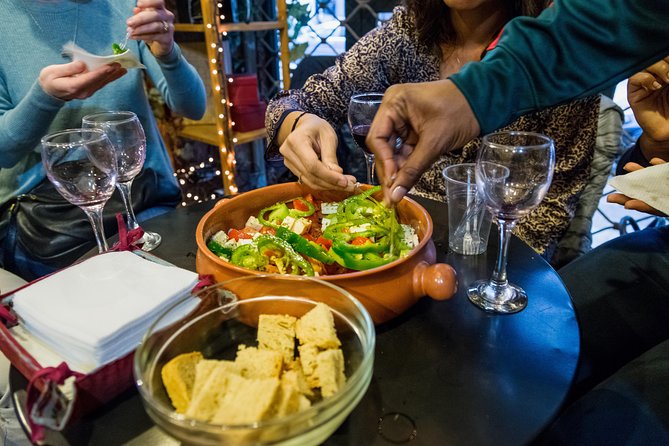


Which neighbourhoods does an Athens food tour visit?
An Athens food tour visits Psyrri, Monastiraki and Plaka, three old quarters of the city centre. Psyrri holds restaurants, bars and live music tavernas, Monastiraki holds the flea market streets, and Plaka spreads over the northern and eastern slopes of the Acropolis.
Psyrri is one of the oldest quarters of Athens. Until the early 1990s it had a poor reputation, but it has since become a fashionable choice in the centre for food, entertainment and places to stay. Its central square is Heroes Square, named because the streets leading to it carry the names of heroes of the Greek War of Independence, such as Karaiskakis and Miaoulis. An Athens food tour crosses this square on its way to the tavernas.
The quarter has literary ties. Lord Byron stayed in Psyrri during his time in Athens and wrote the poem “Maid of Athens” there. Alexandros Papadiamantis, the best known Greek resident of the quarter, lived in the area for more than two decades. In 2007 an extension of Metro Line 3 from Monastiraki west to Egaleo linked the night life hubs of Gazi and Psyrri, with Psyrri served by Monastiraki station. An Athens food tour can start from that station.
Monastiraki, whose name means “little monastery”, is a flea market neighbourhood in the old town and one of the main shopping districts of Athens. The area takes its name from Monastiraki Square, which is named after the Church of the Pantanassa on the square. It holds clothing boutiques, souvenir shops and specialty stores, and its main streets are Pandrossou Street and Adrianou Street. Monastiraki Metro Station, on the square, serves Line 1 and Line 3. An Athens food tour passes through the square between stops.
Plaka, known as the “Neighbourhood of the Gods” for its closeness to the Acropolis, is the oldest district of Athens. People have lived there without a break from the Neolithic to the present day, and streets such as Adrianou and Tripodon trace back to the ancient era. Adrianou Street, the largest street in Plaka, splits it into Ano Plaka, right under the Acropolis, and Kato Plaka, between Syntagma and Monastiraki. An Athens food tour follows its labyrinth of streets and neoclassical buildings.
- Psyrri: Heroes Square forms the centre of this old quarter of restaurants, bars and live music tavernas.
- Monastiraki: The flea market district takes its name from Monastiraki Square, itself named for the Church of the Pantanassa.
- Plaka: The oldest district of Athens sits under the Acropolis, split by Adrianou Street into upper and lower parts.
- Anafiotika: Settlers from the Aegean island of Anafi built this small part of Plaka in the Cycladic style during the reign of Otto.
- Metro: Monastiraki Metro Station serves Line 1 and Line 3, and an Athens food tour can begin there.
These three quarters give an Athens food tour its street frame. Psyrri supplies the tavernas and the bar streets, Monastiraki the flea market and the metro link, and Plaka the old lanes under the Acropolis. Adrianou Street serves as a main street of both Monastiraki and Plaka, so the walk passes from one quarter into the next inside the historic centre.
What is the Central Market on an Athens food tour?
An Athens food tour stops at the Central Market, known as the Varvakios Agora or the Varvakeios municipal market. It stands in the middle of Athinas Street, ranks as the oldest market in Athens and dates from the 19th century. Ioannis Varvakis financed its building.
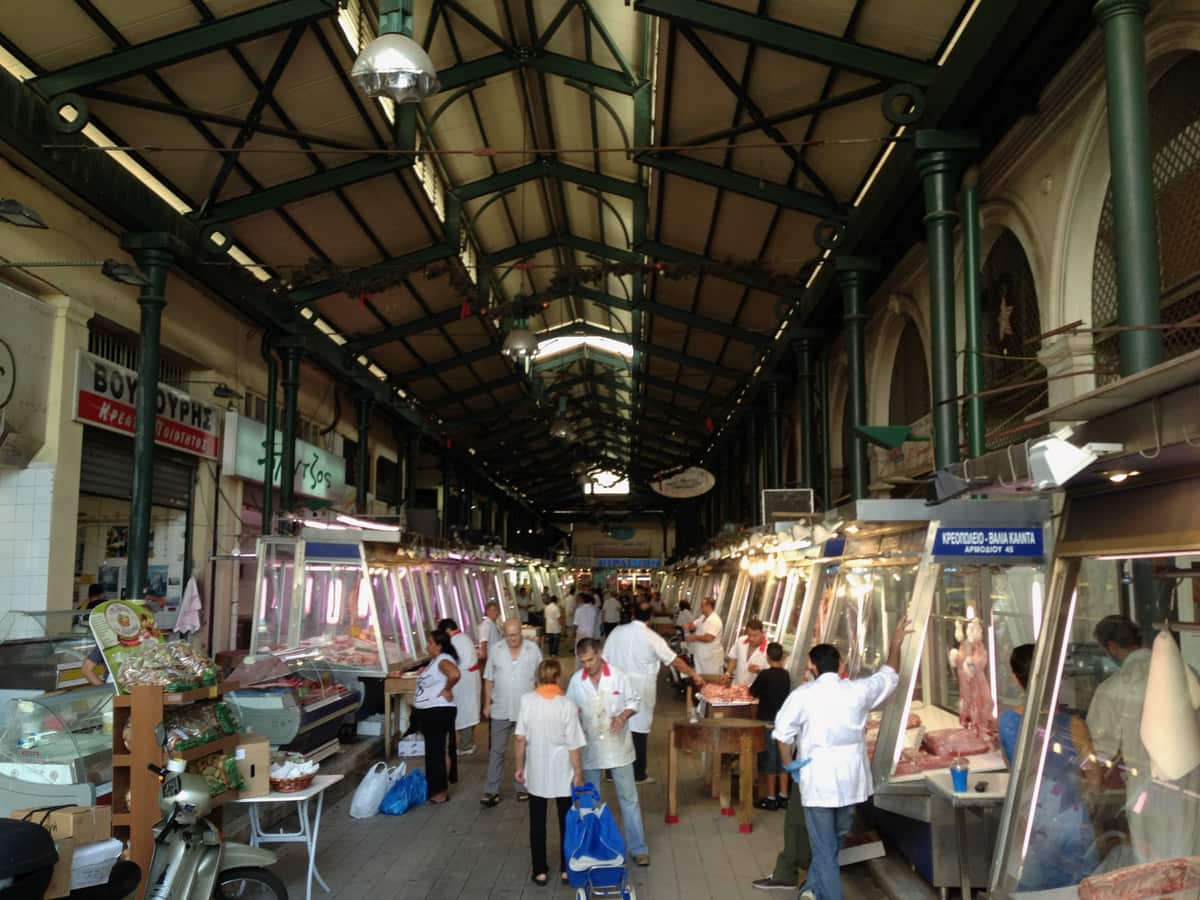
The market sits on Athinas Street, named after Athena, the goddess of wisdom. The street runs from Ermou Street north to Omonoia Square through Psyrri. Its total length is nearly 1 km, and Metro Line 1 runs beneath it for its entire length. Athens City Hall stands on its west side and Kotzia Square lies to the east, while neo-classical buildings line the southern stretch. An Athens food tour reaches the market along this street.
Ioannis Varvakis, who lived from 1745 to 1825, was a Greek privateer, benefactor and member of the Filiki Eteria. Born on the island of Psara, he built a fishery in the northern Caspian Sea that made him a millionaire, and he shipped caviar to Greece in waterproof timber boxes of his own design. He financed the building of the closed market of Athens, the Varvakeios Agora. A statue of him stands in the National Garden. An Athens food tour tells his story at the market.
Varvakis also left money in his will for a high school, named the Varvakeio in his honour. Its first building, designed by Panagis Kalkos, opened in 1860 across from the present-day Varvakios Agora, on a square bounded by Athinas, Sokratous, Armodiou and Aristogeitonos Streets. Alexandros Papadiamantis, the novelist who lived in Psyrri, appears among its alumni. The building came down in 1956. Kalkos also designed the two-storey Athens City Hall on Athinas Street, built between 1872 and 1874.
A kitchen inside the Varvakeio Market cooks soups, and a Greek magazine has printed recipes modelled on them. Evripidou Street, one of the cross streets of Athinas Street, has held a pastourma and sujuk charcuterie at number 45 since 1922. Between 2011 and 2017, under artistic director Myron Michailidis, the Greek National Opera staged concerts and opera galas in unconventional venues, the Varvakeio central market among them. An Athens food tour adds these cured meats and soups to the market stop.
- Names: The market stop of an Athens food tour goes by Varvakios Agora, Varvakeios municipal market and Central Municipal Athens Market.
- Location: The market stands in the middle of Athinas Street, which links Ermou Street with Omonoia Square.
- Founder: Ioannis Varvakis, a benefactor born on Psara, paid for its building.
- Roots: Between 550 and 350 BCE, Greek stallholders grouped by goods, with fish-sellers in one place and clothing in another.
- Cured meats: A charcuterie at 45 Evripidou Street has sold pastourma and sujuk since 1922.
The Central Market gives an Athens food tour its link to the 19th-century city. Beyond it, downtown Athens holds 44 laikes agores, weekly people’s markets of fruit, vegetables, fish and eggs. These street markets have been described as a modern version of the agora of ancient Greece, where officials in Athens checked weights, measures and coinage.
Which street food does an Athens food tour taste?
An Athens food tour tastes four Greek street foods: souvlaki grilled on a skewer, gyros sliced from a vertical rotisserie, the sesame-covered koulouri ring, and spanakopita, a spinach pie in phyllo pastry. Each one traces back to Greek, Byzantine or Ottoman cooking.
Souvlaki means small cuts of meat, at times with vegetables, grilled on a skewer. Greeks eat it hot, straight off the skewer, or inside a rolled pita with lemon, sauces, sliced tomato and onion. Pork is the standard meat in Greece, and the name comes from the Medieval Greek soúvla, meaning skewer. In Athens, meat on a skewer goes by the name kalamaki, or small reed, while souvlaki covers any pita wrap, and an Athens food tour uses both words.
Gyros on an Athens food tour starts as meat roasting on a vertical rotisserie. Cooks stack thin, round slices of seasoned pork on a tall spit in the shape of an inverted cone, with spices such as cumin, oregano, thyme and rosemary. As the spit turns in front of the heat, the cook shaves thin, crisp strips from the outside and wraps them in pita with tomato, onion, fried potatoes and tzatziki. By 1970, gyros wraps were already a popular fast food in Athens.
On an Athens food tour, koulouri is the bread snack, a ring that is as a rule covered in sesame seeds and that Greeks still eat regularly. Its roots lie in the Byzantine Empire, where the ring went by the names boukellon and kollikion. Byzantine authors describe it as barley or wheat bread popular with the army, and Constantine VII Porphyrogennitos wrote of a small ring-shaped bread sold in Constantinople. It comes plain or at breakfast with cheese, tea or fruit preserves.
Spanakopita is a Greek savory pie, and its name joins spanáki, meaning spinach, with píta, meaning pie. Its filling mixes chopped spinach with feta, onions or scallions, egg and seasoning, and dill, mint or parsley add flavor. Bakers wrap or layer the filling in phyllo with butter or olive oil, then cut portions from a large pan or roll single triangles. The crust bakes to a golden color, and an Athens food tour tastes it hot from the oven or at room temperature.
- Bronze Age: Digs at Gla, Mycenae and Pylos found Mycenaean souvlaki trays, ceramic pans that sat under skewers of meat.
- Merida: This souvlaki plate, named after the Greek word for portion, adds fried potatoes, vegetables, sauce and quartered pita.
- Fasting pie: A spanakopita without cheese or eggs is eaten across Greece during Lent and other religious fasts.
The name gyros comes from the Greek word for turn, and Greece once used the Turkish name döner for the dish. The stacked vertical spit began in Bursa in the 19th century, and Greeks from Asia Minor brought it to Greece. Together, the four snacks give an Athens food tour a first taste of pita, pork, sesame, spinach, feta and olive oil before the sit-down courses.
Which meze dishes appear on an Athens food tour?
An Athens food tour tastes four meze dishes: tzatziki, a yogurt and cucumber dip; dolmades, or stuffed vine leaves; keftedes, the Greek fried meatballs; and taramosalata, a spread of cured fish roe. Meze is a set of small appetizer plates, served hot or cold.
Tzatziki is a cold dip built on strained yogurt, with cucumber, garlic, salt, olive oil, red wine vinegar, dill and mint stirred in. In Greece, the yogurt as a rule comes from sheep or goat milk. On an Athens food tour, it arrives as a meze with pita bread, olives, fried eggplant or zucchini, and it also tops souvlaki and gyros. The word reached English around the mid-20th century from Modern Greek, which took it from the Turkish cacık.
Dolmades are vine leaves rolled around a filling. They belong to dolma, a family of stuffed dishes tied to Ottoman cooking, and the Turkish word means stuffed or filled. A common filling mixes minced meat, rice, chopped onion, parsley and tomato, with salt and pepper. Meat-filled rolls come warm, at times with avgolemono sauce. Meatless rolls carry the Greek name ntolmadákia gialantzí, from the Turkish word for fake, and an Athens food tour tastes them at room temperature.
Keftedes, the fried meatballs on an Athens food tour, take their name from the Turkish köfte. The standard Greek mix includes bread, onions, parsley and mint leaf. They belong to kofta, a family of meatball dishes whose first recipes appear in early Arab cookbooks and in the Byzantine Empire, calling for ground lamb. Greek cooks also make tomatokeftedes, a vegetarian version with tomatoes, and kolokithokeftedes with courgettes and feta. Stewed meatballs get a different name, yuvarlákia, and hold small amounts of rice.
Taramosalata starts with tarama, which is salted, cured fish roe from cod, carp or grey mullet. Cooks blend the roe with olive oil, lemon juice and a base of bread or potatoes, or almonds. A pestle and mortar gives the traditional dip a slightly grainy texture. High-quality taramosalata is beige, while dyed versions turn pink. Greeks eat it with onions and lemon on Clean Monday, which opens Great Lent, and an Athens food tour serves it as a spread on bread.
- Word: The Turkish meze, meaning appetizer, comes from the Persian maze, meaning taste or relish.
- Roots: The meze tradition began in the Byzantine Empire and grew in Ottoman Greek houses and taverns.
- Other plates: Grilled octopus, kalamata olives, fava spread, melitzanosalata and fried saganaki cheese also appear in meze spreads.
In Greece, meze comes as a plate of snacks to go with drinks such as ouzo and tsipouro, and taramosalata is served with ouzo as well. Cubes of cheese, olives and grilled meats join the dips and rolls on a full table. The meze stop of an Athens food tour ties these plates to a custom of small dishes with drinks that dates to medieval times.
Which cheeses and olive oil does an Athens food tour include?
An Athens food tour includes three Greek cheeses: feta, a brined white cheese; kasseri, a pale yellow cheese; and graviera, a hard cheese made in wheels. Greek olive oil comes with them, and Greece, Spain and Italy lead the world in olive oil use per person.
Feta is a Greek white cheese made from sheep milk or a mix of sheep and goat milk. It is soft and crumbly, with a slightly grainy texture, and it ages in brine. Its flavor is tangy and salty, from mild to sharp. Since 2002, feta has held protected designation of origin status in the European Union, which limits the name to cheese made the traditional way in mainland Greece and Lesbos Prefecture. An Athens food tour pairs it with olive oil, olives and oregano.
On an Athens food tour, kasseri turns up in sandwiches, kasseropita and saganaki. It is a pale yellow cheese, medium-hard to hard, made from sheep milk with up to 20% goat milk. Its protected designation of origin requires production in Thessaly, Macedonia, Lesbos or Xanthi. The texture is smooth and chewy, not crumbly, under a hard rind. Kasseri belongs to the pasta filata family, like mozzarella and provolone: cheesemakers knead the curd in hot water until it stretches into a thread at least 1 meter long.
Cheesemakers in Crete, Lesbos, Naxos and Amfilochia produce the main varieties of graviera, a hard Greek cheese named after gruyère, the Swiss cheese it resembles. In popularity, it ranks second only to feta among Greek cheeses, and an Athens food tour offers it sliced or fried as saganaki. The wheels carry a crisscross pattern on the rind, left by the draining cloth. Graviera of Crete comes from sheep milk, ripens for at least five months and tastes slightly sweet, with a burnt caramel flavor.
Olive oil runs through an Athens food tour, since it forms the base of a long list of Greek dishes. More than 75% of the oil Greece produces is extra virgin, and the country exports it worldwide. Extra virgin oil, the top grade, comes from cold mechanical extraction with no solvents, and its free acidity stays at 0.8% or lower. A peppery or bitter taste points to a higher polyphenol content. Labels mark Greek oil with the country code GR.
- Feta rules: Under the EU designation, feta uses sheep milk or a blend with up to 30% goat milk from the same area.
- Graviera PDO: Three graviera cheeses hold EU protected status: Graviera Kritis, Graviera Agrafon and Graviera Naxou.
- Athena’s olive: Athens takes its name from the goddess Athena, whose gift of an olive tree was held more precious than Poseidon’s salt spring.
Cheese from sheep and goat milk was a common food in ancient Greece, and Greek records of cheesemaking go back to the 8th century BC. Olive oil goes back further: olives grew in Crete as long ago as 2500 BC, and oil was a major export of Mycenaean Greece. An Athens food tour that ends its savory course with feta, kasseri, graviera and olive oil tastes foods with a long Greek history.
What drinks come with an Athens food tour?
An Athens food tour pairs its tastings with Greek drinks: ouzo and tsipouro served beside small plates, retsina made from the Savatiano grape of Attica, unfiltered Greek coffee brewed in a briki, and the frappé, an iced coffee shaken into a thick foam.
Ouzo is a dry, anise-flavoured spirit drunk widely in Greece and Cyprus. It grew out of tsipouro, credited to 14th-century monks on Mount Athos, and the first ouzo distillery opened in Tyrnavos in 1856. Clear in the bottle, ouzo turns milky white with water or ice, because anethole, the oil of anise, dissolves in strong alcohol but not in water. An Athens food tour pours it over ice in a small glass, with olives, feta and fresh fish on the side.
Tsipouro is an un-aged Greek brandy from Thessaly, Epirus and Macedonia, distilled from grape pomace, the residue of the winepress. It holds 40–45% alcohol and comes pure or flavoured with anise. Less distilled than ouzo, it keeps the aroma of the pomace, and Greek makers advise serving it straight from the fridge. On an Athens food tour, it arrives in shot glasses with nuts, raisins, cheese or olives. Greece won protected designation of origin status for it in 2006.
Retsina is a Greek resinated wine, white or rosé, made for at least 2,000 years. The style is said to come from sealing amphorae with Aleppo pine resin, which kept air out and scented the wine. Modern makers add small chunks of the resin to the fermenting must. Its traditional grape is Savatiano, a drought-resistant white variety grown widely in Attica near Athens. Retsina suits strong flavours such as skordalia, the garlic dip, and an Athens food tour serves it with meze.
Greek coffee is the local name for the unfiltered brew known elsewhere as Turkish coffee; the name took hold after political tensions with Turkey in the 1950s and spread after 1974. Finely ground beans, water and optional sugar are heated in a pot called a briki until they froth, and the grounds stay in the cup. The frappé, invented in Thessaloniki in 1957, is iced instant coffee shaken with water and sugar into foam, with milk optional.
- Kantza Savatiano: In Kantza, a village east of Paiania, Savatiano is made as a single-variety wine without pine resin.
- Frappé sweetness: For two spoonfuls of coffee, a glykós frappé takes four spoonfuls of sugar, a métrios two and a skétos none.
- Frappé on film: A Greek film of 1951 already refers to frappé, prepared with a shaker at a patisserie on Amerikis Square in Athens.
A drinks list on an Athens food tour spans anise and grape spirits, a resinated wine and coffee for the daytime stops. Ouzo, tsipouro and retsina all hold protected status under European Union rules, which limits each name to Greece and Cyprus. Travellers who avoid alcohol can ask for Greek coffee, a frappé or water at any tasting stop on an Athens food tour.
Which sweets close an Athens food tour?
An Athens food tour closes with Greek sweets built on filo, custard, syrup and honey: baklava layered with nuts, galaktoboureko filled with semolina custard, bougatsa served hot with icing sugar and cinnamon, and loukoumades, deep-fried dough balls topped with honey and walnuts.
Baklava is a layered pastry of filo and chopped nuts, sweetened with syrup or honey. Greek cooks favour walnuts over pistachios and add cinnamon, though southern Greece leans towards almonds. Tradition calls for 33 sheets of filo, one for each year of the life of Jesus. Its origins are disputed, but the poet Archestratos, in the 5th century BC, praised the honey-soaked Athenian version of plakous, a pastry seen as a forerunner of baklava. That gives an Athens food tour a local link.
Galaktoboureko is semolina custard baked between sheets of filo and coated in a clear syrup. Bakers make it in a pan, with filo above and below, 20 layers in all, or roll it into single portions about 10 cm long. Unlike mille-feuille, the custard bakes with the pastry instead of going in later, and its flavour can come from lemon, orange or rose. Notable versions are associated with Athens and Thessaloniki, which puts galaktoboureko on the sweet stops of an Athens food tour.
Bougatsa is a Greek filo pie, sweet or savoury, eaten for breakfast or as a mid-morning snack. The sweet bougatsa krema holds semolina custard and comes hot, cut into small pieces and dusted with icing sugar or cinnamon. The name goes back to Byzantine Greek pogátsa and, before that, a Roman term for hearth bread. The modern pie began in Serres and Thessaloniki, and in Athens the custard version is sweet and full of cream. An Athens food tour finds it in specialty shops called bougatsadika.
Loukoumades are balls of yeast batter fried golden brown in hot oil and soaked in honey or syrup. They are a mainstay of Greek cooking, above all in the south, and a street food topped with honey, cinnamon, walnuts or chocolate sauce. Evidence ties them to enkrides, dough fried in oil and eaten with honey in ancient Greece. In Byzantine times, made only from flour, yeast and water, they met the rules of Orthodox fasting. That makes them an easy last stop on an Athens food tour.
- Name: The Greek name loukoumádes comes from the Arabic luqma, a word for a morsel or a bite.
- Smyrna roots: Tradition places the origin of galaktoboureko in the wealthy Greek areas of western Asia Minor, Smyrna above all.
- Chania bougatsa: In Chania, on Crete, bougatsa holds unsweetened mizithra cheese and gets a sprinkle of sugar and cinnamon.
Sweets on an Athens food tour share a short list of ingredients: filo, nuts, semolina custard, honey, syrup and cinnamon. Baklava takes its syrup after baking, galaktoboureko is coated in a clear syrup, bougatsa is dusted with icing sugar, and loukoumades are soaked in honey. Travellers with nut allergies can ask about walnuts and almonds before the sweet stops begin.
Which Athens food tour suits vegetarians and families?
An Athens food tour suits vegetarians when it includes ladera, the vegetable dishes cooked in olive oil, plus gemista, briam, fasolada and boiled greens called horta, and it suits families when the route keeps walking short and offers mild tastes for children.
Ladera, a Greek name meaning “with oil”, are vegetables, plain or stuffed, cooked in a sauce of tomato, onion, garlic and olive oil. They normally contain no meat, and Greeks eat them as a fasting food. Green beans, peas, okra, leeks and zucchini all go into the pot. Ladera come warm or at room temperature, with feta and bread on the side. Because ladera can stand alone as a meal, a vegetarian on an Athens food tour is not limited to side plates.
Gemista, Greek for “filled with”, are bell peppers and tomatoes stuffed with rice, onion, mint, parsley and olive oil, then baked. The same name covers versions with ground beef, so vegetarians do well to ask which filling the kitchen uses. Briam, also called tourlou, is a mixed vegetable dish of eggplant, zucchini, onion, potato, tomato, garlic and parsley, close to the French ratatouille. Both belong to the ladera family. On an Athens food tour, both can fill a meatless plate.
Beans, lentils and chickpeas go into soups and bakes. Fasolada, a soup of dry white beans simmered with tomato, carrot, onion, celery and parsley, is sometimes called the national food of the Greeks, though recipes vary and can include meat. Gigantes plaki are giant white beans baked in tomato sauce; the dish is vegan, which suits it to Orthodox Christian fast days. Fakes, a lentil soup, and revithada, a chickpea soup, complete the set for a taverna stop on an Athens food tour.
Families do well to tell the tour leader the ages of the children when booking, so the route can favour shorter walks and stops with seating. Children with simple tastes can start with bread, fruit, yogurt or a slice of cheese pie, and soft drinks can replace ouzo or wine. Strollers move more easily on flat pedestrian streets than on steps and cobbles, so a question about the terrain helps. A small-group Athens food tour gives parents room to set the pace.
- Greens: Horta are boiled greens eaten hot or cold with olive oil and lemon, drawn from at least 80 kinds.
- Meat check: Cooks at times add sausage or smoked pork to gigantes plaki, so vegetarians can ask before ordering.
- Allergies: Nuts, sesame and dairy appear across Greek cooking, so families can list any allergy when booking.
- Sun and water: On summer walks, children need water, hats and shade between stops.
Vegetarians on an Athens food tour can build full meals from dishes that come in meatless versions: ladera, gemista, briam, fasolada and horta. Families fare better on a slower route with seated stops and simple tastes for children. Stating dietary needs and the ages of children before the day of an Athens food tour lets the tour leader adjust each stop in advance.
What is the history of Greek food behind an Athens food tour?
An Athens food tour serves food with roots in three eras. Ancient Greek cooking rested on wheat, olive oil and wine. Byzantine cooks kept that base and added traded ingredients. Ottoman cuisine later passed on dishes such as kadaifi and halva to Greek kitchens.
Ancient Greek cooking was frugal for the majority of people. Meat appeared rarely on the table, and fish was more common. Legumes mattered as much as grain, and lentil soup, called phake, was the standard meal of a working man. Sardines and anchovies were regular fare for the citizens of ancient Athens, sold fresh or salted, with salted fish the more common form. An Athens food tour that includes lentil soup or salted fish follows a diet with deep roots in the city.
Bread had its own rules. Solon, an Athenian lawmaker of the 6th century BCE, kept leavened bread for feast days, but by the end of the 5th century BCE it was on sale at the market. Goat and ewe cheese was a staple. The first known cookbook, by Mithaecus in the 5th century BCE, survives as one fish recipe with cheese and oil. Pasteli, a sesame and honey bar that can appear on an Athens food tour, also traces back to ancient Greece.
Byzantine cuisine carried the ancient base forward and added caviar, nutmeg and basil. Constantinople lay between key trade routes and was a hub of the spice trade, and dealings with foreigners brought in grains, sugar, fruit and spices. Lemons arrived in the second century and served as medicine before cooks used them in food. The Byzantines made anthotiro, kefalotyri and feta, and city dwellers in Constantinople and Thessaloniki ate at the taverna. An Athens food tour that stops at a taverna continues that habit.
The Byzantine melting pot continued under Ottoman rule, so Greek, Turkish and Balkan cooking still share clear similarities. Ottoman cuisine blended Persian, Levantine, Arabian, Turkish and Byzantine elements, and Greek kitchens inherited kadaifi and halva from it. The name tsoureki comes from the Turkish word çörek, meaning round bread. In the 20th century, the French-trained chef Nikolaos Tselementes shaped modern moussaka by placing a French-style gratin over an existing eggplant dish. A plate of moussaka on an Athens food tour shows that layered past.
- Ancient era: Lentil soup, fasolada, tiganites, retsina and pasteli all trace back to ancient Greece.
- Roman era: Loukaniko, a dried pork sausage, dates from the Hellenistic and Roman periods.
- Byzantine era: Feta, the cured fish roe avgotaraho, moustalevria and the hard bread paximadi come from Byzantium.
- Italian borrowings: Pastitsio, pastitsada and stifado came from Italian cuisine with local changes.
Ancient Greek men also met at the symposium, a gathering of drinkers with a food course first and a drinking course second. Snacks such as chestnuts, beans, toasted wheat and honey cakes came with the wine, which was cut with water. The first Greek cookbook appeared much later, printed on Syros in 1828. An Athens food tour that tells these stories gives each dish a clear place in time.
How does an Athens food tour combine with sightseeing?
An Athens food tour links well with sightseeing. The Monastiraki flea market, the Ancient Agora northwest of the Acropolis and the old lanes of Plaka sit close together, and a pedestrian zone circles the archaeological site of the Acropolis and the Agora.
Monastiraki, whose name means little monastery, is the flea market quarter of old Athens and ranks among the main shopping districts of the city. Clothing boutiques, souvenir shops and specialty stores fill the area, a major draw for bargain shopping. The quarter takes its name from Monastiraki Square, itself named after the Church of the Pantanassa on the square. The metro station there serves Line 1 and Line 3, so an Athens food tour can start straight from the train.
The Ancient Agora lies northwest of the Acropolis, with the Areopagus hill to the south and Agoraios Kolonos, or Market Hill, to the west. In the 5th and 4th centuries BC, women worked there as innkeepers and merchants and sold fruit, pottery and perfume. The Stoa of Attalos, a 2nd-century BC hall lined with shops, was rebuilt in the 1950s as the Museum of the Ancient Agora. An Athens food tour can pass this old marketplace between tastings.
Plaka covers the northern and eastern slopes of the Acropolis, a maze of narrow streets and neoclassical buildings. Its nickname, Neighbourhood of the Gods, comes from that closeness to the rock. Adrianou Street, the largest in Plaka, divides Ano Plaka, right under the Acropolis, from Kato Plaka, between Syntagma and Monastiraki. The routes of Adrianou and Tripodon streets go back to ancient times. Restaurants, tavernas and bars line this entertainment hub of the historic centre, which gives an Athens food tour a dense run of stops.
Inside Plaka, Anafiotika sits on the northeast side of the Acropolis hill. Workers from the island of Anafi built its first houses in the era of King Otto, in Cycladic style with white walls and tight lanes, and 45 houses remain. On the south slope, Dionysiou Areopagitou Street, pedestrianised in 2003, runs from near the Arch of Hadrian to Philopappos Hill, past the Acropolis Museum. An Athens food tour can follow an Acropolis tour along this same street.
- Monastiraki: Pandrossou Street and Adrianou Street form the main streets of the flea market quarter.
- Ancient Agora: The Temple of Hephaestus stands on the west side of the old marketplace.
- Plaka: It is the only neighbourhood in Athens with all utilities, from water to internet, laid underground.
- Acropolis Museum: The museum sits on the southern slope of the rock, 280 metres from the Parthenon.
The Acropolis rises on a flat-topped rock 150 metres above sea level, and its main buildings date from work led by Pericles in the 5th century BC. Apostolou Pavlou Avenue carries the pedestrian zone on around the Acropolis and the Agora. An Athens food tour that uses this car-free route links the main monuments with the food streets below them.
When is the best time for an Athens food tour?
An Athens food tour works in every season, but the weather shifts sharply. Downtown highs average 13.3 °C in January and 34.3 °C in July and August. Spring and autumn sit between these extremes, while Lent and Easter bring their own seasonal dishes.
Athens has a hot-summer Mediterranean climate, and a station near the city centre run by the National Observatory of Athens records a mean annual temperature of 19.2 °C. The city has been called the hottest in mainland Europe, and it was the first in Europe to appoint a chief heat officer. July and August highs average 34.3 °C downtown, and lows stay above 24 °C. An Athens food tour in those two months meets the strongest heat of the year.
Spring and autumn bring milder figures. Average highs reach 17.0 °C in March, 21.1 °C in April, 29.6 °C in September and 24.4 °C in October. Rainfall stays low through the warm months and bottoms out at 5.4 mm in August. The dry pattern comes from a rain shadow cast by the Pindus range and the Dirfys and Parnitha mountains. An Athens food tour in April or October pairs warm days with less rain than winter.
Winter is the wet season, with rain peaking at 76.3 mm in December and January lows averaging 7.1 °C, though snow is uncommon. Clean Monday, a public holiday in Greece and the first day of Great Lent, falls on the sixth Monday before Palm Sunday and by tradition marks the start of spring. People celebrate with outdoor trips, kites, shellfish and lagana, a flat bread baked only on that day. An Athens food tour on this holiday meets these Lenten foods.
Lent covers the 40 days before Easter, and Easter food ends the fast. Magiritsa, a soup of lamb offal with dill, avgolemono, onion and rice, is prepared on Holy Saturday and eaten right after the midnight Divine Liturgy. On Easter Sunday, whole lamb turns on the spit. Tsoureki, a sweet bread of flour, milk, butter, eggs and sugar, carries red-dyed eggs pressed into the dough at Easter. It also appears at a typical Greek breakfast, so an Athens food tour can include it outside Easter too.
- Spring: April lows average 12.3 °C, and advection fog can form along the coast in spring.
- Summer: June highs average 31.6 °C, and average humidity falls to 42 percent in July.
- Autumn: October lows average 16.2 °C, while November rain climbs to 70.8 mm.
- Winter holidays: Christopsomo, a round Christmas loaf with a cross, and vasilopita, baked with a hidden coin for New Year’s Day, belong to the tsoureki family.
Dates matter as much as weather. Lagana belongs to Clean Monday, magiritsa and spit-roast lamb to Easter, and vasilopita to New Year’s Day, while tsoureki also turns up at breakfast. Clean Monday is a moveable feast, so its date shifts each year along with Easter. An Athens food tour booked with the Orthodox calendar in hand can line up the right dish with the right day.
Which Athens food tours include a cooking class?
Athens food tours that include a cooking class add a hands-on kitchen session to the street tastings. A Greek cooking session centres on moussaka, pastitsio, stuffed vine leaves and Greek salad, four dishes that show how Greek home cooking uses olive oil, vegetables and herbs.
On an Athens food tour with a kitchen session, moussaka is the layered bake that the class builds step by step. The modern Greek version comes from Nikolaos Tselementes, a French-trained Greek chef, whose recipe cooks three layers apart before the final baking. Sliced aubergine (eggplant) is sautéed in olive oil for the bottom. Ground lamb fills the middle with tomatoes, onion, garlic, cinnamon, allspice and black pepper. A béchamel sauce or a savoury custard covers the top, and in Greece the dish is served hot.
Pastitsio is a baked pasta dish from the Ionian Islands, made with ground meat and béchamel. Its name comes from the Venetian pasticcio, a family of baked savoury pies. Tselementes created the béchamel version now found across Greece. Tubular pasta such as bucatini forms the base, bound with cheese or egg. Ground beef, or beef mixed with pork, cooks with tomato sauce, cinnamon and cloves for the middle. A béchamel spiced with nutmeg or allspice closes the dish, which Greek tables serve as a main course with a salad.
Stuffed vine leaves, called dolmades in Greece, teach the rolling step of Greek cooking. Each leaf wraps a filling of rice, herbs and spices, and meat versions add minced meat. The meatless kind carries the Greek name ntolmadákia gialantzí and is served at room temperature. Garlic yogurt can go on the side. Stuffed vegetables called gemista belong to the same dish family. On an Athens food tour with a cooking class, the rolling work suits a group, since every person can fill and fold leaves at the same table.
Greek salad, known in Greece as horiatiki or village salad, is the knife-work part of the session. Tomatoes, cucumbers, onion and olives, with Kalamata olives as the common pick, go into the bowl, and a slice of feta sits on top. The dressing is salt, Greek oregano, lemon juice and olive oil. Green bell pepper or caper berries are common additions, above all on the Cyclades islands. The original Greek dish has no lettuce, which sets it apart from the lettuce salads served under the same name outside Greece.
- Moussaka: Aubergine, spiced lamb and béchamel cook as separate layers before one final bake.
- Pastitsio: Tubular pasta, a spiced beef and tomato layer and a béchamel top share one baking dish.
- Stuffed vine leaves: Each leaf is rolled around rice and herbs, with minced meat in the meat version.
- Greek salad: Tomato, cucumber, onion, feta and olives take a dressing of oregano, lemon juice and olive oil.
- Béchamel: This white sauce starts from a roux of butter and flour, heated in milk and seasoned with nutmeg.
Cooking classes are a growing part of food tourism, and classes for visitors can include a market visit before the kitchen work, or take place in a local home. Travelers who want a kitchen session check each listing for the dishes on the menu and for a market stop. An Athens food tour with a cooking class suits travelers who plan to repeat Greek dishes at home after the trip, using the same layers, fillings and dressings.
How do travelers choose an Athens food tour?
An Athens food tour is chosen by format first: a walking tasting tour, evening tour, market tour, private tour or small group. Each format sets the pace, the company and the stops, and the tour boxes on this page lead to the booking listings.
Food tourism treats food as the purpose of the trip, and food tours run in large cities such as London, Paris, Rome and Barcelona. A walking tasting tour is the Athens food tour format built around stops on foot. The group walks from one stop to the next and tastes small portions at each one. A walking tour runs much shorter than an escorted tour, so it fits between other sightseeing plans. The tour leader brings knowledge of each place and its history and culture.
An evening tour moves the tastings to the hours after sightseeing, once the sites and museums are done. The Athens metro links the main night-life areas of the city. The Blue Line, Line 3, connects Gazi at Kerameikos station with Psirri at Monastiraki station and the city centre at Syntagma station, and Gazi and Psirri are busy with bars and nightclubs. An evening Athens food tour suits travelers who want dinner and tastings in one plan. A light lunch on the day keeps room for the final stop.
A market tour starts with fresh produce before any cooked dish. Food tourism lists visits to farms, markets and producers next to food tours and cooking classes. The walk passes fish, meat, cheese, herbs and fruit as local cooks buy them, and tastings can follow from what the stalls sell. Market tours suit early risers, home cooks and travelers who want to see the raw ingredients behind Greek dishes, from olive oil to oregano. A market walk also shows which fruit and vegetables are in season.
A private Athens food tour serves one family, couple or group of friends, with the tour leader working only for them. The stops, the pace and the food choices can follow their wishes, which helps with mixed ages, slow walkers or strict diets. A small-group tour seats travelers with other visitors at the same tables. It suits solo travelers and couples who enjoy meeting people over food. Group size also shapes how close each person stands to the counter and how easy it is to ask questions.
- Walking tasting tour: Stops on foot can cover street food, meze and sweets in the city centre.
- Evening tour: Tastings follow a day of sightseeing and can stand in for dinner.
- Market tour: Stalls of fresh produce come first, and the tastings follow.
- Private tour: One party sets the stops and the pace with its own tour leader.
- Small group: Travelers share the stops and the tables with other visitors.
Each tour box on this page opens the booking listing for that food tour. Travelers check each listing for the meeting point, the stops, what is included and the diet options before they book an Athens food tour, and compare formats side by side. Visitors heading to the islands can compare the same formats with a food tour in Chania on Crete, a city on the north-west coast of the island where Cretan dishes such as dakos belong to the local table.
What do travelers ask about an Athens food tour?
An Athens food tour raises practical questions before booking: whether the tastings replace a meal, whether the tour fits the day of arrival, which format suits a short stay and what to pack. The four answers below take these points one at a time.
Is an Athens food tour a full meal?
An Athens food tour serves small tastings at each stop, but the portions add up over the whole route. In food tourism terms, every tourist eats about three times a day, and the tour can stand in for one of those meals. A light breakfast or a small lunch beforehand leaves room for every stop, including the last one.
Does an Athens food tour suit a first day in Athens?
An Athens food tour on the first day gives an introduction to dishes and streets to revisit later in the stay. Athens International Airport lies about 35 km east of the centre, and metro Line 3 runs from the airport to Syntagma and Monastiraki. A gap between landing and the start time protects the booking from flight delays.
Which Athens food tour works on a short stay?
A walking tasting tour in the centre is the Athens food tour that fits a short stay, since it joins food with streets near the main sights. Booking it at the start of the trip turns the stops into a list of places for later meals. A private tour also fits, because the stops can match the traveler’s plans.
What do travelers pack for an Athens food tour?
Travelers on an Athens food tour pack comfortable walking shoes, water and a hat or sun cream in the warm months. A short note of any allergy or diet helps the tour leader at the first stop. A card or a little cash covers extra purchases, such as olive oil, cheese or sweets bought along the route.
Featured photo: Jakub Hałun, CC BY 4.0, via Wikimedia Commons.