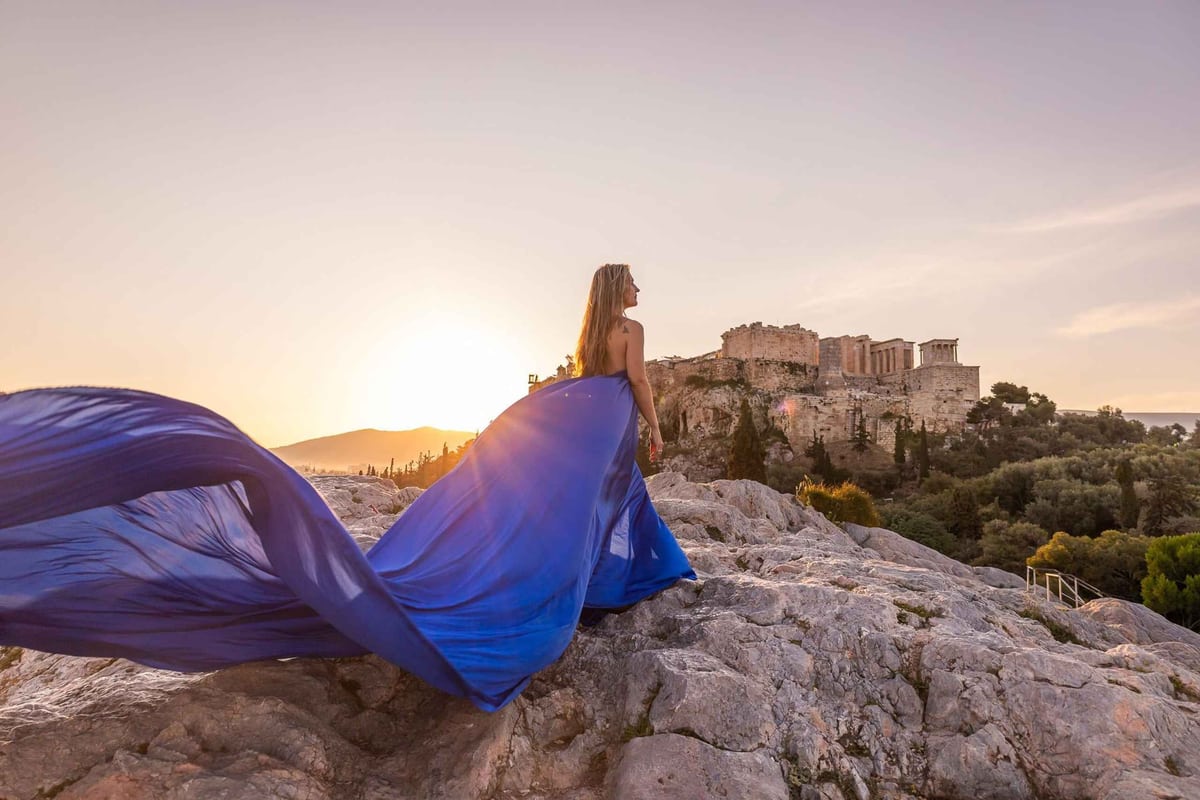
An Athens photo tour visits hills facing the Acropolis and the lanes of Plaka and Anafiotika. It climbs Lycabettus and stops at Monastiraki and the Evzones at Syntagma. It is one of the photo tours in Greece on Greece VIP.
It covers golden and blue hour, night shots and street art. It also covers camera tips and photo rules at sites. Each section ends with an Athens photo tour or photo shoot to book online.
What does an Athens photo tour include?
An Athens photo tour includes a walk with a photographer through the photogenic places of Athens. At every stop, the group gets help with framing and light. Each stop is picked for the picture it allows, not for its place in history.
On an Athens photo tour, the photographer chooses the viewpoints and walks the group between them. At each one, the photographer tells the group why the place was picked.
Framing is the choice of where the subject sits among the other objects in the picture. This choice decides what the picture says. On an Athens photo tour, the photographer shows how small moves change the same scene.
One move is a step to the side. Another is a lower angle, with the camera held closer to the ground. A third is a foreground, an object near the lens, placed along the edge of the frame.
The group tries each version on the spot and compares the results on screen. At the viewpoint, the photographer looks at each screen. Nobody has to rush a shot while others wait behind.
Light is part of every choice, because it shapes colour and texture before the shutter is pressed. The word photography joins two Greek roots: phōs, meaning light, and graphē, meaning drawing. So the craft means drawing with light.
On an Athens photo tour, framing and light matter more than the equipment. So a phone gets the same attention as a lens bag. The coaching for both covers where to stand, where to point and when to wait for a gap.
- Photographer: A working photographer leads an Athens photo tour. The photographer explains each choice of angle and position.
- Framing: The photographer shows what sits inside the edges of the picture and what stays out.
- Devices: An Athens photo tour welcomes phones and cameras of every kind.
- Group size: The groups stay small, so questions and feedback reach everyone.
An Athens photo tour sits beside the history walks of the city rather than replacing them. An Athens walking tour follows the story of each site. Together, the two walks give both the history of a place and a record of how it looked.


Which Acropolis views does an Athens photo tour shoot?
An Athens photo tour shoots the Acropolis from three spots. They are the Areopagus rock, Philopappos Hill and the pedestrian street below the south slope. Each spot gives the Parthenon a different frame. The foreground is a rocky outcrop, a marble monument or the slope itself.
The Areopagus is a rocky outcrop that faces the Acropolis. An Athens photo tour uses it as a platform for wide views over the city. The two rocks share an origin.
The hills of the Areopagus and Mouseion formed from the same nappe as the Acropolis. A nappe is a large sheet of rock moved far from where it formed. Erosion, the slow wearing away of rock, shaped the three hills out of it.
From the Areopagus, an Athens photo tour shows one landform from the top of its neighbour. As the group walks along the outcrop, the Parthenon shifts against the sky.
Philopappos Hill carries the monument of Philopappos, a tomb built of white Pentelic marble. An Athens photo tour treats the tomb as a foreground subject. On its upper level stand three statues.
Antiochus IV is on the left, Philopappos in the centre and Seleucus I Nicator on the right. Latin text on the tomb gives Philopappos the titles of consul and Arval brother. A consul was a top Roman official, and an Arval brother was a Roman priest.
The photographer frames the three figures first as a group, then one by one. The pictures range from a wide view of the facade, or front, to a single figure.
Between 1951 and 1957, the architect Dimitris Pikionis shaped the archaeological site around the Acropolis and Philopappos Hill. His paths use rough-finished marble in irregular shapes that are still strictly geometric. His terraces and steps carry local plants.
He also designed the tourist pavilion of Saint Demetrios Loumbardiaris. On an Athens photo tour, the paved paths act as lines that lead the eye toward the rock. The terraces give the frame a middle layer, between the front and the back of the picture.
Dionysiou Areopagitou Street runs beside the south slope of the Acropolis. In 2003 it became a pedestrian street, closed to cars. Near Philopappos Hill, it continues as Apostolou Pavlou Avenue.
Above the street, the Parthenon measures 69.5 by 30.9 metres and dominates the skyline of Athens. Its base bulges upward by 10.3 cm over 70 metres, and its columns and walls lean slightly inward. So an Athens photo tour treats the temple as a curved form.
- Areopagus: The English name comes from the Late Latin form of the Greek Areios Pagos.
- Socle: The tomb stands on a socle, or base, 3.08 metres high, faced with Hymettian marble slabs.
- Inscriptions: Greek text names Philopappos as son of Epiphanes, of the deme, or district, of Besa.
One walk along these two streets joins the view from below to the view from the hill. At each stop of an Athens photo tour, the group compares the same temple in a new frame.
What does an Athens photo tour frame in Plaka and Anafiotika?
An Athens photo tour frames the old neighbourhood under the Acropolis. Plaka is a labyrinth, or maze, of lanes. Anafiotika has white island-style houses with bougainvillea. The photographer picks angles that join the houses, the plants and the rock above them.
Plaka is also known for neoclassical architecture, a style that borrows the columns and shapes of ancient temples. An Athens photo tour uses both the lanes and the buildings. Adrianou Street runs north and south through the district and divides it in two.
Roman columns stand among the neoclassical houses. So do the Byzantine church of Agios Nikolaos Ragava, the Benizelos mansion and the Karolos Koun theatre. Byzantine refers to the Christian empire that ruled Greece in the Middle Ages.
One frame can therefore hold buildings from different periods. Plaka draws hundreds of thousands of tourists a year. So the photographer on an Athens photo tour picks angles that leave the crowd out.
Anafiotika sits inside Plaka. An Athens photo tour reads its history from the walls. The first two people to live there were listed as G. Damigos, a carpenter, and M. Sigalas, a builder.
Carpenters and stone and marble workers from other Cycladic islands followed them. Cycladic means from the Cyclades, a group of islands in the Aegean Sea. In 1950, part of the quarter was destroyed to make room for archaeological digs.
What stands now is the rest of the quarter. Each house is a small subject for the camera. The streets of Anafiotika carry no official names.
Instead, the houses are numbered Anafiotika 1, Anafiotika 2 and so on. A house number gives the photographer a detail to frame beside a door. Bougainvillea is a climbing plant with bright flowers.
The plant belongs to the Cycladic look of white walls and small spaces. On an Athens photo tour, its flowers supply colour in the foreground of the picture. The white walls fill the middle, and the terraces open onto the city.
- Levels: Ano Plaka, the upper level, lies directly under the Acropolis. Kato Plaka is the lower level.
- Polygnotou: This pedestrian street is lined with traditional shops.
- Alikokkou: Athenians once called the wider district this, after a Frankish family name made Greek.
An Athens photo tour ends in these lanes with pictures that need no monument. The photographer decides the order of the stops. So the group reaches the quietest corners with time to try each angle.
Why does an Athens photo tour climb Lycabettus Hill?
An Athens photo tour climbs Lycabettus Hill because its summit is the highest point in Central Athens. From there, the lens reaches the Acropolis and the Hellenic Parliament. The Temple of Olympian Zeus and the Panathenaic Stadium join them in a single sweep.
Athens spreads across a central plain known as the Attica Basin. Lycabettus, one of the tallest hills in the city itself, looks out over all of it.
An Athens photo tour turns in a full circle on the hill. Every frame gets a new background. Mount Aigaleo closes the basin to the west and Mount Parnitha to the north.
Mount Pentelicus closes it to the northeast and Mount Hymettus to the east. The Saronic Gulf lies to the southwest. So five edges give an Athens photo tour five horizons.
The Lycabettus Funicular, a cable railway, climbs from a lower station on Aristippou Street in Kolonaki. It ends at the Chapel of St. George near the top.
The Greek Tourist Organisation built the railway in the 1960s. It opened on 18 April 1965. A rebuild in 2002 replaced the motor, the brakes and both cars.
At its peak, the line carries about 400 people per hour. It runs entirely in a tunnel, so an Athens photo tour sees nothing from the carriage. The first frames come at the chapel.
The direction of the sunset decides where an Athens photo tour points the camera. Astronomy defines sunset as the moment the top edge of the Sun disappears below the horizon.
Seen from the Northern Hemisphere, the Sun sets to the northwest in spring and summer. It sets to the southwest in autumn and winter. At both equinoxes, the two days a year when day and night are equal, it sets due west.
In the cooler seasons, the Sun therefore drops toward the Saronic Gulf. In the warm seasons, it sets over the northwestern side of the basin.
- Name: Popular stories link the name Lycabettus to wolves that once hid on the hill.
- Myth: Athena dropped the hill while carrying a limestone mountain from the Pallene peninsula for the Acropolis.
- Peaks: The hill has two peaks, so an Athens photo tour has two places to set up.
Lycabettus is the wide-angle stop of an Athens photo tour, where the streets shrink in the frame. The chapel at the top supplies the foreground. The next stop, Monastiraki, reverses the scale, as the camera drops from the hilltop to the crowded square.
What does an Athens photo tour shoot in Monastiraki?
An Athens photo tour shoots the street life of Monastiraki Square. It frames the former Tzistarakis Mosque, the Byzantine Pantanassa church, the flea market lanes and Avissinia Square. Above the rooftops of the old town, the Acropolis closes the frame.
Monastiraki Square rarely sleeps, and an Athens photo tour treats that as the subject. Flea markets, fruit stalls and souvlaki joints, or grill shops, fill the bottom of the frame. All of Athenian history lies underfoot, from Classical and Roman times to Ottoman and modern days.
From the square, the line of sight toward the Acropolis crosses a mosque and a Byzantine church. One position therefore stacks three layers of the city into one picture. Rooftop cocktail bars on the square give an Athens photo tour a raised position with Acropolis views.
The Tzistarakis Mosque is a former mosque on the square. Its later lives give an Athens photo tour a story to frame. After Greek independence, it served as a barracks, a prison and a storehouse.
It also hosted a ball for King Otto in March 1834. A museum took over the building in 1918. An earthquake damaged it in 1981, and it reopened in 1991.
The small Pantanassa basilica stands on the same square. It is a long hall church from the 10th century. It is all that remains of a monastery complex.
The metro lets passengers out on Adrianou Street, the main street of the flea market. It was once part of the ancient city. On Saturday nights, junk sellers set up stalls and mix with the guests of the bars and restaurants.
Avissinia Square holds a second-hand bazaar, or market, named after the Jewish merchants Noah and Elias Yusurum. On Sundays, street bands play live music. The area south of the square becomes an open-air market, a busy scene for an Athens photo tour.
- Metro: The covered riverbed of Eridanos is visible behind the northbound line 1 platform of Monastiraki station.
- Exhibits: Like other metro stations, Monastiraki shows ancient objects or copies. It is an indoor stop for an Athens photo tour.
- Statue: A huge statue of Nike, found in Hadrian’s Library in 1988, is shown on the site.
From Monastiraki, an Athens photo tour moves on to Syntagma. There, the crowd of the market gives way to two figures who stand still.
How does an Athens photo tour capture the Evzones at Syntagma?
An Athens photo tour captures the Evzones at Syntagma during the hourly changing of the guard. It takes place at the Tomb of the Unknown Soldier. The tour also shoots the Grand Change on Sunday morning. Then the whole Presidential Guard marches with a military band.
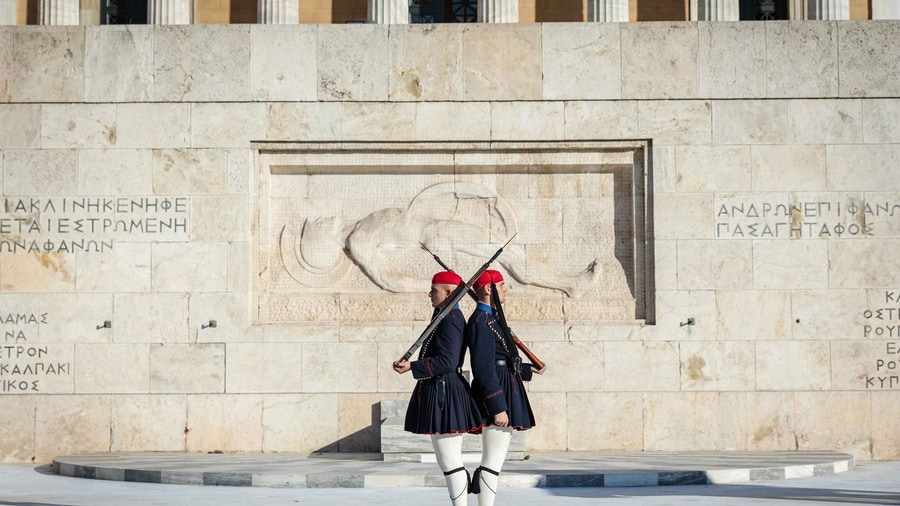
The Tomb of the Unknown Soldier is a war memorial, unveiled on 25 March 1932. It is a cenotaph, an empty tomb that honours the dead buried elsewhere. Its walls carry the names of battles, from the Balkan Wars to Crete and El Alamein.
Architect Emmanuel Lazaridis planned it as a Π-shaped retaining wall of limestone. A staircase runs up each side. The stairs are only for decoration, and people watch ceremonies from the steps.
Two Evzones of the Presidential Guard stand at the tomb, and their uniform rewards a close lens. The fustanella is a cotton kilt made from 30 metres of white cloth. It has supposedly 400 pleats, one for each year of Ottoman occupation.
The farion is a scarlet fez, or brimless cap, with a long black silk tassel. The national emblem sits on its front. The tsarouchia are red leather clogs with black pompons.
Each clog carries 60 to 120 nails under the sole and weighs about 1.5 kilos. So an Athens photo tour frames feet as well as faces.
Each hourly change involves two incoming and two outgoing sentries, or guards on watch. A Corporal of the Change supervises them. Guards on duty move in a very slow and highly formal way.
They switch positions every fifteen minutes. In between, they stay completely still. The Grand Change takes place at 11 am on Sunday.
The band and the majority of the 120 Evzones march from the barracks to the tomb and back. They march to the Evzonaki, a tune played at 48 beats a minute. An Athens photo tour treats this ceremony as the widest scene.
- Sunday dress: Formal dress with the fustanella is worn on Sundays and important national holidays. An Athens photo tour plans for Sunday.
- Rank: Yellow stripes on the lower waistcoat sleeves mark rank, two for sergeants and one for corporals.
- Legs: Two white woollen stockings cover each leg, held up by black silk garters, or bands.
- Height: A new Evzone must stand at least 1.87 metres tall.
Polite photography at the tomb starts from one fact. An Evzone in everyday uniform and police watch keep anyone from approaching or bothering the guards on duty.
So an Athens photo tour keeps its distance and shoots from the steps or the pavement. It waits for the change to take close frames. The guards stay at attention, and the photographer stays equally still.
How does golden hour and blue hour light shape an Athens photo tour?
An Athens photo tour follows the golden hour, when low sun turns daylight redder and softer. This light warms the pale marble of the monuments. In the blue hour, the sun sits below the horizon. The sky then turns deep blue behind lit buildings.
The golden hour is the stretch of daytime after sunrise or before sunset. The term has no fixed length and shifts with the season. An Athens photo tour is timed around it because contrast drops.
Contrast is the gap between the bright and dark parts of a picture. In this light, shadows stay less dark. Bright surfaces keep their detail.
Colour temperature shows how warm or cool light looks, measured in kelvin (K). It sits near 3,500 K in the golden hour and near 5,500 K at midday.
The monuments hold that light well. Pentelic marble has a uniform, faint yellow tint and shines with a golden hue in sunlight. The stone comes from Mount Pentelicus.
It went into the buildings of ancient Athens, above all on the citadel over the city. When low sun reaches the columns, an Athens photo tour sees the marble turn the colour of honey. Long shadows draw every edge.
Direction decides which face of a monument glows. The sun rises in the east, and the sunset point changes with the season. So an Athens photo tour plans each viewpoint by season.
The blue hour comes after sunset and before sunrise. Then the sun sits far below the horizon. Blue is strongest when the sun lies between 4 and 8 degrees below it.
Sharp shadows disappear, because the sun has set or not yet risen. Photographers favour this light for buildings, monuments and city views with artificial light. So an Athens photo tour reaches the lit streets while the sky still holds colour.
- Golden hour: Low side light gives the columns shape on an Athens photo tour.
- Blue hour: Even skylight lets lamps and lit windows stand out.
- Marble: Pale stone picks up the sky, warm at dusk and cooler later.
- Direction: A west-facing wall brightens in the evening and an east-facing wall in the morning.
On an Athens photo tour, light is the first decision. The same monument looks different at each hour, and midday sun draws hard highlights and dark shadows. A route from late afternoon into twilight collects both the golden and the blue light.
What does an Athens photo tour shoot at night?
An Athens photo tour shoots the floodlit Acropolis and the city lights from high ground. Moving traffic stretches into light trails. Long exposures on a steady tripod do the work. This starts once the blue hour has faded and the sky has turned dark.
The floodlit Acropolis is the first subject after dark. The lit marble stands bright against a black sky. That wide gap between light and dark is the hard part of the picture.
Night photographers answer it with exposure stacking and high dynamic range imaging, both standard in city night photography. An Athens photo tour frames the rock from the streets below. There, floodlights lift the stone out of the dark.
Long exposures do the main work at night. A long shutter keeps fixed things sharp and blurs moving ones. Vehicle lights draw bright streaks along the road.
Exposures that run to minutes make walking people vanish from the frame. Night photography uses exposures from seconds to days, a higher ISO or added light. ISO is the camera’s sensitivity to light.
An Athens photo tour leans on the long shutter, since a high ISO costs image quality. It adds noise, a grainy speckle across the picture.
City lights need height. Athens is built around a large number of hills. From high ground, the streets turn into a field of lamps.
Mount Parnitha, the highest peak in Attica at 1,413 metres, shows the reach of such a view. Its summit, about 30 km north of the city centre, takes in central and northern Greater Athens. An Athens photo tour uses the nearer hills for the same effect.
A steady camera matters as much as the view. A camera that stays still while the shutter is open gives a clear, vivid picture. That is why night work needs a tripod, a three-legged stand.
Tripod legs need room, so an Athens photo tour sets up away from stairs, doorways and busy paths. Photographers stay with the group on lit streets. They keep bags zipped and straps on, and watch their footing on polished stone.
- Frame: A wide frame holds the lit rock and the dark sky together.
- Trails: Passing cars leave white and red streaks along the avenues beneath the hills.
- Support: A solid wall can stand in for a tripod through a long exposure.
- Footing: Flat shoes and a small torch make the walk down from a viewpoint safer.
The Athens night tour covers the evening, with the lit monuments, the food and the bus rides. An Athens photo tour spends the same dark hours on fewer places and more frames.
It waits for a gap in the traffic and repeats an exposure. It checks the sky until the light and the picture agree.
What does an Athens photo tour find in Psyrri and the street art districts?
An Athens photo tour finds murals in Psyrri, Kerameikos, Exarcheia and Gazi. They sit on the side walls of hotels and other public spaces. The works can carry political and social messages. The tour records each one as it stands, because street art can change or vanish.
The Greek National Tourism Organisation points visitors to these murals, or large wall paintings. It calls street art a branch of culture grown very popular in Greece in recent years.
An Athens photo tour treats a tall side wall as a frame. A flat wall lets the photographer stand square to it, or face it straight on.
The muralist INO paints across these districts. Apocalypse Now (2021) in Psyrri shows a person in a balaclava, a knitted mask. The figure watches the people at the junction of two streets.
System of a Fraud (2013) in Metaxourgeio shows the face of Solon, drawn from carved busts. Clockwork (2013) in Gazi shows a man with empty eyes and a winding key in his temple. An Athens photo tour can link the three in one walk.
Respect for the artists shapes the pictures. An Athens photo tour credits the artist by name and asks before any commercial use. Street art accepts impermanence, the fact that it will not last.
So a photograph can become the only record of a wall. Greek copyright law 2121/1993 has no freedom of panorama, the right to share pictures of public art freely.
The only exception lets the mass media copy such works from time to time. It applies only to works sited for good in a public place.
- Distance: INO’s Wake Up (2014) covers the narrow side of an eight-storey building in Exarcheia. It was photographed from a parking garage across the street.
- Credit: A caption naming the artist, the work and the district keeps the record clear.
- Signature: The artist’s mark in the frame of an Athens photo tour ties the picture to its maker.
The Athens street art tour reads these walls for their history, their artists and their techniques. An Athens photo tour reads them for their light and their frames.
It returns to the same wall at another hour to see how sun and shade change the paint. It leaves the wall as it was found.
Which camera and phone tips does an Athens photo tour teach?
An Athens photo tour teaches simple framing and exposure habits. The subject goes on the rule of thirds, and lines lead the eye. In strong sun, the exposure is held back. A phone stays steady and close instead of zoomed in.
The rule of thirds divides the frame into nine equal parts with two horizontal and two vertical lines. An Athens photo tour places the subject on those lines or where they cross.
The same rule sets the horizon on the top or bottom line, not through the middle. John Thomas Smith first wrote the expression down in 1797, in his book Remarks on Rural Scenery. Photographers on an Athens photo tour still follow it.
Leading lines are lines that lead to the main subject of a composition, or picture layout. A row of columns, a marble path or a flight of steps works as one.
Fifteen columns of the Temple of Olympian Zeus still stand, each 17.25 metres high. The temple lies about 500 metres southeast of the Acropolis. An Athens photo tour frames the columns as a single row that carries the eye to the sky.
Bright marble makes strong sun the main test on an Athens photo tour. Clipped highlights, bright areas pushed to pure white, lose information. The loss can be permanent.
Exposure is the amount of light that reaches the sensor. A camera starts from the Sunny 16 rule, which sets the lens opening to f/16.
The shutter speed is one over the ISO, so 1/100 second at ISO 100. A negative exposure compensation then holds the marble back. This setting lets in less light than the camera measures.
Phones need different habits from cameras. A digital zoom crops the image and scales it up, so detail is lost. A step closer to the subject keeps the quality.
In bright scenes, an HDR mode combines frames taken at different exposures into one picture. That picture has a wider dynamic range, from dark to bright. On an Athens photo tour, dragging the brightness slider holds back a sunlit column the same way.
- Thirds: Placing the subject off-centre creates more tension, energy and interest than centring it.
- Depth: Lines in a frame give a sense of depth. A foreground step adds distance to a wide scene.
- Stops: One stop doubles or halves the light. A setting of minus one on exposure compensation means half the exposure.
These habits cost nothing and fit any device. Each rule can be tested again at the next column, step or wall.
An Athens photo tour turns an afternoon among the ruins into a skill that travels. The traveler leaves with a method as well as a set of pictures.
Which photography rules apply on an Athens photo tour?
An Athens photo tour follows the rules of the Greek Ministry of Culture. Personal photos without flash are allowed at archaeological sites. Professional shoots and filming need a license, and tripods face limits at museums. Drone flights over archaeological sites need prior approval.
An Athens photo tour is a personal activity, and the Ministry of Culture treats it as one. A Ministry decision permits photos with a simple portable amateur camera and no flash.
This applies in museums, open archaeological collections and archaeological sites, if the pictures are not for professional use. Flash without permission is prohibited. The Acropolis, a World Heritage Site since 1987, falls under the same Ministry, so the rule applies there.
An Athens photo tour that adds professional work follows another path. Professional photography, filming or video recording needs a license before it starts. The license comes from the competent Ephorate of Antiquities, a museum or an Archaeological Council.
An Ephorate of Antiquities is a regional Ministry office for ancient sites. For filming, the application goes in at least one month ahead, with a list of equipment and crew. The Central Archaeological Council then gives an advisory opinion, or formal advice.
A traveler who plans to carry a tripod to an open site asks the Ephorate first. Inside the Acropolis Museum, flash, portable lights and tripods are not allowed.
Drones fall under the Hellenic Civil Aviation Authority. It bars flights over archaeological sites without its prior approval. Its Drone Aware Greece map marks these sites as yellow and magenta zones.
In those zones, flights are either permitted under conditions or entirely prohibited. A request goes in at least 5 days ahead. Drone work on an Athens photo tour begins with that approval.
- Publishing: Professional photographers publish museum material in print or electronic media only with the museum’s written permission.
- Air and water: The same license rule covers photographs and filming made by air or underwater.
- Registration: A drone operator not registered in another EASA member state registers in Greece before flying.
The rules protect the monuments, not the camera. Rules change, so the Ministry of Culture and the Civil Aviation Authority hold the current text. The Ephorate of Antiquities answers questions about a single site.
What do travelers ask about an Athens photo tour?
An Athens photo tour raises common questions. Travelers ask if a phone or a camera suits better and if beginners can join. They ask which time of day works best. They also ask about a photo shoot of themselves and pairing Athens with an island photo tour.
Is a phone or a camera better on an Athens photo tour?
Either works on an Athens photo tour. A phone is light, always at hand and quick to raise among crowds. A camera adds longer reach and manual control.
The choice rests on comfort and not on skill. A traveler who owns only a phone joins the full day with the rest of the group.
Can beginners join an Athens photo tour?
Beginners join an Athens photo tour without trouble, because the day is built around learning. The tour leader explains framing and exposure step by step. The leader also shows how to read the light on marble.
Each traveler tries the settings at the next stop, and each beginner gets time with the instructor. A phone or camera, comfortable shoes and curiosity are all the day asks for.
What is the best time of day for an Athens photo tour?
Summer in Athens is hot and bright. Downtown Athens has a hot-summer Mediterranean climate. The average daily high is 34.3 °C in July and August.
July brings 362.7 hours of sunshine, and December brings the shortest total, at 127.1 hours. In summer, an Athens photo tour therefore starts early or late, when the sun sits lower. The walking is cooler then.
Does an Athens photo tour include a photo shoot of the travelers themselves?
A photo shoot of the travelers themselves is a separate service from an Athens photo tour. On a tour, each traveler takes the pictures. In a shoot, a photographer works with the traveler as the subject and chooses poses, places and light.
The National Garden, 15.5 hectares of paths and trees, gives a green setting away from the monuments. Queen Amalia ordered the garden in 1838.
Can an Athens photo tour combine with an island photo tour?
Athens combines easily with an island trip. Santorini belongs to the Cyclades and lies about 200 km southeast of the mainland. Ferries from the port of Piraeus reach the Cyclades.
A traveler can start with an Athens photo tour and then follow the Santorini photo tour. There, the subjects change from marble ruins to volcanic cliffs.
Featured photo: Athens flowing dress photoshoot, via GetYourGuide.