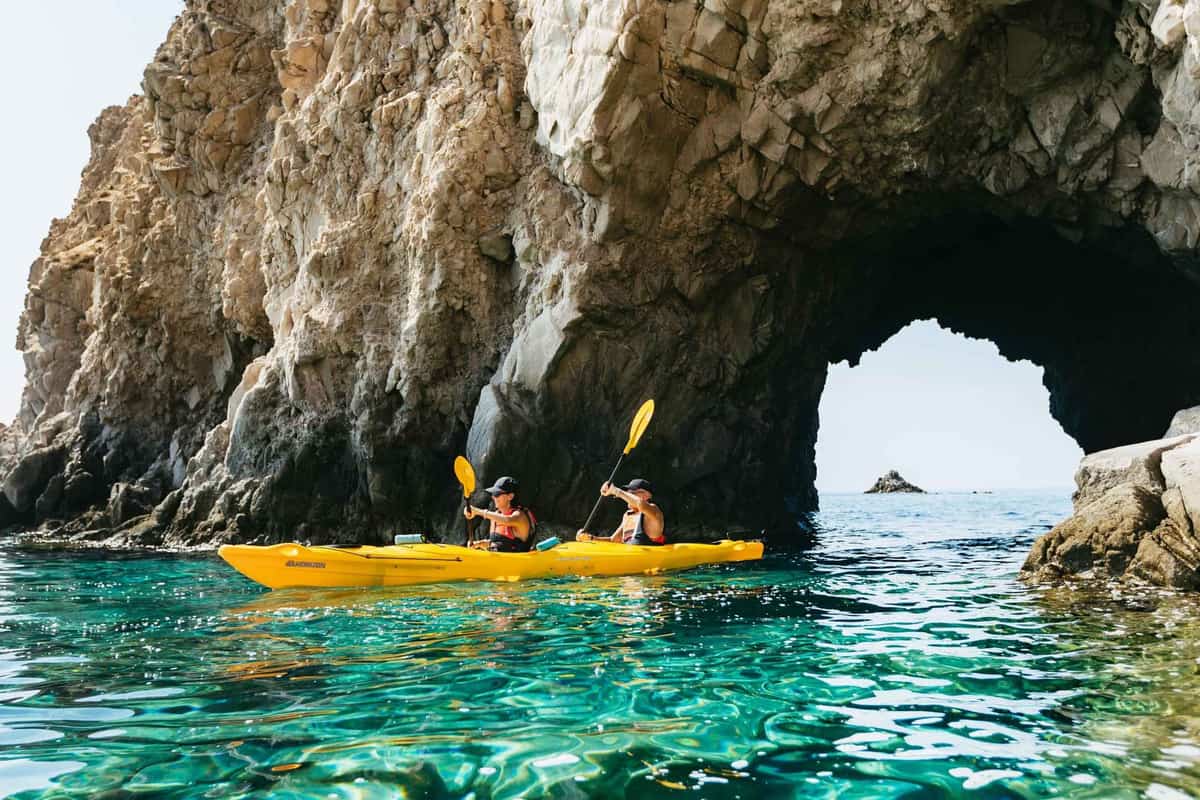
A Milos kayak tour takes paddlers into sea caves and under rock arches that larger boats cannot reach. It is one of the sea kayaking tours in Greece on Greece VIP.
This post covers what a Milos kayak tour includes, the kayaks and skills, and the launch beaches. Kleftiko, Sykia cave, and the wind and the sea come next. Multi-day trips and the best season close the list.
Each section ends with a Milos kayak tour or boat trip that can be booked online.
What does a Milos kayak tour include?
A Milos kayak tour is a sea kayak outing along the volcanic coast of Milos. An instructor leads it. The outing covers a safety briefing, a paddle along the shore, and swim and snorkel stops. A picnic on a beach follows.
Milos sits at the south-western end of the Cyclades, an island group in the Aegean Sea. Volcanic activity there began two to three million years ago. The volcano is now considered dormant, which means quiet but not extinct.
Tuff, trachyte and obsidian are the ordinary stones of the island. Tuff is pressed volcanic ash, and trachyte is a lava rock. Obsidian is a natural glass that forms when lava cools very fast.
This volcanic rock shapes every Milos kayak tour. The paddler sees the cliffs from below, at the line where the sea meets the stone. A Milos boat tour covers the same coast from a deck.
A Milos kayak tour starts on the beach with the instructor. The safety briefing covers the route, the hand signals and the rule of staying together on the water. Hand signals are arm signs that the group reads at a distance.
The Milos kayak tour then follows the shore. At the swim stops, the group snorkels over the rocks. Snorkelling means swimming face-down at the surface while breathing through a short tube.
- Instructor: The expert stays within reach of every paddler.
- Snorkel gear: A mask and a snorkel go aboard for the swim stops.
- Rock colours: The coast shows white, red, yellow and black rock along the shore.
On a Milos kayak tour, the coast sets the pace of the day. The volcanic rock changes shape from one stretch of shore to the next. Each bend brings a new view.

Which kayaks and paddling skills suit a Milos kayak tour?
A Milos kayak tour suits sit-on-top kayaks and sea kayaks, with double kayaks for pairs. Buoyancy aids stay on the whole time. A short lesson on the beach teaches the basic paddle stroke. No earlier kayak experience is needed.
The sit-on-top kayak has an open seat moulded into its top. It is the usual choice for a Milos kayak tour with swim stops. Its seat sits slightly above water level.
Scupper holes run from the seat area to the bottom of the hull. These small drains let sea water flow straight out of the boat. Sit-on-tops are wider and slower than a traditional closed kayak of the same length.
The extra width makes up for their higher centre of gravity, the point where the weight balances. Divers favour this type, and so do anglers, people who fish with a rod and line.
A sea kayak is built for open water on bays and coasts, with a covered deck. A solo sea kayak runs from 3.0 to 5.5 m long. A tandem model, built for two, reaches up to 8 m.
A personal flotation device is a vest that stops the wearer from drowning. A buoyancy aid is the foam kind, built for comfort. A lifejacket keeps a person afloat with air chambers, sealed pockets of air, instead of foam.
The group tries the stroke on the sand before the Milos kayak tour enters the sea. A double-bladed paddle has a blade at each end. Each blade pulls through the water in turn, on alternate sides.
- Sit-on-top: The open seat makes a swim stop easy to start and easy to end.
- Double kayak: Both paddlers keep one pace in the shared boat.
- Buoyancy aid: The vest leaves the arms free to paddle.
On the beach, the instructor matches a kayak to each pair or single paddler. Each person gets a vest and a paddle that fit. The Milos kayak tour then sets off with everyone paddling in step.
Where does a Milos kayak tour launch?
A Milos kayak tour launches from a beach or a bay on the island’s coast. The south coast near Firiplaka is one natural starting point. The north-eastern village of Pollonia is another. The instructor picks the launch point that fits the route.
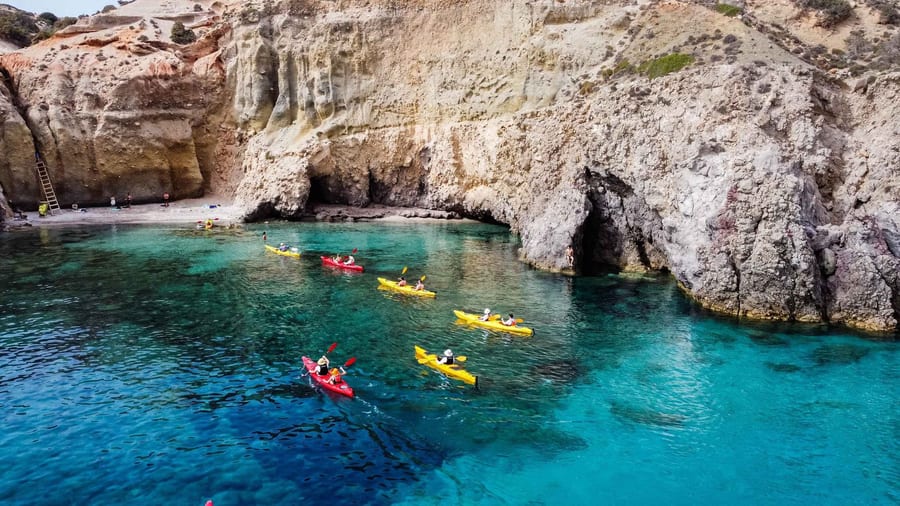
Firiplaka sits between Provatas to the west and Tsigrado to the east. Towering volcanic cliffs rise behind its beach. The sand is fine and snow-grey, with white pebbles, and the water by the shore is shallow.
A Milos kayak tour that starts here sets off with the cliffs at its back. A road reaches the beach. Boats from the port of Adamas also go round the island to Firiplaka.
Pollonia is a seaside village and the second harbour of Milos. A small boat links it with Kimolos, the neighbouring island to the north-east. A channel just 1 km wide separates the two islands.
The village had 268 inhabitants at the 2021 census, the official count of people. It has a sandy main beach, with Polychroni’s beach and Piso thalassa beside it. Piso thalassa is Greek for the back sea.
A Milos kayak tour from Pollonia therefore has three beaches to choose from. Any launch beach needs a safe landing and a clear run along the shore. The Milos kayak tour begins and ends on sand, with the instructor waiting at the water’s edge.
- Choice: The island has over 70 beaches, so the range of launch points is wide.
- Harbour town: The cultural and commercial centre of the island sits on the main harbour.
- Name: Pollonia takes its name from a temple of Apollo that stood east of the village.
What does a Milos kayak tour see at Kleftiko?
A Milos kayak tour sees white volcanic rock, tall arches and sea caves at Kleftiko. The cove lies on the south-west edge of the island, beside Cape Psalida. Over the centuries, wind and sea cut the grey-white stone into odd shapes.
The municipal tourist portal of Milos also notes hollows in this rock. The Aegean Islands portal adds smooth white rocks, underwater caves and small sandy bays. The national tourism organisation speaks of huge white rock formations rising from the sea.
A Milos kayak tour passes each arch slowly, at the waterline. The Aegean Islands portal says the caves of Kleftiko easily fit a big inflatable boat.
The municipal kayak page calls the sea caves and tunnels of Milos ideal for exploration. A sea kayak is far smaller than a big inflatable boat. So a Milos kayak tour reaches the narrow gaps between the rocks.
Tourist boats and private yachts are almost always moored, or anchored, at Kleftiko. A kayak slips through the narrow water between those boats and the rock.
- Nickname: The rocks carry the name Thalassina Meteora, the Sea Meteora.
- Water: The shallow water on a Milos kayak tour shows green and turquoise colours.
- Posters: The cove stars in posters of the Greek Tourism Organization.
Pirates gave Kleftiko its name, from the Greek word for thief. The municipal portal says the cove served pirates as a refuge and base. The Aegean Islands portal says they hid in its caves and hidden coves.
Another page of that portal says the cove was a base of operations during the Turkish occupation. A Milos kayak tour now paddles past those pirate hideouts.
How does a Milos kayak tour reach Sykia cave?
A Milos kayak tour reaches Sykia cave from the sea. The cave is accessible only by sea. It lies on the western coast of Milos. The cave has no roof, so the sky is open above the water inside it.
Boat routes on the Aegean Islands portal pass the Arkoudes, or the Bears, rocky islets near Cape Vani. They circle the north-western coast and the whole western coastline, then pass the cave of Sykia.
The national tourism organisation says a caique trip around the island visits Sykia. A caique is a traditional wooden fishing boat. It calls Sykia one of the largest sea caves on Milos.
The municipal portal of Milos lists Sykia among the western spots of the island. A Milos kayak tour therefore follows the western coast to find it.
Waves open sea caves along weak zones in the rock. These zones include faults, dikes and bedding-plane partings. Those are cracks, old lava walls and gaps between rock layers.
A cave loses its roof when the rock above collapses, which leaves a sinkhole. At Sykia, the municipal portal says, sunrays light the emerald water inside. A Milos kayak tour sees this feast of colours and brilliance from the water.
- Cliffs: Steep cliffs form the shore of the western coastal zone beyond its beaches.
- Rock: The western coast consists of volcanic rocks of the Plio-Pleistocene era.
- Landslides: Landslides after past volcanic activity are a possible threat to the sea caves of the zone.
The western coastal zone of Milos forms a Natura 2000 site. Natura 2000 is the network of protected nature areas in the European Union. The sea caves of the zone shelter the Mediterranean monk seal.
The site record calls uncontrolled boat excursions and diving a nuisance and a possible threat to seals. A Milos kayak tour reaches Sykia in a human-powered craft, so no engine runs beside those shelters.
How do the wind and the sea shape a Milos kayak tour?
A Milos kayak tour is shaped by the meltemi. This is the strong, dry north wind of the Aegean in summer. A bay on the south coast lies in the lee, out of the wind, and gives shelter. The route follows the wind.
The national tourism organisation says the meltemi cools the dry, hot days of summer. The wind is also called the etesians. It blows strongest in the afternoon and can die down at night.
Sometimes it lasts for days without a break. It rises in clear weather without warning. It can reach force 7 to 8 on the Beaufort scale.
A clear sky therefore does not promise calm water on a Milos kayak tour. Wind direction decides which coast gives shelter. The Aegean Islands portal names that southern bay: Agios Dimitrios.
The portal also lists Pollonia as protected from the meltemi. A south wind reverses the picture. Rivari, an enclosed gulf on the south-west, is then the suggested shelter.
In a south wind, the port of Adamantas, also called Adamas, becomes hard to reach. A Milos kayak tour therefore picks its coast by the wind of the day.
- Moderate gale: Force 7 means wind of 50 to 61 km/h and waves of 4 to 5.5 m.
- Gale: Force 8 means wind of 62 to 74 km/h and waves of 5.5 to 7.5 m.
- Fetch: The open water the wind crosses, plus wind speed and duration, sets the size of waves.
The Hellenic National Meteorological Service issues a marine bulletin, a sea forecast, for Greek sea areas. They include the Central Aegean and the Southwest Aegean.
The bulletin gives wind in Beaufort force and the sea state as significant wave height. That is the average height of the highest third of the waves. The highest single waves can reach twice that figure.
The bulletin also warns that gusts, or sudden bursts of wind, can be 40 percent stronger than stated. A Milos kayak tour chooses its route by this forecast.
What is a multi-day Milos kayak tour like?
A Milos kayak tour that runs over multiple days works as a chain of paddling legs. Each leg ends on the shore. The kayak carries camping gear, food and water. Nights are spent on land before the next stretch begins.
Milos measures roughly 23 km from east to west and 13 km from north to south. Its natural harbour was formed by the main volcanic crater, the bowl-shaped top of the old volcano. Around that outline, the coast is varied, with beaches set between rock faces.
Sea kayaks are designed to carry that load, with room for other supplies too. Expedition kayaks, built for long trips, handle best when loaded. That design makes a multi-day Milos kayak tour practical, because the boat doubles as the pack.
Overnight camping from a sea kayak is a popular form of the sport. On Milos, the routine runs in a loop: land, set up camp, reload and paddle on. Every leg depends on the sea of the day, and the instructor picks each landing.
- Kimolos: The island covers 36 km² and had 810 residents at the 2021 census.
- Polyaigos: The uninhabited island covers 18.146 km² and has a coastline of 22 to 27 km.
- Agios Efstathios and Agios Georgios: These two uninhabited islands lie in the Kimolos municipality.
The neighbouring islands widen the map of a Milos kayak tour beyond the main island. Only Kimolos has a port. The coast changes character as the route moves outward.
When is the best season for a Milos kayak tour?
A Milos kayak tour fits the dry months best. The island of Milos has a Mediterranean climate, like the coasts around that sea. Winters are mild and rainy, while summers are warm to hot and dry. Monthly figures show rain almost disappearing from June to September.
Milos has an average temperature of 17.4°C and 410.8 mm of rain a year. Its record heat is 44.0°C, set in June. So a Milos kayak tour in high summer needs shade ashore and plenty of water in the boat.
Aegean surface water, the top layer of the sea, reaches 19 to 24°C in summer. In winter it runs from 8°C in the north to 13°C in the south. In spring and autumn, the sea lies between those two ranges.
Spring and autumn are the shoulder seasons, the months just before and after summer. They bring air that is warm without the summer peak. In autumn, rain returns gradually, month by month, rather than all at once.
- Winter: December is the wettest month at 90.3 mm, and January averages 10.5°C.
- Spring: April averages 15.2°C with 20.5 mm of rain, and the next month 19.3°C.
- Summer: July peaks at 25.0°C with 0.3 mm of rain.
- Autumn: September averages 22.3°C with 5.8 mm, and October 18.5°C.
The best season for a Milos kayak tour runs from early summer into September. Late spring and October are cooler options for travelers who dislike heat. Still, the weather on the water settles each departure, since monthly figures describe climate, not a single day.
What do travelers ask about a Milos kayak tour?
A Milos kayak tour raises five questions. Two concern the fitness needed and whether children can join. Two more cover snorkelling from the kayak and the look of Sarakiniko’s white rocks from the water. The last asks how a sailing day fits in.
How much fitness does a Milos kayak tour need?
Fitness for a Milos kayak tour depends on the boat and the sea. Sea kayaks take one to three paddlers. A shared boat spreads the work, while a single kayak leaves it all to one paddler.
Rudders and skegs help when strong wind or waves come from any direction but straight ahead. A rudder is a steering blade, and a skeg is a fixed fin under the hull. Both help hold the kayak on course.
Can children join a Milos kayak tour?
Children can join a Milos kayak tour within the age rule of the booked departure. Buoyancy aids are also made in versions for children and youth. Kayaks for children under 45 kg are broad-beamed, or extra wide, and meant for beginners.
A child’s vest has understraps that run between the legs. They stop the vest riding up. A headrest flap behind the neck holds the head clear of the water.
Is snorkelling possible on a Milos kayak tour?
Snorkelling on a Milos kayak tour needs a mask, a snorkel, fins and only very basic swimming ability. Organisations recommend swimming with a buddy, a partner who stays close. Monk seals are very sensitive to human disturbance, so snorkellers avoid the caves where they rest.
Can Sarakiniko’s white rocks be seen on a Milos kayak tour?
Sarakiniko sits on the north shore of Milos. A small beach of white sand lies beside it. There, waves driven by north winds have worn down the greyish-white volcanic rock over time.
The rock is bone-white. It is likened to a moonscape, the bare, cratered surface of the moon. Whether the paddle passes Sarakiniko depends on the route of each departure.
Can a Milos kayak tour be combined with a sailing day?
A Milos kayak tour combines well with a sailing day booked separately. The two show the same volcanic coast at different speeds, slow by paddle and faster by sail. A Milos sailing tour covers distance under wind power and gives the wide view of the island.
Featured photo: Milos Tsigrado and Gerakas beach kayaking tour, via GetYourGuide.