
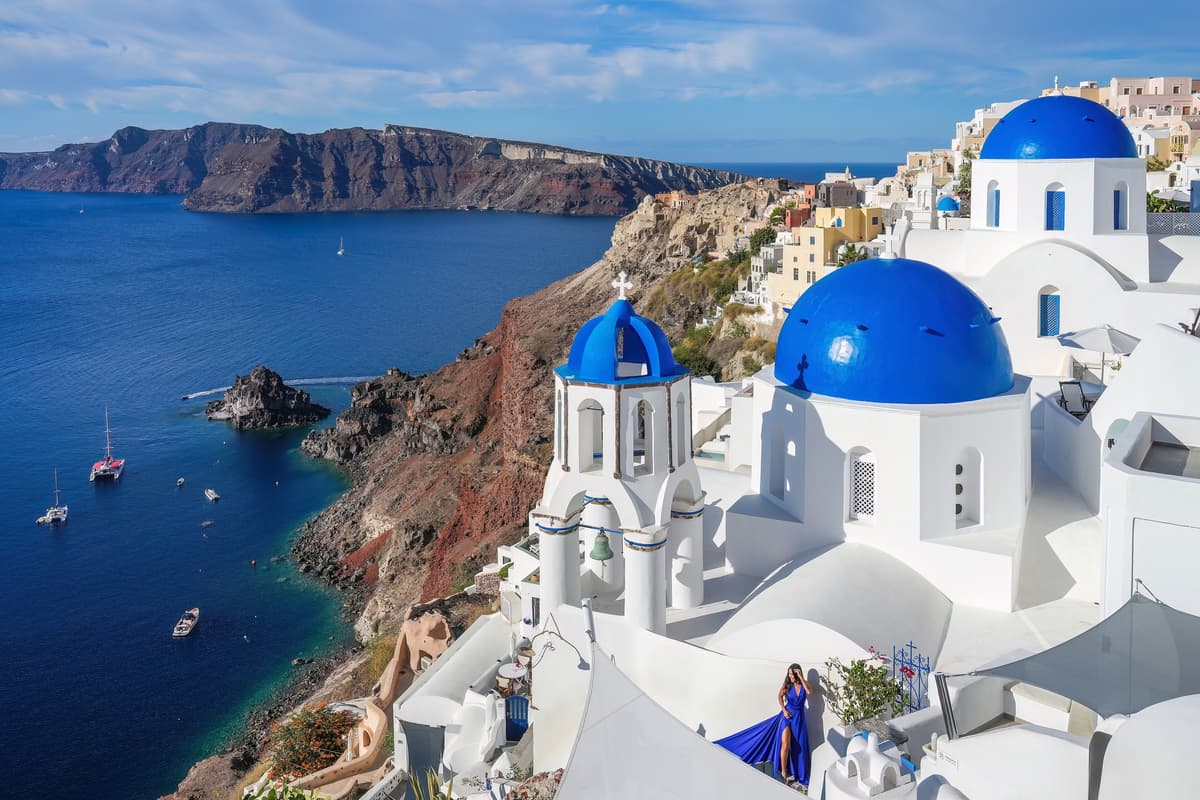
A Santorini photo tour leads travelers to the island’s best photo spots. Each stop is timed for the best light. Stops run from the blue domes and windmills of Oia to the caldera path of Imerovigli. It is one of the Greece tours on Greece VIP.
This post covers what a Santorini photo tour includes. Then come the spots in Oia, Fira, Firostefani and Imerovigli. Next come the light, the inland villages and the volcanic beaches. Photo shoots, camera and phone tips, the rules, the Akrotiri lighthouse and the best season follow.
Each section ends with a Santorini photo tour or photo shoot. All of them can be booked online.
What does a Santorini photo tour include?
A Santorini photo tour includes a walk or drive with a photographer to the island’s photo spots. Stops run from the caldera rim to the whitewashed villages. The timing follows sunrise or sunset light. Each stop leaves time for framing and shooting.
The island group lies in the southern Aegean Sea and belongs to the Cyclades island group. Its caldera, a huge volcanic crater filled by the sea, sits 120 km north of Crete. The caldera measures about 12 by 7 km.
Steep cliffs of 300 m rise along the bay, which reaches a maximum depth of 385 m. Nea Kameni and Palea Kameni sit near the centre of the bay. Therasia and Aspronisi close the ring.
The caldera ranks among the world’s sixteen Decade Volcanoes. That is a short list of volcanoes chosen for close study. So the landform itself is the main subject of a Santorini photo tour.
A walk keeps the caldera in view along the crest, the top edge of the cliffs. A drive on a Santorini photo tour reaches points that stand far from the villages. The island covers 75.8 square kilometres. So one route can pair the rim with the outer slopes.
Light sets the order of the stops. The caldera wall turns warm as the sun drops. A Santorini photo tour plans around the sun rather than the clock. Contrast is the gap between the darkest and brightest parts of a picture.
- Route: The photographer sets both the walking line and the driving line.
- Timing: Stops fall in the first and last hours of daylight, when contrast is low and colour holds.
- Subjects: White walls, blue domes, caldera water and the layered cliff face fill each frame.
- Group size: Small groups fit the narrow lanes and let the photographer help each person in turn.
The sunset route sets the pattern. The group meets on the rim and works the villages in warm light. It finishes above the water as the sky changes colour.
A Santorini photo tour booked through that link follows the same plan on a chosen date. The photographer knows where the light lands at each hour.


Which spots in Oia does a Santorini photo tour visit?
A Santorini photo tour in Oia visits the blue-domed churches and the old windmill. It climbs to the ruined castle at the highest point of the village. Below lies Ammoudi Bay, where 200 steps drop to the port. Cave houses line the lanes between them.
Oia stretches for almost 2 km along the northern edge of the caldera. It sits 70 to 100 m above sea level. So the village forms a long terrace, a flat shelf of land, above the water.
Houses and cave rooms are cut into niches, small hollows in the caldera face. Narrow passageways lead to them. A Santorini photo tour works those lanes in order, from the eastern entrance to the western end. The view changes with each step.
The ruined castle is also known as Fort Londsa. It was once the seat, or main home, of the Argyri family. The steep stairs down to the harbour start just north of the castle. A Santorini photo tour ends the day above the water, where the last light reaches the cliffs.
On 9 July 1956, an earthquake of magnitude 7.8 struck. That is a very strong shock on the scale used for quakes. It caused heavy damage in the village. By 1977 the population had fallen to 306 inhabitants.
- Blue-domed churches: White churches with blue roofs stand along the lanes, with the caldera behind their domes.
- Old windmill: A windmill near the top of the village appears on postcards of Oia.
- Castle ruins: The fort gives a wide view over the bay and the village roofs.
- Ammoudi Bay: A Santorini photo tour walks down to its small harbour and pebble beach.
Ending at the water gives one view of the village from below. The castle gives another view from above. The route works best when the group moves early. It keeps to the western end for the last light of the day.
Which spots in Fira, Firostefani and Imerovigli does a Santorini photo tour visit?
A Santorini photo tour on the western rim visits Fira, Firostefani and Imerovigli. The caldera path links the three villages, with the cliffs below the houses. Skaros rock holds a ruined Venetian castle. Churches with blue domes and bells stand along the route.
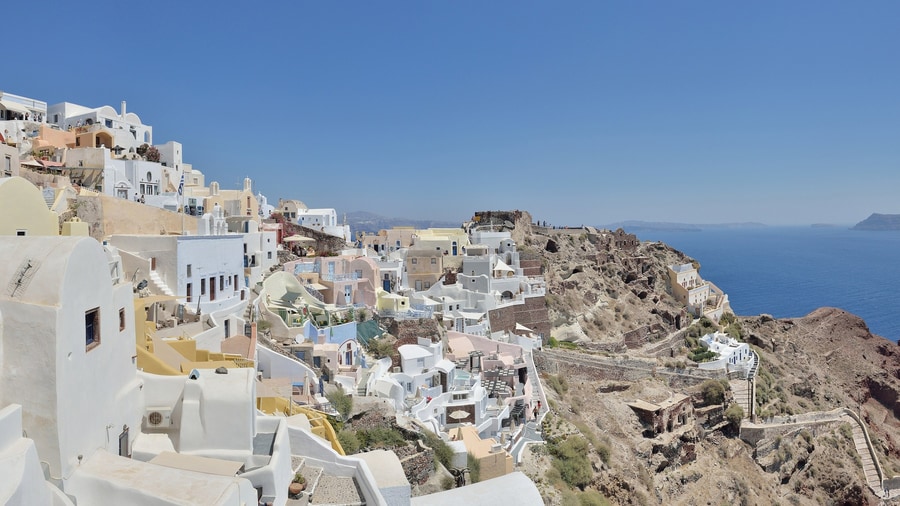
Fira is the island’s modern capital, with 1,516 permanent inhabitants, people who live there all year. Its whitewashed houses stand on the edge of the caldera. Whitewash is a thin white coat made from lime and water. The cliff wall rises about 400 m at that point.
On a Santorini photo tour, the rim walk leaves the town to the north. It passes Firostefani, one of the villages perched on the crest of the caldera. Imerovigli lies further along the same rim, crossed by narrow paved paths.
Imerovigli has 469 permanent inhabitants. Its churches follow the Cycladic style, the plain whitewashed way of building on these islands. They include Ai-Stratis in the village centre. The monastery of Saint Nikolaos stands on the path to Fira.
Skaros rock rises beside the village and holds the remains of a Venetian castle. Marco Sanudo built the castle in 1207. Volcanic activity dated to 68,000 BC formed this promontory. A promontory is a rocky point that juts out over the sea.
Erosion and earthquakes later shaped the rock, wearing it down over time. A Santorini photo tour stops on it for the view back along the rim.
- Caldera path: A Santorini photo tour follows the paved rim walk from south to north.
- Skaros rock: The rock is reached on foot from Imerovigli.
- Churches: The Three Bells of Fira, a blue-domed church, was built in 1757 above the cliffs.
- Cliffs: The caldera runs about 18 km from the southern cape to the northern cape.
A Santorini photo tour on the rim frames white houses against dark water. The villages sit close together, so the group walks between them without a vehicle. The light holds on the cliffs late in the day.
How does light shape a Santorini photo tour?
A Santorini photo tour follows the light. Golden hour comes just after sunrise or before sunset and turns white walls warm and soft. Blue hour follows sunset and washes the caldera in a blue cast. It also softens the shadows under the houses.
The term golden hour is figurative, not a real hour on the clock. The effect has no fixed length. It changes with the season and the latitude, which is the distance from the equator.
On the island the low sun throws long shadows from the houses and the cliff edge. Colour temperature, a measure of how warm or cool light looks, shows the shift in the light.
Shortly after sunrise or before sunset, colour temperature reads about 2,000 kelvin (K). Kelvin is the unit for this measure. It reads about 3,500 K during the golden hour. At midday it climbs to about 5,500 K.
Blue hour is a part of twilight, the dim light between day and night. The sun then sits below the horizon. The blue shade is strongest when the sun is 4 to 8 degrees below it.
That happens just after sunset and just before sunrise. A Santorini photo tour that stays out after sunset catches the caldera in that blue light.
On a Santorini photo tour, sunrise and sunset do different work on the rim. At sunrise the water is quiet, and the eastern sky lights the bay first. At sunset the light lands on the white walls from the west.
A Santorini photo tour can start before dawn or finish after dusk. The choice changes the colour on the cliffs.
- Golden hour: Daylight turns redder and softer than when the sun stands high at midday.
- Blue hour: The remaining sunlight takes on a mostly blue shade.
- White walls: Lime whitewash holds the warm light, and volcanic ash colours the other walls.
No schedule controls the light. A Santorini photo tour that builds in waiting time gets the change from warm to blue.
The white houses hold both tones against the dark water. The cliffs keep their shape as the colour leaves the sky, long after the sun has gone.
Which villages does a Santorini photo tour visit inland?
A Santorini photo tour inland visits Pyrgos, Megalochori and Emporio. These hill and plain villages have narrow lanes, fortified walls, old churches and castle ruins. All of them lie away from the caldera rim. The crowded rim paths stay far behind.
Pyrgos Kallistis has 1,078 permanent inhabitants and stands on a hill above the plain. It keeps the ruins of a castle, the Kasteli. The Kasteli once served as the centre that ran the island.
The streets are narrow and twist like a maze, with hidden passages between the walls. Fortified walls are walls built thick and strong to keep attackers out. A Santorini photo tour works the lanes below the castle. There, white walls and dark stone stand side by side.
Emporio, also called Nimborios, has 3,704 permanent inhabitants in its community. It holds the old Goulas castle and the church of Saint Nicholas Marmaritis. Profitis Ilias, the highest point of the island at 567 m, rises above the village.
The Goulas towers were rectangular and rose more than one floor high. They served as lookouts, places to watch for danger. They also served as places of refuge, or safe shelter.
- Pyrgos: The houses are built in a ring, and the street plan was made for defence.
- Megalochori: One of the local subdivisions of the municipality of Thera, away from the caldera.
- Emporio: In this southern village, a Santorini photo tour pairs the castle with the old centre’s lanes.
The inland route suits the flat midday light, when the rim is harsh and the villages are quiet. A Santorini photo tour moves between the villages in those middle hours.
On a Santorini photo tour, these stops show the lanes that grew up inside the old walls. The villages stand apart from the water, so the walk here runs at a slower pace.
Which beaches does a Santorini photo tour visit?
A Santorini photo tour on the coast visits the Red Beach, Perissa and Kamari. The last two have black pebbles. It also stops at Vlychada, where sand and rock take their colour from cooled lava. Beach sand colour depends on the layer that lies exposed.
The Red Beach is a volcanic sand beach. Its colour comes from oxidised iron, which is rusted iron, and from crushed black and red volcanic rock. The site sits below steep ground prone to landslides. A landslide is a sudden fall of earth and rock down a slope. Parts have been closed since 2013.
Perissa lies 13 km southeast of the island’s capital, near the rock of Mesa Vouno. It has 725 residents. The village holds the ruins of an early Christian church of Saint Irene. The church dates from the first centuries of the faith.
A shortened form of that saint’s name became the island’s modern name. Kamari has 1,065 residents and the longest beach on the island. The water at the darker beaches is warmer, because the lava soaks up heat.
On a Santorini photo tour, Vlychada shows the island’s tomato-processing past. A tomato paste factory opened there in 1945 and closed in 1981. It now houses an industrial museum about that work. The bay beside it once supplied sea water for the plant.
At Vlychada, pale rock and dark sand meet the water in the late afternoon. The flat coastal light holds the colours of the lava, without the glare the rim throws back.
- Red Beach: A Santorini photo tour keeps to the safe end and works the red cliffs from afar.
- Perissa: A long dark beach, where a Santorini photo tour pairs dark sand with shallow water.
- Kamari: The name comes from the arch of a customs house built between 1537 and 1650.
- Vlychada: A Santorini photo tour stops at this coastal settlement for the open water.
Coast and rim do different work for a camera. A Santorini photo tour on the beaches trades white villages for dark sand, red rock and open water. The black pebbles are small stones worn smooth and round by the sea.
How does a Santorini photo shoot differ from a Santorini photo tour?
Santorini photo tour travelers take their own pictures while walking the island. They learn camera settings and viewpoints from an expert in a small group. A private photo shoot works differently. A photographer photographs one couple, family or proposal, and the traveler appears in every frame.
Couples book a private shoot for engagement pictures, weddings, anniversaries or family portraits. Engagement pictures mark the moment a couple agrees to marry. The photographer chooses the times, the poses and the light. The traveler stands inside the scene, with the caldera as the backdrop.
Tourism is the island’s primary industry, the main source of work for the people who live there. Since 2019 the island has drawn couples who come for pre-wedding photographs against the landscape. These are pictures taken before the wedding day.
A shoot of that kind is planned and posed by a professional. It runs to a private schedule. Families with children pick it for group pictures that include everyone.
A Santorini photo tour instead puts the camera in the traveler’s hands. Each person keeps their own images. The pictures show what each traveler noticed and saved.
One option offers a portrait service, with people as the main subject. The other offers a photography-led visit to viewpoints and terraces. A Santorini photo tour builds its day around wide views and walking.
- Private shoot: Portraits come back from the professional as edited files.
- Shared walk: The group shoots the same viewpoints together at an expert-led pace.
- Proposals: A shoot suits this moment, with a photographer who works in low light.
- Skill building: A tour suits travelers who want to learn settings, framing and exposure.
The choice rests on what the traveler wants to keep. Both options use the same island and the same evening light. On a Santorini photo tour, white walls, deep water and the bay’s volcano shape each frame.
Which camera and phone tips help on a Santorini photo tour?
A Santorini photo tour rewards three camera choices. Exposure control keeps white lime walls from greying out. A wide lens holds one dome and the sea in a single frame. A phone at its brightest screen shows the histogram and locks focus before the shutter.
White lime-washed houses reflect a great deal of light. A meter reading, the camera’s own measure of light, then pushes them to grey. Photographers on a Santorini photo tour keep the sun behind the camera. The light then falls on the front of the subject.
Exposure is the amount of light that reaches the camera’s sensor. The sensor is the chip that records the picture. Each stop, one step on the exposure scale, doubles or halves the light in the picture. Shade between the alleys is deep, so dark corners sit right beside bright walls.
A burst of frames at different exposures gives the traveler a choice later. A burst is a quick run of shots.
A wide lens suits the narrow lanes, the cave houses and the churches close to the path. Such a lens fits more of the scene into one frame. The far caldera wall carries bands of solidified lava, molten rock that cooled and hardened.
A useful habit on a Santorini photo tour puts a dome in one corner of the frame. The sea then fills the rest.
The histogram is a small graph of the dark and bright parts of a picture. It shows at a glance whether a frame is too dark or too bright. The grid, a set of thin lines across the screen, helps keep the horizon straight.
Phone users tap the brightest area to lock focus and exposure. That dark reading keeps the highlights from blowing out, or losing all detail.
A fixed white balance holds the colour steady across a run of pictures. White balance is the setting that keeps white looking white in any light. Raw files, the unprocessed data from the sensor, leave room for later editing.
- Exposure: A reading on the brightest wall, then one or two stops brighter, keeps white plaster white.
- Lens choice: A short zoom brings the caldera wall across the water closer.
- Phone setup: The grid stays on, and the automatic flash stays off.
- Backup: Spare cards, a spare battery and a copy to a second device each evening protect the files.
The contrast between sunlit lime and shade is wide. So a short session of practice pays off. Travelers on a Santorini photo tour learn to hold the camera steady in the wind.
A charged power bank, a pocket battery for charging, keeps the phone or camera running. The files then need sorting, and the day’s set is ready.
Which rules apply on a Santorini photo tour?
A Santorini photo tour follows local rules that protect homes and churches. Terraces, rooftops and courtyards stay private. Drone flights obey European Union rules that apply in Greece. Evenings in Oia call for patience and a spot away from doorways and stairs.
Houses along the caldera edge stand close together. A row of them now serves as guest houses, hotels and restaurants. A wall, a gate or a potted plant marks the line between a public path and a household. Travelers on a Santorini photo tour keep to the path.
Oia fills with people in the summer season. Its narrow paths then get congested, or blocked by the crowd. Travelers on a Santorini photo tour work from the edges of the crowd.
They wait for the people in front to move on before taking a frame. A courteous word and a step to one side open more space than a raised camera.
A drone is a small aircraft flown by remote control, with no pilot on board. Regulations 2019/947 and 2019/945 set the drone rules for a Santorini photo tour. These rules have applied in every member state, each country of the European Union, since 31 December 2020.
Operations split into three groups: open, specific and certified. The open category covers low-risk flights. It keeps an aircraft below 120 metres above ground level.
The specific and certified groups cover flights with more risk. Each member state also sets zones where drones are barred. Pilots check these local limits first.
- Private property: A traveler asks before entering a courtyard.
- Worship: Church courtyards are places of worship, and churches open to visitors outside services.
- Crowds: A tripod, a three-legged camera stand, blocks a narrow lane fast.
- Drones: Registration comes before any flight.
Rules on the island are simple to keep. A traveler leaves a church when a service begins. Pictures of a service belong to the people inside. A Santorini photo tour then leaves the village as it was found.
What does a Santorini photo tour see at the Akrotiri lighthouse and the caldera viewpoints?
A Santorini photo tour at the Akrotiri lighthouse looks out from the westmost tip of the island. A tower built in 1892 stands there above open water. The caldera rim gives a wide view of the flooded crater. The dark cone of Nea Kameni rises in the bay.
A lighthouse is a tower with a bright lamp that warns ships near the coast. A French company built the lighthouse west of the village of Akrotiri. It counts among the oldest lighthouses in Greece. It went dark during the Second World War.
The Greek Navy brought it back into service in 1945. A Santorini photo tour reaching the point in late afternoon sees the tower against the sun.
The village below sits 15 kilometres south of Fira, on the slopes of a hill. It has 515 residents. A Venetian castle left its remains on the top of the hill.
Much of the village is built around the ruins of a thirteenth-century fortress, a fort from the 1200s. From the heights above the houses, a Santorini photo tour looks down the caldera cliffs. The dark islands lie spread across the water below.
The steep caldera cliffs rise on three sides of the flooded crater. Nea Kameni, a name that means new burnt island in Greek, is nearly round.
It measures about 2 kilometres across and 3.4 square kilometres in area. Its last small eruption ran in 1950. On a Santorini photo tour, the gravel path to the crater rim climbs 130 metres.
- Lighthouse point: Open water surrounds the point on three sides.
- Caldera rim: Viewpoints above the villages look across the crater to the far wall.
- Late light: The sun drops toward the sea on the west side of the island.
- Ground: The point is bare rock, so a steady stance matters more than a tripod.
The western end of the island rewards a patient stop. A Santorini photo tour can end the day at the lighthouse or on the caldera rim. There, the sun, the water and the volcano fall in one line. The newest crater sits between the camera and the far cliff.
When is the best season for a Santorini photo tour?
A Santorini photo tour works best in late spring and early autumn. The air is clear then, and the lanes are quieter. Summer offers long dry days and steady north winds. Winter brings rain, cloud and softer light on the caldera.
The National Observatory of Athens describes the island’s climate as hot semi-arid, with Mediterranean traits. Semi-arid means dry, with little rain across the year. Average yearly rainfall reaches about 270 millimetres.
The average yearly temperature sits near 19 degrees Celsius. For a Santorini photo tour, the dry half of the year gives steady skies and clean light.
The etesian winds are also called the meltemi. Etesian comes from the Greek word for year, as the winds return each year. They blow dry north air across the Aegean from late spring into early autumn.
They are strongest in the afternoon and fade at night. They bring fine, clear weather that tempers, or softens, the summer heat. A Santorini photo tour in those weeks works with the wind. The wind clears the air and steadies a long lens.
The island draws an estimated 2 million visitors a year, with the largest numbers in summer. The 2021 census, the official count of people, found 15,480 residents. In late spring and early autumn, the light stays long.
Travelers who want more walking between viewpoints can add a Santorini hiking tour to the same week. A Santorini photo tour then moves on foot.
- July: The driest month, with average rainfall of 0.03 millimetres.
- August: The average daily high reaches 30.2 degrees Celsius.
- January: The average daily high reaches 14.3 degrees Celsius.
- December: The wettest month, with average rainfall of 54.6 millimetres.
The season shapes the set of pictures more than the gear does. Spring and autumn add soft light and comfortable walking. In winter the low sun sits close to the water. A Santorini photo tour planned around one of those windows keeps the day workable.
What do travelers ask about a Santorini photo tour?
A Santorini photo tour raises a set of questions. Travelers ask what to wear and whether children can join. They ask about the size of the photo set, sunrise or sunset, and boat trips. The route and the season shape each answer.
What to wear on a Santorini photo tour?
Flat shoes suit the cobbled main street of Oia. They also suit the long flights of steps between the lanes and the water. Layers help on a Santorini photo tour. Wind on an open terrace cools the air faster than in the lanes below.
Light colours and a hat keep the sun off. A light bag leaves both hands free for the camera.
Can children join a Santorini photo tour?
Children join easily when the walking stays short. The caldera villages sit on hilltops, and the steps are steep. A carrier, a seat worn on the back or chest, helps with small children.
A pocket camera gives older children their own frames. A Santorini photo tour for a family pairs a stop for pictures with a stop for a rest.
How big is the photo set from a Santorini photo tour?
The count depends on the day and the traveler. A careful shooter on a Santorini photo tour fills a memory card in a morning. A relaxed traveler takes far less and keeps the best ones. Safe backups matter more than the total.
Is sunrise or sunset better on a Santorini photo tour?
Sunset draws the crowd in Oia. People gather at the viewing point each evening. The white houses and the caldera catch the colours of the setting sun.
Sunrise suits travelers on a Santorini photo tour who prefer the early hours and smaller groups. The choice between the two rests on energy and weather.
Can a Santorini photo tour combine with a boat tour?
The volcanic island in the bay has no residents. Dozens of tourist boats visit it daily through the summer. The small island beside it holds a hot spring, a pool of warm water from the ground.
A Santorini boat tour can meet the group on the water. A Santorini photo tour then carries on from the deck.
Does a Santorini photo tour work on a cloudy day?
A Santorini photo tour works on a cloudy day. Soft light keeps the white walls from burning out, or turning flat white. The blue domes still stand out against a grey sky.
Dramatic clouds over the caldera can make a stronger picture than a clear sky. The photographer moves the route to the spots that suit the weather.
Can a Santorini photo tour include a proposal?
A Santorini photo tour can include a proposal. Photographers on the island plan the moment with care. The partner does not notice the camera until the question is asked.
The spot is chosen in advance, as a rule a quiet terrace with the caldera behind. The photographer stays at a distance until the answer is given.
Featured photo: Giles Laurent, CC BY-SA 4.0, via Wikimedia Commons.