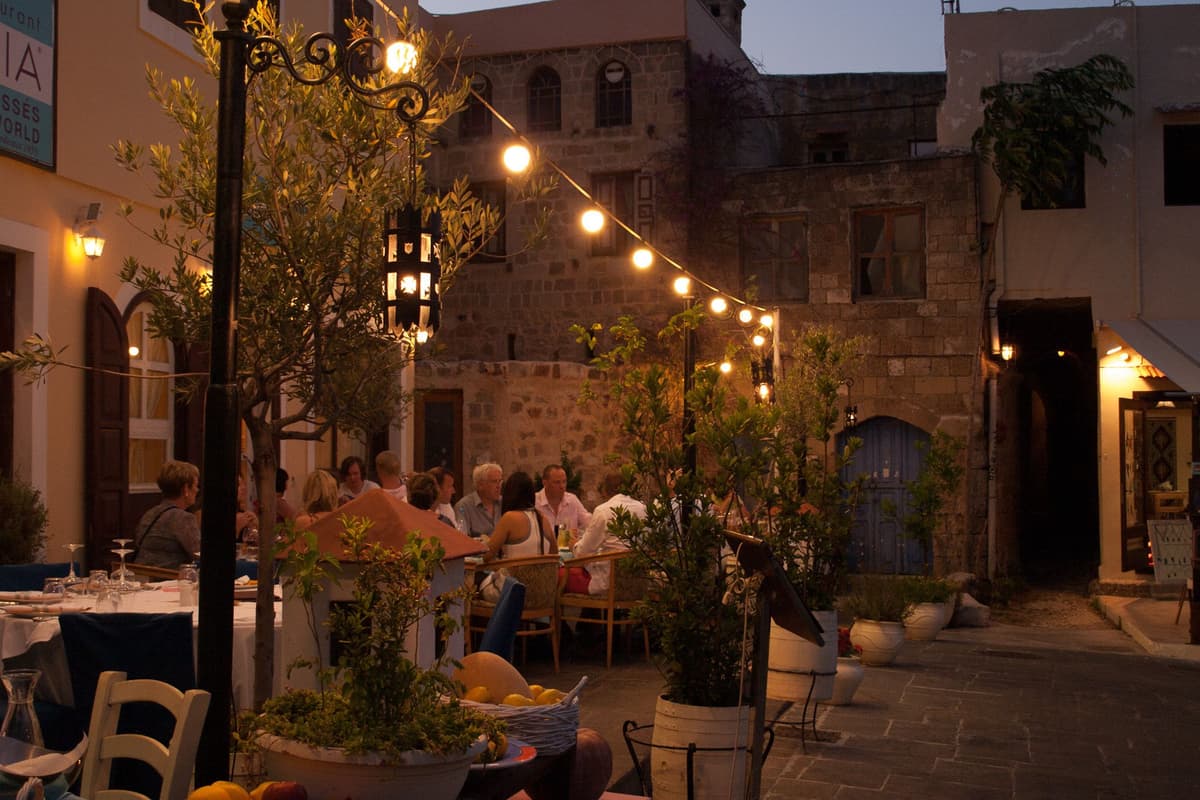
A Rhodes food tour starts in the medieval old town of Rhodes. It walks on to the New Market at Mandraki harbour. Its stops serve street food, taverna dishes, seafood, sweets and local drinks. It is one of the food tours in Greece on Greece VIP.
The sections below also cover coffee, village food, evening tours and the best season. Each section ends with a Rhodes food tour or tasting to book online.
What does a Rhodes food tour include?
A Rhodes food tour is a tasting walk through the town of Rhodes. A tour leader takes a small group on foot. The group moves from one food stop to the next. At the stops, it samples local dishes, drinks and sweets.
Wikipedia defines culinary tourism, or food travel, as the exploration of food as the purpose of tourism. Its activities include food or drink tours and cooking classes. Food and beverage festivals count too, as do visits to farms, markets and producers.
A Rhodes food tour sits in the tasting part of that list. It turns the town of Rhodes into a route of tastes. The food, not the sights, sets the order of the walk.
Food tours vary by place and by operator, the company that runs them. The same article says they are common in London, Paris, Rome, Florence, Toronto, Kuala Lumpur and Barcelona. A Rhodes food tour brings that idea to a Greek island town.
The Greek National Tourism Organisation calls Rhodian cooking, meaning the food of Rhodes, simple and nutritious. It rests on pure raw materials, such as wild greens and fine cheeses from the mountain villages. A Rhodes food tour tastes that cooking in the town.
- Stops: A Rhodes food tour links its stops in a chain, and each stop adds one taste.
- Tastes: Each taste comes with a short note from the tour leader.
- Group: The small size keeps the walk easy. Each taster can ask the leader a question.
A Rhodes food tour tastes the island table on foot. A Rhodes cooking class teaches how to cook that food in a kitchen. Wikipedia notes that cooking classes can include market tours.
So the two activities meet at the market stalls. A Rhodes food tour and a class are two ways into the food of one town.


Where does a Rhodes food tour walk in the old town?
A Rhodes food tour walks the lanes of the walled old town. Its route follows Socratous Street, which leads toward Hippocrates Square. The group pauses for tastes at the food stops along the street. More stops wait on the squares at its end.
The municipal walking route of Rhodes turns right down Socratous Street. It passes old shops on the way toward Hippocrates Square and Evreon Martiron Square. The second name is Greek for Square of the Jewish Martyrs.
A Rhodes food tour keeps to this one line, from the shops to the tables. A plateia is the Greek word for town square. Its plural is plateies.
In traditional villages and provincial communities, plateies are the central places for feasts, celebrations, events and meetings. Wikipedia lists Hippocrates Square among the plateies of Rhodes city.
A Rhodes food tour treats Hippocrates Square as a plateia in that sense. The square becomes a gathering place for the group. There, the tasters can stop, sit and share a taste.
- Ottoman side: The Mehmet Agha Mosque stands on Socratous Street, and the Mosque of Suleiman at its end.
- Jewish quarter: La Juderia lies near a pier used by cruise ships.
- Exit: The route leaves the medieval city by the Virgin Gate and follows a wooden seafront path.
The municipality of Rhodes describes a wide variety of venues in the Medieval City. They include hotels, shops, restaurants, bars and nightclubs. The municipality lists them next to the historical sights that draw visitors there.
A Rhodes food tour draws on that range inside the walls. The restaurants and bars give the group a choice of tables. Those tables line the lanes and squares.
What does a Rhodes food tour taste at the New Market?
A Rhodes food tour reaches the New Market, the Nea Agora on the Mandraki waterfront. It stands in the centre of Rhodes town. A fishmongers pavilion and the flavors of the sea set the tastes of the stop. Fashionable coffee shops offer places to relax.
The New Market is also the Market of Mandraki. Nea Agora is simply Greek for New Market. The architect Florestano Di Fausto built it in the Italian period.
Wikipedia calls it the center of the new city. The market is an irregular polygon, a shape with uneven sides. It encloses the fishmongers pavilion, a covered fish hall built in an Oriental, or Eastern, style.
Di Fausto planned a Garden City, a town plan rich in green space, in the Mandraki zone. He placed the main buildings along the sea promenade, the walkway by the shore. Among them were the Market and the cathedral.
A Rhodes food tour arrives at Mandraki from the old town. It is the oldest port of the island. The municipality calls the market small but very substantial, on one level by the sea.
In its words, jasmine and night flower scent the walk by the water. A Rhodes food tour uses the market as a pause for coffee and sea air.
- Transport: The bus station and the taxi rank stand at the New Market.
- Facilities: A public toilet serves visitors at the New Market.
- Harbour: Cruise boats leave Mandraki for Symi island and the south-east coast as far as Lindos.
The municipal seafront walk lists the New Market as its fifth stop. The Museum of Modern Greek Art and the Grande Albergo delle Rose come before it. So do the City Hall and the church of the Annunciation.
A Rhodes food tour at the New Market therefore stands on a promenade of Italian-era buildings. The Annunciation church copies the ruined medieval church of Saint John of the Knights exactly.
What street food does a Rhodes food tour try?
A Rhodes food tour tries the street food of Greece. Souvlaki and gyros lead, with koulouri bread rings and filo pies beside them. Greek cuisine lists souvlaki, gyros and pitas as common street foods. All of them are handheld snacks for a walk.
Souvlaki is the skewered meat that a Rhodes food tour serves from the grill. Small pieces of meat, and sometimes vegetables, cook on a skewer. People eat them straight off it while still hot.
The skewer can also come with or inside a rolled pita, with lemon and sauces. Pork is the standard meat in Greece. Vendors from Boeotia brought souvlaki in as fast food, and it sold widely from the 1960s.
Gyros is the carved meat of a Rhodes food tour that visits street stalls. The cook stacks seasoned slices on a tall vertical rotisserie, or turning spit. It turns slowly in front of the heat, and the name gyros means turn in Greek.
Thin crisp shavings are cut from the outside. In Greece the meat is pork, with chicken as the other choice. A lightly grilled pita wraps it with tomato, onion and fried potatoes.
- Koulouri: A sesame-crusted bread ring that Byzantine writers called kollikion, first recorded in the 9th century.
- Tiropita: A cheese pie made with Greek feta, also baked as small phyllo triangles.
- Kotopita: A chicken pie from the same family of filo pastry dishes.
Spanakopita completes the pie stop on a Rhodes food tour. Greek cuisine counts countless variations of pitas, the savoury pies. This one holds chopped spinach, feta, scallions and egg inside thin sheets of phyllo pastry.
Cooks make the pie with butter or olive oil. It comes straight from the oven or at room temperature. A fasting version leaves out the eggs and dairy during Lent, the fasting weeks before Easter.
Which taverna dishes does a Rhodes food tour taste?
A Rhodes food tour tastes taverna dishes from the oven and the pot. The plates are moussaka, pastitsio, stifado, gemista and horta. They cover layered bakes, a casserole, stuffed vegetables and boiled greens. So the course spans baked, stewed and boiled cooking.
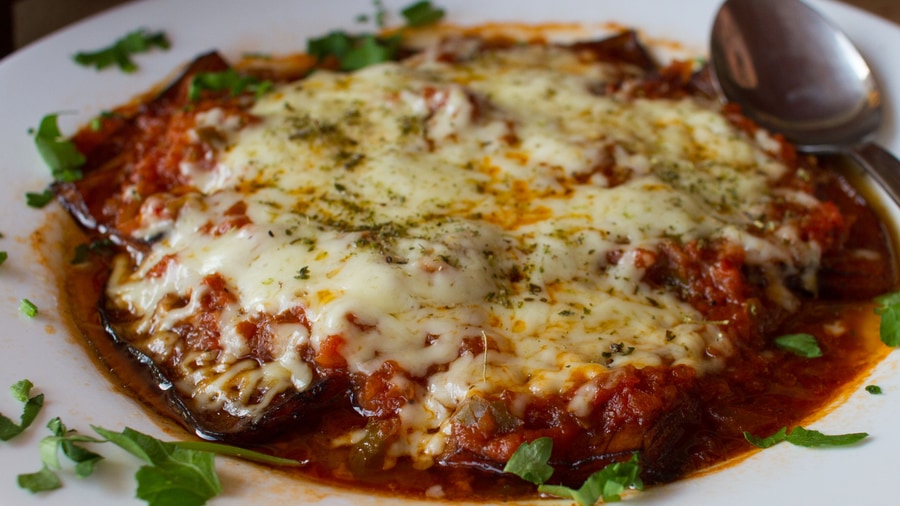
Moussaka is the layered bake of a Rhodes food tour taverna course. The French-trained chef Nikolaos Tselementes set its modern Greek version in three layers in the 1920s. Each layer is cooked on its own before the final baking.
Sliced aubergine, fried lightly in olive oil, forms the base. Ground lamb cooked with tomato, onion and garlic forms the middle. Béchamel, a thick white sauce, covers the top.
Pastitsio is the baked pasta dish on a Rhodes food tour table. Its bottom layer is bucatini or another tube-shaped pasta, bound with cheese or egg. Ground beef in tomato sauce, with cinnamon and cloves, forms the middle layer.
Béchamel covers the top, with grated cheese sprinkled over it. Pastitsio is a main course and arrives with a salad. That makes it the pasta partner of moussaka.
- Stifado: A casserole of baby onions, tomatoes, wine or vinegar and olive oil, with beef, pork or rabbit.
- Gemista: The name means filled in Greek. Peppers and tomatoes bake with rice or ground beef, onions, mint and parsley.
- Kapama: The Greek tourism organisation lists kapama from Rhodes as goat meat stuffed with rice.
Horta close the taverna table of a Rhodes food tour. The word khorta means greens in Greek. The dish is a side, served hot or cold with olive oil and lemon.
Cooks boil edible greens such as endives, amaranth leaves, chicory or chard. A Rhodes food tour ends this course with one plain green plate beside the baked dishes.
Which seafood does a Rhodes food tour serve?
A Rhodes food tour serves three plates from the sea. They are grilled octopus, small fried fish and the tiny shrimp of Symi. Fish dishes are common on the Greek islands. Each of these plates uses a plain method of cooking.
Grilled octopus starts on the shore, and a Rhodes food tour serves the result. Fishermen spear octopuses close to the coast. They pound the flesh against a stone to make it tender.
On the Greek islands, they then hang from a rope in the sunlight, like laundry on a clothesline. After drying, the octopus is served grilled, hot or chilled in a salad. Olive oil, garlic, oregano, pepper and lemon juice dress it.
Small fried fish give a Rhodes food tour its crisp seafood plate. Cooks flour small or medium fish and fry them in sizzling olive oil until crispy.
Marides are small whitebait fish, lightly dusted with flour and then fried. Savoro, a sourish sauce of olive oil, vinegar, rosemary and oregano, sometimes comes alongside.
The Symi shrimp is a rare variety on a Rhodes food tour menu. Symi lies about 24 km north of Rhodes. A day trip to Symi from Rhodes reaches the island.
This shrimp lives only in local waters and is one of four native to Greece. The Greek tourism organisation describes it fried and eaten whole. A Greek government portal says grilled.
- Octopus: Greek cooks rank octopus as a superb meze, a small shared plate, especially beside ouzo.
- Gaelopita: The atherinopita of Symi fries small fish together with onion and batter.
- Squid: Fried squid slices come to the table with a lemon wedge.
The Greek tourism organisation lists oven-baked fish with sesame paste, called tachini, as a dish of Rhodes. This plate adds a baked style to a Rhodes food tour. Symi names fish and seafood as the foundation of its cuisine, and its fishermen are known for skill.
Which sweets and coffee does a Rhodes food tour taste?
A Rhodes food tour tastes Greek sweets and coffee. The sweets are loukoumades, baklava and kataifi, a shredded pastry. The coffees are a small cup of Greek coffee and the frappé. This cold coffee was invented in Thessaloniki in 1957.
Loukoumades open the sweet course of a Rhodes food tour. These are balls of yeast dough, dropped into hot oil and fried golden brown. Syrup or honey soaks them, and cinnamon, walnuts and chocolate sauce can go on top.
Ancient Greek authors such as Aristophanes and Aeschylus already wrote about this honey-soaked fried dough. They called it enkrides. Baklava joins the plate, made of filo pastry, chopped nuts and syrup.
The Greek version of baklava is supposed to hold 33 layers of filo. That is one layer for each year in the life of Jesus.
Kataifi starts as a thin batter poured through fine openings onto a hot, turning griddle. There it cooks into hair-like strands. Desserts made from the strands are baked or fried, then soaked in sugar syrup.
Greek coffee on a Rhodes food tour is very similar to Turkish coffee. That coffee comes in cups of about 90 ml, with a thick froth and a glass of water. The grains left in the cup are read for fortune telling.
- Frappé: Instant coffee, a little water and optional sugar are shaken into foam, then poured over ice.
- Straw: The thick foam on top is bitter, so the frappé comes with a straw.
- Freddo: Espresso freddo and cappuccino freddo are iced espresso drinks that grew popular recently.
A Rhodes food tour pairs old sweets with a young coffee. Loukoumades stayed popular in the Byzantine era during Lent. Dough without dairy or meat met the rules of Orthodox fasting.
The frappé is far newer, yet it is a popular form of coffee in Greece and Cyprus. It is also a hallmark of postwar outdoor Greek coffee culture.
Which drinks does a Rhodes food tour pour?
A Rhodes food tour pours four drinks. Ouzo is a dry aperitif, or pre-meal drink, flavored with anise. Tsipouro is an un-aged brandy made from grape pomace, the residue of the winepress. Greek beer and a glass of local wine complete the list.
Ouzo is the first pour of a Rhodes food tour. Its minimum strength is 40.5 percent alcohol by volume. Water turns the clear spirit cloudy white.
The cause is anethole, the essential oil of anise. It dissolves in strong alcohol but not in water. Ouzo is served with ice cubes in a small glass, or straight from a shot glass.
Small fresh fish, fries, olives and feta come beside it. The municipality of Rhodes lists local ouzo among the drinks of the island.
Tsipouro follows on a Rhodes food tour. It is distilled twice and holds 40 to 45 percent alcohol by volume. The distiller discards the first and last batches, the head and the tail, and keeps only the heart.
Tsipouro is served in shot glasses with meze, straight from the fridge. Greece won PDO status, a protected name tied to its origin, for it in 2006. An anise-flavored variety appeared during the 1900s.
- Beer: King Otto arrived in 1832 with specialists from Bavaria who set out to develop beer.
- Brewing: Greece’s first official brewery opened in Athens in 1864, and about 65 small breweries worked in 2020.
- Retsina: Aleppo pine resin goes into the must, or fresh grape juice, and the EU protects the name.
A glass of local wine joins the other pours of a Rhodes food tour. Greek wine goes back 6,500 years. Greece grows about 200 vine varieties.
The municipality of Rhodes lists white, red and rosé wines for the island. It also lists sparkling wines, aperitifs and liqueurs. So a Rhodes food tour has more than one style to pour.
What does a Rhodes food tour taste in the villages?
A Rhodes food tour tastes village cooking in the villages of Rhodes. Psinthos gives a goat stew, and Kalithies gives a meat casserole. Salakos adds its walnuts. The tour also takes a coffee in a kafeneio, a village coffee house.
The villages give a Rhodes food tour recipes that the municipality of Rhodes lists as traditional. The Psinthos stew cooks goat with rice and cinnamon.
The Kalithies casserole holds braised, or slow-cooked, meat and potatoes. They bake in the oven with olive oil, fresh tomato, onion, garlic and wine. The dish is served mainly at weddings.
Salakos sits on the hills of Mount Prophitis Ilias, 40 km from Rhodes town. The community had 508 residents at the 2021 census. The village is famous for its walnuts.
Its people work mainly in farming, livestock rearing and tourism. A stone-paved, shady square with running spring water and ficus trees stands beside a natural spring named Nimfi. The tavernas of Salakos give a Rhodes food tour a table.
- Kafeneio: Kafenia serve as social centers of the villages and were family-run and furnished simply.
- Table: Kafenia pair beer, retsina and ouzo with meze and rarely serve full meals.
- Kattavia: The southernmost village of Rhodes had 323 residents in 2021 and has five full-service cafes.
The interior of Rhodes is thinly settled and covered with forests of pine and cypress. So each village stop on a Rhodes food tour sits in a small settlement.
Mesanagros has 96 residents and lies 83 km from Rhodes. Its name means a cultivated, fenced, large Byzantine farm. In a kafeneio, people socialize after work or play a game of cards.
What is an evening Rhodes food tour like?
A Rhodes food tour in the evening starts after the heat of the day has passed. It follows the lanes of the walled medieval town in cooler air. The walk ends with a late, seated Greek dinner at a taverna table.
A taverna is a small Greek restaurant. Its dinner hours begin at 20:00 and reach a peak around 22:00. In hot climates, the main meal falls in the evening, after the temperature drops.
Rhodes follows that pattern. So a Rhodes food tour in the evening runs on the same clock as the island. Tastes arrive as the local tables begin to fill.
The city of Rhodes sits at the north-east tip of the island. Its nights stay warm. At the port, the weather station records an average daily low of 25.3 °C in July.
In August, it is 26.0 °C. So an evening walk in summer calls for light clothes and no jacket. Street lamps and taverna windows light the lanes of the old town after dark.
- Walls: The fortifications form a defensive crescent around the medieval town.
- Gates: There are 11 gates, and the Marine Gate was the main entrance from the harbour.
- Acandia Gate: The Italian administration opened it in 1935 to link the commercial harbour with the south-east zone.
The shape of the night follows from the place. The walls and gates give the walk its route, and the taverna hours give it a late finish. The evening tour is a slow stroll through town, kept light by the warm air.
When is the best season for a Rhodes food tour?
A Rhodes food tour is best in late spring and early autumn. Then the daytime heat at the port of Rhodes stays below the midsummer peak. The winter rain has not yet returned. Midsummer brings the strongest sun, and winter the heaviest rain.
Summer is hot and almost dry. In July, the port records an average daily high of 30.9 °C. That month has 0.1 mm of rain, and August has 0.3 mm.
The ultraviolet index, a measure of the sun’s burning strength, reaches 10 in June and July. A Rhodes food tour in midsummer calls for a hat, water and a slow pace. The evening hours suit the walking best.
Late spring brings an average daily high of 23.9 °C and 6.5 mm of rain. So the days are warm without midsummer heat.
September holds an average daily high of 28.6 °C, with 14.1 mm of rain. The summer warmth stays as the dry sky starts to break. In these months, a Rhodes food tour meets walking weather that suits slow stops at a table.
- Early summer: The average daily high is 27.9 °C, with 15.0 hours of daylight.
- October: The average daily high eases to 25.6 °C, and rain rises to 22.3 mm.
- Winter: November brings 21.9 °C and 89.4 mm of rain, and December brings 144.1 mm.
The port records an average yearly temperature of 20.9 °C. Its rain figures split the year into a dry half and a wet half.
A Rhodes food tour fits the dry half, and its edges give the gentlest walking weather. In winter, the tasting stays indoors at the table.
What do travelers ask about a Rhodes food tour?
A Rhodes food tour draws five regular questions from travelers. They ask about vegetarian and other diets, and about children. They ask how much walking is involved and how much food to expect. They ask how to combine the tour with a walk through the medieval town.
Does a Rhodes food tour fit vegetarian and other diets?
A vegetarian Rhodes food tour has plenty to taste. Greek cuisine includes fava, a purée of yellow split peas. It also has gigantes plaki, which is gigantes, or giant, beans baked in tomato sauce.
Spanakopita from the pie stop counts as well. Travelers who avoid pork find poultry, beef and lamb on the same table. Diet needs go to the tour leader when booking.
Can children join a Rhodes food tour?
Children find familiar food on a Rhodes food tour, such as pastitsio from the taverna course. Wheat bread is found everywhere on Greek tables.
Cheeses and yogurt rank among the key ingredients of the cuisine. Children walk the same lanes as adults.
How much walking does a Rhodes food tour involve?
A wall 4 km long encloses the Medieval City of Rhodes. The old town is small enough to cover on foot.
A Rhodes food tour there stays on the lanes inside the walls and by the harbour. A seat at a table comes between stretches of walking, and comfortable shoes help.
How much food does a Rhodes food tour serve?
A Rhodes food tour serves tastes, not a full plate at every stop. A taverna menu starts with bread, salads and appetizers. Soups, pasta, fish, grilled dishes and baked dishes come next.
Fruit and desserts come at the end. The tastes follow that order, and the pace stays slow, as at any Greek table.
Can a Rhodes food tour combine with a medieval town walk?
A Rhodes food tour and a tour of the Old Town of Rhodes cover the same ground. The Medieval City was built from around 1309 to 1523.
UNESCO added it to the World Heritage list in 1988. It has two districts: the high town of Collachium and the lower town, called the Burgh.
Featured photo: gromin, CC BY 2.0, via Flickr.