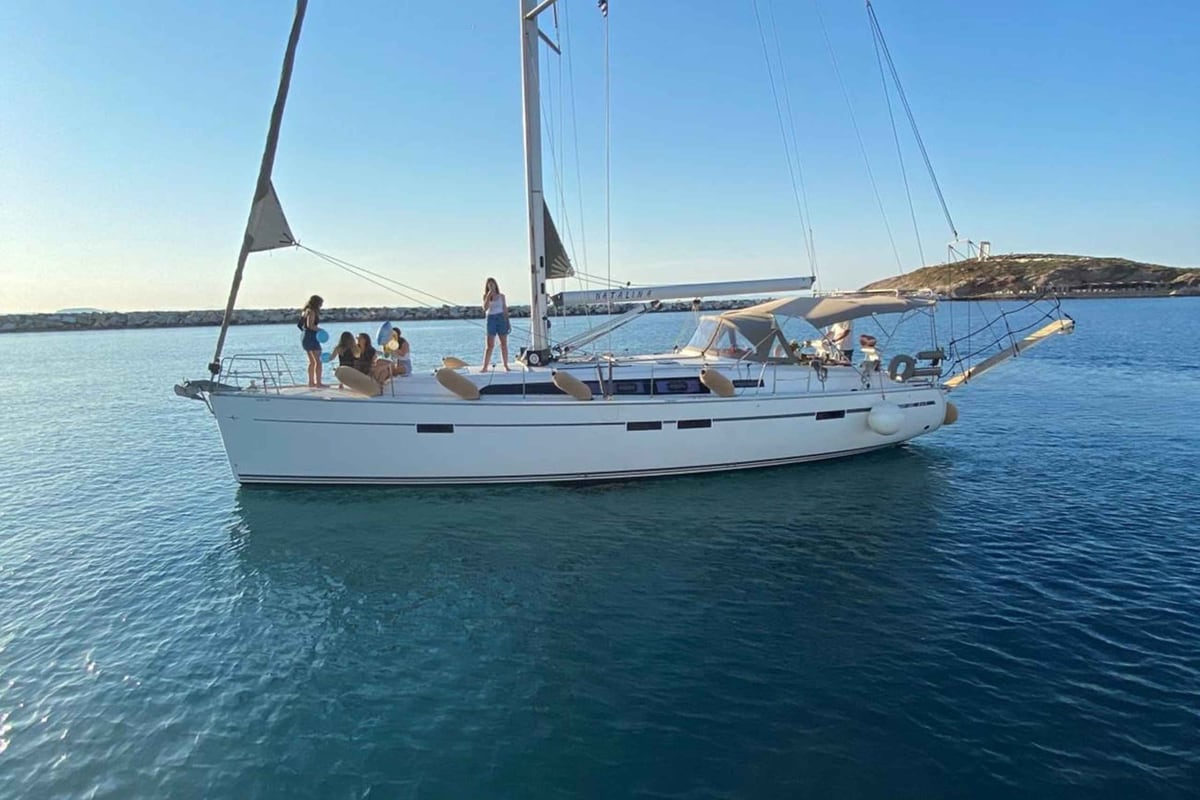
Naxos sailing takes travelers out under sail. The trips run by day, at sunset or with nights on board. It is one of the sailing trips in Greece on Greece VIP.
Each section ends with a Naxos sailing trip or cruise. Travelers can book each one online.
What does a Naxos sailing trip include?
A Naxos sailing trip is a full-day or half-day outing under sail. It leaves from Naxos, the largest of the Cyclades. A small group shares the boat, and the skipper sets the route. The day mixes open water, swim stops and a meal aboard.
Sailing uses the wind to move a craft across the surface of the water. The wind acts on the sails, and a Naxos sailing trip follows that simple principle.
Sailing for fun, called recreational sailing, comes in two kinds: day-sailing and cruising. In day-sailing, people leave the boat at the end of the day. They spend the night ashore.
A Naxos sailing trip belongs to that first kind. Day-sailing needs no fixed destination to reach. The pleasure of moving under sail is the whole point.
The Mediterranean Sea ranks among the coastal cruising grounds, or sailing areas, of the world. A Naxos sailing trip stays close to the shore, in the Aegean Sea.
Island crossings and other cruises also leave from the same harbour. Those outings appear on the separate Naxos boat trip page. A sailing day, by contrast, puts the wind and the canvas sails first.
- Under sail: The wind moves the boat from stop to stop.
- Swim stops: The boat anchors in calm bays for a swim.
- Meal on board: Food and drinks are served on deck.
A Naxos sailing trip rests on three parts: wind, water and people on deck. The format suits travellers who want the sea itself as the main sight. It is not a fast ride between ports.


What does a Naxos sailing trip see when it leaves Naxos Town?
A Naxos sailing trip sees the Portara at the harbour entrance. This marble gate belonged to an unfinished temple of Apollo on the islet of Palatia. Behind the port, whitewashed houses and stone mansions fill the old town. They spread around the medieval Kastro, or castle.
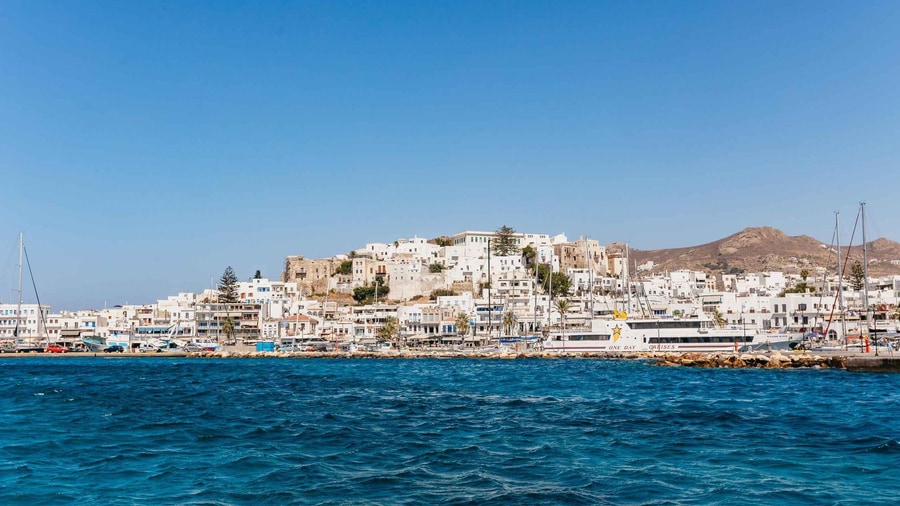
Chora, the capital and port of Naxos, stands on the central west coast. Every Naxos sailing trip starts from its harbour. So every departure opens with the same first view.
The gate is a door frame of four marble sections. Each section is about 6 metres long. In the Venetian period, the rest of the temple served as a quarry for stone.
The gate survived because of its great size and weight. The temple site also had a view of Delos from the northern end of the port.
From the water, a Naxos sailing trip sees a promenade, or seafront walk, along the waterfront. Behind it, the houses follow the Aegean style. Narrow alleys and arches spread around and inside the castle.
A wall once ringed the medieval town, with twelve towers and three gates for entry. It took in the Duke’s Palace and the mansions of the nobles. Sanudo’s Tower and the Della Rocca-Barozzi mansion still survive from the age of the dukes.
- Old sanctuary: An open-air sanctuary of Apollo stood on the islet. It dates from the 9th and 8th centuries BC.
- Temple plan: The temple measured 15.40 by 36.85 metres. That matched the size of the temple of Zeus at Olympia.
- Oldest church: Panagia Theoskepasti, an Orthodox church, is thought to be the citadel’s oldest monument.
A Naxos sailing trip leaves past two layers of history in one view. The gate on its rock and the walled quarter stay in sight as the boat clears the harbour. Then it turns south, and the town gives way to open shore and long stretches of sand.
Which west coast beaches does a Naxos sailing trip pass?
A Naxos sailing trip heading south from the port passes a chain of sandy beaches. Agios Georgios, Agios Prokopios, Plaka and Mikri Vigla line the west coast, seen from the water. The deck shows dunes, juniper shade and a medieval lookout point along the way.
A Naxos sailing trip passes Agios Georgios first. The beach lies beside the main town, 1 km from the port. Its fine sand and clear, shallow water hold a Blue Flag.
Windsurfers, who ride boards with a sail, gather at the southern edge of Agios Georgios. Further south, Agios Prokopios sits 4 km from the port. It has coarse sand and dunes, or hills of sand.
The water at Agios Prokopios shifts from blue to deep blue and turquoise. A Naxos sailing trip sees that contrast of colours from the deck.
The shore of Plaka continues the beach of Agia Anna. Its dunes carry sea lilies after August, and junipers give shade near the water. Plaka was a favourite of hippies in the 1960s and 1970s.
Further on, a Naxos sailing trip passes Mikri Vigla, an observation point under Frankish rule. From there, lookouts gave advance warning of pirates. A rock splits its beach in two, with Limanaki to the north and Sahara to the south.
- Rating: The second beach in the chain is rated third best in Greece and among Europe’s top ten.
- Chapel: A chapel of the same saint stands at its quieter western edge.
- Blue Flag: The Foundation for Environmental Education gives this award. It rewards water quality, safety and environmental management.
Along this shore, a Naxos sailing trip sees the west coast as one long line of sand. Each beach has its own character. The deck keeps them all in view as the boat moves from bay to bay.
What does a Naxos sailing trip see on the south coast?
A Naxos sailing trip on the south coast follows a quieter shore of sandy bays and coves. The stretch runs from Kalantos, at the southernmost point, to the sea cave of Rina. It ends at Panermos, an almost windless beach on the south-east side.
A sail around the southern coast and back covers about 40 nautical miles. That figure comes from the Municipality of Naxos.
The municipality recommends this route in summer. The seasonal northerly winds do not affect this side of the island.
A Naxos sailing trip that reaches Kalantos finds a sandy beach with clear, shallow water. The beach sits at the edge of a bay of the same name.
A wetland, or patch of marshy ground, lies at the mouth of a stream and draws birds. A fishing pier gives boats shelter.
Rina lies about one nautical mile from that bay. Its cove has no access by land.
The cave opens on the right side of its green-water beach, with bird nests inside. A spring of fresh water rises on the left side.
Further east, a Naxos sailing trip passes Korfari, a low hill north-west of Panermos bay. Excavations there uncovered a fortified, or walled, settlement from 2500-2300 BC. It had five horseshoe-shaped towers.
- Psili Ammos: This fine-sand beach on the south-east coast faces Koufonissi. A juniper forest stands behind it.
- Prehistoric rooms: About 20 small stone rooms stood inside the oval wall of the hilltop settlement.
- Swim stops: The coves of the south coast give a Naxos sailing trip sheltered water for swimming.
Along this shore, a Naxos sailing trip trades the ferry port for open coves and sandy shallows. The pace slows, and the anchorages, or places to drop anchor, stay small.
Swimmers drop into clear water straight from the deck. The route suits sailors who want the quiet side of the island.
Can a Naxos sailing trip cross to Paros?
A Naxos sailing trip can cross to Paros. The local municipality names it the closest island to reach by ferry or catamaran. About 5 miles of open sea divide the two coasts. The boat leaves the shelter of land once it clears the harbour.
Agii Theodori, a pebble beach near the tower of Agia, takes its name from a local chapel. It looks out to Paros and Mykonos in the distance.
So a Naxos sailing trip can spot the far shore before the crew casts off the lines. Once out of port, the boat heads west across the open strait. The crossing turns into a true open-water sail.
In the late 13th century, Marco II Sanudo lost a large part of the Duchy of the Archipelago. This duchy was a state of islands ruled by a duke. Licario, a Byzantine admiral, took that part, yet Naxos and Paros stayed in Sanudo’s hands.
Ahmed I was the Ottoman sultan, or Turkish emperor. In 1616 he named Gaspar Graziani Duke of Paros and Naxos. So a Naxos sailing trip across the channel follows a route between islands that once shared one ruler.
- Byzantine retreat: The Byzantines gave up their gains in the islands in 1310.
- Ottoman rule: The Ottomans took over the duchy in 1579.
- End of the title: The sultan ordered the removal of the duke in 1617.
Trips that begin on the other side of the strait form a separate Paros sailing tour. A Naxos sailing trip sees the same strait from the east.
What is a sunset Naxos sailing trip like?
A Naxos sailing trip at sunset is an evening sail. It heads out as the sun sinks toward Paros in the west. On the way, it passes the Portara as the light fades. Then it returns to harbour with its navigation lights burning.
As the sun drops, the neighbouring island turns into a dark outline. The show on a Naxos sailing trip does not end with the sunset.
Opposite the afterglow, the light left after sunset, a pinkish glow rises over the mountains of Naxos. It is called the Belt of Venus. It sits 10 to 20 degrees above the eastern horizon.
As the light fades, the Earth’s shadow opens beneath it as a dark, soft-edged band. The band stands out best when the sky is clear.
The municipal tourism site lists a boat as one viewing spot for a photo of the Portara. At dusk, a Naxos sailing trip sees the gate as a dark frame against the last light.
Coming back in, a sailing boat shows a green light on its starboard, or right, side. It shows red on the port, or left, side, and white at the stern, or back. The skipper keeps clear of ferries moving in and out of the port.
- Rules: After dark, a Naxos sailing trip follows the International Regulations for Preventing Collisions at Sea. These rules were set in 1972.
- Other names: The Belt of Venus is also called the antitwilight arch.
- Berths: Places inside the port are limited. Yachts also anchor in the outer harbour or on the outside of the main pier.
A Naxos sailing trip at sunset swaps the swim stops of the day for colour and silhouettes. The evening suits couples, photographers and anyone who prefers the cooler hours on deck. The boat ties up in port once the last glow leaves the sky.
How do the winds around Naxos shape a Naxos sailing trip?
A Naxos sailing trip meets a wind that the island reshapes. The central mountain lifts moist air and traps clouds. The rough land sends gusts toward the shore. The windy western beaches draw windsurfers and kitesurfers, who read the same breeze.
That mountain is Mount Zas, above the village of Filoti. The clouds it traps bring more rain to the island. Inland areas stay much wetter and cooler in winter because of their height.
A Naxos sailing trip sees that cloud cap from the water. Its cause is orographic lift, where air pushed up rising ground cools. Its humidity climbs, and clouds form.
The same process brings rain shadows, the drier land behind a mountain. It also brings leeward winds on the sheltered side.
Wind over rough land is gustier than wind over a large water surface. A gust is a brief, sudden jump in speed, shorter than a squall. A lull follows it.
Close to the hills, a skipper on a Naxos sailing trip watches for sudden puffs. Naxos counts as a windy island.
Seven sports clubs offer windsurfing and kitesurfing, where a kite pulls a rider on a board. The bulk of the island’s beaches lie on the western side, near Chora.
- Cross-shore: Kiteboarders rate cross-shore and cross-onshore winds as the best for riding without help.
- Onshore: A direct onshore wind can throw a rider onto land or into shallows.
- Offshore: A direct offshore wind can carry a rider out to sea after an equipment failure.
Sea breezes add a daily rhythm to a Naxos sailing trip. Land heats faster than water in the sun. In the afternoon, an onshore breeze blows from the sea.
After sunset, a land breeze flows back toward the water. A Naxos sailing trip that plans around this cycle and the gusts reads the island well.
What is a multi-day Naxos sailing trip like?
A Naxos sailing trip with nights on board links Naxos Town to island ports across the central Cyclades. The group lives aboard, and the boat ties up in a different harbour each evening. Each morning, the group wakes to a fresh coastline.
Cruising means living aboard a vessel while it travels. In island harbours, the yacht ties up with the Mediterranean moor.
It sets a temporary anchor off the pier. Then it approaches at a right angle and runs two lines ashore.
Each boat fills only its width of pier, not its length. So one quay holds a long row of yachts. Deep water and large tides make this method hard to use.
Donousa, the easternmost of the Lesser Cyclades, lies 16 km east of Naxos. Its main port, Agios Stavros, has tavernas, or Greek eateries, plus bakeries and mini markets.
Farther on, Amorgos is the easternmost island of the whole group, reached only by boat. Its port village of Katapola sits at the foot of the hill where ancient Minoa stood. A Naxos sailing trip can spend a night at either harbour.
- Ios: A Naxos sailing trip reaches Ios, halfway to Santorini, with an organised marina at its harbour.
- Delos: The Cyclades take their name from the circle they form around Delos, near Mykonos.
- Peaks: Except for two volcanic islands, the Cyclades are the peaks of a sunken mountain land.
After the Fourth Crusade, Marco Sanudo seized Naxos and soon captured the rest of the Cyclades. Naxos became the seat of his Duchy of the Archipelago. A Naxos sailing trip that links these harbours retraces the sea lanes of that medieval island state.
Which sea life and snorkelling does a Naxos sailing trip offer?
A Naxos sailing trip offers snorkelling over rocky reefs, seagrass and sand. Wrasse, parrotfish and shoals of damselfish swim over the rocks. Stretches of sea around Naxos and its smaller neighbours lie inside protected areas. These cover reefs, seagrass meadows and sea caves.
The ornate wrasse lives on rocky shores with algae, or seaweed. It ranges from the surface down to 50 m and gathers around piers, jetties and wrecks. Males have red heads with blue markings, and both sexes carry a turquoise tail fin.
The Mediterranean parrotfish grazes algae off the same rocks. Adult females turn red with a grey saddle, or back patch, edged in yellow. A Naxos sailing trip that anchors beside a rocky point puts snorkellers among both.
Above reefs and seagrass, the damselfish swims in small midwater shoals. It stays between 2 and 40 m deep. The fish appears commoner off islands than off the mainland.
Purple sea urchins with long, sharply pointed spines cling to rocks just below the low-water mark. Off Grotta, the town’s northern beach, remains of the Mycenaean city lie partly under the sea. They add history to a Naxos sailing trip.
- Naxos site: A Natura 2000 site, part of an EU nature network, covers central and south Naxos. Its sea zone runs from Karades Bay to Moutsouna Bay.
- Lesser Cyclades site: A second site covers Irakleia, Schoinoussa, Koufonisia, Keros, Antikeria and their waters.
- Habitats: The Central Aegean protected areas rank Posidonia meadows, a kind of seagrass, as a priority habitat.
- Turtles: The loggerhead turtle appears in 24 of the 41 areas of that unit, with an unfavourable status.
The noble pen shell shows why protection matters. This clam lives only in the Mediterranean and grows up to 120 cm long. It is strictly protected under the EU Habitats Directive.
By 2019, mass deaths from a new disease germ had been found in Greece. On a Naxos sailing trip, snorkellers leave every pen shell in place, as the law demands.
Is a Naxos sailing trip good for families?
A Naxos sailing trip suits families when the boat carries life jackets in child sizes. It also helps when the skipper picks sandy bays for swimming and shade covers part of the deck. Children rest in the cockpit, the seating area, between swims while adults watch the water.
Buoyancy aids, or floating vests, come in designs for children and youth. They have one or two straps between the legs. The straps keep the vest from riding up and stop the child from slipping out.
A headrest flap holds the head clear of the water. Yellow or orange fabric helps rescuers spot the wearer. Parents check vest sizes with the crew before the boat leaves the harbour.
Shallow sandy bays on the coast of Naxos give children water where they can stand on the bottom. The skipper picks each anchorage with the youngest swimmer in mind. An adult swims beside each young child.
Drowning rates peak among children under five. Drowning can be silent, with no splashing or shouting. A child who cannot swim keeps the life jacket on in the water.
- Bimini top: This open-front canvas roof on a metal frame shades the cockpit from the sun.
- Spray: The canvas gives no cover from wind, rain or spray once the boat moves forward.
- Whistle: A plastic whistle on a passenger life jacket lets a child call for attention.
When is the best season for a Naxos sailing trip?
A Naxos sailing trip meets its warmest and driest weather from June to September. Rain is rare in Naxos town then. Spring and late autumn bring cooler air and more rainy days. They are a better match for passengers who dislike strong heat.
Parts of Naxos have a Mediterranean climate, coded Csa. The weather station at sea level in Naxos town shows what summer brings to a Naxos sailing trip.
The average daily high reaches 25.9°C in June and 27.0°C in August. August nights hold at 22.2°C. July averages 0.4 days with rain, and August 0.3.
Spring warms slowly. March averages 13.4°C and brings 45.7 mm of rain. In April, highs reach 18.7°C, and rain falls on six days.
A Naxos sailing trip in autumn keeps more of the summer heat. October averages 19.7°C, with highs of 21.9°C and 5.5 rainy days. November averages 16.4°C.
- Yearly rain: Naxos town records 370.6 mm of rain over 73.4 rainy days a year.
- Humidity: Relative humidity, the moisture in the air, averages 71.4%. It ranges from 67.9% in June to 74.1% in November.
- Cold record: The lowest reading at the station is -1.0°C, set in February.
In the dry heart of summer, every swim stop meets warm air. The cold half of the year, from November to March, brings the bulk of the yearly rain. A sail in that season meets showers and a chill on deck.
What do travelers ask about a Naxos sailing trip?
A Naxos sailing trip raises five recurring questions. Travelers ask whether passengers need sailing skills and what food comes on board. They ask how swim stops work and how a private boat differs from a shared one. They also ask how to add a tour by land.
Can beginners join a Naxos sailing trip?
Beginners join a Naxos sailing trip as passengers. The skipper and crew raise the sails, work the lines and set the anchor.
In heavy weather, fog or darkness, crews rig a jackline. This safety line runs from the bow, or front, to the stern. A harness clipped to it lets a person move along the deck safely.
What is served on board a Naxos sailing trip?
Food on a Naxos sailing trip draws on island produce. Graviera Naxou is a hard cheese made from 80-100% cow’s milk. It has held PDO status, an EU label for protected origin, since 1996.
Arseniko Naxou is a second local cheese. Kitron is a sweet liqueur made from the fruit and leaves of the citron, a lemon-like tree. It runs from 30% alcohol in the green version to 36% in the yellow.
How do swim stops work on a Naxos sailing trip?
On a Naxos sailing trip, the skipper drops anchor in a bay. Nobody swims before the skipper gives a signal. Swimmers return when the crew calls.
On yachts, the transom, or flat rear wall, can hold a hinged swim platform. Swimmers use it to climb back aboard. A lazarette, a storage locker beside it, holds deck items and leisure toys.
Is a Naxos sailing trip private or shared?
A Naxos sailing trip runs in both formats. A shared departure sells single places on a fixed route, and strangers share the deck.
A private booking reserves the whole boat and its skipper for one party. The private format suits families with children. The shared one suits solo travelers who want company.
Can a Naxos sailing trip combine with a land tour of the island?
A Naxos sailing trip covers the coast, and the interior needs an outing by road. A temple built around 530 BC stands 1.5 km south of Ano Sangri. It is one of the earliest Ionic temples, a Greek style with scroll-shaped column tops.
An ancient quarry above Apollonas holds an unfinished kouros statue, 10.7 m tall. A kouros shows a standing young man. A Naxos island tour by land adds both sites to the time at sea.
Featured photo: Full day Naxos exploration yacht tour, via GetYourGuide.