
A Mykonos ATV tour rides quad bikes away from the busy town of Mykonos. It is one of the outdoor tours in Greece on Greece VIP.
A Mykonos ATV tour follows island roads and dirt tracks across the dry interior. It visits inland villages and the lighthouse on the north-west cape. It also reaches beaches on the north and south coasts.
A Mykonos ATV tour can also run at sunset. Its practical side covers the vehicles, the licence rules, safety and the best season. Both quad rides and island tours on Mykonos can be booked online.
What does a Mykonos ATV tour include?
A Mykonos ATV tour puts riders on quad bikes for a route across the island. An expert leads the group in a convoy, or each rider follows a self-drive plan. The ride links unpaved tracks, quiet beaches, inland villages and hilltop viewpoints.
Mykonos is one of about 220 islands in the Cyclades, an island group in the Aegean Sea. A Mykonos ATV tour treats it as ground to cross, not as a town to walk.
Off-roading means driving on unpaved sand, dirt, gravel, mud or rock. A quad bike is built for exactly this kind of ground. On Mykonos, dirt tracks carry the ride away from the main roads.
A dirt track is a road made only from the natural ground that it crosses. It has no top layer of asphalt, concrete, brick or stone.
On an expert-led Mykonos ATV tour, the riders move as a convoy. A convoy is a group of vehicles that travel together for support and safety. The tour leader rides in front. The quads follow in single file.
Group rides on desert sand keep the same single-file order. On the self-drive version, the rider gets a route and sets the pace alone. In both formats, the person at the handlebars stays in charge of the machine.
- Beaches: Sandy coves at the end of dirt tracks give the ride a stop by the sea.
- Villages: Inland settlements break up the long stretches of loose track.
- Viewpoints: Hilltops give a Mykonos ATV tour a wide view over the sea and nearby islands.
A Mykonos ATV tour differs from a Mykonos island tour by road. That road tour stops at the town sights and the museums. The quad trades those stops for loose surfaces, open hills and quiet coves.
Dirt tracks bake hard in dry weather. They turn muddy and slippery after rain. So the state of the ground shapes every route on the island.

Which vehicles does a Mykonos ATV tour use?
A Mykonos ATV tour uses quad bikes, four-wheeled machines with low-pressure tyres, a straddle seat and handlebars. Single-seat models carry the rider alone, and tandem models add one passenger. An automatic gearbox removes the clutch. A helmet comes with every machine.
An all-terrain vehicle, or ATV, takes the name quad when it runs on four wheels. On a quad, the rider sits astride the seat, with one leg on each side. The handlebars steer the machine just as on a motorcycle.
A Mykonos ATV tour keeps to these straddle-seat quads and leaves out side-by-side vehicles. In a side-by-side vehicle, two or more people sit next to each other.
One type of automatic gearbox is the continuously variable transmission, or CVT. It moves smoothly through an endless range of gear ratios. It has no fixed steps between them.
Inside a CVT, a V-belt runs between two pulleys, the wheels that carry the belt. Each pulley can change its size. The first ATV with a CVT went on sale in 1987.
European rules sort road-going quads into classes of quadricycle, the legal term for a small four-wheeled vehicle. A light quadricycle tops out at 45 km/h. A heavy quadricycle has up to 15 kilowatts (kW) of net engine power.
- Light class: Its spark-ignition engine stays within 50 cm³, and it weighs up to 425 kg empty.
- Heavy class: The passenger model weighs up to 450 kg empty and reaches 90 km/h by design.
- Gear: Manufacturers recommend a helmet, protective eyewear, gloves and riding boots for every rider.
A Mykonos ATV tour matches each machine to its rider. The automatic gearbox suits riders who are new to quads. They work only the throttle, the grip that controls the speed, and the brakes.
Which licence and rules apply on a Mykonos ATV tour?
A Mykonos ATV tour falls under Greek road law. That law ties the licence to the vehicle class and makes a helmet compulsory on every quadricycle. It also sets lower alcohol limits for novice drivers and for riders of motorcycles and mopeds.
Greek licence categories climb in steps with engine power. Category A2 covers motorcycles of up to 35 kW from the age of 20. Category A lifts that power limit from the age of 24.
For light quadricycles, national age limits across the European Union range from 14 to 18 years. On a Mykonos ATV tour, a rider without the matching licence category stays off the controls.
Alcohol rules on a Mykonos ATV tour are strict. Greek law allows 0.5 mg of alcohol per ml of blood for ordinary drivers. Novice drivers, professional drivers and riders of motorcycles and mopeds have a limit of 0.2.
A novice driver here means someone who has held a licence for less than two years. A professional driver is someone who drives for a living. Breath tests use matching limits of 0.25 and 0.10 mg per litre of breath.
A blood level above 0.11% counts as a flagrant misdemeanour, a serious offence under Greek law. It can bring prison and a court fine. The driver also loses the licence for six months.
- Issuer: The Ministry of Infrastructure and Transport issues Greek driving licences.
- Helmet: The same helmet rule covers mopeds, motorcycles and tricycles, but not bicycles.
- Phone: A phone at the controls needs a hands-free base with speakers or a wireless hands-free set.
Breaking any of these rules brings the penalties of the Greek road code. Those penalties apply on every island and on every route, a Mykonos ATV tour included.
What does a Mykonos ATV tour see in Ano Mera?
A Mykonos ATV tour sees Ano Mera, an inland village of 1,459 inhabitants. The village lies almost in the heart of the island. Its main square faces the all-white monastery of Panagia Tourliani. This monastery is one of the leading landmarks of the whole island.
A Mykonos ATV tour enters a village with ancient roots. In the 6th century BC, Skylax described Mykonos as an island with two city-states. One stood at Chora, the main town, and the other on the Palaikastro hill of Ano Mera.
The modern settlement grew up around the monastery, with narrow alleys between its houses. Ano Mera also sits on the road to the northeastern beaches. So the village makes a natural halt between the town and the far coast.
The monastery keeps a miraculous icon of the Virgin, a holy picture in a silver cover. That cover carries the words The Ekatontapyliani of Paros. Island ships once left port only after their sailors had prayed before the icon.
On the Saturday of the first week of Great Lent, islanders carry the icon on foot to Chora. A Mykonos ATV tour on the road between Ano Mera and Chora follows that walk.
In Chora, the icon rests in one of three parish churches: Megali Panagia, Panachrantos or Agia Kyriaki. It returns uphill to the monastery on Lazarus Saturday.
- Square: The main square became a pedestrian zone, closed to cars, in 2001.
- Grill: Cafes and tavernas around it are known for Mykonian meats on the spit and grill.
- Cheese: A Mykonos ATV tour passes a village workshop that makes kopanisti, a spicy cheese.
Mykonians have turned to Panagia Tourliani in every joy and sorrow. Honour to the Virgin stands at the centre of island faith, as it does across the Cyclades. So a Mykonos ATV tour that halts in Ano Mera meets a living village.
Why does a Mykonos ATV tour ride to the Armenistis lighthouse?
A Mykonos ATV tour rides to the Armenistis lighthouse to reach a 19-metre tower. The tower went up after a deadly shipwreck. Its light carried 20 nautical miles out to sea. The stop joins sea history with an open view of the nearby islands.
The lighthouse grew out of a disaster at sea. In 1887 the steamship Volta was wrecked in the Tsoukali area, west of Mykonos. The currents there are dangerous, and the wreck brought heavy loss of life.
The wreck showed that ships crossing the Aegean passage needed a light to steer by. The tower was built in 1891. A Mykonos ATV tour that stops there stands at a site born from that wreck.
The light worked through a Fresnel lens. The French physicist Augustin-Jean Fresnel reinvented this design for lighthouses. It splits a lens into ring-shaped sections that share one centre.
The Fresnel lens needs much less material than an ordinary lens. It has been called the invention that saved a million ships. During World War II, the lighthouse stopped working for a time.
At moments it also became a target. After the war, its light returned as a key landmark for sailors. A Mykonos ATV tour sees a tower with that wartime record.
- Builder: A French lighthouse company built it, with past work at key points across the Greek islands.
- Operator: The Hellenic Navy’s Lighthouse Service runs the light that a Mykonos ATV tour visits.
- Original lens: The first lens now sits in the Aegean Maritime Museum.
The tower looks out over Tinos and Delos, in a wild land of stone walls. A Mykonos ATV tour that ends at Armenistis gains a clear view of Tinos across the water.
Tinos has Andros, Delos and Mykonos as its closest neighbours. Greeks know it well for the Church of Panagia Evangelistria and for around 80 windmills.
Which quiet northern beaches does a Mykonos ATV tour reach?
A Mykonos ATV tour reaches Panormos and Agios Sostis in the bay of Panormos. It also reaches Fokos and Myrsini in the north-east, and the remote beach of Merchia. Wind, waves and almost untouched nature mark these northern shores of the island.
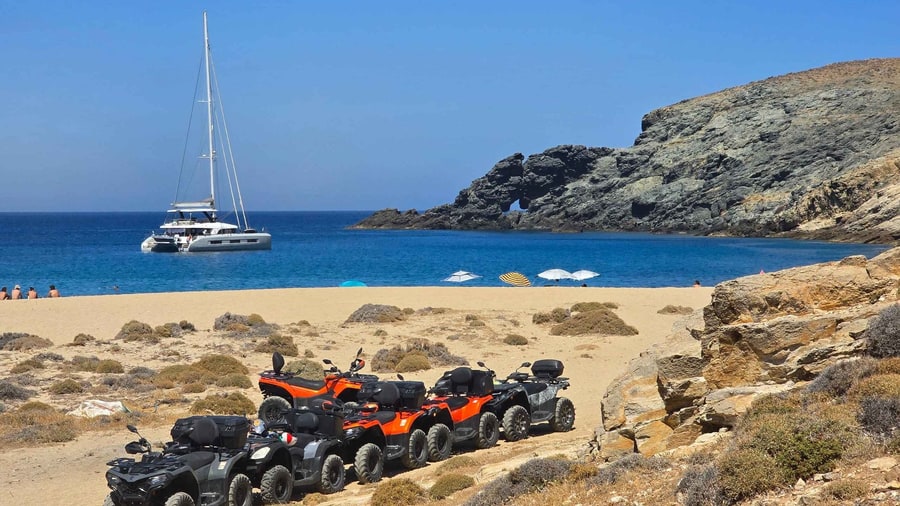
The roads that serve the bay of Panormos are in excellent condition. Panormos beach comes first on the western side of the bay. Locals and people who knew it well once had it largely to themselves.
Its fame has grown over the years. Agios Sostis is a large sandy beach with no umbrellas, sunbeds or beach services on the sand. It is the only well-known beach on Mykonos without them.
A Mykonos ATV tour finds an air of freedom and ease at Agios Sostis. Fokos lies just past the second dam of Mykonos. Its landscape is quite unlike the usual scenery of the Cyclades.
A Mykonos ATV tour leaves the provincial road at Ano Mera and heads towards Maou. After the Fokos dam, the road turns into a dirt track. The track is not especially rough.
Fokos beach runs for 170 m, and Myrsini lies next to it. Myrsini splits into two smaller coves around low rocks that reach the sea. Chora lies 12 km from the pair.
- Marmaronisi: This uninhabited rock island at the entrance of Panormos Bay has stone that suits lime making.
- Gyres islets: Myth says the gods split a rock here to sink Ajax, king of the Locrians.
- Wetland: The Rema Panormou wetland holds an ecosystem, a web of plants and animals, of interest.
Merchia, 14 km from Chora, ranks among the remotest beaches of the island. It has coarse sand and a rich, deep seabed. The road to it is hard going for the greater part of its length.
So the majority of visitors stay away. Merchia faces the strong wind of Mykonos. The best days for a Mykonos ATV tour there are days of weak north wind.
Which south coast beaches does a Mykonos ATV tour reach?
A Mykonos ATV tour reaches the south coast beaches by road. The route runs from Ornos, Psarou and Platys Gialos to Paradise. Further east come Elia, Kalo Livadi and Kalafatis. Each beach differs in sand, water and crowd, from quiet coves to busy beach bars.
Mykonos has no fewer than 25 beaches, facing every point of the compass. A Mykonos ATV tour on the south side starts with the first bays of that shore.
Ornos is a sheltered, south-facing beach with a small fishing harbour. The municipality counts it as the first of the southern beaches. Psarou has fine semolina sand and emerald water.
Psarou is also an organised beach with water sports. Platys Gialos is a fairly large sandy beach lined with hotels and restaurants. Paradise has coarse sand.
The beach bars of Paradise and Super Paradise have shaped the island’s fame since the 1970s. Super Paradise lies 7 kilometres from the town. The municipality names three ways in: private transport, an organised private bus or a boat from Platys Gialos.
A Mykonos ATV tour counts as private transport. Further east, Elia stretches wide, with fine sand and easy access. It also has a section for naturists.
- Paraga: Natural rocks form diving platforms at Paraga, and the view reaches Paros and Naxos.
- Kalo Livadi: Between Elia and Kalafatis, it ranks among the largest beaches of the island.
- Kalafatis: A Mykonos ATV tour finds a Blue Flag beach here that hosts Pan-European Freestyle Windsurfing competitions.
- Agrari: A more isolated sandy beach, it splits into two sections.
A Mykonos ATV tour along the south coast runs out of road at Lia. It is the last southern beach a car can reach, with coarse sand too. Tiny Tsangari is a secret beach with room for only a small crowd.
What does a Mykonos ATV tour see in the dry interior?
A Mykonos ATV tour sees a hilly, dry interior where stone walls divide fields and pastures. Cisterns, threshing floors, animal pens, dovecotes and small chapels stand on the slopes. They sit between low scrub and bare rock, away from the busy coast.
Dry stone walls run over the hills that a Mykonos ATV tour crosses. Their stones sit without mortar, and Mykonians call them pezoules. A wall stands 0.60 to 1.20 metres high on a base about 70 centimetres thick.
Each running metre of a wall 1 metre high takes about 1 tonne of stone. The municipality records that the walls hold soil and let rainwater soak into the ground.
The walls also give crops a stable microclimate, or steady local weather. They shelter wildlife too, such as Agama stellio mykonensis, a lizard found only here.
The island is mainly hilly, with no large flat ground near the coasts. Its landscape is made of phrygana and maquis, two kinds of scrub, and bare rock.
A long dry period and an average yearly rainfall of 371.7 millimetres limit crop yields. Plants grow from around mid-autumn and stop at the start of summer. So a Mykonos ATV tour in the warm months crosses the hills after the growing season.
- Dovecotes: The Venetians brought systematic dove and pigeon breeding for meat and fertiliser in the 15th century.
- Siting: Each dovecote sits on a slope shielded from the north wind, facing open space.
- St. Vlassis: The church of St. Vlassis has a large dovecote of its own.
Farm buildings complete the picture on a Mykonos ATV tour. Cisterns are tanks that store water. Animal pens called voidokelia rise to a maximum of 2 metres.
A threshing floor is a flat yard for separating grain from its straw. These floors served cereals and legumes in late spring and early summer, and later dried figs. Together with the walls, these stone works record how the island farmed a dry, rocky land.
What is a sunset Mykonos ATV tour like?
A Mykonos ATV tour at sunset starts in the late afternoon. It rides through the soft light of the golden hour to an open viewpoint. It stops while the sun drops below the horizon. It returns after dark with headlights and tail lights switched on.
The golden hour falls shortly before sunset, when daylight turns redder and softer than at midday. Contrast drops and shadows grow less dark. The brightest parts of a photo burn out less easily.
So a Mykonos ATV tour reaches its photo stop in the gentlest light of the day. Colour temperature, a measure of how warm light looks, sits around 3,500 K in the golden hour. At midday it sits around 5,500 K.
A sunset viewpoint needs only an open horizon to the west. A hilltop or a headland above the sea gives one. After the sun goes down, the blue hour follows.
The sun then sits well below the horizon, and the leftover indirect light turns blue. A Mykonos ATV tour rides back in this fading light and then in full dark.
The human eye takes about 20 to 30 minutes to adapt fully from bright sunlight to darkness. Cone cells, which see colour, recover their full sensitivity in 9 to 10 minutes. Rod cells, which see in dim light, need 30 to 45 minutes.
- Colour: Air scatters blue and green light more strongly, leaving orange and red at sunset.
- Brightness: Evening air holds more particles than morning air, so sunset colours outshine sunrise colours.
- Green flash: On a clear evening, a Mykonos ATV tour can catch a brief green flash after sunset.
- Custom: In Orthodox Christianity, the day begins at sunset.
A Mykonos ATV tour at dusk joins three kinds of light. They are the golden hour, the sunset colours and the blue hour. Rod cells ignore long wavelengths, so red lights help the eye adjust to the dark.
How safe is a Mykonos ATV tour?
A Mykonos ATV tour is as safe as each rider’s pace, gear and attention. The island has narrow roads and heavy summer traffic. Loose gravel, dust, side winds and strong sun add to the risk. All call for a low speed and a steady convoy.
Quad bikes carry real risk. Four-wheeled quads tend to roll over, and no rigid cab protects the rider. Trauma data from the United States, records of serious injuries, rate ATVs as dangerous as motorcycles.
A Mykonos ATV tour also runs on asphalt. US federal safety tips warn against riding quads on paved roads. Their solid rear axle has no differential, so both back wheels turn at one speed.
Slow, wide turns keep the machine steady on narrow lanes. Summer brings the heaviest traffic, with room on Mykonos for about 50,000 visitors a night. Cars and buses share the roads with the quads.
For the World Health Organization, each 1% rise in average speed lifts fatal crash risk by 4%. Drivers on mobile phones are about four times as prone to a crash.
On a Mykonos ATV tour, the convoy keeps a fixed order and braking gaps. These gaps leave room to stop in time. Photos wait until the quad comes to a full stop.
- Gravel and dust: Loose stones on road edges reduce grip, and dust from the machine ahead cuts visibility.
- Wind: Side gusts on exposed headlands push a light quad off its line.
- Sun and heat: An open machine gives no shade, so water and covered skin count.
A Mykonos ATV tour stays safe when riders treat the quad as a road vehicle, not a toy. Vulnerable road users are people with no shell around them, such as motorcyclists. They account for more than half of road deaths worldwide.
When is the best season for a Mykonos ATV tour?
A Mykonos ATV tour suits late April best, along with the weeks from late September into October. Daytime highs then stay mild, and the meltemi wind is absent. In July and August, strong afternoon winds and crowded roads mark the summer.
The National Observatory of Athens classes Mykonos as hot semi-arid, a hot and fairly dry climate. Its rain falls from October to March. Its station records average daily highs of 27.8 °C in July and 27.6 °C in August.
Nights stay above 24 °C, and July gets 0.1 millimetres of rain. The record high of 37.8 °C came in both June and July. So a Mykonos ATV tour in high summer meets real heat.
The meltemi, also called the etesian or yearly wind, is the strong, dry north wind of the Aegean. It blows from late spring to mid-September. It peaks in the afternoon and tends to drop at night.
It can reach force 7 to 8 on the Beaufort wind scale, or 50 to 74 km/h. It arises in clear weather without warning. For riders, that means calmer mornings and gusty afternoons on meltemi days.
- Spring: April brings average highs of 18.8 °C and 18.7 millimetres of rain.
- Summer: June highs average 26.3 °C, and the sea and north wind keep days dry and sunny.
- Autumn: Average highs reach 25.7 °C in September and 22.0 °C in October.
High summer still works for riders who start early and carry plenty of water. A firm grip on the handlebars helps along the exposed coastal stretches of the island.
What do travelers ask about a Mykonos ATV tour?
A Mykonos ATV tour prompts five recurring questions. Can a passenger ride along, and can children join? Which clothes suit the ride, and can a first-time rider take part? The fifth asks how it pairs with a quad outing on another Cyclades island.
Can a passenger ride on a Mykonos ATV tour?
A passenger fits on a Mykonos ATV tour only on a tandem quad. The American National Standards Institute defines a standard ATV for a single operator, the rider at the controls.
US federal safety advice warns against carrying passengers. They make it hard for the driver to shift body weight. A seated passenger stays still.
Is a Mykonos ATV tour suitable for children?
Children carry the greatest quad risk on a Mykonos ATV tour. Alarming injury rates among children and teenagers appeared almost as soon as modern ATVs did.
The American Academy of Pediatrics agrees with the US Consumer Product Safety Commission here. Both advise that children stay off ATVs until their mid-teens. Younger children can see the coast by car or by boat.
What clothing suits a Mykonos ATV tour?
A Mykonos ATV tour calls for protective gear beyond the helmet. Goggles keep road dust out of the eyes, and sandals stay in the bag. Long, light trousers and a long-sleeved top shield the skin from sun and gravel spray.
Can a first-time rider take a Mykonos ATV tour?
A Mykonos ATV tour suits first-time riders who start slowly. At low speed, the extra wheels of a quad give more stability than a motorcycle.
Safety courses have cut both the number of ATV accidents and how serious they are. A briefing and a practice loop teach a beginner the throttle, the brakes and the turning circle.
Does a Mykonos ATV tour pair with other islands?
A Mykonos ATV tour pairs well with a second ride elsewhere in the Cyclades. High-speed vessels reach Mykonos daily from nearby islands and Athens.
Mykonos is a peak of a sunken mountain range, while Santorini is volcanic. So a Santorini ATV tour crosses a different landscape. A strong meltemi can keep inter-island ferries in port.
Featured photo: Explore Mykonos island 650cc ATV tour, via GetYourGuide.