
A Rhodes cooking class brings travelers into a village kitchen. They cook Rhodian dishes and Greek meze, then share the meal with local wine. It is one of the cooking classes in Greece on Greece VIP.
Each section ends with a Rhodes cooking class or tasting to book online.
What does a Rhodes cooking class include?
A Rhodes cooking class is a hands-on lesson on Rhodes, the largest island of the Dodecanese. A small group cooks Rhodian and Greek dishes there. An instructor works beside the cooks. Then the group sits down together to eat the meal it made.
The Dodecanese take their name from the Greek words for twelve islands. Rhodes is the historical capital of that group. The island is shaped like a spearhead, 79.7 km long and 38 km across at its widest point.
A Rhodes cooking class draws on the kitchen of this island. It also draws on the wider Greek table. Each cook in a Rhodes cooking class prepares a share of the meal.
Cooking schools around the world include schools that train professional chefs. They also include schools aimed at amateur enthusiasts. A Rhodes cooking class for visitors sits on the amateur side, so the lesson centres on the food. An amateur cooks for pleasure, not as a job.
The group is small, so every cook reaches the stove and the work table. The instructor can also answer each question as the dishes take shape.
- Preparation: Washing, chopping, mixing and shaping are done by the cooks themselves.
- Cooking: Pans, pots and ovens finish the dishes while the instructor watches each step.
- Meal: Every dish reaches one shared table, and that meal ends the class.
Food and history fit into one stay on Rhodes. A Rhodes cooking class and a Rhodes Old Town tour complement each other. The class centres on the kitchen and the table.
The tour covers the streets of the Medieval City of Rhodes. The Medieval City forms part of the city of Rhodes. The city sits at the northern tip of the island.


Which Rhodian dishes does a Rhodes cooking class teach?
A Rhodes cooking class teaches Rhodian dishes from the traditional kitchen of the island. The famous pitaroudia are fritters made of chickpeas. Matsi is a pasta made by hand, and lakani is goat cooked with chickpeas. Melekouni is the sweet made of honey and sesame.
Pitaroudia are listed among the traditional dishes of Rhodes and the Dodecanese. First, boiled chickpeas are ground to a rough mixture. Next, chopped onion, grated tomato, mint and cumin go into it. Cumin is a spice of small dried seeds with a warm, earthy taste.
Then the dough is shaped into large flat patties. Each patty is rolled in flour and fried until golden. The fritters are served hot, warm or at room temperature.
A Rhodes cooking class can teach each step of this dish. The lesson runs from the rough grind of the chickpeas to the turn in the pan.
Goat and hand-made pasta fill out the Rhodian table. Lopia is goat cooked with dried beans. Goat meat also goes into the pydiko, a clay pot, for another Rhodian main dish.
Cooks use matsi to make koulouria, a traditional recipe. Trachanas and loukoumi are two more hand-made pastas of Rhodes. A Rhodes cooking class on these dishes shows how goat, chickpeas, beans and pasta make a full meal.
- Karavoli: Snails cooked with bulgur or cumin count among the main dishes of the island.
- Amarangi: Daisy shoots with garlic sauce are listed beside the goat and snail dishes.
- Katimeria: These pancakes, called tiganites, belong to the desserts of the Dodecanese.
Melekouni is the emblematic dessert of joyful events on Rhodes. This pasteli, a sweet seed bar, also holds orange, spices and almonds. A Rhodes cooking class can end on this sweet.
Mantinades, a fried pastry called xerotigana with honey, sit on the same list of Rhodian sweets. Amygdalota, the white almond cookies, sit there too. So a Rhodes cooking class has more than one dessert to teach.
Which Greek meze does a Rhodes cooking class prepare?
A Rhodes cooking class prepares Greek meze, a selection of small dishes served as appetizers. Meze belongs to Eastern Mediterranean cuisines and is similar to Spanish tapas. The class can cook tzatziki, dolmades, keftedes and saganaki by hand. A horiatiki salad completes the set.
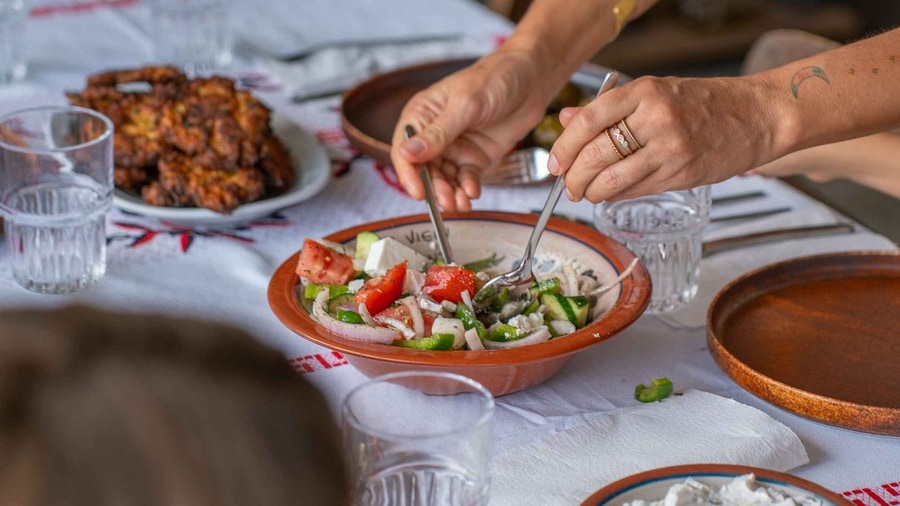
A meze can be part of a multi-course meal. It can also form a meal in itself. So a Rhodes cooking class can build a full meal from meze alone.
Tzatziki is a cold dip of cucumber and yogurt. Its name reached English around the mid-20th century as a loanword from Modern Greek. A loanword is a word that one language takes from another. Modern Greek had taken the word from Turkish.
Keftedes are the fried meatballs of Greece. Their name was also taken from Turkish. The meat mix includes bread, onions, parsley and mint leaf.
Saganaki covers the dishes cooked in a small frying pan. The best-known saganaki is a fried cheese appetizer. Graviera, kefalograviera, kasseri and kefalotyri are among the Greek cheeses used.
The cheese melts in the pan until it bubbles. It then goes to the table with lemon juice and pepper. A Rhodes cooking class can teach both of these small plates.
- Dolmades: On Rhodes, a cyclamen leaf can wrap them, and these kamilakia come with egg-lemon sauce.
- Shrimp saganaki: Shrimp are fried in a pan, splashed with ouzo and covered in tomato sauce.
- Yuvarlakia: Stewed meatballs with a small quantity of rice are the counterpart of fried keftedes.
Horiatiki, the Greek village salad, holds pieces of tomatoes, cucumbers and onion. Feta and olives go in too, such as Kalamata olives. Feta is a soft white cheese with a salty taste.
Salt, Greek oregano and olive oil dress the salad, and lemon juice is a common addition. A Rhodes cooking class that ends on horiatiki sets a cold salad beside the hot dishes.
Which local products does a Rhodes cooking class use?
A Rhodes cooking class uses the products of the island. They include souma, the grape spirit of Rhodes, plus honey, olive oil, cheeses, herbs and vegetables. The shores are rocky. Arable strips of land, fit for farming, grow citrus fruit, vegetables and olives.
A Rhodes cooking class meets souma, a colourless drink that water or ice turns milky white. The official Greek tourism website calls it the national drink of Rhodes. Local cheeses, olives, seafood and rusks, a dry twice-baked bread, go with it.
Mountain villages make souma from grape pomace, the solid leftovers of pressed grapes. The pomace is cleaned of stems and crushed, and its juice is boiled in large copper stills. A still is a closed pot. It catches the steam and cools it back into liquid. The spirit then rests in barrels in cool, shady places.
The municipality of Rhodes lists thyme, pine, flower and eryka (heather) honey. It says that honey of Rhodes and of the South Aegean is awarded every year. The awards rank it among the best in the world.
Olive oil is the ancient, defining element of Greek cooking. In a Rhodes cooking class, it comes from Rhodes. That oil carries a geographical indication, a protected label of origin.
- Cheeses: The island makes cream cheese, Gruyere of Rhodes, goat cheese and synoro.
- Herbs: Sage, camomile and mint grow on the island.
- Vegetables: Tomatoes, melons and watermelons carry the Rhodes name.
Green crushed Rhodian olives and Zupa olives also count among the local products. Grapes, olives, goats, bees and vegetable gardens on Rhodes fill the pantry of a Rhodes cooking class.
The municipality of Rhodes names shops in the villages of Apollona and Sianna for local goods. These shops sell the same honey, olives and cheeses that a Rhodes cooking class uses.
Where does a Rhodes cooking class take place?
A Rhodes cooking class meets in village kitchens, on farms or in the old town of Rhodes city. The villages lie in the countryside. The farms sit among orchards and the animals that supply the kitchen. The old town gives the class a city setting.
One such village for a Rhodes cooking class is Archangelos, at 160 metres above sea level. Its community had 5,695 residents at the 2021 census, the official count of people. It ranks as the fifth largest town of the island.
The main farm products of Archangelos are olive oil and citrus fruit. Stockbreeding, the raising of farm animals, and pottery also shape the work of its people.
A Rhodes cooking class in Lindos meets in a fishing village and former municipality. Its community had 1,096 residents at the 2021 census. The wider municipal unit had 4,496.
Lindos sits in a large bay that faces the village of Charaki. Its fine beaches make it a popular tourist and holiday destination. It is also an archaeological site, a place of ancient remains.
- Village kitchens: A village home kitchen keeps a Rhodes cooking class close to local farms and shops.
- Farms: Goat cheese, honey and olive oil all start on a farm.
- Old town: A class here sits next to the open-air markets of Rhodes city, the island capital.
Both villages sit on the east coast. Archangelos lies about 30 km and Lindos about 40 km south of Rhodes city. The setting changes the surroundings of a Rhodes cooking class, not the local products.
How did history shape the food of a Rhodes cooking class?
A Rhodes cooking class carries three layers of history on the plate. They are Byzantine, Ottoman and Italian. The Byzantine layer brought new ingredients and spices. The Ottoman layer added sweets and coffee, and the Italian layer added pasta dishes to the Greek kitchen.
In 395, the Roman Empire was divided, and the long Byzantine period began for Rhodes. Byzantine cooking resembled ancient cooking, but caviar, nutmeg and basil joined it. Caviar is salted fish eggs. Nutmeg is a warm spice, and basil is a leafy green herb. Honey was the main sweetener.
The Byzantines made cheeses such as anthotiro, a fresh whey cheese, kefalotyri and feta. Garos, a sauce of fermented fish, was a favourite seasoning. Fermented food is left to change slowly, which builds a strong taste. A Rhodes cooking class still works with honey and cheeses from that Byzantine pantry.
Ottoman cuisine blended Persian, Levantine (eastern Mediterranean), Arabian, Turkish and Byzantine traditions. A Rhodes cooking class meets kadaifi and halva, sweets that Greek kitchens took from Ottoman cooking. Kadaifi is a pastry of thin dough threads, and halva is a dense sweet of semolina or sesame.
Coffee was in use in Istanbul by 1539. The brew uses very finely ground beans, boiled in a special pot called an ibrik or a cezve. This small pot has a long handle.
Greeks first called it Turkish coffee. Political tensions in the 1950s brought the name Greek coffee. The coffee pot carries the Ottoman layer into a Rhodes cooking class.
- Trade: Byzantine trade through Constantinople, a global spice hub, brought grains, sugar and spices from other climates.
- Lemons: Introduced in the second century, lemons served as medicine before they entered the diet.
- Stews: Cinnamon, allspice and cloves sit beside meat in Greek stews.
A Rhodes cooking class meets pastitsio, pastitsada and stifado, Italian dishes that Greek kitchens borrowed and changed. Pastitsio is baked pasta with minced meat, and pastitsada is spiced meat in tomato sauce with pasta. Stifado is a stew of meat with small onions.
Greek cooking also makes hilopites, a traditional pasta of flour, eggs, milk and salt. Italy governed Rhodes and the rest of the Dodecanese in the 20th century.
How does a Rhodes cooking class pair with a wine tasting?
A Rhodes cooking class pairs with a wine tasting through the PDO wines of the island. Athiri makes the white, Mandilaria the red and Muscat the sweet. These local grapes give the table three styles. Each style sits beside the dishes from the lesson.
Rhodes has a winemaking tradition from antiquity, the ancient world. Back then, Rhodian wines crossed the Mediterranean in amphorae, clay jars marked with the symbol of the rose.
The island appears among the Aegean Islands appellations, the named wine areas of the region. There a PDO, or Protected Designation of Origin, marks an Appellation of Origin of Superior Quality.
Through the warm months until September, sea breezes cool the vines. The Aegean meltemi winds, strong dry winds from the north, cool them too.
Athiri is one of the oldest Greek varieties and came originally from Santorini. A variety is one type of grape. It is used for retsina, a wine flavoured with pine resin, on the island. The word Rhodes can stand in for this grape on Greek wine labels.
Mandilaria, also called Amorgiano, grows mainly on Rhodes and Crete. Its wine is very tannic, with a strong drying taste. So makers frequently blend it with other grapes to soften the taste.
- Athiri: The flagship white gives delicate aromas of citrus and fruit.
- Mandilaria: The red variety of Rhodes gives wine a deep colour.
- Muscat: White Muscat and Trani Muscat make sweet wines rich in aroma.
Embonas is a mountain village halfway up Mount Attavyros. That grey rocky mountain is the highest point of the island. The village is the centre of the wine industry on Rhodes.
After a Rhodes cooking class, the Greek National Tourism Organisation points travelers to the wineries of the island.
When is the best season for a Rhodes cooking class?
A Rhodes cooking class meets a hot-summer Mediterranean climate, coded Csa. Its winters are mild. Spring and autumn bring warm days without the heat of July and August. That makes them the best fit for cooking and tasting.
Summer on Rhodes is dry. At Rhodes International Airport in Paradeisi, the average daily high reaches 30.6 °C in July. It reaches 30.7 °C in August, and the highest temperature on record is 40.2 °C.
July brings only 0.7 mm of rain. Traffic jams are common in summer, when the number of vehicles more than doubles. So travelers heading to a Rhodes cooking class meet heavy traffic and limited parking.
The same airport station records an average daily high of 20.3 °C in April. The last month of spring reaches 24.0 °C, with only 18.7 mm of rain. That is far less than the 137.8 mm of December.
- Sunshine: Around 3400 hours of actual annual sunshine are expected at the airport, with 391.8 in July.
- Winter: January has an average daily high of 15.4 °C.
- South-east: Lindos has a mean annual temperature of around 22.0 °C, the warmest in Greece.
October reaches 24.6 °C, and November cools to 20.8 °C. Autumn also brings the grape harvest, which runs from early September until early November in the northern hemisphere. That is the half of the Earth north of the equator. A Rhodes cooking class in spring or autumn works with fresh island produce.
What do travelers ask about a Rhodes cooking class?
A Rhodes cooking class draws five regular questions from travelers. They ask about vegetarian and other diets and about children. They ask about missing cooking experience and recipes to take home. The fifth question covers a day trip to Lindos.
Does a Rhodes cooking class work for vegetarian and other diets?
Greek home cooking leans on plants, so a vegetarian Rhodes cooking class has plenty to cook. A vegetarian eats no meat or fish. Lathera are seasonal vegetables stewed with olive oil, herbs and tomato sauce. Fasolada is a soup of dry white beans.
Wheat is the basic grain of Greece. So anyone who avoids gluten, a protein in wheat, checks the bread and pastry dishes.
Can children join a Rhodes cooking class?
Greece sets the legal age to buy and to drink alcohol at 18. So the wine tasting of a Rhodes cooking class stays an adult part.
The cooking itself rests on wheat, vegetables and herbs. Greek cuisine favours oregano, mint, garlic, onion, dill, cumin and bay laurel more than other Mediterranean cuisines do.
Is cooking experience needed for a Rhodes cooking class?
A recipe is a set of instructions needed to prepare a specific dish. A beginner in a Rhodes cooking class follows them from the first ingredient to the last step.
In Greece, the taverna, a simple local restaurant, serves home cooking. That is a sign that the dishes rest on everyday skills.
Can travelers take the recipes home from a Rhodes cooking class?
A modern recipe lists the name of the dish and its yield, meaning how much it makes. It lists the ingredients in order of use, with quantities. It also gives step-by-step instructions, the cooking time and the equipment needed.
A written recipe from a Rhodes cooking class takes this form. So the dish can be repeated in a home kitchen. Recipe books also serve as tools for learning.
Can a Rhodes cooking class combine with a day trip to Lindos?
A Rhodes cooking class can share a stay on the island with a Lindos tour. The tour reaches the acropolis of the village, its fortified hilltop.
There stands the Doric Temple of Athena Lindia, from about 300 BC. Doric is the plainest of the ancient Greek building styles. A castle of the Knights of St John stands beside it.
Featured photo: Rhodes traditional cooking experience, via GetYourGuide.