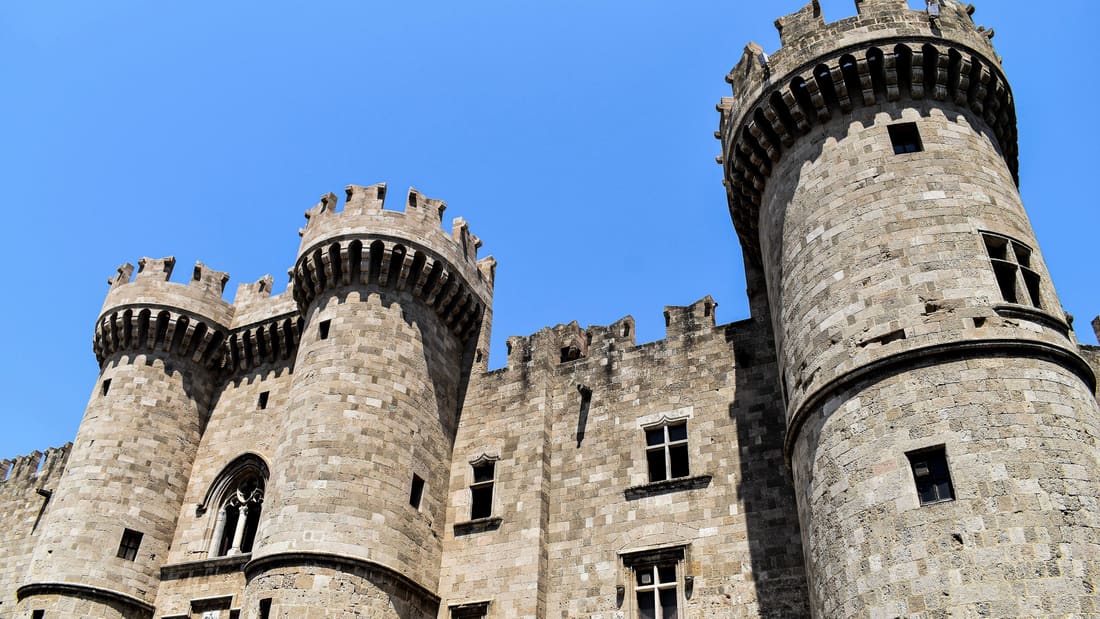
A Rhodes old town tour leads through the walled medieval city of the Knights of St John, from the Palace of the Grand Master and the Street of the Knights to the gates, the moat, the Turkish and Jewish quarters and the harbour of Mandraki. This post covers what a Rhodes old town tour includes, the Knights and the sieges, the palace, the Street of the Knights, the Hospital of the Knights, the walls and gates, the old quarters, Mandraki, ancient Rhodes and the best season. It is one of the Greek island tours on Greece VIP.
Each section ends with a Rhodes old town tour that can be booked online.
What does a Rhodes old town tour include?
A Rhodes old town tour covers the Medieval City of Rhodes, a UNESCO World Heritage Site enclosed by a wall 4 km long. The walk moves between the high town of the Knights and the lower town, and passes the palace, churches, mosques and synagogue.
Rhodes lies at a crossroads of Europe, the Middle East and Africa, and people have lived on the island since about 4000 BC. The medieval city forms part of the modern capital at the north-east tip of the island, which holds about 56,000 residents. A Rhodes old town tour therefore starts inside a small walled quarter of a much larger modern city.
The city lists its main sights as the Grand Master’s Palace, the Street of the Knights, the Holy Trinity church, the Kahal Shalom Synagogue, the Mehmet Aga Mosque and the Mosque of Suleiman the Magnificent. Gothic buildings stand in the historic upper town. The citadel counts as one of the best-preserved medieval towns in Europe, and a Rhodes old town tour links these stops on foot.
A Rhodes old town tour stays inside the walls, while a Lindos tour leaves the city by the Rhodes-Lindos Avenue. The two places share one past, because Lindos, Ialyssos and Kamiros joined in 408 BC to form the city of Rhodes. Lindos is therefore tied to the founding of the city. The walled town records the medieval centuries that came later, from the Hospitallers to the Italians.
In 1923 the architect Florestano Di Fausto and governor Mario Lago produced a city plan that respected the walled town almost entirely and demolished only the houses built on and around the walls in the Ottoman era. Di Fausto turned the Jewish and Ottoman cemeteries into a green zone around the Medieval Town, so a Rhodes old town tour has a clear edge.
- Dates: Construction of the Medieval City ran from about 1309 to 1523.
- Layout: The Hospitallers built the high town in the north, and the lower town lies to the south-south-west.
- Status: The Ministry of Culture protected the medieval town in 1960, and UNESCO named it a World Heritage City in 1988.
Wartime damage and later planning also shape a Rhodes old town tour. Allied bombing raids on the old city in 1944 destroyed a significant portion of the city. One of the first decrees of the Greek government then reserved the damaged areas for excavations. Decrees of 1961 and 1963 provided for wider streets, but the plans were not implemented in the old city because the Archaeological Service resisted them.


How did the Knights shape a Rhodes old town tour?
A Rhodes old town tour follows the work of the Knights Hospitaller, who took the city in 1310, held it for two centuries, rebuilt its defences after the Ottoman siege of 1480 and surrendered it to Suleiman the Magnificent after the siege of 1522.
The Knights Hospitaller came to Rhodes after the fall of Acre in 1291, when the order sought refuge in the Kingdom of Cyprus. Their Master, Guillaume de Villaret, chose Rhodes and reorganised the order into eight langues, or tongues: Aragon, Auvergne, Castile, England, France, the Holy Roman Empire, Italy and Provence. A Rhodes old town tour meets those tongues in bastion names such as Italy and Spain.
Foulques de Villaret carried out the plan, and on 15 August 1310, after more than four years of campaigning, the city of Rhodes surrendered. In 1312 Pope Clement V dissolved the Templars and passed much of their property to the Hospitallers. Wealth from the Holy Land and the Templar estates then fed an economic boom, and the knights spent it on the walls that a Rhodes old town tour follows.
In 1444 the Mamluk sultan of Egypt besieged the town for 40 days without success. The first Ottoman attack on the city that a Rhodes old town tour now covers came in 1480, when a fleet of 160 ships and an army of 70,000 men under Mesih Pasha reached the gulf of Trianda. The Ottomans aimed first at the Tower of St Nicholas, a key point of the harbour defence.
On 27 July about 2,500 Janissaries entered the city through the tower of Italy. Grand Master Pierre d’Aubusson fought with lance in hand, and between three and four thousand Turks died that day. After the siege and the earthquake of 1481, the fortress gained a thicker main wall, a dry ditch of double width and fewer gates. A Rhodes old town tour sees the result in the walls.
- Forces: In 1522 about 400 ships carried up to 100,000 men against about 7,000 men-at-arms.
- Mines: On 4 September two mines blew an 11 m section of the wall at the bastion of England into the moat.
- Fall: The bastion of Spain fell on 17 December, and the city accepted terms on 22 December.
On 1 January 1523 the knights marched out, boarded 50 ships and sailed to Crete, and in 1530 Emperor Charles V granted them Malta. The Ottomans converted the majority of the churches into mosques, and the Greeks moved to new suburbs outside the walls. A Rhodes old town tour therefore reads two layers of power: the Hospitaller city of 1310 to 1522 and the Ottoman town that followed.
What does a Rhodes old town tour show at the Palace of the Grand Master?
A Rhodes old town tour at the Palace of the Grand Master shows a medieval castle that served the Knights as palace, headquarters and fortress. The Italians rebuilt it from 1937 to 1940, and its first floor holds mosaic floors.
The palace that a Rhodes old town tour reaches, also called the Kastello, is one of the rare examples of Gothic architecture in Greece. Before the Knights it was a Byzantine citadel, first built in the late 7th century. After the Hospitallers occupied Rhodes in 1309, they made it the administrative centre of the order and the residence of the Grand Master.
After the Ottoman capture of 1522 the palace served as a command centre and fortress. In 1856 lightning struck a gunpowder magazine under the nearby Church of Saint John. The explosion killed people, destroyed the church and wrecked much of the palace, and the bulk of the upper floors collapsed. A Rhodes old town tour sees the result of that blast.
Under Italian rule the Ottoman-era structures were pulled down. Architect Vittorio Mesturino designed the rebuilding of the palace and of the nearby Street of the Knights. Remains and records of the pre-Ottoman building were lacking, so he re-created a structure that also worked as a government building. Later critics faulted the lack of historical accuracy in what a Rhodes old town tour sees there.
In 1948 Rhodes and the rest of the Dodecanese passed to Greece, and the palace became a museum. The official Greek site describes its first floor as a collection of mosaic floors from monuments of the island, shown with medieval furniture. A Rhodes old town tour reaches those floors and the two permanent exhibitions on the ground floor, which cover the city from 408 BC to 1522.
- Use: The castle became a holiday residence of King Victor Emmanuel III and later of Benito Mussolini.
- Plaque: A large plaque near the entrance still carries the name of Mussolini.
- Treaty: The treaty of 10 February 1947 set the transfer of the Dodecanese Islands to Greece.
The palace therefore holds four layers in one building: a Byzantine citadel, the seat of the Grand Master, an Ottoman fortress and an Italian reconstruction. In 1988, during the Greek presidency of the European Economic Community, Prime Minister Andreas Papandreou and the other leaders of the EEC held a meeting inside it. A Rhodes old town tour shows all four layers there.
Why does a Rhodes old town tour walk the Street of the Knights?
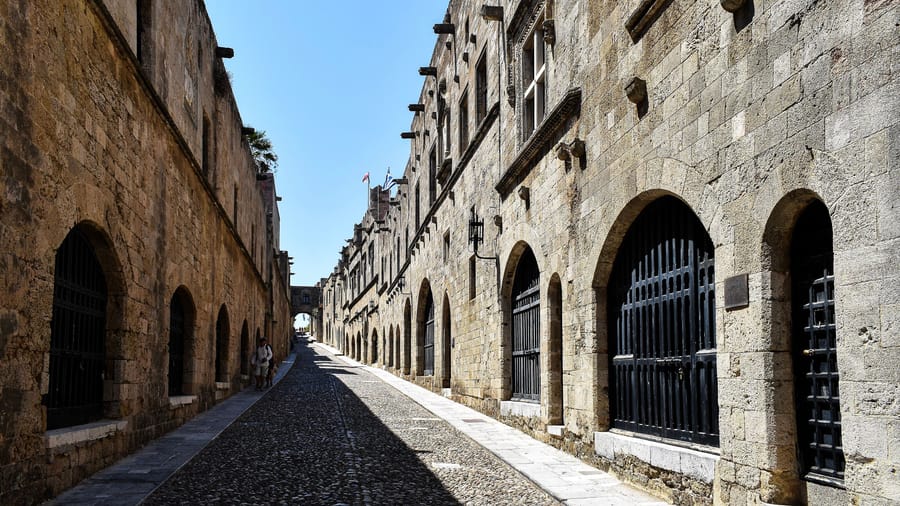
A Rhodes old town tour walks the Street of the Knights because it shows how the Knights Hospitaller lived and were organised on Rhodes. The Order split into langues, or tongues, by language and origin, and each langue kept an inn, called an auberge, as its headquarters.
The Order used the word langue for a division by language and region, and the system began in 1319 at a meeting of the Chapter General in Montpellier. Seven langues stood at first: Auvergne, France, Provence, Aragon, Italy, Germany and England. In 1462 Aragon was divided, and a new langue arose for Castile, León and Portugal. A Rhodes old town tour uses that list to explain the knights who lived in the town.
Each langue had a head called a pilier, or bailiff. The piliers sat on the Grand Council of the Order with the Knights Grand Cross, the bishop, the bailiffs of the convents and the prior of the Conventual Church. The pilier of France was the Hospitaller, and the pilier of Italy was the Admiral of the Order’s fleet. On a Rhodes old town tour, these offices show an order run like a small state.
The headquarters of each langue was an auberge, a French word for inn. Auberges were first built in Rhodes in the late Middle Ages. After the Order moved to Malta in 1530, auberges rose in Birgu from the 1530s and in Valletta from the 1570s. The Rhodes inns came first, and a Rhodes old town tour treats them as the pattern that the Order kept in Malta.
The street also carries a layer from the 20th century. Italian troops took Rhodes in 1912, and the architect Vittorio Mesturino was later asked to design the reconstruction of the Grand Master’s Palace and of the nearby Street of the Knights. The construction works took place between 1937 and 1940. A Rhodes old town tour therefore treats the street as a medieval site that Italian architects reworked.
- Langues: The Order grouped its members by language and region.
- Auberges: Each langue kept an inn as its headquarters.
- Tour link: A Rhodes old town tour ties the street to the langues of the Order.
Each langue also kept its own identity. In Rhodes the langue of England used the arms of England, quarterly France and England. Its Grand Prior, Philip De Thame, acquired the estates allocated to the English langue from 1330 to 1358. A Rhodes old town tour on the street thus meets an order made of separate national groups, all answering to one Grand Master.
What does a Rhodes old town tour show at the Hospital of the Knights?
A Rhodes old town tour shows at the Hospital of the Knights a large building, begun in 1440 and finished under Grand Master d’Aubusson, that now holds the Archaeological Museum of Rhodes. Its collections include the Crouching Aphrodite, a Fikellura pyxis and the Head of Helios.
The museum is housed in the edifice that was the hospital of the Knights of Saint John. The Order grew from a hospital in Jerusalem, founded by merchants from Amalfi, where monks cared for sick, poor or injured Christian pilgrims. Construction on Rhodes began in 1440 and reached completion under Grand Master d’Aubusson, who led the Order from 1476 to 1503. The small Arnaldo Gate in the walls gives access to the New Hospital of Saint John, so a Rhodes old town tour links wall and hospital.
The museum holds archaeological artifacts from different parts of Rhodes and the neighbouring islands. Among them is the Pyxis of the Fikellura type, from the mid-6th century BC. The museum also holds the Head of Helios, which featured in 2011 on the cover of the album Floral Shoppe by Macintosh Plus and became known through the vaporwave movement. The collections thus reach beyond the period of the Knights.
The Crouching Aphrodite, a stop on a Rhodes old town tour, is a marble statue of the 1st century BC, inspired by a 3rd-century BC prototype by the sculptor Doidalsas. The goddess crouches with her right knee close to the ground and turns her head to the right, while she lifts her hair in her fingers to dry it. The figure is 49 cm high, and its base adds 12 cm.
- Building: Work began in 1440 and ended under Grand Master d’Aubusson.
- Objects: The Crouching Aphrodite, a Fikellura pyxis and the Head of Helios stand in the collections.
- Stop: A Rhodes old town tour pairs the hospital building with the objects inside it.
The Aphrodite of Rhodes, as the statue is also called, was an accidental find, unearthed in 1923 in the garden of the Governor’s villa, when Italy held the island after it annexed the Dodecanese from the Ottoman Empire in 1912. It was carved from a single piece of marble and is almost intact: only chips in the hair and abrasions on the toes mar it. A Rhodes old town tour reads it as a landmark of the island.
Which walls and gates does a Rhodes old town tour pass?
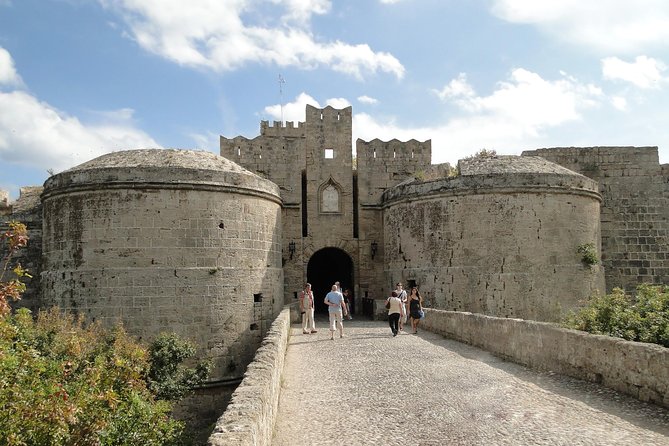
A Rhodes old town tour passes the walls and gates that the Knights built around the medieval city. An embankment, a moat and bastions ring the town, and eleven gates give access, among them the d’Amboise, Marine, St Catherine’s and Liberty gates.
The wall is an embankment encased in stone, built in rubble masonry that withstands gunshots, with smooth outer faces that prevent climbing. The Knights began it in 1309 on older Byzantine walls and used the Theodosian walls of Constantinople as the reference model. The defence was shared by langue: the north face stood under the Grand Master, and the posts to the west and south went to France and Auvergne, Spain, Germany and Italy.
The Bastion of Italy is the post where the Ottomans opened a breach in 1480. The Knights rebuilt it with a chemin de ronde for cannon, and it bears the name of Grand Master Fabrizio del Carretto. After the siege of 1480, terrepleins were set in the middle of the moat so that cannon had no clear shot at the walls. A Rhodes old town tour passes this ditch.
The d’Amboise Gate, passed on a Rhodes old town tour, has a triple defensive belt with chemins de ronde, two round towers and a covered entrance. The Gate of Saint John, known as Porta Kokkini, the red door, takes its name from a tradition that the stones before it were dyed red by the men who fell there in 1522. By Turkish tradition, Suleiman’s troops entered through the Gate of Saint Athanasios, which the Italians reopened in 1922.
At the harbour, the Marine Gate led into the town. Allied bombing in World War II destroyed the upper part of its north tower, and the Greek administration restored the gate in 1951 together with the Gate of Saint Paul. The Liberty Gate follows the style of the medieval gates, and the road through it continues through the Arsenal Gate of the 14th century.
- Gates: Eleven give access to the old city.
- Bastions: Saint George is pentagonal, and its final form came from the architect Basilio della Scuola.
- Route: A Rhodes old town tour passes medieval gates and gates opened in 1924, 1935 and 1955.
After the conquest of 1522 the Ottomans did not demolish the walls but repaired them and kept them under maintenance for four centuries. The Italian city plan of 1923, drawn by the architect Florestano Di Fausto, respected the walled town almost totally and removed only the houses built on and around the walls in the Ottoman era. A Rhodes old town tour on the walls thus covers three periods of one structure.
What does a Rhodes old town tour show in the Turkish quarter?
A Rhodes old town tour shows the Turkish quarter of the walled town: the Mosque of Suleiman, the Hafiz Ahmed Agha Library, the Yeni Hamam bath and the clock tower. The Ottoman centuries that followed the conquest of 1522 shaped this part of the town.
The Mosque of Suleiman is the leading surviving Ottoman monument in Rhodes, so a Rhodes old town tour treats it as the anchor of the quarter. It was the first mosque built in the town after the conquest of 1522 and carries the name of the sultan who led the invasion. It was rebuilt in 1808 on the original design.
The prayer hall has three domed chambers. The central room holds a mihrab, the niche that marks the direction of prayer, and a minbar, or pulpit, of walnut wood. The marble doorway belonged to a funerary monument that the Knights Hospitaller built between 1510 and 1520, and it was moved into the mosque in 1863. The mosque has been closed for worship since 2014.
A Rhodes old town tour reaches the Hafiz Ahmed Agha Library in the same quarter. Hafiz Ahmed Agha, chief equerry of the sultan, founded it in 1793 with 1995 manuscripts for the reading public of his home town. The library holds 1256 manuscripts today, among them a Koran from 1540, a history of the Turkish siege of 1522 and works with Persian miniatures.
Two more sights complete the quarter on a Rhodes old town tour. The Yeni Hamam, the new bath, stands in the same area as the Mustafa Pasha Mosque, and Sultan Mustafa built both. Public baths were among the new buildings of the Ottoman era. The clock tower is listed among the landmarks of the medieval town, next to Socrates Square, the Jewish Square and the old hamam.
- Fountain: A Rhodes old town tour passes an octagonal fountain with eight reused columns in front of the Mosque of Suleiman.
- Ibrahim Pasha Mosque: Finished around 1541, it is the only one of the seven mosques inside the walls open for worship.
- Mustafa Pasha Mosque: Its vaults are the sole example of their kind on the island.
The Turkish quarter shows how the Ottomans reshaped the walled town after 1522. Muslim Turkish families settled inside the walls, churches became mosques, and the Greek residents were forced to move to new suburbs outside them. Baths at the back of houses became a mark of the new style. The Rhodes old town tour then moves to the Jewish Quarter.
What does a Rhodes old town tour show in the Jewish Quarter?
A Rhodes old town tour shows the Jewish Quarter, La Juderia, in the eastern part of the old town. The route passes the Kahal Shalom Synagogue, completed in 1577, and the Square of the Jewish Martyrs, a tribute to the Jews of Rhodes murdered in the Holocaust.
La Juderia was the Jewish quarter of the city, home to Sephardic, Ladino-speaking families who arrived from the 16th century after the expulsion from Spain. Under Ottoman rule they were allowed to live inside the walls, which was forbidden for Christians. Six synagogues and the yeshivas stood here, and residents worked in trade, medicine and weaving. A Rhodes old town tour reads the quarter through plaques in Ladino, Hebrew and Italian.
A Rhodes old town tour reaches the Kahal Shalom Synagogue, completed in 1577, the oldest synagogue in Greece. Two Torah arks stand on either side of the door to the inner courtyard, and the bimah, the podium for reading the Torah, stands in the centre of the sanctuary. The floor is a mosaic of black and white local stones, and a courtyard fountain serves for the washing of hands.
The Jewish Museum of Rhodes sits next to the synagogue, in six rooms that were once the women’s prayer rooms. Aron Hasson of the Rhodes Jewish Historical Foundation established it in 1997. Of the four synagogues then standing in La Juderia, only Kahal Shalom survived the bombing of the Second World War. A Rhodes old town tour treats the building and the museum as one stop.
The Square of the Jewish Martyrs lies near the heart of the quarter. On 23 July 1944, German forces gathered 1,673 of the community’s Jews there. They were taken to the port and shipped to Piraeus, then to the Haidari camp and on to Auschwitz. Of that group, 151 Jews from Rhodes survived. A Rhodes old town tour stops at the square as a memorial.
- Dossiadou Street: The quarter centres on this street, home to the synagogue and the museum.
- Plaques: Plaques in Ladino, Hebrew and French honour the keepers of the synagogue and the victims of the Holocaust.
- Other sites: The quarter also holds the Alliance Israélite Universelle school.
La Juderia gives the walled town a second community beside the Ottoman one. In 1523 the Ottomans resettled 150 Jewish families from Thessaloniki in Rhodes. The Italian occupation of 1912 began a harder era. Only 35 Jews live on the island today. After the quarter, a Rhodes old town tour continues to the harbour.
Why does a Rhodes old town tour end at Mandraki Harbour?
A Rhodes old town tour ends at Mandraki Harbour because the walled town meets the sea there. The harbour holds the bronze deer, the windmills and the Fort of St Nicholas, and it carries the story of the Colossus of Rhodes, a bronze figure of Helios.
The Knights used Mandraki as their military harbour, and the Fort of St Nicholas guarded it. In 1480 the Ottomans made the tower their first target, because it covered both Mandraki and the harbour of Akandia. Turkish guns bombarded it without a break, and Grand Master d’Aubusson came to the aid of the garrison. The attackers were repelled. A Rhodes old town tour ends near this fort.
Bronze deer stand at the harbour, and windmills form a second landmark of the waterfront. The Windmills Tower, also called the Tower of the Angel, was one of two towers that protected the commercial harbour. The Italians of the 1920s mixed Ottoman, Venetian, Renaissance and local elements in the buildings of the Mandraki zone. A Rhodes old town tour sees these layers side by side.
The Colossus of Rhodes was a statue of the sun god Helios by Chares of Lindos, and at about 33 metres it was the tallest statue in the ancient world. Iron tie bars carried bronze plates that formed the skin, and stone blocks filled the interior as the work rose, on a white marble pedestal 15 metres high. Philo of Byzantium wrote that Chares cast the figure in horizontal courses and heaped a mound of earth around each finished section.
The Rhodes old town tour tells the Colossus story at the harbour mouth, where the medieval picture put the giant astride the entrance. That picture grew from a dedication text that names land and sea twice. Engineering analyses show that a bronze figure with its legs apart collapses under its own weight. A relief in a nearby temple shows Helios shielding his eyes, so the statue was possibly built in that pose.
- Iron chain: A heavy iron chain blocked the harbour entrance in 1522, with the fleet anchored behind it.
- Pliny: Pliny the Elder described vast caverns inside the broken limbs of the fallen statue.
- New Colossus: A plan of 2015 for a statue 150 metres tall at the harbour entrance was not carried out.
The harbour walk stays on the quay, which sets a Rhodes old town tour apart from a Rhodes boat trip out to sea. The geographer Strabo ranked the city of the Rhodians above all others in harbours, roads and walls. The Rhodes old town tour closes at the fort, the deer and the windmills, with the Colossus as the last story of the walk.
What does a Rhodes old town tour show of ancient Rhodes?
A Rhodes old town tour shows ancient Rhodes as a planned city: its grid streets, the ruins of the Temple of Aphrodite, and the Acropolis of Rhodes on Monte Smith with its Temple of Apollo, stadium and theatre, all set in the capital of the island.
In 408 BC, near the end of the Peloponnesian War, the three cities of the island, Lindos, Kameiros and Ialysos, combined in a synoecism and built a new federal capital in the Ialysia region. The city of Rhodes then prospered for three centuries, its Golden Age, on sea trade, skilled shipbuilders and open-minded politicians. That golden age lasted until Roman times, and a Rhodes old town tour places the medieval walls against this older story.
The geographer Strabo reports that Hippodamus of Miletus designed the city, although the lifespan of Hippodamus is given as about 480 to 408 BC. Hippodamus is called the father of European urban planning, and the Hippodamian plan is the name for a grid of broad, straight streets that cross at right angles. According to Aristotle, he built the refounded city of Rhodes in the form of a theatre. The ancient city also had a well-built sewage system and a water supply network designed by Hippodamus.
The Acropolis of Rhodes stands on Monte Smith, 3 kilometres south-west of the centre of the modern city, and looks over the west coast. It dates from the 5th century BC. Unlike other acropoleis, it never had a walled citadel. The monuments rise on stepped terraces with substantial retaining walls and mostly date from the Hellenistic period. The Temple of Pythian Apollo, in Doric style from the 2nd century BC, was a landmark for ships sailing to Rhodes, and its re-erected columns still show from the harbour.
A flash flood in 316 BC inundated the lower city because the drains were clogged, and the upper town gave refuge to the people who fled. During the siege of 305 to 304 BC, citizens tore down the theatre and a number of temples to build an emergency wall, vowing to the gods to build finer ones. A later earthquake brought another round of building, aided by donations from the entire Greek world.
- Temple of Athena Polias and Zeus Polieus: Doric porticos ran along all sides, and the temple housed the written treaties that the Rhodians held with other states.
- Stadium: The 210-metre stadium of the 3rd century BC held the Haleion Games in honour of Helios.
- Nymphaea: Four subterranean grottoes cut into the rock contain cisterns and niches, and finds there include figurines of Aphrodite or nymphs.
The Temple of Aphrodite ruins date from about the 3rd century BC, and the island’s list of historical sites also names an ancient theatre and a stadium on the Acropolis of Rhodes. The Italian School of Archaeology at Athens dug the hill from 1912 to 1945, and the Greek Archaeological Service took over afterwards. The Acropolis Archaeological Park covers 12,500 square metres and is protected from any new construction.
When is the best season for a Rhodes old town tour?
A Rhodes old town tour meets mild weather in spring and autumn and strong heat in summer, in a hot-summer Mediterranean climate with mild winters. At the airport station, the mean daily high is 20.2 °C in April and 30.7 °C in August.
Winter is the cool and wet part of the year. The airport station records mean highs of 15.3 °C in January, 15.6 °C in February and 17.3 °C in March. Rain falls at 133.4 mm in January and 84.3 mm in February. A Rhodes old town tour in these months meets cool air and showers, since the winters of Rhodes are mild but not dry.
Spring and autumn sit between the two extremes. In April the mean low is 14.5 °C. The mean high is 28.2 °C in September, 24.6 °C in October and 20.7 °C in November, and the mean low is 19.3 °C in October. A Rhodes old town tour in these months stays below the peak heat of July and August.
Summer brings the highest temperatures and the driest air. The mean high is 27.9 °C in June and 30.5 °C in July, with 2.0 mm of rain in June. The city also fills up. Its permanent population is put at 65,000 to 70,000, and the summer population reaches 100,000, since 25,000 to 30,000 hotel beds operate within the city limits.
- Wettest month: December averages 138.0 mm of rain at the airport station.
- Driest month: July averages 0.7 mm of rain.
- Sunniest month: July totals 391.6 hours of sunshine.
Rain in the shoulder months stays below the winter level, at 32.7 mm in April and 42.0 mm in October. Sunshine totals reach 276.3 hours in April and 254.9 hours in October, so the lanes of the old town stay bright outside summer. A Rhodes old town tour in April, September or October pairs lighter rain than in winter with highs in the twenties.
What do travelers ask about a Rhodes old town tour?
A Rhodes old town tour raises questions about cruise stops, the palace and museum, the size of the walled town, narrow lanes, protection and film sets. Six short answers follow.
Can cruise passengers join a Rhodes old town tour?
Cruise ships call at Rhodes, so cruise passengers can reach a Rhodes old town tour from the port. The Central port serves cruise ships and international traffic, and Rhodes is a popular port of call on cruise itineraries, especially in the summer months. The Marine Gate was the main entrance to the old town from the harbour.
Does a Rhodes old town tour enter the palace and the museum?
Both buildings stand inside the walls, so a Rhodes old town tour can include them. The Palace of the Grand Master became a museum after the Dodecanese passed to Greece in 1948. The Archaeological Museum occupies the New Hospital of Saint John, which the small Arnaldo Gate serves.
How big is the area of a Rhodes old town tour?
The medieval town covers about 42 hectares, the area reached when Grand Master Fluvian expanded the walls. The fortifications still form a belt around it, so the medieval town stays a separate neighbourhood from the new town. A Rhodes old town tour therefore covers a defined, walled area.
Why are the lanes narrow on a Rhodes old town tour?
City plans of 1961 and 1963 provided for wider streets, but the plans were not carried out in the old city because the Archaeological Service resisted them. The Ottomans also added enclosed wooden balconies to façades over the narrow streets. A Rhodes old town tour therefore follows lanes that kept their old width.
What protects the sites on a Rhodes old town tour?
Allied bombing raids in 1944 destroyed a significant portion of the city. One of the first decrees of the Greek government then reserved those areas for future excavation and safeguarded a number of buildings. In 1960 the Ministry of Culture designated the entire medieval town a protected monument. A Rhodes old town tour therefore walks inside a protected area.
Has the setting of a Rhodes old town tour appeared in films?
The medieval town of Rhodes has been the set of a number of movies. Its architecture is predominantly Gothic, because the town developed mostly under the Knights of St John. After the second siege, the Ottomans added mosques, public baths and mansions. A Rhodes old town tour walks through that mixed townscape.
Featured photo: Julian Lupyan, CC0, via Wikimedia Commons.