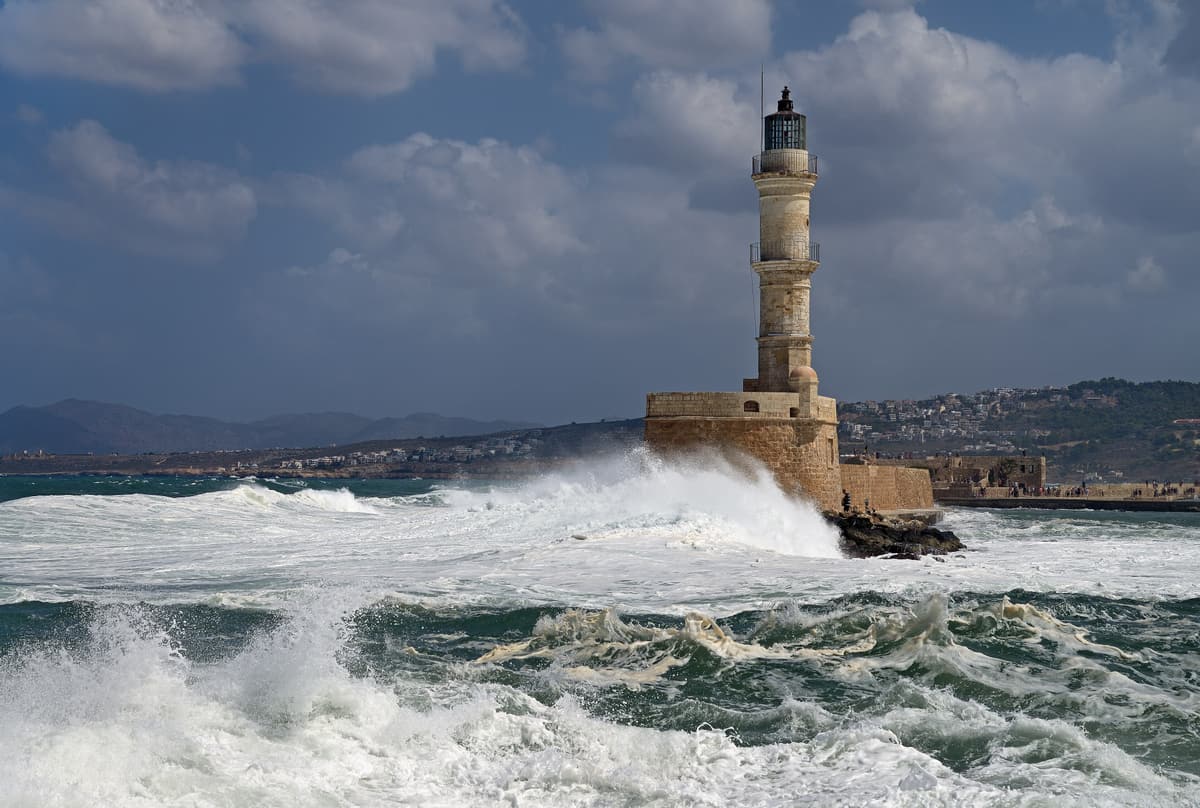
A Chania food tour tastes the cooking of western Crete in the old town of Chania, between the Venetian harbour and the market. This post covers what a Chania food tour includes, from cheeses, olive oil and pies to raki, wine and sweets, plus village visits, cooking classes and the best season. It is one of the best tours in Greece on Greece VIP.
Each section ends with a food tour or a tasting that can be booked online.
What does a Chania food tour cover?
A Chania food tour covers the old town and its 1913 indoor market, then the main groups of Cretan food: cheeses, olive oil, breads and pies, meat and seafood, drinks and sweets. The route links these foods to the farms, kitchens and history of Crete.
Chania is a city on the north west coast of Crete and the capital of the Chania regional unit. Its old town sits beside the old harbour, inside what remains of the Venetian walls, while the modern city spreads to the south. A Chania food tour works inside this old core, where cafes, restaurants and bars fill the lanes and the waterfront. The Agora market hall sits at its edge.
Farming feeds the menu. Agriculture and tourism are the two main sources of wealth in Chania. A large share of city residents, farmers or not, own farmland, and olive trees and citrus lead the crops grown on it. Wine, avocados, dairy and honey count among the other key products. Since 1999, the Prefecture of Chania has run the Agricultural August, a series of events that promotes local quality products. A Chania food tour draws on this same farm base.
Cheese and olive oil anchor the tasting. Cretan cheeses include graviera, xynomizithra, xygalo and pichtogalo, and the island also makes mizithra, anthotyros and kefalotyri. Olive oil is the oldest element of Greek cooking and goes into the bulk of its dishes. Breads and pies follow on a Chania food tour: paximadi, the hard rusk under the dakos salad, and kalitsounia, a Cretan pastry listed among both appetizers and desserts.
Meat and seafood bring antikristo lamb, smoked apaki pork, grouper baked with okra and cuttlefish with fennel. Island drinks include tsikoudia, rakomelo and Cretan wine, plus soumada, a non-alcoholic almond drink made on Crete. Sweets include xerotigana and patouda, two Cretan desserts, and zoumero, a chocolate cake that originates from Chania. On a Chania food tour, drinks and sweets close the tasting.
- Old town: A Chania food tour walks the lanes between the old harbour and Kasteli.
- Market: The Agora, the indoor market built in 1913, marks the edge of the old town.
- Cheese and oil: Graviera, xynomizithra and mizithra sit beside olive oil on the tasting table.
- Savoury plates: Paximadi, kalitsounia, antikristo lamb and cuttlefish with fennel cover breads, pies, meat and seafood.
- Drinks and sweets: Tsikoudia, rakomelo, Cretan wine and zoumero round off the menu.
A Chania food tour therefore joins two layers. The first is place: the old harbour, the lanes of Kasteli, Splantzia and Topanas, and the Agora. The second is Cretan produce: cheese, olive oil, rusks and pies, lamb and seafood, tsikoudia and honey pastry. Each tasting ties one product to one spot in the old town.
What is Cretan cuisine on a Chania food tour?
A Chania food tour presents Cretan cuisine, the traditional cooking of Crete and one of the regional cuisines of Greece. Its core is plant food: seasonal produce from the local area, pulses, wild herbs, fruit and rough cereals, with little or no processing.
Greek cooking, like other Mediterranean cuisines, rests on a triad of wheat, olive oil and wine. It continues traditions from ancient Greek and Byzantine cooking and adds Middle Eastern, Balkan and Italian influences. Italian cooking gave Greece dishes such as pastitsio and stifado, and Ottoman cooking passed on kadaifi and halva. The list of Greek regional cuisines includes Kritikí, the Cretan branch, beside Aegean, Ionian, Epirotic and Macedonian cooking. A Chania food tour tastes the Cretan branch in a city where Venetians and Ottomans both ruled.
In the traditional Cretan kitchen, plant food formed the core and animal food stayed at the edge. People ate what each season gave in the wider local area. Fresh and dried fruit, pulses, endemic wild herbs, aromatic plants and rough cereals, helped by the regional climate, made up the base. This pattern held across the island until the 1960s, when rising living standards moved meals toward meat. A Chania food tour serves plant dishes from that older pattern beside cheese and meat.
Herbs carry the flavour. Crete has a wide range of native herbs, among them common sage, rosemary, thyme and oregano, plus rare ones such as the endemic Cretan dittany and malotira, a kind of ironwort. Greek cooking uses oregano, mint, garlic, onion, dill, cumin and bay leaves more than other Mediterranean cuisines do. Wild greens appear in stamnagathi salad, from a local Cichorium plant, and in horta, boiled greens dressed with olive oil and lemon juice. A Chania food tour can include both salads.
Vegetables, eggs, dairy and grain fill the cooked dishes. Sofegada is a Cretan vegetable stew. Sfougato is an omelette with potatoes, zucchini, onions and cheese. Staka is a buttercream roux, and staka me ayga serves it with poached or fried eggs. Cretan pasta includes skioufichta, magiri, chilofta and avgochilos, and triftoudia is a type of orzo. A Chania food tour can set these beside lathera, seasonal vegetables stewed with olive oil, herbs and tomato sauce.
- Base: Plant food, pulses, fruit and rough cereals formed the core of the old Cretan table.
- Herbs: Sage, rosemary, thyme, oregano, dittany and malotira grow on Crete.
- Greens: Stamnagathi salad and horta put wild and boiled greens on a Chania food tour.
- Change: From the 1960s, rising living standards moved Cretan meals toward meat.
Cretan cuisine on a Chania food tour therefore means plant dishes first: herbs, wild greens, pulses and cereals at the centre, with meat at the edge of the traditional table. This regional branch sits inside the wider Greek frame of wheat, olive oil and wine, and Greek cooking as a whole carries Italian and Ottoman borrowings. Each tasting shows one part of that structure.


Which old town spots does a Chania food tour visit?
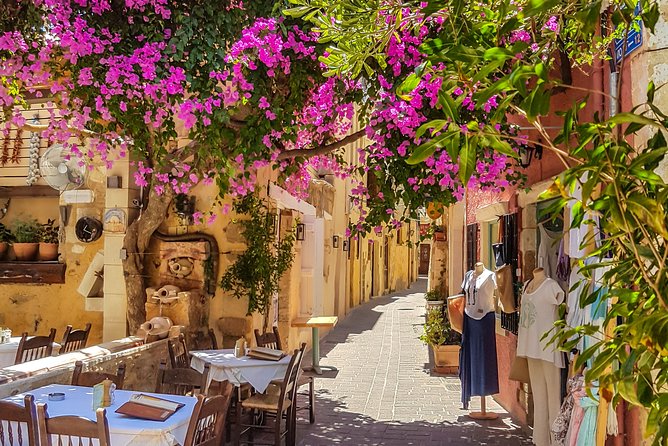
A Chania food tour visits the old Venetian harbour, the old town quarters of Kasteli, Splantzia and Topanas, and the indoor market known as the Agora. The harbour and the quarters hold the main cafes, restaurants and bars of the old town.
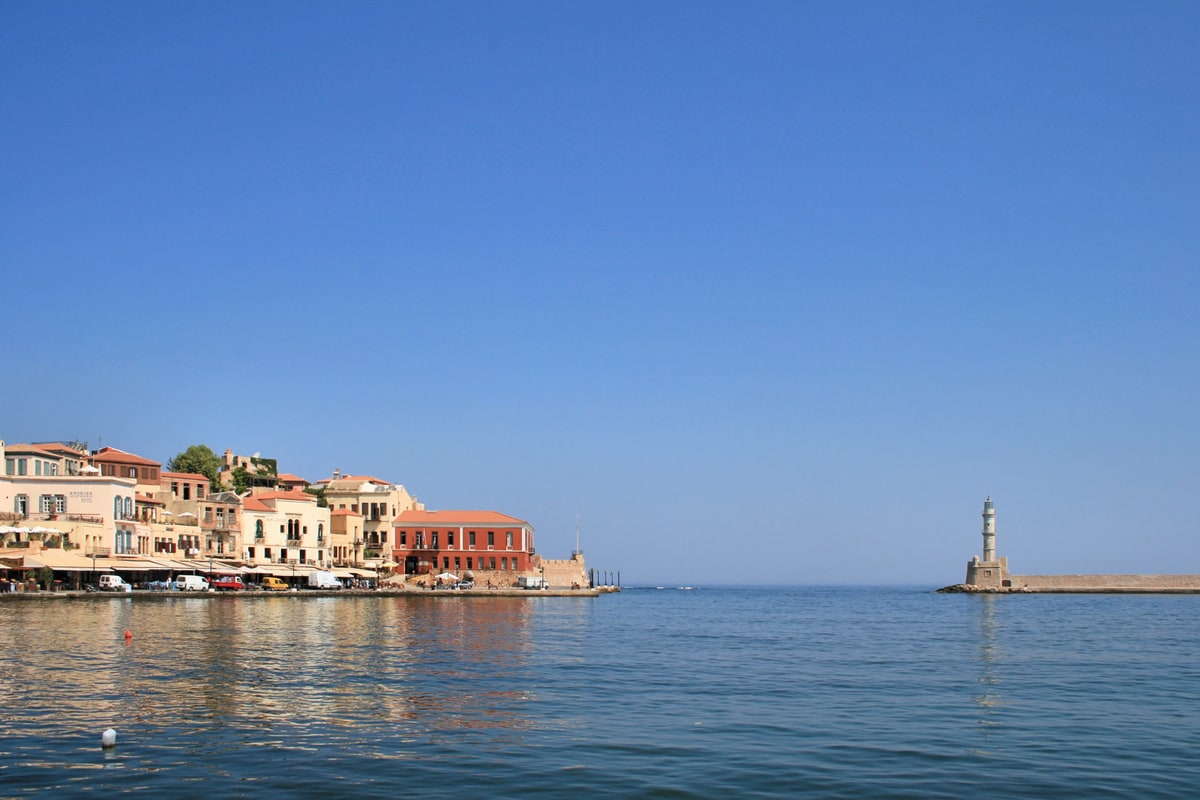
The old Venetian harbour forms the northern edge of the old town, where the sea marks the border. Cafes, restaurants and bars cluster around it, and the seafront streets Akti Tompazi, Akti Kountouriotou and Akti Enoseos, at the marina, mix historic buildings with nightlife. The lighthouse dates from 1864, and the Firkas Fortress, built in 1620 to protect the harbour, saw the Greek flag raised for the first time in 1913. A Chania food tour walks this waterfront between tastings.
Kasteli, the central part of the old town, rises on a small hill beside the seafront. People have lived there since the Neolithic Age, and excavations in the district found evidence of a Minoan city below. The hill offered a secure site next to the harbour and close to a fertile valley in the south. Splantzia, east of Kasteli, is largely untouched, and its square holds cafes, restaurants and bars. Under Ottoman rule, Muslim residents lived mainly in these two eastern quarters.
Eleftherios Venizelos Square, also called Syntrivani from the Turkish word for fountain, is the main square of the old town and its centre of tourist activity. West of it lies Topanas, the Christian quarter of the Ottoman period, named after a Venetian ammunition warehouse. Its narrow alleys hold old buildings, part of them restored as hotels, restaurants, shops and bars. The Jewish quarter, Evraiki, sat in the north-west, behind the harbour and inside Topanas. A Chania food tour threads these alleys on foot.
The indoor market, the Agora, dates from 1913 and stands on the edge of the old town. It draws both locals and tourists, and Market Square, also called Agora, is one of the three largest central squares of Chania. The old Central Markets appear among the city’s landmarks, beside the harbour lighthouse. Halidon Street, the main street joining the modern town to the old town, and the cafes of Enetiki Tafros, the Venetian moat, complete the circuit of a Chania food tour.
- Harbour: The old Venetian harbour, with its 1864 lighthouse, holds the seafront part of a Chania food tour.
- Kasteli: People have lived on the central hill of the old town since the Neolithic Age.
- Splantzia: The quarter east of Kasteli stays largely untouched around its square.
- Topanas: The former Christian quarter holds narrow alleys and the old Jewish quarter.
- Agora: The 1913 market hall serves locals and visitors alike.
These old town spots give a Chania food tour a fixed frame. The harbour supplies the seafront, Kasteli and Splantzia the eastern quarters, Topanas the western alleys, and the Agora the market stop. Each one keeps a layer of the city’s past, from Minoan Kydonia under Kasteli to Venetian walls, Ottoman mosques and the 1913 market hall. A single walk joins them, from the water to the edge of the old town.
Which cheeses does a Chania food tour taste?
A Chania food tour tastes four Cretan dairy foods: graviera, a hard sheep’s milk cheese; mizithra, a soft whey cheese; anthotyros, a fresh cheese that also comes dry and aged; and staka, a hot dish of sheep’s milk cream cooked with flour.
Graviera is the hard cheese on a Chania food tour. Its name comes from gruyère, the Swiss cheese it resembles, and in Greece it ranks second in popularity behind feta. The Cretan version is made from sheep’s milk and ripened for at least five months, and it tastes slightly sweet, with a burnt caramel flavour. Graviera Kritis is registered as a protected designation of origin in the EU and the UK.
Mizithra is the soft cheese of a Chania food tour. It is a whey cheese, or a mix of milk and whey, from sheep, goats or both, made mainly on Crete. Makers bring raw milk to a slow boil and curdle it with rennet, whey from the last batch, lemon juice, vinegar or a broken fig sprig. The curds hang in a cloth bag to drain. With no added salt, fresh mizithra tastes almost sweet and milky.
Anthotyros, whose name means flowery cheese, is the third cheese on a Chania food tour. It is made from sheep or goat milk and whey, commonly in a ratio of 9 to 1, and Crete is one of its production areas, along with Thrace, Macedonia and the Ionian Islands. The fresh form is white and soft, with a sweet, creamy taste and no rind or salt. The dry form is hard and salty, and it can carry a strong smell close to sherry.
Staka brings a hot dairy dish to a Chania food tour. It is a roux specific to Cretan cuisine, made by cooking sheep’s milk cream over a low flame with wheat flour or starch. The protein-rich part of the butterfat sets with the flour and forms the staka itself, served hot and eaten by dipping bread into it. The fat that separates becomes stakovoutyro, or staka butter, which has a faint cheesy flavour.
- Graviera: It is sliced, cubed into salads, grated over pasta or fried as saganaki.
- Mizithra: The fresh cheese is served as a dessert with honey or as a meze with olives and tomato.
- Xynomizithra: Mizithra that is salted and aged turns drier, denser, saltier and more sour, and it is grated.
- Staka butter: The fat kept from staka goes into Cretan pilaf, a dish commonly served at weddings.
Dairy products are important to the economy of Crete, and the island has specialty cheeses such as mizithra, anthotyros and kefalotyri. Xynomyzithra Kritis, the sour mizithra of Crete, also holds protected designation of origin status in the EU and the UK. Cretan cuisine names further cheeses, among them xygalo, pichtogalo, amarino, seliano, tirozouli and tiromalama, so a Chania food tour samples only part of the island’s dairy range.
How does olive oil feature on a Chania food tour?
A Chania food tour tastes the local extra virgin olive oil of western Crete. The Chania area holds a protected geographical indication for oil pressed from Koroneiki and Tsounati olives, with a green-yellow colour, a fruity aroma and a balanced, bittersweet taste.
Olive oil on a Chania food tour carries a long history. Evidence suggests olives grew on Crete as long ago as 2500 BC, and trees were certainly cultivated there by the Late Minoan period, around 1500 BC. The Minoans used the oil in religious ceremonies, and it became a principal product of their civilization, thought to stand for wealth. Egyptians imported olive oil from Crete before 2000 BC.
The oil on a Chania food tour comes from a district where olive trees and citrus are the commonest crops, and where a large share of city residents, not all of them farmers, own farmland. The Chania protected geographical indication covers Kydonia, Kissamos, Selino, Sfakia and Apokoronas. Koroneiki, one of its two olives, covers 50 to 60 percent of olive acreage in Greece and gives small fruit with a high-quality oil yield.
The regional unit that hosts a Chania food tour also holds the olive tree of Vouves, in Ano Vouves village, part of the Kolymvari municipal unit. Tree-ring analysis shows it to be at least 2,000 years old, and University of Crete scientists have estimated 4,000 years, yet it still produces olives. The tree became a protected natural monument in 1997, and its branches were woven into victors’ wreaths at the Athens Olympics in 2004.
Oil is made by grinding olives into a paste, once under large millstones and now in modern mills, then stirring the paste so small oil drops join into larger ones before pressing. Oil produced by mechanical means alone is called virgin oil, and the extra virgin grade has no more than 0.8 percent free acidity. A Chania food tour tastes the oil raw, since extra virgin oil is mainly used uncooked, as a condiment and in salad dressings.
- Chania Kritis PGI: This extra virgin olive oil from western Crete is pressed from Koroneiki and Tsounati olives.
- Minoan roots: The earliest surviving olive oil amphorae date to 3500 BC, in Early Minoan times.
- Harvest cycle: Olive trees crop well every couple of years, so larger harvests come in alternate years.
- Consumption: Greece leads the world in olive oil use per person, around 24 litres a year.
Olive oil also runs through other plates on a Chania food tour. In traditional Cretan cooking it was the main source of fat, used both in salads and in cooking. The city is home to the Institute of Olive Tree and Subtropical Plants of Chania, and the Agricultural August programme, run by the prefecture since 1999, promotes local quality products.
Which breads and pies appear on a Chania food tour?
A Chania food tour serves four breads and pies: paximadi, the hard rusk behind the dakos salad; kalitsounia, small cheese or herb pastries; boureki, a filo pastry from the Greek burek family; and bougatsa, which Chania fills with mizithra and dusts with sugar and cinnamon.
Paximadi, the hard bread on a Chania food tour, is of Greek origin and close to a rusk, made with whole wheat, chickpea or barley flour, and it was a staple food for the people of Crete. It used to be baked in outdoor ovens every ten to fifteen days, then sliced into thick wedges and dried in the ovens again to preserve it. Greek farmers softened it in water and olive oil and ate it in the fields with homemade cheese and olives.
On a Chania food tour, dakos turns paximadi into a Cretan salad. A slice of barley rusk is soaked in water or olive oil, commonly rubbed with garlic and sea salt, then topped with chopped tomato, crumbled feta or mizithra, more olive oil and dried oregano. Olives, capers, peppers and caper berries are common extras. The dish also goes by koukouvagia, meaning owl, and by kouloukopsomo, a name said to come from bread given to puppies under a table.
Kalitsounia are small cheese or herb pastries tied to Crete, and in the Chania prefecture they appear in restaurants and small mountain villages alike, so a Chania food tour meets them easily. Salty kalitsounia hold local mizithra, or herbs from the Cretan land with no cheese, while sweet ones hold mizithra under a pour of honey. For the cheese filling, grated whey cheese is mixed with eggs and finely chopped herbs. Each is baked or fried, depending on the wrapper: dough or filo.
Boureki, or bourekaki, is the Greek name for small pastries made with filo dough, and Greek pastries of this burek family are also called pita, or pie. Bougatsa, a Greek breakfast pie on a Chania food tour, belongs to the same family: filo layered around semolina custard, cheese or minced meat. Its name comes from the Byzantine Greek pogátsa, and the modern version began in Serres and Thessaloniki in northern Greece.
- Paximadi today: Bakers bake it overnight in switched-off ovens, which leaves it dry but not brittle.
- Koulouri: A ring-shaped Cretan paximadi is served drizzled with olive oil and can be topped with oregano and grated tomato.
- Lasithi kalitsounia: In the Lasithi region the pastries are mainly sweet, filled with mizithra, cinnamon and at times lemon zest.
- Bougatsa shops: Specialty shops called bougatsadika or bougatsopolia sell bougatsa and nothing else.
Chania gives bougatsa a local filling. On a Chania food tour, the city’s bougatsa comes filled with mizithra, which is not sweet, and is then sprinkled with sugar and cinnamon. Traditional bougatsa wraps hand-made filo around the filling, and after baking it is cut into small pieces and served hot on a small plate. A television episode filmed in Chania showed bougatsa made with hand-made filo.
Which meat and seafood dishes does a Chania food tour include?
A Chania food tour covers the meat and seafood side of Cretan cooking: antikristo lamb, snails fried with rosemary and vinegar, gamopilafo rice cooked in meat broth, and fish dishes such as grouper baked with okra and cuttlefish cooked with fennel.
Antikristo, also called oftó, is the lamb dish to look for on a Chania food tour. Lists of Cretan specialities record it as lamb meat, and under the name antikrigia it also stands for a traditional Cretan method of cooking meat. The Greek word antikristos is tied to a verb meaning to be across, opposite or face to face. Beef dishes stay uncommon, since the climate and terrain of Greece favour goats and sheep over cattle.
Snails, known in Crete as chochlioi, feature on a Chania food tour as well. One recipe is chochloi mpoumpouristoi, or snails turned upside down: the snails fry in a hot pan on a thick layer of sea salt, with rosemary and vinegar. A second recipe pairs snails with tomato. Edible snails live all over Crete and can bunch together in the hundreds until rain revives them. Eobania vermiculata, a snail species very common in Crete, is also exported from Greece to France for the table.
Gamopilafo, the wedding pilaf of Crete, adds rice to the meat course of a Chania food tour. Cretans serve it at weddings and major celebrations. The rice boils in lamb or goat broth, or in goat and rooster broth, and lemon juice goes in at the end. Ordinary Greek pilafi is fluffy and soft, neither soupy nor sticky, but gamopilafo comes out creamy. Despite its name, it sits closer to a risotto than to a true pilaf.
Seafood completes the savoury side of a Chania food tour, since fish dishes are common on Greek islands and along the coast. The Cretan list of specialities includes rofos me bamies, grouper baked with okra, and soupies me maratho, cuttlefish cooked with fennel. Greek tables also carry grilled octopus, fried squid with lemon, grilled red porgy and marides, small whitebait fried in a light coat of flour. Nea Hora, west of the old town, has narrow lanes leading to a small fishing harbour.
- Tsigariasto: This lamb or goat dish comes mainly from the Sfakia region.
- Katsikaki me stamnagathi: Goat, or lamb in its place, is cooked with avgolemono and a local plant of the Cichorium genus.
- Apaki: This smoked pork, or at times chicken, sits among the Cretan appetizers.
- Sykoti savore: Liver cooked in vinegar is another Cretan appetizer.
Meat and seafood on a Chania food tour draw on both farm and coast. Lamb, goat, pork and snails come from the land, while grouper, cuttlefish and octopus come from the sea. Guests who skip snails or lamb still find grilled fish and squid on the same tables. Local wine goes with the savoury plates of a Chania food tour, and a chilled glass of tsikoudia follows them.
What drinks come with a Chania food tour?
A Chania food tour pours tsikoudia, the Cretan grape pomace brandy that eastern Crete calls raki, along with Cretan wine from local grapes such as Romeiko, Vidiano, Kotsifali and Liatiko. Greek coffee, brought just to the boil with its fine grounds, rounds off the tasting.
Tsikoudia heads the drinks list of a Chania food tour. It is a scented grape brandy from Crete, distilled from the pomace left after grapes are pressed for wine, and its name literally means terebinth. In eastern Crete the same spirit goes by raki, a name taken from Turkish that goes back to a 17th-century Arabic word meaning distilled. Its strength ranges from 40% to 65% alcohol by volume, and the pomace ferments for about six weeks in a sealed barrel.
Set beside grappa or marc, the tsikoudia poured on a Chania food tour differs in one step: it passes through the still only once, while those spirits are commonly distilled twice and can include anise. The single run keeps more of the grape flavour and adds no flavourings. As a rule, a Cretan village has one or two residents licensed to distill. The spirit is almost always served chilled from the freezer, and Cretan restaurants commonly offer it free as a digestif, with fruit and sweets after the meal.
Wine on a Chania food tour comes from an island with a long wine history. The Minoans made wine on Crete in the Bronze Age, and in the 2nd century AD Crete sent a sweet wine called protropos to Italy. Between the 14th and 16th centuries, vino di Candia, Candia being the Italian name for Heraklion, was highly valued in western and northern Europe. Cretan appellations include Peza, Archanes, Dafnes and Sitia.
Greek coffee is the hot drink of a Chania food tour. Greeks once asked for it as “Turkish”, until political tension with Turkey in the 1950s brought in the name Greek coffee, which spread further after the Turkish invasion of Cyprus in 1974. Very finely ground coffee is brought just to the boil in a pot called a briki, and the grounds stay in the cup. Guests state the sugar level when ordering, and a glass of water comes alongside.
- Romeiko: This red grape of the Chania area also makes marouvas, a wine similar to sherry.
- Vidiano: This white Cretan grape gives aromas of peach, apricot, melon, honey and herbs.
- Kotsifali: This red Cretan grape blends with Mandilaria into a ruby dry wine.
- Liatiko: This old red grape ripens in July and once went into sweet Malvasia.
Not every glass on a Chania food tour holds alcohol. Soumada, a syrupy almond drink made on Crete, has none, and kafenia, the traditional Greek cafés that act as social centres in villages and on islands, pour Greek coffee and frappé with meze or free snacks. In winter, rakomelo blends raki with honey and spices such as cinnamon and is served warm.
Which sweets and honey close a Chania food tour?
A Chania food tour ends with sweet kalitsounia, mizithra pastries topped with honey, along with xerotigana fritters and loukoumades, fried dough balls with honey and cinnamon. Thyme honey, drawn from one of the native herbs of Crete, links these sweets together.
Sweet kalitsounia, also known as lychnarakia, open the dessert course of a Chania food tour. These small Cretan pastries are filled with mizithra and finished with honey. For cheese kalitsounia, cooks grate the whey cheese and bind it with eggs so the filling holds together. Sfakianopita, a thin pan-fried pie from Sfakia in the Chania prefecture, uses the same pairing: mizithra inside, honey drizzled over the top and at times sesame seeds. It is served as a dessert as well as a pie.
Xerotigana, also spelled kserotigano, is a sweet Cretan fritter that a Chania food tour sets beside other local sweets. Patouda are Cretan cookies that wrap flaky dough around a sweet nut filling, and stafidota are cookies with a raisin stuffing. Mamoulia, traditional cookies from Chios and Crete, join them on the plate. Amygdalopita and portokalopita also appear among Cretan desserts. Across Greece, sweets lean on nuts, honey, fruit, sesame and filo pastry.
Loukoumades add fried dough balls to the dessert plate of a Chania food tour. A soft yeast batter is dropped into hot oil, fried golden brown and soaked in honey or syrup, with cinnamon or walnuts on top. The Greek name derives from the Arabic luqma, meaning a morsel or bite. Evidence links them to enkrides, dough fried in oil and eaten with honey in ancient Greece, and the sweet stayed popular in Byzantine times during Lent, because it held no dairy or meat.
Honey ties the sweets of a Chania food tour together. Greek honey comes from the nectar of citrus and fruit trees, from thyme and from pine, and pine honey makes up 60–65% of Greek production. Thyme is one of the native herbs of Crete, along with sage, rosemary and oregano, and Greece is famous for wild thyme honey. Greek myth places the infant Zeus on Crete, fed on milk and honey, and calls the father of his nymph nurses Melisseus, the honey-man.
- Cretan bee: Apis mellifera adami is a western honey bee subspecies endemic to Crete.
- Hives: Western Crete builds hives from terracotta, wood and wicker, while eastern hives are always ceramic.
- Charisioi: Ancient Greek cakes likened to loukoumades were said to serve as prizes at drinking games.
Honey, mizithra and fried dough carry the dessert course of a Chania food tour, from kalitsounia and sfakianopita to xerotigana and loukoumades. Each sweet puts the same short list of Cretan ingredients to a different use. Honey keeps its place after the tasting too: stored properly, it does not spoil, so a jar of thyme honey travels home from a Chania food tour without trouble.
Which village and farm visits extend a Chania food tour?
A Chania food tour can extend east into the villages of Apokoronas or west into Kissamos. Both sit in the Chania regional unit, where farm stops can include olive groves, olive mills and vineyards between the White Mountains foothills and the coast.
The Chania regional unit covers the westernmost quarter of Crete and holds seven municipalities: Apokoronas, Chania, Gavdos, Kantanos-Selino, Kissamos, Platanias and Sfakia. The limestone White Mountains, or Lefka Ori, fill much of this land and contain more than 40 peaks above 2,000 metres. Chania also receives more rain than any other regional unit of Crete. A Chania food tour that leaves the old town enters this rural landscape.
Apokoronas lies on the north coast, east of Chania, and counts 75 villages, with its seat at Vryses. The land runs from the foothills of the White Mountains to the sea across a wide plain of rolling hills. The area is green and fertile, a contrast with the rocky ground of much of Crete, and the local economy rests on farming and tourism. Vamos, Armenoi and Vryses are the main towns, with taverns and large churches.
Kissamos covers the far western edge of Crete. Its port and fishing harbour lie 41 km west of Chania, and the town is also known as Kastelli, after a Venetian castle that once stood there. The old Venetian governor’s palace now houses the town museum, and finds in the town include mosaics from the Roman city of Kisamos. Villages in the Kissamos unit include Sfinari, Polirinia, Platanos and Kallergiania, so a Chania food tour can pair the harbour with a village stop.
Farm stops follow the local crops. In Chania, agriculture and tourism are the two main sources of wealth, and a large share of city residents, not all of them farmers, own farmland. Olive trees and citrus are the commonest plants on that land, and wine, avocados, dairy and honey are other key products. Viticulture and olive groves are significant across Crete, so an olive grove, an olive mill or a vineyard fits a Chania food tour. Since 1999, the Prefecture of Chania has organised Agricultural August to promote local products.
- Apokoronas villages: Vamos, Armenoi, Vryses and Gavalochori lie east of Chania on fertile farmland.
- Kissamos: The municipal unit around this western port, also called Kastelli, includes the Gramvousa peninsula.
- White Mountains foothills: The Apokoronas plain starts at these foothills and runs north to the coast.
- Olive groves and vineyards: A Chania food tour can stop where olive trees, citrus and wine grapes grow.
A village or farm extension adds rural context to a Chania food tour. Apokoronas suits a route along the north coast; its plain runs from the mountain foothills to the sea, and much of the film Zorba the Greek was shot there. Kissamos suits a trip to the far west, with its port, museum and nearby villages. Each Chania food tour extension depends on the season, the crops and the farms open to visitors.
How does the Cretan diet connect to a Chania food tour?
A Chania food tour connects to the Cretan diet through the foods on its route: olive oil, greens, pulses, bread and cheese. Studies in Crete and southern Italy gave early data on this way of eating, later confirmed by the Seven Countries Study.
Ancel Keys, an American biologist, and Margaret Keys, a chemist, first proposed the Mediterranean diet as a concept in 1975. They based it on eating habits seen in Greece, Italy and the Mediterranean coasts of France and Spain in the late 1950s and early 1960s. The pattern stresses unprocessed cereals, legumes, vegetables and fruit, moderate fish and dairy, and low amounts of red meat, refined grains and sugar. Olive oil is its main source of fat.
The Seven Countries Study, directed by Keys, was the first epidemiological study to cover more than one country. It formally began in the autumn of 1958 in Yugoslavia and enrolled 12,763 men aged 40 to 59 in 16 cohorts across seven countries, with two cohorts in Greece. Keys focused on men in villages rather than in cities, where people moved more. Coronary deaths ran far higher in the United States and Northern Europe than in Southern Europe.
The traditional Cretan pattern rested on plant foods: fresh and dried fruit, pulses, wild herbs and coarse cereals. Dairy appeared daily in low to moderate amounts, poultry and fish each week, and red meat only a small number of times a month. Olive oil served for both salads and cooking, unlike the animal fat used in northern Europe. Red wine came with meals in moderate amounts, and yogurt with fresh fruit was the commonest dessert.
The traditional pattern held across the island until the 1960s, when better living standards shifted diets toward more meat and animal products. The Seven Countries Study linked a shift toward a less active life and a Western-style diet with a higher risk of heart disease. In 2010, UNESCO added Mediterranean cuisine and its traditions to the Intangible Cultural Heritage of Humanity under the name Mediterranean Diet. A Chania food tour puts the older pattern on the table through dishes built on vegetables, pulses and olive oil.
- Olive oil: It is the main fat in both the Mediterranean diet and traditional Cretan cooking.
- Plant foods: Cereals, legumes, vegetables and fruit form the base of the diet and of a Chania food tour menu.
- Wine: The diet limits alcohol to low or moderate amounts of wine, taken with meals.
- Fat share: Fat supplies 25% to 35% of total calories, and saturated fat stays at or below 8%.
A Chania food tour does not replace a diet plan, but it visits one of the places that inspired the Mediterranean diet. Olive oil, greens, pulses, cheese and fruit can appear at each stop. Observational studies tie the diet to lower all-cause mortality, and the World Health Organization counts it as a healthy way of eating. Each Chania food tour stop links a plate to this research history.
Which Chania food tour suits families or vegetarians?
A Chania food tour suits vegetarians well, since Cretan cuisine rests on plant foods such as wild greens, pulses and vegetable stews. Families do best with a short walking route, mild tastings and a tour leader told in advance about allergies or picky eaters.
Wild greens, known in Greek as horta, sit at the heart of a vegetarian Chania food tour. A horta salad consists of greens that are boiled, then dressed with olive oil and fresh lemon juice. The mix can include endives, amaranth greens, wild chervil, chicory, chard or asparagus. Cretan cuisine lists a stamnagathi salad among its appetizers. Stamnagathi is a local plant of the Cichorium genus, but it also goes into a Cretan goat or lamb dish with avgolemono.
Vegetable dishes fill the rest of the menu. Cretan cuisine lists sofegada, a vegetable stew, and sfougato, an omelette with vegetables such as potatoes, zucchini and onions, plus cheese. Raw cardoons and askordoulakoi, the pickled bulbs of the tassel hyacinth, appear among Cretan appetizers. Greek home cooking adds lathera, seasonal vegetables stewed with olive oil, herbs and tomato sauce, and briam, a mix of eggplant, zucchini, potatoes and tomatoes. Gemista can hold rice, ground beef or both, so vegetarians do well to ask.
Pulses round out a vegetarian Chania food tour. Lentil soup, known as fakes, traces back to ancient Greece. Fava turns yellow split peas, onions and spices into a creamy purée that works as a dip or a main dish. Fasolada combines dry white beans, olive oil and vegetables in a soup, and revithada is a chickpea soup. Gigantes plaki is a baked dish of gigantes beans with tomato sauce and herbs, served as a main course.
Families need a different plan. A Chania food tour for children works best on a short route with frequent stops, shade and places to sit. Mild foods such as bread, cheese, yogurt and fruit suit young tasters. Parents can tell the tour leader about allergies, intolerances and picky eaters when booking. Small groups let children ask questions and taste at their own pace. A flat route also suits strollers better than steep lanes.
- Greens: Horta salad and stamnagathi salad put wild and local greens on the plate.
- Pulses: Fava, fasolada, fakes and gigantes plaki cover split peas, beans and lentils.
- Check first: Sfougato contains eggs and cheese, so it suits vegetarians but not vegans.
- Children: A Chania food tour with bread, cheese, yogurt and fruit suits young eaters.
A vegetarian or family Chania food tour depends more on planning than on the menu, since Cretan cooking already offers greens, pulses and vegetable stews. Travellers who share dietary needs early give the tour leader time to adjust tastings at each stop. Families who choose a flat route with shade and seating keep children comfortable. With these points settled, a Chania food tour fits mixed ages and diets.
Which Chania sights combine with a Chania food tour?
A Chania food tour pairs with the lighthouse at the mouth of the Venetian harbour, the Maritime Museum of Crete at the Firkas Fortress, the Splantzia and Halepa quarters, and the three monasteries in the hills of the Akrotiri peninsula.
The lighthouse stands at the entrance of the port, on the site of a Venetian naval post. Egyptian troops rebuilt it in 1864, and only the Venetian base survives. Its stone masonry tower stands 26 metres over the bay. On the west side of the harbour, the Firkas Fortress houses the main collection of the Maritime Museum of Crete at its entrance. Ship models, nautical instruments, paintings and war relics run in date order from the Bronze Age.
Splantzia sits next to the east side of Kasteli, the central hill of the old town, and has changed little. Under Ottoman rule, Muslims lived mainly here and in Kasteli. The square of the quarter holds the Church of Saint Nicholas, built around 1320 by Dominican friars as a Catholic cathedral. It served as the Hünkar Mosque and became an Orthodox church in 1918. A Chania food tour in the old town can pause at this square.
Halepa was once a town of its own and is now a district on the east side of Chania. It gave its name to the Pact of Halepa, an 1878 agreement on the running of Crete inside the Ottoman Empire. The local aristocracy lived here, and during the Cretan State the district gained neoclassical embassies and consulates. Its streets hold the house of Eleftherios Venizelos and the Palace of 1882, home of Prince George.
The Akrotiri peninsula joins the rest of Crete by a wide causeway between Chania and Souda, and three monasteries stand in its northern hills. Agia Triada was built in the 17th century by two brothers of the Venetian Zangaroli family. Its monks produce and sell wine and olive oil on site, the same staples a Chania food tour presents in town. Gouverneto, 5 km further north, looks like a fortress. A footpath beyond it descends 140 steps to the abandoned Katholikon, built into the cliff.
- Lighthouse: The tower, listed as an archaeological site since 1962, flashes red every 2.5 seconds.
- Minaret: Saint Nicholas has both a bell tower and a minaret, a pairing found on no other building in Greece.
- Minoan ship: The Moro Shipyard at the eastern end of the harbour holds a 17 m replica Minoan ship.
- Gouverneto: A 1637 census counted 60 monks, then one of the largest communities in Crete.
The lighthouse, the museum and Splantzia sit inside the old town, so a walk links them with a Chania food tour. Halepa adds a walk east of the centre. The Akrotiri monasteries are reached by car, since Gouverneto stands about 19 km from Chania. Agia Triada, with its own wine and olive oil, extends the tasting theme of a Chania food tour beyond the city.
When is the best season for a Chania food tour?
A Chania food tour fits any season in a hot-summer Mediterranean climate of sunny, dry summers and mild, rainy winters. For harvest produce, Northern Hemisphere grapes are picked mainly from late August to early October, and Mediterranean olives from October onwards.
Between April and October, Chania sees clear skies nearly every day. Heat waves above 38 °C stay uncommon, since the etesian winds, known as Meltemia, come off the Aegean Sea and cool the air. A record 44.3 °C was logged on 1 July 2021 at the city station of the National Observatory of Athens. In summer, cultural events such as plays, concerts and exhibitions run daily, and an evening event can follow a Chania food tour.
Winters are mild, windy and rainy, with spells of sunny days. Near the coast, frost and snow seldom occur. On 8 January 2017, the last significant snowfall left the whole city and the old harbour white. Higher up, the mountains of Crete see regular snow from November to April. Western Crete, where Chania lies, gets more rain than the east, so a winter Chania food tour needs a plan for wet days.
In the Northern Hemisphere, the grape harvest falls between August and October, with the main picking from late August to early October. Romeiko, a red grape, grows across Crete and above all around Chania. Since 1999 the Prefecture of Chania has run the Agricultural August to promote local quality products, and a Chania food tour in August can coincide with it. Pomace from the wine press feeds the village stills for tsikoudia in late October and early November.
Around the Mediterranean, the olive harvest runs through autumn, starting in October. Pickers shake whole trees or single branches, and in parts of Greece the fruit is picked by hand because the land is too mountainous for machines. Olive trees and citrus are the leading crops around Chania, home to the Institute of Olive Tree and Subtropical Plants. A Chania food tour from October onwards falls in the olive harvest months.
- Spring heat: Heat waves can start in March, when the Sirocco, or Livas, blows hot from the south with Saharan dust.
- Records: Crete holds the highest temperatures recorded in Europe for October, November, January and February among W.M.O. stations.
- Mountains: The Lefka Ori range rises south of the city, and the higher parts of Crete have a cold-summer climate.
- Vineyards: Hot winds from North Africa and cool breezes from the Aegean shape the climate of Cretan wine.
The choice of season for a Chania food tour depends on the goal of the trip. Summer offers clear days and daily cultural events. Late summer and autumn bring the grape harvest, the olive harvest from October and the tsikoudia stills. Winter stays mild near the coast, with sunny breaks between rainy spells, so a Chania food tour remains possible through the cold months.
How do travelers reach the city for a Chania food tour?
A Chania food tour is within reach by air, sea and road. Chania International Airport lies 14 km from the city on the Akrotiri peninsula, ferries from Piraeus arrive at Souda, 6.5 km east, and the national road links Chania with Rethymno and Heraklion.
Chania International Airport takes its name from Daskalogiannis, an 18th-century Cretan rebel against Ottoman rule, and uses the IATA code CHQ. It sits near Souda Bay, 14 km from the city, and serves as a joint civil and military airfield, the sixth-busiest in Greece. Civil flights moved here from Maleme in 1959, international flights began in 1974, and a new terminal opened in 1996. For a Chania food tour, it is the closest airport.
Buses link the airport with Chania and Rethymno, and cars and taxis use the main road network. Crete has a second international gateway at Heraklion, whose Nikos Kazantzakis airport lies about 5 km east of that city and ranks as the second-busiest in Greece after Athens. Chania lies 145 km west of Heraklion, so arrivals there add that distance by road before a Chania food tour.
Souda is the port of Chania, with daily ferries to and from Piraeus. The town sits at the head of Souda Bay, a deep natural harbour about 15 km long and two to four km wide, between the Akrotiri peninsula and Cape Drapano. The Ottomans began the town in the 1870s on former salt beds and marshland, as a new port for the city. Ferry passengers then cover 6.5 km by road into central Chania for a Chania food tour.
Greek National Road 90 runs along the north coast from Kissamos to Sitia, through Chania, Rethymno, Heraklion and Agios Nikolaos. From Chania eastward it forms part of European route E75, which crosses from Piraeus to Chania by ferry. Rethymno lies about 70 km east of Chania. Motorway sections bypass all three cities, while the stretches between them remain a trunk road. Day visitors from Rethymno or Heraklion reach a Chania food tour along this coast road.
- Kissamos: This port, 41 km west of Chania, has ferries to Kythira, Antikythera and the Peloponnese.
- Heraklion port: Daily ferries sail to Piraeus, and boats also serve Santorini, Paros, Mykonos and Rhodes.
- Rail: Crete has no railway lines, so every land transfer to Chania runs by road.
- First section: The Chania to Rethymno stretch opened first on the new national road.
The shortest transfer is from Chania International Airport, 14 km from the city. Ferry passengers from Piraeus land at Souda, and drivers from Heraklion or Rethymno follow the national road west along the north coast. Every route ends in the same city, so a Chania food tour fits all three arrival options, with no rail link to plan around.
How do travelers choose a Chania food tour?
A Chania food tour takes one of these forms: an old-town walking tasting, a market visit, a farm or village tasting, or a wine and raki tasting. Each can run as a private or small-group tour, so the choice rests on interest and group style.
An old-town walking tasting suits travelers who want food and street life in one outing. The old town of Chania lies next to the old harbour, and cafes, restaurants and bars fill its lanes, above all around the Venetian harbour, the Venetian moat and Splantzia square. A Chania food tour in this format moves on foot from one tasting stop to the next, so sightseeing and tasting happen together. The Topanas district has narrow alleys and old buildings, so flat, closed shoes help on the walk.
A market visit suits travelers who like to see raw ingredients before the tasting starts. The indoor market of Chania, known as the Agora, was built in 1913 and stands on the edge of the old town, and it draws tourists and locals alike. A Chania food tour that begins at a market shows the produce of the area before it reaches the plate. Olive trees and citrus are the main crops around the city, and wine, avocados, dairy and honey are other local products.
A farm or village tasting leaves the city for the land around it. Agriculture and tourism are the two main sources of wealth in Chania, so a farm stop shows the working side of local food. A wine and raki tasting centres on drink instead. Romeiko, a red grape found above all in the Chania region and in Kissamos, is blended with other grapes into red, rosé and white wines, and its pomace is distilled into tsikoudia, a Cretan grape spirit that eastern Crete also calls raki.
The last choice is group style. A private Chania food tour sets the pace and the stops around one party, which helps travelers who want to linger or ask more questions. A small-group tour seats travelers who have not met before at the same tables, which suits solo travelers and couples who enjoy company. The tour boxes on this page lead to the booking listings. Before booking, it helps to read each listing for its stops, its tastings and its group size.
- Format: Each format gives a Chania food tour a different focus, from old-town lanes to market stalls, farmland and drink tastings.
- Pace: Old-town and market tastings move on foot, while farm and village tastings need transport out of the city.
- Drinks: Tsikoudia contains 40% to 65% alcohol by volume, so drivers and travelers who avoid alcohol can pick a food-only format.
- Group style: Private tours fit travelers who want their own pace, and small-group tours fit travelers who enjoy shared tables.
A Chania food tour fits a trip when its format matches one clear interest: street life, raw produce, farm work or local drinks. With that interest set, travelers compare the pace, the drinks and the group size, and the choice narrows fast. Reading the full listing behind each tour box before booking avoids surprises about stops and tastings. Travelers with more time in the area can pair a walk in town with a farm visit.
Which Chania food tours include a cooking class?
A Chania food tour that adds a cooking class shows it in the listing, so the listing is the place to check. A Cretan session works with dishes such as dakos, boureki, kalitsounia and stuffed vegetables, made with rusks, filo, mizithra, tomatoes, rice and herbs.
Dakos needs no oven, so it is a simple dish for a Chania food tour with a cooking class. It is a Cretan salad built on a slice of paximadi, a barley rusk soaked in water or olive oil. Garlic and sea salt can be rubbed onto the rusk first. Chopped tomatoes, crumbled feta or mizithra and olive oil go on top, with herbs such as dried oregano. Olives, capers and caper berries are common extras. The dish also goes by the name koukouvagia, which means owl.
Kalitsounia are small cheese or herb snacks tied to Crete, and the Chania region makes them both salty and sweet. The salty kind is stuffed with mizithra, a mild whey cheese made locally, or with Cretan herbs and no cheese. The sweet kind also holds mizithra but gets honey poured on top. For the cheese filling, cooks grate the whey cheese and mix it with eggs, which bind it, and finely chopped herbs. Kalitsounia are baked or fried, depending on whether the wrapper is dough or filo.
Boureki brings filo into the class. In Greek cooking, boureki, also called bourekaki, names small pastries made with filo dough, and pastries of this family also go by the name pita, meaning pie. The wider börek family uses a thin, flaky dough such as filo, with fillings such as meat, cheese, spinach or potatoes. Its name comes from a Turkish verb meaning to roll or to twist. In a class, the work comes down to filling, rolling and baking the dough.
Stuffed vegetables are the oven dish of the set. In Greek they are called gemista, a word meaning filled with, and they are common across Greek cuisine. Bell peppers and tomatoes are hollowed out and stuffed with rice, ground beef or both, plus onions, mint, parsley and olive oil, then baked. Zucchini get a filling of rice and sometimes meat in kolokithakia gemista, cooked on the stovetop or in the oven. Gemista belong to the dolma family of stuffed dishes, which spread during the Ottoman Empire.
- Hands-on or demonstration: A hands-on class puts the dough and the knife in each traveler’s hands, while a demonstration keeps the group watching the cook.
- Dish list: Before booking, travelers can check which dishes a Chania food tour with a cooking class names, such as dakos, kalitsounia, boureki or gemista.
- Shared meal: It helps to check whether the class ends with a shared meal of the cooked dishes, since that changes plans for the next meal.
- Recipes: Travelers who want to cook at home can ask whether written recipes come with the class.
A Chania food tour with a cooking class turns tasting into practice. Dakos and kalitsounia both sit on the list of Cretan appetizers, and the set trains distinct skills: soaking rusks, mixing whey cheese, handling filo and stuffing vegetables for the oven. Olive oil runs through dakos and gemista, and in traditional Cretan cooking it was the main fat, used in salads and in cooked dishes. Travelers who want to repeat the dishes at home pick a hands-on class.
What do travelers ask about a Chania food tour?
A Chania food tour raises a short set of practical questions before booking: whether it suits a first visit to Crete, whether it includes wine, whether it counts as a full meal, and which format fits a short stay in the city.
Does a Chania food tour suit a first visit to Crete?
Yes. A Chania food tour gives a first-time visitor a broad taste of island food. Chania is the capital of the Chania regional unit and lies on the north west coast of Crete. Crete is the largest island of Greece, so one city tasting serves as an introduction, and later meals across the island fill in the rest.
Does a Chania food tour include wine?
A wine and raki tasting includes wine by design. For other formats, the booking listing is the place to check. Wine has firm local roots: it is one of the important farm products of Chania, and Crete makes 20% of all Greek wine. Travelers who avoid alcohol can pick a Chania food tour built around food and market stops.
Is a Chania food tour a full meal?
A Chania food tour rests on tastings, so it works like a meze spread rather than a plated meal. Meze is a selection of small dishes served as appetizers, and in Greece these dishes come hot or cold, spicy or savory. A meze can also form a meal in itself, so travelers plan only a light meal before the tour.
Which Chania food tour works on a short stay?
An old-town walking tasting fits a short stay, because its stops sit in the old town by the old harbour and the indoor market stands at the edge of that area, so no transfer is needed. Farm, village and cooking-class formats leave the centre or add cooking time, so a Chania food tour of that kind suits a longer stay.
Featured photo: Ввласенко, CC BY-SA 3.0, via Wikimedia Commons.