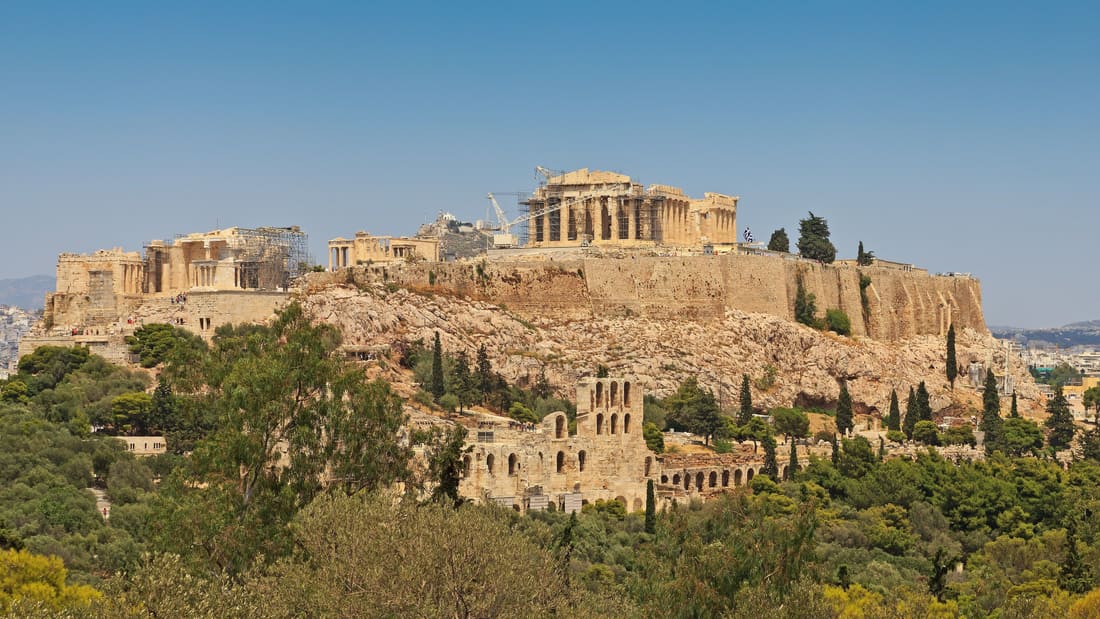
A Piraeus shore excursion turns a cruise stop at the port of Athens into a day ashore, from the cruise terminals by the harbour to the Acropolis and its museum, the old quarter of Plaka, Syntagma Square and the ancient stadium, or out along the coast to Cape Sounion and west to Ancient Corinth. This post covers what a Piraeus shore excursion includes, the cruise port, the route into Athens, the sights of the city, the trips beyond it, Piraeus itself, Greek food on a port day, the kinds of excursion and the best season. It is one of the shore excursions in Greece on Greece VIP.
Each section ends with a Piraeus shore excursion that can be booked online.
What does a Piraeus shore excursion include?
A Piraeus shore excursion is an escorted trip from the cruise port of Athens. A tour leader takes ship passengers by vehicle to the main sights of the capital, shows each monument on site and returns the party to the quay before the ship sails.
As the chief port of Athens, Piraeus is also the largest port in Greece. It has ranked as the top cruise destination in Greece for ten consecutive years, ahead of Santorini, Mykonos, Rhodes and Crete. Cruise traffic reached 1,098,091 passengers in 2019, up from 961,632 in 2018, an increase of 14.2%. A Piraeus shore excursion therefore runs beside a cruise port that grew by that margin in a single year.
Athens made Piraeus its harbour in the early 5th century BC. A new silver vein found in the Laurion mines in 483 BC paid for 200 triremes, and the Athenian fleet moved to Piraeus, where the ships were built in its shipyards. That fleet fought the Persians at the battle of Salamis in 480 BC, and Piraeus stayed the navy base afterwards. A Piraeus shore excursion starts from a harbour with this naval past.
An escorted Piraeus shore excursion differs from the Athens hop-on hop-off bus in who sets the plan. A tour leader plans the route, picks the stops and times the return to the ship, while a hop-on hop-off bus runs a loop on which each rider picks stops alone. The escorted format keeps one party together at each site and names the monuments on the spot, which suits a ship with a set sailing time.
- Berths: The cruise port has 11 vessel berths along its quay.
- Arrivals: The port received 524 ship arrivals in 2018 and 622 in 2019.
- Olympic Games: In 2004, 13 cruise ships docked at Piraeus to serve as floating hotels.
About a third of cruise sailings at Piraeus begin there, so the quay serves passengers who join a voyage as well as day visitors. Piraeus has been inhabited since at least the 26th century BC, and the port now forms part of the Athens urban area. A Piraeus shore excursion uses that closeness to reach the Acropolis and the old quarters, then returns each party to its berth in time for sailing.


Where does a Piraeus shore excursion start?
A Piraeus shore excursion begins at the cruise terminal assigned to the ship. The port runs three terminals, named A, B and C, along 2,800 metres of cruise quay, so the meeting point depends on the berth that the ship receives on arrival.
Terminal A is the main terminal. It checks in 1,200 passengers an hour, and two medium-sized ships can check in there at the same time. It lies within walking distance of the centre of the municipality of Piraeus, and a Piraeus shore excursion can start there. Terminal B was built in 2013 for the largest ships, checks in 1,500 passengers an hour and has space for 120 tour buses. Terminal C is the smallest, built in 2003 and expanded in 2016, with 700 passengers an hour.
Piraeus is the largest port in Greece and one of the largest in Europe. In 2014 it was the busiest passenger port in Europe, with about 18.6 million passengers. In 2018 it handled 4.9 million TEU container units, which moved it to second place among all Mediterranean ports. A Piraeus shore excursion starts inside this busy harbour, at the cruise side of it.
The city proper is a rocky peninsula that was an island in prehistoric times. The central harbour is the hub of commercial and passenger shipping, and the cruise terminals sit there. The western part of the port handles cargo, with three container terminals and two car terminals. Greater Piraeus also holds the harbours of Drapetsona, Keratsini and Perama. A Piraeus shore excursion never needs the cargo side of the port.
- Draft: The quay takes ships that draw up to 11 metres of water.
- Security: The terminals meet the International Ship and Port Facility Security Code.
- Shuttle: A shuttle bus service carries passengers between the terminals and the port gates.
Piraeus ranks in the top 10 cruise destinations of Europe and the Mediterranean, and in 2019 it won the title of Best Cruise Port in the Eastern Mediterranean Region. The meeting point of a Piraeus shore excursion changes with the terminal, and the terminal changes with the ship, so passengers confirm the berth on the day of arrival.
How does a Piraeus shore excursion reach Athens?
A Piraeus shore excursion reaches central Athens by road over the eight kilometres between the port and the city centre. Line 1 of the Athens Metro joins the harbour station to the centre by rail, and the tram serves the coast south of Piraeus.
The same corridor has linked port and city since antiquity. The Long Walls, built under Cimon and Pericles, secured the route from Piraeus and its ports to Athens. The Spartans tore them down in 404 BC, and Conon rebuilt the walls in 393 BC. The modern link followed in 1869, when the Athens-Piraeus railway opened, and a Piraeus shore excursion by road covers the same eight kilometres today.
Line 1 is the oldest of the three lines of the Athens Metro. It opened on 27 February 1869 as a steam railway between Piraeus and Thiseio, and it was electrified in 1904. Piraeus metro station sits beside the harbour as the southern terminus of Line 1 and as an interchange with Line 3. The line runs east to Faliro, then north through Kallithea and Petralona to Thissio, Monastiraki and Omonia. A Piraeus shore excursion by coach leaves the platforms to independent travellers.
The Athens Tram is a modern network of 27 kilometres through ten suburbs. Line 6 starts at Syntagma Square and runs southwest to the coast before it turns southeast to Pikrodafni. Line 7 starts at Voula and runs northwest along the coast to Akti Poseidonos in Piraeus. The two lines share track from Pikrodafni to the junction of Poseidonos and Achilleos avenues. A Piraeus shore excursion by road passes beside this coastal route.
- Metro line: Line 1 runs between Piraeus and Kifissia.
- Tram opening: The tram opened on 19 July 2004, ahead of the Olympic Games.
- Tram stops: Thirteen tram stops lie in Piraeus.
The Corinth Canal opened in 1893, and with the Athens-Piraeus railway it made Piraeus more important than before. Rail, tram and road now join the port to the capital, and a Piraeus shore excursion by coach avoids the platforms and the timetables. The party travels from the terminal to the first site as one group and returns to the berth with the same escorted routine.
Why does a Piraeus shore excursion climb the Acropolis?
A Piraeus shore excursion climbs the Acropolis because the rock above Athens holds the Parthenon, the Propylaea, the Erechtheion and the Temple of Athena Nike, all raised in the fifth century BC under Pericles, and UNESCO lists the site as World Heritage.
Around 500 BC the Athenians stopped work on the Olympieion, a temple linked with the tyrant Peisistratos and his sons, and used the Piraeus limestone meant for it to build the Older Parthenon. Builders levelled the south of the summit with about 8,000 two-ton blocks of limestone. The Parthenon later rose on the base of that earlier temple, so the rock that a Piraeus shore excursion climbs already drew on Piraeus stone around 500 BC.
Every four years the Athenians held the Great Panathenaea, which rivalled the Olympic Games in popularity. A procession crossed the city by the Panathenaic Way and ended on the Acropolis, where a new robe of woven wool, the peplos, went onto the statue of Athena Parthenos in the Parthenon. In the yearly Lesser Panathenaea, the robe went onto Athena Polias in the Erechtheion. A Piraeus shore excursion follows the last stretch of that route.
A Piraeus shore excursion also reaches modern history. In 1941, at the start of the Axis occupation, German soldiers raised the Nazi war flag over the Acropolis, and Manolis Glezos and Apostolos Santas took it down in one of the first acts of resistance. In 1944 the prime minister, Georgios Papandreou, went up the rock to celebrate liberation. The first photograph of the Acropolis, printed in 1842, shows a small mosque inside the Parthenon.
- Lift: Since 2020 a lift has carried visitors with mobility difficulties about 25 metres up to the plateau.
- Restoration: The project begun in 1975 reassembled 686 stones from original fragments.
- Floor: The Parthenon’s stylobate bulges upward at the centre by 10.3 centimetres over 70 metres.
A full Acropolis tour with an expert-led walk adds the slopes, where the Theatre of Dionysus and the Odeon of Herodes Atticus stand, while a Piraeus shore excursion keeps to the summit buildings that fit a ship’s port call. UNESCO has listed the Acropolis as World Heritage since 1987, the same year as Delphi.
Can a Piraeus shore excursion include the Acropolis Museum?
A Piraeus shore excursion can include the Acropolis Museum, which stands by the southeastern slope of the rock, 280 metres from the Parthenon. It is a thematic museum with the finds of one archaeological site only, and its top floor holds the Parthenon sculpture.
The ground floor shows finds from the sanctuaries and the settlement on the slopes, and its floor slopes upward like the ancient path to the rock. On the first floor, a circular route covers the summit from the 2nd millennium BC to the end of antiquity. The third floor holds the Parthenon sculpture, and the ruins of an ancient neighbourhood lie at the base. A Piraeus shore excursion goes to the top level first and then descends in chronological order.
The Parthenon Gallery shows the pediment sculptures at eye level. The marbles face outward, as they did on the temple, while the Duveen Gallery of the British Museum shows them facing inward. More than half of the Parthenon sculptures are in the Acropolis Museum. The statue of Poseidon from the west pediment broke in 1688, and its front part is in Athens while its back part is in London. A Piraeus shore excursion meets the Athens half of that split.
Glass panels in the floor of the ground-floor gallery give a view of the excavation below. The slopes held sanctuaries, theatres, music venues and, further downslope, private homes. The old museum on the rock is closed and due to house workshops. Between January and March 2008, 4,200 items, among them about 80 pieces taken down from the monuments, moved from that old building to the new museum.
- Caryatids: A Piraeus shore excursion finds the Caryatid Kore B of the Erechtheion, dated 420-415 BC, in the first-floor west gallery.
- Frieze: 112 fragments of the Erechtheion frieze survive.
- Damage: Elgin’s removal of one Caryatid caused significant damage to the temple.
A Piraeus shore excursion that adds the museum sees the Parthenon sculpture indoors, 280 metres from the temple. The building also holds an amphitheatre, a virtual theatre and a hall for temporary exhibitions. Glass walls on all four sides let daylight fall on the marbles as it falls on the temple above. The museum was among the six finalists for the 2011 Mies van der Rohe Award.
What does a Piraeus shore excursion show in Plaka and the Ancient Agora?
A Piraeus shore excursion shows Plaka, the old quarter on the northern and eastern slopes of the Acropolis, and the Ancient Agora to the northwest, where the Temple of Hephaestus and the rebuilt Stoa of Attalos stand among the ruins of the ancient meeting place.
Adrianou Street divides Plaka into Ano Plaka, right under the Acropolis, and Kato Plaka, between Syntagma and Monastiraki squares. Albanian settlers reached Attica in two waves, after 1540 and after 1570. Plaka had a sizable Albanian community until the late 19th century, with its own courts that used the Albanian language. The district is the oldest in Athens, inhabited since the Neolithic, so a Piraeus shore excursion passes monuments from all periods of the city’s history.
The Ancient Agora that a Piraeus shore excursion crosses was around half cleared by the close of the 1935 season. The finds by then included almost 600 items of sculpture, over 6,000 pieces of pottery and over 41,000 coins. The mapping of the Panathenaic Way in 1938 fixed the full boundaries of the Agora, and the season of 1939 cleared 56,000 tons of earth, more than in any other year.
The Temple of Hephaestus measures 13.71 by 31.78 metres and uses marble from nearby Mount Penteli, except for the bottom step. Its east frieze shows Theseus fighting the Pallantides, and its west frieze shows Centaurs and Lapiths. Pausanias recorded bronze statues of Athena and Hephaestus inside, and tradition credits Alcamenes with them. In the 3rd century BC, a garden of pomegranate, myrtle and laurel was planted around the temple on the north-west side of the Agora.
- Stoa of Attalos: The walls that a Piraeus shore excursion sees in the rebuilt stoa are limestone from Piraeus.
- Treaty: Ten countries signed their accession treaty to the European Union in the stoa in 2003.
- Slave letter: A lead tablet found in 1974 holds a letter written by a slave named Lesis.
The last liturgy in the church of Saint George Akamates took place in the temple on 21 February 1833, during the celebrations for the arrival of King Otto. When Athens became the capital in 1834, the royal edict was published there. A Piraeus shore excursion that ends at the Agora stops at a well-preserved Doric temple on Agoraios Kolonos hill.
What does a Piraeus shore excursion show at Syntagma?
A Piraeus shore excursion shows Syntagma Square, the Hellenic Parliament in the former royal palace, the Tomb of the Unknown Soldier and the Evzones of the Presidential Guard. The stop covers the political centre of modern Athens in one open space.
A Piraeus shore excursion starts at Syntagma Square, which Amalia Avenue borders on the east and Otto Street on the south. King Otto first planned his palace for Omonia Square, but a site above the eastern square won, and work began in 1836. Members of the royal family lived in the Old Palace until 1924, when a referendum abolished the monarchy. It then served as a makeshift hospital and a museum until November 1929, when the government chose it to house Parliament.
A Piraeus shore excursion sees a tomb with its own planning story. Army general Theodoros Pangalos took the decision to build it, and the Army Ministry approved the study of the architect Emmanuel Lazaridis on 9 October 1926. Pangalos wanted the Army Ministry housed in the Old Palace, but in 1929 Eleftherios Venizelos chose Syntagma Square, reasoning that the monument belonged in the city centre like the Arc de Triomphe in Paris. Fokion Rok became sculptor in 1930, after funds ran out for a Gigantomachy design.
The Evzones of the Presidential Guard stand watch at the tomb. The term Evzones returned to the Greek army in 1824, and a royal decree of 12 December 1868 created four independent Evzone battalions. The fustanella uniform became official in the same year. After 1974 and the end of the monarchy, the ceremonial unit took the name Presidential Guard. On certain days an army band joins the change of guard, with the majority of the 120 Evzones present.
- Inscriptions: A Piraeus shore excursion sees battle names from the Balkan Wars to El Alamein and Korea.
- Steps: The side stairs are decorative and serve as places to watch ceremonies.
- Seats: The unicameral Parliament that a Piraeus shore excursion views has 300 members, elected for four years.
A Piraeus shore excursion leaves the square at a transport hub. Buses and trolleybuses start and end there, with routes to the northern suburbs and the Athens Olympic Complex in Maroussi. The square has also been a protest ground: between 2010 and 2012 mass protests filled it during the Greek government debt crisis.
Which ancient monuments does a Piraeus shore excursion pass on the drive?
A Piraeus shore excursion drives past the Temple of Olympian Zeus, Hadrian’s Arch and the marble Panathenaic Stadium in central Athens. Each of the three monuments reached its finished form in the second century AD, so the route covers one Roman-era stretch.
The Temple of Olympian Zeus measured 110.35 m by 43.68 m and carried 104 Corinthian columns, each 17.25 m high. In 86 BC Sulla carried unfinished columns to Rome for the Temple of Jupiter on the Capitoline Hill. The Heruli sacked Athens in 267 AD and badly damaged the temple, and an earthquake in the fifth century finished the destruction. Builders then took its material for a nearby basilica. A Piraeus shore excursion passes the surviving columns.
Hadrian’s Arch stands at the north-west corner of the temple precinct. Its marble comes from Mount Pentelicus, 18.2 km to the northeast, and it has more inclusions than the stone of the best Athenian buildings. One proposal reads the arch as a welcome for Hadrian, who had become an Athenian citizen nearly two decades earlier. A thin stone screen, about 7 cm thick, closed its central upper opening. A Piraeus shore excursion passes the arch on Amalias Avenue.
The Panathenaic Stadium has three building phases. Lykourgos built a poros-stone stadium about 330 BC, 260 m long. Herodes Atticus rebuilt it in Pentelic marble with minimal concrete, and Theodosius banned the festivals in the late fourth century. Anastasios Metaxas duplicated the second-century design for 1896, and a statue of Averoff was unveiled outside on 5 April 1896. A Piraeus shore excursion passes that statue.
- Statues: Pausanias recorded statues of Hadrian at the temple entrance.
- Names: Under Ottoman rule Turks called the temple the Palace of Belkis.
- Columns: A Piraeus shore excursion passes columns that Ciriaco de’ Pizzicolli counted as 21 standing in 1436.
A Piraeus shore excursion also passes a stadium with a long Olympic record. It hosted the 1906 Intercalated Games and the archery contest of the 2004 Olympics, and it is the last venue in Greece for the Olympic flame handover to the host nation. Atmospheric pollution has discoloured the Arch of Hadrian and worn its inscriptions.
Can a Piraeus shore excursion reach Cape Sounion?
A Piraeus shore excursion can reach Cape Sounion along the EO91 coast road south from the port, which ends at the Temple of Poseidon on the headland. The headland juts into the Aegean Sea, so the visit adds an open sea view.
The EO91 runs along the western face of the Attica peninsula from Athens to Sounion. A presidential decree of 28 June 1928 created it, and from 1955 until 1963 the same route carried the number EO3. From Palaio Faliro the road follows the coast of the Saronic Gulf through Vouliagmeni, and at Sounion it meets the EO89. A Piraeus shore excursion joins this coast road from new Faliro, where Poseidonos Avenue begins in Piraeus.
Athens backed new sanctuaries in Attica between 508/7 and 480/79 BC, at Rhamnous, at Mounychia in Piraeus and at Eleusis, and Sounion belongs to that period. The Archaic sanctuary had its own walled court, a gateway and two covered walkways, and the temple is thought to have been a large investment by the state. After Marathon the Athenians were weak and open to a naval strike, so a lookout on the cape kept watch over the sea.
The architectural historian William Dinsmoor called the marble ceilings over the flanks of the later temple rare in Greek design, while the porch ceilings were of the coffer type. Archaeologists have identified at least forty-one limestone drums of the older temple, which measured about 13.06 by 30.20 metres. Its construction is believed to have reached geison level. Valerios Stais theorised that high winds or an earthquake brought it down, and a Piraeus shore excursion visits the ground where both temples stood.
- Epithet: Ancient grammarians tied the name of the Aegean Sea to Poseidon, who carried the epithet Aigaios.
- Sight: One ancient reading derives the name from words meaning that the land is always in sight.
- Goats: Another reading says the islands looked like a herd of goats rising from the water.
A Piraeus shore excursion that includes Sounion keeps to the temple on the headland, whereas a full Cape Sounion tour adds the Athena sanctuary, the fortress and the town of Lavrio. The ancient deme of Sounion lay between Amphitrope on the west and Thorikos on the north, and its settlement stood north of the cape, between Ano Sounio and Kato Sounio.
What does a Piraeus shore excursion show in Piraeus itself?
A Piraeus shore excursion in Piraeus itself shows the marina harbour of Mikrolimano, the hill of Kastella, the story of the ancient Long Walls and the Archaeological Museum of Piraeus, where four bronze statues found in 1959 stand beside sculpture from the Attic coast.
A Piraeus shore excursion reaches Mikrolimano, one of two small harbours east of the central port, where recreational and fishing craft moor. The harbour carries the ancient name Munichia. In 403 BC the exiles from Phyle under Thrasybulus seized Munichia and defeated the Thirty Tyrants of Athens in a battle there. The steep hill above it is modern Kastella, which Hippias fortified in 511 BC. Neo-classical mansions, the open-air Veakeio Theater and a church dedicated to the Prophet Elijah stand in Kastella.
The Long Walls linked Athens with its ports at Piraeus and Phaleron and ran about 6 kilometres. The Middle Wall of the 440s BC ran parallel to the first Piraeus wall and formed a narrow protected corridor. The treaty of 404 BC required Athens to demolish the walls, and Persian support paid for the rebuilding. On a Piraeus shore excursion, the walls explain the value of the harbour: they kept a sea route open during land sieges.
On a Piraeus shore excursion, the Archaeological Museum of Piraeus holds sculpture found in Piraeus and along the Attic coast, from the Bronze Age through Roman times. Its sections cover Mycenaean finds, pottery, bronze statues, a reconstruction of a Classical sanctuary of Cybele, gravestones and Hellenistic and Roman sculpture. A copy of the Piraeus Lion, the colossal sculpture that stood at the harbour entrance, is on display. The original left in 1687, when Francesco Morosini carried it to the Venetian Arsenal.
- Kastella: The hilltop looks over the Athens basin and the Saronic Gulf.
- Zea: Excavations here revealed the Skeuotheke, an ancient store for ship rigging.
- Themistoclean Walls: Parts of these walls and of the harbour mole survive in good condition.
The four bronze statues came to light on 18 July 1959, when pipe-laying work near the Tinaneios Gardens uncovered the hand of a bronze kouros about 1.50 metres down. The finds were an Apollo of the 5th century BC, two figures of Artemis and an Athena above life size, and the three women date to the 4th century BC. A Piraeus shore excursion that enters the museum meets them in the bronze statues section.
Can a Piraeus shore excursion visit Ancient Corinth?
A Piraeus shore excursion can visit Ancient Corinth, because the Isthmus of Corinth lies west of Piraeus and the Corinth Canal joins the Saronic Gulf to the Gulf of Corinth. A port-day stop covers the canal and the ruins of the ancient city.
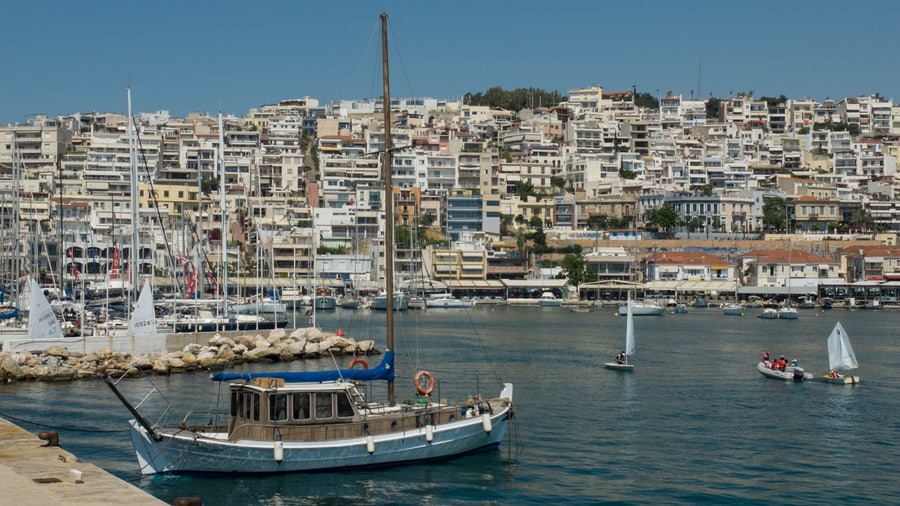
Piraeus and the eastern end of the canal both open onto the Saronic Gulf. Completed in 1893, the Corinth Canal crosses the isthmus that links the Peloponnese with the rest of Greece. It has no locks and is of little economic importance today, so a Piraeus shore excursion treats it as a sight. At the surface the channel measures 24.6 metres across, too narrow for large oceangoing ships.
The channel was put out of action in October 1944, when retreating German forces set off explosives to bring down landslides, destroyed the bridges and tipped locomotives and wreckage into the water. The United States Army Corps of Engineers began clearing the canal in November 1947. It reopened to shallow-draft traffic by 7 July 1948 and to all traffic by that September. A Piraeus shore excursion therefore stops at a cut that engineers restored after the war.
Corinth stood on the isthmus as a city-state, roughly halfway between Athens and Sparta. A conference at the Isthmus of Corinth in 481 to 480 BC set up the Hellenic League against Persia. Corinth sent 400 soldiers to Thermopylae, forty warships to Salamis and 5,000 hoplites to Plataea. The Corinthians also developed the trireme, the warship that filled the 372 shipsheds of Piraeus in classical times.
- Isthmus: All land traffic to the Peloponnese passed through this strip, so Corinth grew wealthy.
- Acrocorinth: This fortress rock was the last line of defence in southern Greece.
- Cenchreae: This Saronic Gulf harbour served ships from Athens, Ionia, Cyprus and the Levant.
A port-day visit covers the canal and the main ruins in outline, while a full Ancient Corinth tour works through the Temple of Apollo, the site museum and the other monuments in detail. A Piraeus shore excursion to Corinth also links two navies: forty Corinthian warships fought at Salamis beside the Athenian fleet, whose triremes were built in the shipyards of Piraeus.
What Greek food can a Piraeus shore excursion taste?
A Piraeus shore excursion can taste Greek street food, meze and the seafood of a port city: souvlaki grilled on a skewer, small plates served with ouzo, and fried squid, whitebait and grilled octopus from the tavernas of Mikrolimano.
Souvlaki means meat chunks threaded on a skewer and grilled, and Greece uses pork. Cooking on skewers goes back to the Bronze Age, and Mycenaean sites at Gla, Mycenae and Pylos yielded rectangular ceramic pans set beneath the skewers. The French traveller Gustave Flaubert saw Greeks grilling meat on bamboo sticks in Boeotia in 1850. Vendors from Boeotia began to sell skewers as fast food in the 1960s, and a Piraeus shore excursion tastes the result.
A Piraeus shore excursion also serves meze, small dishes that arrive as appetizers, hot or cold. The word comes from Turkish, which borrowed it from the Persian maze, meaning taste. The custom started in the Byzantine Empire and grew up in the houses and tavernes of Ottoman Greeks. A meze table holds grilled octopus, fried whitebait or calamari, taramosalata made from fish roe, and saganaki, a fried or grilled cheese.
A Piraeus shore excursion lands in a port that was a town of fishermen when settlement restarted in 1829, and the tavernas along Mikrolimano and Piraiki specialise in seafood. Greek cuisine lists kalamarakia tiganita, squid slices fried and served with lemon, and marides tiganites, small whitebait dusted with flour and fried. Garides saganaki cooks shrimp in ouzo and tomato sauce and tops them with crumbled feta.
- Souvlaki: Grilled pork is lifted off the skewer or wrapped in a rolled pita.
- Taramosalata: This dip mixes fish roe, olive oil, lemon juice and bread or potatoes.
- Bakaliaros: Fried cod comes with skordalia, a garlic dip.
The seafood tradition has old roots. Cooking in ancient Greece was built on wheat, olive oil and wine, and fish was eaten more than meat. Byzantine cooks added caviar, nutmeg and basil, and feta and avgotaraho, cured fish roe, both trace back to Byzantium. A Piraeus shore excursion therefore tastes a menu with ancient and Byzantine roots in a harbour that has served Athens since the early 5th century BC.
Which kind of Piraeus shore excursion suits a port day?
A Piraeus shore excursion on a port day takes one of three forms: a private tour with a driver and tour leader, a small-group tour, or an independent visit by metro. Each form trades pace, crowds and control of the return to the ship.
The size of the city shapes all three forms. The municipality of Athens holds 643,452 residents on 38.96 square kilometres, and the urban area holds 3,059,764 people. Piraeus lies eight kilometres south-west of the centre. Traffic congestion plagues the Athens area, and in the 1980s an ever-growing fleet of cars added to the smog. A Piraeus shore excursion by road shares those streets.
A private tour fixes the route around one party. A driver meets the party at the port, where Terminal B has space for 120 tour buses, and a tour leader explains each stop. The party sets the pace and decides when to turn back. That control over the return to the ship is the strength of a private Piraeus shore excursion.
A small-group tour shares one vehicle and one fixed route with other passengers. The order of the stops is set in advance, so the pace follows the group and not one traveler. The tour leader keeps the group together.
An independent visit by metro uses the oldest line of the network. Line 1 runs from Piraeus to Kifissia over 25.7 kilometres and 24 stations, with a transfer to Line 3 at Monastiraki and to Line 2 at Omonia and Attiki. Construction of Lines 2 and 3 began in 1992 to decrease traffic congestion and improve the air quality of Athens.
- Private: One party sets the stops, the pace and the hour of return.
- Small group: A fixed order of stops sets the pace.
- Independent: The traveler alone keeps the time for the return to Piraeus.
The three forms differ in how they treat the clock. A private tour bends to one party, a small-group tour bends to the group, and a metro visit bends to the traveler alone. Line 1 has carried passengers between Piraeus and the centre since 1869, when a steam railway opened between Piraeus and Thiseio.
When is the best season for a Piraeus shore excursion?
A Piraeus shore excursion in spring or autumn meets milder air than the hot summer, while winter brings the wettest days. The port of Piraeus has hot semi-arid weather and receives just 331.9 millimetres of rain a year.
Athens belongs to the Csa class of hot-summer Mediterranean climates, and its mean annual temperature stands at 19.2 °C at the station near the city centre. Piraeus is the only area of Attica that clearly falls into the hot semi-arid class, and its mean annual temperature stands at 19.4 °C. The Saronic Gulf moderates the climate of the areas to the south.
In July and August the downtown highs average 34.3 °C, against 21.1 °C in April. Athens has been referred to as the hottest city of mainland Europe, partly because of its strong urban heat island. Land breezes on summer nights keep the minimum temperatures high at Piraeus. A summer Piraeus shore excursion meets the hottest air of the year.
Spring and autumn fall between the hot and the wet months. The downtown highs average 17.0 °C in March and 24.4 °C in October. Rainfall stays low at 27.6 millimetres in April and 38.6 millimetres in October, and it climbs to 70.8 millimetres in November. These months meet air that is cooler than July and drier than December.
- Winter: December brings 76.3 millimetres of rain and January 55.6 millimetres.
- Snow: Snowfall is relatively uncommon, and areas adjacent to Piraeus stayed clear on 24 January 2022.
- Fog: In spring, advection fog can appear along the coastline, though fog is rare in the centre.
Cruise traffic at Piraeus rose from 961,632 passengers in 2018 to 1,098,091 in 2019, and ship arrivals rose from 524 to 622. The port has 11 vessel berths and three cruise terminals, and it has been the top cruise destination in Greece for ten consecutive years. A Piraeus shore excursion in any month shares the port with that cruise trade.
What do travelers ask about a Piraeus shore excursion?
A Piraeus shore excursion begins in the chief sea port of Athens, on the Saronic Gulf. The municipality of Piraeus has 168,151 residents, and Greater Piraeus has 448,051, so the port stands inside a large city of its own, beside the capital.
How does a Piraeus shore excursion return to the ship on time?
Piraeus metro station lies beside the port and joins Lines 1 and 3. A free shuttle bus service brings passengers to the other terminals. Terminal A lies within walking distance of the centre of Piraeus, so a Piraeus shore excursion that ends at the station finishes beside the quay.
Can a Piraeus shore excursion fit the Acropolis and the museum in one day?
Athens holds two UNESCO sites, the Acropolis and the Daphni Monastery. The Acropolis Museum opened in 2009 and replaced the old museum on the rock, and almost one million people visited it from June to October of that year. The Akropoli metro station shows ancient artifacts or replicas.
Is a Piraeus shore excursion suitable for limited mobility?
Athens grew around a large number of hills, and Lycabettus is one of the tallest. Dionysiou Areopagitou Street is pedestrianised and passes beneath the southern slopes of the Acropolis. Line 1 runs mostly at ground level from Piraeus, while Line 2 runs entirely underground.
What clothing suits a Piraeus shore excursion?
The downtown UV index stands at 10 in both June and July and falls to 2 in December. The average low downtown is 24.2 °C in July, and humidity runs at 42 percent in July against 73 percent in December. A Piraeus shore excursion in winter meets cool, damp air, and one in July meets hot, dry air.
Can a Piraeus shore excursion combine Athens and the coast?
Piraeus lies along the Saronic Gulf, in the Athens Riviera. The Athens Tram runs from Syntagma Square to Palaio Faliro, where it splits into two branches: one heads toward Piraeus and the other follows the coastline to Voula. The tram network covers the majority of the Athens coastline.
What changes on a disembarkation day for a Piraeus shore excursion?
About a third of cruise sailings at Piraeus are home ported there, so those ships begin or end a cruise at the port. Terminal C has customs and a check-in and departure hall. The Line 3 stations Maniatika, Piraeus and Dimotiko Theatro were completed on 10 October 2022 and connect the port with Athens International Airport.
Featured photo: A.Savin, CC BY-SA 3.0, via Wikimedia Commons.