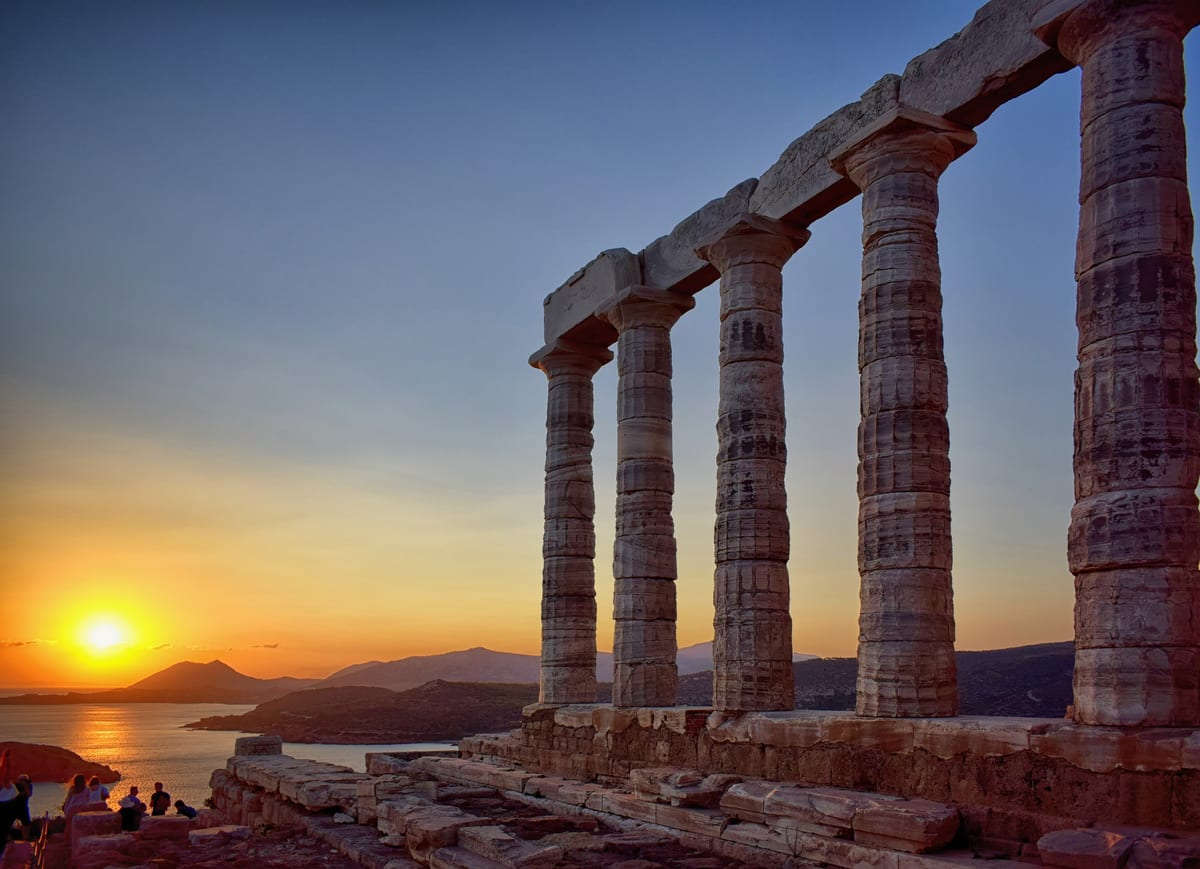
A Cape Sounion tour follows the coast road south from Athens to the Temple of Poseidon, which stands on the cliff at the tip of Attica above the Aegean Sea. This post covers what a Cape Sounion tour includes, the temple, the history and myth, the road along the Athens Riviera, the stops, the sunset, the sights nearby and the best season. More Greece tours are listed on the Greece VIP homepage.
Each section ends with a Sounion tour that can be booked online.
What does a Cape Sounion tour cover?
A Cape Sounion tour covers the Temple of Poseidon on a headland 69.5 km southeast of Athens, the coast road of the Athens Riviera that leads there, and the sunset over the Aegean Sea as seen from the ruins on the cliff.
Cape Sounion forms the southern tip of the Attica peninsula. It lies 8 km south of the town of Lavrio, the ancient Thoricus, and belongs to the municipality of Lavreotiki in East Attica. On the map it falls between the villages of Kato Sounio and Legrena. The goal of every Cape Sounion tour is the group of ruins on the headland, where the Aegean Sea closes in on three sides. The temple stands almost 60 metres above the water.
The main sight on a Cape Sounion tour is the Temple of Poseidon, the monument the cape is known for. It ranks among the major works of the Golden Age of Athens. In Greek religion, Poseidon ruled the sea, storms and earthquakes. For Athens, a city that lived by sea trade and relied on its navy in the 5th century, the god held special weight. Greek builders tended to link temple sites to the god they honoured, but at Sounion practical needs counted too.
Every ship that followed the coast of Attica had to pass around the cape. From the headland, lookouts saw ships on the sea lanes to and from Piraeus first on arrival and last on departure. Jessica Paga and Margaret M. Miles tie the site to the rise of the Athenian navy and the conflict with Aegina. The temple is thought to have doubled as a watch post over a sea busy with merchant ships. A Cape Sounion tour takes in the same wide view.
The Athens Riviera is the coastal strip of the southern suburbs of Athens, running from Piraeus to Sounio and Lavrio. Sounion marks its southeastern end, so a Cape Sounion tour along the coast runs to the far point of the Riviera. Evening is the final stage. Since the first growth of modern tourism in the early 19th century, day visitors from Athens have come to watch the sun go down over the Aegean Sea from the ruins.
- Cape of Columns: From the 17th century the headland went by the Venetian name Capo Colonne, as temple columns had stood there from antiquity.
- Municipality: Lavreotiki was set up in 1890 under the name Sounio and renamed in 1891.
- Site works: The archaeological site that a Cape Sounion tour visits was arranged in a 2011–2013 project co-financed by the Greek Ministry of Culture and Sports and the European Union.
A Cape Sounion tour also follows a long line of earlier visitors. Early modern travel accounts of the cape came from George Wheler in 1676, Lady Mary Wortley Montagu in 1718, Richard Chandler in 1765 and Edward Dodwell in 1805. Martin Heidegger visited in 1962. In his book Sojourns he likened the standing columns in the strong sea breeze to the strings of an invisible lyre.


What does a Cape Sounion tour see at the Temple of Poseidon?
A Cape Sounion tour sees a Doric temple of white marble, built in 444–440 BC under Pericles on the ruins of an older temple, with 15 of its 34 columns still standing and modern inscriptions cut into the stone, among them the name of Lord Byron.
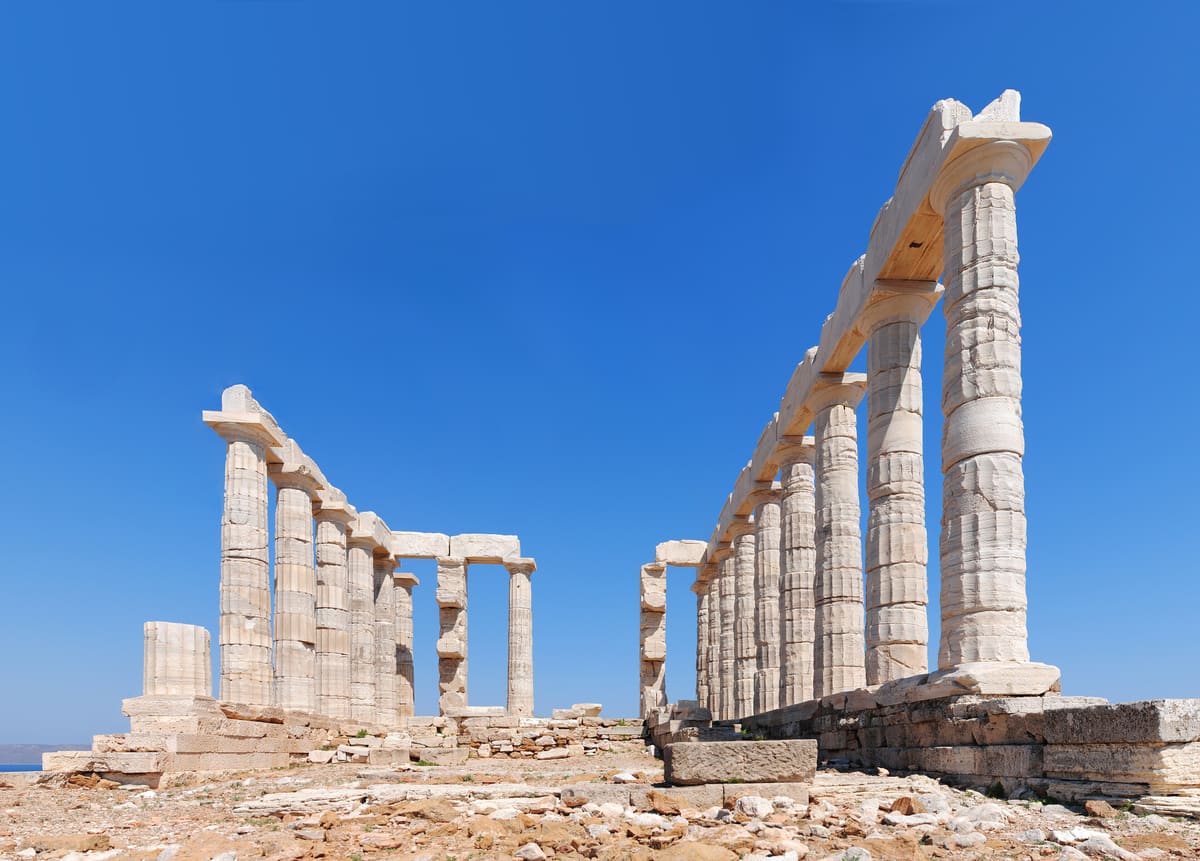
The temple seen on a Cape Sounion tour went up between 444 and 440 BC. The work fell in the years when Pericles, who also rebuilt the Parthenon, led Athens. The new building rose on the ruins of an Archaic-period temple of tufa. After the defeat of Xerxes in the sea battle of Salamis, the Athenians set up a whole captured trireme, a warship with three banks of oars, at the cape as a gift to Poseidon.
The building is a rectangle with a colonnade on all four sides. Its front porch is hexastyle, with six columns. The columns follow the Doric order. Each stood 6.10 m high, 1 m wide at the base and 79 cm wide at the top. Of the original 34, 15 remain upright, and a Cape Sounion tour sees these today. Intact, the temple is thought to have looked much like the Temple of Hephaestus below the Acropolis.
The marble came from the Agrileza quarries and is coarse-grained, rougher than polished stone. In 1884 Wilhelm Dörpfeld showed that the classical temple rests on an older one. The builders laid the new marble over the old limestone crepidoma, or stepped base, enclosing it. Dörpfeld also found that the first plan called for 6 by 12 columns, not the 6 by 13 in place now. On a Cape Sounion tour, large stretches of paint still show on the marble.
The best-known carving at the site is the name of Lord Byron, cut into the base of one column. One view links it to his first trip to Greece, on his Grand Tour, before he became famous. Byron spent months in Athens in 1810–11 and made two recorded visits to Sounion. No direct proof shows that he carved the name himself. He named Sounion in his poem Isles of Greece. A Cape Sounion tour stops at the column base that bears it.
- Venice: Two columns fell in 1825, and one went to the Venetian Arsenal in 1826.
- Sailors’ marks: Blocks of that column carry modern inscriptions, one by French sailors that reads “Le Zefire Bric Du ROI 1816”.
- England: Four drums sit under a bust of the sixth Duke of Devonshire at Chatsworth House, and a fifth is in the British Museum.
- Excavation: Inscriptions found by Valerios Stais between 1897 and 1915 overturned the claim of Pausanias that the cliff-top temple belonged to Athena.
A Cape Sounion tour also sees two building phases side by side. Two foundation blocks of the Archaic temple are still in place under the southeast corner of the classical one. Nineteen step blocks line the east and south sides, and a number of them look discoloured, a possible sign of burning. Dörpfeld argued that the Persians demolished the older temple in 480/479 BC, which explains its unfluted columns, missing roof and traces of a great fire.
What is the history behind a Cape Sounion tour?
A Cape Sounion tour enters a story that begins in Homer’s Odyssey, where Menelaus gave his helmsman funeral honours at the cape, and continues with the myth of King Aegeus, the Temple of Athena Sounias and the fortress Athens built in 413 BC.
Long before any Cape Sounion tour, the headland had a place in epic poetry. The oldest written mention of the cape is in Homer’s Odyssey, Book III, lines 278–285. As the Greek leaders sail home from Troy, the helmsman on the ship of King Menelaus of Sparta dies at his post while rounding Holy Sounion, the Cape of Athens. Menelaus lands there and gives his companion full funeral honours, a cremation on a pyre on the beach.
The sea seen from a Cape Sounion tour bears the name of Aegeus, a mythical king of Athens and the father of Theseus. When Theseus sailed to Crete to kill the Minotaur, Aegeus asked him to hoist white sails if he won. Theseus forgot. Seeing black sails, Aegeus took his son for dead and leapt from a height. One version places the leap on the Acropolis, while Latin authors say he fell into the sea, named Aegean after him.
Sounion is known for two sanctuaries, and a Cape Sounion tour takes in both. The second stood on a low hill 300 m northeast of the Temple of Poseidon. The Temple of Athena Sounias dates from 470 BC and replaced an older 6th-century building. Its plan was unusual, with colonnades only on the south and east sides, a detail Vitruvius recorded. Next to it lies an enclosure taken to be the grave and shrine of Phrontis, the helmsman of Menelaus.
In 413 BC, in the Peloponnesian War, Athens ringed the cape with a wall and towers to keep it out of Spartan hands. The city needed the sea route for grain from Euboea, since the Spartan fort at Dekeleia had cut its land supply lines. The Temple of Poseidon stood in the southeastern corner of the fortress, and a small naval base in the northwestern corner held a shipshed for two warships. A Cape Sounion tour crosses ground that was once a fortress.
- Festival: Herodotus tells of a festival at Sounion every four years in the 6th century BC, with Athenian leaders arriving by sacred boat.
- Deme: Sounion was a deme of the Leontis tribe, with four seats in the Boule of 500 under Cleisthenes.
- Revolt: Rebel slaves from the nearby silver mines of Laurium later seized the fortress from Athens.
- Kouros: The Sounion Kouros, a statue of a young man, was found in 1906 in a pit east of the temple.
The fortress stayed in use into the Hellenistic period, with repairs during the Chremonidean War of 266–261 BC. Its prosperity, thought to owe much to the Laurium silver mines, passed into a proverb, but by the time of Cicero the place had fallen into decay. On a Cape Sounion tour, the line of the walls and their square towers can still be traced, except where steep rock gave natural defence.
How does a Cape Sounion tour travel from Athens?
A Cape Sounion tour leaves central Athens and follows the coast south along the Athens Riviera. The drive ends at the promontory on the southernmost tip of the Attica peninsula, which lies 69.5 km southeast of Athens and forms the southeastern endpoint of the Riviera.
The Athens Riviera is the coastal area in the southern suburbs of Athens. It stretches from Piraeus to Sounio and Lavrio, and it lies about 16 km from downtown Athens. A Cape Sounion tour joins this coast after it leaves the city centre and then heads south past one seaside suburb after another. The Greek National Tourism Organisation names the main Riviera areas as the Bay of Zea, Aenaon Park, Elliniko, Glyfada, Voula, Vouliagmeni, Lagonisi, Varkiza, Anavyssos and Sounio.
The road along the shore is Poseidonos Avenue, part of the EO91 road. Glyfada connects to central Athens through Poseidonos Avenue and Vouliagmenis Avenue, and a tram line runs along the seaside next to Poseidonos Avenue. In Vouliagmeni, Vouliagmenis Avenue turns into Athinas Avenue, a boulevard lined with palm trees that runs parallel to the seashore and continues south. Further on, Varkiza also links to Poseidonos Avenue, just east of Vouliagmeni, so a Cape Sounion tour keeps close to the water.
Distances from the city centre mark the progress of the drive. Vouliagmeni lies 18 km south of the Athens city centre. Varkiza lies 22 km south of the centre and 2 km south of Vari, to the northwest of Cape Sounio. The cape itself lies much further on, so a Cape Sounion tour still has a long stretch of coast ahead after Varkiza. The Riviera list also names Anavyssos, the driest area in mainland Greece, with around 290 mm of rain each year.
Cape Sounion is the promontory at the southernmost tip of the Attica peninsula. It belongs to the Lavreotiki municipality in East Attica and sits between the villages of Kato Sounio and Legrena. In ancient times, anyone sailing along the coast of Attica had to go around this point, and the cape saw heavy merchant traffic at sea. On land, the same position makes the cape the turning point of a Cape Sounion tour.
- Start: The drive leaves central Athens and reaches the Athens Riviera, which lies about 16 km from downtown.
- Coastal road: Poseidonos Avenue, part of the EO91 road, runs next to the seaside tram line in Glyfada.
- Vouliagmeni stretch: Athinas Avenue is a palm-lined boulevard that runs parallel to the seashore and continues south.
- End point: Cape Sounion sits 69.5 km southeast of Athens at the southeastern endpoint of the Athens Riviera.
A Cape Sounion tour therefore links central Athens with the far southern tip of Attica along one continuous coast. The first part of the drive passes the Riviera suburbs, with their beaches, marinas and seafront avenues. The last part reaches the headland of the Lavreotiki municipality, where the coastal route ends at the temple above the sea and the return to Athens begins.
Which stops does a Cape Sounion tour make on the Athens Riviera?
A Cape Sounion tour along the Athens Riviera passes three seaside stops: Glyfada, Vouliagmeni with its lake, and Varkiza. Each town sits on the coastal route south of Athens, and each offers a seafront, a beach or a marina before the final stretch to the cape.
Glyfada is the first of the three stops. The town lies in the South Athens regional unit on the coast of the Saronic Gulf, and it took its name from local salt-water wells. In ancient times the area was the deme of Aixone. The Riviera plan itself began here in 1957 with the creation of Asteria. An American airbase stood nearby until the early 1990s. A Cape Sounion tour that pauses in Glyfada finds a modern marina and a shopping district along Metaxa Avenue.
Vouliagmeni is the second stop on a Cape Sounion tour. Its name means “sunken”, and since 2011 it has been part of the Vari-Voula-Vouliagmeni municipality. Between Athinas Avenue and the sea lie two pine-covered peninsulas, Megalo and Mikro Kavouri, or “Big Crab” and “Little Crab”, where sand and pebble beaches alternate with rocky shores. The beaches hold EU blue flags, and excavated ruins of the Temple of Apollo Zoster sit inside a public beach. The triathlon of the 2004 Summer Olympics also took place here.
Lake Vouliagmeni, which gave the suburb its name, sits just south of the town and very close to the sea. Its brackish water comes from underground currents that pass through the rock of Mount Hymettus. The lake formed about 2,000 years ago, when a large cavern collapsed after an earthquake, and its underwater cave has never been fully explored. Warm seawater keeps the lake above 18 °C, and a Cape Sounion tour can pause at a spa in use since the end of the 19th century.
Varkiza, once called Alianthos, comes next on a Cape Sounion tour. It belongs to the Vari-Voula-Vouliagmeni municipality, and its street names draw on Greek mythology. Just after the Second World War it was a small fishing village. Today it has a widely known beach with tennis courts, parkland, restaurants and taverns, and its population triples in summer. The Treaty of Varkiza, signed in 1945 at the Kanelopoulos Mansion in Vari, aimed to end the Greek Civil War.
- Glyfada: The Glyfada Golf Club lies on the northwest side of the town, south of the former Ellinikon Airport.
- Vouliagmeni: The suburb has two marinas, and the small rocky islet of Fleves lies off its shore.
- Lake Vouliagmeni: The lake is a natural monument and the only home of the sea anemone Paranemonia vouliagmeniensis.
- Varkiza: The Hymettus mountains rise to the northwest of the town, and the Mesogeian plain lies to the north.
Together, these three towns give a Cape Sounion tour a clear sequence on the way south. Glyfada shows the modern Riviera and its roots, Vouliagmeni adds a lake born from a collapsed cave, and Varkiza offers a widely known beach and a name tied to the Greek Civil War. After these stops, the coastal route continues toward the headland at the far end of the Riviera.
Why is sunset the time for a Cape Sounion tour?
A Cape Sounion tour aims for sunset because the sun goes down over the Aegean Sea in view of the temple ruins. The temple stands almost 60 metres above the water on a headland with sea on three sides, so the view stays open.
The cape is a popular excursion for visitors based in Athens. The sunset over the Aegean Sea, seen from the ruins, has been a sought-after sight since modern tourism first grew in the early 19th century. A Cape Sounion tour that reaches the headland in the late afternoon follows this long tradition. The timing leaves room to walk around the temple in daylight and then watch the sky change colour as the sun sinks.
On the headland, the ground drops steeply from the temple to the water. The sun sets in the west, so visitors on a Cape Sounion tour gather along the west-facing side of the cliff to watch it go down. From that edge, the view runs out over the sea toward the horizon. Behind the viewers, the white marble columns of the temple, cut from stone quarried nearby, take on the evening light.
The site was chosen with the sea in mind. Scholars link the temple’s position to its view of the sea lanes to and from Piraeus, since the cape gave the first and last sight of ships coming and going. Ships nearing Attica saw the cape with ease. The cape lies on the coast of the Myrtoan Sea, and a Cape Sounion tour at dusk looks out over the same wide stretch of water.
Summers at the cape are hot and dry, so an evening visit spares visitors the strongest heat of the day on the open rock. Arriving before the sun meets the sea leaves time to walk the site and pick a place on the west side. Firm shoes help on the rocky ground around the temple. A light layer also helps on a Cape Sounion tour, since the ride back to Athens takes place after dark.
- Setting: The temple stands almost 60 metres above the sea on a headland with water on three sides.
- Tradition: The sunset seen from the ruins has drawn visitors since the early 19th century.
- Vantage: The cape once gave the first and last sight of ships on the sea lanes to and from Piraeus.
- Timing: An early arrival leaves time to find a place on the west side before the sun sets.
Sunset gives a Cape Sounion tour a clear end point. The coastal drive along the Riviera leads to a high headland, and the temple above the Aegean frames the last light of the day. Visitors who arrive early, find a place on the west side of the cliff and stay until the sun goes down end the day with the temple against the evening sky.
Which nearby sights add to a Cape Sounion tour?
A Cape Sounion tour can add Lavrio, a town 8 km north of the cape known in antiquity for its silver mines. Lavreotiki, the municipality that includes the cape, adds the theatre of Thorikos and a mineral museum, while the Sounio national park dates from 1974.
Lavrio lies 8 km north of the cape, close enough for a Cape Sounion tour to take in its streets and port. Also called Lavrion or Laurium, the town sits about 60 km southeast of central Athens and serves as the seat of Lavreotiki municipality. From the Middle Ages until 1908 it carried the name Ergastiria. Its bay looks east toward Makronisos, the island known in antiquity as Helena. The EO89 road runs through the town, and the Archaeological Museum of Lavrion tells much of the story of the mines.
The ancient silver mines of Laurion spread over southern Attica between Thorikos and Cape Sounion, about 50 km south of central Athens. Mining traces date back to around 3200 BC, and systematic work began in the 6th century BC under Peisistratos. Silver was the main product, with copper and lead as well. Archaeologists have found around 700 ancient mine shafts. Estimates put the workforce at almost 20,000 slaves, who raised and washed ore holding only 0.1% silver. Shafts, galleries and surface workshops still survive in the area today.
A Cape Sounion tour that stops at Lavrio crosses ground that shaped Athenian power. After a rich vein was struck around 483 BC, Themistocles persuaded the Athenians to spend the silver on 200 triremes, which won at Salamis in 480 BC. Athens minted its silver coins almost entirely from Laurion ore. Mining stopped in the 1st century BC and ran again from 1864 to 1978. The Mineralogical Museum of Lavrion, set in an industrial building from 1875, displays 740 mineral samples, miners’ tools and silver coins of ancient Athens.
Lavreotiki, the municipality at the southeastern tip of the Attica peninsula in East Attica, takes in the cape, Lavrio and Thorikos, so a Cape Sounion tour can reach all three without leaving it. Archaeologists and geologists have identified more than 250 ore washeries in the district. The Sounio national park was set up in 1974 with a core area of 750 hectares, and its Greek title marks it as a national woodland park. In a national park core, only research, mild recreation and the gathering of environmental information are permitted.
- Thorikos theatre: The theatre at Thorikos, built around 525–480 BC, is a key survival of the ancient town, whose acropolis stood on Velatouri hill.
- Thorikos in myth: In the Homeric Hymn to Demeter, the goddess, disguised as an old woman, names Thorikos as her landing place after leaving Crete.
- Mineral wealth: More than 610 mineral species have been found beneath the Lavrion area, equal to 16% of the minerals known worldwide.
- Makronisos: The island facing the port of Lavrio stretches 13 km from north to south and ranks as the largest uninhabited island in Greece.
- Park plant cover: The Sounion park lies in an Aegean ecoregion where maquis, low phrygana shrubland and pine forest form the main plant communities.
These sights sit within easy reach of the cape, so a Cape Sounion tour can add one or two of them before or after the temple visit. The Laurion mines also served the city itself, since lead from them went into water pipes and clamps for the rebuilding of Athens after the Persians left around 479 BC. Travelers who plan to see the ancient citadel above the city can book tickets for the Acropolis ahead of the coast trip.
When is the best season for a Cape Sounion tour?
A Cape Sounion tour works in every season. The cape has a hot semi-arid climate, with hot, dry summers and mild, wetter winters. At Lavrio, July and August are the driest months, December and January the rainiest, and its station has never logged an air frost.
Weather on a Cape Sounion tour follows the dry pattern of the Attica coast. The hot semi-arid type found at the cape also covers Piraeus and much of the Athens Riviera. Lavrio, 8 km north, shares it and sits close to the border of the hot-summer Mediterranean climate that covers the largest part of Attica. The Riviera, which ends at Sounion, counts as the warmest area in continental Europe. Its mean annual temperature reaches 19.4 °C in places, and the coast falls mostly in hardiness zone 10b.
Summer is the hottest season for a Cape Sounion tour. In lowland Mediterranean parts of Attica, summer days are mainly sunny and dry, and rain falls as showers or thunderstorms. Lavrio has hot summers with warm nights, yet its summer highs run 2 °C below Piraeus and 4 °C below downtown Athens. The etesian winds, or meltemia, peak in July and August and keep Aegean temperatures lower than those of mainland Greece. Heatwaves tend to stay milder on the coast, where the cooler sea and sea breeze temper the heat.
Winter is the wetter season on this stretch of coast. At Lavrio, December and January form the rainiest period, and in the Mediterranean zone winter rain tends to persist. Any snow that falls melts fast, above all on south-facing slopes. The south of mainland Attica has very mild winters, while the north turns wetter and colder. Lavrio is the only area in mainland Attica with no air frost on record at a National Observatory of Athens station running since 2008. A Cape Sounion tour in winter meets mild air.
Spring and autumn fall between the dry summer and the wet winter. The etesian winds can blow from late spring until October, so a Cape Sounion tour in either season can meet them. Rainfall stays low along this coast: Anavyssos, part of the Athens Riviera, records around 290 mm a year, the lowest total in mainland Greece. The hottest summer days strike farther inland. The interior of the Athens Basin and western areas record the highest July and August temperatures, with average summer highs above 35 °C in places.
- Piraeus: Land breezes keep August nights hot at the port, with an average low of around 27 °C.
- Nea Smyrni: This area in the south of mainland Attica records a January average high close to 15 °C and a low of around 9 °C.
- Parnitha: On this mountain, January brings an average high of around 4 °C and an average low below 0 °C.
- Hellinikon: On 26 July 2023, it logged a daily low of 32.9 °C, the highest minimum temperature on record in mainland Attica.
- Elefsina and Tatoi: Both recorded 48.0 °C on 10 July 1977, the highest temperature ever measured in Attica.
The best season for a Cape Sounion tour depends on the weather a traveler wants from the day. Visitors who enjoy heat can choose July or August, start early and pack water, hats, sun cream and firm shoes. Those who dislike strong heat can avoid the peak of summer and pick spring or autumn instead. Winter suits travelers who do not mind rain, since winters on this coast stay mild, though a light jacket helps on the exposed headland.
What do travelers ask about a Cape Sounion tour?
A Cape Sounion tour prompts four common questions from travelers: whether it suits children, whether it includes a swim stop, whether it can follow an Acropolis visit on the same day and whether a private trip pays off. Each answer below draws on facts and plain planning.
Does a Cape Sounion tour suit children?
Children who enjoy myths can hear how the temple honored Poseidon, whom the Greeks called the master of the sea. The ruins stand almost 60 m above the water on a headland ringed by sea on three sides, so parents can keep small children close near the edges. Hats, water and sun cream matter in the hot, dry summer months.
Does a Cape Sounion tour include a swim stop?
A swim stop depends on the plan agreed for each Cape Sounion tour, so travelers who want one can ask before booking. The Athens Riviera, which runs from Piraeus to Sounio and Lavrio, takes in areas such as Vouliagmeni, Varkiza, Lagonisi and Anavyssos. A swimsuit, a towel and a dry change of clothes take little space in a day bag.
Can a Cape Sounion tour follow an Acropolis visit on the same day?
Yes. The Acropolis rises on a rocky outcrop above the city, while the cape lies 69.5 km southeast of Athens. A plan that covers the Acropolis in the morning, leaves time for lunch and a rest, and heads for the coast in the afternoon reaches Sounion before the evening light. Water and firm shoes help at both ancient sites.
Is a private Cape Sounion tour worth it?
For families, small groups and travelers with special interests, a private Cape Sounion tour gives control over the day. The group sets the pace at the temple, picks stops such as Lavrio or Thorikos, and chooses when to leave. A licensed tour leader can shape the commentary around the group, while a shared coach keeps one fixed plan for everyone.
Featured photo: Petroskaz, CC BY-SA 4.0, via Wikimedia Commons.