
An Athens hop on hop off bus is an open-top sightseeing bus that links the main sights of the city, so riders can step off at one stop and board a later bus at the next. This post covers what an Athens hop on hop off bus covers, the city sights, the ancient sites near the stops, Piraeus, the coast, the museums, how to use the ticket and the best time to ride. It is one of the best tours in Greece on Greece VIP.
Each section ends with a bus ticket or a tour that can be booked online.
What does an Athens hop on hop off bus cover?
An Athens hop on hop off bus covers the historic centre of the Greek capital, the port of Piraeus and the coast to the south. Riders join an open top sightseeing bus, step off at a sight, and board a later bus to continue.
The open top bus sits at the heart of the idea. It is a bus, not always a double-decker, built or modified to run without a roof. Early buses had no roofs at all, and in Britain the first double-deckers were not allowed one until the 1920s. In recent times, new open top buses have been built only for tourist and sightseeing services. Their colourful liveries show the route, and certain models carry a roof section that can be refitted in bad weather.
A hop on hop off service runs to a regular timetable along a route of tourist sights. Passengers leave the bus at one stop, see the place, and catch a later bus to the next one at their own pace. Double-decker and open top buses serve this work because the upper deck gives a clear view. An Athens hop on hop off bus applies the same plan to a city whose recorded history spans more than 3,400 years.
Central Athens forms the core of the route. Athens is the capital and largest city of Greece, and no other capital on the European mainland lies further south. Its classical heritage survives in ancient monuments, and the Parthenon on the Acropolis, a key landmark of early Western culture, is the best known of them. The Acropolis is one of two UNESCO World Heritage Sites in the city, with the medieval Daphni Monastery as the other. The city also keeps Roman, Byzantine and a smaller number of Ottoman monuments.
Beyond the centre, an Athens hop on hop off bus reaches the sea. Piraeus, the port city of the Athens urban area, lies eight kilometres southwest of the city centre on the east coast of the Saronic Gulf, and it holds the largest harbour in Greece. The Athens Riviera runs along the southern suburbs from Piraeus to Sounio and Lavrio, about 16 km from downtown. Glyfada, Voula and Vouliagmeni appear among its main areas, as listed by the Greek National Tourism Organisation.
- Roofless deck: Open top buses now serve mainly as tour buses in cities and seaside towns.
- Own pace: A hop on hop off service runs to a regular timetable between tourist sights.
- City centre: Syntagma Square and the Acropolis anchor an Athens hop on hop off bus route.
- Port and coast: Piraeus lies eight kilometres southwest of the centre, on the Saronic Gulf.
An Athens hop on hop off bus therefore links three zones: the historic centre around the Acropolis and Syntagma Square, the harbour city of Piraeus, and the southern coast of the Athens Riviera. In the centre, the Temple of Olympian Zeus stands about 700 m south of Syntagma Square. The open upper deck gives a clear view of each zone.
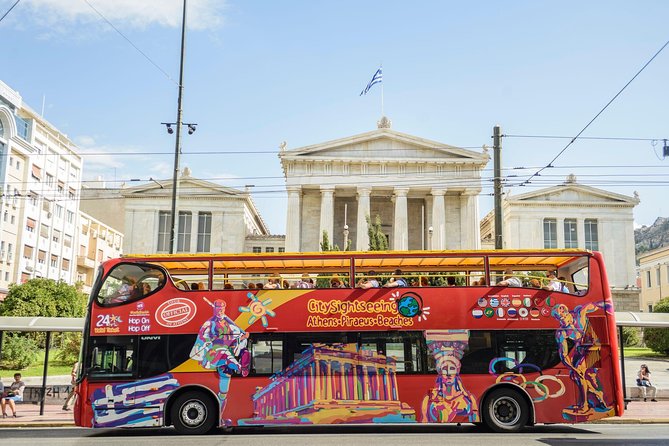


Which city sights does an Athens hop on hop off bus pass?
An Athens hop on hop off bus passes Syntagma Square and the Hellenic Parliament in the Old Royal Palace, where the Evzones guard the Tomb of the Unknown Soldier. The National Garden lies behind the Parliament, and the marble Panathenaic Stadium faces its southern end.
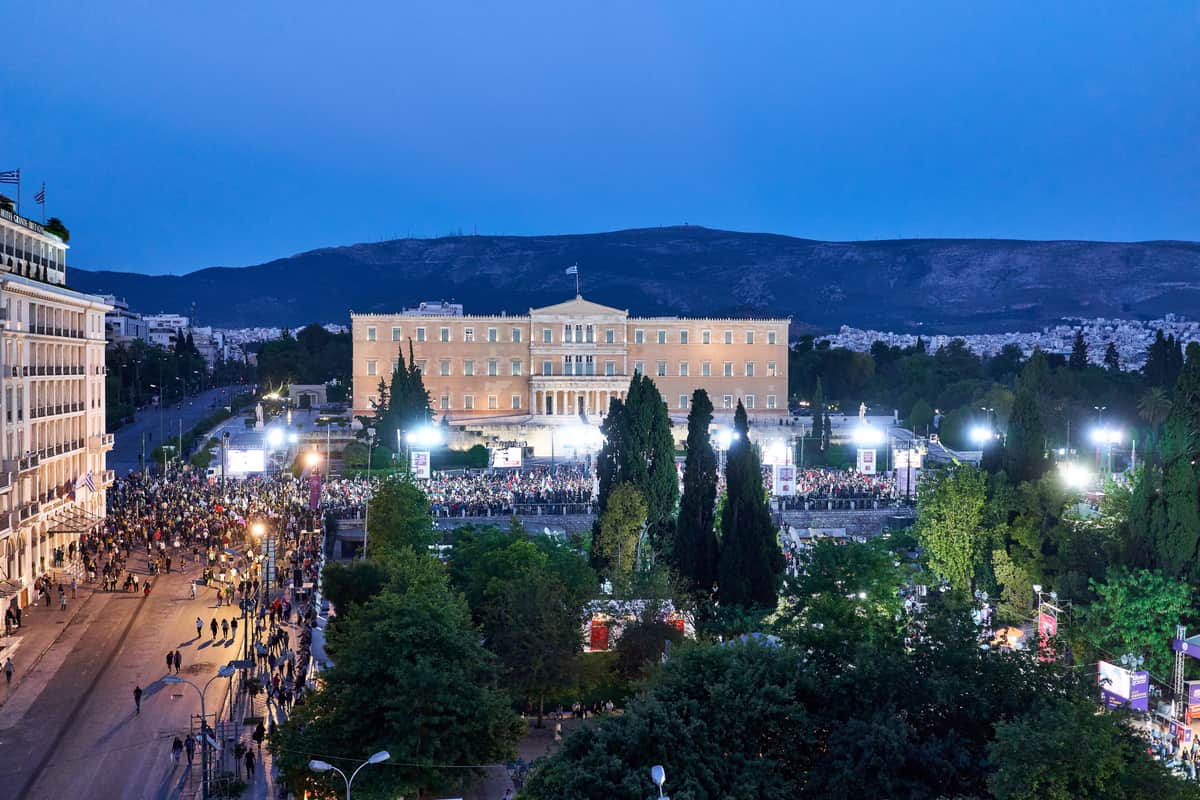
Syntagma Square, or Constitution Square, sits at the centre of Athens. Its name recalls the constitution that Otto, the first King of Greece, had to grant after a popular and military uprising on 3 September 1843. Marble steps climb its higher eastern side to Amalias Avenue, and a mid-19th century fountain stands in the centre. Metro lines 2 and 3 meet in the station beneath the square, and the tram has its northern terminal beside it, so an Athens hop on hop off bus stop here connects with both.
Across Amalias Avenue to the east stands the Hellenic Parliament. Friedrich von Gärtner designed this neoclassical three-floor building, finished in 1843 as a palace for the Greek monarchs, which explains its other name, the Old Palace. Fire damaged it in 1909, a long renovation followed, and the Senate met there on 2 August 1934. The building is closed to the public, even outside sessions. An Athens hop on hop off bus on Amalias Avenue passes its west-facing formal entrance, which looks toward the Tomb of the Unknown Soldier.
The Tomb of the Unknown Soldier lies in the formal forecourt of the Parliament. Work on the monument began in 1929, and it was inaugurated on 25 March 1932. The Evzones of the Presidential Guard guard it round the clock. This ceremonial unit is the last one of Evzones in the Hellenic Army, and every member is a volunteer at least 1.87 metres tall. Sentries switch places every fifteen minutes and stay motionless in between, and a small change of the guard takes place every hour.
Behind the Parliament spreads the National Garden, a public park of 15.5 hectares that bore the name Royal Garden until 1974. Queen Amalia commissioned it in 1838, and the German agronomist Friedrich Schmidt brought in over 500 plant species. Its southern end meets the Zappeion area, across from the Panathenaic Stadium, the world’s only stadium built wholly of marble. Herodes Atticus rebuilt it in marble by 144 AD with 50,000 seats, and in 1896 it held the opening and closing ceremonies of the first modern Olympics.
- Transport hub: Syntagma Square links the metro and the tram with an Athens hop on hop off bus.
- Uniform: The Evzone fustanella uses 30 metres of white cloth, with a reputed 400 pleats.
- Grand Change: On Sunday mornings the whole Guard marches to the Tomb with a military band.
- Marathon finish: The Panathenaic Stadium marks the finishing point of the annual Athens Classic Marathon.
Four of these city sights face Amalias Avenue: Syntagma Square on its west side, and the Parliament, the Tomb of the Unknown Soldier and the National Garden on its east side. The Panathenaic Stadium stands in the central district of Pangrati, east of the garden and the Zappeion. An Athens hop on hop off bus joins this chain of sights to the ancient monuments around the Acropolis.
Which ancient sites lie near an Athens hop on hop off bus stop?
An Athens hop on hop off bus stop near the Acropolis gives access to the Parthenon on the rock, the Acropolis Museum on its southeastern slope, the Temple of Olympian Zeus with Hadrian’s Arch, and the Ancient Agora to the northwest of the hill.
The Acropolis heads the list of ancient sites near an Athens hop on hop off bus route. This ancient citadel sits on a flat-topped rock that rises 150 m above sea level. People lived on the hill as early as the 4th millennium BC, yet the main surviving buildings date from the fifth century BC, when Pericles coordinated the work: the Parthenon, the Propylaea, the Erechtheion and the Temple of Athena Nike. In 1687 a Venetian bombardment hit gunpowder stored in the Parthenon and caused heavy damage.
The Acropolis Museum stands by the southeastern slope of the hill, 280 m from the Parthenon, with its entrance on Dionysiou Areopagitou Street beside the Akropoli metro station. Bernard Tschumi designed the building with Michael Photiadis, and it opened on 20 June 2009. Inside, more than 4,250 objects fill 14,000 square metres, and glass floors reveal the excavations below. An Athens hop on hop off bus stop near the rock serves the museum and the citadel together.
The Temple of Olympian Zeus, or Olympieion, lies about 500 m southeast of the Acropolis and about 700 m south of Syntagma Square. Work began in the 6th century BC under the Athenian tyrants, and Emperor Hadrian dedicated the finished temple in 132, around 638 years after the start. Of its 104 colossal columns, 15 still stand and a sixteenth lies where a storm felled it in 1852. Close by, the Arch of Hadrian, 18 m high and built of Pentelic marble, rises above Amalias Avenue.
The Ancient Agora of Athens lies northwest of the Acropolis. The Areopagus hill bounds it on the south and the Agoraios Kolonos, or Market Hill, on the west. The Stoa of Attalos, a 2nd-century BC hall lined with shops, was rebuilt in the 1950s and now houses the Museum of the Ancient Agora, whose exhibits relate to Athenian democracy. The Temple of Hephaestus stands on the west side, and the American School of Classical Studies at Athens began excavations here in 1931.
- Propylaea: Visitors from an Athens hop on hop off bus enter the Acropolis through this gate.
- Erechtheion: One porch of this Ionic temple rests on huge female figures, the caryatids.
- Arch inscriptions: One arch inscription names Athens the city of Theseus, the other the city of Hadrian.
- Parthenon hall: The top hall of the Acropolis Museum shows the Parthenon marbles facing outwards, as on the temple.
These sites lie close together. The Acropolis Museum sits 280 m from the Parthenon, Hadrian’s Arch stands 325 m southeast of the rock, and the Olympieion lies about 500 m southeast of it, while the Ancient Agora lies to its northwest. An Athens hop on hop off bus stop near the Acropolis therefore opens a walk from classical Athens to the Roman works of Hadrian.
Does an Athens hop on hop off bus reach Piraeus?
An Athens hop on hop off day and a trip to Piraeus share one map, because the port city lies within the Athens urban area. Three places anchor a visit there: the central harbour, the small harbour of Mikrolimano and the Archaeological Museum of Piraeus.
The Port of Piraeus is the chief sea port of Athens and the largest port in Greece, on the Saronic Gulf. Athens has used it as its harbour since ancient times. Until the 3rd millennium BC the site was a rocky island, joined to the mainland by low land that flooded for much of the year. Silt later closed that gap and shaped a main port, Cantharus, and two smaller harbours, Zea and Munichia.
Piraeus is the largest passenger port in Europe, with a total quay length of 2.8 km, and its passenger traffic reached 15.5 million in 2017. Ferries leave the harbour for the Saronic islands, the Cyclades, Crete, the North Aegean islands and the Dodecanese. Cruise passengers who arrive here for an Athens hop on hop off day come ashore at one of three cruise terminals, named A, B and C. Terminal A, the main one, lies within walking distance of central Piraeus.
Mikrolimano, also known as Tourkolimano, is the smallest of the three harbours of Piraeus and carries the ancient name Munichia. With Zea, or Pasalimani, it serves recreational and fishing craft, and both small harbours work as marinas. Tavernas and restaurants spread along the coasts of Mikrolimano and Piraiki, with seafood as their speciality. An Athens hop on hop off visitor looking for a meal by the water finds it here. The name Munichia also belongs to a steep hill of 86 metres in Piraeus, known today as Kastella.
The Archaeological Museum of Piraeus holds mainly sculpture from the city and the Attic coast, spanning the Bronze Age to Roman times. Its two-storey building opened in 1981 beside the ancient theatre of Zea. Four bronze statues, found on 18 July 1959 near the Tinaneios Gardens, largely led to the creation of the modern museum: an Apollo kouros, a large Artemis, a smaller Artemis and a larger-than-life Athena. For an Athens hop on hop off visitor, the museum lies a 5-minute walk from the cruise reception area.
- Metro link: Piraeus metro station, next to the port, links Line 1 and Line 3.
- Cruise terminals: Terminal B, built in 2013, handles mega cruise ships and 1,500 passengers an hour.
- Kastella: The hill holds the Veakeio Theater, known for summer performances, and a church of the Prophet Elijah.
- Municipal Theater: Built in 1885, this neo-classical building stands across from the Neo-Byzantine Piraeus Cathedral.
People have lived in Piraeus since at least the 26th century BC, and remains of ancient ship sheds can still be seen at Zea, Munichia and the Kantharos navy yard. Visitors who add the port city to an Athens hop on hop off trip find ferries, cruise terminals, a marina lined with seafood tavernas and a museum with four ancient bronze statues.
Does an Athens hop on hop off bus reach the coast?
An Athens hop on hop off visit to the centre leaves the coast within reach: Palaio Faliro lies 6 km southwest of the city centre, at the northwestern end of the Athens Riviera, and the Stavros Niarchos Foundation Cultural Center stands in neighbouring Kallithea.
The Athens Riviera is the coastal strip of the southern suburbs, running from Piraeus to Sounio and Lavrio. The Greek National Tourism Organisation lists its main areas as the Bay of Zea, Aenaon Park, Elliniko, Glyfada, Voula, Vouliagmeni, Lagonisi, Varkiza, Anavyssos and Sounio. In 1954 the newspaper Kathimerini argued that Glyfada and Voula had the potential to outdo the French Riviera in popularity. A development plan followed in 1957, starting with the creation of Asteria in Glyfada.
The Riviera also holds ancient remains. Glyfada was once the deme of Aixone, and in Vouliagmeni the ruins of the Temple of Apollo Zoster have been excavated. Finds of early settlement along this coast include Neolithic and Bronze Age foundations and an outpost of the 5th century BC. For an Athens hop on hop off rider interested in classical temples, the Temple of Poseidon at Sounion, built during 444–440 BC, stands almost 60 metres above the sea.
Palaio Faliro is a town and municipality on the east coast of Phalerum Bay. Before the 5th century BC, Phaleron served as the port of Athens, until Themistocles made Piraeus the main port. Works for the 2004 Summer Olympics reshaped this shore, which now has a seaside promenade, sports venues, a marina and the Naval Tradition Park. An Athens hop on hop off rider who wants sea air finds it at the Flisvos Public Park, next to the beach and the Marina of Flisvos.
The Stavros Niarchos Foundation Cultural Center occupies the site of the former horse racing track. Architect Renzo Piano shaped it as an artificial hill, with the roofs of the National Library of Greece and the Greek National Opera rising along its slope and a canopy on thin steel columns at the top. Completed in 2016, it was donated to the Greek state in 2017. An Athens hop on hop off visitor who reaches it also finds the Stavros Niarchos Park, 210,000 square metres in size.
- Warships: The Naval Tradition Park displays the warships Georgios Averof and Velos and a replica of the trireme Olympias.
- Planetarium: The Evgenidio Foundation, known as the Athenian Planetarium, is a landmark of Palaio Faliro.
- Opera stages: The Greek National Opera has a 1,400-seat main auditorium and a 400-seat black box theatre.
- Aenaon Park: The Faliro Delta, on the waterfront side of the cultural center, is becoming a park named Aenaon.
Visitors who combine an Athens hop on hop off ticket with a day on the coast add the Saronic Gulf to the city’s monuments. Change continues along this shore: work on the Ellinikon Metropolitan Park began in July 2020 on the site of the former Athens airport at Elliniko. Tram lines T6 and T7 link central Athens and Piraeus with the coast.
Which museums sit near an Athens hop on hop off bus route?
An Athens hop on hop off day in the centre can take in three collections: the National Archaeological Museum on Patission Street, the Benaki Museum opposite the National Garden, and the Museum of Cycladic Art, with its Stathatos Mansion on Vassilissis Sofias Avenue.
The National Archaeological Museum holds artifacts from sites across Greece, from prehistory to late antiquity, and its collection of Greek antiquities is described as the richest in the world. It stands in the Exarcheia area of central Athens, with its entrance on Patission Street beside the historical building of the National Technical University of Athens. Construction began in 1866 and ended in 1889. The museum first bore the name Central Museum and took its present name in 1881.
The prehistoric collection shows marble Cycladic figurines from Delos and Keros, including the Lutist, and Heinrich Schliemann’s finds from Grave Circles A and B at Mycenae, among them the golden funerary mask wrongly named the mask of Agamemnon. Two golden cups from Vafeio show the capture of a bull. The Egyptian collection counts more than 6,000 artefacts, with 1,100 on display. An Athens hop on hop off visitor can also see finds from the Antikythera wreck and the Epigraphical Museum in the south wing.
Antonis Benakis set up and funded the Benaki Museum in 1930 in memory of his father, Emmanuel Benakis, and it occupies the Benakis family mansion. It holds over 100,000 artifacts and covers Greek art from prehistoric to modern times. Since its re-opening in 2000, the main building has focused on Greek culture, while satellite museums hold other collections. An Athens hop on hop off visitor finds the main building opposite the National Garden, on Queen Sofias Avenue.
The Museum of Cycladic Art was founded in 1986 to house the collection of Nikolaos and Dolly Goulandris, who from the early 1960s collected Greek antiquities with a special interest in prehistoric art from the Cyclades. Its main building, by the Greek architect Ioannis Vikelas, went up in the centre of Athens in 1985, and in 1991 the museum added the neo-classical Stathatos Mansion. The permanent collection includes over 3,000 items, and temporary shows in the mansion have featured El Greco, Picasso and Ai Weiwei.
- Metro access: The nearest metro stop, Victoria on Line 1, sits a 5-minute walk from the National Archaeological Museum.
- Wheelchair access: The National Archaeological Museum offers full wheelchair access, which helps Athens hop on hop off riders with limited mobility.
- Cycladic collection: The New York Times ranked the Goulandris holdings among the world’s leading private collections of Cycladic antiquities.
- Benaki branches: Satellite sites include the Toy Museum in the seaside Kouloura Mansion in Palaio Phaliro.
The three museums cover Greek art from the Neolithic era to modern times. Visitors who pair an Athens hop on hop off ticket with museum visits can start with prehistory at the National Archaeological Museum, move to Cycladic art at the Goulandris collection, and end at the Benaki Museum, which follows Greek culture across the span of the country’s history.
How do travelers use an Athens hop on hop off ticket?
An Athens hop on hop off ticket works best with a plan made before the first boarding. Travelers pick the stops that matter, ride between distant points, walk the short gaps through Plaka and Monastiraki, and buy entry tickets for the main archaeological sites ahead of the ride.
Planning starts before the first boarding. Travelers rank the sights they want, mark the ones that need a long visit, and note the ones that suit a quick photo stop. A first loop without stepping off shows the order of the stops and the gaps between them, which makes the later choices easier. After that, the Athens hop on hop off ticket becomes plain transport between the chosen places. A short written list beats a long wish list, because every stop taken costs time spent waiting for the next bus.
Plaka, the old historical quarter of Athens, covers the northern and eastern slopes of the Acropolis and mixes a maze of streets with neoclassical architecture. It sits between Syntagma and Monastiraki square. Adrianou Street, the largest street in Plaka, splits it into two levels: Ano Plaka, under the Acropolis, and Kato Plaka, between Syntagma and Monastiraki. A walk through Kato Plaka joins the two squares on foot, while the bus covers the longer distances on either side. The nickname Neighborhood of the Gods comes from its closeness to the Acropolis.
Monastiraki, a name meaning little monastery, is the flea market district of the old town and ranks among the main shopping areas of Athens. The area holds clothing boutiques, souvenir shops and specialty stores, and its main streets are Pandrossou Street and Adrianou Street. The square takes its name from the Church of the Pantanassa, which stands inside it. Monastiraki Metro Station, on the square, serves Line 1 and Line 3, so an Athens hop on hop off day can end there with a metro trip back to the hotel.
Site visits work best as fixed points in the day. Travelers who buy tickets for the Acropolis before the ride can build the bus plan around that visit, not the other way round. The same habit suits the other main ancient sites of the centre. A pedestrian street also links a chain of them on foot: Dionysiou Areopagitou Street runs from the Temple of Olympian Zeus, under the southern slopes of the Acropolis near Plaka, to just beyond the Temple of Hephaestus in Thiseio, away from the busy city centre.
- Stop list: Write down the chosen stops in order, with a long visit or a photo stop noted beside each one.
- Walking link: Cover the stretch between Syntagma and Monastiraki on foot through the streets of Kato Plaka.
- Site entry: Buy entry tickets for the main archaeological sites before the day of the ride.
- Metro backup: Use Monastiraki station, on Line 1 and Line 3 of the Athens Metro, for a quick trip back.
- Ticket check: Read what the bus ticket covers before purchase, and keep it at hand for each new boarding.
An Athens hop on hop off day runs smoothly when each part has a clear job. The bus covers the long gaps between districts, walking covers Plaka and Monastiraki, and the site tickets set the order of the visits. Travelers who sketch this frame the evening before spend their hours at the sights rather than waiting at stops, and they keep the metro at Monastiraki as a fallback for tired legs once the walking part of the day is over.
When is the best time for an Athens hop on hop off ride?
An Athens hop on hop off ride suits spring and autumn days and the cooler hours of summer. Summers in Athens are hot, with downtown highs averaging 34.3 °C in July and August, while January averages a daytime high of 13.3 °C and snowfall is uncommon.
The Athens climate is hot-summer Mediterranean. In summer the city can run warmer than Seoul, Melbourne, Buenos Aires and Cape Town, cities at similar or lower latitudes. Daily lows stay high downtown, at 24.2 °C in July and 24.4 °C in August. Athens has been called the hottest city in mainland Europe, and it was the first European city to appoint a chief heat officer for severe heat waves. An Athens hop on hop off ride in these months fits the early morning or late afternoon.
Winter downtown stays mild. January averages a high of 13.3 °C and a low of 7.1 °C, and December a high of 14.4 °C and a low of 8.7 °C. Snowfall is uncommon, and fog is rare in the centre. Rain is the main winter factor: December has the highest monthly total in the downtown table at 76.3 mm, ahead of November at 70.8 mm. A waterproof layer and a look at the morning forecast keep a winter ride on the open deck practical.
Spring and autumn sit between the extremes. April averages a high of 21.1 °C and October 24.4 °C, with lows of 12.3 °C and 16.2 °C. Rainfall is lower, at 27.6 mm in April and 38.6 mm in October. The Athens basin is dry for a Mediterranean climate, because the Pindus range and the Dirfys and Parnitha mountains cast a rain shadow over it. Advection fog can form in spring, mainly along the coastline, and it can soften sea views from the top deck.
The open top deck gives the widest views and the strongest sun. The downtown climate table lists a UV index of 10 in July and 9 in August, against 2 in January and December. A hat, sunscreen and water belong on every summer ride, and a seat downstairs makes sense around midday. Air pollution remains an issue on the hottest summer days. In winter, the top deck stays usable on dry days with a jacket against the wind, and an Athens hop on hop off loop runs in cooler air.
- Summer: Ride in the early morning or late afternoon, since July and August highs average 34.3 °C downtown.
- Winter: Wear a warm layer on the top deck, as January averages a high of 13.3 °C and a low of 7.1 °C.
- Rain: Check the forecast from November to January, the three wettest months in the downtown records.
- Sun: Pack a hat, sunscreen and water, since the July UV index in the climate table reaches 10.
- Spring and autumn: Choose April or October for average highs of 21.1 °C and 24.4 °C and lower rainfall.
The best Athens hop on hop off ride matches the hour to the season. Spring and autumn give the widest window, summer favors an early start, and winter calls for a jacket and a glance at the rain forecast. The station near the city centre run by the National Observatory of Athens records a mean annual temperature of 19.2 °C, so the open deck stays an option across the whole year, with rainy days as the main exception.
What do travelers ask about an Athens hop on hop off bus?
An Athens hop on hop off bus prompts four practical questions: whether it suits a first day, whether it works for children, whether it can replace the metro, and whether it helps cruise passengers. Each answer below draws on the city layout, parks, main metro lines and ports.
Does an Athens hop on hop off bus suit a first day in Athens?
Yes, as a way to learn the layout. The Athens urban area spreads over 50 kilometres, from Agios Stefanos in the north to Varkiza in the south, and the city is built around a large number of hills. A first Athens hop on hop off loop shows how the central districts connect, and the longer visits fill the following days.
Does an Athens hop on hop off bus suit children?
It suits families who plan short legs and regular breaks. Children see the streets from the upper deck, and each stop gives a chance to stretch. Parks help with pauses: the Pedion tou Areos, or Field of Mars, covers 27.7 hectares near the National Archaeological Museum. In summer, hats and water matter for young riders on the open deck.
Can an Athens hop on hop off bus replace the metro?
Not fully. The Athens Metro runs three lines, Line 1 (Green), Line 2 (Red) and Line 3 (Blue), and Line 3 continues to Athens International Airport. A number of its stations display archaeological remains found during construction. An Athens hop on hop off bus suits sightseeing at street level, while the metro covers fast trips across the wider city.
Is an Athens hop on hop off bus useful from a cruise port?
It can be, with a firm eye on the clock. Besides Piraeus, Rafina and Lavrio act as alternative ports of Athens and also serve arriving cruise ships. From Piraeus, Metro Line 1 runs to Kifissia and meets Line 3 at Monastiraki. Cruise passengers check the boarding deadline first, then plan the ride with a wide margin before the ship sails.
Featured photo: Chrisfl (retouched by AM), CC BY-SA 2.5, via Wikimedia Commons.