An Ancient Corinth tour walks the ruins of the city that once held the isthmus between two seas, from the Archaic Temple of Apollo and the site museum to the Bema where St Paul stood before the Roman governor, the Peirene fountain, the Lechaion Road and the forum of the Roman colony. This post covers what an Ancient Corinth tour includes, the history of the city, the temple, the museum, the Bema, the fountain, the Roman city and the best season. It is one of the history tours in Greece on Greece VIP.
Each section ends with an Ancient Corinth tour that can be booked online.
What does an Ancient Corinth tour include?
An Ancient Corinth tour covers the excavated city of Corinth, which stands on the Isthmus of Corinth below the rock of Acrocorinth. A tour leader walks the ruins: the Temple of Apollo, the Roman city, the museum and the places linked to Paul the Apostle.
The ruins stand on two large terraces. Arable plains and natural springs lie at the southern edge, and seasonal rivers from the Ayios Vasilios valley and Mount Ziria add fresh water. Neolithic pottery suggests that people lived on the site from at least 6500 BC. An Ancient Corinth tour starts from this setting, which suited human habitation, and then moves to the monuments.
The modern village of Ancient Corinth lies directly over the ancient city, so digging has concentrated on the ground around the Temple of Apollo. The Corinth Excavations of the American School of Classical Studies at Athens started in 1896. Before the Second World War, Bert Hodge Hill, Carl Blegen, William Dinsmoor Sr., Oscar Broneer and Rhys Carpenter uncovered much of the site.
Digging has also reached beyond the village centre, to the Potters’ Quarter, the Sanctuary of Asklepios and the Kenchreian Gate Basilica. Current investigations focus on the Panayia Field, which lies to the southeast of the Forum. A Corinth Canal tour is built around the waterway cut across the isthmus, while an Ancient Corinth tour is built around this excavated city.
- Acrocorinth: The summit held a temple to Aphrodite, later a church and then a mosque.
- Demeter and Kore: Their sanctuary lies on the slopes of Acrocorinth.
- Pausanias: The second book of his Description of Greece is devoted to Corinth.
Remains at the site run from the Early Neolithic period, 6500 to 5750 BC, to early modern times. An Ancient Corinth tour therefore crosses Greek, Roman, Byzantine and later layers in one visit. Acrocorinth adds a medieval castle held by the Franks, the Venetians and the Ottoman Turks, so an Ancient Corinth tour that includes the summit meets those later centuries.


What history does an Ancient Corinth tour tell?
An Ancient Corinth tour tells the history of a Greek trading city between two seas, its destruction by Rome in 146 BC, its refounding as a Roman colony in 44 BC and its slow decline through earthquakes, invasions and conquest.
Corinth had two harbours. Lechaeum on the Corinthian Gulf was the principal port, with trade to Italy and Sicily, where Corinth founded colonies such as Corcyra and Syracuse in 733 BC. Cenchreae on the Saronic Gulf served the Eastern Mediterranean. Until the mid-6th century BC the city also exported black-figure pottery. An Ancient Corinth tour places this trade at the centre of the Greek story.
In 146 BC Rome declared war on the Achaean League, and Lucius Mummius led 23,000 infantry and 3,500 cavalry against 14,000 infantry and 600 cavalry at Corinth, the league’s capital. The Achaeans broke within hours. The Romans waited three days, then entered Corinth, killed the men, enslaved the women and children, and burned the city. An Ancient Corinth tour treats 146 BC as the dividing line between the Greek and Roman city.
The city did not recover for over a century. Julius Caesar re-established it as Colonia Laus Iulia Corinthiensis, the colony of Corinth in honour of Julius, in 44 BC, shortly before his assassination. An amphitheatre was built at that time. An Ancient Corinth tour therefore reads the ruins in two layers, the Greek city and the Roman colony built over it.
- Earthquakes: Quakes in AD 365 and AD 375 largely destroyed the city.
- Walls: Under Justinian I a stone wall named the Hexamilion, about 10 km long, crossed the isthmus.
- Silk: The city peaked in the 11th and 12th centuries, with a flourishing silk industry.
The Normans plundered Corinth in 1147. The Ottomans conquered it in 1458, the Venetians captured it in 1687 and the Ottomans retook it in 1715. The city was liberated in 1832. In 1858 an earthquake destroyed the village around the ruins, and New Corinth was founded 3 km northeast. An Ancient Corinth tour ends at the modern village that overlies the ancient city.
What does an Ancient Corinth tour show at the Temple of Apollo?
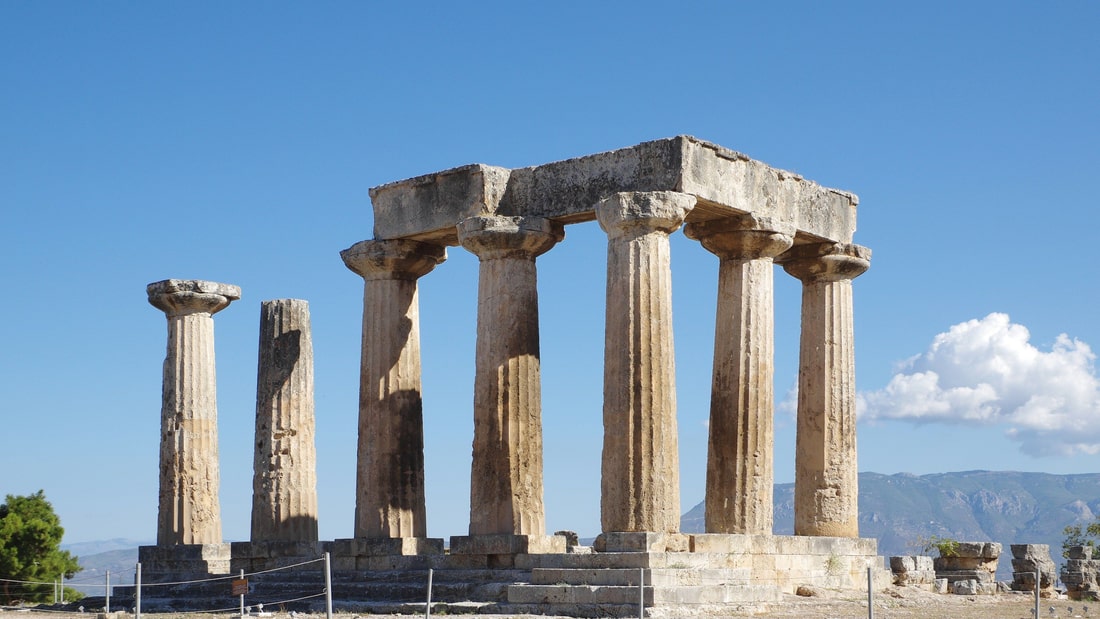
An Ancient Corinth tour shows the Temple of Apollo, a Doric temple of the mid-6th century BC that dominates the excavated site. The temple rises from a stepped base and carries an outer ring of Doric columns, the simplest of the Greek orders.
Construction of the Temple of Apollo dates to 550 BC, in the early third quarter of the 6th century BC. That places the building in the Archaic period, which ran from about 800 BC to 480 BC. The temple rises from a stylobate, the stepped base of a Greek temple. At the temple, an Ancient Corinth tour stands before a building of the Archaic period.
The temple belongs to the Doric order, the earliest and simplest of the Greek orders, with simple circular capitals. Doric columns have 18 to 20 flutings and stand directly on the stylobate, while Ionic and Corinthian columns have bases. A Doric capital consists of a circular echinus and a square abacus. On an Ancient Corinth tour, these details identify the order at a glance.
The Corinthians were considered the inventors of the Doric order. Apollo links the temple to Delphi, where he was venerated as the god of the oracle. In 657 BC the polemarch Cypselus obtained an oracle from Delphi that he read as a call to rule Corinth. The temple’s style is similar to the Temple of the Alcmeonidae at Delphi. An Ancient Corinth tour follows that link from temple to oracle.
- Stylobate: The base measures 21.36 by 53.30 metres.
- Outer columns: The pteron columns numbered 6 by 15.
- Interior: A double row of inner columns stood inside the temple.
The Doric order evoked the rigorous simplicity of the Spartans, while the Corinthians developed the Corinthian order as a third main style beside the Doric and the Ionic. The Corinthian order was more complicated than the other two and showed the wealth of the city. An Ancient Corinth tour therefore meets the simplest order at the temple.
What does an Ancient Corinth tour show in the museum?
An Ancient Corinth tour shows the Archaeological Museum of Ancient Corinth, which stands inside the site and holds the finds from its excavations. Its galleries cover prehistoric vases, Classical Corinth, Roman mosaics and the clay offerings from the sanctuary of Asklepios.
The museum was built in 1931 and 1932 to display the recent excavations, to a design by the architect Stuart Thompson. On an Ancient Corinth tour, the prehistoric gallery shows vases and cult figurines from Korakou Hill and the site of Zygouries. The classical gallery covers the Geometric to Hellenistic city and holds the twin kouroi, confiscated from traffickers of antiquities at Klenia.
An Ancient Corinth tour meets finds from the Potters’ Quarter of Corinth in the museum. The black-figure method was a Corinthian invention of the 7th century BC and spread to Sparta, Boeotia, Euboea, the east Greek islands and Athens. Early Corinthian black-figure gives animal motifs the greatest prominence on the vase. As painters gained confidence with the human figure, the animal frieze shrank beside the human scene.
An Ancient Corinth tour reaches the Roman gallery, which shows sculptures and mosaics from Roman villas and glazed plates from the Byzantine and Frankish periods. One mosaic floor carries the head of Dionysos in a frame of ornaments and dates to around the 2nd century AD. A section named Return to the homeland shows 274 repatriated objects, stolen in 1990 and traced to the USA a decade later.
- Asklepieion: Clay offerings shaped as human body parts come from the sanctuary of Asklepios.
- Atrium: Statues and Greek and Latin inscriptions show the Jewish community of the Roman city.
- Krater: A Mycenaean krater with a chariot scene comes from the Julian Basilica.
The word Corinthian also names an architectural order, the last of the three principal classical orders. Vitruvius credits the sculptor Callimachus, who drew acanthus leaves growing around a votive basket on the grave of a Corinthian girl. An Ancient Corinth tour in the museum links the city to a column style and a vase style.
Why does an Ancient Corinth tour stop at the Bema?
An Ancient Corinth tour stops at the Bema because Acts places the trial of Paul before Gallio in Corinth. A bema is a raised platform that served as a tribunal in Athens, and the Bema of Corinth later became a church of the Apostle Paul.
On an Ancient Corinth tour, the story begins with Paul, who reached Corinth from Athens during his second journey and founded the Church of Corinth. There he met Priscilla and Aquila, who worked beside him and attended the synagogue. When Jewish listeners refused his preaching, Paul resolved to go to the Gentiles. He stayed eighteen months before he sailed from Cenchreae to Ephesus.
According to Acts 18, the Jews of Corinth brought Paul before Gallio, then proconsul of Achaea, and accused him of violating Mosaic Law. Sosthenes, a synagogue ruler, presumably led the action. Gallio was indifferent towards religious disputes between Jews and Christians, so he refused to judge and had Paul and his accusers removed from the court. At the Bema, an Ancient Corinth tour retells this scene.
Gallio was a Roman senator and the brother of the writer Seneca. Claudius calls him “my friend and proconsul” in the Delphi Inscription, around 52. The proconsulship of Gallio is the principal fixed point for dating Paul’s time in Corinth. His tenure falls between AD 51 and 52, so the trial is the date known with the greatest accuracy in the life of Paul.
- First letter: 1 Corinthians addresses divisions, immorality, marriage, food sacrificed to idols, worship and the resurrection.
- Authorship: Pauline authorship of 1 Corinthians is undisputed, and Sosthenes is named as co-sender.
- Informants: Apollos, the household of Chloe and Stephanas informed Paul of the conflicts.
Only two canonical epistles from Paul are addressed to Corinth, though he acknowledges two other letters: a Warning Letter before the first and a Severe Letter between the two canonical ones. An Ancient Corinth tour that stops at the Bema joins a trial recorded in Acts to the letters Paul wrote to the church he founded here.
What does an Ancient Corinth tour show at the Peirene fountain?
An Ancient Corinth tour shows the Peirene fountain, where Bellerophon found the winged horse Pegasus drinking and tamed him. The route continues to the fountain of Glauke and to the Lechaion Road, which linked the city to its main port.
Peirene was a woman in Greek myth whose son Cenchrias was unintentionally killed by Artemis. Her grief was so deep that she became a spring made of tears. The fountain was sacred to the Muses, and poets travelled there to drink and receive inspiration. The Corinthians offered honey-cakes to Pirene at a small sanctuary beside it in the dry months of early summer.
The traveller Pausanias described the approach in the 2nd century AD. Leaving the market-place along the road to Lechaion, he reached a gateway with two gilded chariots, carrying Phaethon and Helius. A bronze Heracles stood beyond it, and then came the entrance to the water of Peirene, a spring ornamented with white marble. An Ancient Corinth tour at the fountain stands near the start of that road.
Another spring on an Ancient Corinth tour is the fountain of Glauke. Glauke was a Corinthian princess, the daughter of King Creon, whom Latin authors call Creusa. She married Jason, and Medea killed her, either by sending a peplos steeped in flammable poison or by setting fire to the royal palace. In Corinthian tradition, Glauke threw herself into a well to wash off the poison.
- Road: A road 2.3 kilometres long ran between the Long Walls from Corinth to Lechaion.
- Battlefield: Sparta and Athens fought in the space between the walls in 391 BC.
- Fleet: In 334 BC Corinth gave 160 triremes to the fleet of Alexander the Great, and Athens gave 20.
Lechaion was one of the earliest active ports in Europe, in use as a commercial port as early as 1381 BC. Cenchreae on the Saronic Gulf, the second port, served trade with the Eastern Mediterranean. An Ancient Corinth tour that follows the Lechaion Road reads the city as a trading centre with two harbours.
What does an Ancient Corinth tour show of the Roman city?
An Ancient Corinth tour shows the Roman city that Julius Caesar refounded in 44 BC as Colonia Laus Iulia Corinthiensis: the forum on the old Greek agora, the South Stoa, the theatre and the odeon, and the basilica, temple and amphitheatre of the Roman colony.
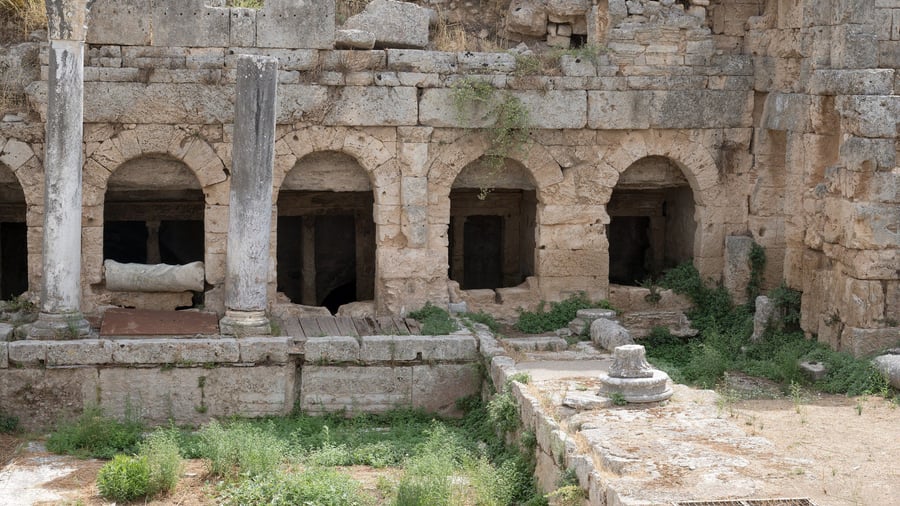
Rome destroyed Corinth in 146 BC, after the Battle of Corinth, and the site stayed largely deserted until Caesar refounded it. The new colony began with 16,000 colonists and a Roman grid plan, and Latin became the language of its administration. The Greek agora was transformed into a Roman forum, the marketplace. An Ancient Corinth tour reads this forum area as the core of the Roman city.
The Roman builders kept the South Stoa, a Greek structure, and repurposed it to fit the new civic layout. The excavation record names the building together with its Roman successors, in the volume The South Stoa and Its Roman Successors. The list of site features in the museum article also names surrounding shops, and current excavations focus on the Panayia Field, southeast of the Forum.
An odeon was a roofed building for singing, musical shows and poetry competitions, smaller than a theatre, with the roof there for acoustics. Corinth had an odeon that was a gift of Herodes Atticus, the benefactor behind the odeon of Athens, built in about 160 AD. The excavation series has a volume on The Odeum, published in 1932, and one on The Theatre, published in 1952.
- Julian Basilica: A building of the Roman colony, suggested as a site of imperial cult activity.
- Temple E: The second building proposed for imperial cult activity.
- Amphitheatre: A Roman-style building, uncommon in Greek cities.
- Anaploga villas: Elite estates with elaborate mosaics.
The Roman colony had a large mixed population of Romans, Greeks and Jews, and it became the capital of the province of Achaea. Corinth is the main entry point to the Peloponnese peninsula, so an Ancient Corinth tour pairs with a Mycenae and Epidaurus day trip to the other sites of the Peloponnese.
When is the best season for an Ancient Corinth tour?
An Ancient Corinth tour fits spring and autumn best, the months that separate the hottest weather of July from the cold of January. The excavated ruins lie outdoors, so midsummer heat and cool-month rain shape a visit more than any indoor stop does.
The Hellenic National Meteorological Service operates the weather station of Velo, the nearest to Corinth. Its records give the city a hot-summer Mediterranean climate, coded Csa in the Köppen classification. In this climate the summer is hot and dry, while the winter is cool and rainy. Corinth is the capital of the Corinthia regional unit, which lies in the north-eastern part of the Peloponnese peninsula.
The ruins of Ancient Corinth stand on two large terraces, and the Temple of Apollo dominates them as a monument visible since antiquity. An Ancient Corinth tour in July meets the hottest weather of the year on this open ground. On 17 July 2007, a forest fire struck the area around Acrocorinth and its castle, the rock that rises directly above the ruins.
The coast of Corinthia has hot summers and mild winters, while the mountainous areas have somewhat colder winters with snowfalls. Kyllini, in the west, is the tallest mountain of the regional unit. The eastern coastlands near the ruins hold pastures and farmland, where olives, grapes, tomatoes and vegetables grow. The coast of the unit gives the milder side of the local climate.
- July: The hottest month, with an average of 28.7 °C.
- January: The coldest month, with an average of 9.1 °C.
- Rainfall: Corinth receives about 463 mm a year.
- Annual average: The mean over the whole year is 18.1 °C.
The ancient calendar followed the same seasons. One event of the Isthmian Games took place in the spring of AD 51, in the years of Roman Corinth. Paul stayed in Corinth in the late winter after writing the second epistle, and he wrote his Epistle to the Romans there. Both events belong to the city that the American School of Classical Studies has uncovered since 1896.
What do travelers ask about an Ancient Corinth tour?
An Ancient Corinth tour draws questions about reaching the site from Athens, adding the Corinth Canal and Acrocorinth, following the footsteps of the apostle Paul, and visiting other sites of Corinthia such as Nemea, Sicyon and the Heraion of Perachora.
Is an Ancient Corinth tour a day trip from Athens?
The A8 toll motorway links Athens with Corinth, and the city joined the Athens Suburban Railway in 2005. Corinthia borders Attica, and Agioi Theodoroi counts as a suburb of Athens. An Ancient Corinth tour from Athens ends at the village of Ancient Corinth, which directly overlies the ancient city.
Can an Ancient Corinth tour include the Corinth Canal?
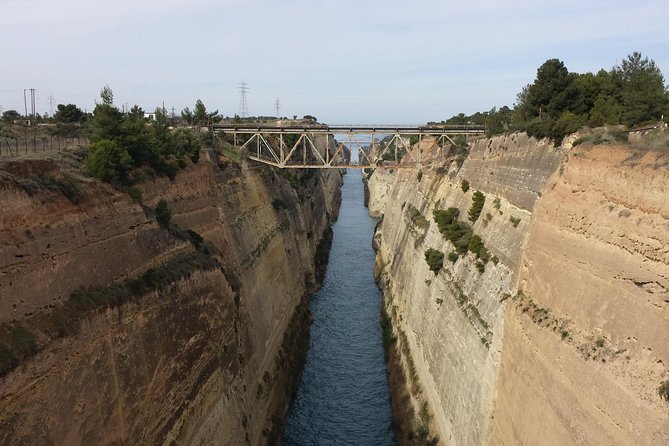
The Corinth Canal lies about 4 kilometres east of the modern city, so an Ancient Corinth tour can add it as a second stop. The canal is 6.4 kilometres long and 21.3 metres wide at its base, and the builders cut it at sea level without locks.
Does an Ancient Corinth tour include Acrocorinth?
Acrocorinth is the monolithic rock that overlooks the ancient city, and people occupied its fortress from archaic times to the early 19th century. Three circuit walls form the defence, and the Upper Peirene spring lies inside them. A temple of Aphrodite crowned the highest peak.
Is an Ancient Corinth tour a biblical tour?
The apostle Paul first visited Corinth in AD 49 or 50, when Gallio was proconsul of Achaia, and he lived there for eighteen months. He wrote the First and Second Epistles to the Corinthians. An Ancient Corinth tour visits the setting of those New Testament texts.
Which other sites of Corinthia can follow an Ancient Corinth tour?
Corinthia holds the archaeological sites of Nemea, Sicyon and the Heraion of Perachora. American excavations have also explored the settlements of Korakou, Kenchreai and Isthmia in the wider area. The thermal springs of Loutraki belong to the same regional unit in the north-eastern Peloponnese.
Featured photo: Berthold Werner, CC BY-SA 3.0, via Wikimedia Commons.