An Athens day trip leaves the capital for the great sites, islands and wine country within a day’s reach, from the oracle of Delphi and the monasteries of Meteora to the Temple of Poseidon at Cape Sounion, the Argolid, Corinth, the Saronic islands, Olympia and Nemea. This post covers what an Athens day trip includes, each of these destinations, how the trips travel and the best season. It is one of the day trips in Greece on Greece VIP.
Each section ends with an Athens day trip that can be booked online.
What does an Athens day trip include?
An Athens day trip leaves the Greek capital for an ancient site, an island or a region and returns to the city the same day. The main destinations are Delphi, Meteora, Cape Sounion, the Argolid, Corinth, the Saronic islands, Olympia and Nemea.
Attica is the historical region that holds the entire Athens metropolitan area. It is a triangular peninsula in the Aegean Sea, and its modern region includes the Saronic Islands. A ferry ride to one of them is an Athens day trip that never leaves Attica.
Cape Sounion ends the Lavrio region at the southeastern edge of Attica, and the Athenians worshipped Athena there. Beyond the Isthmus of Corinth, the Peloponnese holds Ancient Corinth at its north end, Epidaurus, Argos and Nemea in the northeast, and Olympia in the northwest. North of Attica, Delphi belongs to Central Greece and Meteora to Thessaly.
An Athens day trip runs by coach, private car, train or ferry. Intercity buses to the Peloponnese leave from the Kifissos terminal, and buses to Central Greece from the Liosion terminal. The Suburban Railway reaches Kiato, 106 km west of Athens.
- Road: The A1/E75 leaves Athens northward and the A8/E94 leaves westward.
- Rail: Athens is the hub of the national railway system.
- Sea: Rafina and Lavrio serve as alternative ports to Piraeus.
Athens works as a base because the capital holds the largest airport and the largest port in Greece. The Attiki Odos toll motorway, 65 km long, is the largest metropolitan motorway network in the country. Roman tourists already visited Athens, Corinth and Thebes, so an Athens day trip continues an old habit.


Which Athens day trip goes to Delphi?
The Athens day trip to Delphi goes to the oracle of the Pythia on Mount Parnassus in central Greece. UNESCO inscribed the sanctuary of Apollo because its monuments, built by the leading Greek city-states, show a shared Hellenic unity.
In tradition, the three winged sisters of Parnassus, the Thriae, taught Apollo the art of divination while he grazed his cattle there. The Suda names the she-serpent Delphyne as the creature that Apollo killed on the site. An Athens day trip to Delphi therefore enters ground with more than one origin story.
The Delphi day trip from Athens visits a sanctuary that Sulla sacked in 86 BC. After 200 BC two priests of Apollo, appointed for life, ran the site. The Pythia gave answers on one day of each month only, and from the late third century BC a woman older than fifty held the office.
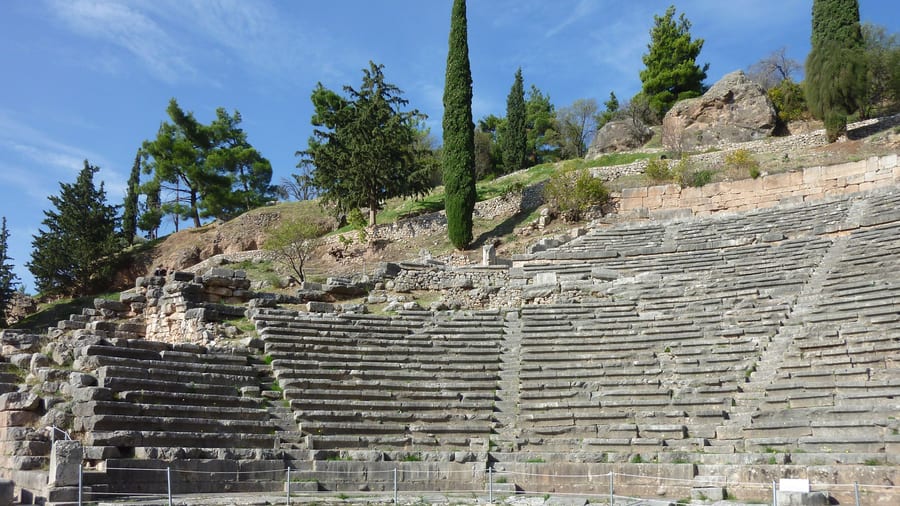
Landslides threatened the stability of the theatre for decades, and it has been restored. It hosted the Delphic Festivals of Sikelianos and Eva Palmer in 1927 and 1930. The stadium dates from the fifth century BC, and Pindar mentioned the hippodrome where Hieron of Syracuse raced chariots.
- Room 13: The bronze Charioteer belonged to a complex with a chariot, horses and possibly a stable boy.
- Room 11: Daochos II, tetrarch of Thessaly, dedicated nine statues.
- Room 12: A statue of Antinous, the favorite of the emperor Hadrian, stands here.
The museum shows its finds in order of date. Its first two rooms hold Mycenaean figurines, including a seated figure on a three-legged chair, and the last room covers the final years of the sanctuary. An Athens day trip to Delphi follows that order from the earliest finds to the end of the oracle.
Which Athens day trip reaches Meteora?
An Athens day trip reaches Meteora, where monasteries crown tall pillars of sandstone and conglomerate in Thessaly, beside the town of Kalambaka and the village of Kastraki. UNESCO added the six surviving monasteries to its World Heritage List for their outstanding architecture and beauty.
Theopetra Cave, 4 km from Kalambaka, records the replacement of Neanderthals by modern humans and the later shift from hunting and gathering to farming. A stone wall across two thirds of its entrance dates to 23,000 years ago. An Athens day trip to Meteora therefore reaches a landscape with prehistoric occupation.
Of the 24 monasteries of the 16th century, six survive. Saint Stephen, a convent run by nuns since 1961, is one of four occupied monasteries open to visitors, with Great Meteoron, Varlaam and Holy Trinity. Saint Nicholas Anapausas and Rousanou are no longer in active use as monasteries.
In 2018 the municipality took the name Meteora, with Kalambaka as its seat. The communities of the municipal unit are named after villages, and Kastraki is one of them. The Church of the Dormition, from the late 11th or early 12th century, is the only medieval monument of the town that survives.
- Holy Trinity: It served as a filming location for a 1981 James Bond film.
- Saint Nicholas Anapausas: The katholikon occupies the second floor.
- Great Meteoron: The hermitage of its first founder is a small building carved in rock.
Athanasios the Meteorite began Great Meteoron with a church dedicated to the Mother of God and later added small cells for monks. His successor, Saint Joasaph, built more cells and a hospital. An Athens day trip to Meteora therefore reaches a community that grew from a single church.
Which Athens day trip visits Cape Sounion?
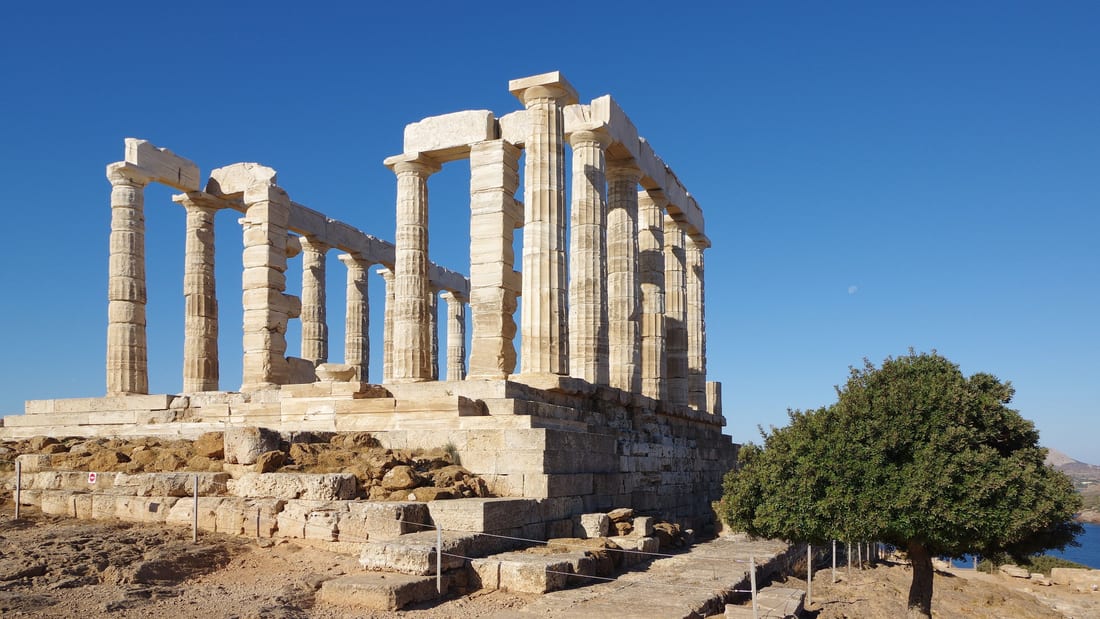
An Athens day trip to Cape Sounion reaches the marble Temple of Poseidon at the southern end of the Attica peninsula. The headland, 69.5 km southeast of the capital, has the Aegean Sea on three sides below the temple.
The coast road follows the Athens Riviera, and Sounion forms its southeastern endpoint. Villas rose across the bay northwest of the cape in the 1960s and 1970s, and Sounion is now a summer home location for Athenians. An Athens day trip follows that shore to Lavreotiki, the East Attica municipality that holds the cape.
Beneath the marble temple lie the remains of an earlier limestone temple, which Wilhelm Dörpfeld uncovered in 1884. Its dimensions were roughly 13.06 by 30.20 metres, and the builders of 444 to 440 BC made the new temple just large enough to cover its stepped base. An Athens day trip therefore stands on older foundations.
One column carries the carved name of Lord Byron on its base. Byron stayed in Athens in 1810 and 1811, with two documented visits to Sounion, but no direct evidence shows that he made the inscription. William Falconer, a Scottish poet, was shipwrecked off the cape in 1750.
- Athena: A second temple stands 300 metres to the northeast.
- Fortress: Athenians walled the site in 413 BC.
- Park: Sounio National Park dates from 1974.
Day visitors from Athens have watched the sun set over the Aegean Sea from the temple ruins since the early 19th century, when modern tourism began. An Athens day trip to the cape ends with the same view. The Venetian name Capo Colonne, the Cape of Columns, dates from the 17th century.
Which Athens day trip visits Mycenae, Epidaurus and Nafplio?
An Athens day trip to Mycenae, Epidaurus and Nafplio crosses the Argolis, a regional unit of the Peloponnese. Mycenae stands roughly 120 kilometres south-west of Athens, Epidaurus lies by the Saronic Gulf, and Nafplio sits on the Argolic Gulf.
An Athens day trip enters Mycenae through the Lion Gate, built as a relieving triangle that supports the weight of the stones. A stepped ramp leads past Grave Circle A to the palace. Near 1200 BC builders added a secret passage of 99 steps down to a rock-cut cistern.
The theatre at Epidaurus began with 34 rows, and Roman builders added another 21. Tradition holds that unamplified words from the stage reached all 14,000 spectators, yet in-situ measurements moderate that claim. Sophocles’s Electra opened the modern performances there in 1938, and Maria Callas sang Norma on the same stage in 1960.
Palamidi crowns the hill north of the old town and was the last major construction of the Venetian empire overseas. Kapodistrias made Nafplio the capital in 1829, and King Otto decided in 1834 to move it to Athens. An Athens day trip leaves the present capital for the city that held that role first.
- Mycenae: The citadel rises 274 metres above sea level.
- Epidaurus: The sanctuary had a guest house with 160 rooms.
- Nafplio: Bourtzi occupies the middle of the harbour.
Two of the three stops hold UNESCO listings. The Mycenae and Epidaurus day trip covers Mycenae, listed with Tiryns in 1999 for its outstanding architecture, and the sanctuary and theatre of Epidaurus, listed in 1988. An Athens day trip to these places stays inside the regional unit of Argolis.
Which Athens day trip visits Ancient Corinth and the canal?
An Athens day trip to Ancient Corinth and the canal reaches the Isthmus of Corinth, the strip of land that links the Peloponnese with mainland Greece. A cutting finished in 1893 splits the isthmus at sea level, and Ancient Corinth lies below Acrocorinth.
On an Athens day trip, the canal appears as a lock-free channel 6,343 metres long and 8 metres deep. A motorway, a road and a railway line cross it about 45 metres above the water. In October 2019 a 195-metre cruise ship set the record as the longest ship to pass through.
In 400 BC Ancient Corinth held 90,000 people, and in 146 BC the Romans demolished it. Julius Caesar refounded the city in 44 BC. The Temple of Apollo, built in 550 BC, has stood in view since antiquity, and excavations began around it in 1896. An Athens day trip walks this rebuilt Roman colony.
Acrocorinth, the rock above the ancient city, was occupied continuously from archaic times into the early 19th century. Three circuit walls and a secure water supply let it serve as the last defensive line in southern Greece. A temple of Aphrodite stood on the highest peak, which later held a church and then a mosque.
- Paul: He came to Corinth in AD 49 or 50.
- Gallio: The proconsul presided over his trial.
- Bema: The monument later became the Church of Apostle Paul.
An Athens day trip meets the canal and the ruins on one land bridge. In the 7th century BC the tyrant Periander chose the Diolkos, a stone carriageway for towing ships between the two seas, over a canal. Remnants of the Diolkos still exist next to the modern canal.
Which Athens day trip sails to the Saronic islands?
The Athens day trip to the Saronic islands sails from Piraeus to Aegina, Poros and Hydra across the Saronic Gulf. Ferries serve the archipelago regularly, and each island adds a different sight: a Doric temple, a narrow strait or a harbour town without cars.
An Athens day trip to Aegina ends at the sanctuary of Aphaia, where a Doric temple crowns a hill about 160 m high. In 1811 the architect Charles Robert Cockerell and Baron Otto Magnus von Stackelberg removed its fallen pediment sculptures. Almonds and olives grow on the plains, but the pistachio characterises the island today.
An Athens day trip to Poros reaches an island pair, where a bridge links Sphairia and Kalaureia across a narrow strait. In 273 BC the last explosion of the Methana volcano changed the shape of Poros. Limestone from the island went into Mycenaean tholos tombs, including the Tomb of Aegisthus.
The name Hydra derives from a Greek word meaning water, after the natural springs on the island. Hydra Harbor, the main town, counted 1,900 people in 2011. The island bans cars and motorcycles by law, and residents walk almost everywhere, since the town is compact.
- Piraeus link: Hydrofoils and catamarans serve Hydra and stop at Poros first.
- Mainland link: A passenger ferry crosses from Metochi to Hydra Harbor.
- Main islands: Poros, Agistri, Aegina and Salamis count as the main inhabited islands.
A Hydra, Poros and Aegina cruise covers three islands of an archipelago that Greece administers as part of Attica. Athenians own second homes on Aegina and make up a sizable share of the visitors to Hydra. Poros is a weekend destination for Athenian travellers, so each Athens day trip to the Saronic Gulf follows a route the capital itself uses.
Which Athens day trip visits Ancient Olympia?
The Athens day trip to Ancient Olympia heads west across the Peloponnese to the sanctuary of Zeus, where the ancient Olympic Games began in the 8th century BC. The site holds the stadium, the workshop of Pheidias and an archaeological museum.
An Athens day trip to Ancient Olympia crosses a site of more than 760 significant buildings. Pausanias counted over 70 temples, plus treasuries, altars and statues. Tradition dates the first major games at the stadium to the 720s BC, under the management of the Eleans.
The workshop of Pheidias lies beside the Temple of Zeus. Pheidias sculpted the gigantic statue of Zeus in ivory and gold, and Antipater of Sidon ranked it among the Seven Wonders of the Ancient World. A Christian community later converted the workshop into a basilica.
Olympia received a museum in 1888, the first one that Greece opened outside Athens. Wilhelm Dorpfeld and Friedrich Adler designed the neoclassical building. An Athens day trip to the museum meets a large bronze collection, the Hermes and the Infant Dionysus attributed to Praxiteles, and the Nike of Paionios.
- Cast: Women representing the Vestal Virgins perform the lighting ceremony.
- Ritual: A poem by Pindar is recited and doves are released.
- Ancient fire: The idea comes from the sacred fire at the sanctuary of Hestia.
The Olympic flame is kindled at the temple of Hera, then goes to the Coubertin Grove and to a handover ceremony in the Panathenaic Stadium. Carl Diem introduced the torch relay at the 1936 Games in Berlin. Every Athens day trip to Olympia visits a site that the Ministry of Culture records among the UNESCO monuments of Greece, inscribed in 1989.
Which Athens day trip suits wine lovers in Nemea?
The Athens day trip that suits wine lovers in Nemea pairs the Nemea wine zone with ancient Nemea. The zone grows the red Agiorgitiko grape, while the ruins include a temple of Zeus, a stadium of the Nemean Games and the myth of Heracles.
An Athens day trip to Nemea starts in a Corinthian basin about 300 m high, where limestone soil, altitude and climate suit vines. Nemea ranks among the Peloponnese wines with PDO status, and Agiorgitiko is the only variety the zone permits.
Agiorgitiko means St. George’s grape. Its wine carries the nickname Blood of Hercules, after a legend in which the hero drank it once he had slain the lion. Vineyards on the Asprokampos plateau climb to 900 m.
An Athens day trip to ancient Nemea reaches a temple that dates to about 330 BC. Three of its 32 limestone columns have stood since the builders raised them. The stadium lies in a natural hollow, and athletes entered it through a vaulted tunnel 36 m long.
- Nemean Games: The games are documented from 573 BC and took place every two years.
- Prize: Winners received a wreath of wild celery.
- Founding myth: The Seven against Thebes founded the games for the infant Opheltes.
The Nemean lion had golden fur that no mortal weapon pierced, and Heracles killed it in his first labour. He blocked one entrance of its cave, entered through the other and strangled the beast with his bare hands. An Athens day trip to Nemea therefore joins the grape, the games and the myth in one valley.
How does an Athens day trip travel?
An Athens day trip leaves the capital by motorway, rail or sea. The A1 runs north to Thessaly, the A8 west to Corinth and Patras, and Attiki Odos rings the city, while a railway reaches Kalambaka and ferries sail from Piraeus and Lavrio.
The A1 is the second longest motorway in Greece, at 557 km. It starts at Neo Faliro in Attica and links Athens with Thessaly and Macedonia. The A8, called Olympia Odos, spans 290 km and connects Athens with Pyrgos and Patras by way of Corinth. An Athens day trip to Thessaly follows the A1, and one to Corinth follows the A8.
Attiki Odos wraps Greater Athens in 70 km of beltway motorways, and its western part, opened in November 2003, begins at a junction with the A8. The main harbour of Athens, Piraeus, is also the largest port in Greece. From the harbour, ferries serve the Saronic islands, the Cyclades and Crete. Lavrio, 60 km southeast of Athens, sends ferries to Kea, the Cyclades island nearest to Attica.
- Coach: one large vehicle carries a big group.
- Small group: a limited party travels with an expert-led tour leader.
- Private car: one party travels alone and sets its stops.
- Train: rail covers the route to Kalambaka.
Kalambaka railway station is the northwesternmost part of the Greek railway network in operation. A Meteora day trip from Athens by train joins the Athens-Thessaloniki mainline at Palaiofarsalos, where the Kalambaka line meets it. A rail replacement bus currently links the two stations, so an Athens day trip to Meteora by train ends on the road.
When is the best season for an Athens day trip?
An Athens day trip runs best in spring and autumn, away from the dry midsummer heat and the winter rain. The climate of Greece is mainly Mediterranean, and the inland sites of Delphi and Meteora sit beside mountain ranges, while island trips depend on the summer sea winds.
Athens has hot summers within a Mediterranean climate, and Piraeus and much of the Athens Riviera are hot semi-arid. Summer days are sunny and dry, and the cooler sea with its sea breeze softens heat waves on the coast. Between 26 July and 10 August 2021, Greece endured one of its longest and strongest heat waves on record. An Athens day trip in midsummer meets that heat.
Mount Parnassus carries the sacred precinct of Delphi on its southwestern side. Meteora lies in the northwest of the Plain of Thessaly, beside the Pindus Mountains and the Pineios river. The Pindus divides the climate: the west is wetter, while the east has drier and windier summers. Snowfall is abundant on the high Pindus, where winters are harsh and summers are cool.
- Summer: etesian winds arrive in late spring and last until October.
- Cyclades: summer brings very windy days around the islands.
- Winter: persistent rain falls, and snow on south-facing slopes soon melts.
Hot semi-arid climate marks the islands of Aegina and Hydra in the Saronic Gulf. Etesian winds peak in frequency during July and August. Over the Aegean they hold temperatures under the Ionian and mainland levels. Higher ground such as Mount Parnitha in Attica, above 1,000 m, has a warm-summer Mediterranean climate.
What do travelers ask about an Athens day trip?
An Athens day trip covers two kinds of place. Inland sites such as Delphi and Meteora lie in central Greece and Thessaly, on the mainland motorway network, while islands such as Aegina and Hydra lie in the Saronic Gulf, which Piraeus overlooks.
Which Athens day trip suits a first visit?
An Athens day trip for a first visit has three kinds of choice. Delphi offers a sacred precinct on the slope of Mount Parnassus, Meteora offers monasteries on rock pillars in Thessaly, and Aegina and Hydra offer island visits. Each kind starts on a different route.
Do tolls apply to an Athens day trip by road?
A toll is due on the Attiki Odos motorways. The A8 is a toll motorway with toll stations at Eleusis, the Isthmus and Zevgolateio. Private consortia handle the charging on parts of the A1. Tolls therefore apply on all three roads that lead out of Athens.
Can an Athens day trip combine two sites?
Two sites fit together when they share a road. The A8 passes Corinth on the way to Patras, and the A1 passes near Thebes, Lamia and Larissa. Delphi on Mount Parnassus and Meteora in Thessaly lie in different regions of Greece.
Which Athens day trip needs a ferry?
A trip to a Saronic island needs a ferry from the port of Piraeus. High-speed hydrofoils and catamarans run from Piraeus to Hydra, calling first at Poros, and Aegina is another island of the Saronic Gulf. Delphi and Meteora lie inland, so those trips need no sea crossing.
Can a car join an Athens day trip to Hydra?
No. An Athens day trip to Hydra leaves cars behind, because wheeled vehicles are not permitted on the island, including cars, motorcycles and bicycles. Water taxis, horses, mules and donkeys carry passengers instead, and the only motor vehicles are rubbish trucks.
Which regions of the Peloponnese does an Athens day trip reach?
The Peloponnese is the peninsula at the southern tip of the Greek mainland, and it divides into seven historic regions: Achaea, Corinthia, Argolis, Arcadia, Laconia, Messenia and Elis. Corinthia holds Ancient Corinth and Nemea, Argolis holds Mycenae, Epidaurus and Nafplio, and Elis holds Olympia.
Which peninsula of the Peloponnese does an Athens day trip reach first?
The Peloponnese ends in four south-pointing peninsulas: the Messenian, the Mani, Cape Malea and the Argolid. The Argolid, in the far northeast of the Peloponnese, lies closest to Athens, so it is the first of the four that a road trip from the capital reaches.
Featured photo: Berthold Werner, CC BY-SA 3.0, via Wikimedia Commons.