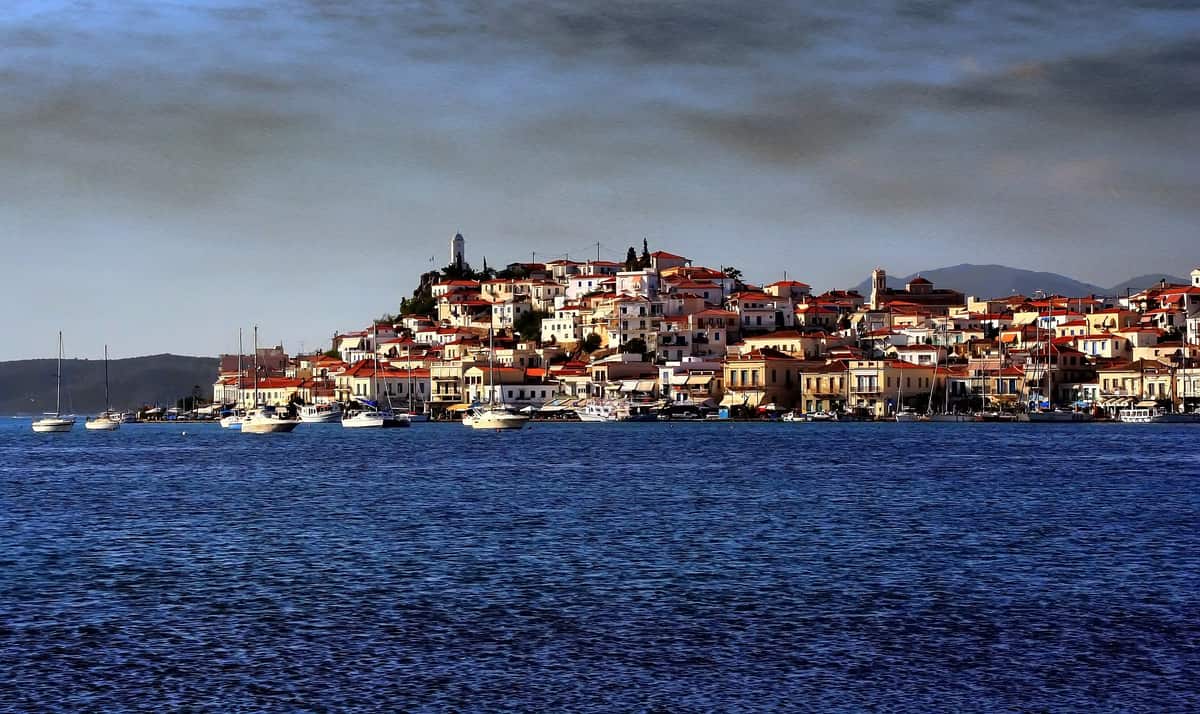
A Hydra Poros Aegina cruise visits three Saronic islands in one day from Athens: Hydra with its stone harbour town, Poros across a narrow strait from the Peloponnese, and Aegina with the Temple of Aphaia. This post covers what a Hydra Poros Aegina cruise includes, each island, where the cruise starts, the history of the islands, other Saronic sights and the best season. It is one of the best tours in Greece on Greece VIP.
Each section ends with a Saronic cruise that can be booked online.
What does a Hydra Poros Aegina cruise cover?
A Hydra Poros Aegina cruise covers three of the Saronic Islands, the archipelago named after the Saronic Gulf between the peninsulas of Attica and Argolis. Aegina lies 27 km from Athens, Poros about 58 km south of Piraeus and Hydra 69 km from Piraeus.
The Saronic Islands lie in the Saronic Gulf, just off the Greek mainland, and the group belongs to the Greek administration of Attica. Aegina and Poros rank among its main inhabited islands. Hydra lies off the north-east tip of the Peloponnese, between the Saronic Gulf and the Argolic Gulf, so lists of the archipelago only sometimes include it. The Athens urban area lines the north coast of the same gulf, with the port of Piraeus on its north-eastern edge.
A Hydra Poros Aegina cruise links three islands with close ties to Athens. Hydra lives on tourism, and Athenians make up a large share of its visitors. Poros, like other Saronic ports, draws travellers from the city at weekends. Aegina, the nearest of the three, holds the second homes of Athenian families. Ferries from Piraeus and the Peloponnese serve the whole group on a regular basis.
The three islands of a Hydra Poros Aegina cruise differ in size. Aegina is the largest, with an area of 87.41 km2. Hydra covers 49.6 km2, and bare, rocky hillsides dominate its landscape. Poros has a surface area of about 31 km2 and 3,261 inhabitants (2021). Each island has one main town: Aegina town at the north-western end of its island, Hydra port with 1,900 residents in 2011, and Poros town on the slopes of a hill.
Between the stops, a Hydra Poros Aegina cruise crosses the Saronic Gulf, which forms part of the Aegean Sea. The gulf takes its name from Saron, a mythological king who drowned at the Psiphaea lake, the modern Psifta. Its waters are one of the gathering areas of short-beaked common dolphins in the Aegean, and fin whales have been sighted in the gulf as environmental conditions improve.
- Hydra: This car-free stop on a Hydra Poros Aegina cruise has captains’ mansions ringing its harbour.
- Poros: The island-pair of Sferia and Kalaureia is joined by a bridge and faces the town of Galatas on the Peloponnese.
- Aegina: The island is known for the temple of Aphaia, the pilgrimage site of St. Nektarios and pistachio production.
Taken together, a Hydra Poros Aegina cruise shows three kinds of island in one outing: a port town without cars, an island-pair joined by a bridge, and Aegina, where an extinct volcano makes up two-thirds of the land. Each stop also carries its own past, from Hydra’s merchant fleet to the Temple of Poseidon on Poros and Aegina’s years as a city-state that rivalled Athens.



What does a Hydra Poros Aegina cruise see on Hydra?
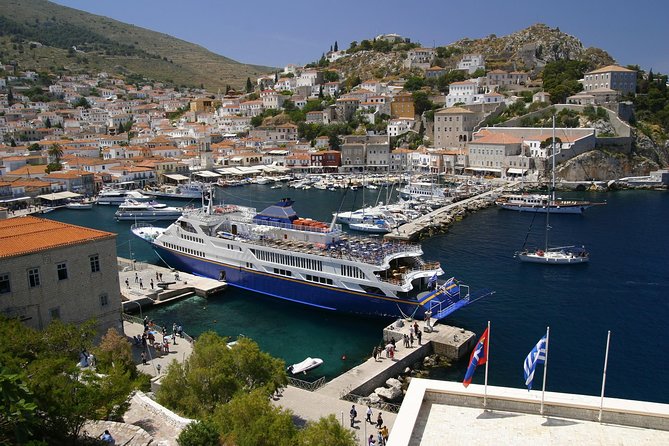
A Hydra Poros Aegina cruise stops at Hydra port, the main town of an island where cars are banned by law. The visit covers the harbour front, the cathedral on the quay, the captains’ mansions and the past of a fleet that fought for Greek independence.
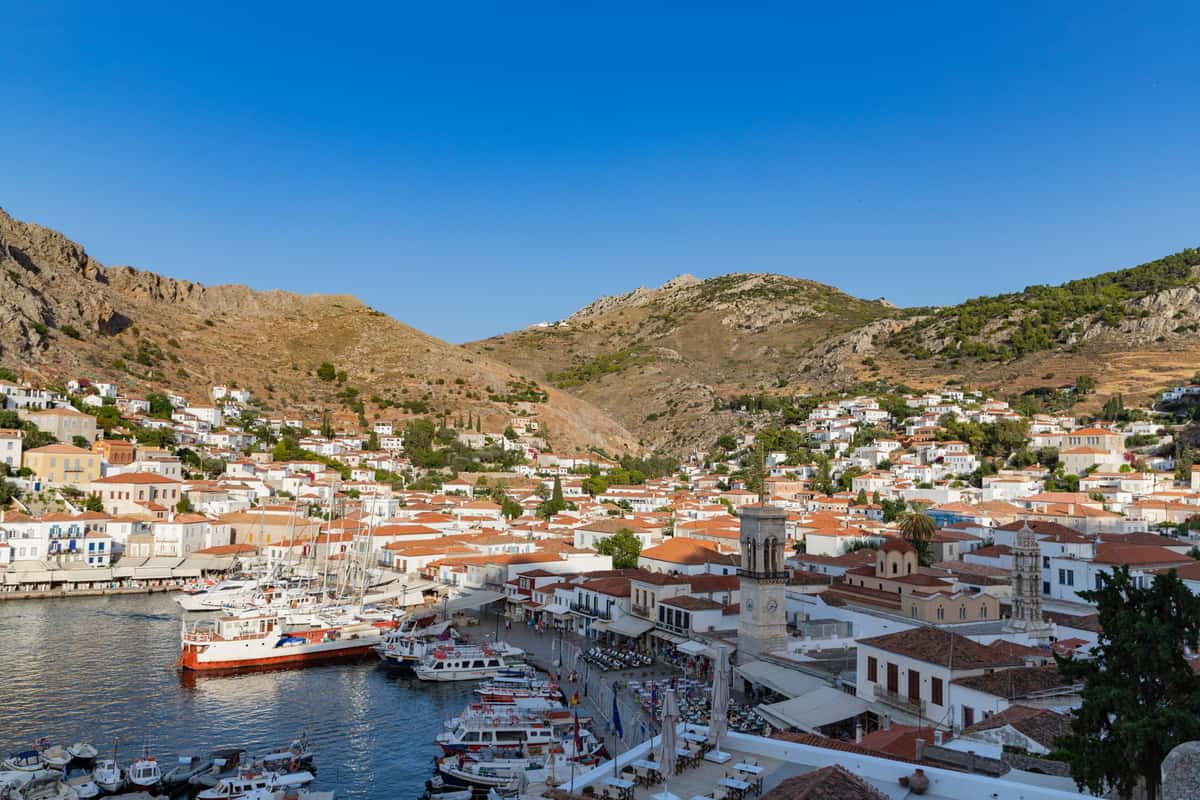
The ban on wheeled vehicles goes beyond cars. Motorcycles, scooters, bicycles and e-bikes are also barred, and rubbish trucks are the only motor vehicles on Hydra. Horses, mules, donkeys and water taxis serve as public transport. The inhabited area is compact enough for residents to walk everywhere, so a Hydra Poros Aegina cruise stop on the island is spent on foot, starting from the quay.
Passengers on a Hydra Poros Aegina cruise step ashore in Hydra port, a town built around a crescent-shaped harbour. Restaurants, shops, markets and galleries line the waterfront and serve both visitors and Hydriots, as the islanders are known. On the quayside stands the cathedral, the old Monastery of the Dormition of the Virgin. Its huge silver chandelier was a gift from Napoleon, who thanked the Hydriots for running the British blockade and bringing food to France.
Shipping money built the captains’ mansions that circle the harbour, in full view of any Hydra Poros Aegina cruise boat coming in. The Tsamadou mansion, on the left as boats enter the port, was donated by the Tsamados family and now houses a Maritime Academy. The Tombazis mansion is part of the Athens School of Fine Arts. The house of Lazaros Kountouriotis runs as a branch of the National Museum of History, and the Kountouriotis, Boudouris, Kriezis, Voulgaris, Sachinis and Miaoulis mansions hold 18th-century island furniture.
Hydra’s naval story began with poor soil, which pushed the islanders to the sea. They opened a school for mariners in 1645 and launched a 250-ton vessel in 1757. After the Treaty of Küçük Kaynarca, Hydriot ships sailed under the Russian flag and carried goods between Southern Russia and the Italian ports of Ancona and Livorno. In the 19th century the island counted 125 boats and 10,000 sailors.
- Monasteries: Profitis Ilias, founded in the 19th century, and Ayia Efpraxia stand on a hill above the main harbour.
- Old Carpet Factory: A house built for the Tsamados family on the hill above the port once served as a weaving school for textiles and carpets.
- Miaoulia Festival: Held in the last week of June, the festival reaches its high point with a staged burning of an Ottoman armada at sea.
Hydra’s fleet played a central part in the Greek War of Independence. The island sent about 150 ships, and admiral Andreas Miaoulis used Hydriot fire ships to cause heavy Ottoman losses. Lazaros Kountouriotis, the richest sea captain on the island, gave his whole fortune to the cause, and his tomb lies in the cathedral. On a Hydra Poros Aegina cruise, the harbour, the mansions and that tomb form the visible record of the period.
What does a Hydra Poros Aegina cruise see on Poros?
A Hydra Poros Aegina cruise calls at Poros, an island-pair separated from the Peloponnese by a channel 200 m wide. The town and its clock tower of 1927 stand on Sferia, and a bridge leads to Kalaureia and the ruins of the Temple of Poseidon.
The Poros call of a Hydra Poros Aegina cruise lands in the southern part of the Saronic Gulf, on two islands linked by a bridge over a narrow strait. Sferia, the southern island, is of volcanic origin and holds the modern town. Kalaureia, also written Kalavria or Calauria, is the northern and larger one, and its name means ‘gentle breeze’. In antiquity Poros bore the name Pogon, and old pine forest covers large areas of its south and centre.
Poros town, with its neoclassical buildings, is laid out like an amphitheatre on the slopes of a hill. Its best-known landmark is a clock tower built in 1927. Across the strait lies Galatas, a town on the Peloponnese coast linked to Poros by car ferry. In The Colossus of Maroussi, the American writer Henry Miller wrote that arriving at Poros by boat, as a Hydra Poros Aegina cruise does, felt like sailing through the streets.
The Sanctuary of Poseidon lies in the north of the island, on Kalaureia, and its ruins can still be reached on a hilltop close to the town. Researchers date its Doric temple to around 520 BC, though the exact year is unknown. The temple measured 27.4 by 14.4 m, with six columns across each end and twelve along each side, and was built mainly of poros stone. A low wall enclosed it, with the main entrance on the east.
The sanctuary is also where Demosthenes died. Condemned to death by the pro-Macedonian party at Athens, the orator took refuge in the sanctuary and poisoned himself with hemlock on 16 October 322 BCE, as the officers of Antipater approached. Swedish archaeologists first dug the site in 1894. The Swedish Institute in Athens resumed the work in 1997 with the Greek National Heritage Board. By then only foundation trenches and roof tiles of the temple remained.
- Vigla: The highest peak of Poros rises to 358 m in the west-central part of the island.
- Beaches: Sandy beaches lie along the southern shore, with the bay of Vayionia as the one exception in the north.
- Archaeological Museum: The museum on Korizis Square keeps finds from the Sanctuary of Poseidon and from ancient Troizen.
The temple also ties Poros to Aegina, another stop on a Hydra Poros Aegina cruise. The historian Strabo described a league of seven cities that shared in sacrifices at the sanctuary, and his list names Aegina and Athens. No archaeological evidence supports the list, and modern scholars see the league as a later Hellenistic invention. A plaque from the third century BCE that celebrates its ‘revival’ has been found.
What does a Hydra Poros Aegina cruise see on Aegina?
A Hydra Poros Aegina cruise reaches Aegina, a Saronic island 27 km from Athens. The island is known for the Temple of Aphaia, for its pistachio crop and for the pilgrimage site of Saint Nektarios. Aegina town sits at the northwestern end of the island.
On a Hydra Poros Aegina cruise, the best-known ancient site on Aegina is the Temple of Aphaia. This Doric temple stands on a peak of about 160 m in the east of the island, around 13 km by road from the main port. Aphaia was a goddess worshipped only at this sanctuary. The present temple dates from about 500 BC. Its pediment sculptures, removed in 1811, are on display in the Glyptothek of Munich.
Aegina town is the regional capital and lies at the northwestern end of the island. The island’s buildings date from the 19th century and mix Neoclassical architecture with a strong folk element. North of the town stands Colona, an ancient acropolis with a sanctuary of Apollo. Venetian sailors gave the site its name, after the temple columns they used as a landmark. One column still stands. Buses run from the town to places such as Agia Marina.
On a Hydra Poros Aegina cruise, the farm product linked with Aegina is the pistachio, the characteristic crop of the island. It arrived in the 19th century, and in 1896 the physician Nikolaos Peroglou began systematic cultivation. By 1950 it had pushed aside other farming, helped by high profits and by phylloxera in the vineyards. The dry climate and volcanic soil shape its quality. Since 1996, Fistiki Aeginis has been a Protected Designation of Origin.
The Monastery of Agios Nektarios honours Nectarios of Aegina, a recent saint of the Greek Orthodox Church. Born Anastasios Kephalas in 1846, he became a monk and later a bishop. In 1904, at the request of nuns, he founded the Holy Trinity Monastery on Aegina. He settled there in 1908 and paid for new buildings with his own funds. He died in 1920 and was buried at the convent. Patriarch Athenagoras of Constantinople declared him a saint in 1961.
- Temple of Aphaia: A Doric temple of about 500 BC on a hilltop in the east of Aegina.
- Aegina town: The regional capital, with 19th-century Neoclassical buildings and Colona to the north.
- Aegina pistachio: A protected product since 1996, grown in dry volcanic soil.
- Agios Nektarios: A pilgrimage site on the Hydra Poros Aegina cruise route, linked with a saint who died in 1920.
A Hydra Poros Aegina cruise stop on Aegina covers three sides of island life. The temple recalls the city-state that once rivalled Athens. The pistachio orchards show the farm economy of the modern island. The monastery remains a pilgrimage site for Saint Nektarios. All of these sights lie on an island of 87.41 km2, about 15 km from east to west.
Where does a Hydra Poros Aegina cruise start?
A Hydra Poros Aegina cruise starts on the Athens coast of the Saronic Gulf. The port of Piraeus, 8 km southwest of the Athens city centre, is the chief port in Greece. Palaio Faliro, 6 km southwest of the centre, holds the Marina of Flisvos.
A Hydra Poros Aegina cruise from Piraeus starts at the chief sea port of Athens. Piraeus is a port city inside the Athens urban area, on the east coast of the Saronic Gulf. It holds the largest harbour in Greece. The central harbour handles commercial and passenger shipping. Ferries sail from it to the Saronic islands, the Cyclades, Crete and the Dodecanese. The Saronic Islands have regular ferry links with Piraeus and with the Peloponnese.
Piraeus has three natural harbours. Next to the central one, two smaller harbours lie to the east: Zea, also called Pasalimani, and Munichia, known as Mikrolimano or Tourkolimano. These two serve recreational and fishing craft and act as marinas. For a Hydra Poros Aegina cruise from Piraeus, the metro station stands next to the port. It links Line 1 and Line 3 and is the southern end of Line 1. The X96 express bus runs between the port and Athens International Airport.
Palaio Faliro is a town and municipality on the Saronic Gulf coast. It lies on the east side of Phalerum Bay, 6 km southwest of the Athens city centre, at the northwestern end of the Athens Riviera. The Faliro coast was rebuilt for the 2004 Summer Olympics. It now has a seaside promenade, sports venues, a marina and the Naval Tradition Park, where museum ships are on show. The Flisvos Public Park sits next to the Marina of Flisvos, beside the beach.
Poseidonos Avenue runs along the sea and links Palaio Faliro with the port of Piraeus. The tram and buses serve the town, and the X96 express bus reaches the airport from there. From this coast, the three islands lie at different distances. Aegina is 27 km from Athens. Poros is about 58 km, or 31 nautical miles, south of Piraeus. Hydra is about 37 nautical miles, or 69 km, from Piraeus. A Hydra Poros Aegina cruise links all three in one sailing.
- Piraeus: The chief sea port of Athens, 8 km southwest of the city centre.
- Zea and Mikrolimano: Two smaller Piraeus harbours that serve recreational and fishing craft.
- Flisvos: A marina and public park at Palaio Faliro, a second start point for a Hydra Poros Aegina cruise.
- Sea route: Hydrofoils and catamarans from Piraeus call at Poros before Hydra.
The two start points share a long history. Before the 5th century BC, Phaleron was the port of Athens, because it lay closest to the city. Themistocles then made Piraeus the main port, and in 483 BC the Athenian fleet moved there from Phaleron. A Hydra Poros Aegina cruise now leaves the same coast that once served the fleet of ancient Athens.
What is the history of the islands on a Hydra Poros Aegina cruise?
The Hydra Poros Aegina cruise passes three islands that shaped modern Greece. Aegina served as the first capital of the new Greek state. Hydra gave about 150 ships to the War of Independence. Poros held the first naval base of modern Greece.
During the War of Independence, Aegina became an administrative centre for the Greek revolutionary authorities. On a Hydra Poros Aegina cruise, it is the island whose flag reads “Aegina: First capital of the new Greek state”. Ioannis Kapodistrias, the first administrator of free modern Greece, arrived on Aegina on 8 January 1828. A statue in the principal square honours him. The government later moved to Nafplio and finally to Athens.
From 1826 to 1828, the Tower of Markellos served as the headquarters of the temporary government. Between 1828 and 1829, Kapodistrias built a large orphanage for children who lost their parents in the war. The building also held schools, the National Public Library, the National Archaeological Museum, a military academy and the National Printing Office. From about 1880 it served as a prison, so locals call it The Prison. In 1832, Nikolaos Levidis took charge of the newly built National Mint in Aegina.
Hydra grew rich through shipping. In the 19th century it was home to about 125 boats and 10,000 sailors. The island gave about 150 ships, plus supplies, to the War of Independence. Admiral Andreas Miaoulis, born on Hydra, used Hydriot fire ships to cause heavy losses to the Ottoman fleet. With the fleets of Psara and Spetses, Hydra won control of the eastern Aegean. A Hydra Poros Aegina cruise enters the harbour below the bronze statue of Miaoulis.
Poros has its own naval past. In the Mycenaean age, the chief naval base of the region stood on the islet of Monti, or Liontari, off Calauria, the northern part of Poros. The Venetians took Poros in 1484 and used it as a strategic port. During the War of Independence, the first naval base of modern Greece opened on the island. Its main work moved to Salamis Naval Base in 1881, yet the Hellenic Navy still trains its personnel on the site.
- Aegina: The first capital of the new Greek state, reached by Kapodistrias on 8 January 1828.
- Hydra: Home of Lazaros Kountouriotis, the richest sea captain, who gave his entire fortune to the war.
- Poros: The island on a Hydra Poros Aegina cruise where envoys of England, France and Russia met Kapodistrias in September 1828.
- Miaoulia: A June festival on Hydra with a sea re-enactment of the burning of an Ottoman armada.
The three stories met in 1831. Leaders on Hydra opposed Kapodistrias, and Admiral Miaoulis seized the national fleet at Poros. Russian ships and government troops then closed in, and Miaoulis blew up the flagship Hellas and the corvette Hydra. Fort Heideck on the Bourtzi islet fell in the same fight. A Hydra Poros Aegina cruise sails past each of these places, from the first capital to the first naval base.
Which other Saronic sights fit a Hydra Poros Aegina cruise?
A Hydra Poros Aegina cruise sails across the Saronic Gulf, an arm of the Aegean Sea between Attica and Argolis. Other sights in the same waters include the volcanic Methana peninsula, pine-covered Agistri next to Aegina, and Spetses, home of the war heroine Laskarina Bouboulina.
The Saronic Gulf, the stretch of water that a Hydra Poros Aegina cruise crosses, is also known as the Gulf of Aegina. It marks the eastern side of the Isthmus of Corinth, where the Corinth Canal ends. The Athens urban area wraps around its northern and eastern coasts, and the port of Piraeus sits on its northeastern edge. Beaches run along long stretches of shore, from Poros to Epidaurus and from Piraeus down to Anavyssos. Short-beaked common dolphins gather in the gulf.
Methana is a volcanic peninsula joined to the Peloponnese, though it belongs to the Attica region. It holds more than 30 volcanic eruption centers, and its highest point, Helona Mountain, rises to 740 metres. The last eruption on land took place near Kameni Chora in the 3rd century BC, and Ovid, Strabo and Pausanias wrote about it. A submarine volcano north of the peninsula erupted in the 17th century. A hydropathic institute still uses the hot sulphurous water that surfaces there.
Agistri, whose Greek name means fishing hook, is a small island very close to Aegina. Pine forest covers its center, and wild cyclamen, thyme and caper bushes grow there. It has a land area of 13.367 square kilometres and 1,131 inhabitants by the 2021 census, spread across three settlements: Milos, also called Megalochori, Skala and Limenaria. Agistri is not one of the three stops of a Hydra Poros Aegina cruise, but boats and small water taxis link it with Aegina.
Spetses also counts among the Saronic Islands group. Its ancient name, Pityussa, described an island rich in pine trees, while the modern name comes from the Venetian word for spices. No private cars are allowed inside the town limits, so people walk or use horse-drawn carriages, bicycles and mopeds. Trails circle the island for about 25 to 30 kilometres. A life-size statue of Bouboulina stands on the main dock, and ferries and fast hydrofoils arrive from Piraeus.
- Methana volcano: The peninsula forms the northwestern end of the arc of active volcanoes that also takes in Milos, Santorini and Nisyros.
- Agistri wildlife: Peafowl brought to the island have turned feral, and swifts breed along its rocky eastern coast.
- Spetses revolt: Spetses was the first Greek island to raise the flag of revolution, on 3 April 1821 by the old calendar.
- Epidaurus: The ancient theatre at Epidaurus and the nearby asclepieion rank among the archaeological sites of the gulf.
The north shore of the gulf is Athens itself, where the Acropolis stands on a rocky outcrop above the city and holds the Parthenon. An expert-led Acropolis tour covers that citadel on land, while a Hydra Poros Aegina cruise covers the islands by sea. Methana, Agistri and Spetses lie off the three-island route, and each adds volcanic rock, pine forest or lanes closed to private cars to a longer stay in the area.
When is the best season for a Hydra Poros Aegina cruise?
A Hydra Poros Aegina cruise meets the driest weather from April to August, based on station records for Aegina and Hydra. July and August bring highs near 33 °C and almost no rain, while September and October stay warm but turn wetter.
Aegina and Hydra both have a hot semi-arid climate, coded BSh in the Köppen system. The climate atlas of the Hellenic National Meteorological Service lists both islands, along with Piraeus, in this dry group. Aegina averages around 20.0 °C across the year, with less than 340 mm of rain. Hydra averages around 20.4 °C, with about 390 mm. The monthly figures below come from National Observatory of Athens bulletins and show what a Hydra Poros Aegina cruise meets in each season.
Summer is the hottest and driest stretch. On Aegina, the average high reaches 33.8 °C in July and 33.5 °C in August, and July rain totals just 4.7 mm. Hydra runs slightly cooler, with highs of 32.9 °C in July and 32.8 °C in August, and only 1.0 mm of July rain. Record highs on both islands passed 42 °C in August. Shade, water and a hat matter on deck and on harbour walks during these months.
Spring and autumn bring milder heat. April highs reach 21.4 °C on Aegina and 20.8 °C on Hydra, and April rain stays under 19 mm at both stations. June warms to highs near 30 °C. September holds highs of about 29 °C, yet its rain jumps to 45.8 mm on Aegina and 42.5 mm on Hydra. October highs sit near 24 °C. A Hydra Poros Aegina cruise in these shoulder months trades a little warmth for cooler walks ashore.
Winter is the wet season. November, December and January each bring more than 50 mm of rain on both islands, and January highs drop to 14.1 °C on Aegina and 14.8 °C on Hydra. At sea, the surface layer of the Aegean warms to 19–24 °C in summer and cools in winter to between 8 °C in the north and 13 °C in the far south. The etesian winds, also called meltemia, blow from late spring to October and peak in July and August.
- Wind shelter: The Attic mainland gives the Saronic Gulf partial cover from the summer meltemi, which reaches Force 7 and above further east in the Aegean.
- Cooling winds: The etesian winds keep Aegean temperatures and daily swings lower than those of the Ionian Sea or mainland Greece.
- Island season: On Spetses, the bulk of hotels and restaurants open from Easter until October.
- September event: Spetses marks the naval battle of 8 September 1822 on the second weekend of September with a re-enactment in the harbour.
The records point to a clear trade-off. Summer gives the warmest sea and the driest skies, along with strong heat ashore. April, June, September and October offer milder days, with more rain in autumn. Winter brings the heaviest rain and the coolest water. The right month for a Hydra Poros Aegina cruise therefore rests on how much heat, rain and sea warmth each traveler wants. Swimmers lean toward July and August, while walkers lean toward April and October.
What do travelers ask about a Hydra Poros Aegina cruise?
A Hydra Poros Aegina cruise raises four common questions: whether lunch is included, whether it suits children, whether there is time to swim, and whether it can follow a visit to the Acropolis. The answers below draw on island records and plain planning advice.
Does a Hydra Poros Aegina cruise include lunch?
Meal plans differ between cruises, so the inclusions list at booking settles whether a Hydra Poros Aegina cruise covers lunch. Travelers with dietary needs mention them when they book. Lunch ashore is another option. The main town, Hydra port, wraps around a crescent-shaped harbour lined with restaurants, shops and galleries, and Aegina is known today for its pistachio crop.
Does a Hydra Poros Aegina cruise suit children?
Parents planning a Hydra Poros Aegina cruise with children check the age rules at booking. On Hydra, the law bans cars and motorcycles, so the lanes carry no car traffic, but steep stone streets climb from the harbour, so a baby carrier beats a stroller. Hats, water and sun cream belong in the day bag.
Is there time to swim on a Hydra Poros Aegina cruise?
Swim time depends on the schedule, so the itinerary shows whether a beach stop is planned. Beaches are a draw on Aegina, and regular buses run from Aegina town to Agia Marina. When a Hydra Poros Aegina cruise allows free time ashore, a swimsuit and towel in the day bag make a quick dip possible.
Can a Hydra Poros Aegina cruise follow an Acropolis visit?
Yes, and splitting the two across separate days keeps each one unhurried. Ferries to the Saronic Islands leave from Piraeus, the port of Athens, which lies eight kilometres southwest of the city centre and is served by Metro Lines 1 and 3. Acropolis station, on Metro Line 2, sits beside the Acropolis Museum and serves Plaka, Koukaki and Makrygianni.
Featured photo: Vlahos Vaggelis, CC BY 3.0, via Wikimedia Commons.