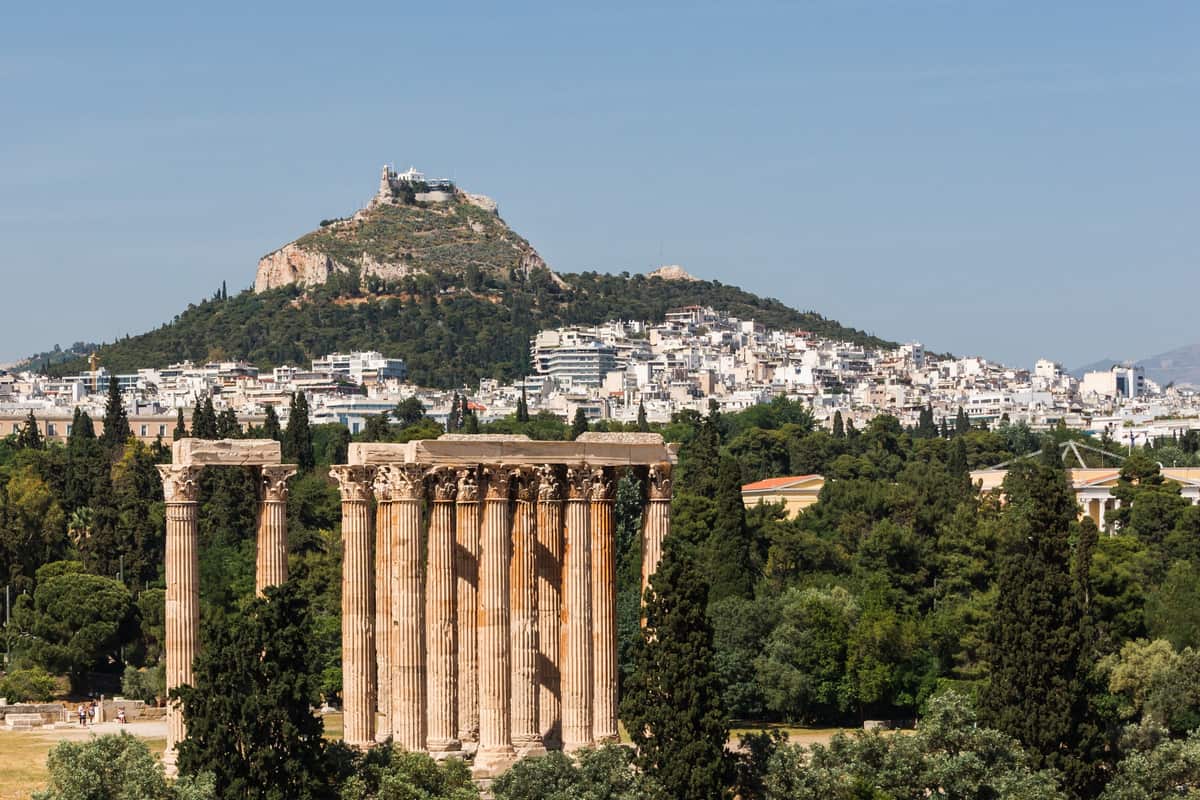
An Athens shore excursion turns a cruise call at Piraeus or Lavrio into a day among the monuments of the Greek capital, from the National Archaeological Museum and the Temple of Olympian Zeus to the marble Panathenaic Stadium, the Roman Agora, the hill of Lycabettus and the coast of the Athens Riviera. This post covers what an Athens shore excursion includes, the cruise ports, the museums, the great monuments beyond the Acropolis, the viewpoints, the formats for a short call, the longer trips, access for limited mobility, the festivals and the best season. It is one of the cruise shore excursions in Greece on Greece VIP.
Each section ends with an Athens shore excursion that can be booked online.
What does an Athens shore excursion include?
An Athens shore excursion includes a day in the capital of Greece that reaches past the Acropolis. The day can cover museums, the Olympieion, the Panathenaic Stadium, the Roman Agora, the city hills, the coast of Attica and longer trips.
Athens is the capital of Greece and of the Attica region, and its urban area has over 3.6 million people. The Cave of Schist holds the oldest known human presence in the city, dated to between the 11th and 7th millennia BC. Athens replaced Nafplio as the capital in 1834, when the war of independence had left a town of about 4,000 people.
Classical works still stand in the city, and an Athens shore excursion also meets Roman, Byzantine and Ottoman monuments. Under Roman rule the city was given the status of a free city because of its widely admired schools. Sultan Mehmed II took the city of Athens in 1458 and forbade the looting or destruction of its ancient monuments on pain of death.
On an Athens shore excursion, sites beyond the Acropolis include the Temple of Olympian Zeus, Philopappos Hill, the Tower of the Winds, Plato’s Academy and the Ancient Agora. Attica holds sites outside the capital. Eleusis, in western Attica, was the home of the Eleusinian Mysteries, the Mysteries of Demeter and Kore, from as early as 1700 BC up to the 4th century AD.
- Marathon: Tumuli there hold the ashes of Athenian and Plataean hoplites.
- Marathon museum: It preserves finds from the area and the battle.
- Roman visitors: Ancient Roman tourists came to Athens, Corinth and Thebes.
Athens ranks among the major tourist destinations of Greece, beside Santorini, Mykonos, Rhodes, Corfu and Crete. In 2009 Central Macedonia welcomed 3.6 million tourists, followed by Attica with 2.6 million. Ships reach the capital through Piraeus, the largest port in Greece, where every Piraeus shore excursion begins, and the same port can open an Athens shore excursion.


Which cruise ports serve an Athens shore excursion?
An Athens shore excursion can start at Piraeus, Rafina or Lavrio, three ports in Attica. Piraeus is the largest port in Greece, Rafina lies 25 km east of the city centre, and Lavrio lies about 60 km southeast of it.
Lavrio is a town in the southeastern part of Attica and the seat of the municipality of Lavreotiki. It forms part of the Athens metropolitan area, and its port is an alternative harbour for cruise ships. An Athens shore excursion from Lavrio starts on the site of the ancient village of Thoricus. The town takes its name from the region of the mines of Laurium.
After the battle of Marathon, Themistocles persuaded the Athenians to spend the revenue of a major strike in the Laurion silver mines, around 483 BC, on a fleet of 200 triremes. Output fell towards the end of the 5th century BC, partly because of the Spartan occupation of Decelea. In 1896 a miners’ strike ended violently, and a military force was permanently established to patrol the miners.
Rafina is a port town on the Aegean coast of Attica, northeast of the Mesogaia plain. It is the seat of the municipality of Rafina-Pikermi, and its municipal unit covers 18.979 km2. An Athens shore excursion from Rafina begins on that eastern coast. Piraeus, on the Saronic Gulf, was a rocky island until the 3rd millennium BC, when silting joined it to Attica.
- Modern mining: French and Greek companies reworked the mines for lead, manganese and cadmium.
- Rafina: Kallitechnoupoli is the only other town in the municipal unit.
- Piraeus harbours: Cantharus is the main port; Zea and Munichia are smaller.
The three ports lie in the Athens Metropolitan Area, which spans 2,928.717 km2 within Attica and includes 58 municipalities in seven regional units. Athens and Piraeus serve as its two metropolitan centres. An Athens shore excursion from Lavrio or Rafina therefore begins inside the same metropolitan area as one from Piraeus.
Which museums can an Athens shore excursion visit?
An Athens shore excursion can visit four museums in the capital: the National Archaeological Museum, the Museum of Cycladic Art, the Benaki Museum and the Byzantine and Christian Museum. They hold Greek art and finds from prehistory to modern times.
An Athens shore excursion to the National Archaeological Museum meets the golden funerary mask of Mycenae that carries the wrong name of Agamemnon, and a warrior’s vase dating from the 12th century BC. The Egyptian collection centres on a bronze statue of the princess-priestess Takushit, made around 670 BC and found south of Alexandria in 1880. The Stathatos collection adds about 1000 objects, mainly jewels.
On an Athens shore excursion, the Cycladic marble figurines of the 3rd millennium BC resemble modern art, and they inspired artists such as Henry Moore. The Museum of Cycladic Art keeps its temporary exhibitions in the Stathatos Mansion, where shows have presented Salvador Dalí, Caravaggio and Cy Twombly. In 1931 the Benakis family donated its Athens house and more than 37,000 Islamic and Byzantine objects to the Benaki Museum.
An Athens shore excursion to the Byzantine and Christian Museum reaches the Ilissia Villa, a building of 1848 that Stamatios Kleanthis designed, at 22 Vassilissis Sofias Avenue. The museum was founded in 1914 and first occupied the first floor of the Academy. It holds more than 25,000 exhibits from the 3rd century AD to the Late Middle Ages, among them frescoes and manuscripts.
- Founding: Ioannis Kapodistrias set up the first national museum on Aigina in 1829.
- War years: The antiquities were sealed in protective boxes and buried.
- Mascots: The daidala statuette inspired the 2004 Athena and Phevos mascots.
Three of the four museums renewed their halls ahead of the 2004 Olympic Games. The National Archaeological Museum reopened in July 2004, and the Byzantine and Christian Museum reopened in June 2004 with another wing. The Benaki Museum moved its Islamic collection to a new home that year. An Athens shore excursion therefore visits museums ready for the Games.
What does an Athens shore excursion see at the Temple of Olympian Zeus?
An Athens shore excursion sees the Olympieion, the colossal temple of Olympian Zeus, and Hadrian’s Arch beside it. The tyrants of Athens began the temple in the 6th century BC, and Hadrian completed it in the 2nd century AD. Sixteen of its 104 columns survive.
The tyrants planned a Doric temple on a platform of 41 m by 108 m, with eight columns across the front. The tyranny fell in 510 BC with only the platform and parts of the columns finished. In 174 BC the Seleucid king Antiochus IV Epiphanes revived the work under the Roman architect Decimus Cossutius, and the design changed to Pentelic marble and the Corinthian order.
Hadrian visited Athens in 124–125 AD and began a building programme that included the completion of the temple. A walled, marble-paved precinct surrounded it, and the dedication gave Hadrian the title Panhellenios. An Athens shore excursion sees thirteen surviving columns at the south-east corner and three near the south-west corner. A storm in 1852 felled the central one of those three.
An Athens shore excursion reaches Hadrian’s Arch at the north-west corner of the temple enclosure. Builders made it of Pentelic marble without cement or mortar and joined the cut stones with clamps. The arch is 18 m high and its single passage 6.5 m wide. Credit goes either to the Athenian state or to the Panhellenes, an association of Greek cities based in Athens.
- Column: Each stands 17.25 m high.
- Precinct: The poros wall enclosed 205.85 m by 128.72 m.
- Excavation: Francis Penrose dug there in 1887.
An Athens shore excursion finds the Olympieion about 500 m south-east of the Acropolis, the rock that an Acropolis tour climbs. Pausanias recorded four statues of Hadrian before the entrance. In 1436 Cyriacus of Ancona found 21 of the 104 columns still standing. Greeks of the Ottoman period called the ruin the Palace of Hadrian.
Why does an Athens shore excursion stop at the Panathenaic Stadium?
An Athens shore excursion stops at the Panathenaic Stadium because it is the only stadium in the world built entirely of marble. Herodes Atticus rebuilt it in marble by 144 AD, and it staged the opening ceremony of the first modern Olympics in 1896.
A racecourse stood on the site from the 6th century BC and hosted the Panathenaic Games, held every four years in honour of Athena. The Games ran from 566 BC to the 3rd century AD and included athletics, horse racing and music. Winners received amphorae of olive oil, and the chariot champion took 140. An Athens shore excursion reaches the venue of the athletic events.
Lykourgos built a stone stadium of poros around 330 BC, with a track 204 m long and 34 m wide. Herodes Atticus replaced it with Pentelic marble masonry and minimal concrete. An Athens shore excursion enters a stadium built for 50,000, where owls in relief on the seats stood for Athena. After Theodosius I banned the festivals, the site fell into ruin.
Ernst Ziller excavated the buried stadium in 1869–70, and the Zappas Olympics, an early revival of the ancient games, followed in 1870 and 1875. For 1896 the architect Anastasios Metaxas duplicated the dimensions and design of the second-century stadium in Pentelic marble, funded by George Averoff. The opening ceremony fell on 6 April 1896, Easter Monday and the anniversary of Greek independence.
- Sports: It held four of the nine sports in 1896.
- Setting: It fills a ravine between Agra and Ardittos.
- District: It stands in Pangrati.
In 1896 the marathon winner Spyridon Louis led the medalists on a lap of honour round the track. The 2004 marathons for women and men finished there, as the annual Athens Classic Marathon does. An Athens shore excursion also reaches the last venue in Greece for the handover of the Olympic flame to the host nation.
What does an Athens shore excursion see at the Roman Agora and Kerameikos?
An Athens shore excursion sees the Roman Agora with the Tower of the Winds, Hadrian’s Library, and the Kerameikos cemetery with the Dipylon Gate. The first three lie north of the Acropolis, and the Kerameikos lies to the north-west of the same hill.
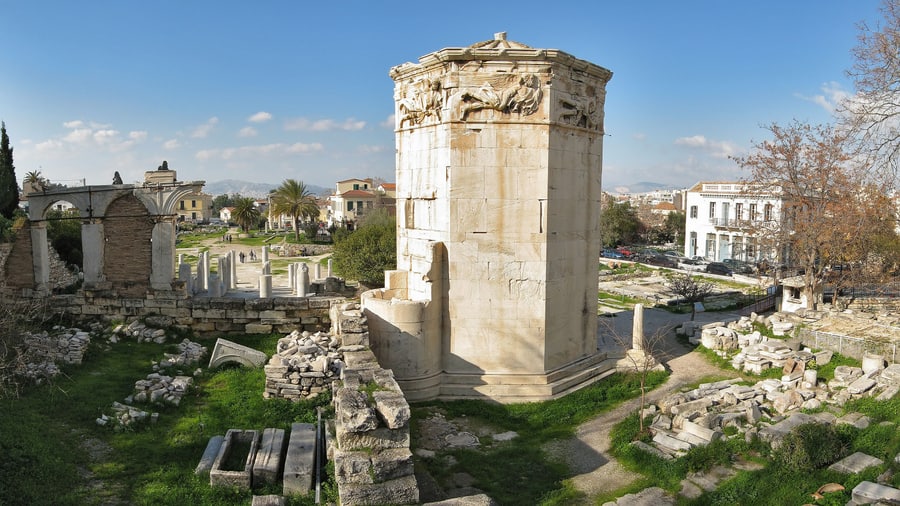
The Roman Agora lies east of the Ancient Agora, and an inscription on its Gate of Athena Archegetis records a decree from Hadrian’s reign on the tax duties of oil merchants. An Athens shore excursion reaches the Tower of the Winds beside the east gate. The octagonal tower is 12 m tall, with eight reliefs of wind gods, eight sundials and a water clock fed from the Clepsydra spring.
An Athens shore excursion passes Hadrian’s Library, which Hadrian built in 132 AD on the north side of the Acropolis. A high wall with niches enclosed a courtyard with columns and an oblong pool. Papyrus rolls sat in cupboards on the east side, and the corners served as lecture halls. After the Herulian invasion of 267, the prefect Herculius repaired the library in 407–412.
The Kerameikos was the potters’ quarter of Athens, which gave English the word ceramic. Clay carried by the Eridanos river fed the workshops, and an organised cemetery grew there from about 1200 BC. A wide road, the Dromos, ran through the double-arched Dipylon Gate to the Platonic Academy. Pericles delivered his funeral oration in 431 BC at the Demosion Sema, the public graveyard.
- Tower: Andronicus of Cyrrhus designed it.
- Library: A colossal statue of Nike was found there in 1988.
- Kerameikos: A Greek worker dug up a stele in April 1863.
The Kerameikos Museum is a small neoclassical building with an extensive collection of burial-related objects. Plaster replicas stand in place of the original grave sculptures at the site. The bulk of the site lies 7–10 m below modern street level. An Athens shore excursion enters an enclosed site whose entrance opens on the last block of Ermou Street.
Which viewpoints does an Athens shore excursion climb?
An Athens shore excursion climbs two hills for views of the capital: Mount Lycabettus, with its Chapel of St. George and funicular, and Philopappos Hill, which faces the Acropolis and holds a Roman monument beside the Pnyx, the ancient assembly ground.
Pine trees cover the base of Mount Lycabettus, and two peaks crown it. The nineteenth-century Chapel of St. George, a restaurant and a large open-air amphitheatre occupy those peaks. The amphitheatre closed in 2008 for safety and reopened in September 2023. An Athens shore excursion to the hill meets a legend: popular stories say wolves, lycos in Greek, sheltered there.
The Greek Tourist Organisation inaugurated the Lycabettus Funicular on 18 April 1965. The upper station stands at the Chapel of St. George, and the line between them runs entirely in tunnel. A refurbishment in 2002 replaced the motor, the brake unit, the safety electronics, the control room and both cars. An Athens shore excursion rides this railway up the hill.
Philopappos Hill lies southwest of the Acropolis and joins the hills of the Nymphs and the Pnyx. The monument on its top is built of Pentelic marble on a base of porous marble veneered with Hymettian marble. Only two-thirds of the facade survives, and the burial chamber is destroyed except for its base. The Dora Stratou theatre stands to the south.
- Name: A second theory gives the name a Pelasgian origin.
- Access: Residents won a 2015 case that kept Philopappos Hill open.
- Reuse: Ottoman builders used its parts in a Parthenon minaret.
The Pnyx is a rocky hill. The Athenian assembly moved there from the Agora in the early fifth century BC, and a defence wall with seven towers protected the site. An Athens shore excursion that climbs the Pnyx stands where the assembly met before it moved to the Theatre of Dionysus.
What does an Athens shore excursion see along the Grand Promenade?
An Athens shore excursion sees the Grand Promenade, the pedestrian route along Dionysiou Areopagitou Street and Apostolou Pavlou Avenue around the Acropolis. The walk passes the gates of the Theatre of Dionysus and the Odeon of Herodes Atticus on the slopes.
An Athens shore excursion walks Dionysiou Areopagitou Street, where buildings stand on both sides near Amalias Avenue. After Makrygianni Street the buildings cease on the north side, and the Acropolis site fills that side. The south side holds apartment buildings and houses, in a residential district. Residents have included the composer Vangelis, the painter Konstantinos Parthenis and the economist Xenophon Zolotas.
The Unification of Archaeological Sites of Athens is the masterplan that redeveloped parts of the city centre and drew funding from the European Union. A company of the same name began remodelling the western stretch of Ermou Street on Wednesday 9 July 2003. The Grand Promenade starts at the Panathenaic Stadium on Vasilissis Olgas Avenue and ends on that western stretch.
An Athens shore excursion passes the Theatre of Dionysus, a stone auditorium of seventy-eight rows. Twelve stairways split the seats into thirteen wedge-shaped blocks, and the central throne belonged to the priest of Dionysus. Wooden bleachers built for plays in the Agora collapsed, and the plays moved to the sanctuary of Dionysus on the slope. Rousopoulos began the excavation in 1861.
An Athens shore excursion then reaches the Odeon of Herodes Atticus, a gift to the city whose scenery structures were 28 metres high and whose niches held statues. It was the largest concert venue of its time. The Miss Universe pageant of 1973 took place there, and Luciano Pavarotti sang there in 1991 and 2004. Nana Mouskouri sang there in 1984.
- Theatre gate: The entrance lies near Makrygianni Street.
- Odeon gate: The entrance lies near the western end.
- Western end: Apostolou Pavlou Avenue takes over near Philopappos Hill.
Ermou Street links the Kerameikos site with Syntagma Square in central Athens through Thiseio, Psiri and Monastiraki. Its western section was remodelled for the 2004 Olympic Games as a pedestrian way between Agion Asomaton Street and Peiraios Street. An Athens shore excursion that follows the promenade to its end reaches that section.
Which Athens shore excursion suits a short port call?
An Athens shore excursion for a short port call keeps to one fixed format: a panoramic drive, the hop-on hop-off bus, the metro from Piraeus, a small-group walk or a private car. Each format reaches different sights in the city.
A panoramic drive runs on a large coach, a bus larger than a regular transit bus, with two to four axles. Its seats face the front, and its windows are tinted. Amalias Avenue meets the start of Dionysiou Areopagitou Street, which was pedestrianised in 2003, so an Athens shore excursion by panoramic drive views that pedestrian zone from its edge.
The Athens hop-on hop-off bus is a tour bus service with a route around tourist attractions and a regular schedule. Passengers can travel between the attractions at their own pace. The open upper deck has the roof partly or fully removed and a guard rail. An Athens shore excursion of this kind leaves the choice of stops to each rider.
The metro from Piraeus is Line 1, which Greeks call the Electric after its electrification. The line is mostly overground, and its underground section lies between Monastiraki and Attiki. Petralona on Line 1 and Syngrou-Fix on Line 2 are the nearest stations to the Philopappou area, south of the monument. Passengers validate a ticket at the gates on entering and leaving a station.
- Small-group walk: Walkers cover the pedestrian zone around the Acropolis site.
- Private car: A car reaches Aristippou Street, where the funicular starts.
- Open-top bus: Modern designs have low floors for easy access.
The Athens Metro has three lines, 66 stations and 91.7 kilometres of track. Line 3 is the longest of them, at 47.3 kilometres. Photography and video-taking are permitted across the whole network. An Athens shore excursion by metro runs on a system whose Line 1 links the port with the centre.
Can an Athens shore excursion visit the Athens Riviera?
An Athens shore excursion can visit the Athens Riviera, the coastal belt of southern suburbs that starts at Piraeus and lies about 16 km from downtown Athens. Glyfada, Vouliagmeni and Varkiza belong to this stretch of the Saronic Gulf coast.
The Greek National Tourism Organisation also lists Elliniko, Voula, Lagonisi and Anavyssos as main areas, and the Athens Riviera tour covers that run of seaside towns. Poseidonos Avenue and Vouliagmenis Avenue join Glyfada with central Athens, and a tram line runs beside Poseidonos Avenue. At Vouliagmeni the road becomes the palm-lined Athinas Avenue, which follows the seashore and continues south.
Glyfada stretches from the foot of Mount Hymettus to the Saronic Gulf, so an Athens shore excursion there meets mountain and sea. Nightclubs, upscale restaurants and shops fill the town. The Glyfada Golf Club lies south of the former Ellinikon Airport. An old quarry on the Hymettus slope holds the Aixoni Quarry Sculpted Theatre, a major work of Nella Golanda.
Vouliagmeni lies 18 km south of the city centre, and an Athens shore excursion there meets two pine-covered peninsulas, Megalo and Mikro Kavouri. Sandy and pebble beaches lie between rocky shores, beside two marinas and the chapel of St. George of the crab. Lake Vouliagmeni lies south of the town, close to the sea, and works as a year-round spa.
- Shopping: Glyfada’s shops run across Metaxa Avenue and Grigoriou Labraki Street.
- Cuisine: An American airbase helped shape Glyfada’s Greek and American cuisine.
- Heritage: The Riviera holds Neolithic and Bronze Age building foundations.
In July 2020 work began on the Ellinikon Metropolitan Park, part of the redevelopment of the former airport at Elliniko. The Faliro Delta is being redeveloped as a major urban waterfront park, to be called Aenaon Park. An Athens shore excursion here therefore meets a coast that is still being rebuilt.
Can an Athens shore excursion reach Delphi or Mycenae on a long call?
An Athens shore excursion can reach Delphi or Mycenae only on a long call, such as an overnight stay or a late departure. Mycenae stands about 120 km south-west of Athens, while Delphi lies in central Greece on Mount Parnassus.
Kastri, a village of about 100 houses, stood on the ruins of Delphi until an earthquake damaged it, and its people took a new village in exchange for the site. In 1893 the French Archaeological School removed vast quantities of soil from landslides to reveal the sanctuary of Apollo and the temple of Athena Pronoia, which an Athens shore excursion visits.
At Mycenae, an Athens shore excursion reaches a citadel on a hill 274 metres above sea level, 19 km inland from the Saronic Gulf. A secret passage of 99 steps leads down to a rock-cut cistern 15 m below the surface, fed by a spring tunnel. The largest stones, lintels and gate jambs among them, weighed well over 20 tonnes.
An Athens shore excursion to Epidaurus reaches a sanctuary of Asclepius about 8 km from the town, on the Argolid Peninsula. The cult of Asclepius is attested there in the 6th century BC, when the older hilltop sanctuary of Apollo Maleatas was too small. The town had its own theatre, dated to the 4th century BC, with about 2000 seats.
Nafplio is the capital of Argolis, on the Argolic Gulf. Pausanias wrote that the Nauplians were Egyptians from the colony that Danaus brought to Argos. Local dishes include giosa, made with lamb or goat, and bogana, lamb with potatoes. Since 2003 the University of Peloponnese has run a School of Fine Arts in the town, with a Department of Theatre.
- Delphi: Argos completed one of the largest treasuries in 380 BC.
- Mycenae: A committee formed in 1999 laid out walkways and information stations.
- Nafplio: Rail service began in 1886; a ten-kilometre branch joins Argos.
Mycenae, Epidaurus and Nafplio belong to Argolis, so an Athens shore excursion with a long call can link the three. Delphi lies in central Greece and needs its own outing. Greek National Road 48 links Amfissa in the west with Livadeia in the east, and old and new Delphi lie on it.
Which Athens shore excursion suits travelers with limited mobility?
An Athens shore excursion suits travelers with limited mobility when it uses the Acropolis lift, the wheelchair routes on the rock and a museum with ramps and lifts. A separate entrance leads to the lift along a path with specifications for disabled persons.
The lift does not use the Central Entrance, so an Athens shore excursion for wheelchair users enters by a separate gate on the west slope. A path of 350 m with specifications for disabled persons leads from there to the lift. Trained security staff accompany visitors in wheelchairs. The lift also carries a lone parent with two or more infants.
Riders step out north of the Erechtheion, onto the plateau. A route passes west of the Erechtheion and the ancient temple of Athena, with a direct view of the place of the sacred olive tree. At the Parthenon’s north side, wheelchair users turn left along the northern colonnade or right toward the Propylaea, a branch with a gradient above 6%.
Special ramps for wheelchairs and strollers serve all entrances of the Acropolis Museum, and elevators and toilets for disabled visitors are available on every floor. The Visitor Services Desk lends wheelchairs to visitors in need. The Information Desk offers a Braille description of the museum in Greek and in English. Visitors with mobility difficulties have priority use of the elevators.
- Metro: Acropolis station’s elevator-only entrance lies in the museum’s eastern wall.
- Second lift: A second lift descends to the old museum courtyard.
- Old approaches: Two ancient approaches were steep, narrow flights of steps.
Only 400 metres of walking separate the Acropolis Museum from the Parthenon. The first-level hall has a sloping floor that resembles the ascent to the rock. Parts of the museum floor are glass over the excavations below, and an Athens shore excursion can reach part of that excavation through the courtyard.
Which festivals and events can an Athens shore excursion catch?
An Athens shore excursion can catch the Athens Epidaurus Festival from late spring to October, Orthodox Easter, the Sunday Grand Change of the Evzones, the August full moon nights at the Acropolis Museum and the Athens Classic Marathon on the second Sunday of November.
The Athens Epidaurus Festival fills stages in Athens and Epidaurus with music and theatre. Its main venue in the capital is the Odeon of Herodes Atticus. In 1955, the first year, Dimitris Mitropoulos and the New York Philharmonic played Skalkottas’ 36 Greek Dances. Luciano Pavarotti performed at the Odeon in 1991 and 2004, and Vangelis premiered Mythodea there in July 1993.
The Presidential Guard of the Evzones keeps watch at the Presidential Mansion and the Tomb of the Unknown Soldier. Its Grand Change takes place on Sunday mornings, when the whole Guard, its officers and a military band march from the Guard Barracks to the Tomb and back. The unit also provides personnel for the flag ceremony on the Acropolis on Sundays and official holidays.
Holy Week marks the seven days before Orthodox Easter, and an Athens shore excursion in that week meets its church services. The Paschal full moon fixes the date of Easter, and Orthodox churches use the Julian calendar while Catholic and Protestant churches use the Gregorian one. The Epitaphios, a cloth embroidered with the image of Christ prepared for burial, is carried in procession around the outside of the church.
- Start: The course begins in the town of Marathon.
- Climb: The route runs uphill from the 10 km to the 31 km mark.
- Finish: The race ends at the Panathenaic Stadium.
The Acropolis Museum stays open on the August full moon nights and also hosts night concerts in its courtyard. Epidaurus adds ancient drama, as the festival stages Aeschylus, Sophocles, Euripides and Aristophanes in its ancient theatre, which has room for 10,000 people and renowned acoustics. Performances fall on Fridays and Saturdays during July and August.
When is the best season for an Athens shore excursion?
An Athens shore excursion in April meets a downtown high of 21.1 °C and one in October a high of 24.4 °C, while July and August reach 34.3 °C and the July average record high stands at 38.8 °C.
In 1833 a cruise ship sailed from Naples in early June on a route that included Athens. Tourism in Greece peaks from late spring to September, and about 75% of tourist visits happen in that window. Piraeus counted 622 ship arrivals in 2019, up from 524 in 2018, so an Athens shore excursion then visits the city in its peak season.
Downtown highs rise from 17.0 °C in March to 31.6 °C in June, while the lows climb from 9.2 °C to 21.6 °C. Average humidity falls from 66 percent in March to 50 percent in June, and rain drops from 45.6 mm to 11.6 mm. At Elliniko on the coast, the July high is 32.2 °C.
Kifissia in the north features lower temperatures and slightly more rain year-round owing to its higher elevation, and Mount Parnitha above 1,000 metres falls into the warm-summer Csb class. Temperatures of 47.5 °C and over have been reported in the metropolitan area, and on 10 July 1977 the reading at Elefsina, west of the city, reached 48.0 °C.
- March: Elliniko counts 11.3 rain days.
- April: Elliniko counts 9.3 rain days.
- October: Elliniko counts 8.6 rain days.
Autumn eases the heat and brings the rain back, as the downtown high drops from 29.6 °C in September to 18.9 °C in November and rain climbs from 25.8 mm to 70.8 mm. Snow is infrequent in the capital, but the storm of 16 February 2021 blanketed the entire urban area.
What do travelers ask about an Athens shore excursion?
An Athens shore excursion meets tour coaches at the Piraeus cruise terminal, ramped museum entrances, a town 60 km southeast of the city centre, site dress rules, a second World Heritage Site beyond the Acropolis and six closed holidays.
Ship tour or independent Athens shore excursion?
A tour bus service is an escorted sightseeing tour, and Terminal B in Piraeus has room for 120 tour buses. An independent Athens shore excursion can ride a hop-on hop-off bus, which follows a regular schedule and lets passengers travel at their own pace.
Do museums on an Athens shore excursion suit children?
The Acropolis Museum has special ramps for wheelchairs and strollers at all entrances and elevator access on all floors. Tickets include the excavation beneath the building, which opens from the entrance courtyard, and the Museum runs educational programs for schools in Greek or English.
Can an Athens shore excursion start at Lavrio?
An Athens shore excursion from Lavrio starts about 60 km southeast of the city centre, where the EO89 road runs through town. Lavrio belongs to the Athens metropolitan area, and in summer it runs 2 °C cooler than Piraeus and 4 °C cooler than downtown Athens.
What clothing suits an Athens shore excursion?
The Ministry of Culture bars visitors from dressing in a way that does not suit an archaeological site or museum, and it recommends footwear suited to walking. The Acropolis itself stands on a rocky outcrop and admits small backpacks and handbags.
Can a second Athens shore excursion skip the Acropolis?
Athens holds a second World Heritage Site, the eleventh-century Daphni Monastery, which stands 11 kilometres northwest of central Athens in the suburb of Chaidari. Its gold-ground mosaics include Christ Pantocrator in the dome, so a repeat visit can turn from the rock to Byzantine art.
Which holidays affect an Athens shore excursion?
The Acropolis and the Ancient Agora list six closed holidays, among them 1 January, 25 March, 25 December and 26 December. The Ministry of Culture also lists all archaeological sites, monuments and museums as closed on Easter Sunday, an official national holiday.
Featured photo: Jebulon, CC0, via Wikimedia Commons.