
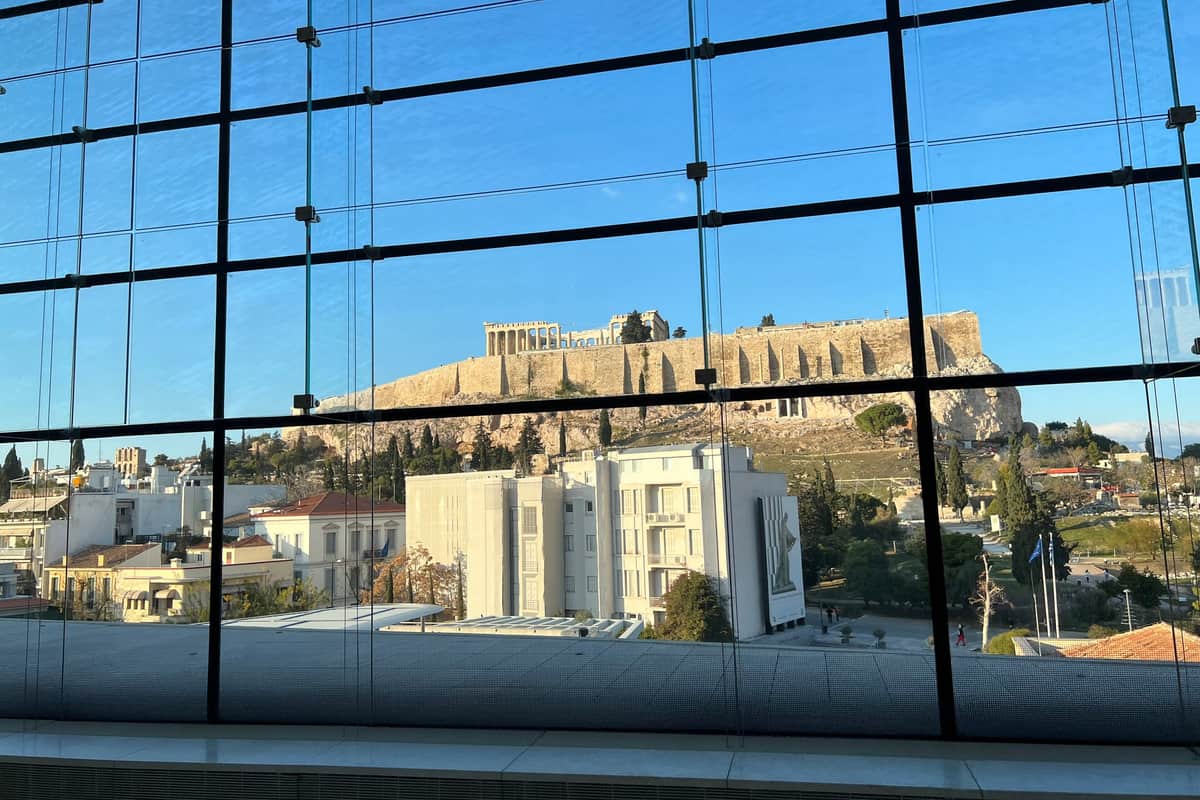
Acropolis Museum tickets open the museum at the foot of the Acropolis in Athens, where the sculptures and finds from the hill are shown in a glass and concrete building beside the ruins. This post covers what Acropolis Museum tickets include, where the museum stands, the excavation under the floor, the archaic gallery, the Parthenon Gallery, the Caryatids, the Parthenon Marbles dispute, Athena Nike and the Propylaea, the sights nearby and the best season. More tours in Greece are listed on the Greece VIP homepage.
Each section ends with Acropolis Museum tickets or a tour that can be booked online.
What do Acropolis Museum tickets include?
Acropolis Museum tickets give entry to an archaeological museum beside the southeastern slope of the Acropolis in Athens. The museum holds finds from the rock and its slopes, from the Bronze Age to Roman and Byzantine times, and it opened to the public in 2009.
The collection has a single theme. The museum was built to house every artifact found on the Acropolis rock and on its surrounding slopes, so the displays follow one hill through its long history, from the Bronze Age to the Byzantine period. Acropolis Museum tickets also admit visitors to a building that stands over the ruins of part of Roman and early Byzantine Athens.
A first museum already stood on the rock. It was completed in 1874 and enlarged in the 1950s, but later excavations produced far more artifacts than its rooms held. Every recent proposal for a new museum treated a gallery for the Parthenon Marbles as key to the design. Acropolis Museum tickets now open the building that took over the role of that older museum.
The search for a design took four competitions. The first two, in 1976 and 1979, produced nothing because the chosen plots were unsuitable. An international contest in 1989 went to two Italian architects, but it was annulled in 1999. The final competition, held by invitation, went to the New York-based architect Bernard Tschumi, who worked with the Greek architect Michael Photiadis.
- Size: The exhibition area behind Acropolis Museum tickets covers 14,000 square metres and holds over 4,250 objects.
- Levels: Three levels hold the collections, and a fourth middle level carries the shop and the offices.
- Founding: The museum was founded in 2003, and the Organization of the Museum followed in 2008.
- Recognition: The American Institute of Architects gave the museum its 2011 Institute Honor Award for Architecture.
Acropolis Museum tickets thus cover a purpose-built museum, not a converted hall. Its displays hold the rock and its slopes, its design came from the fourth competition in a search that began in 1976, and its public opening in 2009 ended that search. The sections below move from the street to the floor and up to the galleries.


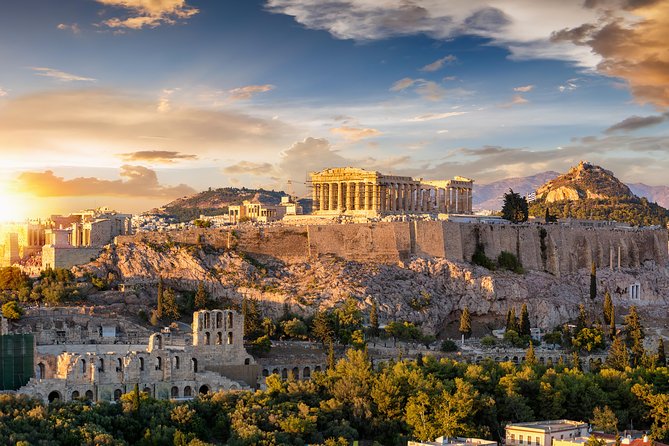

Where do Acropolis Museum tickets lead in Athens?
Acropolis Museum tickets lead to the Makrygianni district of Athens, on the southeastern slope of the Acropolis hill. The entrance opens onto the pedestrian street Dionysiou Areopagitou, next to the Acropolis metro station, and the Parthenon stands 280 metres away.
The plot has a history of its own. It was the unused Camp Makrygianni gendarmerie barracks, opposite the Theatre of Dionysus, on public land. The site also lies on the ancient road that led up to the sacred rock in classical times. The main block of the old barracks, the neoclassical Weiler Building, now houses the Museum of the Center for the Acropolis Studies. Acropolis Museum tickets lead to this corner of Makrygianni, not to the rock itself.
Dionysiou Areopagitou Street carries the entrance that Acropolis Museum tickets open. The street is named after Dionysius the Areopagite, the first Athenian convert to Christianity after the sermon of Apostle Paul. It was first mapped in 1857, farther north than today, and it was pedestrianized in 2003. Foundations of the house of Proclus were found in the middle of the street. Visitors who add the hilltop to the day can read about Acropolis tickets for the rock itself.
The Acropolis metro station sits under Makrygianni Street, on the east side of the museum. While it was being built, its planned name, Olympieion, after the Temple of Olympian Zeus, was dropped. It opened on 15 November 2000. Two of its three entrances are in the museum’s eastern wall, and one of those is elevator-only. Reproductions of the Elgin Marbles of the Parthenon cover parts of the platforms.
- Theatre of Dionysus: Its entrance lies near Makrygianni Street, on the same pedestrian street as the museum.
- Odeon of Herodes Atticus: Its entrance lies near the far end of the street, close to Philopappos Hill.
- Arch of Hadrian: The street begins at Amalias Avenue near this arch.
- Walk: The Parthenon lies 400 metres away on foot, so Acropolis Museum tickets and a hilltop visit sit close together.
Acropolis Museum tickets thus belong to a compact corner of Athens. Makrygianni gives the neighbourhood, Dionysiou Areopagitou Street gives the address, and the Acropolis station gives the rail link. All three sit beside the south slope of the Acropolis hill, so the rock and the museum can share one walk on the same street.
What lies under the floor on a visit with Acropolis Museum tickets?
Acropolis Museum tickets lead over an excavated ancient neighbourhood. Roadside houses and workshops from the classical era and from the early Byzantine era lie below the building, and the ground-level glass flooring shows the site and the continuing excavation.
The ground shaped the building. Digging for the foundations of an earlier design stopped when sensitive archaeological remains appeared. The fourth competition then made no provision for the ancient site, until local and international campaigners, among them ICOMOS, exposed the oversight. The plans were adjusted so that the building rose above ground on pillars. Acropolis Museum tickets thus admit visitors to a structure drawn around the ruins beneath it.
Excavation revealed two layers of modest private houses and workshops along an ancient roadside. One layer dates from the classical era and the other from the early Byzantine era. Once the layout and stratigraphy of the findings were clear, positions for the foundation pillars were chosen. The pillars pass through the soil down to the underlying bedrock, so the building stands over the remains without resting on them.
The excavation opened to visitors on 21 June 2019. From that day the public walked, for the first time, through an ancient Athenian neighbourhood that survived from the Classical era to Byzantine times. The dig itself is not finished, so the site changes as work below ground level goes on. A visit with Acropolis Museum tickets shows archaeology in progress as well as archaeology of the past.
- Layers: Two layers of roadside houses and workshops lie below, one classical and one early Byzantine.
- Pillars: The foundation pillars cross the soil and reach the bedrock beneath.
- Glass floor: Glass sections of the floor give holders of Acropolis Museum tickets a view of the excavations below.
- Courtyard: Part of the site is open to the public through the museum’s courtyard.
Acropolis Museum tickets thus cover two stories at once: the finds from the rock above and the ordinary remains beneath the building. The excavated neighbourhood places the museum in a long line of Athenian life beside an ancient road, from the classical era through the early Byzantine era. The sections that follow climb to the galleries above.
What does the Archaic Gallery show with Acropolis Museum tickets?
Acropolis Museum tickets open the Archaic Gallery on the first floor, where sculptures from the sanctuary before 480 BC stand together. The hall holds the korai, maiden statues, the old temple pediments, and the Peplos Kore, a marble figure with traces of its original paint.
The museum dates the Archaic period on the Acropolis to 700-480 BC. The hill of those years carried large temples and a crowded field of offerings to the gods, and every sculpture in this hall comes from that sanctuary. Large windows and roof skylights fill the space with daylight, which recalls the open-air setting where the statues first stood. Acropolis Museum tickets lead into the age before the Persian attack.
A kore is a free-standing statue of a young woman from the Archaic period. Korai wear thick drapery, while the male kouroi are nude. People gave the statues to goddesses such as Athena and Artemis as votive offerings. After the Persians desecrated the hill in 480/479 BCE, the Athenians buried the korai in graveyards on the Acropolis. The largest dig of korai came in the 1880s, and Acropolis Museum tickets lead to those finds.
The Peplos Kore is one of the best-known statues that Acropolis Museum tickets reach in this hall. The white marble figure stands 118 cm high and dates to around 530 BC. Excavators found it in three pieces in 1886, north-west of the Erechtheion. The name comes from the peplos, a woman’s gown, yet the dress is now known not to be one. Bore holes in the head and shoulders show that bronze ornaments were once attached.
- Pediments: The Gigantomachy pediment of the Old Athena Temple, the “Olive Tree” pediment and the Hekatompedon pediments.
- Other statues: The highlights include the Calf-bearer and the Rampin Rider.
- Painted colour: Brighter dyes cost more, so colour marked wealth.
The Archaic Gallery shows the Acropolis as it stood before the Persian destruction. For years after 480 BC the hill lay in ruins, until Perikles planned its renovation. In 1975 the Museum of Classical Archaeology in Cambridge painted a cast of the Peplos Kore and set it beside an unpainted cast. Acropolis Museum tickets cover both the old hill on this floor and the rebuilt hill above.
What is in the Parthenon Gallery for Acropolis Museum tickets?
Acropolis Museum tickets lead up to the Parthenon Gallery on the third floor, a glass-walled hall that matches the orientation of the temple. The hall shows the frieze, the metopes and the pediment figures, and plaster copies join the original marbles where pieces are held abroad.
The museum describes the top floor as a glass-walled chamber around a rectangular core. The core matches the orientation and dimensions of the Parthenon cella. The top level sits askew on the floors below to share the compass direction of the temple. Steel columns equal the Parthenon columns in number, and glass walls give a direct line of sight to the monument. Acropolis Museum tickets therefore reach sculptures that face the building they came from.
The Parthenon frieze is a low relief in Pentelic marble, carved between about 443 and 437 BC. It ran 160 metres and carried 378 figures and 245 animals, and 128 metres survive. The mainstream reading sees the Greater Panathenaic procession climbing to the Acropolis, with twelve seated gods at the east end. Acropolis Museum tickets give a close view of faces and hooves that once sat high on the cella wall.
The metopes that Acropolis Museum tickets reach were carved in high relief, and the temple held 92 of them. The east metopes show the Gigantomachy, the battle of the Olympian gods and the Giants. The west metopes show the Amazonomachy, the Athenians against the Amazons. The south side shows the Centauromachy, with the Lapiths and Theseus against the Centaurs. The east pediment held the Birth of Athena, and the west pediment her contest with Poseidon for Athens.
- Frieze: The blocks form a band behind the metopes, set lower than on the temple.
- Metopes: They stand in pairs between the steel columns.
- Pediments: The large figures rest on low pedestals, visible from all directions.
The exhibition mixes original marbles with plaster copies of the sculptures kept in the British Museum and other foreign museums. White casts mark the position of the pieces held in London, and empty space marks sculptures that no longer survive. Every statue on the west pediment has a finished back that stood out of sight on the temple. Acropolis Museum tickets show the whole composition, with its gaps in plain view.
Which Caryatids do Acropolis Museum tickets show?
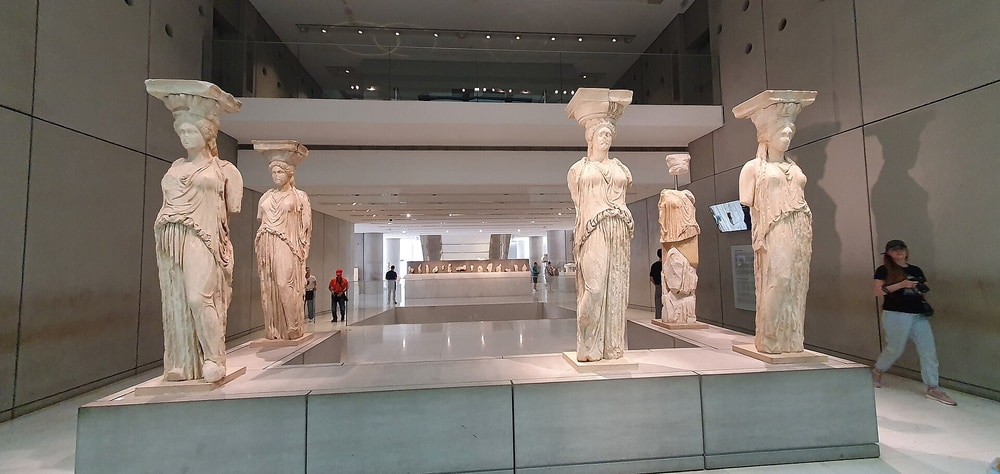
Acropolis Museum tickets show five of the six Caryatids from the porch of the Erechtheion, displayed on a balcony that allows viewing from all sides. The sixth maiden is held in the British Museum in London, and replicas now stand on the porch on the Acropolis.
A caryatid is a sculpted female figure that takes the place of a column and carries the entablature on her head. The word karyatides means maidens of Karyai, an ancient town on the Peloponnese. The Roman architect Vitruvius tied the name to women of Karyai punished with slavery, but modern writers doubt that story. Acropolis Museum tickets lead to the original maidens.
The Erechtheion stands north of the Parthenon, and Acropolis Museum tickets show its maidens indoors. Its Porch of the Maidens, on the south wall, has six sculpted figures as supports, all facing south. The six look alike but are carved separately, in face, stance, drapery and hair. The three on the left stand on the right foot, and the three on the right stand on the left foot. Bulky, intricate hairstyles give static support to the thin necks.
One figure left the Acropolis in the early 19th century, when Lord Elgin removed it, and the removal caused significant damage to the temple. The Romans had already copied the maidens, with copies in the Forum of Augustus, the Pantheon and Hadrian’s Villa at Tivoli. The Tivoli copies, found in 1952, showed that the maidens carried phiale. The lower arms of all the figures are lost.
- Five originals: They stand on a special balcony with a view of every side.
- Sixth figure: It is in the British Museum, and its pedestal stays empty.
- Replicas: They stand on the porch in place of the five originals.
From 2011 to 2015 a specially built laser cleaned the five Caryatids and removed soot and grime without harming the patina of the marble. Each figure was cleaned in place, and a television circuit relayed the work live to visitors. The International Institute for Conservation gave the museum the Keck Award in 2012 for the conservation and restoration. Acropolis Museum tickets therefore show maidens that have been through laser cleaning.
What is the Parthenon Marbles dispute for Acropolis Museum tickets?
Acropolis Museum tickets open the gallery at the centre of the Parthenon Marbles dispute. Lord Elgin’s agents carried off about half of the Parthenon’s surviving sculpture between 1801 and 1812, and the British Museum holds it. Greece has asked for its return since 1983.
The Parthenon Marbles are the frieze, metopes and pediment figures of the Parthenon, the temple of Athena built on the Acropolis from 447 BCE. The collection is known as the Elgin Marbles, after Thomas Bruce, the 7th Earl of Elgin, who was ambassador to the Ottoman sultan from 1798. Elgin said that Ottoman officials, who ruled Athens then, gave permission for the removal, and the legality of his actions is disputed.
From 1801 Elgin’s agents took sculptures from the Parthenon, the Erechtheion, the Temple of Athena Nike and the Propylaia, and the work ended in 1812. A parliamentary inquiry in 1816 found that Elgin had acquired the marbles legally, and the collection passed to the British Museum. It includes 21 pediment figures, 15 metope panels and 75 metres of frieze. Acropolis Museum tickets lead to the other principal holder of Parthenon sculpture.
Greece asked Britain for the return of the sculptures in 1983 and listed the dispute with UNESCO in 1984. Greek supporters argue that the marbles were obtained illegally or unethically and are best shown together in the Acropolis Museum. The British Museum argues that they were obtained legally and that its collection sets them beside other ancient cultures. Discussions between British and Greek officials are ongoing, and Acropolis Museum tickets lead to the Athens share in the meantime.
- Gallery casts: White casts in the gallery mark the positions of elements held in London.
- Lost frieze: About 30% of the frieze has been lost or destroyed, so the gallery that Acropolis Museum tickets open leaves space there.
- UNESCO: In 2021 UNESCO called on the British government to resolve the issue at the intergovernmental level.
The Parthenon Marbles dispute gives Acropolis Museum tickets a context beyond the displays. The museum was designed, in part, to arrange the surviving Parthenon sculptures as they stood on the temple and to counter arguments that the Elgin Marbles are better preserved and displayed in the British Museum. Both positions are on record. The lower floors then turn to Athena Nike and the Propylaea.
Which sculptures from Athena Nike and the Propylaea do Acropolis Museum tickets show?
Acropolis Museum tickets show the frieze and parapet reliefs of the Temple of Athena Nike, plus sculptures from the Propylaea. These pieces stand on the museum’s first level. Copies of the Nike frieze now stand in place on the temple.
The Temple of Athena Nike is the smallest on the Acropolis. A steep bastion at the southwest corner carries it, beside the entrance on the right. The architect Kallikrates designed it, and it was finished around 420 BC. In 1998 the temple was dismantled to replace its crumbling concrete floor. Its frieze was then moved into the new museum, which opened in 2009.
Acropolis Museum tickets lead to the frieze, which ran around all four sides of the building. The north side showed a battle between Greeks with cavalry, the south side the victory over the Persians at Plataea and the east side an assembly of gods. Around 410 BC a parapet was added to keep people from falling off the bastion. Its outer face carries reliefs of Nike, including two Nikai setting up a trophy.
The best-known parapet figure is a wingless Nike, leaning toward her sandal. Scholars read the gesture as removing or loosening the sandal, an act of worship for those entering the temple. Acropolis Museum tickets also lead to this statue, which was found in 1835 near the temple. Mnesikles built the Propylaea from 437 to 432 BC. It carries no architectural sculpture, and its metopes and pediments were left empty.
- Gateway name: Propylaia means “that which is before the gates” in Greek.
- Nearby offerings: Pausanias described statues and reliefs around the entrance, among them Hermes Propylaios by Alkamenes.
- First request: In 1836 King Otto asked Britain to return four slabs of the Nike frieze.
Acropolis Museum tickets thus join a small temple and a gateway in one gallery. Later Athenians called the cult statue Apteros Nike, or wingless victory, and a story held that the wings were left off so the goddess was unable to leave the city. The gateway beside it tells its story through architecture.
Which sights near the museum suit Acropolis Museum tickets?
Acropolis Museum tickets suit walks to the Theatre of Dionysus, opposite the museum, and to the Odeon of Herodes Atticus. The Temple of Olympian Zeus and Hadrian’s Arch lie south-east of the rock, while Plaka and Anafiotika lie on its northern and eastern slopes.
Opposite the museum that Acropolis Museum tickets open, the Theatre of Dionysus grew from the sanctuary of Dionysus Eleuthereus on the south slope. Drama moved to this sanctuary by 499 to 496 BC, and the Great Dionysia, the first theatre festival, was held there. The Odeon of Herodes Atticus, on the southwest slope, had a three-story stone front wall and an entry portico with a mosaic floor.
The Temple of Olympian Zeus lies about 500 m south-east of the Acropolis, which makes it a second stop after Acropolis Museum tickets. Antiochus IV Epiphanes revived the stalled project in 174 BC and switched the order to Corinthian. The Arch of Hadrian spans an ancient road that ran from the centre of Athens to the temple complex. It was built from solid Pentelic marble without cement or mortar.
Plaka is the old neighbourhood clustered around the north and east sides of the Acropolis, and the Acropolis Museum is counted among its museums, so Acropolis Museum tickets suit a walk through its lanes. A fire in 1884 burned a large part of the district, which let archaeologists excavate the Roman Agora and Hadrian’s Library. Anafiotika, a small quarter inside Plaka, began under King Otto, when island builders from Anafi arrived to refurbish his palace.
- Theatre: It was the first theatre with an orchestra, where the chorus stood.
- Odeon: It hosted Maria Callas in 1957 and two benefit concerts by Frank Sinatra in 1962.
- Olympieion: In 1436 Cyriacus of Ancona found 21 of the original 104 columns standing, and fifteen stand today.
These sights form a circuit around the museum, from the theatre opposite it to the arch and the temple beyond, and back through Plaka. Acropolis Museum tickets fit that walk because the museum holds finds from the Acropolis rock and the slopes around it. An Acropolis tour visits the places where those finds were made, from Classical drama to Hadrian’s Athens.
When is the best season for Acropolis Museum tickets?
Acropolis Museum tickets work in every season, because the galleries are indoors while the weather outside shifts from a hot Mediterranean summer to a wetter, cooler winter. Visitors who dislike heat favour the cooler months, and a rainy day moves the museum to the top of the plan.
Greece has 11 climates under the Köppen system, the highest count in Europe for a country of its size, and the Mediterranean type dominates. Athens belongs to the hot-summer branch, coded Csa, which is also the predominant type in Greece. Across the Greek lowlands that type brings sunny, dry summers and wet winters, so the year splits into two halves rather than four sharp seasons. Anyone choosing a date for Acropolis Museum tickets is therefore picking between a hot half and a wet half, and the museum works in both.
Summer is the demanding half. The urban heat island effect gives the wider urban agglomeration higher mean annual temperatures than the observatory station near the centre records. Athens has drawn the label of hottest city on the European mainland, and Tatoi and Elefsina share the Greek record of 48.0 °C, set on 10 July 1977 and standing as the European record until 2021. A museum building gives a break from that weather, so Acropolis Museum tickets for July or August lead indoors, away from the open streets of the capital.
The cooler half brings the rain, yet the Athens basin stays drier than a typical Mediterranean setting. Air arriving from the west is dried by the Pindus range, and air from the north by the Dirfys and Parnitha mountains, the rain shadow effect. Winters in the Greek lowlands are wet, and snow does not stay for long. The port of Piraeus receives just 331.9 mm of rain a year. Visitors with Acropolis Museum tickets for a winter day meet showers rather than lasting snow, and the galleries stay dry.
Weather shifts across the metropolitan area. Kifissia in the north stands higher and has moderately lower temperatures with slightly more rain through the year. Areas to the south, such as Piraeus, see smaller temperature swings because the Saronic Gulf moderates them. Fog seldom forms over the central districts, yet the eastern side near Mount Hymettus sees it more. Lycabettus, a tall hill in the city, overlooks the whole Attica Basin. None of these local differences changes a visit built on Acropolis Museum tickets, since the exhibits stay under one roof.
- Summer: A heat wave from 26 July to 10 August 2021 ranks among the longest and strongest in Greek records, which shows how severe high summer can become.
- Spring: Advection fog can occur in spring, especially along the coastline, while the city centre sees fog rarely.
- Snow days: Snowstorms on 16 February 2021 and 24 January 2022 blanketed the urban area, although snowfall remains relatively uncommon in Athens.
- Etesian winds: Their frequency peaks in July and August, and over the Aegean they hold temperatures below those of the mainland.
Season changes the weather around the museum, not the museum itself. A hot July day and a wet January day both favour an indoor stop, while a clear cool day leaves the open streets of Plaka and Koukaki open as well. Acropolis Museum tickets therefore suit the whole calendar. Open-air stops follow the weather, and the museum stays the fixed point, so a change in the forecast moves the walk around it and never the visit itself in any season.
What do travelers ask about Acropolis Museum tickets?
Acropolis Museum tickets bring up four practical questions about the setting: how large the population of Athens is, what the Acropolis is, whether an Athens hop on hop off bus fits another day, and whether a Delphi trip can follow. The answers below take each question in turn.
How large is the population of the city behind Acropolis Museum tickets?
The municipality of Athens had 643,452 residents in 2021, on a land area of 38.96 square kilometres. Adding Piraeus and the former Athens prefecture gives the dense Athens Urban Area, with 3,059,764 inhabitants. The metropolitan area, which also covers towns of East and West Attica, held 3,744,059 people. Acropolis Museum tickets lead into the centre of that large city.
What is the Acropolis behind Acropolis Museum tickets?
The Acropolis is a citadel from antiquity on a rocky outcrop over Athens. Its name joins the Greek words for highest point and city, and other Greek cities have an acropolis of their own. In ancient times the rock was also called Cecropia, after Cecrops, the supposed first Athenian king. Acropolis Museum tickets cover finds from that rock and slopes.
Can Acropolis Museum tickets pair with an Athens hop on hop off bus on another day?
Yes, the bus tour and the museum visit fit on separate days. The museum stands in Makrygianni, part of the 1st of seven municipal communities, and the municipality holds 53 districts in all. A day on an Athens hop on hop off bus gives a view of that layout across the capital, while Acropolis Museum tickets fill an indoor day.
Can Acropolis Museum tickets pair with a Delphi day trip from Athens on another day?
It does, across two separate days. Delphi sits in central Greece, its precinct set on the Parnassus slope facing southwest, so the Delphi day trip from Athens heads out of the capital. The Pythia held court there, and its name derives from the she-serpent Delphyne. Acropolis Museum tickets cover the Athens day, and the oracle’s precinct fills the other.
Featured photo: Pinterpandai.com, CC BY-SA 3.0, via Wikimedia Commons.