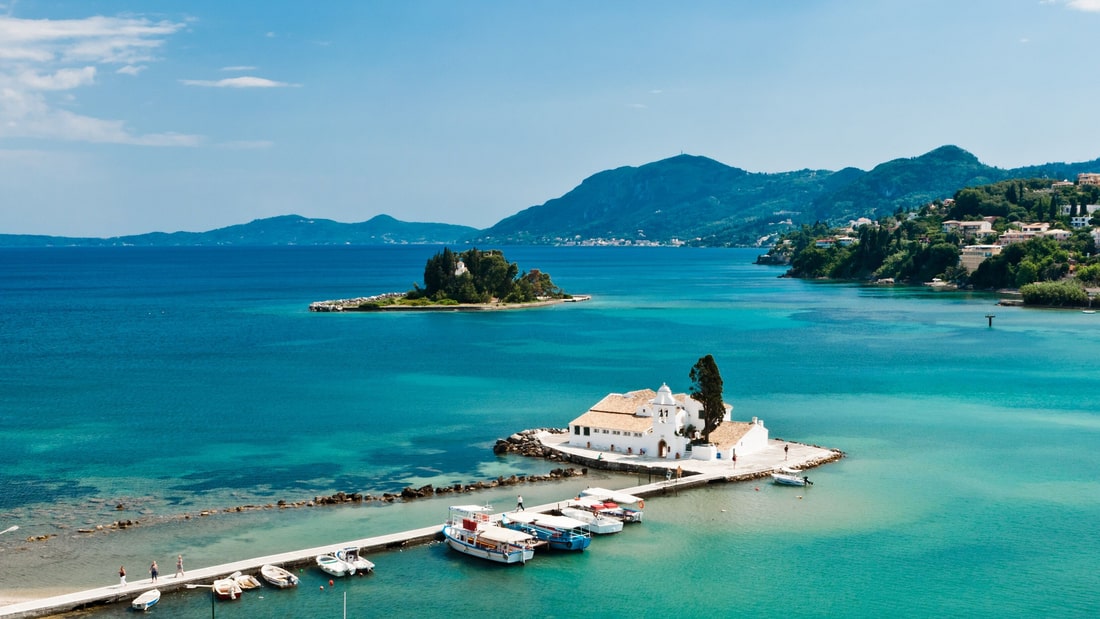
A Corfu tour travels by road around Corfu in the Ionian Sea, from the Venetian old town and its fortresses to the palace of the Achilleion, the green hills of the west and the villages under Mount Pantokrator. This post covers what a Corfu tour includes, Corfu Old Town, the Old and New Fortress, the Achilleion, Kanoni and Mon Repos, Paleokastritsa and Lakones, Angelokastro, the north and the south-west of the island, the history and the best season. It is one of the Greece tours on Greece VIP.
Each section ends with a Corfu tour that can be booked online.
What does a Corfu tour include?
A Corfu tour by land includes the main sights of the island, reached by bus, minibus or private car: the old town with its two fortresses, the Achilleion palace, the villages of the west coast and the northern hill villages, all linked by the road network.
Corfu is one of the Ionian Islands in western Greece. Measured from end to end, the island is about 64 km long and around 32 km wide at its broadest point, an area of 592.9 km2. A Corfu tour has a lot of ground to cover, so the route is planned by district rather than as one sweep, and the island has 99,134 residents.
Two high ranges divide Corfu into three districts. The north is mountainous, the centre is undulating and the south is low-lying. The Pantokrator range is the more important one, and its summit of the same name, at 906 m, tops the whole island. The second range ends at Santi Jeca, named for the Ten Saints. Olive trees and cypresses give the hillsides their typical Corfiot look. A Corfu tour climbs highest in the mountainous north.
The capital is also named Corfu. It is the largest city on the island and the seat of both the regional unit and the Ionian Islands region, with 23,541 residents. Smaller towns around it include Kanali, Potamos, Kontokali, Alepou and Gouvia. Beyond them, villages such as Kassiopi, Sidari and Palaiokastritsa sit on the coast, and every Corfu tour reaches them by road.
Two national roads leave the capital. The EO24 runs west towards Palaiokastritsa, and the EO25 runs south towards the Achilleion. These roads give a land Corfu tour its basic shape: one arm to the west coast, one arm to the south and side roads up into the northern hills. Public buses connect the city with Glyfada, Sidari, Paleokastritsa, Lefkimmi and Piri.
- Bus tour: A coach follows the two national roads and stops at the large sights of the island.
- Minibus tour: A smaller vehicle takes the narrower village roads of the hills and the west coast.
- Private car tour: A car with a driver follows a route set in advance for one party.
- Walking stop: The old town lanes are cobbled and narrow, so each Corfu tour continues on foot there.
Sea outings form a separate product. A Corfu boat trip covers the coast from the water, while this Corfu tour stays on the roads, the towns and the hills. The next two sections follow a Corfu tour of the capital, first through the old town and then to the two Venetian fortresses.


What does a Corfu tour see in Corfu Old Town?
A Corfu tour in Corfu Old Town sees the UNESCO-listed Venetian streets, the Spianada square, the Liston arcade and the church of Saint Spyridon, which keeps the relics of the patron saint of the island. The streets carry the marks of Venetian and British rule.
UNESCO inscribed the old town on the World Heritage List in 2007. Four centuries of Venetian rule left multi-storied buildings along narrow lanes. The heritage assessment classed the urban fabric as predominantly Neoclassical, and it records that German bombing in the Second World War destroyed whole blocks. Where a lane is too narrow for a vehicle, the Corfu tour continues on foot.
The Spianada is the largest square in Greece and the open centre of a Corfu tour in the old town. It lies directly in front of the Old Fortress. Its name comes from a Venetian word for an open flat area, and the present layout goes back to the French occupation of the Napoleonic Wars. Locals call its fountain the Vagianos well.
A pedestrian street, the Liston, runs along the western edge of the Spianada, and a Corfu tour walks its length. The French imperial commissioner Mathieu de Lesseps built it in 1807, and its design took the Rue de Rivoli in Paris as a model. The ground was once a firing range for Venetian troops. The name comes from a Venetian word for an evening promenade.
A Corfu tour that enters the church of Saint Spyridon sees a single-nave basilica built in 1589. A chapel right of the iconostasis holds the relics in a double sarcophagus of wood with silver-leaf trim. Doxaras painted the ceiling scenes in 1727, and later copies replaced them. The Romanov coat of arms above the western door recalls Russian protection from 1807 to 1917.
- Upper Square: The southern part has flower beds, walkways, the circular Maitland Rotunda and a bandstand.
- Lower Square: The northern part is a flat grass field used for cricket, a game that arrived with the British Protectorate.
- Botides: On Holy Saturday, residents throw water-filled clay pots from the balconies along the Liston to remove misfortune.
- Bell tower: The tower of Saint Spyridon dates from 1620 and is the highest in the Ionian Islands.
A Corfu tour of the old town therefore joins four sights within one district: the Venetian lanes, the open square, the pedestrian street and the church. The square and the street date from French rule, while the church dates from Venetian rule. The fortress on the headland is the next stop on the route.
Which fortresses does a Corfu tour visit?
A Corfu tour visits the Old Fortress, a Venetian stronghold reached by a bridge from the old town, and the New Fortress on the hill of Saint Mark. Two castles enclose the capital, which is the only city in Greece surrounded in this way.
The Old Fortress stands where the medieval town began. Defences first appear on the peninsula around the 6th century AD, after the Ostrogoths destroyed ancient Corcyra and its people sought shelter on the headland. In the early 11th century Anna Komnene called the place the very strongly fortified city of Corfu in her book the Alexiad. The medieval town then grew inside these walls until the 13th century.
The citadel has two peaks, and the Venetians named both. The western peak, higher and closer to the town, was Castel a Terra, the Castle near the Land. The eastern peak was Castel a Mare, the Castle by the Sea, and for a time it served as a powder magazine. A Corfu tour reaches the peaks on foot, over the bridge that now spans the Contrafossa.
Inside, the old British barracks hold the public library of Corfu, and the Hellenic Music Research Lab of the Ionian University works in the same fortress. The grounds also host art and culture exhibitions. The Old Fortress served as a location for the James Bond film For Your Eyes Only, in a scene where a Mercedes is pushed off a cliff.
The New Fortress crowns the hill of Saint Mark, and the Venetians built it in stages. Its exact dates are not settled, because accounts differ. Ferrante Vitelli was the first architect. During their rule of the island the British added the present buildings: a stone building for defence at the top and a brick building that now serves as the headquarters of the Naval Station of Corfu. This second stop on a Corfu tour once held 700 pieces of artillery.
- Gates and moat: Two baroque gates open the walls, and a dry moat runs along the western side from the vegetable market to the new harbour.
- Underground works: The bastion holds cisterns, powder magazines, artillery positions and underground halls.
- Twin bastions: They are named Skarponas and Epta Anemoi, the Seven Winds.
- Wall inscription: A rampart monument from 1728 shows the Lion of Saint Mark above a Latin text.
The Venetian Senate elected the governors of the Old and New Fortresses for two-year terms. Each governor swore never to communicate with the other, so that neither was able to persuade the other into treason. A Corfu tour that visits both fortresses sees the two commands that once defended the citadel and the wider town.
Why does a Corfu tour stop at the Achilleion?
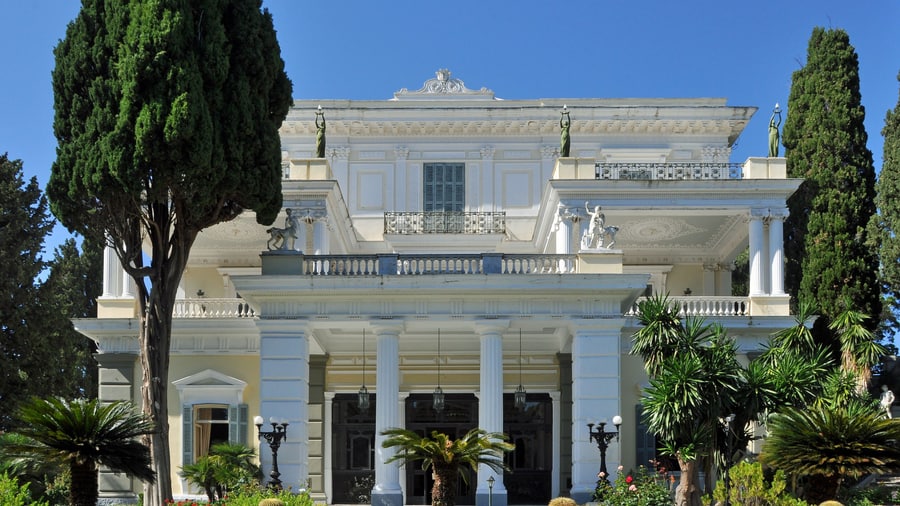
A Corfu tour stops at the Achilleion because the palace in the village of Gastouri links two rulers. Empress Elisabeth of Austria built it as a refuge, Kaiser Wilhelm II bought it later, and its gardens hold statues of Achilles.
Gastouri, home of the Achilleion, sits in the hills roughly ten kilometres south of Corfu city. Empress Elisabeth of Austria had the palace built after her only son, Crown Prince Rudolf, died in the Mayerling incident of 1889. The Austrian consul Alexander von Warsberg suggested the idea, and the Italian architect Raffaele Caritto drew the plans. A Corfu tour reaches the palace by the EO25, the national road that runs south from the city towards the Achilleion.
Elisabeth wanted a home that recalled an ancient palace of mythical Phaeacia, and the design centres on Achilles, the hero of the Trojan War. The building follows a Pompeian style, with paintings and statues of heroic and tragic scenes from the war. Only her daughters and their husbands were received there, and Emperor Franz Joseph never saw the palace. A Corfu tour therefore shows a private refuge, not a court residence.
Kaiser Wilhelm II bought the palace in 1907 and used it as a summer residence. During his visits the Achilleion became a hub of European diplomacy. He hired the botanist Carl Ludwig Sprenger to tend the park and invited the German archaeologist Wilhelm Dörpfeld to the retreat. A Corfu tour sets this second owner beside the first, so the palace carries two separate stories.
The gardens hold the two main statues. Ernst Herter made the Dying Achilles in Berlin in 1884, and it forms the centrepiece. The Kaiser added a bronze Achilles by the sculptor Johannes Götz, which shows the hero in full hoplite uniform with a gorgon’s head on the shield and faces north toward the city. A Corfu tour compares the two figures, one dying and one armed.
- Palace: Raffaele Caritto designed it for Empress Elisabeth on an area of 200,000 square metres.
- Statues: Herter’s Dying Achilles and Götz’s bronze Achilles stand in the gardens.
- Film: The 1981 James Bond film For Your Eyes Only shot its casino scene at the Achilleion.
The Achilleion now works as a museum within the Greek National Tourism Organization. For a Corfu tour, the stop adds an imperial layer to a route that otherwise runs through Venetian and British Corfu. The palace also connects to Mon Repos, where Elisabeth first fell in love with the island, so the next stop continues the same story.
What does a Corfu tour see at Kanoni and Mon Repos?
A Corfu tour sees the hills of Kanoni, the Vlacherna Monastery and Mouse Island from the shore, then the Mon Repos villa and the ancient Palaiopolis around it. The stop joins a coastal view to a royal estate and the ruins of ancient Korkyra.
The old city of Corfu once lay between Garitsa Bay and Kanoni, and that site is now called Palaiopolis, which means old city. The airport sits about three kilometres south of Corfu city, and its runway lies close to the hills of Kanoni and to the Vlacherna Monastery. A Corfu tour stops on the land side of this corner to take in the monastery and the islet of Pontikonisi together.
Pontikonisi means Mouse Island. A Byzantine chapel of Christ Pantokrator, dating from the 11th or 12th century, is its prominent feature. Seen from afar, the white stone staircase of the monastery looks like a mouse’s tail, which gave the island its name. The ashes of the British conservationist Gerald Durrell, with those of his sister Margaret, were scattered there, as the Durrells lived on Corfu as children and swam out to it. A Corfu tour views the islet from the shore.
Mon Repos lies south of Corfu city in the forest of Palaeopolis. The neoclassical villa was built between 1828 and 1831 for the British Lord High Commissioner Frederick Adam and his Corfiot wife, Diamantina Palatino. After the union with Greece in 1864 it passed to King George I, who renamed it Mon Repos, French for My Rest. The royal family used it as a summer residence until King Constantine II fled the country in 1967. A Corfu tour presents the villa as a royal summer home.
Mon Repos stands on the ruins of ancient Korkyra, known as Palaiopolis. The Temple of Hera, built around 610 BC on Analipsis Hill, lies in the grounds and counts as one of the earliest examples of archaic Greek architecture. Excavators found no ruins left at the hilltop, so on a Corfu tour the museum in the villa carries the story of the site. The Temple of Artemis, built around 580 BC in the suburb of Garitsa, was the first Doric temple made wholly of stone.
- Birth: Prince Philip, Duke of Edinburgh, was born at the villa in 1921.
- Museum: The first floor shows finds from the Archaic to the Roman period.
- Kanoni: The Archaeological Museum of Corfu holds terracotta statuettes of Artemis from the small temple at Kanoni.
The Mon Repos stop links the two halves of the day. Empress Elisabeth stayed at the villa in 1863, fell in love with the island there, and later built the Achilleion at Gastouri. A Corfu tour that visits both places follows one story from her first stay to the finished palace, and then moves on towards the coastal villages of the west.
What does a Corfu tour see at Paleokastritsa and Lakones?
A Corfu tour sees the monastery in Paleokastritsa, dated to 1225, and the village of Lakones, the former municipal seat nearby. The stop shows the cliffs and beaches of the west coast from the shore side, together with the setting of an Odyssey legend.
Paleokastritsa, also spelled Palaiokastritsa, is a village in northwestern Corfu, on the west coast just south of Angelokastro. Its name means Old Little Castle and refers to that nearby fortress. The EO24, the national road that runs west from Corfu city, leads towards the village, and regular buses also link the city with Paleokastritsa. A Corfu tour therefore reaches the bay overland, and its sea views come from the shoreline.
The monastery in Paleokastritsa dates from 1225 and houses a museum. It gives a land route a fixed point in a place known for its great cliffs and nearby beaches. The setting also carries a legend. Corfu has been suggested as the mythical island of the Phaeacians, and the bay of Palaiokastritsa as the place where Odysseus came ashore and met Nausicaa for the first time. A Corfu tour tells this story from the shore side and leaves the water alone.
Lakones was the seat of the former Palaiokastriton municipality. In the present municipal unit, the community of Lakones includes both Lakones and Paleokastritsa, so the two places count as one community. Seven other communities make up the unit: Aleimmatades, Gardelades, Doukades, Krini, Liapades, Makrades and Skripero. A Corfu tour that adds Lakones shows how the district is organised around villages, not only around one bay.
- Area: The municipal unit of Palaiokastriton covers 48.379 square kilometres.
- Population: The 2021 census counted 3,389 residents in the unit.
- Reform: Since the 2019 local government reform the unit belongs to the municipality of Central Corfu and Diapontia Islands.
- Seat: Lakones was the town of the formerly independent Palaiokastriton municipality.
The stop closes the west-coast section before the road reaches Angelokastro. A Corfu tour that pairs the monastery with Lakones covers the religious, legendary and village sides of the district in one visit. The cliffs and the beaches nearby supply the setting, and the monastery museum supplies the history of the place.
Why does a Corfu tour climb to Angelokastro?
A Corfu tour climbs to Angelokastro because the Byzantine castle crowns a cliff above the northwest coast and never fell to attackers. Its walls sheltered villagers during Ottoman sieges, and its height let the garrison warn the city of Corfu of any approaching enemy.
Angelokastro sits at the top of the highest shoreline peak on the northwest coast, close to Palaiokastritsa. The castle rises 305 m (1,000 ft) above the sea on a steep cliff. A Corfu tour that reaches the top sees the city of Corfu and the mainland mountains to the southeast, and a wide area of the island to the northeast and northwest. One reading ties the name to the Komnenoi Angeloi, the Despots of Epirus.
The exact date of building is not known. Estimates point to Manuel I Komnenos, or to Michael I Komnenos Doukas, also called Michael I Angelos, who took Corfu in 1214. His son Michael II Angelos fortified the area further and is named as the builder. The earliest written record is an Angevin document of 1272. A Corfu tour therefore visits a castle with a firm date for its first mention but not for its birth.
The castle proved its strength in defence. In 1403 a Genoese fleet landed about 10,000 mercenaries at Palaiokastritsa, and the Corfiot garrison drove them back after a year-long siege. In 1537, 3,000 villagers sheltered behind the walls, and the invaders were repulsed four times. In 1571 a garrison of about 4,000 peasants held out, then rolled boulders onto the retreating Ottoman army. From 1387 until late in the sixteenth century, the castle was the capital of Corfu, and a Corfu tour walks the same ground.
- Graves: A Corfu tour sees seven graves cut into the rock in the shape of a human body in the cemetery on the west side.
- Excavation: Digs in 1999 unearthed two Early Christian closure slabs at the top, which shows that the site was in use between the 5th and 7th centuries AD.
- Praise: Paolo Giovio, in his History of 1555, singled out Angelokastro among the castles of Corfu and praised the bravery of its defenders.
Angelokastro answers a simple question for a Corfu tour: why the northwest of the island held out for centuries. The cliff, the walls and a garrison of local villagers did the work, and the Venetians paid for repairs. A restoration programme, co-sponsored by the Greek Ministry of Culture and the European Union, has run since 1999.
What does a Corfu tour see in the north of the island?
A Corfu tour in the north sees Mount Pantokrator and its monastery, the harbour village of Kassiopi below its castle, the abandoned village of Old Perithia and the resort village of Sidari. These stops cover a summit, a harbour, a deserted village and a resort.
Mount Pantokrator rises to 906 m in the northeast and is the highest mountain on Corfu. A road with winding bends climbs to the summit from the coast. The top holds a café, a telecommunications station and a monastery, and the whole island lies in view. On clear days Italy can be seen, around 130 km away. A Corfu tour that makes this stop stands on the summit of Corfu.
On the northeast coast, Kassiopi began as a fishing village of Ancient Greek origin and counted as a city in antiquity. Ptolemy calls it a city, and Suetonius records that Emperor Nero sang at the altar of its temple. The Byzantine castle above the village has a wall of 1.073 km with 19 towers. The Venetians had it taken apart after its defenders resisted them in 1386, and a Corfu tour now reaches it by a narrow walkway from the southeast between houses and backyards.
Old Perithia lies at about 450 m on the foothills of Mount Pantokrator. The height protected the villagers from pirates and from the malaria of the coast. In its best years the village held up to 1,200 inhabitants, about 130 houses and eight churches. Families left gradually in the 1960s, once malaria was beaten and tourism brought jobs to the coast. A Corfu tour now walks through a village that was declared a monument in 1996.
Sidari is a resort village in the north. It forms part of the Esperies municipal unit, which fills the northwest corner of the island, and the island’s list of beach areas names it. Public buses run between Corfu town and Sidari, as they do to Glyfada, Paleokastritsa, Roda and Acharavi. A Corfu tour that ends here closes a loop through the north.
- Monastery: The Angevins built the first monastery on the summit in 1347, and the present church of about 1689 honours the Transfiguration of Christ.
- Kassiopi church: The church of Panayia Kassopitra, rebuilt in 1590 and 1591, has two altars for Catholic and Orthodox worship.
- Parking: A car and coach park at the top of Kassiopi eases the traffic around the harbour.
- Perithia church: The 14th-century church of Agios Iakovos o Persis at the entrance to Old Perithia holds frescoes.
The north gives a Corfu tour a long span of history in one run of roads. Kassiopi reaches back to Roman times, Old Perithia and the first monastery on the summit to the 14th century, and the departure of the villagers to the 1960s. Old Perithia is also a starting point for the walk up to the peak, so the same hills link the stops.
What does a Corfu tour see in the south and west?
A Corfu tour in the south and west sees Lake Korission and its dunes, the village of Pelekas, and the west coast villages and beaches of Agios Gordios and Glyfada from the road. These stops link a protected lagoon with the villages and beaches of the west.
Lake Korission is a coastal lagoon in the south of Corfu, near the village of Agios Mattheos. It covers 427 ha and is cut off from the sea by Chalikouna Beach, which a channel bisects. Sand dunes closed off the basin between 140,000 and 250,000 years ago, and the dunes rise above 15 m. A Corfu tour at the lagoon sees a prickly juniper forest, reed beds, tamarisk groves and white water lilies.
Natura 2000 protects the lagoon and the coast around it. More than 126 species of birds have been recorded there, among them great egrets and greater flamingo. The Corfu dwarf goby lives only in the lagoon and its springs, and the dunes hold 14 species of orchid. Excavations found part of the lower jaw of a hippopotamus and a worked stone from the Paleolithic. A Corfu tour at Lake Korission therefore passes a site of both nature and early human presence.
Pelekas is a village in the central part of the island, southwest of the city of Corfu. The community includes Agios Onoufrios, Avramis, Glyfada, Kokkinogeia and Plakoto, so Glyfada belongs to Pelekas. City buses run from Corfu town to Pelekas. On the west coast, Agios Gordios, known locally as Ai Gordis, is a coastal village whose beach lies downhill from Sinarades. A Corfu tour sees these shores from the road.
- Lagoon: A Corfu tour at Lake Korission meets a Natura 2000 area that also serves as a stopover for birds migrating south.
- Beaches: The beaches of the Parelioi unit lie at Agios Gordis, Glyfada, Kondogialos and Ermones.
- Sinarades: Sinarades is the largest village of Parelioi and holds the Historic and Folklore Museum of Central Corfu.
The south and west add a different Corfu tour to the north and the town. The lagoon shows dunes, birds and an endemic fish, Pelekas shows village life in the middle of Corfu, and the west coast shows the beaches that carry the tourism economy of Parelioi. Buses from Corfu town serve both Glyfada and Pelekas.
What history lies behind a Corfu tour?
A Corfu tour covers ancient Corcyra, the long Venetian rule, the French and British periods and the union with Greece in 1864. It passes the island where Ioannis Kapodistrias was born, the first governor of independent Greece. Each stop belongs to one of these chapters.
The oldest written mention of the island is a Linear B word meaning man from Kerkyra, dated to about 1300 BC. Settlers from Corinth founded the city of Corcyra in about 730 BC. Its fleet fought the first naval battle recorded in Greek history in 665 BC, according to Thucydides, and in 480 BC the island manned the second-largest Greek fleet, with 60 ships. The ruins of the ancient city lie at Palaiopolis, which means old city.
Venice took control of Corfu in 1386 and held formal sovereignty from 1401 until 1797. The island became known as the Door of Venice. Ottoman forces besieged it in 1537, 1571, 1573 and 1716, and the city defences held each time. In 1716 Count von der Schulenburg led the defence, and Vivaldi wrote the oratorio Juditha triumphans for Venice to mark the victory. The historian Will Durant credited Venice with the fact that the Ottomans never conquered Corfu.
The Treaty of Campo Formio gave Corfu to the French in 1797, and they ran it as the département of Corcyre. A joint Russian and Ottoman squadron under Admiral Ushakov expelled them. After Waterloo, the Treaty of Paris of 5 November 1815 made the Ionian Islands a British protectorate, with Corfu as the seat of the Lord High Commissioner. British rule brought new roads, a better water supply and the expansion of the Ionian Academy into a university.
The Treaty of London, signed on 29 March 1864, pledged the transfer of the Ionian Islands, and in the same year the islands united with Greece. King George I, formerly Prince Wilhelm of Denmark, received them as a coronation gift from Britain. Ioannis Kapodistrias was born in Corfu under Venetian rule. He studied medicine, philosophy and law at the University of Padua, served as foreign minister of the Russian Empire, and governed Greece from 1828 to 1831.
- Palaiopolis: The site of ancient Korkyra holds the ruins of Greek temples and other remains.
- Saint Spyridon Church: The church holds the preserved body of the patron saint, who is credited with saving the island in 1716.
- Old Palace: The Palaia Anaktora housed the British governors first and the Kings of Greece later.
- Kapodistrias Airport: The airport takes its name from the statesman born in Corfu.
The chapters sit close together around the capital, so one Corfu tour can follow the story in order, from Corcyra to 1864. Ancient ruins, Venetian defences, a British palace and an airport named for Kapodistrias all lie near the town. A licensed tour leader links the stops, and the old town and the citadel hold the Venetian chapter in stone.
When is the best season for a Corfu tour?
A Corfu tour runs best in the dry months of the Mediterranean year and in Holy Week, when Corfu town holds its Easter processions. Winter rainfall on the island is far heavier than on other Greek islands, and the winter air is mild to cool.
Corfu belongs to the Csa climate type in the Köppen system, the Mediterranean class with a hot summer. The year splits into a hot, dry half and a wet, cooler half. The weather records show the range: the highest temperature ever recorded is 42.8 °C, on 24 July 2007, and the lowest is minus 6.0 °C, on 17 January 2012. A Corfu tour includes walking stops in the old town and at hill sites, so these extremes matter for planning.
Plant life shapes what a Corfu tour sees from the road. Olive trees dominate the slopes, and together with cypress trees they form the typical Corfiot landscape. High maquis is the main natural cover, followed by deciduous oak forests and a smaller share of pine forests. More than 1800 plant species have been recorded. Spring, summer and autumn all sit outside the very rainy winter, so those seasons carry the main case for a land tour.
Easter is the season with its own set of local customs. It is a moveable feast on the first Sunday after the Paschal full moon, an approximation of the first full moon on or after 21 March, and the Catholic community of Corfu follows the Greek Orthodox calendar. Since Venetian rule, both churches have celebrated Easter together in the town. On Holy Friday, 33 epitaphs are carried through the streets, one for each year of the life of Christ.
- Dry season: The hot, dry summer leaves the roads and castle paths free of winter rain.
- Wet season: Winter is mild to cool and very rainy.
- Holy Week: Processions, philharmonic bands and the Saint Spyridon litany fill the old town.
- Carnival: The parade called Ta Karnavalia is Venetian in origin and brings costumes and floats to the narrow streets.
Holy Saturday holds the custom of the botides. Bells ring for the First Resurrection, red cloth hangs from the windows, and residents throw clay jugs full of water into the street. The custom is celebrated only in Corfu and has roots in the Venetian era. The procession of Saint Spyridon, with the Epitaph, comes earlier the same day. Travelers who plan a Corfu tour around Holy Week meet these customs in the old town.
What do travelers ask about a Corfu tour?
A Corfu tour raises practical questions about starting points, vehicles, routes and ages. Travelers ask about the harbour, private and group formats, public buses, churches and children. The answers below rest on facts about the island, its old town and its main places.
Can a Corfu tour start from the harbour in Corfu town?
A Corfu tour can start in Corfu town, the capital of the island, which has a harbour of its own. The island has again become an important port of call, and the airport lies around three kilometres south of the town. Both arrival points sit close to the capital.
Is a private Corfu tour different from a group Corfu tour?
A private Corfu tour is built around one party, so the route and the stops follow that party’s wishes. A group Corfu tour follows a fixed route with other travelers and a tour leader. Both formats reach the same island, so the choice concerns pace and flexibility, not the places on the map.
How does a Corfu tour combine the old town with the island?
A Corfu tour joins the two by pairing the old town, a UNESCO World Heritage Site since 2007, with sites beyond the capital, such as Angelokastro on the northwest coast near Palaiokastritsa. Two castles enclose the capital, and the island castles continue the same defensive story across the countryside.
Can public buses replace a Corfu tour?
Public buses link Corfu town with Glyfada, Sidari, Paleokastritsa, Roda, Acharavi, Lefkimmi and Piri, and city buses run to the airport and the Achilleion. A Corfu tour adds a planned route and a tour leader, which the public network does not provide, and it links the stops in a set order.
Which churches and monasteries does a Corfu tour pass?
A Corfu tour can pass Saint Spyridon Church, which holds the preserved body of the patron saint. The city has thirty-seven Greek churches, and the church of Saint Jason and Saint Sosipater is reputedly the oldest on the island. The Vlaheraina Monastery and the monastery on Pontikonisi lie near the airport.
Does a Corfu tour suit children?
A Corfu tour suits families, because the island is widely visited by middle-class families, mainly from the UK, Scandinavia and Germany. The Spianada, the biggest square in South-Eastern Europe, has green spaces. The naturalist Gerald Durrell wrote three books about his childhood on Corfu between 1935 and 1940.
Featured photo: Danel Solabarrieta, CC BY-SA 2.0, via Wikimedia Commons.