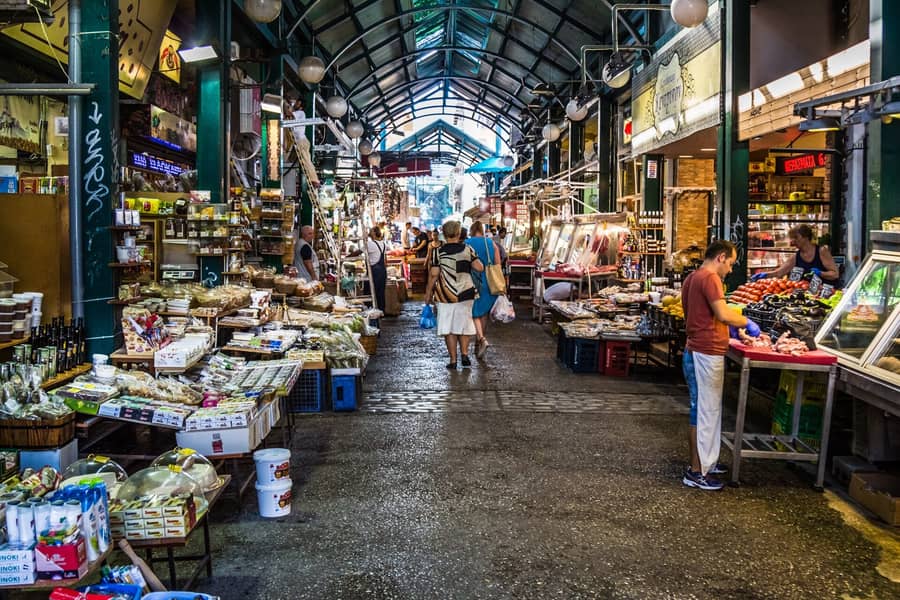
A Thessaloniki food tour walks through the market streets and old quarters of Thessaloniki, the port city of northern Greece, tasting the pastries, sweets and small plates the city is known for. This post covers what a Thessaloniki food tour includes, the markets, bougatsa and koulouri, the sweets, the history behind the food, Ladadika, meze and tsipouro, and the best season. More tours in Greece are listed on the Greece VIP homepage.
Each section ends with a Thessaloniki food tour that can be booked online.
What does a Thessaloniki food tour include?
A Thessaloniki food tour is an escorted walk through the old commercial centre, with stops at covered markets, bakeries and tavernas. Each stop adds a local dish or drink, so the Thessaloniki food tour works as a tasting of the city’s cooking.
Thessaloniki is the second-largest city in Greece and the capital of the geographic region of Macedonia. It stands on the Thermaic Gulf, at the northwest corner of the Aegean Sea, and its port makes it a transport hub for Greece and southeastern Europe. A Thessaloniki food tour starts from that port-city setting and moves from the market stalls in the centre to the tables where the produce is served.
The city also holds a title from UNESCO. The Creative Cities Network was launched in 2004 to link cities that treat culture and creativity as drivers of sustainable urban development, and Thessaloniki became the first Greek city to join it for gastronomy. The criteria for a City of Gastronomy include a vibrant community of traditional restaurants and chefs, and traditional food markets. A Thessaloniki food tour passes through exactly those places.
The food of the city kept an Eastern character. Thessaloniki stayed under Ottoman rule for about 100 years longer than southern Greece, and spices play a larger part in its cooking than they do in the southern regions. A Thessaloniki food tour gives a chance to taste that local character at the market stalls, in the bakeries and in the tavernas.
- Markets: Stalls sell fish, meat, vegetables, fruits, olives, nuts and spices.
- Bakeries: Bougatsa and koulouri serve as the breakfast and snack stops.
- Tavernas: Tavernas serve traditional meze and other local dishes.
- Setting: The route stays in the historic centre, around Aristotelous Square.
A Thessaloniki food tour therefore covers more than eating. It joins a port city, a UNESCO-recognised food scene and a working market district in one walk. The sections below cover the markets, the bakery stops, the sweets, the history of the food, the Ladadika district, meze and the best season for the route.


Which markets does a Thessaloniki food tour visit?
A Thessaloniki food tour visits two markets in the old commercial centre: the Modiano Market, an enclosed market hall, and the Kapani market, also called Agora Vlali, which is the oldest central market in the city. Both lie close together in the district named Kapani.
The Modiano Market, also called Stoa Modiano, is an enclosed market in the centre of Thessaloniki. It was built between 1922 and 1925, after the great fire, on the site of the old Talmud Tora synagogue. The market takes its name from the architect Eli Modiano, a member of the Italo-Jewish Modiano family, who owned the area and later the market. The office of his architectural practice was also inside the building, and a Thessaloniki food tour begins there.
Inside the stoa there are fish markets, butcher shops, tavernas and bars, and the building is a place of social meeting as well as a trading hall. The market forms the central point of the wider market district, which spreads across a group of city blocks. The building was restored and reopened on 5 December 2022, after the Hellenic Republic Asset Development Fund bought it. A Thessaloniki food tour uses the hall to show where local fish and meat are sold.
The Kapani market, known in Greek as Agora Vlali, is the oldest central market in Thessaloniki. Its shops sell fish, meat, vegetables, fruits, drinks, olives, sweets, nuts and spices, and the Modiano Market stands nearby. Among the criteria UNESCO sets for a City of Gastronomy are traditional food markets and a traditional food industry. A Thessaloniki food tour stops here for that reason, because the stalls show the local produce in daily use.
- Modiano Market: An enclosed stoa built between 1922 and 1925 on the site of the old Talmud Tora synagogue.
- Kapani market: The oldest central market in the city, also called Agora Vlali.
- Produce: Shops sell fish, meat, vegetables, fruits, olives, nuts, spices and sweets.
- Setting: Both markets stand close together in the old commercial centre.
Both markets sit in the old commercial centre, so a Thessaloniki food tour covers them on foot without leaving the historic core. The stops show how the city trades and eats: fish and meat at the stalls, produce along the aisles, and tavernas inside the Modiano building. The market stops also lead into the bakery and taverna stops that follow.
What is bougatsa on a Thessaloniki food tour?
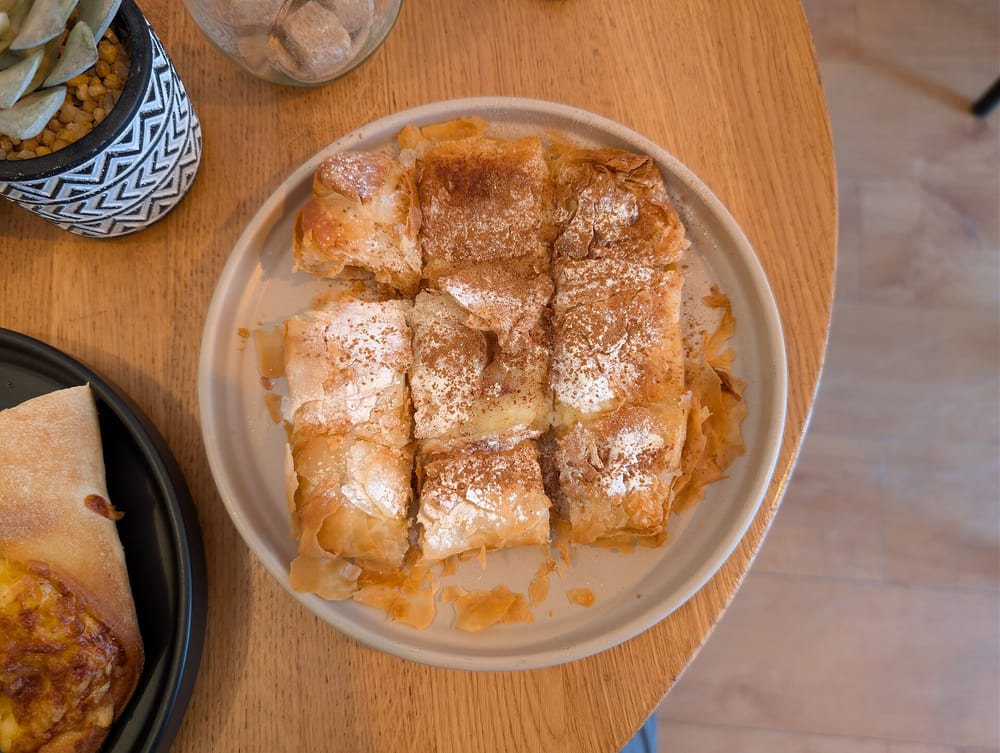
A Thessaloniki food tour includes bougatsa, a Greek breakfast pastry of filo wrapped around cream, cheese or minced meat. The modern version comes from Serres and Thessaloniki in northern Greece, and the koulouri, a sesame bread ring, is the matching snack.
Bougatsa is a Greek breakfast food, sweet or savoury, that is also eaten as a mid-morning or midday snack. The best-known version is bougatsa krema, with a filling of semolina custard. The name comes from the Byzantine Greek pogatsa, which goes back to a Roman term for hearth bread. A Thessaloniki food tour serves the local style, where the cream is crunchy and not very sweet, unlike the very sweet cream of Veria.
Bougatsa was a staple of the Cappadocian Greeks in the Byzantine Empire. Its modern version came from northern Greece, in particular from Serres and Thessaloniki. Traditional bougatsa is made from hand-made filo wrapped around a filling, baked, cut into small pieces and served hot on a small plate, dusted with icing sugar or cinnamon. Machine-made filo is now the norm, though hand-made bougatsa survives in cafes and bakeries.
The fillings vary. Besides cream, bougatsa comes with feta, mizithra cheese, spinach, spinach and feta, potato purée, apple, chocolate cream or minced meat, a mix of beef and pork or beef and lamb. Specialist shops called bougatsadika or bougatsopolia sell bougatsa exclusively, and a Thessaloniki food tour stops at one of these to taste the pastry served hot on a small plate.
The koulouri is a circular bread encrusted with sesame seeds. It has its origins in the Byzantine Empire, where it was known as kollikion. Constantine VII Porphyrogennitos first mentioned the kollikion in the 9th century, describing a small ring-shaped bread sold in Constantinople. In Greece the bread is still eaten regularly, and in Thessaloniki it is a popular snack, so a Thessaloniki food tour pairs it with the bougatsa.
- Cream: Bougatsa krema has a semolina custard filling, dusted with icing sugar or cinnamon.
- Cheese: A savoury version uses feta, and another uses mizithra cheese.
- Minced meat: The meat version is a mix of beef and pork or beef and lamb.
- Koulouri: The koulouri is a sesame bread ring eaten as a snack.
At the bakery stop, a Thessaloniki food tour shows how one pastry and one bread ring carry the history of the city. Bougatsa links Serres and Thessaloniki, while the koulouri goes back to the Byzantine Empire. Both are breakfast and snack foods, so they give the route a simple first taste before the sweets, the history, Ladadika and the meze.
Which sweets does a Thessaloniki food tour taste?
A Thessaloniki food tour tastes trigona from Panorama, tsoureki bread, and the syrup pastries of the north, such as baklava and kataifi. The sweets show how Ottoman rule, Asia Minor kitchens, and local bakers shaped the dessert table of the city.
Trigona is the sweet tied to Panorama, a suburb of Thessaloniki at the foot of Mount Chortiatis. Panorama is the seat of the municipality of Pylaia-Chortiatis, and its trigona counts among the notable sweets of the city, together with roxakia and kourkoubinia. On a Thessaloniki food tour, the sweets come after the breakfast pastries, and the tour leader sets the trigona beside a coffee so the group can taste it slowly.
Tsoureki is a sweet holiday bread made with flour, milk, butter, eggs, and sugar. Bakers season it with lemon and orange zest, mastic resin, or mahleb. In Greece the loaf belongs to Easter, and dyed red eggs are pressed into the dough. The name comes from the Turkish word çörek, which means round bread, so even the title of the loaf shows how closely Greek and Ottoman kitchens overlapped. A Thessaloniki food tour treats it as a sweet to taste, not only a festival loaf.
The syrup pastries on a Thessaloniki food tour start with filo and shredded dough. Baklava is a layered pastry of filo, chopped nuts, and syrup or honey. Greek baklava is flavored with cinnamon, and in the north it is made with walnuts. Kataifi is fine shredded dough, baked or fried and then soaked in sugar syrup. Macedonian cooking lists baklava from Asia Minor, a reminder of the Anatolian kitchens that fed into the region.
- Trigona: the sweet of Panorama, named among the notable sweets of Thessaloniki.
- Tsoureki: a sweet holiday bread of flour, milk, butter, eggs, and sugar.
- Baklava: layered filo with chopped nuts, sweetened with syrup or honey.
- Kataifi: fine shredded pastry dough, soaked in sugar syrup after baking or frying.
The sweet course works as a short lesson in the past of the city. Thessaloniki stayed under Ottoman rule about 100 years longer than southern Greece, and its kitchens kept an Eastern character, with spices playing a larger role than in the south. A Thessaloniki food tour therefore closes its sweet stops with a comparison of a soft festival bread and a crisp syrup pastry, each with its own story.
Which histories shaped a Thessaloniki food tour?
A Thessaloniki food tour follows three histories: the Byzantine and Ottoman city, the Sephardic Jewish community and its cooking, and the Greek refugees from Asia Minor who arrived after the 1923 population exchange. Each layer left dishes, spices, and habits at the table.
Thessaloniki was the second city of the Byzantine Empire after Constantinople, with a population of 150,000 in the mid-12th century. The Ottoman Sultan Murad II captured it on 29 March 1430, and Ottoman rule ended on 8 November 1912. Because the city stayed Ottoman about 100 years longer than southern Greece, spices and Eastern tastes still run through its cooking, a contrast that readers can set against the Athens food tour. A Thessaloniki food tour reads those centuries from the plate.
Sephardic Jews arrived after Spain expelled them under the Alhambra Decree of 1492, and nearly 20,000 settled in Greece. In 1519 Ottoman records counted Jews as 54 percent of the city, and Thessaloniki became the largest Jewish city in the world. Their cooking, a strand of every Thessaloniki food tour, was a variant of Judeo-Spanish cuisine. Fish was eaten fried, baked, marinated, and braised, and chamin, a stew of meat, wheat, chickpeas, and white beans, simmered for the Sabbath meal.
The Convention Concerning the Exchange of Greek and Turkish Populations was signed at Lausanne on 30 January 1923. Over 160,000 Greeks from Asia Minor and East Thrace were resettled in Thessaloniki, which changed the makeup of the city. The refugees brought Anatolian customs, cuisine among them, and Macedonian cooking still lists Anatolian and Constantinopolitan elements from that wave, which a Thessaloniki food tour meets at the table. The Great Fire of 1917 had already destroyed the old centre, so the arrivals settled in a city under reconstruction.
- Byzantine: the second city of the empire, ranked behind Constantinople.
- Ottoman: rule from 1430 to 1912 left spices and Eastern tastes in the kitchen.
- Sephardic: settlers after 1492 brought Judeo-Spanish cooking, fish dishes, and the Sabbath stew that a Thessaloniki food tour describes.
- Refugees: the 1923 exchange brought over 160,000 Greeks from Asia Minor and East Thrace to the city.
These histories explain why no plate on the route has one origin. Byzantine trade, Ottoman spice, Sephardic fish dishes, and Anatolian recipes share the same kitchens. Deportations began in 1943 and nearly destroyed the Jewish community, so a Thessaloniki food tour cannot tell the story without that loss. UNESCO has named Thessaloniki a City of Gastronomy, which recognizes how much history sits inside the food.
Why does a Thessaloniki food tour end in Ladadika?
A Thessaloniki food tour ends in Ladadika because the old oil-merchant district by the port now holds restored buildings, tavernas, and bars within pedestrian streets and small squares. The former oil stores and merchant warehouses give the route a natural close, with a table and a drink.
Ladadika is a historic district of Thessaloniki near the port, and for centuries it ranked among the leading marketplaces of the city. Its name came from the olive oil shops that filled the area. Jewish families lived there, and the Frankish district, home to French and Italian merchants, lay beside it. A Thessaloniki food tour ends here because the quarter was a place where olive oil, spices, and other foodstuffs were traded.
The Ministry of Culture listed Ladadika as a heritage site in 1985, and its 19th-century buildings are preserved and protected. After the 1978 earthquake and into the early 1980s, the warehouses and shops were gradually abandoned, and the area declined. Regeneration began in the early 1990s, and the buildings were saved from demolition. The street layout and the old facades remain, which gives a Thessaloniki food tour a setting that matches the food on the table.
Today Ladadika forms the entertainment district of the city. Bars, nightclubs, restaurants, and pubs fill the old oil stores and merchant warehouses, and they spill out into pedestrian streets and small squares such as Morichovou Square. Tavernas in the district serve traditional meze, so a Thessaloniki food tour finds a full table there. Critics note that the trade of the harbour marketplace has shrunk to a minimum, so the district now works as a place for leisure more than for commerce.
- Location: beside the Port of Thessaloniki, with Tsimiski, Salaminas, Kountourioti, and I. Dragoumi Streets around its core.
- Name: taken from the olive oil shops that once filled the district.
- Protection: listed as a heritage site by the Ministry of Culture in 1985.
- Today: bars, nightclubs, restaurants, and pubs in former oil stores and warehouses, where a Thessaloniki food tour ends.
Ending in Ladadika gives the route a clear shape, since it finishes where the city once traded oil and spices. The group sits down in a restored warehouse district with a drink, and the evening can run on from there, because Thessaloniki is known as the city that never sleeps. For a Thessaloniki food tour, the district joins the past of the port with the table of the present.
Which meze and drinks does a Thessaloniki food tour pour?
A Thessaloniki food tour pours tsipouro and ouzo, two Greek spirits, and serves them with meze, which are small plates of cheese, olives, seafood and meat. The plates are shared at the table and the drinks are sipped slowly over the meal.
Tsipouro is a strong, un-aged brandy made from grape pomace, the residue left behind by the winepress. Its strength runs from 40 to 45 percent by volume. Double distillation is typical, and the maker discards the first and last batches of each run, keeping only the middle batch, known as the heart. The anise version is newer and arrived during the 1900s.
Depending on the time of year, tsipouro works as a refreshment or as a hot drink, and depending on the time of day, it replaces coffee or wine. Greek makers advise pouring it straight from the fridge, while other drinkers dilute it with water or add ice. The glass is a shot glass, and a small dish of meze sits beside it. A Thessaloniki food tour follows this habit of pairing each pour with a bite.
Ouzo is the second spirit of a Thessaloniki food tour, a dry aperitif that tastes of anise. Makers distil rectified spirit with anise and extra flavours such as star anise, fennel, mastic, cardamom, coriander, cloves and cinnamon. The finished drink runs between 42 and 55 percent by volume, with 40.5 percent as the minimum allowed. Poured neat, it is clear, and a splash of water or a cube of ice clouds it to milky white, a change called louching.
Anise tsipouro and ouzo taste almost identical, yet ouzo starts from a 96 percent rectified spirit, while tsipouro keeps the aroma of the pomace. Both suit ouzeries, the café-like venues of Greece, where ouzo comes with mezedes, the plural of meze. The custom is to sip it slowly in the early evening and share the plates with others. The same slow rhythm shapes a Thessaloniki food tour, where one small tasting follows another.
- Tsipouro plates: Nuts, dried fruit, raisins, cheese, olives, seafood, meat, halva and paximadi, a rusk, come beside a shot glass of tsipouro.
- Ouzo plates: Small fresh fish, fries, olives and feta come with ouzo.
- Cheese: Saganaki, a fried or grilled cheese, shares the table with cubes of cheese from sheep, goat or cow milk.
- Seafood: Fried whitebait, calamari and grilled octopus stand among the fish plates of a meze spread.
A Thessaloniki food tour ties these drinks to the city’s own table. Thessaloniki stayed under Ottoman rule for about 100 years longer than southern Greece, and its cooking kept an Eastern character, with spices playing a larger part than they do in the south. Tsipouro and ouzo arrive beside plates that share that character, so the spirit and the food form one tasting.
When is the best season for a Thessaloniki food tour?
A Thessaloniki food tour fits spring and autumn best, when the city sits between cold winters and hot summers. July and August average 28 degrees Celsius downtown, while January averages 8, so the months between suit long walks along the waterfront.
Winters in the city are somewhat dry, with occasional morning frost. Each winter brings snowfall, and the white cover melts within days. The city logs 32 days of sub-zero frost in an average year. About 17 days a year are foggy, and they cluster in the autumn and winter months. January is the coldest month, and a winter Thessaloniki food tour meets wind of about 11 km/h in January and February.
Hot, moderately dry weather defines the summer. Daytime highs climb above 30 degrees Celsius, and the average number of days above 32 degrees is 32. Air blowing in off the Thermaic Gulf takes the edge off the heat. Rain falls in summer mainly during thunderstorms. July and August stay the hottest months. A Thessaloniki food tour in those months meets the peak of that heat.
The waterfront promenade, called Nea Paralia, runs for 3 km along the coast from the White Tower to the concert hall and holds 12 thematic gardens. In summer, Thessalonians fill it for long evening walks, a habit known as volta. The averages of 8 and 28 degrees leave the spring and autumn months between the two extremes, which suits a Thessaloniki food tour that links one tasting to the next on foot.
Two events add fixed dates to the calendar. The feast day of Saint Demetrius, the patron saint of the city, falls on 26 October, and the Dimitria festival, founded in 1966, carries his name with music, theatre, dance and exhibitions. The Thessaloniki International Fair has been held in the first week of September since 1926, and similar trade fairs ran in the city as far back as the Byzantine era.
- Winter: January averages 8 degrees Celsius in downtown Thessaloniki, with wind and frost.
- Summer: July and August average around 28 degrees Celsius, softened by the sea breeze.
- Early September: The Thessaloniki International Fair is held in the first week of the month.
- Late October: The feast day of Saint Demetrius falls on 26 October.
Timing a Thessaloniki food tour comes down to the weather and the calendar. Cold winters bring frost and wind, hot summers bring highs above 30 degrees, and the Thermaic Gulf breeze softens the worst of the heat. The fair in September and the feast of Saint Demetrius in October give the year fixed points, while spring and autumn sit between the extremes.
What do travelers ask about a Thessaloniki food tour?
A Thessaloniki food tour takes place in a city on the Thermaic Gulf in northern Greece, reached by air through Makedonia Airport and by rail through the main station. Travelers also ask about the White Tower, the landmarks near the old markets and a Vergina trip.
How do travelers reach the start of a Thessaloniki food tour by air or rail?
Travelers bound for a Thessaloniki food tour land at Thessaloniki Airport, called Makedonia, 13 km southeast of the city in Thermi, which serves the Athens route, one of the busiest in the EU. The main railway station stands on Monastiriou Street, and Hellenic Train runs long-distance services from it to Athens, Larissa, Florina and Alexandroupolis.
What is the White Tower that travelers ask about on a Thessaloniki food tour?
The White Tower is a monument and museum on the Thessaloniki waterfront, a cylinder 34 m high. The Ottomans built it after 1430 as a prison and place of execution, earning the names Red Tower and Tower of Blood. A convict whitewashed it in 1890, and it has stood as the symbol of the city since 1912.
Which landmarks stand near the old market streets on a Thessaloniki food tour?
Kapani, Agia Sofia and Rotonda are districts around Aristotelous Square, the main city square, which Ernest Hébrard designed in 1918 after the Great Fire of 1917. The Rotunda of Galerius, an early fourth-century monument, and the Church of St. Sophia belong to the UNESCO group of Thessaloniki monuments listed in 1988.
Can a Thessaloniki food tour pair with a Vergina day trip on another day?
A Thessaloniki food tour and a Vergina day trip can share one stay because the two cover different ground. The food tour stays in the city, while Vergina in Imathia marks the site of ancient Aigai, first capital of Macedon, where researchers uncovered three tombs in 1977, and a museum now houses the finds.
Featured photo: zorand, CC0, via Wikimedia Commons.