A Vergina day trip travels from Thessaloniki to Vergina in northern Greece, the site of Aigai, the first capital of ancient Macedon, where the royal tombs lie under a great earth mound. This post covers what a Vergina day trip includes, Aigai, the museum of the royal tombs, the discovery, the palace and theatre, Pella and the best season. It is one of the best tours in Greece on Greece VIP.
Each section ends with a Vergina day trip that can be booked online.
What does a Vergina day trip cover?
A Vergina day trip covers the small town of Vergina in Imathia, northern Greece, and the remains of ancient Aigai, the first capital of Macedon. It takes in the museum of the royal tombs and the ruins of a site on the UNESCO World Heritage List.
The town of Vergina lies in Imathia, Central Macedonia, within the municipality of Veroia. The modern town dates from 1922. Greek families from Asia Minor settled it during the population exchange that followed the Treaty of Lausanne. The metropolitan of Veroia proposed the name, after a legendary queen called Vergina. The town was its own municipality until 2011, when it joined Veroia. A Vergina day trip takes its name from this small town.
At the centre of a Vergina day trip lies ancient Aigai. Its remains spread across the Haliacmon valley, on the foothills of the Pierian Mountains, between Vergina and Palatitsia. The site faces the central Macedonian plain. UNESCO inscribed the archaeological site of Aigai on the World Heritage List in 1996. The listing presents Aigai as evidence of the move from the classical city-state to the imperial structure of the Hellenistic and Roman periods.
The Museum of the Royal Tombs of Aigai lies 75 km west of Thessaloniki, so a Vergina day trip from the city covers that distance in each direction. Today the ancient city holds an archaeological site and two museums. On the ground, the visit links the royal tombs under the Great Tumulus with the excavated palace and theatre. Three major archaeological missions have worked at Aigai, from the 1860s to restoration work in the 2000s.
- Old villages: The modern town was founded between two older villages, Kutlesh and Barbes.
- Modern town: In 2011, 1,242 people lived in Vergina itself, out of 2,464 in the former municipality.
- Rediscovery: Aigai was abandoned in the 3rd century AD and found again in the 19th century.
A Vergina day trip joins the modern town with the ancient city around it. Before the finds at Vergina, scholars placed Aigai at Edessa, and the French excavator of the 1860s linked the ruins to a city called Valla. That view held until 1976. Today the royal tombs, the palace and the theatre are all identified as parts of Aigai, and a Vergina day trip covers each of them.


Why was Aigai the first capital on a Vergina day trip?
A Vergina day trip visits Aigai, the original capital of Macedon. Ancient writers tied its founding to Perdiccas I, who followed an oracle from Delphi. The capital later moved to Pella, but Aigai remained the sacred city and burial place of the kings.
Macedon, the kingdom of the Argead dynasty in Lower Macedonia, had its first seat of power at Aigai. According to historian Robert Malcolm Errington, an early Argead king set up the capital here in the mid-7th century BC. Herodotus traces the royal house to Perdiccas I, who fled from Argos in about 650 BC. Aigai grew as a set of villages around a walled acropolis, so a Vergina day trip crosses ground that never held one large city.
The name Aigai comes from the ancient Greek word for goat and means ‘goat town’. Diodorus Siculus wrote that the Pythia at the Oracle of Delphi told Perdiccas I to found his city at the spot where goats with white horns rested at dawn. Thucydides backs the same story, which served as the official founding myth in the 5th century BC. On a Vergina day trip, this oracle explains the name of the site, called Aiges in modern Greek.
At the start of the 4th century BC, Archelaus moved the capital northeast to Pella. Aigai kept its role as a ceremonial and religious centre, home to the old cult sites, a royal palace and the royal tombs. It remained the burial place of the kings, and one of the first acts of Alexander the Great as king was to bury his father here. This role explains why a Vergina day trip centres on royal graves.
- Persian period: From 513 to 480 BC, Aigai was part of the Persian Empire, though Amyntas I kept relative independence.
- Euripides: The playwright wrote and staged his last tragedies at Aigai.
- Roman conquest: In 168 BC the Romans overthrew the kingdom and destroyed both the old and the new capitals.
The tumuli cemetery at Aigai stretches for more than 3 km and contains over 500 burial mounds, with graves going back as far as the 11th century BC. In the 3rd century BC, Gallic mercenaries serving Pyrrhus plundered the royal cemetery. On a Vergina day trip, these mounds show how long Aigai served as a burial ground.
What is inside the museum of the royal tombs on a Vergina day trip?
A Vergina day trip enters an underground museum inside the Great Tumulus, where the tombs stay in place. The tomb attributed to Philip II held a gold larnax marked with the Vergina Sun, along with gold wreaths, armour and silver vessels.
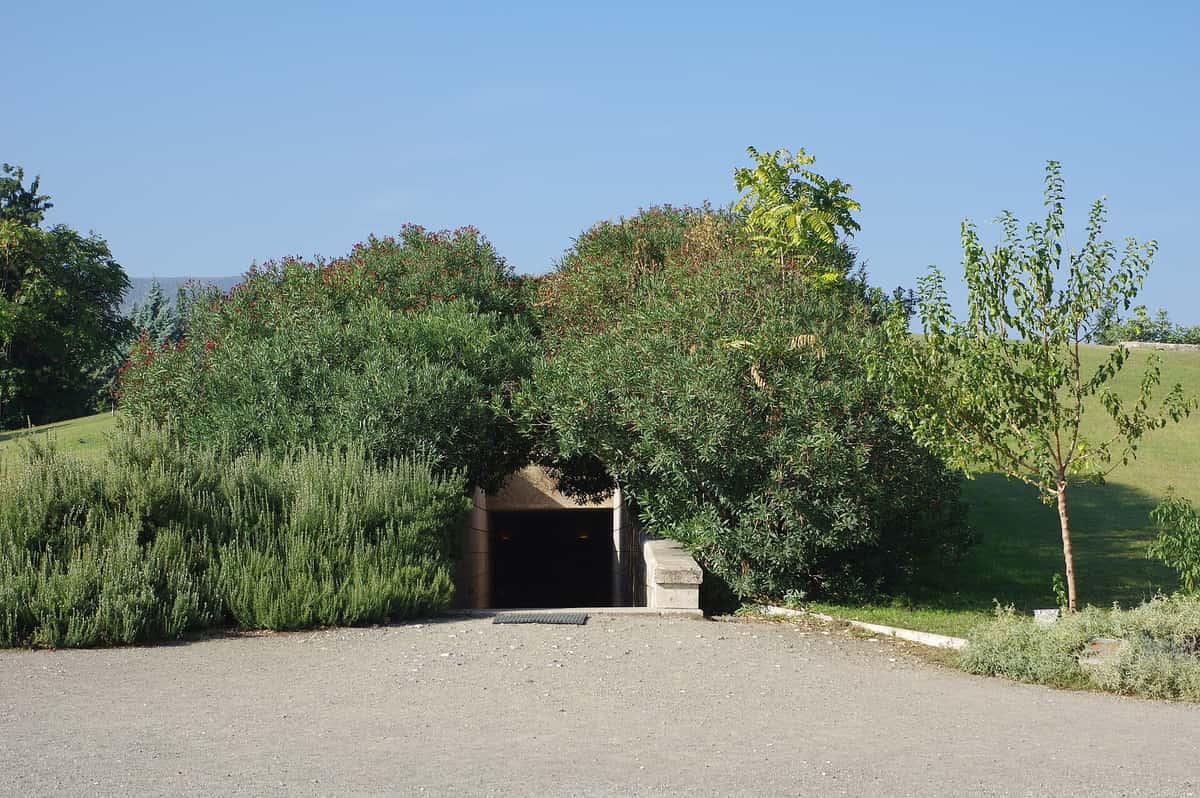
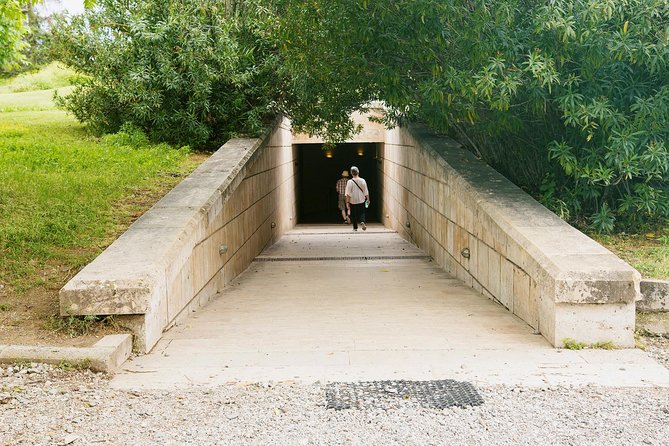
The museum was built over the royal tombs, which stayed where they were found. The structure restores the outline of the mound as it stood before the excavations. The mound dates from the early 3rd century BC, when Antigonos Gonatas raised it to protect the royal tombs from further looting. Inside it, a Vergina day trip reaches four tombs and a small heroon, a temple for the burial cluster of Philip II.
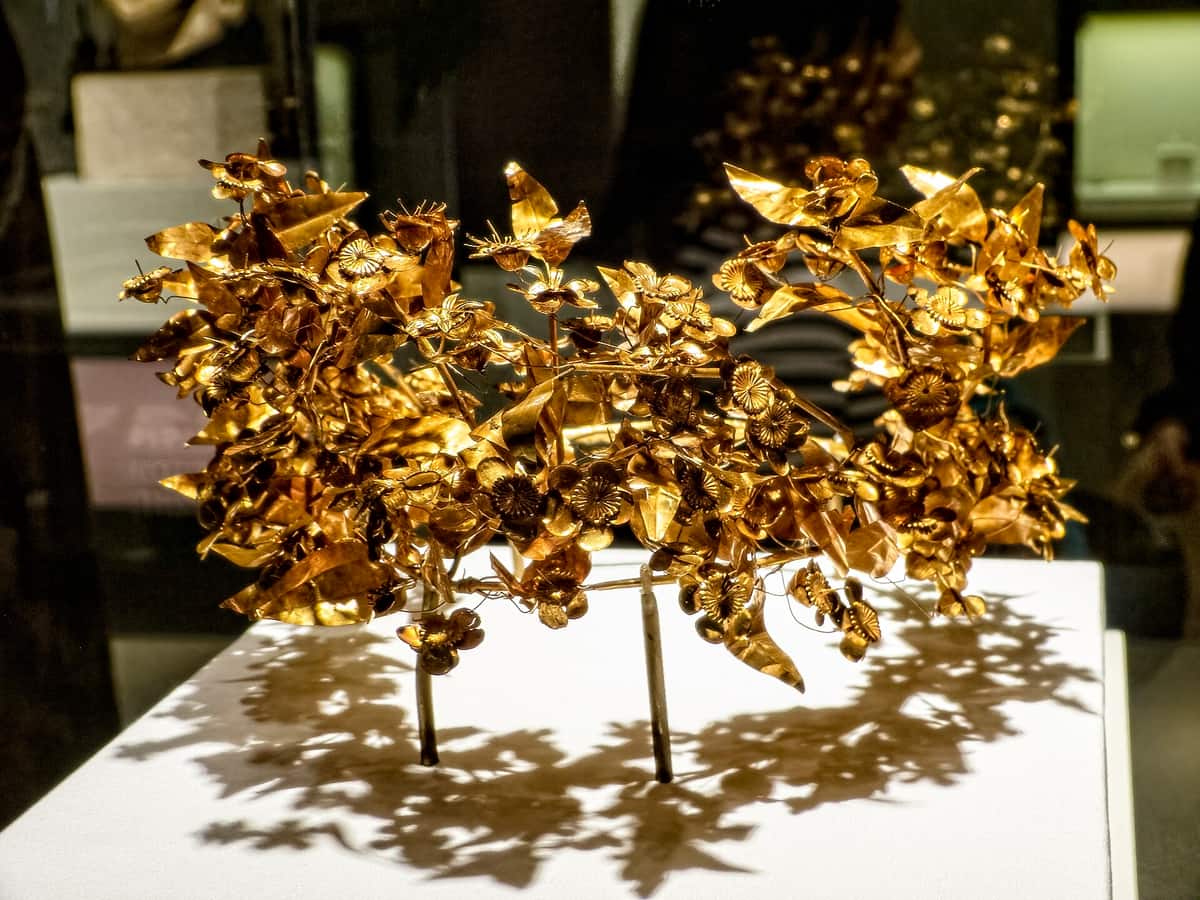
The main room of the tomb attributed to Philip II held a marble chest, and inside it sat the Golden Larnax. This box is made of 24-carat gold, weighs 11 kilograms and bears the Vergina Sun on its lid. The bones of the dead lay inside, together with a gold wreath of 313 oak leaves and 68 acorns weighing 717 grams. A Vergina day trip shows both objects in the museum.
The Vergina Sun is a solar symbol with sixteen triangular rays. It is also called the Star of Vergina or the Argead Star, a possible royal emblem of the Argead dynasty. The name spread after the excavations of the late 1970s. In February 1993, the Greek parliament made it an official national symbol, and it appears on Greek passports and driving licences. Visitors on a Vergina day trip see the symbol on the original larnax.
- Antechamber: A second gold larnax held the bones of a woman wrapped in gold and purple cloth.
- Hunting scene: A wall painting measuring 5.6 metres runs above the Doric entrance of Tomb II.
- Tomb III: A silver hydria held the cremated bones, with a gold oak wreath placed on it.
The museum presents its finds in four connected areas, including the burial cluster of Philip II and the royal burial cluster of the Temenid dynasty. The single wall painting in Tomb I shows the abduction of Persephone by the god of the Underworld, attributed to Nicomachus of Thebes. A Vergina day trip also covers ivory ornaments from the funeral couch and jewellery from the other tombs.
Who found the royal tombs on a Vergina day trip?
A Vergina day trip leads to tombs found by Manolis Andronikos, a Greek archaeologist who taught at the Aristotle University of Thessaloniki. In 1977 he excavated the Great Tumulus and uncovered four tombs, two of them undisturbed since antiquity and filled with burial goods.
Manolis Andronikos was born in Bursa on October 23, 1919, and his family later settled in Thessaloniki. He studied philosophy at the Aristotle University of Thessaloniki and continued his training at Oxford under Sir John D. Beazley from 1954 to 1955. He returned to the same university in 1957 to teach archaeology. His teacher, K. Rhomaios, had founded the university excavation at Vergina in 1937, so a Vergina day trip covers the work of two generations of scholars.
Andronikos believed the hill known as the Great Tumulus covered the graves of the Macedonian kings. On November 8, 1977, he reached an unplundered tomb that held a golden larnax. He identified this grave, Tomb II, as that of Philip II, father of Alexander the Great. He linked Tomb III to Alexander IV, the son of Alexander the Great and Roxana. A Vergina day trip passes both tombs inside the museum.
The identification of Tomb II started a long debate. Supporters point to a pair of greaves, one shaped for a leg with a misaligned tibia, and records state that Philip II broke his tibia. The skull shows damage to the right eye, which the historical record links to an arrow. A study of the skeletons in 2010 backed Andronikos. In 2015, two scientists placed Philip in Tomb I, and the Greek Ministry of Culture called the claim baseless.
- First dig: Léon Heuzey began excavations in 1861 with support from Napoleon III, but the risk of malaria stopped the work.
- War years: Digging stopped in 1940 when war with Italy broke out, and Andronikos resumed it in 1949.
- Exhibition: Finds now seen on a Vergina day trip toured four cities in the United States from 1980 to 1982.
Studies still disagree. In 2023, a study led by Antonios Bartsiokas of the Democritus University of Thrace placed Philip II in Tomb I, Philip III, half-brother of Alexander the Great, in Tomb II and Alexander IV in Tomb III. Andronikos died on March 30, 1992, years before these studies. Whichever king lies in Tomb II, a Vergina day trip shows the royal tombs that Andronikos brought to light.
What does the palace of Aigai show on a Vergina day trip?
A Vergina day trip reaches the palace of Aigai, the largest building of classical Greece, on a plateau directly below the acropolis. Next to it lies the theatre where Philip II was killed in 336 BC and where his son Alexander was proclaimed king.
The palace stood two stories high, possibly three, around a large open courtyard flanked by Doric colonnades. A large gallery on the north side looked on the stage of the neighbouring theatre and over the whole Macedonian plain. Excavations date the building to the reign of Philip II, though the king also kept a palace at Pella. The theatre, from the second half of the 4th century BC, was closely tied to the palace, so a Vergina day trip sees the two as one complex.
The rooms had mosaic floors, painted plastered walls and fine relief tiles, and high-quality marble stucco covered the masonry. A landslide in the 1st century AD left about 3–4 m of soil over the ruins and preserved them. Restoration teams have since rebuilt nearly 30 large columns of the main peristyle, the tallest rising to 25 ft, and conserved over 5,000 square feet of mosaics, including the ravishing of Europa. The palace reopened to the public after a 16-year restoration project.
In October 336 BC, the royal court gathered at Aigai for the wedding of Cleopatra, the daughter of Philip II and Olympias, to King Alexander of Epirus. Philip entered the theatre unprotected, to appear approachable to the Greek diplomats and dignitaries present. Pausanias of Orestis, one of his seven bodyguards, stabbed him in the ribs. The assassin ran for the horses waiting at the entrance to Aigai, but his horse tripped on a vine, and three other bodyguards killed him. A Vergina day trip passes the same theatre.
- Rank: The palace is counted, together with the Parthenon, among the key buildings of classical Greece.
- Architect: One proposal names Pytheos of Priene, known for the Mausoleum at Halicarnassus, as its designer.
- Date: Philip II died in October 336 BC, possibly on 25 October, at the theatre that a Vergina day trip visits.
- Motive: Aristotle, author of the only known surviving contemporary account, says Pausanias had been offended by Attalus and his friends.
On a Vergina day trip, the palace and the theatre of Aigai tell the political story of the kingdom, next to the burial story of the tombs. The palace dates from the reign of Philip II, and its courtyard, colonnades and mosaics show the scale of his court. The theatre beside it marks the end of his reign and the start of the reign of Alexander the Great.
Why does a Vergina day trip add Pella?
A Vergina day trip adds Pella because the two sites tell the story of one kingdom. Aigai was the first capital of Macedon, and Pella replaced it in the 4th century BC. Pella was also the birthplace of Philip II and Alexander the Great.
At the beginning of the 4th century BC, King Archelaus moved the capital of Macedon north-east from Aigai to Pella, while Aigai remained the burial place of the kings. Pella was then a port, linked to the Thermaic Gulf by a navigable inlet, but the harbour has since silted up and the ruins now lie inland, 1 km outside the modern town of Pella. Philip II was born there in 382 BC and Alexander the Great in 356 BC.
Pella grew into the largest and richest city in Macedonia, and its pebble-mosaic floors are its best-known finds. Excavations begun in 1957 revealed large houses with colonnaded courts and mosaic floors. The scenes include a lion hunt, Dionysus riding a panther and a lion-griffin attacking a stag. These floors decorated rich houses named after their images, such as the Houses of Helen and Dionysus. A Vergina day trip that adds Pella finds mosaic floors from the House of Dionysus in the museum.
The Archaeological Museum of Pella stands on the site of the ancient city, near the remains of the palace. The architect Kostas Skroumpellos designed it, and it was completed in 2009. Its rectangular atrium recalls the central peristyle courtyard of the ancient houses of Pella. At the entrance stand a head considered a portrait of Alexander the Great and a statuette of the god Pan. The last gallery covers the palace and the life and personality of Alexander.
- Theatre history: Euripides finished his days at Pella, and his Bacchae was first staged there about 408 BC.
- Sanctuaries: Mosaics, inscriptions and vases come from the sanctuaries of Darron, of the Mother of Gods and Aphrodite, and the Thesmophorion.
- Cemeteries: Finds from burials of the Bronze Age to the Hellenistic period show that the residents spoke Doric Greek.
- Palace: The Pella palace, on a 70 m hill, covered 75,000 square metres and has opened to the public, a second royal palace on a Vergina day trip.
A Vergina day trip that adds Pella follows the kingdom from its first capital to its second. Aigai keeps the royal tombs and the palace where Alexander became king, while Pella keeps his birthplace, its mosaic floors and a palace that served as a seat of government as well as a royal residence. Both palaces have parts from the time of Philip II.
When is the best season for a Vergina day trip?
A Vergina day trip suits spring and early autumn, the months between the January cold and the July and August heat of Central Macedonia. Imathia, the regional unit of Vergina, has a mainly Mediterranean climate, with warm, dry summers and mild, wet winters.
Thessaloniki has a transitional climate, cold semi-arid across the city and hot semi-arid in the centre. Its summers are hot and moderately dry. Daily highs rise above 30 °C but rarely pass 40 °C, and on average 32 days a year go above 32 °C. July and August are the hottest months, with a 24-hour average of around 28 °C, while a sea breeze from the Thermaic Gulf moderates the heat. A Vergina day trip in July or August meets this heat.
Winters in Thessaloniki are somewhat dry, with morning frost on certain days. January is the coldest month, with a 24-hour average of 8 °C in the city centre, and frost comes on 32 days a year on average. Fog appears on about 17 days a year, mainly in autumn and winter, and January and February bring average winds of about 11 km/h. Snow falls more or less every winter, but the cover lasts only days.
Veria, the capital of Imathia, has a Mediterranean climate that borders on cold semi-arid. Its summers run from April to October, hot and dry, with rain mainly in thunderstorms. Winters, from mid-October to March, are wet and cool, but temperatures stay above freezing, and snow falls once or twice a season. The Ottomans named the town Karaferye, or “black Veria”, after its morning mist in the humid winter months. Travelers on a Vergina day trip in winter meet the same wet, cool pattern.
- Dry winds: The Pindus range dries the westerly winds and keeps the climate around Thessaloniki dry.
- Records: Thessaloniki has recorded a high of 44 °C and a low of −14 °C.
- Festivities: A Vergina day trip from 15 August to 15 September coincides with the Imathiotika festivities in Veria.
For a Vergina day trip, spring and early autumn avoid both the July and August peak and the cold, windy weeks of January and February. Summer visits meet high heat, eased in Thessaloniki by the sea breeze, while winter visits meet frost, fog and the chance of snow. Fog days fall mainly in autumn and winter, which favours spring and the early weeks of autumn.
What do travelers ask about a Vergina day trip?
A Vergina day trip reaches a site 12 km south-east of Veria, in the valley of the Haliacmon, the longest river flowing entirely in Greece. The Vergina Sun found there now marks Greek passports, and Mount Athos rises on the Chalkidiki peninsula of central Macedonia.
Which city lies near the site of a Vergina day trip?
On a Vergina day trip, the nearby city is Veria, whose municipality has included Vergina since 2011. The site lies 12 km south-east of the city centre, between the towns of Vergina and Palatitsia. Veria lies 73 km west-southwest of Thessaloniki, and the discovery of the tomb of Philip II made it a tourist destination.
Which river runs near the site of a Vergina day trip?
The Haliacmon, or Aliakmonas, runs through the valley where Aigai stood, on the foothills of the Pierian Mountains. At 297 km, it is the longest river of Greece flowing entirely on Greek soil. South-east of Veria it enters the central Macedonian plains and ends in the Thermaic Gulf. Julius Caesar described it as the border between Macedon and Thessaly.
Where does the sun symbol seen on a Vergina day trip appear today?
The Vergina Sun, a symbol with sixteen triangular rays, became an official Greek national symbol in February 1993. On a blue background, it serves as the emblem of the three administrative regions of Greek Macedonia. It also appears on the Greek driving license and as a watermark across pages 22 and 23 of Greek passports.
Can a Vergina day trip pair with a Mount Athos cruise on another day?
Yes. Mount Athos rises on the Athos peninsula, the easternmost leg of Chalkidiki in central Macedonia, so a Mount Athos cruise fits a separate day. Its monastic community joined the UNESCO World Heritage List in 1988, and Aigai followed in 1996. Women are barred from the area that the monks govern, and visitors arrive by boat from Ouranoupoli.
Featured photo: Berthold Werner, CC BY-SA 3.0, via Wikimedia Commons.