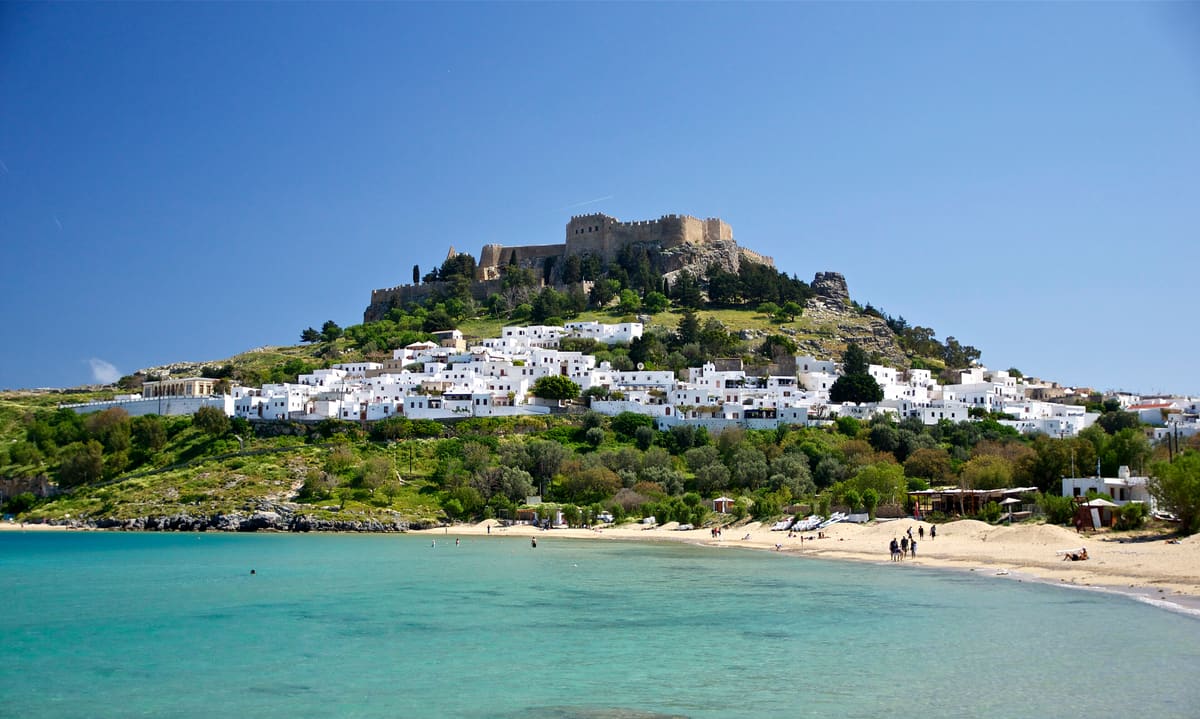
A Lindos tour leads to the village of Lindos on the east coast of Rhodes, with its acropolis above the sea, its white houses and its bays. This post covers what a Lindos tour includes, the acropolis, the village, the beaches, the trip from Rhodes town, the boat trips and the best season. More Greece tours are listed on the Greece VIP homepage.
Each section ends with a Lindos tour or ticket that can be booked online.
What does a Lindos tour cover?
A Lindos tour covers four parts: the trip from Rhodes town, the acropolis on the rock above the town, the lanes of the fishing village below it, and the bay and beaches on the east coast of the island of Rhodes.
Lindos lies on the east coast of Rhodes, in the Dodecanese, Greece. It is an archaeological site and a former municipality. Since the 2011 local government reform, it has formed a municipal unit of the municipality of Rhodes, with an area of 178.9 km2 that also takes in Kalathos, Laerma, Lardos and Pylona. A Lindos tour, however, keeps to the town itself and the rock that rises over it.
The rock is the acropolis of Lindos, a natural citadel above the modern town. Greeks, Romans, Byzantines, the Knights of St John and the Ottomans fortified it in turn. Those layers make the site hard to dig and to read, so a licensed tour leader helps a group on a Lindos tour sort the periods. From the summit, the view takes in the harbours and the coastline.
Below the rock lies the village, and around both lies the bay. Lindos stands in a large bay and faces Charaki, a fishing village and small resort 10 km to the north. Its fine beaches have turned Lindos into a popular spot for tourists and holidays. A Lindos tour therefore mixes ancient stones, the lanes of the village and the shore of the bay.
A Lindos tour from Rhodes town heads about 40 km south. The route joins two old cities of the island. In ancient times Lindos, Ialysus and Camirus were the three Rhodian members of the Dorian Hexapolis, a league of six cities. Lindos declined in importance once the city of Rhodes was founded in the late 5th century BC. Today the trip links the newer city with the older town.
- Acropolis: The rock holds the Temple of Athena Lindia, a Hellenistic stoa and a castle of the Knights of St John.
- Village: Whitewashed homes and a 14th-century chapel stand in the town below the rock.
- Bay: Fine beaches line the large bay that faces Charaki.
Each stop on a Lindos tour adds a different period of history. The acropolis shows Greek, Roman, Byzantine and Knights’ work on one rock. The village shows the fishing town that grew at its foot. The bay shows the coast that now draws holidaymakers. Seen together, the parts trace Lindos from a Dorian city to a modern resort.



What does a Lindos tour see on the Acropolis of Lindos?
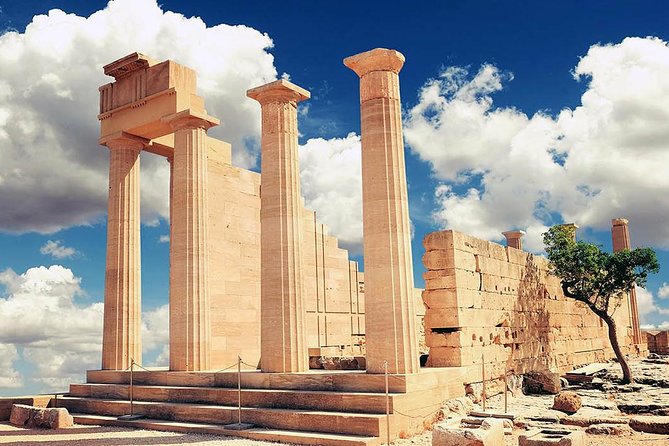
A Lindos tour on the acropolis sees the Doric Temple of Athena Lindia, the Hellenistic stoa of 42 columns, the castle of the Knights of St John and the relief of a Rhodian warship carved into the rock at the base of the stairs.
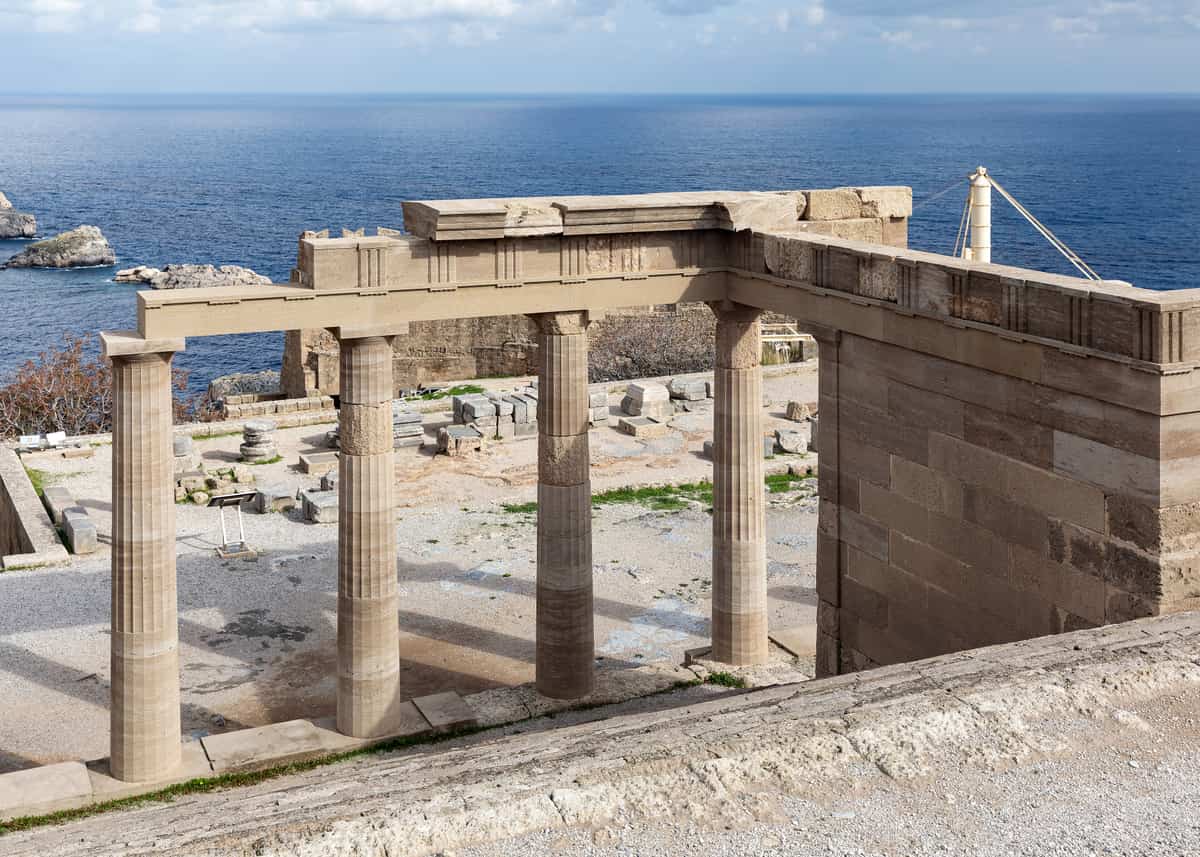
The climb on a Lindos tour starts at the foot of the steps, where a Rhodian trireme, a type of warship, is carved into the rock face. The relief dates from about 180 BC. A statue of General Hagesander once stood on its bow, made by the sculptor Pythokritos. From there, a Hellenistic staircase of the 2nd century BC leads up to the main archaeological area of the site.
A Lindos tour also covers the castle of the Knights of St John, who fortified the acropolis to guard Rhodes against the Ottomans. The castle rose before 1317 on older Byzantine fortifications, and its walls and towers follow the line of the cliff. A pentagonal tower on the south side controlled the harbour, the settlement and the road from the south. Today a tower at the southwest corner and one on the west survive.
The Hellenistic stoa seen on a Lindos tour dates from about 200 BC. It ran 87 metres, carried 42 columns and had wings projecting at each side. The Propylaea of the sanctuary are older, from the 4th century BC; their staircase climbs to a D-shaped stoa and a wall with five doorways. A Hellenistic wall of the same age rings the acropolis. A Roman inscription credits P Aelius Hagetor, priest of Athena in the 2nd century AD, with repairs to the wall and its towers.
At the top, a Lindos tour reaches the Doric Temple of Athena Lindia, from about 300 BC, which stands on the site of an earlier temple of the 6th century BC. The later building measured 7.75 by 21.65 m. Inside lie the table of offerings and the base of the cult statue. Alexander the Great offered sacrifices at the temple and dedicated weapons after his victories. The Lindos Chronicle, an inscription of 99 BC, lists earlier gifts made there.
- Roman temple: Remains of a Roman temple from about 300 AD, possibly for the Emperor Diocletian, survive on the acropolis.
- Church: The Greek Orthodox Church of St John dates from the 13th or 14th century.
- Victory base: The sanctuary held a smaller offering of the same type as the base of the Winged Victory of Samothrace.
What a Lindos tour sees today is partly a rebuild. The Carlsberg Institute of Denmark dug the site down to bedrock between 1900 and 1914, under Karl Frederik Kinch and Christian Blinkenberg. During the Italian occupation from 1912 to 1945, workers rebuilt the staircase to the propylaea, set columns of the stoa back up and covered large surfaces with concrete. Greek and international teams now restore and protect the remains under the Greek Ministry of Culture.
What does a Lindos tour see in the village?
A Lindos tour in the village sees whitewashed homes below the acropolis, the late 14th-century Chapel of Saint George Pachymachiotis in the historic centre, and, on the northern headland of the bay, a stone mound known as the Tomb of Cleobulus.
Lindos is still a fishing village, and its modern town sits at the foot of the acropolis. Rhodes has small villages of whitewashed homes beyond its main city, and Lindos is one of them. Myth dates the town far back: Dorians under King Tlepolemus of Rhodes founded it after arriving around the 10th century BC. A Lindos tour moves through these streets before and after the climb to the summit.
In the historic centre stands the Chapel of Saint George Pachymachiotis, built in the late 14th century. Near the theatre of Lindos lies the Byzantine church of Saint Stephen. Early in the 20th century, a Danish expedition found the Lindos Chronicle there, reused as a paving block. The marble slab is now broken into two pieces. A Lindos tour thus ties a stone found in the town to the temple on the rock above.
Trade shaped the town that a Lindos tour sees today. The eastern position of Rhodes made the island a meeting point for Greeks and Phoenicians, and Lindos was a major trading centre by the 8th century BC. In the 6th century BC the town was ruled by Cleobulus, a poet born in Lindos and one of the Seven Sages of Greece. Clement of Alexandria called him king of the Lindians, while Plutarch called him a tyrant. His daughter Cleobulina became known for riddles in hexameter verse.
On the northern headland of Lindos bay, a stone mound bears the name Tomb of Cleobulus. The town also gave Rhodes the sculptor Chares of Lindos, a pupil of Lysippos. He built the Colossus of Rhodes in 282 BC, a bronze statue of the sun god Helios and one of the Seven Wonders of the Ancient World. An earthquake destroyed it in 226 BC. Laches, another inhabitant of Lindos, is named as a possible finisher of the work.
- Saying: One saying credited to Cleobulus reads “Moderation is the best thing.”
- Chronicle: The Lindos Chronicle holds about 45 entries, and 37 of them are still legible.
- Later names: Patriarch Joannicius II of Constantinople and the politician and economist Ioannis Zigdis are also counted among the notable people of Lindos.
The village part of a Lindos tour fills in the human side of the acropolis. The whitewashed homes hold today’s fishing town. The chapel and the Byzantine church show its Christian centuries. The names of Cleobulus and Chares tie the town to the Seven Sages and the Seven Wonders. Together with the citadel above, the town gives a full picture of Lindos from myth to the present.
Which beaches and bays does a Lindos tour reach?
A Lindos tour reaches four stretches of shore: the beach of Lindos, St Paul’s Bay, where the apostle is reported to have landed during a storm, the beach of Vliha Bay, and the half-moon bay of Charaki, 10 km to the north.
Lindos lies on the east coast of Rhodes, and its fine beaches are a main draw for holiday visitors. The village stands in a large bay and looks north toward the small resort of Charaki. The beach of Lindos is the swim stop inside the village itself. A Lindos tour that ends on this sand gives the group a rest after the walk up to the acropolis and back down.
St Paul’s Bay carries the name of the apostle Paul. Reports say he landed in this bay during a storm. Acts 21:1 records that Paul stopped at Rhodes near the end of his third missionary journey. By tradition, he helped set up an early Christian church on Rhodes in the first century. Lindos also has a St Paul’s church, now in demand as a wedding chapel.
Vliha Bay has a beach of its own and gives a Lindos tour a further place to swim. The acropolis looks out over the surrounding harbours and coastline, so the bays can be picked out from the top before the walk down. A visit to the rock first, followed by time on the shore, splits the day between ancient stones and the sea. The order also keeps sand and salt off the climb.
Charaki, 10 km north of Lindos, is a small fishing village and resort with tavernas, restaurants and bars around its half-moon bay. In 2022 that bay was rated among the cleanest beaches of the Greek islands. Agia Agathi beach lies nearby and draws summer visitors. On a hill over Charaki stands Feraclos Castle, first built by the Knights of St John, with views over Charaki bay, Agia Agathi beach and the acropolis of Lindos.
- Beach of Lindos: The swim stop inside the village, in the large bay that looks toward Charaki.
- St Paul’s Bay: The bay named for the apostle Paul and linked to his reported landing.
- Vliha Bay: A further bay on the Lindos coast, with a beach of its own.
- Charaki bay: A half-moon bay 10 km north that a Lindos tour can add on the way back.
A Lindos tour does not need to cover every bay. Pairing the acropolis with one swim stop keeps the plan simple and leaves the rest of the coast for another visit. Swimwear, a towel, sun cover and drinking water are the basic kit for any of these stops. The choice of bay also shapes the way back to Rhodes town, by road or by boat.
How does a Lindos tour travel from Rhodes town?
A Lindos tour leaves Rhodes town, at the north-east tip of the island, and heads south on the EO95 to Lindos, which lies about 40 km south of the city on the east coast. The road runs for about 48.2 km.
Rhodes town is the starting point for three of the five main avenues on the island. One of them, the Rhodes-Lindos Avenue, is the national road known as the EO95. It runs from the city to the village of Lindos, and the city end is the easternmost point of the Greek national road network. A Lindos tour by coach or car follows this road south.
On its way south, the EO95 passes through Vrysia and Kolymbia. At Vrysia, a branch road heads west to Rhodes International Airport. Between the city and Kolymbia, the road has four lanes and is largely a dual carriageway, with one grade-separated interchange at Afantou. From Kolymbia on to Lindos it has two lanes. A Lindos tour on this road runs mainly inland, from north to south, rather than along the water.
A second road keeps to the shore. The Rhodes-Kallithea-Faliraki avenue has two lanes and runs down the east coast from the city to the resort of Faliraki, about 14 km south of the town. Further down the same side of the island, Stegna lies about 30 km south of Rhodes town. The island is shaped like a spearhead, 79.7 km long, with the town at its northern tip.
Orange KTEL buses leave from the city centre for the suburban routes of the east coast, and KTEL Rodou links Rhodes town with Charaki and Lindos by regular services. The road itself has changed: when the EO95 was created in 1963, it was narrow and curvy. Just before Lindos, a two-lane road branches off and heads on to Katavia, the southernmost village of the island.
- Main road: The EO95 carries a Lindos tour about 48.2 km south, through Vrysia and Kolymbia.
- Coastal road: The two-lane Rhodes-Kallithea-Faliraki avenue gives a Lindos tour a shore-side start as far as Faliraki.
- Public bus: Orange KTEL buses leave the city centre for the villages and resorts of the east coast.
Summer brings heavy traffic to Rhodes: vehicle numbers more than double, jams are common, and parking downtown and around the old town is limited. A Lindos tour that starts from the city centre by coach avoids the search for a space. An early start also puts the group on the road ahead of the heaviest traffic. The same roads then carry the group back north to Rhodes town.
Which boat trips make up a Lindos tour?
A Lindos tour by sea starts at Mandraki Port, the oldest port on Rhodes, where cruise boats begin daily trips down the east coast as far as Lindos. Cruise boats also leave the fishing harbour of St. Apostolos at Faliraki direct for Lindos.
Mandraki lies in the centre of Rhodes town. Its name holds the Greek word mandraki, a term for a small sheltered harbour where small boats and fishing vessels moor. The city’s municipal marina is also in downtown Mandraki. Cruise boats from this port run either to the island of Symi or down the south-east coast to Lindos. A Lindos tour by sea from the town takes the second route.
Rhodes town also hosts three major ports, each with its own role. Kolona handles traffic between the Dodecanese islands, the Central port takes cruise ships and international routes, and Akandia serves domestic and cargo traffic. Travellers heading to Lindos by boat from town look for Mandraki, not these larger terminals. At the Mandraki entrance, two pillars stand where local belief places the Colossus of Rhodes, the bronze statue of the sun god Helios.
Faliraki, the main seaside resort on Rhodes, offers a second starting point on the east coast. Its fishing harbour of St. Apostolos is a busy spot in the morning. Fishing boats unload their catch there, and cruise boats leave direct for Lindos, Rhodes town and the beaches. For visitors staying in Faliraki, a Lindos tour by sea can start at this fishing harbour instead of in town.
Lindos is a fishing village as well as an archaeological site, and the end point of the Mandraki cruise boats. Within the Lindos municipal unit, the village of Lardos has a dock on a rocky shore, now being developed as a backup port for times when weather closes the central port. The island has a coastline of about 220 km, and a Lindos tour by boat covers only the eastern stretch between the town and Lindos.
- Mandraki Port: The oldest port on Rhodes and the town starting point for a Lindos tour by sea.
- St. Apostolos harbour: The fishing harbour at Faliraki, where cruise boats leave direct for Lindos.
- Lardos dock: A dock in the Lindos municipal unit, being developed as a backup port.
A Lindos tour by sea depends on the weather on the day, and the same weather that can close a port can also cancel a coastal run. Checking the boarding point the evening before saves a rush at the quay. Sun cover, water and a light layer for the deck make the trip easier. Valuables travel best in a sealed bag, away from spray.
Which Rhodes sights combine with a Lindos tour?
A Lindos tour joins easily with four other Rhodes sights: the Medieval City of Rhodes, the Tsambika monastery between Kolymbia and Archangelos, the old pottery town of Archangelos, and the Valley of the Butterflies near Kremasti on the west coast.
The Medieval City of Rhodes is part of the modern capital, which stands at the northern tip of the island. It was built between about 1309 and 1523, and UNESCO added it to the World Heritage list in 1988. A wall 4 km long encloses two districts: the high town to the north, built entirely by the Knights Hospitaller, and the lower town to the south-southwest. A Lindos tour that starts or ends in Rhodes town leaves room for a walk inside this wall.
Main sights of the city include the 15th-century Grand Master’s Palace, the Street of the Knights of Rhodes and the Mosque of Suleiman the Magnificent. In La Juderia, the old Jewish quarter, the Kahal Shalom Synagogue dates from 1557 and is the oldest synagogue in Greece. The walls date from the mid-14th century and were rebuilt after the Ottoman siege of 1480 and the earthquake a year later. In 1960 the Ministry of Culture declared the whole medieval town a protected monument.
A Lindos tour by road passes the Tsambika monastery, which stands halfway between Kolymbia and Archangelos. Regional plans for the EO95 include a new line for the road around it. Greek first names cluster around local saints, churches and monasteries, and Tsambikos and Tsampika are first names of Rhodes. Archangelos lies 30 km south of Rhodes town, at 160 m above sea level. After 1453 the Knights Hospitaller built a fortress on a hill near the town, and ruins of this castle of Saint John remain.
The Valley of the Butterflies, Petaloudes in Greek, lies not far from Kremasti, a west-coast town 12 km from Rhodes town on the road to the airport. After the wet season, thousands of Jersey tiger moths of the Rhodes subspecies, Euplagia quadripunctaria rhodosensis, cover the valley, drawn by the scent of its Oriental sweetgum trees. The moths have no stomach, so each flight spends stored energy, and quiet visitors protect them. A natural history display at Petaloudes covers the mammals, birds, reptiles, insects, plants and geology of Rhodes.
- East coast pair: Tsambika and Archangelos both lie on the east side, between Rhodes town and Lindos.
- Cross-island road: The EO100 runs inland from the east coast to the airport at Paradeisi, part of the Petaloudes municipal unit.
- Pottery town: Local lore holds that light bricks from Archangelos went into the dome of Hagia Sophia.
- Palace history: In 1856 a lightning strike on a gunpowder store destroyed much of the Grand Master’s Palace.
A Lindos tour from Rhodes town reaches the Medieval City at the start or the end of the day, and Tsambika and Archangelos fall on the way south. Petaloudes lies on the other side of the island, near the west coast, so it suits a separate day or a private route. A licensed tour leader sets the order of stops around road traffic, which grows heavy on Rhodes in the summer months.
When is the best season for a Lindos tour?
A Lindos tour suits spring and autumn best for walking, with average highs at Lindos of 22.4 °C in April and 26.6 °C in October. Summer brings dry heat, with average highs of 35.4 °C in July, while winter stays mild and wet.
Rhodes has a hot-summer Mediterranean climate, coded Csa in the Köppen system, with mild winters and hot summers. The south-east of the island runs warmer than the rest. Lindos has an annual average temperature of 22 °C, the warmest of any area in Greece, and south-east Rhodes records the highest mean annual sunshine in the country, with over 3,100 hours. A Lindos tour therefore meets strong sun for much of the year, and hats and water belong in every day bag.
Spring warms fast at Lindos. Average highs at the local weather station climb from 18.7 °C in March to 22.4 °C in April, and April rain falls to 24.1 mm, against 107.2 mm in January. At Rhodes airport, rain days drop from 10.5 in March to 7.6 in April, and April brings 271.3 hours of sunshine. A Lindos tour in April meets mild heat on the climb to the acropolis and far less rain than in winter.
Summer is hot and dry. At Lindos, average highs reach 32 °C in June, 35.4 °C in July and 35 °C in August, and the July average low stays at 27.6 °C. August rain there averages 0 mm. The island record of 43.6 °C was set at Lindos, and the village counts 6.1 days a year on which the minimum stays above 30.0 °C. A Lindos tour in these months works best with an early start, shade breaks and plenty of water.
Autumn cools slowly. Average highs at Lindos stand at 31.6 °C in September and 26.6 °C in October, when rain reaches 22.8 mm and bulbous plants across Rhodes come into flower. Rain returns in November, with 73 mm. Winter is mild and wet: January highs average 16.4 °C, December rain reaches 123.9 mm, and Rhodes airport logs about 15 rain days in each of those two months. The airport station has not dropped below 1.2 °C since 1977.
- Spring: Lindos averages highs of 18.7 °C in March and 22.4 °C in April.
- Summer: July averages 391.8 hours of sunshine and 0.2 rain days at Rhodes airport.
- Autumn: October still averages 255.6 hours of sunshine and 6.7 rain days at Rhodes airport.
- Winter: January brings 15.5 rain days and the year’s lowest sunshine, 152.6 hours, at Rhodes airport.
The best season depends on the plan. A Lindos tour built around the acropolis climb and the village lanes runs easiest in April, October and the weeks around them, when the heat stays well below the July peak. A tour built around swimming fits the dry months from June to September. In summer, cruise calls and road traffic both peak on Rhodes, so an early departure keeps the day calmer.
What do travelers ask about a Lindos tour?
A Lindos tour raises four common questions: whether it suits children, whether the acropolis ticket is part of it, whether a swim stop fits in, and whether it works for cruise passengers. The short answers below draw on the site layout and the island climate.
Does a Lindos tour suit children?
A Lindos tour suits children who handle steps and heat. The acropolis rises above the modern town as a natural citadel, and a Hellenistic staircase leads to its main archaeological area. In July, average highs at Lindos reach 35.4 °C, so a morning climb, sun hats and water make the visit easier for young travelers.
Does a Lindos tour include the acropolis ticket?
A Lindos tour listing states whether entry to the acropolis is part of the package, and this differs between tours. Travelers check that line before booking and confirm it with the tour leader. On the site, Greek and international archaeologists under the Ministry of Culture restore and protect the ancient buildings.
Can a Lindos tour include a swim stop?
A Lindos tour can include a swim, since Lindos sits in a large bay and its beaches draw visitors. On the road from Rhodes town, the golf course at Afantou lies next to one of the longest beaches on the island, and Stegna, 3 km from Archangelos, has a bay with tavernas close to the beach.
Does a Lindos tour work for cruise passengers?
A Lindos tour fits a cruise call, since the Central Port of Rhodes serves cruise ships and the city is a popular port of call, especially in the summer months. Lindos lies about 40 km south of the city. Passengers match the return time to the ship’s departure and leave a margin for summer traffic.