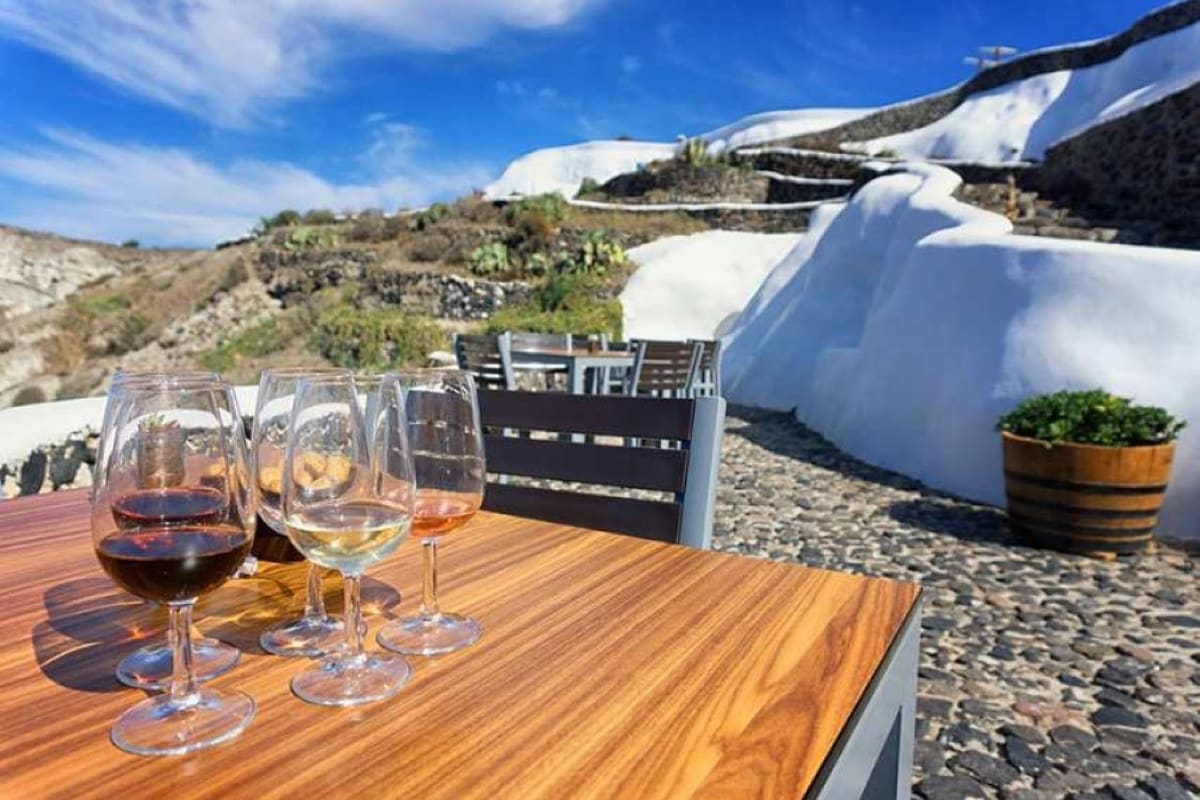
A Paros wine tour visits the vineyards and wineries of Paros, an island in the middle of the Cyclades. Tastings pair local wine with island food in old farming villages. It is one of the wine tasting tours in Greece on Greece VIP.
This post covers what a Paros wine tour includes, the vineyards and the grapes, with Monemvasia and the PDO Paros label. It also covers vine training, wine history, the villages and how wine is made. Food, spirits, festivals, tasting, nearby sights, travel, soil and climate, the best season and common questions come last.
Each section ends with a Paros wine tour or a nearby tour that can be booked online.
What does a Paros wine tour include?
A Paros wine tour takes visitors into island wineries to taste local wine. Each visit starts with the story of the winery. Then the group sees how the wine is made and tastes it. Bigger tastings can include a full meal built around the wines.
Wine tourism is an active kind of travel. It can mean a winery visit, a vineyard tour or a tasting. Visitors can even take part in the grape harvest. A Paros wine tour draws on these activities.
Small, low-output wine regions work in a personal way. The owner hosts the visit and walks the guests through the vines. At certain wineries, guests can also stay in a small guest house.
Buying bottles is part of the visit. Sales at the winery itself can reach up to 33% of its yearly sales. Food pairing tours and cooking classes work well beside a Paros wine tour.
In 2008 the Aegean islands founded the Aegean Wineries, known as ENOANA. The group promotes quality wine and wine tourism on the islands. In the South Aegean wine revival, Paros follows Rhodes and Santorini.
A Paros wine tour also meets island teamwork. The local winemakers formed a cooperative, a union that works as one, in 1929. Its first winery opened in 1956, and a modern winery followed in 1981.
Older islanders remember wine sold in bulk in the 70s and 80s, or kept in barrels at home. It was a ruby, deep red wine. It came sweet, sun-dried or dry, a style called brusque.
- New style: Younger winemakers tried modern flavours and reached a refined, steady quality.
- Feasts: Islanders pour wine and their own raki for guests at church feasts.
- Hotels: Cyclades hotels welcome visitors with branded local wines.
- Enotourism Day: The second Sunday of November promotes cellar visits in Greece.
Cooperatives and private winemakers in the South Aegean now run modern facilities. Plenty of their wines sell across Greece and abroad. A Paros wine tour tastes them where the grapes grow.


Where are the vineyards on a Paros wine tour?
A Paros wine tour finds vineyards scattered all over the island. The best sites lie around Mount Profitis Ilias, at 250-400 m. The bulk of the vines grow on its foothills, in the centre of Paros. Vineyards sit both in the lowlands and on the mountains.
A Paros wine tour fits a wider rule. Vineyards tend to sit on hillsides, in soil of little value to other plants. A common saying holds that the worse the soil, the better the wine.
The Marpissa mountain range rises from the centre of the island. It has peaks at Agion Panton and Stroumpoula, at 800 m. Farmed land spreads in all directions from these central hills.
Inland, small and large vineyards stand in neat rows. Growers keep them so tidy that not a weed or twig shows. North of the equator, vines go on south-facing hillsides for maximum sun.
A Paros wine tour also passes terraces, flat steps of land on the slopes. They are a typical sight of the Cycladic landscape. Vine growing keeps these terraces alive and in good repair.
The Parian vineyard is a classic Aegean vineyard. In ancient times, the vineyards of Paros, Naxos, Amorgos, Kea and Syros were all famous. A wine tour on Naxos pairs well with a Paros wine tour.
Paros produces olive oil, potatoes, wine, vegetables, fruit and cereals, so vines share the farmland. Across the South Aegean, rough ground, the sea and the sun give each wine its own personality.
- Drainage: Good drainage cuts the water a vine takes up without need.
- Steep hills: Top wines can come from steep slopes, where other crops do not pay.
- Parikia: Luxuriant vines shade the houses of this town.
On a Paros wine tour, vineyards also feed homes. At the end of August, Parians harvest and press their grapes. Every grower also presses grapes in a home press, for the next year’s meals and parties.
Which grapes grow on a Paros wine tour?
A Paros wine tour meets a long list of island grapes. They include Monemvasia, Mantilaria, Aidani, Vaftra, Karampraimi, Asyrtiki and Savvatiano. Malagouzia, Roditis, Maloukato and Potamisi grow too. Farming methods have changed over time, but the varieties remain the same.
Today, two grapes make almost all the wine on a Paros wine tour. They are the white Monemvasia and the red Mantilaria. Aidani grows on the island in both a black and a white form.
On a Paros wine tour, white Aidani stands apart. It grows on the island. Yet the rules keep it out of PDO Paros, the protected local label. It makes dry whites and, more rarely, dessert wines aged long in oak.
Aidani wine is medium bodied, with moderate alcohol and acidity. It can develop for at least five years. Young dry Aidani suits seashells and dense fish. It makes a fine seafood match on a Paros wine tour.
Asyrtiki, or Assyrtiko, also grows here. Away from Santorini, it keeps its crisp, mineral taste. It shows more fresh fruit aromas and a lighter structure. Its wines can age for five or even ten years.
Older names belong on a Paros wine tour too. Mavrotragano, Mavrathiri and the lesser-known Papatsouda have grown on Paros. Growers kept mixed vineyards, with different grapes on one estate.
Malagouzia was almost extinct until the 1970s. That decade, wine professor Vassilis Logothetis found it again in Nafpaktia. The grape is highly aromatic and makes soft, elegant wines. It is possibly related to Malvasia.
- Roditis: This pink-skinned Greek grape comes from the Peloponnese by tradition.
- Late ripening: Roditis ripens late and keeps its acidity in hot weather.
- Setbacks: Powdery mildew and phylloxera cut Roditis plantings in the 20th century.
Wine growers all over Greece have started to explore Aidani, given its high quality. Its dessert wines can keep for decades. A Paros wine tour shows this grape on its home ground.
What is Monemvasia, the main grape of a Paros wine tour?
A Paros wine tour centres on Monemvasia, the leading white grape of the island. The vineyards of Paros cover about 1,200 acres. Monemvasia gives wines with notes of citrus and white-fleshed fruit. These aromas can sit on a mineral backdrop, a note that recalls clean stone.
Monemvasia on a Paros wine tour has relatively low acidity, the fresh, sharp taste in wine. It is also prone to oxidation, so contact with air harms it. Growers deal with both traits at harvest time and at the winery.
Winemakers commonly use prefermentation maceration with Monemvasia. This step lets the juice rest with the skins before fermentation. They also shelter the juice from oxygen at every stage. These steps keep a delicate grape fresh for a Paros wine tour glass.
Careful handling pays off in the glass. Monemvasia wine has medium body, so it feels neither thin nor heavy. Its acidity still tastes clean and refreshing on a Paros wine tour.
Monemvasia also helped bring an old wine back. Its blending into Monemvasia-Malvasia marks the revival of malvasias oenos, Greek for Malvasia wine. That is one of the best-known Greek wines in history.
That blend includes Kidonitsa, Assyrtiko, Monemvasia and Asproudi. Oddly, none of the grapes called Malvasia go into it. A Paros wine tour tastes the same grape in its dry island form.
Back on Paros, Monemvasia grapes reach a high sugar content. Sweet wine needs that trait. So the grape suits the sweet white Malvasia Paros, a dessert style of the island.
- Share: PDO Monemvasia-Malvasia must contain at least 51% Monemvasia.
- Start: PDO Monemvasia-Malvasia, a protected label, was established in July 2010.
- Ageing: Monemvasia-Malvasia must go through oxidized ageing for at least two years.
A Paros wine tour also tells the story of this grape. The island helped spread Monemvasia throughout the Aegean. It also promoted malvasias oenos, the top Greek wine in popularity under Venetian rule.
What does the PDO Paros label mean on a Paros wine tour?
A Paros wine tour pours wines under the PDO Paros label, a protected designation of origin. The label covers both white and red wines. Every PDO Paros wine is still and dry. Still means the wine has no CO2 bubbles.
PDO Paros red follows a fixed recipe. It must contain at least 35% Mandilaria, a red grape. The rest comes from Monemvasia. This white grape adds aromas and softens the roughness of Mandilaria.
Dry means the wine does not taste sweet. Sweet wines on a Paros wine tour carry a separate label, PDO Malvasia Paros. Paros got this appellation, or protected wine name, in line with the Monemvasia-Malvasia appellation in Lakonia.
The rules for this sweet wine are strict. Monemvasia must make up at least 85% of each wine. The rules also set at least 24 months in oak barrels before release.
The name has a long story. Malvasia wine was mainly exported from the port of Monemvasia. Over time, the term came to be treated as a generic name. That means a style name, not one place.
The label rests on EU wine rules. Member states delimit the areas of production and set the rules. The European Commission publishes the information. Every PDO bottle on a Paros wine tour ties back to these rules.
Appellations tend to carry the geographical name of the area that makes the wine. Protection for wine names is the only kind recognised by the TRIPS trade agreement. The World Trade Organization runs that agreement.
- Aegean: Large parts of the Aegean produced big amounts of sweet Malvasia wine.
- Crete: Paros was the obvious choice for a Malvasia appellation, along with Crete.
- Rulebook: The main EU wine market regulation runs to over 46,000 words.
Origin is only one test for a protected name. The wine must also meet quality criteria. So a PDO glass on a Paros wine tour reflects both place and quality.
How are vines trained against the wind on a Paros wine tour?
A Paros wine tour shows vines that hug the ground. Paros is a largely flat island. Its traditional vines have no trunk. Their branches crawl along the soil to protect the grapes from strong winds. Locals call the system aplotaries.
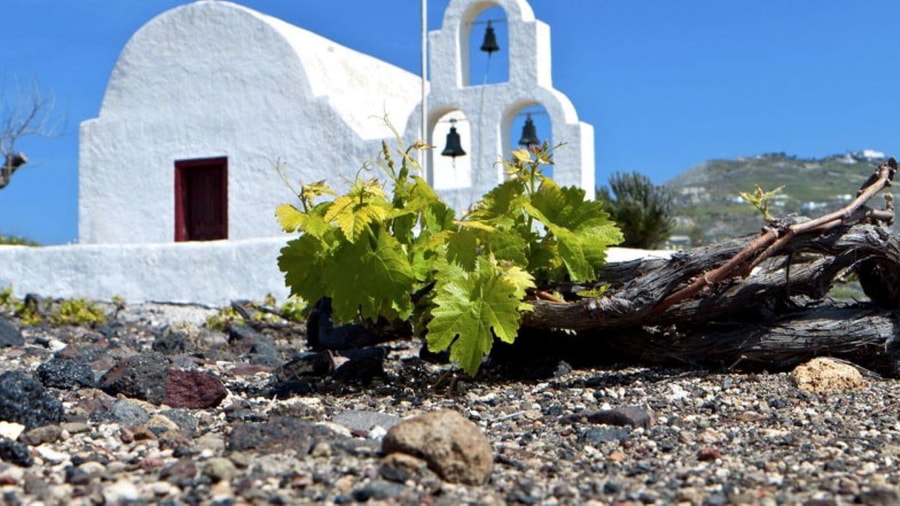
The word aplotaries comes from the Greek verb aplono, which means to spread. On Paros, the vines grow freely in bush form. The name suits the low, sprawling vines on a Paros wine tour.
The shape follows a clear pattern. The old wood extends horizontally, close to the soil. The young shoots grow vertically from it. Together they form a floor covering of vines, like a low green carpet.
Grapevines are climbing plants. Unlike trees, they have no natural support of their own. The weight of leaves and grape clusters pulls their arms toward the ground. Arms here means the main branches of the vine.
Elsewhere, growers keep these arms off the ground. A vine that touches soil sends out shoots and takes root there. On a Paros wine tour, the old aplotaries vines break that rule.
The rule has a reason. Since phylloxera, a large number of vines are grafted onto resistant rootstock, a hardy root base. If the top part of a grafted vine takes root, it risks infection.
A trellis is the stakes, posts, wires or other structures a vine is tied to. Other vines grow free standing, with no trellis at all. The low vines on a Paros wine tour need no trellis.
- Bush vine: The gobelet, or bush vine, is very old and was used by the Egyptians and Romans.
- Low vigour: The gobelet suits weak-growing vines, staked or left free standing.
- Machines: VSP, or vertical shoot positioned trellis, suits vineyards worked by machines.
In recent years, a large number of Paros winemakers have invested in upright training with supports and props. Upright vines grow fuller and larger, and the harvest is easier. So a Paros wine tour passes both old and new vine shapes.
What history lies behind a Paros wine tour?
A Paros wine tour follows a story that starts with the ancient Greeks. A wine god, a poet, colonies and wars all shaped the island over the centuries. Old names, shrines and temples still keep that story alive.
Ancient Greeks called the cultivated vine hemeris, from their word for tame. Old names said to belong to Paros include Demetrias, Hyria, Hyleessa, Minoa and Cabarnis. Hyleessa comes from hyle, the Greek word for forest.
A Paros wine tour also recalls old colonies. Tellis, an ancestor of the poet Archilochus, helped set up the cult of Demeter on Thasos.
Athens was a large wine market, so big vineyard estates grew in Attica and on Thasos. On a Paros wine tour, the poet Archilochus links the island to Dionysus, the wine god.
Inscriptions from his shrine suggest his role in bringing that cult was disputed. The Parians condemned his songs as too iambic, meaning too harsh. The oracle of Apollo then told them to honour the poet.
At his sanctuary, admirers made sacrifices to him and to Apollo, Dionysus and the Muses. An Ionic capital from his grave, a carved column top, carries his name. It stands in the Archaeological Museum of Paros.
In 490 BC, Paros sided with the Persians and sent a trireme, a warship, to Marathon. Miltiades then besieged the town and demanded a fine of 100 talents. The Athenians sailed away after 26 days.
- Temple: Miltiades got his fatal wound at a temple of Demeter Thesmophoros on Paros.
- Legend: Women who took the boy’s cow left a lyre in its place. They were the Muses.
- Democracy: In 410 BC, Theramenes replaced rule by a small group with democracy.
Under the 1832 treaty, fellow Greeks ruled the Parians for the first time in over six centuries. A Paros wine tour moves through land shaped by all of these eras.
Which villages does a Paros wine tour pass?
A Paros wine tour passes farm villages in the hills and on the eastern plain. Each village keeps its own name story, church or museum. Fields, orchards and vines fill the land around them. They show island farm life.
Lefkes is a mountain village at 200 metres. It took its name from the poplar trees, called lefkes in Greek, that once grew there. Its main street, Ramnos, is named after a buckthorn tree that once stood in the road.
Kostos has long been known for its farm products. It was declared a traditional settlement in 1978. Travellers who enjoy local produce on a Paros wine tour can add a cooking class on Paros.
A Paros wine tour meets Prodromos, once called Dragoulas. It lies on the east side at 30 metres. The land around Prodromos and Marmara has plenty of orchards, its own water and a lot of cows.
A Paros wine tour also reaches Marmara, near the bay of Kefalos, at 22 metres. Prodromos, Marmara and Marpissa are known together as the villages of Kephalos. The name comes from the steep hill of Kephalos.
Near Marpissa lies the Cave of the Demons, also called Kalampaki. People used it in the late Neolithic and early Cycladic periods. Finds include conical cups, seashells, animal bones and remains of fire.
Marpissa holds the Perantinos Sculpture Museum and a Folklore Museum. On a Paros wine tour in the north-east, Ampelas shows another farm scene. Farmers around this coastal village grow cereals, vegetables and vines.
- Taxiarchis: A 17th-century church of the Archangel stands at the entrance of Marmara.
- Bell towers: The Dormition church in Marmara has three different bell towers.
- Pera Panagia: This Marmara church has two aisles and three arches on ancient columns.
Before the Kapodistrias reform, Paros was split into 8 communities. They were Archilochos, Marpissa, Naoussa, Parikia, Kostos, Alyki, Agkairia and Lefkes. A Paros wine tour links these old local units.
How is wine made on a Paros wine tour?
A Paros wine tour shows how grapes become wine. The work starts with the harvest and moves on to pressing and fermenting. The young wine then rests, settles and turns clear. Each step changes taste, colour and strength.
The harvest date depends on the sugar level of the grapes, measured in degrees Brix. Acid and pH, the measure of sourness, also count. Grapes are then picked by machine or by hand.
Mechanical harvesters are large tractors that straddle the vine rows. Rubber or plastic rods strike the vines and shake the grapes loose. The machines can also pick up leaves, rocks and even bird nests.
On a Paros wine tour, hand picking shows its value. Pickers can leave behind clusters that are unripe or have bunch rot. White grapes in the main go straight from the picking bins to the press.
A Paros wine tour also explains yeast, which is already on the grapes as a powdery look. Wild yeast can stop before all the sugar is gone. It can also make acetic acid, the acid of vinegar.
A Paros wine tour covers sugar and alcohol. Each gram of sugar gives about half a gram of alcohol. So a 12% wine needs a must, or fresh juice, with about 24% sugar. A saccharometer, a special hydrometer, reads the sugar.
Free-run juice flows out as soon as grapes are crushed. It has higher quality than press juice. Pressed juice can make up 15% to 30% of the total. Modern presses raise the pressure from 0 to 2.0 bar.
- Chilling: Wine sits near freezing for 1 to 2 weeks to shed tartrate crystals.
- Ageing: Wine rests three to six months under an airlock and turns from cloudy to clear.
- Warm regions: Malolactic fermentation, a later bacterial step, is less needed there.
In warm places, that bacterial step can even harm the wine. A Paros wine tour links each step, from the vine row to the tank. Each one leaves its mark on the final glass.
What local food pairs with a Paros wine tour?
A Paros wine tour pairs its glasses with harbour fish, mountain herbs, wild greens and giant snails. Island cheeses and fig sweets complete the table. Each dish comes from the land or the sea near the vineyards. Pairing starts with the strongest taste.
In the old harbour of Naoussa, fresh bogue, Atlantic chub mackerel and picarels come to the tables. A Paros wine tour that ends in Naoussa eats this catch beside the fishing boats.
The fishing village of Alyki is known for its octopus. The octopus hangs on ropes and dries in the sun all morning. Then it reaches the plate warm.
In the mountain village of Lefkes, locals gather agkathitis, a mushroom that grows near pine trees. Cooks prepare it with sage, oregano, fennel and savory. A Paros wine tour through the hills meets this taste.
The fields add wild greens. Atsirides are common sowthistle, and mavroradika are spiny chicory. Galatsides are common brighteyes, and agriomaroula is prickly lettuce.
Broad beans and split peas have been the cornerstone of the local diet for centuries. Kefalisio, a gentle and spicy yellow cheese, sits beside them. Touloumisio cheese is creamy, soft, intense and spicy. On a Paros wine tour, fresh bread and rusks bring out these island flavours.
Karavoles, the giant snails of Paros, began as a humble dish and now count as a gourmet treat. Cooks boil them with garlic or fry them lightly, a style called boubouristi. Stifado, an onion stew, is the third way.
- Figs: Parian figs become samata or pastelaria, a dense fig cake.
- Baklava: Zacharobaklava skips filo pastry and uses almonds, grated rusks and cinnamon.
- Must: Grape must turns into wine, jelly, molasses, cookies and sweets.
- Pies: Rafiola, skaltzounia and myzithropitakia are small pies filled with local cheese.
On a Paros wine tour, the pairing rule starts with the dominant flavour of the dish. That flavour can come from the sauce rather than the meat.
Which spirits sit beside wine on a Paros wine tour?
A Paros wine tour sits beside souma, the grape spirit of the island. Islanders distil it each autumn in cauldrons and grill food over the same fire. Grape spirits from pomace form a wider family. Rusks, cheese and olives go with each glass.
Souma is distilled all over the island of Paros. It comes from a single distillation of grapes, so the liquid passes through the still once. For a Paros wine tour, autumn is the season of the new souma.
Souma is a colourless spirit from the tsipouro family of grape spirits. Its strength depends on each maker, but it sits close to 50 degrees as a rule. It is also a traditional drink of Rhodes, Samos and Ikaria. In the old method, the pomace rests for about 30 days while yeast ferments it.
The first spirit out of the cauldron, the head, is very strong. The last part, the tail, is weak and not for drinking. Locals call the head protoraki and the tail aporaki. Both go back into the next batch, which locals call a kazania. The spent pomace then serves as fertiliser.
A newer method crushes whole grapes, stems included. The juice and skins ferment together for 15 to 20 days before distillation.
Each autumn, the men of the island make both wine and souma. The work uses rakidia, the cauldrons of the still. Purists gather around them to taste the souma of the new crop.
The fire under the cauldron also cooks. Local sausages, steaks, octopus and fresh squid go on the grill. Parians drink the new souma, nibble local delicacies, sing and dance to island music.
The diet of Paros counts souma among its basics, next to fish, olive oil, wine and dairy products. On a Paros wine tour, the spirit and the wine share one table.
The island names rusks, local cheese and small koroneikes olives as the ideal companions for souma. A Paros wine tour with a spirit tasting meets this simple plate.
Pomace brandy is distilled from pomace, the leftovers of winemaking after the grapes are pressed. Unlike wine brandy, pomace brandies are mostly neither aged nor coloured. In red wine making, the pomace soaks in the must for the whole fermentation.
- Red: Fermented pomace suits brandy best, as it is soft, dry and high in alcohol.
- Rosé: Semi-fermented pomace comes out before the fermentation ends.
- White: Virgin pomace from white wine making is not fermented at all.
The pomace ferments to the end, and then the alcohol is distilled off. Pomace alcohol is also the traditional base of certain anise-flavoured spirits. A Paros wine tour thus tastes two products of one harvest.
Which festivals tie in with a Paros wine tour?
A Paros wine tour can meet a full calendar of local feasts. Dozens of events fill the island year, above all in summer. Church days, a souma festival, the Naoussa carnival and Easter customs bring food, music and dance.
Every church on Paros has its own day of celebration each year. The church service comes first, and food, dance and local delicacies follow. A Paros wine tour on such a day meets a lively village.
Music festivals take place at the Cultural Park of the Municipality of Paros. The park lies at Agios Ioannis Detis, near Naoussa. Classical music is also played at times in the courtyard of the Ekatontapiliani church.
A Paros wine tour can also follow food events. Aliki holds the Festival of the Fish, and Marpissa hosts The Routes of Marpissa. The Parian and Aegean Gastronomy Festival joins the list.
The souma festival moves to a different distillery each year. Visitors come back every year to join it. For a Paros wine tour, it links the spirit to the people who make it.
The carnival period in Naoussa begins on the feast of Agios Antonios, on 17 January. Everyone is welcome at the carnival feast. The one rule is to knock on the door in costume.
At carnival, Naoussa residents dance the Ageranos to bagpipes and clarinets. Legend says Theseus danced the Geranos on Delos after returning from Crete, to thank the god Apollo.
- Good Friday: At midday, residents of Prodromos serve visitors their traditional chickpea soup.
- Easter Monday: Large festivals fill the Agios Georgios churches in Agairia, Lagada and Naoussa.
- Epiphany: Each priest throws the Cross into the sea, and young swimmers dive for it.
- Music: Violin, lute, bagpipes and tympaki, a small drum, play for the dances.
Carnival sweets in Naoussa use fresh myzithra cheese, sugar and honey, and then they are fried. A Paros wine tour timed with a feast sees the wine among music and dance.
How do tasters judge wine on a Paros wine tour?
A Paros wine tour follows the rules that wine judges use. Each glass gets points on a set scale. Tasters also check for faults, such as a corked bottle. Scales run out of 20 in Europe and out of 100 in the United States.
One scoring system gives appearance 15%, the nose 35% and the palate 50%. The palate means the taste in the mouth. No modern wine scores below half, since that points to an obvious fault.
Robert M. Parker, Jr. introduced the 50–100 scale, now in common use. On it, 85 points or more means a good wine. A score of 90 marks an outstanding one, and 95–100 a classic.
On a Paros wine tour, a hidden label keeps the verdict fair. At the Judgment of Paris in 1976, French judges tasted wines from France and California blind. The California wines won.
Labels sway ordinary tasters as well. For six years, a university in Texas poured wines marked France, California and Texas. Nearly all tasters ranked the French best, yet all three held the same Texan wine.
On a Paros wine tour, tasters also see tears of wine run down the glass. In German they are Kirchenfenster, or church windows. Other names are fingers, curtains and feet.
Tears form because alcohol leaves the thin film on the glass faster than water. This pulls more wine up the side, a flow called the Marangoni effect. A cover on the glass stops the tears.
Ancient ideas shape tasting too. Aristotle proposed tasting wine by the four elements: air, water, fire and earth.
- Corked: Cork taint brings musty, mouldy, earthy or mushroom smells to a corked wine.
- TCA: The compound trichloroanisole, or TCA, causes an estimated 80-85% of all cork taints.
- Sulfur: Too much sulfur dioxide makes a wine smell of matchsticks, burnt rubber or mothballs.
Between 1% and 5% of bottles suffer cork taint, by one estimate. Certain experts sense TCA at only 1-2 ng/L, or billionths of a gram per litre. A specially trained group reached 0.3 ng/L.
Which sights lie near the wineries on a Paros wine tour?
A Paros wine tour passes temple ruins, a museum of island finds and old villages. Ancient temple sites lie around Parikia. The Archaeological Museum of Paros keeps finds from the Neolithic, or New Stone Age, to Roman times.
A temple of Asclepius once stood on a hillside in the southern outskirts of Parikia. Its remains lie on the left of the Parikia–Alyki road. A Paros wine tour on that road passes close by.
A second temple honoured Demeter Thesmophoros. Ludwig Ross found its site through an inscription, or words cut into stone. The site lies on a low hill beyond the old town boundary.
A Paros wine tour that pauses in town can add the Archaeological Museum of Paros. Room A holds Archaic and Classical sculpture. Room B holds pottery, sculpture and small finds.
The atrium, an open inner court, holds sculptures, architectural parts and urns. It also has a Roman mosaic floor. The museum also shows a mosaic of the Labours of Herakles, from the 3rd century AD.
The Fat Lady of Saliagos is a marble figure from about 5000 to 4000 BC. It is the oldest known Cycladic statue. Its head and left shoulder are missing. John Davies Evans and Colin Renfrew found it in 1964/65.
The Nike of Paros is a white Parian marble figure from about 480 BC, found before 1885. She once had wings and seemed to float in mid-air. She wears an unbelted peplos, a long dress hanging open.
- Victory: The Nike is carved all the way round, which points to a victory monument.
- Gorgon: The Gorgon of Paros, from the middle of the 6th century BC, guarded a grave monument.
- Artemis: A statue of Artemis from about 360 BC comes from her sanctuary at the Parian Delion.
Away from Parikia, a Paros wine tour meets more history. The villages of Kephalos are rich in ancient remains. Experts think they stand on the site of an ancient town. Lefkes had 545 inhabitants in the 2011 census.
How do travelers get around on a Paros wine tour?
A Paros wine tour mixes tasting with travel, so a sober driver matters. A designated driver stays sober and drives the others home. Visitors who fly in land at the island airport. It stands in the Kampos area, 38 m above sea level.
Paros has three main ports: Parikia, Naoussa and Drios. Naoussa was ancient Argousa, a harbour for warships. The port of Drios, in the south, is also called Porto Trio.
The designated driver idea grew in Scandinavia over decades, starting in the 1920s. A formal program followed in the 1980s. Canada launched a designated driver program of its own in 1986.
The idea reached the United States in 1988. Its campaign is credited with helping cut alcohol-related traffic deaths between 1988 and 1994. A Paros wine tour group can use the same plan.
Groups fail in simple ways. They forget to name a driver before setting out. They arrive in separate cars, or the chosen driver drinks anyway. Each slip puts a Paros wine tour group at risk.
Naming the driver early helps. A study at the Tijuana/San Diego border asked groups to pick a driver before entering the bar district. Those drivers came back with much lower blood alcohol levels.
Flights add another way to start a Paros wine tour. In 2018 the Paros airport handled 204,924 passengers, a rise of 25.7%. It also recorded 3,712 aircraft movements, meaning both take-offs and landings.
The old Paros airport stood at Alyki. It first opened on 5 October 1982, on land that Nikolas Panteleou gave. For that reason, it also carried a second name, Panteleou Paros Airport.
- Start: The old airport began as a municipal airport with a dirt runway and an 80-square-meter building.
- 1985: Workers built a paved runway at the old airport.
- 1987: The terminal gained a floor for the civil aviation authority and the weather service.
- 1989: The old airport became a national airport.
In time, the old 710-meter runway grew too short. More passengers needed larger aircraft, so a new airport was built. A Paros wine tour visitor who flies in today lands at that newer airport.
How do soil and climate shape a Paros wine tour?
A Paros wine tour crosses dry, sandy and clay-like vineyard soil. Winters on the island are mild, with low rainfall and no frost. Summers are hot, with more humidity at night and cool winds blowing at the same time.
The Municipality of Paros calls the island’s vineyards xeric. The word means suited to dry conditions. The climate dictates this way of farming. A Paros wine tour therefore meets vines that live on little water.
A grapevine needs around 710 mm of water during the growing season. Natural rainfall does not always supply all of it.
The bedrock under a Paros wine tour is crystalline and metamorphic, meaning rock reshaped deep underground. It formed 40 to 45 million years ago, in the middle Eocene. The depth then was 40 to 45 km.
These deep rocks rose to the surface about 25 million years ago. Granite-forming magma, or molten rock, rose with them while the Alps were forming. A rise of granodiorite, a rock close to granite, followed 17 million years ago.
The slopes of the central mountain chain fall gently towards the sea. They turn into fertile coastal plains. One is the Kambos behind Parikia, and another lies behind Naoussa. A third runs along the whole east side. The fourth, at Aliki in the southwest, is sometimes marshy.
On a Paros wine tour, Parikia and Marpissa stand out as the island’s richest farming areas. Vines are among the plants that dominate the vegetation of Paros. They share that place with tamarisks, cypresses, pines, carob, fig and olive trees.
Phylloxera, a vine pest, spared areas whose soils were mainly sand or schist, a layered rock. Its spread also slowed in dry climates. Travelers who compare island vineyards can also look at a Milos wine tour.
- Bedrock: Paros is mainly granite, with large pockets of limestone that turned into marble.
- Ripening heat: A large share of vine processes run at full stride near 27 °C. That is when clusters start to ripen.
- Climate group: The majority of Greek wine regions share a Mediterranean climate.
In Mediterranean wine climates, very little rain falls while the grapes grow. The rain comes mainly in winter. That raises the risk of drought in the vineyards a Paros wine tour visits.
When is the best season for a Paros wine tour?
A Paros wine tour meets a mild average high of 25 °C in September. July and August climb to 29 °C on the island. September therefore gives cooler walks between the vines, after the peak of summer heat.
Paros has a mean yearly temperature of 18.5 °C. Winter averages about 12 °C. A Paros wine tour therefore never meets harsh cold, even in the darkest months.
Paros gets about 3,072 hours of sunshine a year. July is the sunniest month, with about 434 hours of sun. August follows with 403 hours.
Summer stays almost dry. June gets about 4 mm of rain, and July and August about 2 mm each. September gets about 11 mm, while October jumps to about 50 mm.
In August, the meltemi, a strong summer wind, tempers the heat for about 20 to 30 days. A Paros wine tour in that month therefore finds the heat softened by wind.
Grapes with the greatest exposure to warmth, on the outer canopy, change colour first. Grapes in the shade near the trunk change last. Visitors can watch that slow shift along each row.
A vine bud tends to hold three tiny shoots. Buds turn brown during the winter rest. The first green shoots then appear in spring, so a spring Paros wine tour sees fresh growth.
- After harvest: Vines keep making food from sunlight and store reserves in roots and trunk.
- Leaf colour: Once enough reserves are stored, the leaves turn from green to yellow.
- White grapes: Their colour comes from carotenoids, which replace the green chlorophyll in the skin.
The vine then enters dormancy, a kind of deep winter sleep. It shuts down and saves its energy for the next growing cycle. A Paros wine tour in the cold months meets resting vines waiting for spring.
What do travelers ask about a Paros wine tour?
A Paros wine tour takes place on the third largest island of the Cyclades. The municipality counted 14,520 residents in the 2021 census. Locals work mainly in fishing, farming, livestock and tourism. Wine stays part of that farming life.
How much wine does the island of a Paros wine tour make?
Paros produces large amounts of wine every year, and small wineries work across the island. Across the Cyclades, farm produce includes wine, fruit, wheat, olive oil and tobacco. Wine is therefore one island crop among others.
Are the vines on a Paros wine tour organic?
The weather on Paros favours the vines so much that they are referred to as organic crops. Adequate sun, heat and water are all vital to healthy vine growth during the growing season. The island gives its vines plenty of the first two.
Is the soil on a Paros wine tour fertile?
Apart from Naxos, the soil of the Cyclades is not very fertile. Paros and Naxos are geological twins, and they once formed a single landmass. Both islands share the same deep rock, though their farmland differs.
What grew on Paros long before a Paros wine tour?
In ancient times, important products of Paros were figs, melons and Parian pies. When the Parian poet Archilochus went to Thasos, he missed one of them. He never forgot the black figs of Paros, called aimonia.
Is winter a good time for a Paros wine tour?
December and January have the least sun on Paros, about 124 hours each. January is also the wettest month, with about 94 mm of rain. Wild mushrooms grow from late November to early March, depending on each year’s rain.
Why does wind matter on a Paros wine tour?
In summer, the meltemi blows on Paros more than half of the time. It blows at force 5 to 7 and frequently hits force 8 to 9 by day. Wind, humidity, sunlight and day-to-night temperature swings all shape how vines grow.