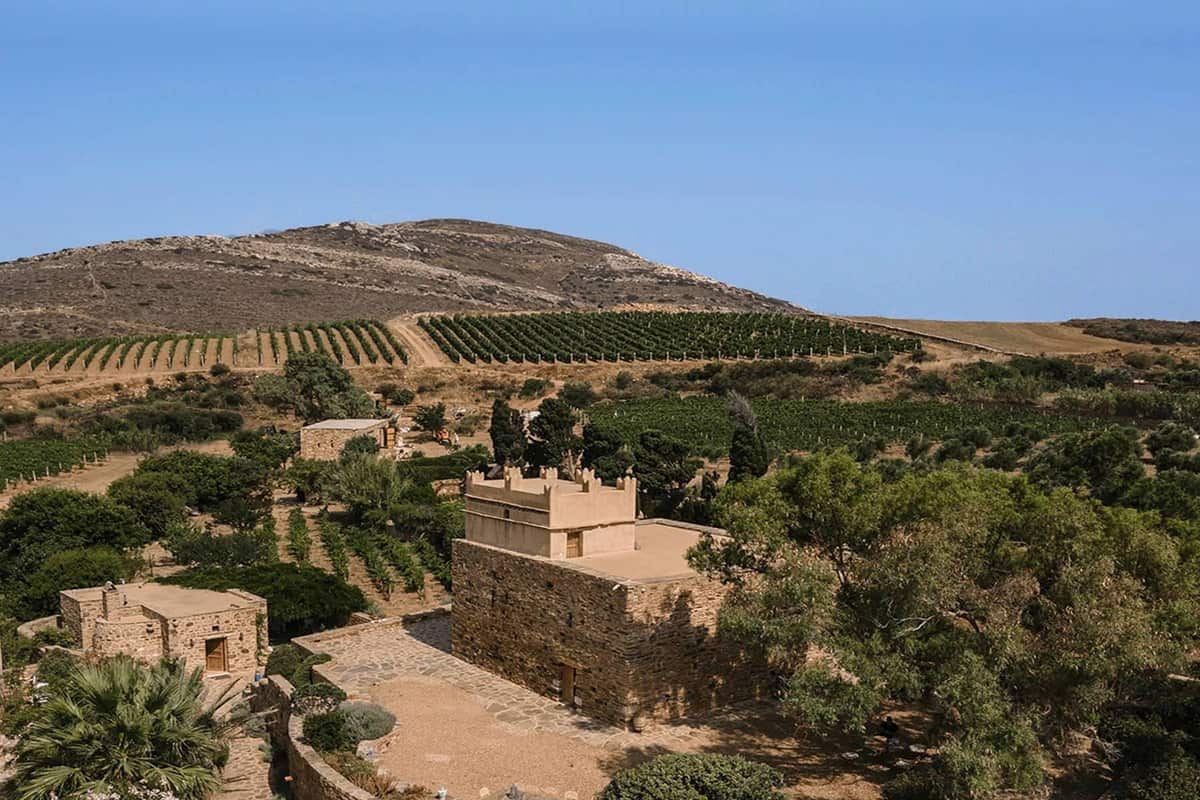
A Naxos wine tour visits the vineyards and wineries of Naxos, in the Cyclades. Guests taste local wines and learn how island grapes grow. It is one of the winery tours in Greece on Greece VIP.
This post covers what a Naxos wine tour includes, the grapes of the island and where the vineyards grow. It also covers the history of Naxian wine, kitron liqueur and food pairings. Winemaking, the best season and common questions come last.
Each section ends with a Naxos wine tour or a nearby food tour that can be booked online.
What does a Naxos wine tour include?
A Naxos wine tour includes vineyard walks and winery visits. Naxos lies inside the PGI Cyclades wine zone. PGI means a protected regional label. This zone started in 2008 and covers all the Cycladic islands, Naxos among them.
On a Naxos wine tour, visitors meet the growers. The majority of grape growers run their own winery. A small share send their grapes off the island after the harvest. Local tastings also appear on food tours in Naxos Town.
Pickers cut the bunches by hand with shears and carry them in crates. Workers sort the grapes by colour. Then a crusher, a holed cylinder with paddles, spins 600 to 1,200 times a minute.
Winemakers check the sugar in the must, the fresh grape juice. White must needs 11.5 to 13 degrees Baumé, a sugar scale. Whites ferment at 18 °C, while reds and rosés ferment at 22 °C.
A Naxos wine tour also shows how colour forms. Rosé juice stays on the skins for about 12 to 24 hours. Red juice stays for 3 to 5 days. Island reds then age in oak barrels and the bottle for 1 to 3 years.
- Wine styles: PGI Cyclades wines come in white, rosé and red, from dry to sweet.
- Altitude rule: Vineyards for PGI Cyclades wine must stand above 30 m.
- Other labels: The Cyclades also hold two PDO wines, PDO Santorini and PDO Paros.
Summer visits to the vineyard and winery are seen as the best way to promote Naxos wine. The national wine body lists 10 wineries making PGI Cyclades wine. It expects that number to grow.


Which grapes grow on a Naxos wine tour?
A Naxos wine tour shows mainly native wine grapes on the island. Potamisi, Fokiano, Assyrtiko, Monemvasia, Mandilaria and Aidani cover the largest areas. Smaller plots grow Athiri, Roditis, Savvatiano and Psarosyriko. The old varieties Tzemeri and Harem-Ibrahim also survive there.
Potamisi has its main centre on Santorini. It spread to Naxos, Tinos, Amorgos, Folegandros, Ios and Milos. White Potamisi grows in the mountains and lowlands. Black Potamisi grows mainly in mountain villages.
White Potamisi buds in late March and ripens in late August. It gives a fairly strong white wine with medium acidity. Its bunches are large and uneven, with yellow-green skins.
On a Naxos wine tour, Fokiano stands out. Its main home is Ikaria. It has black, kokkineli and white forms, and kokkineli is a pink form. Black Fokiano resists drought. People eat it as a table grape too.
Aidani on Naxos is mostly the white form, grown in mountain areas. It gives a dry white with intense aromas. It is possibly the “edani vine” named by Hesychius, a 5th-century AD word-list writer.
- Assyrtiko: It resists drought, but its dry white tends to oxidise, or spoil with air.
- Mandilaria: It grows in all three vine zones but suffers from botrytis, a grey rot.
- Monemvasia: It is seen as the only Greek white grape in both white and red PDO wines.
Old Naxian grapes include Bastardiko, Kouforogo, Flaska, Avgoulato, Tragano, Rozako and Psoriatis. They were 80% white and 20% red. Blended, they gave a light amber wine. Ancient Naxos even had its own grape, called naxia.
Where are the vineyards of a Naxos wine tour?
A Naxos wine tour visits vineyards in three main vine zones, set by altitude. Zone 1 is the north-west, at 100 to 150 m. Zone 2 is the south-west, at 150 to 300 m. Zone 3 is the mountains, above 300 m.
The harvest starts in zone 1 in the first 20 days of August. It reaches zone 2 in early September. Zone 3 harvests from 15 September to the first 10 days of October.
Zones 1 and 3 lie on slopes, so vines grow on terraces, once called achtia. These slope vines are low cups. Each has a 40 to 50 cm trunk and 3 to 4 arms.
On a Naxos wine tour, the flat zone 2 looks different. Vines stand in rows 2 to 2.20 m apart. They run along three wires on posts 1.20 to 1.50 m long.
A Naxos wine tour reveals dry farming. Vines rely on rain and soil water. Young vines get 3 to 4 waterings in dry years. The usual vine soil is dry clay-limestone, so growers use one American rootstock, Richter 110.
- Halki: This Tragaia plateau village stands at 270 to 280 m.
- Melanes: This western lowland village sits at 110 to 160 m.
- Ano Sangri: It lies in the central-western lowland at 190 to 200 m.
The Naxos lowland covers 126.96 km², mainly the Livadia plain in the west. The smaller Eggares plain lies in the north. Kato Potamia, at 80 to 110 m, is known for vegetables and cheeses.
What history lies behind a Naxos wine tour?
A Naxos wine tour follows a wine story that reaches back to ancient times. Old coins of the island show a wine cup and grapes. Myths tie the wine god Dionysus to the island. Later rulers also traded its wine.
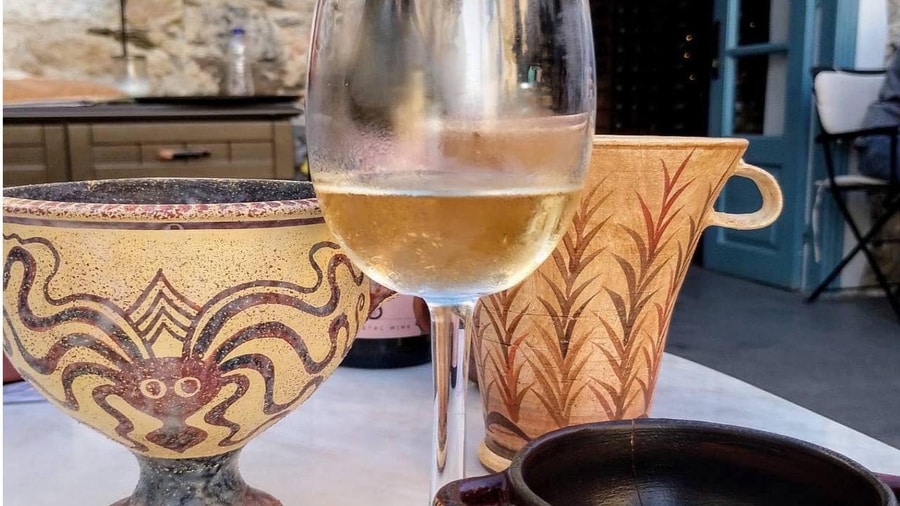
A silver stater, a type of coin, comes from Naxos in 520/515–490 BC. It shows a kantharos, a drinking cup with tall handles. Bunches of grapes hang from the handles.
The Museum of Cycladic Art explains why Dionysus appears so much on Naxian coins. His sacred wedding with Ariadne was placed on the island. A Naxos wine tour walks through this old story.
Ancient Greek poets praised Naxian wine beside the wines of Chios, Kos, Lesbos and Thasos. In one myth, Dionysus hired a Tyrrhenian pirate ship to sail from Icaria to Naxos.
After the Venetian conquest, newcomers took the richest land. Naxians farmed it as serfs or worked barren mountain plots. Joseph Nasi, made Duke of Naxos in 1566, held the sole right to the wine trade with Moldavia.
- Coin weight: The Naxian stater followed the Aeginetan standard, with a drachma of 6.1 grams.
- Son of the god: Staphylus, a son of Dionysus, lived on Naxos and married Chrysothemis.
- Sicilian link: Settlers from Naxos and Chalcis founded Naxos in Sicily in 734/5 BC.
Today farmers grow vines and olives widely in the mountain villages of the north and east of Naxos. A Naxos wine tour links these green fields to a long and rich past.
What is kitron on a Naxos wine tour?
A Naxos wine tour leads to kitron, a spirit drink tied to the Greek citron tree. The fruit grows on a small, spiny tree. Kitro of Naxos holds a protected place name under EU law, with Greece as its country.
The Greek citron is a variety of Citrus medica, called kitria in Greek. The citron is one of the original citrus fruits behind all others. Lemons and plenty of limes came from citrons.
Experts think the citron is native to the south-east foothills of the Himalayas. Its name comes from Media, where people once thought it began. Writers credit Alexander the Great with spreading it west to Greece and Italy.
Theophrastus wrote that the citron was not eaten but smelled strong. He added that it kept moths off clothes. Pliny the Elder called the tree the Assyrian apple. A Naxos wine tour brings this old fruit back into view.
The tree grows slowly to about 8 to 15 feet tall. The evergreen leaves smell of lemon and have slightly toothed edges. It blooms again and again with almost no rest, so frost harms it easily.
- Fruit colour: The fruit is green when unripe and turns yellow-orange when overripe.
- Heavy fruit: A citron stays on the branch and can reach 8-10 pounds.
- Acidic type: The Greek citron is an acidic variety, like the Florentine and Diamante citrons.
The Greek citron mainly served as the etrog, a Jewish ritual fruit for Sukkot. Greece no longer exports it for ritual purposes. On a Naxos wine tour, kitron gives the old tree a new role.
What food pairs with a Naxos wine tour?
A Naxos wine tour pairs well with the island’s local cheeses. Arseniko Naxou is a hard, mature table cheese. Xinotiri is a mountain cheese made from raw milk. Both carry strong, herby flavours that meet wine head on.
Arseniko Naxou is made from raw sheep’s and goats’ milk. Shepherds named it arseniko, meaning masculine. The name shows it is the strongest in fat and protein, the longest-lasting and the hardest.
The cheese is made only in the months of highest milk production. It must mature for at least three months. Cheesemakers turn the wheels and coat them with olive oil. The taste is intense, spicy and bittersweet.
Xinotiri of Naxos sits on the Slow Food Ark of Taste, a list of endangered heritage foods. It comes in small pinecone shapes made from free-range goat and sheep milk.
In wine, body comes mainly from alcohol. Salt and spicy heat make that alcohol feel hotter. On a Naxos wine tour, an older idea matches strong cheeses with strong wines.
- Two strategies: Pairings either complement flavours or contrast them.
- Grazing: The sheep and goats feed on thyme, broom, rock-rose, lentisc and Kermes oak.
- Cheese wheels: Arseniko Naxou comes in whitish to yellowish wheels of 1 to 4 kilograms.
A Naxos wine tour links wine to the land and its herds. Strong local cheese meets wines with real weight and body. Old pairing ideas help each flavour on the table stand out more clearly.
How is wine made on a Naxos wine tour?
Naxos wine tour visits explain how grapes become wine. Workers crush the grapes into must, which is juice with skins, seeds and stems. Yeast makes the must bubble as it ferments. The wine then rests in tanks or oak barrels.
The word must comes from the Latin vinum mustum, meaning young wine. The solid part, called pomace, makes up 7–23% of its total weight. Pomace is what stays behind after pressing.
A patitiri is a Greek treading tank. Treaders press the grapes with bare feet until must runs out. Its walls stand about one metre high above a sloping floor with an outlet.
Ancient presses, called lenoi, stood on sloping ground. Juice ran down into a lower basin, the hypolenion. Treaders moved in rhythm and sang Epilenian hymns, songs of the wine press.
A basket press holds crushed grapes in a basket. A screw or hydraulic plate squeezes the juice. Pressure stays controlled so crushed seeds do not add unwanted tannins. Travelers can compare this with wine tours in Nemea.
- Floating cap: Carbon dioxide pushes skins up, so winemakers punch them down.
- Colour: Skin contact releases colour more slowly past about 10% alcohol.
- Oak: One oak tree can give enough wood for two 225-litre barrels.
Fermentation, from the Latin fervere, to boil, makes heat. An old Bordeaux trick set the vat on blocks of ice. A Naxos wine tour links these old ideas to today’s glass.
When is the best season for a Naxos wine tour?
A Naxos wine tour fits best from August to October, during the harvest. September brings a mean temperature of 23.0 °C on Naxos. October stays mild, with an average minimum of 17.0 °C. Spring suits cooler visits.
Greek folk tradition calls September Trygominas or Trygitis, the month of the grape harvest. On the Aegean islands, October is Trygominas too. August is also called Trygitis and Sykologos, the fig gatherer.
The saying “theros, trygos, polemos” means reaping, vintage, war. It shows how whole villages joined the harvest like a festival. Crush camps let visitors pick and crush grapes during harvest season.
In hot climates, workers pick fast or in the cool of night.
October is also called Vrocharis, the rainy one, in parts of Greece. At the Naxos station, 3 m above sea level, October averages 38.6 mm of rain. North winds rule every month.
- April: The mean temperature is 16.1 °C, with 17.6 mm of rain.
- Late spring: In the fifth month, wind is lightest at 10.0 knots, with a mean of 19.6 °C.
- June: Wind averages 10.3 knots, and the mean temperature is 23.5 °C.
Harvest months bring the busiest cellars, while spring offers calmer air. A Naxos wine tour fits both seasons. Choice depends on heat, wind and the wish to see grapes crushed.
What do travelers ask about a Naxos wine tour?
A Naxos wine tour raises common questions about tasting, spitting, glasses and buying wine. Wine tourism, or enotourism, means travel to taste, drink or buy wine near where it is made. Clear answers help visitors enjoy each cellar visit.
How large is a tasting flight on a Naxos wine tour?
A tasting flight is a set of small glasses served in a row. It holds three to eight wines in a normal case. Large events can stretch up to fifty glasses. Small sips keep each wine easy to compare side by side.
Is spitting polite on a Naxos wine tour?
Spitting is normal at tastings. It is polite to ask where to spit before the tasting begins. In certain regions, tasters spit on the floor or onto gravel around the barrels. Spitting does lose the finish, or aftertaste, of each wine.
How is a glass held on a Naxos wine tour?
Certain authors advise holding the glass by its stem, the thin leg under the bowl. This keeps the hand from warming the wine or smudging the bowl. The Wine & Spirit Education Trust advises 6 to 10 °C for sparkling wines.
Does the tongue map matter on a Naxos wine tour?
No. The tongue map is a myth, and every taste is sensed across the whole tongue. It grew from a 1942 book by Harvard psychologist Edwin Boring. He replotted a 1901 German paper by David Hänig. Sipping freely works fine.
Can beginners judge wine on a Naxos wine tour?
Yes. Taste is easy to trick. Researcher Frédéric Brochet served a white wine dyed red, and tasters described it like a red. Richard Wiseman ran a 2011 test with 400 people. The public failed to tell expensive wines from cheap ones.
Can wine from a Naxos wine tour go home in luggage?
Rules depend on the home country. Australia allows travellers aged 18 or over 2.25 litres of alcoholic drinks duty free. New Zealand limits duty-free alcohol to 4.5 litres of wine or beer, from age 17. Travellers check their home rules before packing bottles.