A Paros cooking class brings travelers into a kitchen on the island of Paros. There they cook island dishes and Greek classics by hand. It is one of the cooking classes in Greece on Greece VIP.
This post covers what a Paros cooking class includes. Next come island dishes, Greek classics, local products and where classes take place. How a class works, the Mediterranean diet and the best season follow.
Each section ends with a Paros cooking class or tasting that can be booked online.
What does a Paros cooking class include?
A Paros cooking class is a hands-on lesson on the island of Paros. Small groups cook Greek and island dishes with an instructor. At the end, the cooks eat the meal they made. A glass of local wine comes with the food.
A cooking school teaches the art and science of cooking and food preparation. Amateur cooking schools are for home cooks. They link closely with culinary tourism, which means travel for food. A Paros cooking class brings that idea to a holiday island.
Hands-on teaching lets people learn through experience. In a Paros cooking class, each cook chops, mixes and shapes the food by hand. No one simply watches a demonstration. Raw ingredients at the start turn into a whole meal by the end.
Paros lies in the central Aegean Sea. It belongs to the Cyclades, a group of Greek islands. Across Greece, the taverna and the estiatorio are eating houses that serve home cooking. A Paros cooking class borrows their spirit, with the table at the centre of the day.
In a Paros cooking class, table talk is part of the lesson, not a break from it. The municipality of Paros lists wine among the island’s dietary staples. These are the basic foods of daily life on the island.
- Hands-on cooking: The instructor stays close by while each cook works.
- Small groups: A small group leaves room at the work table and time for questions.
- Shared meal: The whole group eats together at one table.
- Local wine: The wine comes from the island itself.
A Naxos cooking class covers the table of the neighbouring island. A Paros cooking class focuses on Paros itself: its fish, its pies and its village recipes. Visitors who stay on both islands can cook on each and compare the food.


Which island dishes does a Paros cooking class teach?
A Paros cooking class teaches the island dishes of Paros and the Cyclades. Gouna is a sun-dried fish, and revithada is a chickpea stew. Local pies use island cheeses. The recipes come from the sea, the mountain villages and the wood-fired ovens.
Gouna is salted as well as dried, and it is a local variety of Paros. Grilled sun-dried chub mackerel from the island is served as a mezze. A mezze is a small dish shared at the table. Sun-drying also keeps dried figs and tomatoes on the island.
Paros kitchens grill fish, fry it, or cook it with vegetables, greens and legumes. Salatouri is another fish dish. It is a ray salad with a sauce of lemon and oil and fresh herbs. A Paros cooking class can cover each of these methods.
The village of Prodromos celebrates revithada. It serves the stew piping hot from the cauldrons of an old wood-fired oven. On Sifnos, another Cycladic island, revithada cooks overnight. The cooks use clay pots called skepastaria.
Pies belong to the same tradition. Aegean cooks wrap small pies in thin dough around local cheeses. Tsibita are sweet mini-pies filled with mizithra, a whey cheese. A Paros cooking class folds such pies by hand and bakes them for the shared meal.
- Fish: Gouna, salatouri and grilled mackerel come from the island’s fishing tradition.
- Legumes: Revithada puts chickpeas at the centre, cooked slowly with olive oil and onions.
- Pies: Careful folding by hand gives the island pie its shape.
- Meat: Stuffed lamb and kidling, a young goat, are filled with herbs, greens and rice.
The stuffed lamb and kidling are cooked in a pot or in the oven. The municipality’s list of Paros dishes also names tomato, chickpea, zucchini and potato balls. These balls are simple recipes for a Paros cooking class to add.
Which Greek classics does a Paros cooking class cook?
A Paros cooking class also cooks the classic dishes served all across Greece. These include tzatziki, dolmades, moussaka, spanakopita and Greek salad. The instructor teaches the classics beside the island recipes. Together, the two sets make a full Greek meal for the table.
Tzatziki mixes strained yogurt with cucumbers, garlic, salt and olive oil. It serves as a cold appetiser or a side dish. It is also a sauce for souvlaki and gyros, two Greek meat dishes.
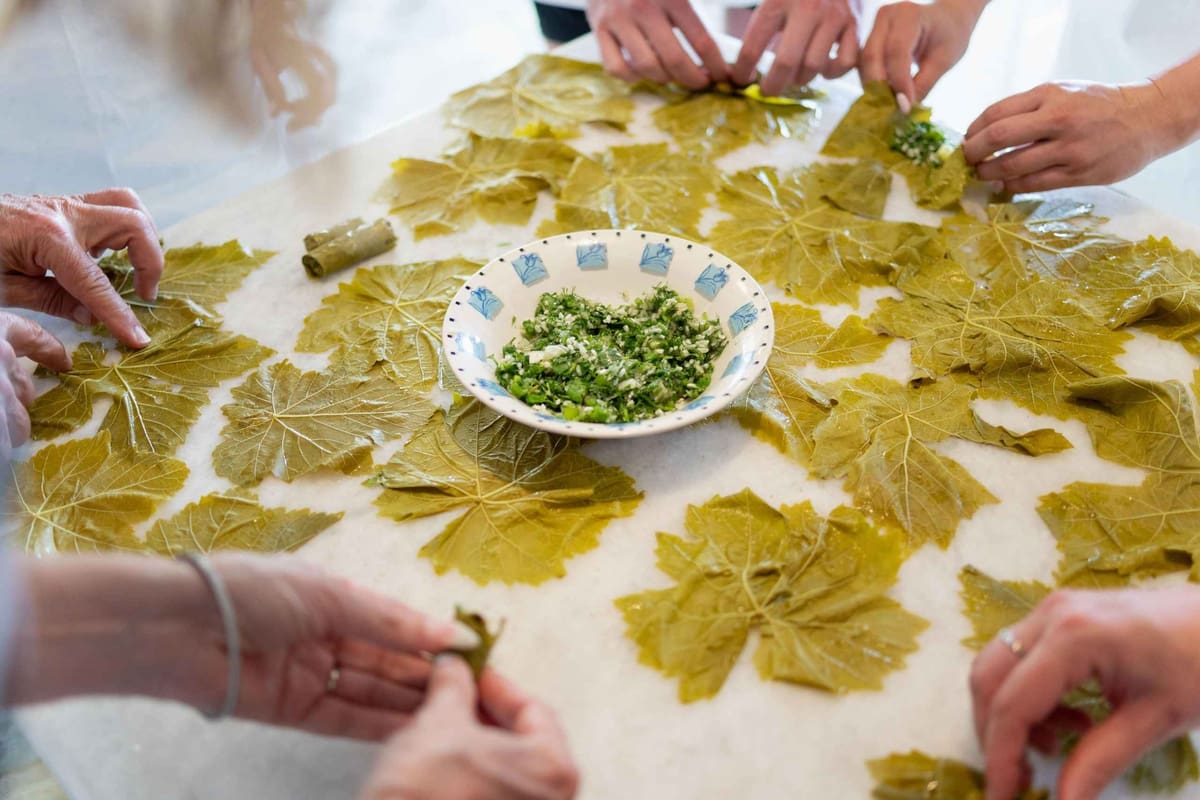
Dolmades are stuffed grape leaves. The word dolma comes from Turkish and means something stuffed. The filling is meat or grain, such as minced meat with rice, onion and parsley. A Paros cooking class teaches the rolling of dolmades.
The rolls are served hot, cold or at room temperature. Modern Greek moussaka dates from the 1920s. Nikolaos Tselementes, a chef trained in France, created it.
Moussaka has layers of aubergine and lamb. The aubergine is sautéed in olive oil. The lamb cooks with tomato, onion, garlic and spices. Béchamel, a creamy white sauce, goes on top. A Paros cooking class bakes it until golden.
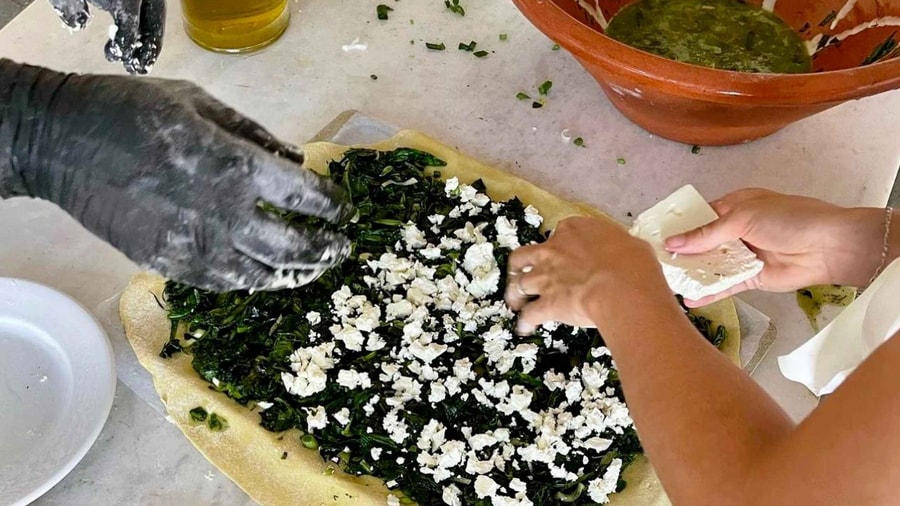
Spanakopita is a spinach pie. Chopped spinach, feta, onions or scallions, egg and seasoning fill it. The wrapping is phyllo, a paper-thin pastry, with butter or olive oil. Cooks bake it in a large pan cut into servings, or roll it into triangles.
- Ingredients: Greek salad holds tomatoes, cucumbers, onion, feta, olives, oregano and olive oil, with no lettuce.
- Cutting: Tomatoes are cut in wedges, while cucumbers, onions and peppers are sliced thinly.
- Name: Horiatiki means village salad, a dish that began as a farmer’s breakfast or lunch.
Both moussaka and spanakopita have vegan versions made for fast days. Fast days are religious days when people skip dairy products. A Paros cooking class can adapt the Greek classics for cooks who avoid dairy and meat.
Which local products does a Paros cooking class use?
A Paros cooking class uses local products grown and made on the island itself. Paros wine carries a Protected Designation of Origin. Local cheeses range from soft to sharp. Capers, aromatic honey, olive oil, garden vegetables and fresh herbs complete the list.
Wine is the best-known local product behind a Paros cooking class. The Municipality of Paros traces the ancient island vineyard back to the Cycladic civilization. That civilization was the early culture of these islands.
Two grapes carry the wine. Monemvasia is a strong white variety with a discreet aroma of peaches. Mandilaria is a deep red variety with high tannins. Tannins give wine a dry feel in the mouth.
Growers first blended the two grapes in the Venetian era, when Venice ruled the island. That blend earned Paros wine its protected status. A Protected Designation of Origin is a legal label. It ties a food or drink to the place where it is made.
A Paros cooking class can also use cheese made on the island itself. Fresh xinomyzithra, whose name means sour myzithra, is soft and creamy. Kefalotiri is salty. Kopanisti, whose name means beaten, is sharp and soft.
Kopanisti also holds that protected label as a cheese of the Cyclades. Myzithra is a fresh white cheese. Paros also makes oil cheese, kept in oil, and brine cheese, kept in salty water.
So a Paros cooking class has a wide choice of cheese for pies and for the table. At the table, the cheese sits beside koroneiki olives, a small olive variety.
The garden supplies the rest. Herbs such as oregano, sage and thyme grow on the island. Its gardens give eggplant, zucchini, green beans, broad beans and wild greens. Olive oil stands among the foundations of Parian food. Fruit, vegetables, wine and dairy products complete that base.
- Cheese: Toumoumi is a salted cheese cooked in goatskin.
- Greens: Nettles, chard and wild beets are among the wild greens.
- Figs: Parian dried figs are filled with sesame seeds, almonds and preserves.
The island measures 196.3 square kilometres, and every product above comes from that small area. In a Paros cooking class, the instructor shows how each local ingredient changes a simple dish.
Where does a Paros cooking class take place?
A Paros cooking class takes place in the countryside of the island, in farmhouses and family kitchens. Classes also meet in the villages around them, such as Lefkes, Marpissa, Naoussa and Parikia. Whitewashed houses and village squares set the scene.
The setting of a Paros cooking class is a home kitchen. It is not a restaurant kitchen where cooks work in a line. A farmhouse or a family kitchen holds the long table and the stove. The garden lies beside the door, where the herbs grow.
The home setting suits the food of the island. That food grows in gardens and is cooked simply with olive oil. So the class stays close to the people who grow the ingredients.
The villages give a Paros cooking class its address. Lefkes is an inland mountain village 10 km from Parikia. It is the settlement at the highest altitude on the island. Its narrow streets climb the hill in rows, like the seats of an amphitheatre.
Marpissa stands on a hill on the east side, 19 km from Parikia. Four windmills stand on its main square. Both villages are traditional settlements. They make a fitting backdrop for a Paros cooking class that starts from garden produce.
- Naoussa: This fishing village on the north side has the largest fishing fleet in the Cyclades.
- Parikia: The capital and main port sits on a bay, among gardens of oranges and pomegranates.
- Farmhouses: A farmhouse class keeps away from the harbour towns.
The place sets the mood of a Paros cooking class more than the menu does. A mountain village brings the interior, the inland part of the island. A harbour town brings the sea, and a farmhouse brings the garden.
How does a Paros cooking class work step by step?
A Paros cooking class works step by step. It opens with a welcome drink and moves to picking herbs or vegetables in the garden. Next come preparing the ingredients and cooking with the instructor. Last, everyone shares the finished meal at one table.
Parian wine suits the welcome at the door, and so does souma. Souma is the local spirit, distilled from grape pulp after pressing. Then the group walks into the garden. Cooks cut herbs and gather tomatoes, greens and other vegetables for the dishes of the day.
Picking first means the ingredients reach the kitchen fresh. In this way, the garden decides the menu. Next, the instructor shows how to wash, chop and prepare each ingredient. Then the group moves to the stove to cook together.
At the stove, the instructor stays at the side of the group to explain each step. In a Paros cooking class, tasks run from the pie filling to the wild greens salad.
- Welcome: The first drink sets the pace of a Paros cooking class.
- Cooking: Each guest takes a task, so the meal is the work of the whole group.
- Table: The dishes that the group made itself fill the table.
The steps of a Paros cooking class follow the order of a family meal. Cooks greet, gather, prepare, cook and eat. They leave with a clear idea of how island cooking is done at home.
What does a Paros cooking class teach about the Mediterranean diet?
A Paros cooking class puts the Mediterranean diet into practice at the stove. Olive oil serves as the cooking fat. Vegetables and legumes sit at the centre of the plate. Sharing the finished meal at one table is part of the diet too.
UNESCO lists the Mediterranean diet as intangible cultural heritage. This heritage means a living tradition, not a building or object. Seven countries share the listing: Greece, Cyprus, Croatia, Spain, Italy, Morocco and Portugal.
The listing treats the diet as more than a menu. It covers skills, knowledge, rituals, symbols and traditions. These run from crops, harvesting and fishing to animal husbandry, the raising of farm animals.
The chain goes on through conservation, processing and cooking. Conservation means keeping food so it lasts. A Paros cooking class teaches the cooking link of that chain.
Olive oil is the characteristic and ancient element of Greek cuisine. Greece has the highest olive oil use per person in the world. Each person there consumes around 24 litres a year.
The wider Mediterranean diet stresses unprocessed cereals, legumes, vegetables and fruit. Fish and dairy come in moderate amounts, while red meat, refined grains and sugar stay low. A Paros cooking class shows how that pattern looks on a real plate.
- Olive oil: Boiled greens are dressed with it and fresh lemon juice.
- Legumes: Beans, lentils and split peas serve as both starters and main courses.
- Fish: Fish dishes are common in coastal regions and on the islands.
Eating together is the part of the diet that no recipe holds. UNESCO calls it the foundation of cultural identity and continuity for communities around the Mediterranean basin.
UNESCO also calls the shared meal a moment of social exchange and communication. A cooking class on Paros carries that idea from the stove to the table.
When is the best season for a Paros cooking class?
A Paros cooking class meets sunny, dry weather and a steady wind in summer. Autumn brings a new olive crop, and winter brings wetter days. The best season depends on what the traveler wants to taste and see on the island.
Greece has a Mediterranean climate, and the Cyclades show it clearly. Summer weather is sunny and dry. The cooler sea and the sea breeze keep coastal temperatures milder.
Heatwaves do arrive, but they stay mild at the coast. Rain is scarce: Schoinoussa in the Cyclades gets only 239.3 mm a year. It counts as the driest area in Greece.
Summer classes on the island meet steady sun. The meltemi, or etesian wind, defines summer in the Aegean. This seasonal wind blows from late spring until October.
Its peak comes in July and August. It keeps Aegean temperatures below those of the Ionian Sea. It can reach force 7 to 8 on the Beaufort scale, a measure of wind strength.
Such wind can stop inter-island ferries. The strait between Paros and Naxos carries a constant strong wind. Travelers who pair a Paros cooking class with ferry or boat days plan around that wind.
- Winter: Winters are wet, and any snow that falls does not last long.
- Olives: Olives are harvested in the Mediterranean from October onwards.
Home-cooked Greek meals rely on seasonal vegetables stewed in olive oil with herbs and tomato sauce. Such dishes are called lathera. So the menu of a Paros cooking class follows the calendar.
Weather decides how the day outside feels, while produce decides what lands on the plate. Season is a choice between wind and sun, greens and olives.
What do travelers ask about a Paros cooking class?
A Paros cooking class raises five practical questions for travelers. They ask which diets the menu meets and whether children can join. They also ask about cooking experience and taking recipes home. The fifth is how the class fits beside a day on the water.
Does a Paros cooking class suit vegetarians and other diets?
The Greek kitchen has a large vegetarian side, and a Paros cooking class can build on it. Savoury pies filled with spinach, wild greens or zucchini are vegetarian.
Vegan menus, allergies and religious diets differ by organiser. Travelers with a strict diet state the need before booking.
Can children join a Paros cooking class?
UNESCO says the Mediterranean diet brings together people of all ages, conditions and social classes. That tradition makes a Paros cooking class a natural family activity.
Age limits and the tasks open to young cooks differ by organiser. Families check those details on the booking page.
Is cooking experience needed for a Paros cooking class?
Cooking experience is not a condition of the tradition behind the class. The Mediterranean diet is linked with simple but varied cooking methods.
UNESCO says its knowledge passes on through the daily practice of exchange at markets. Beginners join a tradition built on exchange between people, from the market to the table.
Can travelers take the recipes home from a Paros cooking class?
Important vegetables in Greek cooking include tomatoes, aubergines, potatoes, green beans, okra, green peppers and onions. A dish from a Paros cooking class can be rebuilt with them in another kitchen.
Whether an organiser hands out written recipes differs from class to class. Travelers ask about it before booking.
Can a Paros cooking class combine with a day on the water?
Paros lies 8 km west of Naxos. The channel to Antiparos is less than 2 km wide at its narrowest. Naoussa offers a natural harbour for boat traffic.
A traveler can book a Paros cooking class for one day and a Paros sailing tour for another. The sailing day shows these waters from the deck.
Featured photo: Greek cooking class with a local chef in Drios, Paros, via GetYourGuide.