
A Milos wine tour visits the vineyards of Milos, a volcanic island in the Cyclades, and tastes the wine they make. Tastings sit beside old mines, cool caves and village food. It is one of the wine tours on the Greek islands on Greece VIP.
This post covers what a Milos wine tour includes, the vineyards and the grapes. It also covers volcanic soil, the history of Milos wine and the local food that pairs with it. Wine caves, the best season and common questions come last.
Each section ends with a Milos wine tour or a nearby tour that can be booked online.
What does a Milos wine tour include?
A Milos wine tour centres on tasting island wine at vineyards open to visitors. Clays mined on the island also serve wine cellars. Island custom ties wine to church feasts. Tasting has its own simple terms as well.
The South Aegean Region’s tourism site names Milos with Leros, Kos, Mykonos, Tinos and Sifnos. On these islands, viticulture, the growing of grapes for wine, is developing. The same site lists Milos, Syros, Naxos and Mykonos for vineyard visits with tastings.
A Milos wine tour also meets an old island habit. Aegean island families commonly make the wine they drink with meals. At festivals held at churches and chapels, they treat guests to wine and raki, a local spirit.
Bentonite, a clay also mined on Milos, soaks up protein. Winemakers use it to remove extra protein from white wines. Without it, white wines can form cloudy hazes in warm weather. Their proteins break down in the heat.
For white wine, bentonite can go into the must, the fresh grape juice, before fermentation. Fine particles then clump together and settle. A Milos wine tour also pairs well with a day of snorkeling around Milos.
- Perlite filters: In depth filtration, wine is pushed through thick pads of cellulose fibres or perlite.
- Faster clearing: Bentonite also helps red and white wines turn clear more quickly.
- Blue fining: Potassium ferrocyanide takes out copper and iron that enter wine from bentonite, metal tools or sprays.
Tasting terms help on a Milos wine tour. A tasting flight is a set of wines poured for comparison. It runs from three to eight glasses as a rule, and at times up to fifty.


Which vineyards and wineries does a Milos wine tour visit?
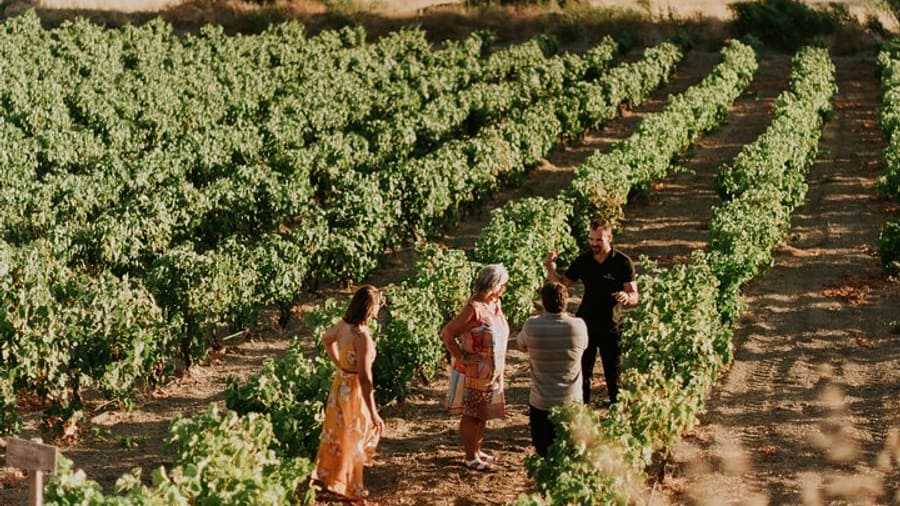
A Milos wine tour visits vineyards that grow in hard conditions. Long droughts, high heat, strong winds and salty water test every vine. One vineyard even grows on an old perlite mine. The island also falls inside the PGI Aegean Sea wine zone.
In 2014, a vineyard of 5 hectares was planted on a worked-out perlite mine. A study in the Bulletin of the Geological Society of Greece looked at it. The study sees the mine vineyard as a possible new line of work for local people.
On restored mine land on Milos, only native plants survive. They can rest through the 6-month hot, dry season with no watering. Trial plots there tested four crops: vines (Vitis vinifera), prickly pear, jojoba and olive.
In his 1885 book on the Cyclades, Theodore Bent described central Milos. He found its low ground “perfectly alive with volcanic matter”. Vineyards covered all the land around it. But with not enough men to tend them, they were turning into wastes of stone.
- Island-wide label: PGI Aegean Sea, a protected wine zone, covers every Aegean island but Evia and Crete.
- Near the sea: Aegean island vineyards stand close to the sea and get plenty of sun all season.
- Sea breezes: In summer, winds blowing inland from the sea soften the heat in these vineyards.
- Low yields: Aegean island vines give small harvests and take a lot of labour.
A Milos wine tour shows the wider island picture too. Altitude, soil and slope direction give the Aegean islands separate terroirs, or growing settings. Even the smallest inhabited islands now have wineries working with native grapes.
Which grapes grow on a Milos wine tour?
A Milos wine tour meets the grapes allowed under the PGI Aegean Sea rules. The bulk of these wines come from grapes native to the Aegean. A number of them are rare in vineyards. Foreign grapes are allowed too.
On a Milos wine tour, white wine belongs to a zone with rare native grapes. The rules allow Begleri, Platani and Hidiriotiko. Chardonnay, Sauvignon Blanc and Ugni Blanc can join them from abroad.
Red wine follows the same pattern. Native reds include Agianniotiko, Aidani Mavro, Limnio and Chiotiko. Foreign reds run from Cabernet Sauvignon, Cinsault and Grenache Rouge to Merlot and Mourvedre. Carignan, Syrah and Tempranillo are permitted too.
The Vitis International Variety Catalogue, a world list of grape types, records 41 other names for Mandilaria. Among them are Papoudes and Mavro Spetzon. It lists 20 other names for the white grape Aidani Aspro, such as Moschaidano. Its taste is classed as aromatic.
- Gaidouria: This white-skinned Greek grape has 7 other names in the catalogue, such as Gaidouricha.
- Katsano: This white-skinned Greek wine grape has just one other catalogued name, Katsamon.
- Avgoustiatis: This black-skinned Greek grape serves both for wine and as a table grape for eating.
- Maloukato: This white-skinned Greek wine grape is also spelled Malukato.
A Milos wine tour also touches famous wine history. Wine from Kea, called Keos by Bent, was much sought after in medieval Constantinople. Michael Psellos called it sweet-scented and black in colour.
How does volcanic soil shape a Milos wine tour?
A Milos wine tour crosses an island built by volcanoes. Volcanic rocks cover the larger part of its surface. These rocks give light soils that drain well. Grapes grow in this dry ground, and they rank with cotton and barley as the main crops.
Eruptions on Milos happened both on land and under the sea. So fossil shells lie inside parts of the island’s rocks. The ground also holds sedimentary rocks, made from old layers, and metamorphic rocks, changed by heat and pressure.
Two extinct volcanoes stand on the island. Fyriplaka sits in the south-east, with a crater about 1700 metres across and 220 metres high. Trachilas lies in the north-north-west. A Milos wine tour passes through land shaped by both.
Kastro hill and Profitis Ilias, the highest peak, are volcanic domes. They formed from lava that set before it had time to flow. This lava is mostly andesite, a kind of volcanic rock.
Soils formed in volcanic ash are called andosols. They are light, with a bulk density of 0.9 kg per cubic decimetre or less. In a dry climate, they are very fertile, unless phosphorus gets locked up.
- Perlite: This mineral, mined on Milos, is a light, powdery and lustrous volcanic vineyard soil type.
- Bentonite: This clay from Milos is mixed with sulfur to make slow fertilizer pellets.
- Hot springs: Warm water on the island reaches up to 55 °C.
The ideal vine soil holds enough water but drains well, so roots do not get waterlogged. Mixed into soil, perlite lets water through and stops packing down. On a Milos wine tour, olive, orange, juniper and arbutus trees grow across the land.
What history lies behind Milos wine?
A Milos wine tour touches an old story of vines and trade. In Roman times, a floor mosaic showed vines in a sanctuary of Dionysus, the god of wine. Old jars, coins and place names add more layers to this long past.
In the Archaic period, the city at Klima made “apple amphorae”. These were clay jars with scenes from Greek mythology. From at least 470 BC, the Melians also exported terracotta reliefs.
From the 6th century BC, Melos struck coins on the Milesian weight standard. Melos was the only Aegean island to use this standard. Its coins carried the word ΜΑΛΙΟΝ, meaning “of the Melians”.
In 426 BC, Athens sent 2,000 men to raid the Melian countryside. Athens also set a tribute of 15 talents of silver for Melos. The Athenian siege ended the relief trade.
After the war, the coins switched to the Rhodian standard, with tetradrachms of 15.3 g. In Roman times, the town centre moved to Tramythia. There, diggers found a mosaic with vines, fish and wild animals.
- Kanava: This spot near Adamas carries a Theran dialect name for a closed winery and wine store.
- Pirates: The pirate Hayreddin Barbarossa occupied Milos in 1537.
- Taxes: In the early 18th century, a Turkish governor collected heavy taxes.
In December 1883, the traveller Theodore Bent wrote that Syra had taken the trade of Milos. He also saw Cretan exiles leave the fertile centre unfarmed, hoping to return home.
What local food pairs with a Milos wine tour?
A Milos wine tour pairs well with simple island food. The official visitor portal names pitarakia among the typical dishes. These are filled with peppery dry cheese, or with myzithra, a soft white cheese, and mint. Meat, fish and sweet pies complete the table.
The portal recommends octopus, grilled or cooked in wine. It also suggests rooster, braised or cooked in wine. Baked lamb with tomato paste is another local meat dish. These plates sit well beside a glass on a Milos wine tour.
On Milos, ladenia is a pie made with oil, tomato and onion. It comes from nearby Kimolos, where people have made it since Venetian rule. People eat this lenten pie all year and compare it to Greek pizza.
Traditional ladenia is rectangular. Cooks bake it in an aluminium tray and cut it into squares. The dough holds only flour, yeast, olive oil, water and salt. In winter, cooks use tomato paste instead of fresh tomato.
Watermelon pie is a traditional sweet pie of Milos. It belongs above all to Ios, Milos, Folegandros and Kimolos. Plenty of sesame goes under and over it, and watermelon replaces juice, water or milk.
- Koufeto: This sweet is made from sweet pumpkin with honey and almonds.
- Weddings: The mother of the bride serves koufeto at weddings and engagements.
- Meaning: The honey stands for a sweet married life, and the almonds stand for fertility.
In summer, families ate part of a watermelon fresh and baked the rest into pie. The rind became a spoon sweet or a pickle. Sun-dried tomatoes spend 4–11 days in the sun.
How do caves help store wine on a Milos wine tour?
A Milos wine tour links wine with soft volcanic rock. Underground caves stay cool and damp all year. Both conditions help wine age slowly and safely. Damp air also cuts the wine that barrels lose each year through evaporation.
Humidity is the amount of water in the air. In wine caves, it runs from 70 to 90%. Winemakers like over 75% for reds. They like over 85% for whites in barrels.
On a Milos wine tour, numbers show the gain. A 230-litre barrel in a Northern California warehouse loses about 15 litres a year. A cave cuts that to about 3.8 litres.
The industry treats a constant 13 to 16 °C as best for ageing. Deep rock in Northern California holds a steady 14 °C. A warehouse needs energy to cool, heat and humidify.
The top 1 m of ground follows sun and weather. From about 8 to 20 m deep, it nears the yearly air average. There, the warmest point arrives about 6 months later.
The Catacombs of Milos are cut into tuff, a soft volcanic rock. Their corridors add up to about 200 m. Travelers can compare a Milos wine tour with a wine tour on Mykonos.
- Cave size: A typical cave is 4.0 to 5.5 m wide.
- Passive cellars: They cost nothing to run.
- Largest cellar: Mileștii Mici in Moldova has 250 km of tunnels, with 120 km in use.
- French caves: Wine caves in France sit at 13 °C.
Cave storage saves real wine over time. Reds spend about two years in barrel and save around 10% of their volume. Whites spend about one year and save about 5%.
When is the best season for a Milos wine tour?
A Milos wine tour works well in spring and autumn. April brings a mean daily high of 18.4 °C. November stays mild, with a mean daily high of 18.0 °C. Summer on the island brings the Milos Festival.
NOAA climate normals for 1961-1990 come from station number 16738. April has a mean daily low of 12.4 °C. Relative humidity, the share of water in the air, averages 67.0%.
Rain is rare in April on a Milos wine tour. The month averages 2.9 days with at least 1.0 mm of rain. April records run from 5.4 °C to 28.4 °C.
The month after April has lower humidity, averaging 63.5%. Its lowest reading on record is 8.0 °C. October shares that record low. October can turn hot, with a record high of 32.0 °C.
On a Milos wine tour in September, the record low is 11.6 °C. November averages 15.3 °C, with a mean daily low of 13.1 °C. November records run from 2.8 °C to 27.8 °C.
Rain grows late in the year. November brings 60.7 mm over 5.8 days with at least 1.0 mm. March averages 12.1 °C, with 47.2 mm over 5.7 rainy days.
- Yearly rain: An HNMS station on Milos records a mean 408 mm a year for 1955-2001.
- Yearly humidity: Humidity on Milos averages 68.0% over the year.
- Festival dates: The festival runs from late June to September.
A Milos wine tour fits spring, early autumn or late autumn. Each season shows mild average figures. Travelers can match the month to their own taste for heat or rain.
What do travelers ask about a Milos wine tour?
A Milos wine tour raises practical questions. Travelers ask about buses, water and food. Wine also needs care after a tasting ends. Light, heat and dry fridges can harm bottles that travelers carry home from the island after the trip.
How do buses work for a Milos wine tour?
City buses serve parts of Milos. In the summer months, the routes run at frequent times. Passengers buy their ticket on the bus itself. A bus ride lets a wine taster skip driving after a tasting.
How can water help on a Milos wine tour?
Alcohol dehydrates the body by raising urine output. This brings thirst, dry mouth and dizziness. Drinking water before bed can ease these signs, plus headache. A glass of water between wines also helps the body on a tasting day.
What is lightstruck wine after a Milos wine tour?
Lightstruck wine has had too much ultraviolet light, mainly from 325 to 450 nm. It smells of wet cardboard or wet wool. Delicate wines such as Champagne suffer worst. Reds rarely do, because phenolic compounds, natural plant chemicals, protect them.
Which bottles hold up best after a Milos wine tour?
In France, lightstrike is called goût de lumière, a taste of light. Coloured bottle glass blocks ultraviolet light. Wines in clear, light green and blue bottles face the greatest risk. Buyers can keep such bottles out of the sun.
Can heat spoil wine bought on a Milos wine tour?
Heat-damaged wine is called cooked or maderized. Signs include wine along the cork or a cork pushed partly out. Reds can turn a brick colour. Professor Cornelius Ough held that wine can briefly face 49 °C without damage.
Can a hotel fridge hold wine from a Milos wine tour?
Refrigeration dries the air. That dry air can quickly dry out corks. Wine expert Tom Stevenson advises against keeping wine in a refrigerator. A hotel fridge is no place for a bottle meant to last.