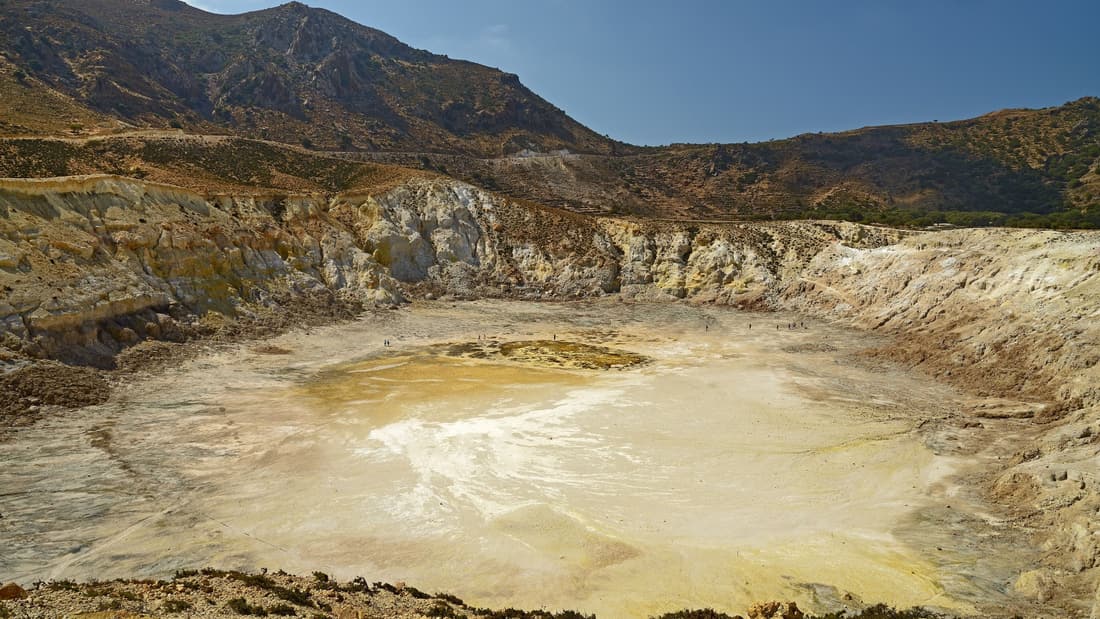
A Nisyros volcano tour crosses from Kos or Rhodes to the round volcanic island of Nisyros in the Dodecanese and drives down into its caldera, where steaming craters open in the caldera floor. This post covers what a Nisyros volcano tour includes, where the boats leave from, the Stefanos crater, how the caldera formed, the other craters and the myth behind them, Mandraki, the villages on the rim and the best season. It is one of the Greece tours on Greece VIP.
Each section ends with a Nisyros volcano tour that can be booked online.
What does a Nisyros volcano tour include?
A Nisyros volcano tour visits a round volcanic island of the Dodecanese that lies between Kos and Tilos. The programme centres on the caldera, with its craters and vents, and runs as a boat day trip from Kos or Rhodes or as a tour on the island.
Nisyros is a volcanic island and municipality in the Aegean Sea, and it belongs to the Dodecanese group. The outline is close to round, about 8 km across, and the island covers 41.6 km2, with land that climbs to 698 metres. That compact shape defines a Nisyros volcano tour. The island is one volcanic body, not a town with a volcano nearby, so every stop on the programme belongs to the same system.
The caldera sits at the centre of the island. Its width runs from 3 to 4 kilometres, so it spans between a third and a half of the island’s breadth. The craters hold the fumaroles, and the volcano counts as active even though it is not erupting. That status sets a Nisyros volcano tour apart from a walk around a cold, extinct cone, because the vents still release steam and gas today.
Two kinds of Nisyros volcano tour exist. The first is a crossing by sea, a day trip by boat from Kos or Rhodes that lands at the island’s harbour. The second is a tour on the island itself, built for visitors who stay in Mandraki or in one of the villages and travel to the crater field from there. Both end at the caldera.
- Centre: The caldera fills the middle of the island, and the fumaroles of the volcano vent at its craters.
- Sea day trip: A boat from Kos or Rhodes carries the visitor across to the island.
- Island tour: A tour on Nisyros itself starts from Mandraki or a village and goes up to the volcano.
A Kos boat trip is the wider outing across the waters around Kos, and Nisyros is only one of its calls, since Kos lies north of the volcano island. A Nisyros volcano tour narrows the plan to one subject. The caldera, the craters and their steaming vents are the reason for the day, and the crossing and the port are only the means to reach them.


Where does a Nisyros volcano tour leave from?
A Nisyros volcano tour leaves from Kardamaina or Kos town on the island of Kos, or from Rhodes by ship. Boats land at Mandraki, the main port and capital of Nisyros, and Piraeus is a further ship link. A heliport on the island handles arrivals by air.
Kardamaina is a town set midway along the southern coast of Kos, 7 km from the island’s international airport. It began as a small fishing village and became a summer resort in the 1960s. Between June and September its population triples. The trips to Nisyros that run daily in summer start from this village, so it is the natural base for a Nisyros volcano tour from the south of Kos.
The islet of Gyali lies halfway between the south coast of Kos at Kardamaina and Nisyros. It is built of rhyolitic obsidian lava domes and pumice deposits, and its pumice is mined. Gyali therefore marks the middle of the gap that a Nisyros volcano tour crosses from Kardamaina, and it forms part of the Nisyros volcanic complex, which is why the short crossing already runs through volcanic country.
Kos town holds the main harbour of Kos and is its population centre, and it is the second Kos departure point for a Nisyros volcano tour. Rhodes is the third. Ships reach Nisyros from Rhodes, from Kos and from Piraeus, so a tour that starts on Rhodes relies on the ship link rather than on the short summer trips from Kardamaina. All of them land at the main port.
Mandraki is the harbour of Nisyros and its capital, and it is the largest settlement on the island. Boats and ships land at this main port, so Mandraki is where a Nisyros volcano tour changes from a sea crossing to a land tour. The caldera lies at the centre of the island, so the route runs inland from the coast to the craters.
- Kardamaina: A town on the southern coast of Kos, from which daily summer trips cross to Nisyros.
- Rhodes: A port with a ship link to Nisyros.
- Mandraki: The capital of Nisyros and its main harbour, where the boats land.
Every departure for a Nisyros volcano tour ends at the same island, so the choice of port depends on where the visitor stays. Kardamaina suits the southern coast of Kos, Kos town holds the chief harbour of the island, and Rhodes has its own ship link. A heliport on Nisyros adds an air route, and Mandraki receives the sea arrivals before the tour turns inland to the caldera.
What is the Stefanos crater on a Nisyros volcano tour?
A Nisyros volcano tour reaches Stefanos, the largest crater of the volcano, where fumaroles vent steam and sulphurous gas. Fumarole activity breaks down the rock around each vent and deposits sulphur there, so the crater shows brightly coloured altered rock and heat from below.
Stefanos is the name of the largest crater of the Nisyros volcano. It is one of the craters at which fumaroles are found, and the volcano is classed as active but not erupting. A fumarole is an opening in the ground that lets out hot gas and steam with no liquid or solid material alongside, so a crater such as Stefanos releases steam and gas, not lava or rock.
Steam makes up the main vapour at a fumarole, because groundwater circulates through heated rock and turns to vapour. Sulphur compounds and other volcanic gases travel with the steam, and a vent that gives off significant sulphur compounds is called a solfatara. This is what a Nisyros volcano tour shows at the craters: hot vents, a sulphur smell and ground that the gases have changed.
The activity breaks down the rock around each vent while it deposits sulphur and other minerals. Acidic fumes leave brightly coloured haloes of altered rock around the opening. Gas leaves a fumarole at temperatures between about 100 and 1,000 degrees Celsius worldwide, and the vapours can be hot and poisonous, so active fumaroles count as a hazard and a licensed tour leader matters on a Nisyros volcano tour.
- Sulphur: Fumarole activity deposits sulphur and other minerals around the opening.
- Rock: Acidic fumes break down the rock and leave brightly coloured haloes.
- Hazard: Hot, poisonous gases make an active fumarole a risk without a tour leader.
Almost all eruptions of the volcano involved phreatic activity, which means groundwater heated to steam drove them. The last such event was the steam blast of 1888. A hydrothermal explosion happens when superheated water trapped below the surface turns rapidly to steam and breaks the rock around it, and the Stefanos crater is the largest mark of that kind of volcano on a Nisyros volcano tour.
How did the caldera form on a Nisyros volcano tour?
A Nisyros volcano tour reaches a caldera whose width runs from 3 to 4 kilometres, left when the ground sank into an emptied magma chamber. Three eruptive stages shaped it during the past 150,000 years, on a volcano of the South Aegean Volcanic Arc.
The volcano owes its place to a stretching of the crust. The southern Aegean arc moved south and took its curved shape, and the Aegean Sea opened behind it where the crust was thin and weak. Magma then broke through that crust and built a second arc, a chain of volcanoes. A fault zone to the north let the Aegean Sea plate break away from Eurasia. Every Nisyros volcano tour stands on a volcano born of that stretching.
A caldera forms when a magma chamber empties. The ground above loses its support and drops into the void, so the hollow is a sinkhole made by collapse, not a crater blasted out by one explosion. On Nisyros, three separate eruptive stages shaped it, from explosive and effusive andesitic eruptions to explosive and effusive dacitic and rhyolitic activity. That sequence is the rock record behind the Nisyros volcano tour.
Water drives the explosions recorded in historical times. A phreatic explosion starts when magma heats groundwater and the water flashes to steam, which throws out rock and ash. Small eruptions of ash in 1871 and 1873 came first, and a steam explosion in 1888 is the latest eruptive activity. Four historical eruptions are on record, each with a Volcanic Explosivity Index of 2. A Nisyros volcano tour therefore visits a volcano that is active but not erupting.
- Ongoing stretch: The extension behind the arc is still ongoing.
- Neighbours: Kos, Nisyros and Yali are named side by side among the volcanoes of the arc.
- Recent unrest: Nisyros is one of only three volcanoes in the arc to erupt or show significant unrest during the past 100 years, which places a Nisyros volcano tour on one of three volcanoes.
- Monitoring: An international scientific team began to monitor the volcano after seismic unrest struck in 1996–1997.
A Nisyros volcano tour shows how a collapse and a run of eruptions made one island. The ground dropped after magma left, three stages of eruption built the rocks, and steam explosions kept the volcano active in historical times. Steam explosions of this kind work like hydrothermal explosions elsewhere: superheated water turns to steam below the surface and breaks the rock above it.
Which other craters does a Nisyros volcano tour pass?
A Nisyros volcano tour passes the other craters of the volcano, where fumaroles vent steam and hot gas. The island’s own story gives another cause: the giant Polybotes lies crushed under a piece of Kos that Poseidon broke off and threw.
Fumaroles mark the craters of Nisyros. These vents carry steam and hot volcanic gas up from the heated ground, and the gas works on the rock around each opening. It breaks the rock down and leaves deposits of sulfur and other minerals behind. Hot, poisonous gas also makes an active vent a hazard. Fumaroles belong to the late stages of volcanic activity, and the steam at the craters is the sign of that activity that a Nisyros volcano tour can see.
Greek myth explains the island in another way. The mythographer Apollodorus wrote that Polybotes, one of the giants, was chased through the sea by Poseidon and came to Kos. Poseidon broke off the piece called Nisyrum and threw it on him. The geographer Strabo told the same tale, with a trident doing the breaking, and added that other tellers place the giant beneath Kos itself. Each Nisyros volcano tour follows ground that carries this story.
A second version changes the throw. After Zeus struck him, Polybotes swam away, and Poseidon hurled a trident at him but missed. The trident became the island of Nisyros, which was also called Porphyris. Homer mentions the island in the Iliad, so the island has a place in Greek epic poetry. Both versions tie a Nisyros volcano tour to the same giant.
- Wider system: The same system stretches under the sea toward Kos and takes in Gyali and a section of Kos.
- Gyali: Deposits of perlite and pumice on Gyali provide much of the wealth of the island.
- Vase painting: A black-figure amphora in the Louvre shows Poseidon carrying the island of Nisyros on his left shoulder, ready to hurl it at the giant.
A Nisyros volcano tour pairs two ways of explaining the same craters. Geology points to heat, groundwater and steam beneath the caldera, while myth points to a giant buried by a god. Both accounts link Nisyros to Kos, and both give a reason to look closely at every vent that the route passes.
What does a Nisyros volcano tour see in Mandraki?
A Nisyros volcano tour sees Mandraki, the port and largest settlement of the island, with a castle built in 1315 above it. Beside the castle stands the monastery of Panagia Spiliani, and ancient walls of the fifth century BC lie near the village.
Mandraki serves as the capital of the island municipality and is the largest settlement on Nisyros. It is also the harbour, so much of the island’s tourism trade is based here, with hotels, apartments, beaches and places to eat and drink. The population was 791 in 2021. A Nisyros volcano tour reaches the craters from this village, and the village keeps its own history on show.
Settlement rights came first. The Knights Hospitaller received permission in 1315 to live on the island in return for rent paid to the Genoese government, and they built the crusader castle that overlooks Mandraki. The Ottomans took the island in 1566, and the Italians followed in 1911 together with the other Dodecanese islands. It joined the Greek Kingdom in 1947, after the Second World War.
Panagia Spiliani means the Blessed Virgin Mary of the cave. It is the largest of the four monasteries on Nisyros and stands beside the medieval castle at Mandraki. No monks live in the four monasteries today, yet celebrations still take place in them. The New Martyr Niketas of Nisyros is the island’s patron saint, and Orthodox Christian churches are found across the island.
- Walls: Ancient walls near Mandraki date to the fifth century BC and belong to the acropolis of the island.
- Castle: The castle built in 1315 overlooks the settlement that a Nisyros volcano tour visits.
- Monastery: Panagia Spiliani, the largest monastery on the island, is built beside the castle.
- Harbour: Mandraki is the main town and port of Nisyros.
A Nisyros volcano tour reads Mandraki as a stack of layers: walls of the fifth century BC, a crusader castle from 1315 and a cave monastery beside it. The harbour village also sets the island apart from the crater country, because it holds the port, the beaches and the places to eat and drink. Each layer adds a date to the story of Nisyros.
Which villages does a Nisyros volcano tour visit on the caldera rim?
A Nisyros volcano tour reaches Nikia and Emporeios, the two smallest of the four villages on Nisyros. Nikia counts 61 residents and Emporeios 27, against 660 in the main town of Mandraki and 239 in Paloi, so both stops are small settlements.
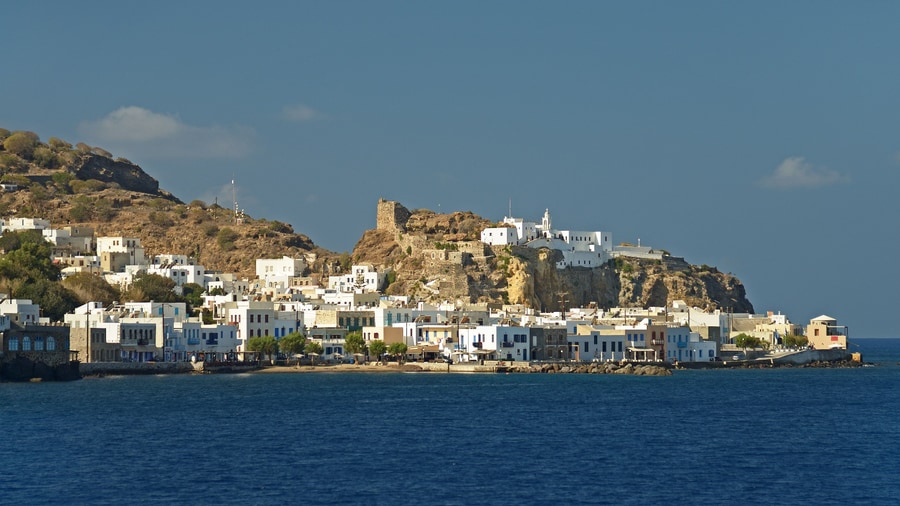
Nisyros has four villages, and their sizes differ widely. Mandraki is the main town and port, Paloi comes second with 239 residents, Nikia has 61 and Emporeios has 27. A Nisyros volcano tour that stops in the last two enters settlements that are small even by island standards. The whole municipality counted 1,008 residents at the 2011 census, a figure that includes 21 people on the islet of Gyali.
The village populations grow in summer. According to the island article, tourists arrive and expatriate Nisyrians return for their holidays, so visitors add to the resident count. A Nisyros volcano tour in the warm months therefore meets more people in the villages than the census figures suggest. The same article adds that tourism is less developed on Nisyros than on other Greek islands.
The island is nearly round, with a diameter of about 8 km, and its caldera measures 3–4 km across. On an island of that size, the villages and the crater field belong to one outing. The island used to be self-sufficient, with crops grown on its terraced slopes, and today the terraces are cultivated on a smaller scale. Gyali, the islet in the same municipality, holds deposits of perlite and pumice that provide much of the island’s wealth.
- Nikia: The village has 61 residents, the second-smallest count among the four villages.
- Emporeios: The village has 27 residents, the smallest count on the island.
- Paloi: The village has 239 residents and ranks between Mandraki and Nikia.
Nikia and Emporeios supply the village stops of a Nisyros volcano tour, and the population figures show their scale: 61 and 27 residents, against 660 in Mandraki. Two such villages sit on an island of 41.6 km2, where the volcano shapes the landscape and the settlements stay small. The next section turns from the villages to the calendar and the weather.
When is the best season for a Nisyros volcano tour?
A Nisyros volcano tour meets a hot semi-arid climate, with mild winters, hot summers and etesian winds from June to August. The milder months fall outside that wind season, while high summer adds the heat of the day to the force of the wind.
The National Observatory of Athens station records a hot semi-arid climate on Nisyros, coded BSh in the Köppen scheme. Winters are mild and summers are hot. The average annual temperature is around 20.0°C and the average annual rainfall around 350 mm, measured in the record from 2017 to 2023. The larger part of the Dodecanese has a hot-summer Mediterranean climate, while Nisyros, Karpathos and Kasos fall in the drier type.
High summer adds heat to a volcano that is already active. Fumaroles are found at the craters of Nisyros, and the gases that leave a fumarole range from about 100 to 1,000°C in the general reference article. A Nisyros volcano tour in July or August therefore pairs summer air with vents that release hot gas, while the milder months remove the seasonal part of that heat.
The etesians are the strong, dry north winds of the Aegean Sea, and they blow from late spring to mid-September. On Nisyros they arrive between June and August, and trees on the eastern and western flanks lean toward the south under the force of the wind. Jet effects can strengthen it as it passes over Kos. The wind reference lists inter-island ferries among the vessels that cannot sail at force 7 or 8, so the sea crossing of a Nisyros volcano tour depends on the day.
- Afternoon peak: The etesians are at their strongest in the afternoon and can fade at night.
- Cooling effect: The northerly winds temper the fierce summer heat of the Aegean, and the weather under them is fine and clear.
- Sunshine: South East Rhodes records the highest mean annual sunshine in Greece, with over 3,100 hours.
The season for a Nisyros volcano tour is a trade between wind and heat. July and August bring both, with the etesians over the crossing and hot summer air over the craters. The months from mid-September to late spring fall outside the etesian season and sit in a climate with mild winters. The final section answers the questions that travelers ask.
What do travelers ask about a Nisyros volcano tour?
A Nisyros volcano tour raises five common questions: whether the volcano is active, whether the crater is safe, why the air smells of sulphur, how earthquakes matter and whether the route starts on Kos or Rhodes. Each answer keeps to facts from reference sources.
Is the volcano on a Nisyros volcano tour still active?
The volcano is active but not erupting. Fumaroles open at the craters, and its four historical eruptions all had a VEI of 2, and almost all involved steam. The last recorded blast was a steam explosion in 1888. A Nisyros volcano tour therefore crosses ground that the island article calls currently active.
Is it safe to walk into the crater on a Nisyros volcano tour?
The volcano is monitored, and its gas vents are a known hazard. Active fumaroles can emit hot, poisonous gases. Almost all eruptions of Nisyros were phreatic, a type that can release carbon dioxide or hydrogen sulfide, a broad-spectrum poison. After the unrest of 1996–1997, an international team began monitoring Nisyros under the EU-sponsored Geowarn project.
Does a Nisyros volcano tour smell of sulphur?
Fumarole gases can carry a sulphur smell. A fumarole releases steam together with gases from cooling magma, including sulfur compounds such as hydrogen sulfide. In trace amounts, hydrogen sulfide has the foul odor of rotten eggs. Fumaroles are found at the craters, so a Nisyros volcano tour can bring that smell.
Do earthquakes affect a Nisyros volcano tour?
Earthquakes are frequent on Nisyros. The 1933 Kos earthquake, of magnitude 6.4, collapsed buildings on Kos, Nisyros and other islands, and the seismic intensity on Nisyros was VI–VII. The Aegean is a seismically active area, so a Nisyros volcano tour runs in a region with frequent earthquakes.
Does a Nisyros volcano tour leave from Kos or from Rhodes?
Both islands have ship links to Nisyros. The island article lists ship routes from Piraeus, Rhodes and Kos, and adds that summer brings daily trips from Kardamena on Kos. Kos lies north of Nisyros, and Tilos lies on its other side, and Rhodes, the leading island of the Dodecanese since antiquity, also has a ship route.
Featured photo: Ввласенко, CC BY-SA 3.0, via Wikimedia Commons.