A Naxos boat trip leaves the harbour of the largest island in the Cyclades for the Small Cyclades to the south-east, the beaches of the Naxos coast and the neighbouring islands of Paros, Delos and Mykonos. This post covers what a Naxos boat trip includes, the departure harbour, the Small Cyclades, the Naxos coast from the sea, Paros and Antiparos, Delos and Mykonos, the sea history of Naxos and the best season. It is one of the tours in Greece on Greece VIP.
Each section ends with a Naxos boat trip that can be booked online.
What does a Naxos boat trip include?
A Naxos boat trip is a voyage that starts from Naxos, the biggest island in the Cyclades group. The main kinds are cruises to the Small Cyclades, coastal trips along the shore, crossings to nearby islands and sunset cruises.
No island in the Cyclades is bigger than Naxos, and only Syros has more residents. Chora, the main town, holds the port and stands on the western side of the island. Behind the shore, the island rises to Mount Zeus, which stands 1,001 metres high and is the highest peak in the Cyclades. A Naxos boat trip starts in the harbour of Chora.
The water around Naxos has an origin story. During the last ice age the islands of the Cyclades were largely united in one big landmass, and the Aegean flooded it when the sea level rose around 9,000 BC. The Lesser Cyclades, known as well as the Small Cyclades, formed in that way and lie south-east of Naxos. Cruises there head out from the town to islands such as Koufonisia and Donoussa.
Coastal trips stay near land instead. The beaches of Naxos lie mainly on the western side, close to Chora, and include Agia Anna, Aliko, Kastraki and Agios Georgios. The newer districts of Chora lie south of the old town, and Agios Georgios Beach marks their western limit. A Naxos boat trip along this shore shows the beaches from the water, one after another.
Crossings to nearby islands head out from the same harbour as the other trips, and they have an old precedent, since emery was exported from Naxos to other islands in Cycladic times. Sunset cruises are evening outings on the same waters. The land sights of the island, from its inland villages to its ancient sites, are covered by the separate Naxos tour, while a Naxos boat trip keeps to the sea and the shore.
- Small Cyclades cruises: This kind of Naxos boat trip sails south-east toward 32 islands and rocks.
- Coastal trips: These follow the shoreline near the town.
- Island crossings: These run from the main harbour to nearby islands.
- Sunset cruises: These take place in the evening instead of during the day.
These four kinds share one island and one sea. The Small Cyclades lie to the south-east, the beaches line the western shore, and the choice between them is made at the harbour. Each Naxos boat trip takes in a different part of that water, and each begins with one question: which harbour does the boat leave from?


Where does a Naxos boat trip leave from?
A Naxos boat trip departs from the port of Naxos town, commonly called Chora, on the northwestern side of the town. The port has a breakwater and piers, and it also gives smaller vessels such as fishing boats a place to dock.
Through that port, the town connects by ferry to all neighbouring islands. Beyond the harbour front, the Kastro, a circular fortress on the hill where the ancient acropolis once stood, holds a medieval town that is still largely preserved. The houses of Bourgos and Nio Chorio were built between the harbour and that fortress. A Naxos boat trip therefore leaves from a shore with a fortified town behind it.
The harbour has a medieval past. When the Venetian Marco Sanudo took Naxos, his fleet first landed at Potamides. He then moved the capital back to the seaside and built at least one pier. The site of that pier is thought to lie partly under the chapel of Panagia Myrtidiotissa. A Naxos boat trip leaves from a shore that has served ships since Venetian times.
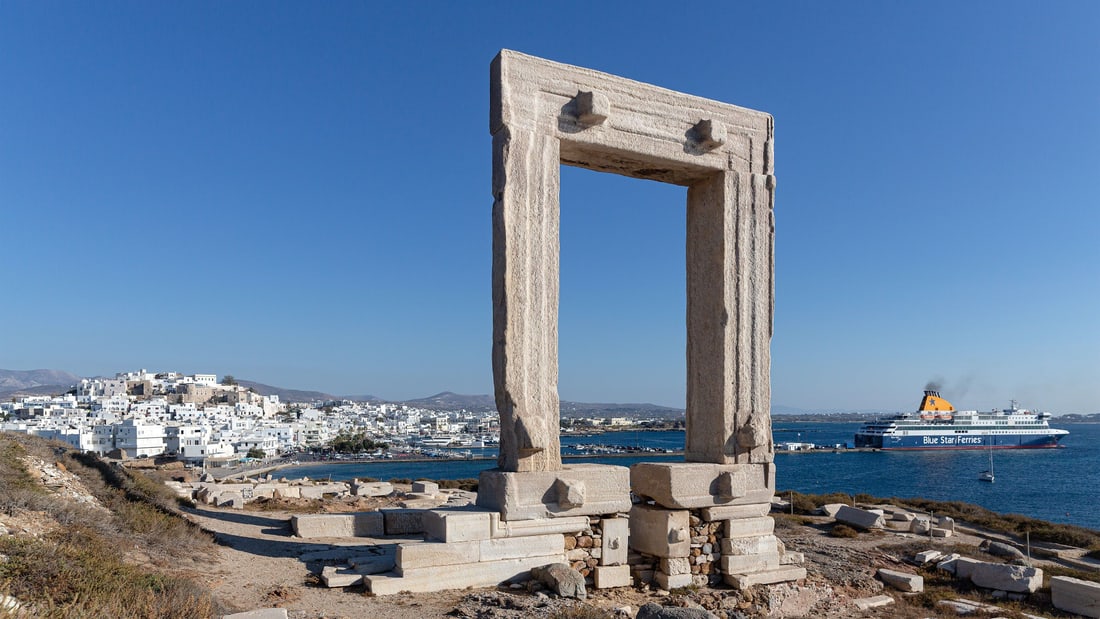
The islet of Palatia, at the northern end of the harbour and joined to the town by a causeway built in 1919, holds the Portara, the large marble gate of an unfinished temple of Apollo dating to the 6th century BC. Away from the town, the island has smaller harbours. Moutsouna, a seaside village on the east coast, has a relatively open bay and limited port facilities. It lies opposite Chora.
- Main harbour: The harbour of Chora serves as the home port of a Naxos boat trip.
- Kastro: Marco Sanudo founded this fortress in 1207.
- Moutsouna: This village lies 39 km from the capital of the island.
- Grotta: The northern beach of the town lies beside Mycenaean remains that are partly underwater.
The harbour of Chora is where a Naxos boat trip begins. The Kastro, the pier built by Sanudo and the islet of Palatia all belong to the same part of the island, while Moutsouna and Potamides mark other points on the coast. From the main harbour, the sea route turns south-east toward the Small Cyclades.
Which Small Cyclades does a Naxos boat trip reach?
A Naxos boat trip reaches the main islands of the Small Cyclades: Koufonisia, Iraklia, Schoinoussa, Donoussa and Keros. The group lies to the south-east of Naxos and has 32 islands and rocks in all, although only four of its islands are inhabited.
Koufonisia lies on the south-southeast side of Naxos. One explanation for the name points to Koufos Limin, the old name of the gulf between Koufonisia and Glaronisi, meaning lee port, where ships can anchor. The channel between Pano and Kato Koufonisi once gave pirates a safe shelter. On 15 August, fishing boats carry the congregation back to Pano Koufonisi from the little church of Kato Koufonisi, and the crews race each other. A Naxos boat trip to Koufonisia enters this sheltered water.
Iraklia, the biggest of the group, lies between Naxos and Ios. A fortress from the 4th to the 2nd century BC stood at Livadi, and an inscription from the early 3rd century BCE records an oath to ban goats. Schoinoussa sits at the centre of the group, between Irakleia and Koufonisia. Its rainfall of around 240 mm a year is the second lowest in Greece.
Donoussa sits at the eastern edge of the group, and Early Cycladic remains show that people lived there around 3,000 BC. In Roman times exiles were sent there, and later pirates used it as a hideout. Keros lies about 10 km south-east of Naxos. The island is uninhabited, and landing there is now forbidden, so a Naxos boat trip sees it from the sea.
Beside Keros lies Daskalio, a tiny islet that was once attached to Keros and became separate as the sea level rose. Excavations there in 2007 and 2008 uncovered a Cycladic settlement, and 7000 square metres of the islet were occupied in the Early Bronze Age, which makes it the largest site in the Cyclades. A Naxos boat trip that passes Keros passes an important site of Cycladic civilization.
- Koufonisia: The complex lies west-northwest of Amorgos.
- Iraklia: The island covers 17.795 square kilometres, and its port is Agios Georgios.
- Schoinoussa: The island covers 8.512 square kilometres and ranks second in population in the group.
- Donoussa: The island covers 13.75 square kilometres and lies north of Amorgos.
- Keros: The island covers 15 square kilometres, and its highest point is 432 metres.
These five names cover the main stops of a Naxos boat trip to the Small Cyclades. Koufonisia has sheltered anchorages, Donoussa marks the eastern edge, and Keros stays a view from the water. Each of the five has remains from ancient times, and the town of Naxos is the seat of the municipality that governs them.
What does a Naxos boat trip see along the coast of Naxos?
A Naxos boat trip sees the western coast, where beaches such as Agios Prokopios, Plaka and Mikri Vigla line the shore, and the eastern coast, where the village of Moutsouna once loaded emery onto boats. Mount Zeus rises above the island.
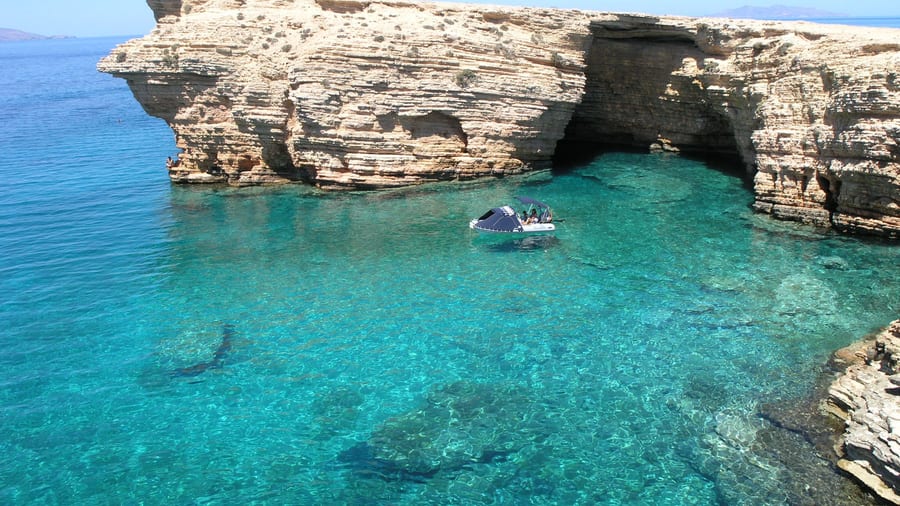
Naxos is the largest island of the Cyclades, so a Naxos boat trip that follows the shore covers a wide stretch of coastline. The island also ranks first in the group for fertility. Mount Zeus rises to 1,001 metres, traps the clouds and permits greater rainfall. Seen from the water, the mountain forms the high backdrop to the bays below it.
The western side holds the best-known beaches. Agia Anna, Agios Prokopios, Aliko, Kastraki, Mikri Vigla, Plaka and Agios Georgios are all named among the beaches of Naxos, and the larger group lies on the western side, near Chora. The island is also windy, with seven sports clubs offering windsurfing, kitesurfing and other water activities. A Naxos boat trip along this shore sails the same wind-swept water.
The eastern coast is a different scene. Moutsouna is a small seaside village with a relatively open bay and limited port facilities. Until the early 1980s it was the port from which emery was loaded onto boats and exported. The emery was mined up the mountain and carried down by an aerial cableway, and the remains of the transfer station can still be seen. A Naxos boat trip passes this bay from the sea.
- West coast: Agios Prokopios, Plaka and Mikri Vigla are named beaches.
- Mountain: Mount Zeus, at 1,001 metres, is the highest peak in the Cyclades.
- East coast: Moutsouna sits about 39 km from the capital.
The two coasts of Naxos show two sides of the island. The west is the side of beaches and water sports, and the east is the side of emery and a small open bay. A Naxos boat trip that follows the shore covers both the leisure side and the working past that made the island famous.
Why does a Naxos boat trip sail to Paros and Antiparos?
A Naxos boat trip sails to Paros and Antiparos because both islands lie close to the west: Paros is 8 km from Naxos across a narrow channel, and Antiparos is under 2 km from Paros. Harbours, villages and a cave give the route clear stops.
Paros lies 8 kilometres west of Naxos, separated by a narrow channel. A constant strong wind blows through the strait between the two islands, which makes it a favoured windsurfing spot. A Naxos boat trip across this strait therefore sails water that windsurfers already know well. The island of Paros is composed of marble, with a single mountain rising at its core.
Parikia, the capital of Paros, sits on a bay on the north-west side. Its harbour is a major hub for Aegean ferries and catamarans, with sailings to Naxos, Mykonos, Santorini and Piraeus. Above the seafront stand the remains of a medieval castle built from the marble of an ancient temple of Apollo. Naoussa Bay, on the north side, is a natural harbour that a chain once closed in ancient times.
Antiparos is a small island linked to Paros by a local ferry. Its main settlement lies at the north-eastern tip, opposite Pounda. The Venetian castle, built in 1440 by Giovanni Loredan, forms the historical centre, with 24 two-storey houses in its outer ring. A Naxos boat trip that reaches Antiparos arrives at white houses, cobbled streets and flowers in the yards.
At the heart of Antiparos island stands its cave, which has served as a natural shelter since the Neolithic period, and the goddess Artemis was worshipped in the area. The church of Agios Ioannis Spiliotis stands at the entrance. Lord Byron and King Otto carved their names inside, and Russian forces took stalactites to the Hermitage Museum during the Orlov Revolt.
- Parikia: The capital harbour links Paros with Naxos, Mykonos and Santorini.
- Antiparos: The Venetian castle dates from 1440 and holds 24 outer houses.
- The cave: The cave has steps, barriers and lighting after a twentieth-century renovation.
The crossing joins Naxos to its closest neighbours. Paros adds a capital harbour and a marble past, and Antiparos adds a castle town and a cave with a long record of visitors. The separate Paros boat trip page covers the larger island in detail. A Naxos boat trip in this direction therefore links three Cycladic harbours.
Can a Naxos boat trip reach Delos and Mykonos?
A Naxos boat trip can reach Delos and Mykonos, because Mykonos lies in the Cyclades between Tinos, Syros, Paros and Naxos, and Delos sits only 2 km from Mykonos. Day trips from Naxos link the sacred island and the harbour town in one route.
Delos is a small island of 3.43 square kilometres near Mykonos, yet it is a leading mythological, historical and archaeological site in Greece. In myth, it is the birthplace of Apollo and Artemis. UNESCO added Delos to the World Heritage List in 1990, and the ongoing excavations are extensive by Mediterranean standards. Finds are shown in the Archaeological Museum of Delos.
The ancient site holds the Sacred Harbour, the Temple of the Delians, the House of Dionysus with its floor mosaic and the House of the Dolphins. The Terrace of the Lions was dedicated to Apollo by the people of Naxos shortly before 600 BC, and seven of the original lions remain. A Naxos boat trip to Delos therefore reaches a site with a direct link to Naxos.
Mykonos covers 85.5 square kilometres and has the nickname Island of the Winds. In ancient times it was an important place for supplies and transit for Delos. Its main town, Chora, holds the Kato Mili windmills that the Venetians built in the 16th century, the fishing houses of Little Venice and the church of Panagia Paraportiani. A Naxos boat trip reaches the town of Mykonos on the west coast.
- Delos: The census of 2011 counted 24 inhabitants on the whole island.
- Naxian hall: The Oikos of the Naxians dates from the early sixth century BC.
- Mykonos: The island rises to 341 metres and belongs to the same municipality as Delos.
Delos and Mykonos work as a pair on a route from Naxos. One island holds the ancient sanctuary, and the other holds the harbour town that supplied it. Because the two lie 2 km apart, a Naxos boat trip can pair the ruins of Delos with the waterfront of Mykonos in a single day trip.
What sea history lies behind a Naxos boat trip?
A Naxos boat trip crosses waters shaped by three layers of history: the myth of Ariadne, left on the island by Theseus and found by Dionysus, a long record of Naxian sea trade, and the Venetian Duchy of the Archipelago, a maritime state centred on Naxos.
Greek myth gives the sea around Naxos a cast of characters. Ariadne, daughter of King Minos of Crete, helped Theseus escape the Minotaur. In the main versions of the myth, Theseus abandoned her on Naxos, where Dionysus saw her sleeping, fell in love and later married her. Another tale has the sea god Poseidon, driving his chariot over the sea near Naxos, first see the nereid Amphitrite dancing there.
Naxos dominated Cycladic commerce in the 8th and 7th centuries BC, long before Venice arrived. Around 500 BC Herodotus described it as the Greek island of greatest prosperity. A failed Persian attack on Naxos in 499 BC led to the Ionian Revolt. Around 469 BC Naxos became the first city-state to try to leave the Delian League, and Athens answered by stripping the island of its warships.
The Venetian chapter opened in 1207. Marco Sanudo, a Venetian nobleman, borrowed eight galleys from the Venetian Arsenal, anchored at Potamides, now Pyrgaki on the south-west coast of Naxos, and largely captured the island. He made Naxos his headquarters as Duke of the Archipelago and kept Paros and Antiparos in his own hands. The duchy covered all the Cyclades except Mykonos and Tinos, and it became a tributary of the Ottoman Empire in 1537.
- Dia: The island name Dia was transferred to Naxos, which was more widely supposed than any other island to be the wedding isle of Dionysus.
- Two Ariadnes: Plutarch records a Naxian story of two Ariadnes, one with a nurse named Korkyne whose tomb was shown on the island.
- Fiefs: Sanudo divided Naxos into 56 provinces and shared them out as fiefs among the leaders of his men.
A Naxos boat trip therefore follows a sea that served myth, trade and conquest. The Venetians valued the islands for their trade routes to Anatolia and the Eastern Mediterranean, and exported corundum and marble from Naxos. Saracen raiders, Genoese pirates and Anatolian raiders also came to Naxos across the same waters that a Naxos boat trip crosses.
When is the best season for a Naxos boat trip?
A Naxos boat trip is shaped by the meltemi, the strong dry north wind that blows across the Aegean from late spring to mid-September, so crossings to the Small Cyclades outside that span avoid the wind and its afternoon peak.
Depending on where on the island you stand, the weather of Naxos ranges from Mediterranean to hot semi-arid. Inland areas sit higher, so they are much wetter and cooler in winter, and lower temperatures are recorded at height across the Cyclades. The archipelago as a whole is dry and mild overall. A Naxos boat trip leaves the cooler, wetter interior behind and works on the dry climate of the shore.
The etesian, or meltemi, is a dominant weather influence in the Aegean Basin. Its name comes from the Greek word etos, meaning year, a reference to the yearly return of the wind. It is strongest in the afternoon and eases at night, yet at times it blows for days without a break. The weather under it is ordinarily fine and clear, and the northerly air tempers the fierce summer heat of the region.
For small boats the wind sets the limits. The winds are dangerous to sailors, since they come up in clear weather without warning and can blow at force 7 to 8, a strength at which certain yachts and the bulk of inter-island ferries cannot sail. The weeks before late spring and after mid-September fall outside the periodic season, which leaves crossings to the Lesser Cyclades, among them Donousa, Irakleia, Koufonisia and Schoinousa, free of the meltemi.
- Season: The etesians blow periodically from late spring to mid-September.
- Direction: The wind is north-easterly to northerly in the north Aegean, northerly in the centre and north-westerly in the south.
- Winter: The meltemi is dry and has no opposite wind in winter.
Season therefore sets the terms for a Naxos boat trip. High summer brings dry, hot days and the periodic north wind together, while the weeks before late spring and after mid-September leave the sea free of it. The etesians are a summer feature of the whole Aegean, so crossings to the Small Cyclades follow the same calendar.
What do travelers ask about a Naxos boat trip?
A Naxos boat trip prompts questions about the difference between the Small Cyclades and the coast, the beaches along the shore, sudden wind on clear days, the sacred island of Delos and the number of islands in the Cyclades around Naxos.
How does a Naxos boat trip to the Small Cyclades differ from a coastal trip?
The Small Cyclades are the minor islands of the archipelago, among them Donousa, Irakleia, Koufonisia and Schoinousa, and the majority of the smaller islands have no residents. A coastal Naxos boat trip stays along Naxos itself, where seven named beaches lie, mostly on the western side near Chora.
Which beaches line the coast on a Naxos boat trip?
Beaches on Naxos include Agia Anna, Agios Prokopios, Aliko, Kastraki, Mikri Vigla, Plaka and Agios Georgios. The majority lie on the western side near Chora, so a Naxos boat trip along that shore passes the coast where these beaches cluster.
Do clear skies mean calm water on a Naxos boat trip?
Not always. Etesian winds come up in clear weather without warning, which is why they are dangerous to sailors. In antiquity Philip II of Macedon planned his campaigns around them, since fleets coming from the south made slow headway northward while the wind blew. A bright sky on a Naxos boat trip says little about the sea.
Why does Delos matter to a Naxos boat trip?
Delos gave the Cyclades their name, since the islands form a circle around the sacred island. Its sanctuary kept its standing as a holy site through antiquity until the rise of Christianity. A Naxos boat trip stays inside this island circle, and Naxos is the largest island in it.
How large is the island group around a Naxos boat trip in the Cyclades?
The Cyclades include about 220 islands, with Amorgos, Antiparos, Delos, Mykonos, Paros, Syros, Tinos and Santorini among the major ones. Naxos is the largest island of the group, Syros the island with the largest population, and the Sea of Crete bounds the archipelago on the south.
Featured photo: Manfred Werner (Tsui), CC BY-SA 4.0, via Wikimedia Commons.