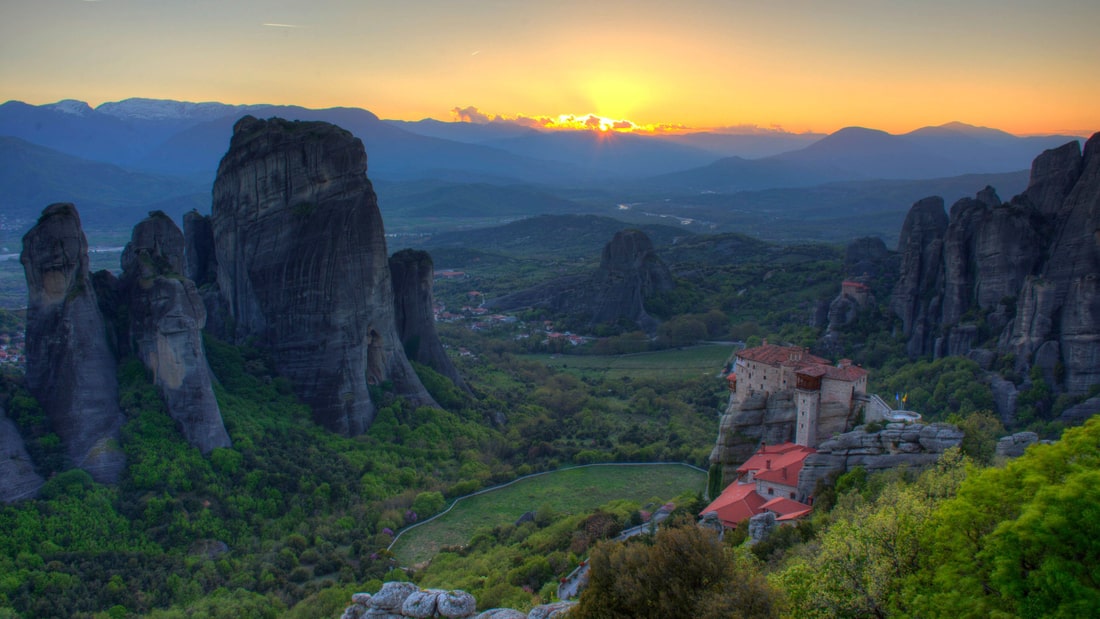
A Meteora sunset tour climbs the road above Kalambaka and Kastraki in Thessaly to watch the evening light fall on the giant rock pillars of Meteora and the monasteries built on their summits. This post covers what a Meteora sunset tour includes, where it starts, the viewpoints, the monasteries it passes, how the rocks formed, the hermit caves, the history of the monasteries and the best season. It is one of the best tours in Greece on Greece VIP.
Each section ends with a Meteora sunset tour that can be booked online.
What does a Meteora sunset tour include?
A Meteora sunset tour visits the rock pillars of Meteora in Thessaly and the monasteries on their summits, with the stops set for the late-day light. The six standing monasteries form a UNESCO World Heritage Site, and each tour keeps to the rocks above Kalambaka.
The rocks of Meteora stand in Trikala, a regional unit in the northwest of Greece, and carry a prominent complex of Eastern Orthodox monasteries. Giant natural pillars and rounded, hill-like boulders dominate the local area, and the monasteries stand on top of them. Of the 24 monasteries built there, six remain. Four are occupied, managed by monks and open to visitors. A Meteora sunset tour passes these working houses.
The World Heritage List has carried the six extant monasteries as one complex since 1988. UNESCO gave outstanding architecture and beauty, combined with religious and cultural significance, as its reasons. The word Meteora is commonly used for the rocks around Kalabaka and Kastraki only, although the wider formation runs northwest into the Gavros and Agios Dimitrios areas. A Meteora sunset tour keeps to the nearer rocks.
The long Meteora day trip from Athens spends its effort on the journey north from Athens, while an evening tour on site starts beside the rocks and stays among them. Cut stairs and paths now lead up to the monasteries, which crown the high cliffs of the massif. That setting shapes the three kinds of Meteora sunset tour set out below.
- Minibus tours: A minibus links the stops by road between Kalambaka, Kastraki and the rocks.
- Hiking tours: Trails run from Kastraki to the rocks and the monasteries.
- Photography tours: These tours frame the giant pillars and rounded boulders, with the monasteries on top.
A Meteora sunset tour therefore combines the rock pillars, the monasteries on their summits and a minibus, hiking or photography format, all set in Thessaly. Wikipedia also notes that hikers, trail runners, mountain bikers and rock climbers visit Meteora from around the world, and that an annual mountain bike race is held there.


Where does a Meteora sunset tour start?
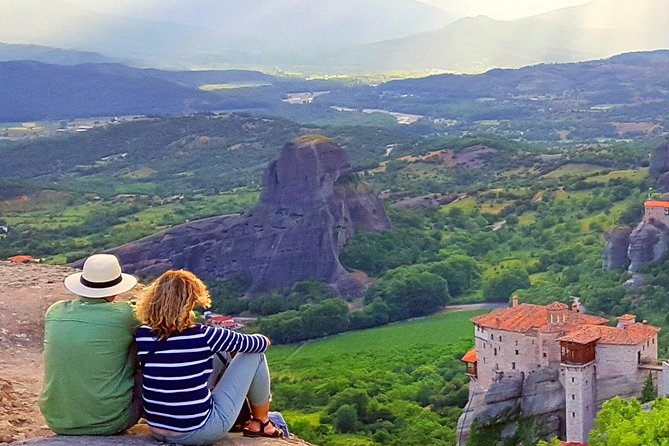
A Meteora sunset tour starts in the town of Kalambaka or the village of Kastraki, the two settlements below the rocks. Kalambaka lies at the base of the massif, while Kastraki occupies a small valley opening on the massif’s southwest side.
Kalabaka is a town in the Trikala regional unit and the seat of the municipality of Meteora. A reform in 2018 changed the name of the municipality to Meteora and made Kalabaka its seat. The whole Meteora massif belongs to the Kalabaka municipal unit. The town stands at the foot of the massif, on the left, northern bank of a river that flows north to south there.
Kalabaka has a record older than the monasteries. A Greek inscription on the wall of one of the oldest churches, Saint John the Baptist, testifies to an ancient settlement named Aiginion. Relics of an ancient Greek temple are built into the wall of the oldest church, dedicated to the Virgin Mary. A Meteora sunset tour from this town starts beside that church history, and the Metropolis of Stagoi and Meteora has had its seat there since 1991.
Kastraki lies on the northwest of the main Kalabaka municipal unit. Precipices surround the village, and the valley entrance lies on the west side. The main road joins the village to the town, whose northern edge meets the rocks. An access road leads up to Meteora, where the monasteries are sprinkled on tall precipices. A Meteora sunset tour from Kastraki therefore starts inside the rocks.
- Area: The Kalabaka municipal unit covers 277.087 square kilometres, and the administrative village of Kastraki covers 47.9 square kilometres.
- Communities: Kalabaka and Kastraki are two of nine communities in the municipal unit.
- First monastery: Saint Nicholas Anapausas, the first monastery that pilgrims meet, stands on a narrow rock about eighty metres high.
A Meteora sunset tour therefore starts from one of two clear points. Kalabaka offers a town base on the northern bank of the river, and Kastraki offers a valley base closed in by precipices. Both lie below the same massif, and an access road leads up to the rocks and the monasteries.
Which viewpoints does a Meteora sunset tour stop at?
A Meteora sunset tour stops at the named places that look over the Pineios valley and the other monasteries. The sources name Rousanou, Varlaam, Saint Stephen and the west entrance of the Kastraki valley, and the rocks around Kastraki.
Rousanou lies in the middle of the site, so visitors there see the other monasteries from one spot. They also see the ruins of the Monastery of St. John the Baptist and the Pantokrator. The monastery stands 484 metres above sea level. A Meteora sunset tour built around views fits this central position, since one stop shows the other monasteries at once.
Varlaam crowns a cliff of 373 metres and, UNESCO notes, dominates the valley. Saint Stephen, also part of the World Heritage Site, stands on a plateau-like structure, a broader setting than the small narrow rock of Saint Nicholas Anapausas. On a Meteora sunset tour, these two monasteries stand for two kinds of outlook in the sources: the high cliff over the valley and the wider ground of a plateau.
Kastraki has a single open direction, the west, and the valley entrance there stands between the rock columns Agio Pneuma and Surloti. The Pineios, a river in Thessaly, runs along the Meteora region. It rises near the village of Malakasi, east of Metsovo, and its drainage basin covers 9,500 square kilometres. Kalampaka is listed directly after Malakasi among the places along the river.
- North: Dupiani is the named rock on the northern side of Kastraki.
- East: Agio Pneuma, Kumaries, Toichos Alpha, Beta, Gamma and Delta, Surloti, Modi and Alysos stand on the eastern side.
- South: Pyxari, Badovas and Ambaria stand on the southern side.
The viewpoints of a Meteora sunset tour rest on named places: Rousanou and its sight of the other monasteries, Varlaam above the valley, Saint Stephen on its plateau-like rock and the rock columns at the Kastraki valley entrance. The Pineios valley stays the common backdrop to all of these named places.
Which monasteries does a Meteora sunset tour pass?
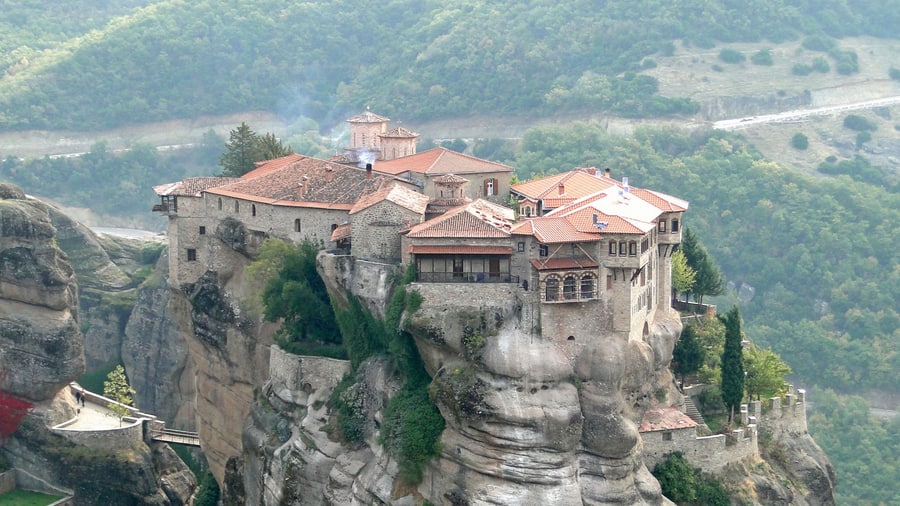
A Meteora sunset tour passes six monasteries: Great Meteoron, Varlaam, Rousanou, St Nicholas Anapausas, St Stephen and Holy Trinity. Each stands at the top of a rocky precipice above the Pineios valley, and together the six form the UNESCO World Heritage Site named Meteora.
A Meteora sunset tour reaches Great Meteoron, known in Greece as the Monastery of the Transfiguration of the Saviour. It tops a rocky precipice more than 415 metres above the Pineios valley floor. The Devil’s Tower, a large towering rock, stands directly to its south, beside the ruins of a former monastery on Ypsilotera Rock. Varlaam has the Dragon Cave to its south, below the monastery.
On a Meteora sunset tour, Rousanou stands in the middle of the site, in sight of the other monasteries and the ruins of the St John the Baptist and Pantokrator monasteries. St Nicholas Anapausas sits on a narrow rock about eighty metres high, and an interior staircase links its floors. Ruins of St John Prodromos, the Pantocrator and the chapel of Panagia Doupiani surround it.
St Stephen and Holy Trinity stand apart from the main group, which lies further north. St Stephen occupies a plateau-like structure below Kukulas peak. Holy Trinity tops a precipice over 400 metres high. A foot track of 3 kilometres leads to it from Kalambaka, a winch-operated lift offers another way up, and a chapel of St Athanasius of Tzertzi lies to its northeast.
- Varlaam: Hoisting materials took twenty-two years, yet the building is reported to have taken around twenty days.
- St Nicholas Anapausas: Restorations took place in the 16th century and the 1960s.
- Holy Trinity: The church has a cruciform plan and a dome on two columns.
These six are a small part of the original count. Twenty-four monasteries were built at Meteora, and the remaining eighteen historic monasteries are listed apart from the six, together with sketes, hermitages and rocks. A Meteora sunset tour therefore passes the surviving houses, while ruins on neighbouring rocks mark the rest.
How did the rocks form on a Meteora sunset tour?
A Meteora sunset tour passes pillars of sandstone and conglomerate, shaped in two stages. Streams first built a thick layer of sediment over millions of years. Uplift about 60 million years ago then cracked that layer, and weathering widened the cracks into steep towers.
The first stage behind a Meteora sunset tour was slow deposition. Streams ran into a delta at the edge of a lake and dropped stone, sand and mud there for millions of years, which built a thick layer. The articles on the monasteries describe the same sediments as lying in an inland sea. Both accounts point to water as the rock’s builder.
The second stage was movement. Around 60 million years ago, earth movements lifted the seabed and split the thick sandstone layer along vertical faults. The monastery articles say the cliffs rose as a cone during earthquakes and formed steep rock columns, known as the heavenly columns. Water, wind and wide temperature swings then wore the faulted rock into separate pillars.
The formation and its weathering are confined to a relatively localised area within the surrounding mountains. One description calls the complex an exhumed continental remnant of Pangean association. The sediments are uniform, with little sign of vertical layering, and the weathering cut abruptly downward along the faults. A Meteora sunset tour therefore passes towers that stand within a small part of a larger mountain formation.
- Holy Spirit Rock: This rock is long and thin, with a central peak like a tab.
- Named rocks: Dupiani, Agio Pneuma, Kumaries, Surloti, Modi, Pyxari, Badovas and Ambaria surround Kastraki.
- Climate record: Petrified diatoms in Theopetra Cave contributed to understanding the palaeo-climate.
The rocks also stand in lines. Holy Spirit Rock trends north-east, and a second line of precipices with the same trend lies south of it, separating Kastraki from urban Kalabaka. The Pineios River flows from north to south west of the valley, so a Meteora sunset tour takes in rows of rock beside a river.
What hermit caves does a Meteora sunset tour see?
A Meteora sunset tour sees rocks where hermit monks lived in caves and cracks before any monastery stood. The named cave sites include the Cave of St George of Mandila, the cave hermitages of Pyxari and Ambaria, and the rock cave of Badovas.
Religious communities had set up hermitages at the foot of the cliffs by the 11th century, and by the end of the 1100s an ascetic community had flocked to Meteora. Great Meteoron still holds the hermitage of its first founder, a small building carved in rock, and a chapel of the Virgin Mary stands in a cave. A Meteora sunset tour passes their rocks.
On a Meteora sunset tour, Holy Spirit Rock, on the northern flank of the Kastraki valley, carries the ruins of the Monastery of the Holy Spirit. A path carved into the cliff leads to its surviving church, where the altar and sacristy are carved into the rock. The Cave of St George of Mandila is possibly the same as the Cave of Archimandrite Makarios near Pigadion.
Other rocks around Kastraki keep cave sites. Pyxari, at the southwestern edge of the complex, has cave hermitages perched on cliffs, and the Cell of Constantius lies northeast of it. The Monastery of St Nicholas of Badova was founded around 1400 in a rock cave at Badovas. Ambaria also has cave hermitages, and a Meteora sunset tour can name all three rocks.
- Cave dwellers: Caves near Meteora held settlers continuously between 50,000 and 5,000 years ago.
- Theopetra Cave: The cave lies 4 kilometres from Kalambaka, with an entrance 17 metres wide.
- Stone wall: A wall built 23,000 years ago blocked two-thirds of the Theopetra entrance.
The hermit settlements led on to monasteries. Ypapantis Monastery was founded in 1367 by the abbot of the Skete of Dupiani and restored in 1765 by Athanasios Vlachavas. It is now inactive and rarely visited, and trails connect it with Dupiani Rock and Kastraki. A Meteora sunset tour therefore covers both the first ascetics’ caves and an abbot’s monastery.
What history lies behind a Meteora sunset tour?
A Meteora sunset tour looks at monasteries founded in the 14th century, when Serbian rulers in Trikala sponsored monks who sought refuge on the rocks. The houses peaked in the 16th century, declined through the 17th century and the world wars, and recovered from the 1960s.
Stefan Dušan conquered Thessaly in 1348 and added it to the Serbian Empire. His half-brother Simeon Uroš set up a court at Trikala in 1359 and sponsored the monks of Meteora. Sources give 1356 for the Great Meteoron and 1366 or 1367 for the monastic community, and one account calls the exact date unknown. Joasaph, successor to Athanasios, kept building cells, a hospital and renovated churches.
The Great Meteoron thrived in the 16th century on imperial and royal donations. Varlaam stood empty for two hundred years until two monk brothers began to rebuild it. They spent twenty-two years hoisting materials up the rock, yet the building itself took around twenty days. In the world wars, the monasteries were bombed and ransacked, and the rock-cut chapel at Holy Trinity was looted.
Recovery began in the 1960s. The small monastery of St Nicholas Anapausas was restored then, and St Stephen became a nunnery in 1961. Emilianos led the Great Meteoron from 1961 to 1973, and his disciple Alexios followed until 1976. Kalabaka regained its own bishopric in 1991, as the Metropolis of Stagoi and Meteora. St Stephen counted 28 nuns as of 2015.
- John Uroš: Simeon’s son ruled from 1370, became a monk three years later and died at the Meteoron in the early 1420s.
- Great Meteoron: Over three hundred monks lived there in the 16th century, against three as of 2015.
- Varlaam: Seven monks remained as of 2015, after a decline that began in the 17th century.
A Meteora sunset tour therefore meets a site that grew from hermit caves to fortified refuges, and now to small working houses. Traces of each stage remain: Holy Trinity carries frescoes from 1741 and a treasury building from 1684, and the Great Meteoron keeps its founder’s hermitage, a small building carved in rock.
When is the best season for a Meteora sunset tour?
A Meteora sunset tour suits spring and autumn best, because Trikala stays mild in both seasons, without extremely high or low temperatures. Summer brings warm-season haze that mutes the sunset colors, and winter nights bring freezing temperatures at times.
Thessaly lies east of the Pindus watershed, and its Trikala and Larissa lowlands form a central plain ringed by mountains. The plain has distinct summer and winter seasons. The province mainly has a hot-summer Mediterranean climate, with a rare humid subtropical type in the far north. Kalabaka stands on the south-west side of the Meteora massif, on the northern bank of the Pineios.
The sun sets to the northwest in spring and summer and to the southwest in autumn and winter, . A low sun gives redder, softer light, weaker direct light and longer shadows. Haze alters the picture: dust and smoke build up in dry air, wet haze is mainly a warm-season event, and on hazy days sunset colors and even the sun appear subdued.
Spring and autumn are quite mild in Trikala, a city close to the rocks. At both equinoxes the sun sets due west, between the northwest of summer and the southwest of winter. The area around the monasteries is hilly and forested, with river valleys, and includes a protected area known as the Trikala Aesthetic Forest. The golden hour has no fixed length and varies with season and latitude.
- Spring: Mild weather, with the sunset moving from due west toward the northwest after the March equinox.
- Summer: Very hot days and warm-season haze, with sunset in the northwest.
- Autumn: Mild weather returns, with the sunset moving from due west toward the southwest after the September equinox.
- Winter: Freezing temperatures occur sporadically on winter nights, and sunset falls in the southwest.
The best season for a Meteora sunset tour depends on what the evening is meant to show. Spring and autumn give mild air, summer adds haze that softens the colors, and winter adds frost on cold nights. A forecast check a day ahead settles the choice between a clear and a hazy evening.
What do travelers ask about a Meteora sunset tour?
A Meteora sunset tour raises five practical questions: whether the monasteries are open, what to wear, whether it combines with a morning tour, how photography works and whether children can join. Short factual answers to each question follow below.
Are monasteries open on a Meteora sunset tour?
A Meteora sunset tour reaches four occupied monasteries that are open to visitors. They are the Great Meteoron, Varlaam, Holy Trinity and St Stephen. Interior entry on the evening is confirmed with the operator at booking, while the rocks around Kastraki and Kalabaka stay in view from outside.
What dress rules apply on a Meteora sunset tour?
A Meteora sunset tour calls for modest dress at the occupied monasteries, which are working Orthodox houses. Covered shoulders and knees suit the churches. Trikala shows a wide gap between day and night temperatures, so a light layer helps after sunset. Closed shoes with grip suit the staircases and rock-cut paths as the light fades.
Can a Meteora sunset tour combine with a morning tour?
Yes, a Meteora sunset tour can follow a morning tour of the monasteries. The morning covers the houses and their museums, and the evening turns to the rocks and the light. Theopetra Cave, 4 kilometres from Kalambaka, is open to the public after restoration.
Is a Meteora sunset tour good for photography?
A Meteora sunset tour suits photography, because a low sun gives redder, softer light and longer shadows. Contrast falls, so shadows are less dark and highlights overexpose less easily. Haze mutes sunset colors, while the blue hour after sunset has no sharp shadows.
Can children join a Meteora sunset tour?
Children who manage stairs and uneven ground can join a Meteora sunset tour. The monasteries sit on high cliffs reached by staircases and rock-cut paths, and Varlaam is entered through ladders on the north side of its rock. Adults keep small children within reach, since falling rock is a constant threat and the light fades in stages.
Featured photo: Dimitris9444, CC BY-SA 4.0, via Wikimedia Commons.