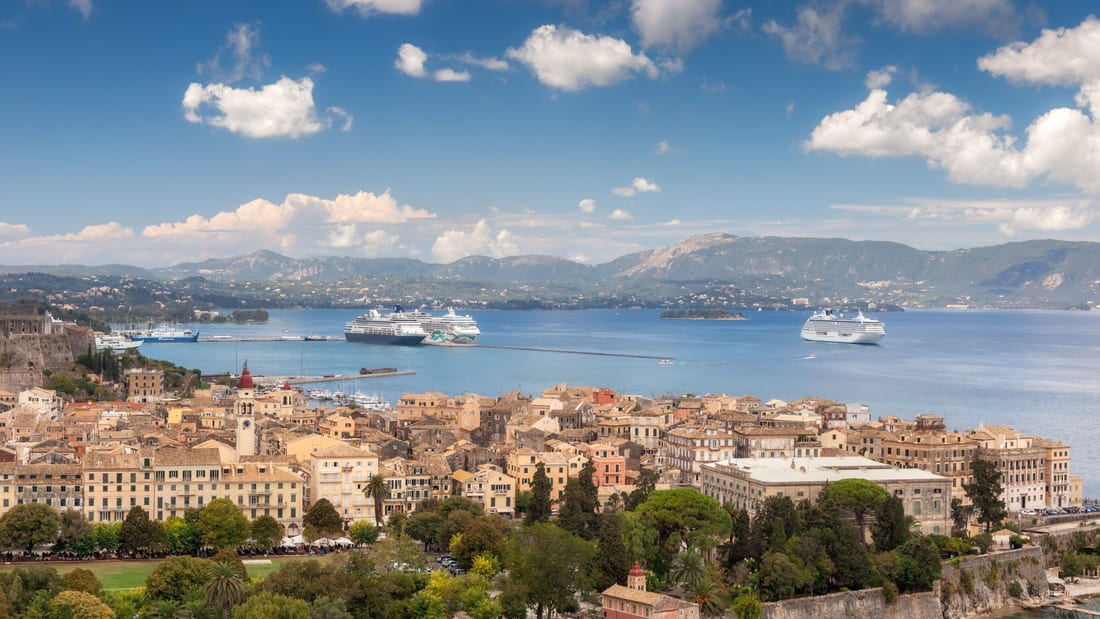
A Corfu Old Town walking tour follows the lanes, squares and fortresses of the UNESCO-listed old town of Corfu, where Venetian, French and British buildings stand side by side between the Old Fortress and the New Fortress. This post covers what a Corfu Old Town walking tour includes, the Spianada, the Liston, the Old Fortress, the Palace of St Michael and St George, Saint Spyridon, the Campiello, the squares and cathedrals, the Jewish quarter and the New Fortress, the history and the best season. It is one of the best tours in Greece on Greece VIP.
Each section ends with a Corfu Old Town walking tour that can be booked online.
What does a Corfu Old Town walking tour include?
A Corfu Old Town walking tour covers the UNESCO-listed historic core of Corfu city on foot. The route passes Venetian lanes, buildings from the French and British periods, open squares and the edge of the citadel, and a tour leader joins the stops into one walk.
Inscription on the World Heritage List came in 2007, based on an ICOMOS evaluation of the old town. In the experts’ view, the city layout and the Venetian fortifications make Corfu a quintessential example of a fortified maritime city. They found no special architectural features in the urban fabric alone. A Corfu Old Town walking tour therefore reads the plan street by street.
Venetian nobility ruled Corfu from 1386 to 1797. French rule of the Ionian Islands ran from 1807 to 1814, and a British protectorate ran from 1814 to 1864. Of the buildings put up before the 20th century, about 70% date from the British period, according to ICOMOS. Air raids in the Second World War destroyed whole blocks, replaced in the 1960s and 1970s.
The island drive and the town walk answer different needs. A Corfu tour covers the island by road, while a Corfu Old Town walking tour stays on foot inside the town. The cobblestone streets are called kantounia in Greek. The fortifications limited the space for building, and the town sits at the wide end of a peninsula that ends in the Venetian citadel.
- Group walk: A small group follows a set route behind a licensed tour leader.
- Private walk: A private party sets its own stops and speed with an expert tour leader.
- Food walk: The route links the lanes with Ionian cooking, which carries a lot of Italian influence.
- History walk: The route follows the fortifications and the Venetian, French and British layers.
The city of Corfu serves as capital of its regional unit and of the Ionian Islands region and has 23,541 residents. The old town lies inside that city. A Corfu Old Town walking tour begins at the open ground in front of the Old Fortress, which is the Spianada.


Where does a Corfu Old Town walking tour start?
A Corfu Old Town walking tour starts on the Spianada, the esplanade in front of the Old Fortress. The Spianada ranks as the largest square in Greece, with a cricket ground, a rotunda, a bandstand and a fountain across its two halves.
The name Spianada means esplanade in Greek. No square in Greece covers a larger area, and the Spianada ranks 27th among the squares of the world. The Upper Square forms the southern half and the Lower Square forms the northern half. The two halves differ in character, and a Corfu Old Town walking tour crosses both before it enters the lanes.
The Lower Square, called Enoseos Square, runs parallel to the Liston. It is an open, flat, grass-covered field and holds the cricket ground of the city. British rule brought the game during the protectorate from 1814 to 1864. Corfu is the only place in Greece where cricket is popular, so a Corfu Old Town walking tour passes a rare sight.
The Upper Square, called Leonida Vlachou Square, is an elongated area of dense vegetation, flower beds and landscaped walkways. The Maitland Rotunda stands at its centre. Colonel George Whitmore of the Royal Engineers designed it, and it was built in 1821 to honour Sir Thomas Maitland, the first Lord High Commissioner of the Ionian Islands. Twenty Ionic columns form the ring.
- Cistern: It stands on a Venetian cistern built in 1781 and was restored in 2004.
- Bandstand: The Palko hosts concerts by the local philharmonic societies.
- Fountain: The Vagianos well was donated by the physician Georgios Vagianos of Konya.
The Old Fortress faces the square, the Palace of St. Michael and St. George dominates its northern end, and the Liston runs along its western edge. A Corfu Old Town walking tour therefore stands among landmarks on three sides at the start. The route continues along the western edge to the Liston.
What does a Corfu Old Town walking tour see at the Liston?
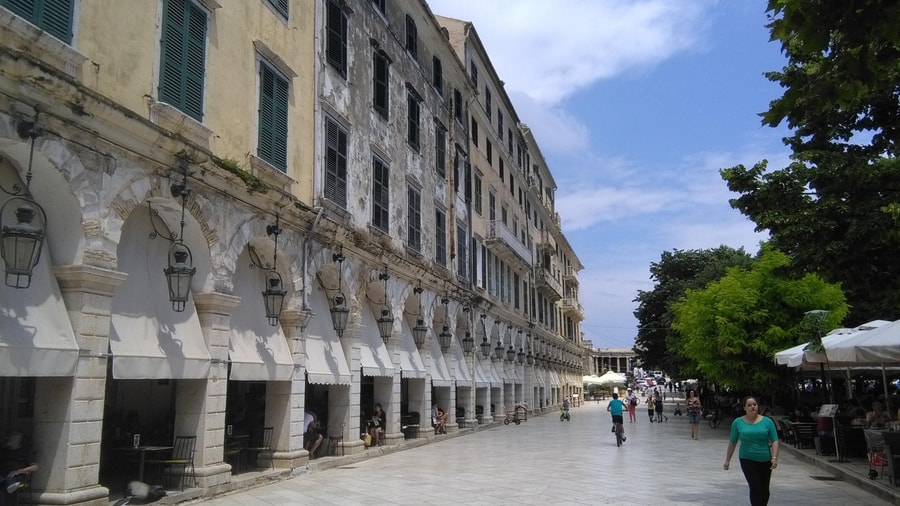
A Corfu Old Town walking tour sees at the Liston a pedestrian street and district on the western edge of the Spianada. The French built it in the Napoleonic period, and its design drew on the Rue de Rivoli in Paris.
Mathieu de Lesseps, the French imperial commissioner, is named as the builder of the Liston. The work dates from the French rule of the Ionian Islands, from 1807 to 1814, when Corfu was part of the First French Empire. His son Ferdinand de Lesseps developed the Suez Canal, so a Corfu Old Town walking tour passes a street tied to that family.
The model was the Rue de Rivoli in central Paris, a commercial street named after Napoleon’s victory over the Austrians at the Battle of Rivoli in 1797. Napoleon began building that street in 1802, and it was completed in 1865. His planners extended a single-facade program that produced arcades and facades along the street. The Liston took its design from that Paris street.
Former Venetian cities have a square called Liston, from a Venetian word for an evening promenade. The name can also point to a closed list, since the nobility registered in the Libro d’Oro held an upscale area for themselves. Brewster Chamberlin’s 2005 poem describes people sitting, snacking and watching the promenaders, and a Corfu Old Town walking tour follows the same promenade.
- Position: The street runs along one side of the Spianada, part town square and part park.
- Resident: Dionysios Solomos, the national poet of Greece, is listed among its residents.
- Anthem: Solomos wrote the Hymn to Liberty, the Greek national anthem since 1865.
The Liston therefore joins a Venetian name, a French design and a Greek literary tradition in one street. Solomos moved to Corfu, the main intellectual centre of the Ionian Islands in those years. A Corfu Old Town walking tour reads each layer along the single street between the Spianada and the lanes.
Why does a Corfu Old Town walking tour enter the Old Fortress?
A Corfu Old Town walking tour enters the Old Fortress because the citadel stands on the promontory where the old town began. A moat called the Contrafossa separates it from the town, and the island it forms holds a classical church and a high central peak.
Byzantine fortifications stood on the headland before the Venetian era. In the early 15th century the Venetians began to replace them with defences of their own design. They cut the Contrafossa, a sea channel that connects the Gulf of Kerkyra with the Bay of Garitsa. A bridge now replaces the old drawbridge, and a Corfu Old Town walking tour crosses it on foot.
In 1537 Sultan Suleyman sent 25,000 men under the admiral Hayreddin Barbarossa against Corfu. They landed at Govino Bay and destroyed the village of Potamos. The Venetians turned away women, children and the elderly, whom they called the inutili, and the rejection angered the Corfiots. The garrison still held the fort, and it held again in 1571 and in 1716.
The church of Saint George lies at the foot of the central high point. Six Doric columns punctuate its classical style, unlike the Byzantine style of other Greek Orthodox churches. Above it the summit rises like a giant natural obelisk, with an observation post and a giant cross on top. A Corfu Old Town walking tour sees a temple-like front below a lookout.
- Peak names: The western peak was also Castel Nuovo, the eastern Castel Vecchio.
- Events: Concerts and Sound and Light productions have the Ionian Sea as a backdrop.
- Bombardment: The Italian Air Force bombarded the fortress in 1923.
The Ottoman guns of 1716 stood on the hills of Avrami and Sarocco, and afterwards Venice built new forts on both hills. These forts were demolished when Corfu united with Greece in 1864. A Corfu Old Town walking tour therefore enters the citadel that the later forts were built to protect.
What does a Corfu Old Town walking tour see at the Palace of St Michael and St George?
A Corfu Old Town walking tour sees the Palace of St Michael and St George, a neoclassical building raised by the British north of the Spianada. The building now houses the Museum of Asian Art, the only museum in Greece dedicated to Asian art.
Sir Thomas Maitland, the British Lord High Commissioner of the Ionian Islands, commissioned the palace. The foundation stone was laid on St George’s day in 1819, and the building was completed in 1824. Colonel George Whitmore of the Royal Engineers designed it in the Greek Revival style. It consists primarily of limestone imported from Malta, and Maltese workers were employed in its construction.
The palace was the residence of the High Commissioner and the home of the Ionian Senate and the Order of St Michael and St George. After Corfu joined the Kingdom of Greece in 1864, it became a royal residence, and until 1967 the Greek king used it on state occasions. A Corfu Old Town walking tour sees a building that changed rulers.
The museum opened in 1927 as the Museum of Sino-Japanese Art, with the collection of the ambassador Gregorios Manos. A later donation from N. Chatzivasileiou, a former ambassador to India and Japan, added objects from India, Tibet and Siam, so the museum took its present name. A Corfu Old Town walking tour finds about eleven thousand objects, the oldest dating from the 11th century BC.
- Sculptors: Vincenzo and Ferdinando Dimech and Pavlos Prosalentis made the sculptural elements.
- Gates: The gate of St Michael and the gate of St George flank the palace.
- State rooms: A rotunda leads to the Throne Room and the state dining room.
The museum belongs to the Ministry of Culture. Its rooms keep the ornate furniture and decorations of the British period, so a Corfu Old Town walking tour sees the setting as well as the collection. The gardens, with old Venetian stone aquariums, overlook the bay and are called the Garden of the People.
What is the Church of Saint Spyridon on a Corfu Old Town walking tour?
A Corfu Old Town walking tour reaches the Church of Saint Spyridon, the Greek Orthodox church that holds the relics of Corfu’s patron saint. Its tall bell tower rises higher than any other in the Ionian Islands, and processions carry the relics through the town.
The church stands in the old town and is the best-known church of a city with thirty-seven Greek churches. Its bell tower follows a design similar to that of San Giorgio dei Greci, a church in Venice. Inside, the marble iconostasis front resembles the entrance of a baroque church. A Corfu Old Town walking tour sees Venetian ties in the tower and the lamps.
Saint Spyridon was born in Cyprus around 270, worked as a shepherd and became bishop of Trimythous. Tradition counts him among the bishops at the First Council of Nicaea in 325. His body went to Constantinople in the 650s, and the monk Kalohairetis brought the relics to Corfu after the city fell in 1453. The right arm returned from Rome in 1986.
The relics leave the church in procession every Palm Sunday, and the Philharmonics of Corfu take part. On Holy Saturday three city bands play funeral marches in the Epitaph procession. Venice founded the Litany of Saint Spyridon on 11 August after the siege of 1716. A Corfu Old Town walking tour that meets a procession sees the saint carried through the streets.
- Plague: Believers hold that the plague scratched a stone of the old citadel as it left.
- Lamps: Venice gave a gilded silver lamp after the siege of 1716.
- Patronage: He is also the patron saint of potters and of Piraeus.
The Eastern Church keeps the feast of Saint Spyridon on the Saturday before Great Lent, known as Cheesefare Saturday, and again on 12 December. A Corfu Old Town walking tour therefore treats the church as part of the yearly calendar of Corfu, and not only as a building to enter.
What does a Corfu Old Town walking tour see in the Campiello?
A Corfu Old Town walking tour enters the Campiello, a district of the old town whose name is the Italian word for a little square. Its cobbled lanes, called kantounia, run narrow between multi-storey Venetian houses and past Saint Spyridon church.
The Campiello belongs to the old town that Venice ruled from 1386 to 1797. In the 1580s the relics of Saint Spyridon moved to a new church built within the city fortifications in this district. The earlier church stood in the San Rocco suburb and made way for walls built after the Ottoman siege of 1537. A Corfu Old Town walking tour walks inside these defences.
The lanes are the main sight. The cobblestone streets of the old town carry the local name kantounia, and they stay narrow because the town was built inside fortifications. Multi-storey buildings line them, and much of the city still reflects the Venetian era. Parts of the lanes are too narrow for vehicles, so a Corfu Old Town walking tour goes on foot.
Not every house dates from the Venetian centuries. The ICOMOS experts who assessed the old town for UNESCO noted that about 70% of its buildings from before the 20th century date from the British period. Wartime bombing destroyed blocks of the old town, and new constructions replaced them in the 1960s and 1970s. A Corfu Old Town walking tour crosses three building periods.
- Ground: Older kantounia sometimes follow the gentle irregularities of the ground.
- Arches: Arches mark the old buildings and recall Venice.
- Churches: The city has thirty-seven Greek churches, and Saint Spyridon is best known.
Language marks the district as well as stone. Venetian-speaking families settled in Corfu, and Veneto da mar was spoken there until the second half of the 20th century. Local Greek took in a large number of Italian and Venetian words. A Corfu Old Town walking tour meets this Venetian inheritance in speech and in stone.
Which squares and cathedrals does a Corfu Old Town walking tour pass?
A Corfu Old Town walking tour passes the San Giacomo theatre, which became the city hall, the Catholic cathedral of Saints James and Christopher, and the Orthodox cathedral of Our Lady of the Cave. Each marks a chapter of Corfu history.
The Nobile Teatro di San Giacomo was established in 1693 as a gathering place for the Venetian nobility. It became a theatre in 1720, the first modern theatre in Greece, and staged its first opera in 1733. The building later became the city hall, and the Municipal Theatre replaced it in 1902. A Corfu Old Town walking tour pauses here for this history.
The Cathedral of Saints James and Christopher is the seat of the Roman Catholic Archdiocese of Corfu, Zakynthos and Cephalonia. Bishop Jacobus Cocco consecrated it on 31 December 1533. Konstantinos Tzanes painted the Virgin Vrefokratousa Enthroned in 1654, and the church keeps it. The old Catholic cathedral had stood in the Old Fortress. A Corfu Old Town walking tour stops for the painting.
The Orthodox cathedral is dedicated to Our Lady of the Cave, Panagia Spēliōtissa in Greek. The foundation of the see of Corfu is attributed to two disciples of Saint Paul, Jason of Tarsus and Sosipatrus, who set up a shrine of Saint Stephen, and its bishops attended church councils from 325 to 787. A Corfu Old Town walking tour passes the cathedral of this see.
- Theatre: San Giacomo performed the first opera on an exclusively Greek libretto in 1867.
- Catholic cathedral: Fire destroyed it in 1718, and bombing in 1943 nearly destroyed its interior.
- Metropolis: The Orthodox see covers the prefecture of Corfu, including Paxoi and the Diapontian Islands.
Two cathedrals stand in the town because two powers ruled the church there. After Western powers took the island from the turn of the 13th century, a Roman Catholic archbishopric appears in the records in 1228. The Orthodox bishopric was not restored until 1800. A Corfu Old Town walking tour passes both cathedrals.
What does a Corfu Old Town walking tour see in the Jewish quarter and at the New Fortress?
A Corfu Old Town walking tour sees Evraiki, the Jewish quarter, and its active synagogue, then the Venetian New Fortress on the hill of Saint Mark. The quarter recalls the Jewish community of Corfu, and the fortress shows Venetian defences.
Evraiki is a section of the old town whose Greek name means Jewish suburb. The name recognises the Jewish contribution to Corfu city. An active synagogue stands there with about 65 members, and they still speak their original language, Italkian. Italkian mixes Hebrew and Italian, with Greek words added. A Corfu Old Town walking tour reaches the quarter through the lanes.
Italian Jews took refuge in Corfu during the Venetian centuries. After a pogrom in 1891, part of the Jewish population left, mainly for Thessaloniki. Bombing in 1943 destroyed whole blocks, especially in Evraiki. In June 1944 the Gestapo rounded up the Jews of the city and sent them to Auschwitz. A Corfu Old Town walking tour in Evraiki recalls this history.
On the hill of Saint Mark, the New Fortress defends the city outside the old citadel. Venetian builders raised it after the Ottoman siege of 1537. The lower level holds a three-storey building called Punta Perpetua and a pentagonal bastion with a maze of arched chambers, galleries and ventilation shafts. A Corfu Old Town walking tour adds this second stronghold.
- Sea defences: The British destroyed the sea defences in 1864 as Corfu joined Greece.
- Vido blast: Demolishing the Vido fort broke house windows on the Corfu side of the channel.
- Bombing: Italian aircraft bombed both fortresses in 1923, with no casualties among refugees inside the New Fortress.
The works also widened the defensive perimeter of the old citadel, and the historian Katsaros dates the start of construction to 1577. A British building below the bastion served as barracks and now houses art exhibits and social events. A Corfu Old Town walking tour ends at a fortress that Venetian and British builders shaped.
What history lies behind a Corfu Old Town walking tour?
A Corfu Old Town walking tour follows a town that grew on a peninsula between two fortresses. Venetian, French and British rulers each left a layer in its streets, and UNESCO placed the Old Town on the World Heritage List in 2007.
A Corfu Old Town walking tour covers the later of two settlements. The earlier city, Chersoupolis, lay between Garitsa Bay and Kanoni until the Ostrogoths destroyed it in 551. The main settlement moved north to the rocky hills of the present Old Fortress. Its twin peaks gave the medieval city the name Korypho, meaning city on the peak, and Corfu comes from that name.
Building inside fortifications left the town with narrow cobblestone lanes called kantounia. Venetian-speaking families, called Corfiot Italians, spoke Veneto da mar there until the second half of the 20th century. Greek took in a large number of Italian and Venetian words. In 1732 the island became home to the first academy of modern Greece. The two castles also gave the city the name Kastropolis, or Castle City.
A French administration returned in 1807, after the Treaty of Tilsit, under the governor François-Xavier Donzelot. In 1809 a British Royal Navy fleet that had taken the other Ionian islands besieged the town in vain. After Waterloo the British protectorate began, Greek became the official language, and in 1823 the Earl of Guilford founded a university in the town, which closed when the protectorate ended.
- Bombing: On 14 September 1943 the Luftwaffe bombed Corfu and destroyed churches, homes and whole city blocks.
- Lost buildings: The Ionian Academy, the Municipal Theatre and the Municipal Library were among the worst losses.
- Rebuilding: New constructions replaced whole blocks in the 1960s and 1970s.
The ICOMOS experts noted that about 70% of the buildings from before the 20th century date from the British period. They judged the layout and the Venetian fortifications a quintessential example of a fortified maritime city. A Corfu Old Town walking tour therefore reads as a British town laid out on a Venetian plan.
When is the best season for a Corfu Old Town walking tour?
A Corfu Old Town walking tour meets two extremes of weather: a hot, humid summer reaching 33 °C and a mild but very wet winter near 10 °C. The seasons between them avoid both, and Holy Week fills the lanes with processions and band music.
Corfu town has a hot-summer Mediterranean climate, classed Csa in the Köppen system. Its summers are hot and dry but carry high relative humidity, and daytime temperatures reach 33 °C. The highest temperature ever recorded on the island is 42.8 °C, set on 24 July 2007. A Corfu Old Town walking tour in summer therefore meets heat that humidity makes heavier.
The winters are mild and wet, with temperatures around 10 °C. The island’s climate record adds that the rain is very heavy and the winters are much wetter than on other Greek islands. The lowest temperature ever recorded on the island is minus 6.0 °C, on 17 January 2012. A winter walk meets cool, damp air in place of heat.
Holy Week fills the old city with music. On Good Friday the bands of the three Philharmonic Societies split into squads and accompany the Epitaph processions of the city churches. On Holy Saturday the bands join the procession of Saint Spyridon with the relics. The custom dates from the 19th century, when colonial administrators banned the British garrison band from the Friday cortege.
- Carnival: The Venetian parade of Ta Karnavalia follows a figure called Karnavalos through the narrow streets.
- Funeral marches: On Good Friday the Old Philharmonic plays Albinoni’s Adagio and the Capodistria plays Chopin’s Funeral March.
- Costumes: Corfiotes follow the parade in costume, and dance and costume parties are traditional at night.
On Holy Saturday, after residents smash water-filled clay pots on the pavement, the three bands parade the clay-strewn lanes with the Graikoi march. The march serves as the anthem of the island and dates from Venetian rule. A Corfu Old Town walking tour in Holy Week hears it in the lanes of the old city.
What do travelers ask about a Corfu Old Town walking tour?
A Corfu Old Town walking tour raises practical questions about fortresses, footwear, the port, food and children. The answers below rest on facts from the town’s own record: its cobblestone lanes, its two citadels, its Venetian kitchen and its harbour.
Does a Corfu Old Town walking tour include the fortresses?
The Old Fortress stands on an artificial islet, and its restored interior hosts concerts and sound and light productions. The New Fortress, shaped by the British during their rule, was a restricted naval area and is now open to the public, with tours through its corridors.
Which shoes suit a Corfu Old Town walking tour?
The streets are paved with cobblestones, and the older ones sometimes follow the gentle irregularities of the ground. Flat, closed shoes with a firm grip suit that surface better than thin sandals, and the same grip helps on wet pavements in the rainy winters.
Can a Corfu Old Town walking tour start near the port?
The road from the New Port, called Neo Limani, to the city passes the fish market, and the huge walls of the New Fortress loom over it. That fortress dominates the north-eastern part of the city, so a walk from the harbour meets the defences first.
Is food part of a Corfu Old Town walking tour?
Venetian rule shaped Corfiot cooking. Pastitsada, the favourite dish of the island, derives from the Venetian pastissada, and the cuisine also includes sofrito, savoro, bianco and mandolato. The Liston arcade carries restaurants and bistros, so tasting stops fit between the sights.
Does a Corfu Old Town walking tour suit children?
The Spianada beside the Old Fortress is replete with green spaces. Its ornate music pavilion hosts the local Philharmonic orchestras, which give classical performances. These open spaces break up a walk through the narrow streets of the old city and give children room to move.
Featured photo: Anton Zelenov, CC BY-SA 4.0, via Wikimedia Commons.