A Marathon tour goes from Athens to the plain of Marathon, in north-east Attica. There, in 490 BC, the Athenians and their allies beat a Persian army. It is one of the history day trips from Athens on Greece VIP.
This post covers what a Marathon tour includes, the battle, the burial mounds and the museum. It also covers the story of the marathon run, the modern race route, Lake Marathon, Schinias and Rhamnous. Other battles, the best season and common questions come last.
Each section ends with a Marathon tour or day trip from Athens that can be booked online.
What does a Marathon tour include?
A Marathon tour is a day trip from Athens to the Marathon plain in north-east Attica. It covers the battlefield where Athens beat a Persian army. It also visits the burial mounds of the fallen. The archaeological museum and the marathon race start complete the visit.
Marathon is a town on the outskirts of Athens, in the East Attica regional unit. Today it works as a resort town and a centre of farming.
A Marathon tour links this modern town with the open plain of its ancient story. The tour is one of the Athens day trip options built around a single battle.
A Marathon tour covers one coastal plain, not a mountain sanctuary or an island. Its stops follow the story of the fighting, from the army camp to the graves.
The Athenian camp stood on a spur of Mount Agrieliki, next to the plain. A spur is a ridge that sticks out from the side of a mountain.
Remains of the camp walls are still visible. So a Marathon tour can show where the army waited. The plain today holds pine forest, wetlands and marshes.
A Marathon tour crosses this mix of trees, water and open fields between stops. The Athenians chose this ground for its marsh and mountain. These kept the Persian cavalry apart from the foot soldiers.
The name Marathon means a place full of fennel, a herb called márathon in Ancient Greek. Scholars link the name to the large amount of fennel that once grew here.
A Marathon tour can trace the word back to Linear B, the early script of Mycenaean Greek. In ancient times the small plain held four places.
They were Marathon, Probalinthus, Tricorythus and Oenoe. Together they formed the Tetrapolis, a union of four towns. A Marathon tour enters one of the twelve districts of Attica.
These districts existed before their union into one state. Legend says the Heracleidae found refuge here. They were descendants of Heracles, driven from the Peloponnese.
The people of Marathon claimed to be the first Greeks to honour Heracles as a god. Another legend says Theseus overcame a fierce bull that used to ruin the plain.
- Battlefield: A Marathon tour walks the open ground where the two armies met.
- Burial mounds: Two earth mounds on the battlefield hold the Athenian and Plataean dead.
- Museum: The Archaeological Museum of Marathon adds an indoor stop to the open-air sites.
- Race start: The town marks the starting point of the long-distance race that carries its name.
Homer mentions Marathon in the Odyssey in a way that suggests an important place. Pausanias linked the name to a hero called Marathon, son of King Epopeus of Sicyon. A Marathon tour therefore visits ground with a fame far older than the battle.


How does a Marathon tour reach the plain from Athens?
A Marathon tour reaches the plain by road, heading north-east from Athens across Attica. The bay of Marathon lies about 27 km from the capital. The route passes Mount Pentelicus and ends in the town of Marathon. Public buses also serve the area.
Mount Pentelicus rises right between Athens and Marathon. It stands northeast of Athens and southwest of Marathon. Its highest peak, Pyrgari, is 1,109 m high.
Forest covers a large share of the mountain’s slopes. A Marathon tour passes its foothills. Suburbs such as Dionysos and northern Gerakas now spread there.
Pentelic marble from this mountain went into much of the Athenian Acropolis. The stone is white with a faint yellow tint, so it shines gold under sunlight. A Marathon tour therefore passes the source of the stone behind the great monuments of Athens.
The road that serves the town is National Road 83, called the EO83 for short. A ministerial order of 9 July 1963 created it from the older EO8 on the same line.
The EO83 has the shape of an upside-down U. A Marathon tour follows it out of the city. On its first arm, the road branches off the EO54 at Ampelokipoi, a district of Athens.
The road then passes through Kifissia along Kifisias Avenue. Next comes Agios Stefanos, the site of ancient Oeum. A Marathon tour on this arm reaches the town of Marathon itself.
From Marathon, the same road turns south and meets the EO54 again at a junction. The EO54 runs 26.7 km from central Athens through Stavros, near Gerakas.
A Marathon tour can leave on one arm of the U and return on the other. The municipality of Marathon took its present form in the 2011 reform of local government.
It joined four former municipalities, with its seat in Marathon. These were Grammatiko, Marathon, Nea Makri and Varnavas. A Marathon tour enters an area of 222.75 square kilometres with 31,331 residents in 2021.
A Marathon tour can also use the public bus network of Athens. Bus routes in the 300 series reach Marathonas, the modern Greek form of the town name. Route 310 runs 41.4 km by way of Mati and ends in Marathonas.
- Road length: The EO83 runs 53.0 km from one end to the other.
- Town: Marathon itself counted 5,260 residents in the same census, and its municipal unit counted 10,063.
- Villages: The municipal unit also includes Ano Souli, Vranas, Avra, Vothon and Agios Panteleimonas.
- Landmark: A naval transmission mast at Kato Souli stands 250 m tall, the tallest structure in Greece.
The town of Marathon sits 33 m above sea level, with the Petalioi Gulf to its east. This Aegean gulf stretches between the east coast of Attica and the south tip of Euboea. A Marathon tour therefore ends on low ground beside open water.
What does a Marathon tour say happened at the Battle of Marathon?
A Marathon tour tells how Athens and its ally Plataea defeated a larger Persian force. Datis and Artaphernes led the Persians in 490 BC. The Athenian general Miltiades made his wings strong. Herodotus counted 6,400 Persian dead against 192 Athenians.
The war began with the Ionian Revolt. In that revolt, Greek cities in Ionia rose against Persian rule. Athens and Eretria sent troops, who captured and burned the city of Sardis.
A Marathon tour recalls what King Darius I did next. He had a servant repeat each day: Master, remember the Athenians. The Persian fleet then crossed the Aegean.
It brought the Cyclades islands under Persian rule and attacked Naxos. Next it besieged Eretria on the island of Euboea. The Persians captured the city and burned it.
Hippias, an exiled former tyrant of Athens, advised the landing in the bay at Marathon. The Athenian army marched out and blocked the two exits from the plain.
Plataea, a small city, sent its full force of 1,000 hoplites, citizen soldiers with spears and shields. Sparta was holding a religious festival, so its army waited for the full moon.
For about five days, the two armies faced each other across the plain. Ten generals led the army, one from each Athenian tribe. They served beside Callimachus, the elected war leader.
A Marathon tour adds that the generals were split on whether to fight at all. Miltiades won the vote of Callimachus with a speech about freedom or slavery for Athens.
By one ancient account, each other general then gave him his day of command. A Marathon tour places the two lines at least 8 stadia apart, about 1,500 m.
The centre, held by the tribes of Themistocles and Aristides, stood only four ranks deep. The wings stood eight ranks deep. The Greeks charged at a run.
The ancient record suggests that no Greek army had charged at a run before. The Persian centre broke through. But the Athenian and Plataean wings won and turned inward.
The Persians fled to their ships, and the Athenians captured seven of them. A Marathon tour also recalls Cynaegirus, brother of the playwright Aeschylus. He lost a hand seizing a ship.
- Commanders: Datis was a Median noble and admiral, and Artaphernes was a nephew of Darius.
- Fleet: The ancient count gives 600 triremes, galleys with three banks of oars.
- Army size: Modern historians suggest about 25,000 Persian infantry and about 1,000 horsemen.
- Losses: More Persians drowned in the swamps, and the Athenian dead included the general Stesilaos.
The Persian fleet then sailed around Cape Sounion to attack Athens directly. The army hurried back in time to stop a landing. A Marathon tour ends with the Spartans, who arrived next day after marching 220 km in three days.
What does a Marathon tour see at the Tomb of the Athenians?
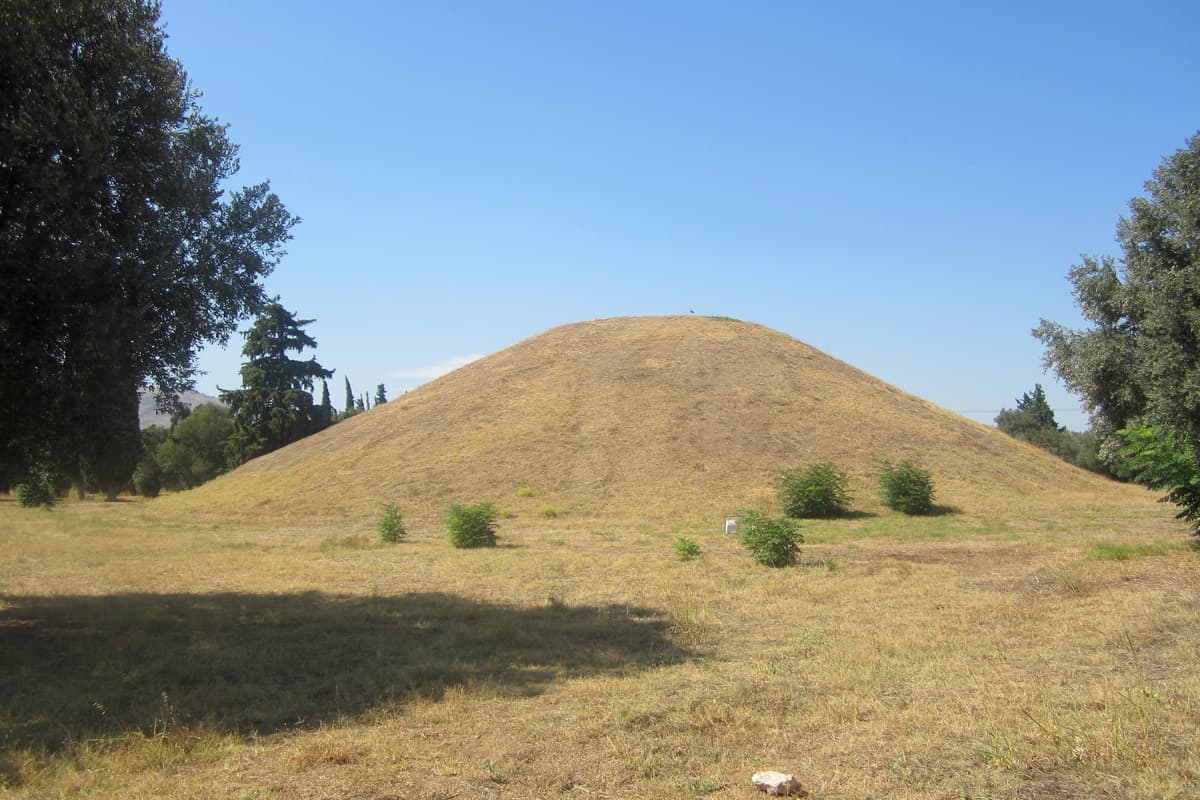
A Marathon tour sees a broad mound of earth that local people called the Soros. It holds the ashes of the Athenian dead from the battle. The mound rises from the flat, open plain. It stands only a short way inland from the sea.
The Greek Ministry of Culture describes the Soros as a great mound of earth. Athens burned and buried its fallen on the battlefield itself. That burial was the honour the city gave them. A Marathon tour reads the mound as a tribute to fighters for freedom.
Official figures for its size do not agree. The state gives a height of 9 metres. The national tourism board gives 10 metres, and one more account gives about 12 metres. A Marathon tour can walk around a base that measures 50 metres across.
The Athenians raised the mound shortly after the battle. They used soil from the battlefield itself. The dead lay in the pit left by the digging, under the returned earth. A Marathon tour sees the result: a rounded mound shaped like half a sphere.
In central Greece, such grand mound burials had been out of style since the 7th century BC. Athens normally buried its war dead in the Kerameikos. This area of the city held an important cemetery. A Marathon tour therefore sees a rare exception to that rule.
Certain scholars see the mound as a deliberate echo of the Iliad, an ancient epic poem. Its shape matches the funerals of heroes in that poem. So does the way the dead lie inside. On this reading, a Marathon tour stands at a tomb that honours citizens as heroes.
Dimitrios Philios dug into the mound first, in 1884. Valerios Stais returned in 1890 and 1891. Inside, he found a large layer of ash, burned bone and vessels. A Marathon tour hears that these finds proved the mound was a mass grave.
Today a small park surrounds the mound. A marble memorial stele marks the spot. A stele is an upright slab of stone set up as a monument. From its base, a Marathon tour looks over the plain where the Persian army lined up.
- Term: Archaeologists call such a mass grave a polyandrion, a communal tomb for more than one body.
- Excavator: Stais came from the island of Kythira and later ran the National Archaeological Museum of Athens.
- Peace march: A March for Peace starts at the mound each year and ends in central Athens.
- Landscape: Towards the sea, visitors can make out the area where the Persians landed.
That march recalls the first peace rally from Marathon to Athens. Police banned the rally, so the politician Grigoris Lambrakis walked the route alone. His immunity as a member of parliament protected him. A Marathon tour thus finds a modern layer of memory at the ancient grave.
What does a Marathon tour see at the Tomb of the Plataeans?
A Marathon tour sees a second, smaller earth mound beside the Archaeological Museum of Marathon. It carries the name of the Plataeans. They were the allies who fought beside Athens. Its excavator opened it in 1970, yet scholars doubt that it holds them.
The mound lies at Vranas, about 5 km from the mound of the Athenians. The Ministry of Culture took over the land by expropriation. That is a forced purchase by the state. A Marathon tour finds the mound and the museum inside this one protected area.
Plataea was an ancient Greek city with its own government. It lay in Boeotia, near the border with Attica. The city stood at the foot of Mount Cithaeron, beside the river Asopus. A Marathon tour hears that this river divided its land from the land of Thebes.
In 520 BC, Plataea refused to submit to its powerful neighbour. It first asked Sparta for protection. Sparta advised it to turn to Athens instead. A Marathon tour explains that Plataea then stayed loyal to Athens for the rest of its history.
Unlike the Athenian mound, this one held whole bodies laid in the earth. Archaeologists call this inhumation. The word means burial without burning the body. A Marathon tour can therefore compare two burial customs at two mounds from the same battle.
The mound is far smaller than the Soros, at around 3 metres high. Official dating places it in the 5th century BC. That is the century of the battle. On a Marathon tour, it looks like a low hump of earth beside the museum building.
A Marathon tour hears that Spyridon Marinatos identified the mound. He dug only part of it, not the whole mound. He believed that it held the Plataean soldiers who fell in the battle. His best-known dig was at Akrotiri, an ancient settlement on the island of Thera.
Scholars widely judge his identification of the mound unsound. Unsound means that the evidence does not support it. State records still use the label so-called tomb of the Plataeans. A Marathon tour therefore presents the name as a tradition, not a proven fact.
- Early history: Plataea was first settled in the Bronze Age, long before the wars with Persia.
- Tradition: Local tradition said that the first Plataeans sprang from the soil itself.
- Modern town: The modern Greek town of Plataies stands next to the ruins of the ancient city.
- Critic: The archaeological historian Andreas Vlachopoulos found nationalist exaggerations in the Marathon digs of Marinatos.
The regional tourism office still calls the site the tomb of the allied Plataean warriors. So the old name lives on, side by side with the modern doubts. A Marathon tour that stops here sees how careful digging tests old stories.
What does a Marathon tour find at the Archaeological Museum of Marathon?
A Marathon tour finds five rooms at the Archaeological Museum of Marathon. It also finds a covered atrium, a large open space surrounded by a building. The displays run from the Neolithic, or New Stone Age, to the late Roman period.
The museum went up in 1975. Eugenios Panagopoulos, a businessman of the Greek community abroad, paid for it. In 2004, works for the Olympic Games renewed the building and set out the finds again. A new roof also went up over the Bronze Age cemetery next door.
The permanent display tells local history through finds from excavations around Marathon. The museum is small. Yet it also holds objects from other periods and regions. A Marathon tour can therefore follow the plain through thousands of years in one building.
Room III covers the historical age, from the 10th to the 4th century BC. A Marathon tour sees storage jars and lidded boxes from local graves. Geometric patterns of lines cover them. Cups and wine jugs from the late Geometric period add early images of people and animals.
Later vases use the black-figure style. Here the figures are dark on the red clay. The red-figure style reverses this and leaves the figures in the colour of the clay. On a Marathon tour, these vases show myths, worship and scenes of daily life.
One small oil flask, an aryballos, takes the form of two female heads back to back. A red-figure loutrophoros shows the wedding of two gods. This long-necked jar with two handles carried water for the bath of a bride. A Marathon tour counts both among the standout pieces.
The room also holds clay figures of a woman on a throne and of a pig. A Marathon tour then sees an inscribed marble discus. The discus thrower Dikaios won it as a prize. He offered it to a god at a local shrine that remains unknown.
Room IV belongs to Herodes Atticus, a Roman senator and speaker of the 2nd century AD. He came from Marathon and owned an estate there with a country house. A Marathon tour sees statues of Herodes and his wife Regilla. Portrait heads show Herodes and his pupil Polydeukion.
- Herms: Headless stone pillars, called herms, honour the favourite pupils of Herodes and curse anyone who harms them.
- Welcome: An inscription records the festive welcome that Athens gave Herodes after a long absence.
- Reclining figure: A man on a rich couch possibly stands for the river Charadros or a local hero.
- Mirror: A wooden folding mirror from the historical age has survived in Room III.
Display cases in the old atrium hold the finds from both burial mounds of the plain. They are mainly black-figure vases. People left them as offerings to the heroic dead. A Marathon tour ends the museum visit beside these gifts to the fallen.
What does a Marathon tour find at the prehistoric tumuli and cemeteries?
A Marathon tour finds three prehistoric burial grounds close together. Spyridon Marinatos excavated an Early Bronze Age cemetery of family graves at Tsepi. He also dug Middle Bronze Age burial mounds, called tumuli, at Vranas. A Mycenaean tholos, a beehive-shaped stone tomb, stands at Arnos.
A Marathon tour starts its prehistoric stops at Tsepi, a site on Plataion Street. Its cemetery is Early Helladic, from the early Bronze Age of mainland Greece. It dates from 3000 to 2300 BC.
Marinatos found the first burials there in 1969. The digging went on until 1974. A Marathon tour at Tsepi sees 70 graves and one deposit pit for offerings.
Families shared these graves, which are rectangular or round and stand in parallel rows. Stone slabs or dry-stone walls lined each grave. Flat slabs of schist, a layered rock, covered it.
Each grave had an entrance on one narrow side. This let a family reuse it for later burials. The dead lay curled up like an unborn baby, with older bones pushed aside.
A central pit held more than 1,500 clay vessels, figurines and animal bones from funeral rites. The finds show strong influence from the Cycladic islands. Marble figurines, obsidian tools from Milos and pan-shaped vessels prove this link.
One frying-pan vessel was made between 2800 and 2500 BC. Its handle is shaped like human feet. For a Marathon tour, Tsepi marks a new Aegean-style culture on the east coast of Attica.
A Marathon tour then reaches Vranas, a fenced site beside the Archaeological Museum of Marathon. Its burial mounds are Middle Helladic, from the Middle Bronze Age. They date from 2000 to 1600 BC.
A share of them stayed in use in Mycenaean times. That use ran from the 14th to the 12th century BC. Travellers such as W.M. Leake and G.J. Fraser noted the mounds in the 19th century.
In 1970 Marinatos excavated four of the seven mounds. He did this for the Archaeological Society of Athens. Tumuli V, VI and VII have been traced in the wider area but not yet excavated.
A Marathon tour sees Tumuli I to III today under a modern shelter. Tumulus IV lies outside, covered with earth. Italian troops made it a gun post in the Second World War, wrecking much of it.
- Tumulus I: This round mound held eight graves, both stone-lined boxes and simple pits.
- Tomb of the queen: Marinatos gave this nickname to grave 2, the richest in Tumulus I.
- Tumulus II: Its single large grave is shaped like a long hall. It has a porch, an antechamber and a main chamber.
- Later intruders: A burial of the 4th to 5th century AD disturbed Tumulus I. So did a later horse skeleton.
The Mycenaean tholos at Arnos completes the prehistoric stops of a Marathon tour. A tholos has a false dome of stone rings, each smaller toward the top. One theory links such tombs to Middle Bronze Age mound burials like those at Vranas.
What is the Trophy of Marathon that a Marathon tour visits?
A Marathon tour visits the Trophy of Marathon, a victory monument. Athenians raised it after defeating the Persians. It took the form of a white marble column with an Ionic capital. A modern marble copy now stands at Mesosporitissa, the spot judged to be its first home.
A Marathon tour at the Trophy meets an old Greek custom. A tropaion, root of the English word trophy, marked a victory. It used the armour of the beaten foe.
In early Greek times a trophy stood at the turning point. There the enemy line broke and ran. Trophies after battles between Greek cities were simple: enemy armour hung on a tree trunk.
Trophies of the Persian Wars, like the one on a Marathon tour, were lasting monuments. The victory came in 490 BC. The Athenians raised the Marathon trophy a short span of years later.
Pausanias, a travel writer of the 2nd century AD, recorded that the trophy was white marble. Its pieces were later built into a medieval tower. It stood near the church of Panagia Mesosporitissa.
A Marathon tour finds those original pieces in the Archaeological Museum of Marathon. The trophy was a smooth column without grooves, ten metres tall. An Ionic capital crowned it.
A hollow in the capital, the carved head block, held a statue. Only a small fragment of the statue survives. It seems to have shown Nike, the goddess of victory, as a young winged woman.
Experts date the monument by the style of its capital and its sculpture. Both point to the age of Cimon, an Athenian statesman, around 470 to 460 BC. A Marathon tour therefore meets a monument raised two to three decades after the fighting.
The original column collapsed long ago. Experts worked out its form from the surviving pieces and rebuilt it in marble. On a Marathon tour, the copy seen today matches the original in height and in general mass.
Inside the fenced Trophy site, a Marathon tour finds Panagia Mesosporitissa. This small church was built after Byzantine times. It is a long, single-room building.
The church has a wooden roof made of cedar trunks. Its wall paintings and altar screen date from the late 19th or early 20th century.
- Dedication: The church honours the Presentation of the Virgin Mary in the temple.
- First site: One view puts the original trophy in the church’s west part and forecourt.
- Reused stone: Its builders seem to have reused stone from a medieval tower just to the west.
- Find of 2021: Restorers removing outer plaster found two marble trophy parts in the church walls.
A Marathon tour at Mesosporitissa thus sees two eras on one spot. The marble copy stands for a classical victory over the Persian army. The small church beside it belongs to a far later chapter of the same ground.
What does a Marathon tour see at the sanctuary of the Egyptian gods at Brexiza?
A Marathon tour sees a Roman-era sanctuary of the Egyptian gods at Brexiza, founded by Herodes Atticus. A walled sacred square with four gateways forms its core. A luxurious bathhouse and a large oval water tank lie nearby. Copies of giant statues stand at the gates.
A Marathon tour reaches Brexiza at Mikro Elos, the Small Marsh. It lies on the south side of the plain. Early travellers called the spot Nissi, meaning island.
In 1792 the French consul L.S. Fauvel drew its ruins. They stood on an islet cut off by a canal. Digs revealed a Roman canal up to 40 metres wide, with built walls 2 metres thick.
Boats seem to have used the canal, which cut the islet off from the land. Works by the Ministry of Culture opened the site to visitors. The European Union paid for part of this work.
Herodes set up the complex around AD 160, possibly inside his own estate. The great orator chose Marathon because it was his home town. It was also his place of residence.
On a Marathon tour, the site matches the sanctuary of Canopus named by his biographer Philostratos. Herodes copied the emperor Hadrian. Hadrian built a Serapis shrine on a man-made islet at Tivoli, near Rome.
Hadrian’s shrine in turn copied the Serapeion, or temple of Serapis, at Canopus. Canopus lies in the Nile Delta. A Marathon tour at Brexiza therefore sees an Egyptian model first copied in Italy.
The walled enclosure measures 60.50 by 64.60 metres. A gateway sits in the middle of each side. Each gateway copies an Egyptian pylon, a gate set between two rectangular towers.
On a Marathon tour, marble steps and a threshold still show between the towers. A pair of larger-than-life statues framed each gateway on its inner and outer face. The male figure followed the pharaoh type and showed the god Osiris.
The female figure showed Isis in different forms. She appears as Demeter with wheat or as Aphrodite with roses. Three pairs of these statues survive in the museum at Marathon.
One more male figure has stood in the National Archaeological Museum since 1843. A Marathon tour sees copies of the statues on their original bases at the site.
- Centre: Paved roads run from the four gateways to a stepped structure. It sits on a raised rectangular terrace.
- Side rooms: Two rooms held a marble Isis and an Egyptian-style sphinx. They also held giant clay lamps and marble falcons for Horus.
- Baths: Marble-clad baths stood near the shore. Their round and six-sided heated rooms ringed a large oval pool.
- Portraits: Busts of Herodes and of the emperors Marcus Aurelius and Lucius Verus came from here.
A Marathon tour at Brexiza stands where the great feasts of Isis and Serapis took place. The Ploiaphesia fell in March, the Serapia in April and the Lychnapsia in August. The Search for Osiris followed in October and November.
How does a Marathon tour connect to the legend of Pheidippides?
A Marathon tour connects to the legend of Pheidippides through two old stories. The earliest historian sends the Athenian runner to Sparta to ask for help before the battle. Later writers added a run from Marathon to Athens that ends with his death.
Herodotus, the first historian of the story, calls the Athenian messenger a hemerodrome. The Greek word means a day-runner, a professional courier who ran long distances.
A Marathon tour begins the legend with this trained courier. He covered about 240 km south to Sparta in two days. There he reached the Spartan government with his plea.
He warned that Eretria, another Greek city, had already been enslaved. The Spartans agreed to help. Yet their law kept their army at home for a time.
A Marathon tour also hears of the god Pan. The runner met him on Mount Parthenium, above Tegea. Pan asked why Athens paid him no attention.
Pan pointed out that he had helped the city before. Athens later gave him a shrine under the Acropolis. The god also received a yearly torch race.
Plutarch lived from 46 to 120 AD. He gives the earliest written account of a Marathon-to-Athens run. His essay is called On the Glory of Athens.
In it, the runner is a herald named Thersippus or Eukles. In this Marathon tour story, the famous courier does not carry the victory news.
A century later, Lucian, a comic satirist, gives the run to a man called Philippides. In his version, the runner announces the victory with a cry of joy. Then he collapses and dies.
A Marathon tour hears that two modern historians call this ending a romantic invention. On a Marathon tour, timing matters too. The first historian wrote 30 to 40 years after the events.
He drew on eyewitnesses. Yet he never mentions a runner from Marathon to Athens. One modern study reads that silence as a sign the victory run never happened.
In 1879 the English poet Robert Browning published a poem called Pheidippides. It joins the Sparta run of the first history with the satirist’s death run.
A Marathon tour meets this blended version of the old Greek tale. In the late 19th century, it entered popular culture as a historical legend.
- Spelling: This spelling appears elsewhere only in The Clouds, a comedy by Aristophanes from 423 BC.
- Calendar: It was the ninth day of the month, so Sparta waited for the full moon.
- Test run: In 1982 five British air force officers tested the run, and three finished it.
- Spartathlon: Since 1983, a yearly 246 km race has followed the runner from Athens to Sparta.
A Marathon tour therefore carries three layers of one legend. The courier comes from the first history. The dying herald comes from the later writers.
The blend of both comes from a poet. The modern marathon race grew from the victory run. The Sparta races grew from the first journey.
How does a Marathon tour trace the first marathon race at the 1896 Olympics?
A Marathon tour traces the first Olympic marathon to Michel Bréal, a French language scholar. He proposed the race for the 1896 Games in Athens, the first modern Olympics. A Greek water carrier, Spyridon Louis, won it on 10 April.
The scholar was born at Landau, in the German Palatinate, in 1832, and died in 1915. He helped found modern semantics, the study of what words mean.
He coined that term in 1883. A Marathon tour thus begins the sports story with a scholar of old languages. In 1894 he attended the founding congress of the International Olympic Committee.
At its closing dinner, he sat beside Pierre de Coubertin, father of the modern Games. On 15 September he wrote to propose a race to the Pnyx, a hill in central Athens.
A Marathon tour also meets his prize. The letter offered a Marathon Cup to the winner. A Paris jeweller later made this silver trophy, six inches tall.
Before his proposal, the Games had planned no race longer than 1,500 metres. A Marathon tour hears that Greece first held trial races to pick its runners.
The first marathon ever took place on 22 March, at the Panhellenic Games, a national meet. Charilaos Vasilakos, a long-distance runner from Piraeus, won it in 3 hours and 18 minutes.
A second trial followed on 5 April, and Ioannis Lavrentis won it in 3:11:27. The future champion, a former soldier, finished only fifth in that race.
His former army commander, Colonel Papadiamantopoulos, knew his talent and convinced him to try out. Of 25 athletes who travelled to Marathon, only 17 started the race.
Those starters came from five nations, a small field of runners. A Marathon tour hears that the same army colonel gave them the starting signal. A Frenchman, Albin Lermusiaux, led early.
Then Edwin Flack, an Australian track champion, took over. At Pikermi, the Greek runner reportedly stopped at an inn for a glass of wine. When he passed the tiring Flack, spectators cried “Hellene, Hellene!”, meaning “Greek, Greek!” in English.
- Finish: The winner ran the last lap beside Crown Prince Constantine and Prince George and finished in 2:58:50.
- Third place: Spyridon Belokas lost third place for riding part of the course in a carriage.
- Rejected entry: Officials refused Stamata Revithi a start, so she ran the course alone the next day.
- Gifts: Admirers offered the champion jewellery and even a free shave for life.
The win was the only Greek victory in athletics at those Games. In Greece, “to become Louis” still means to vanish by running fast. A Marathon tour hears that the Olympic Stadium of Athens and its outside road bear his name.
What does a Marathon tour see at the Marathon Run Museum and the race start?
A Marathon tour visits the Marathon Run Museum. Its more than 4,000 exhibits trace the race’s history. The museum and the starting area lie in the town of Marathon. The first Olympic race set off there, and the classic road race still does.

The museum occupies the first public school building of Marathon, raised around 1908 to 1910. A Marathon tour learns that a national benefactor, Andreas Syggros, paid for it.
The building grew in 1930 to 1932. It took its present form between 1960 and 1965. For the Athens Olympic Games, the town authority gave it to a centre.
The centre’s job was to promote the Marathon route. It housed Olympic Marathons, an exhibition of texts and photographs. They came from the Olympic Museum in Lausanne.
A Marathon tour enters what became a full sports museum in 2007. The visit covers two buildings, each with its own part of the collection.
The first follows the history of Olympic marathons through rare objects. The second covers marathons around the world, Olympic champions, women runners and even running gear.
A Marathon tour sees the original medal of the first Olympic marathon champion. A copy of the cup he received stands beside his personal belongings.
The original cup sold in London in 2012. That sale broke the auction record for Olympic memorabilia. Medals and personal items of the Greek runner-up are also on show.
Stelios Kyriakides, a Greek Cypriot, won in Boston in 1946. His medals and cups are here. Grigoris Lambrakis was a Balkan champion and a member of parliament.
The museum remembers him through his flag from a 1963 peace march. A Marathon tour finds Emil Zatopek, Rosa Mota and Naoko Takahashi honoured in the Olympians section.
The section also honours Ron Hill, Yuko Arimori and Stefano Baldini. Other displays show Olympic torches, Olympic posters and photographs of Olympic and international marathons.
For the first Olympic race, runners reached the village the night before. They gathered on a bridge. The old village priest, Ioannis Veliotis, was set to pray for them.
The prayer was to take place in the church of Saint John. A Marathon tour hears that the priest refused to bless a woman hoping to run.
- Marathon Flame: Before each classic race, a flame lit at the battle tomb travels to the town stadium.
- Symposium: An international meeting on marathons takes place in the town the day before the race.
- Sister city: Marathon is twinned with Hopkinton, Massachusetts, where the world’s oldest annual marathon begins.
A Marathon tour therefore joins two stops in one town, the museum and the starting point. The museum also runs school programmes on the values of sport.
These programmes also teach the Olympic ideal. Two of them are Search and Find and Respecting Diversity. The second promotes the Olympic Truce, a call for peace during the Games.
How does a Marathon tour trace the route of the Authentic Athens Marathon?
A Marathon tour follows the route of the Authentic Athens Marathon. This road race runs every year. Runners cover 42.195 km from the town of Marathon to the Panathenaic Stadium in Athens. The middle part of the course climbs uphill for a long stretch before the city.
The race also goes by the name Athens Classic Marathon. It falls on the second Sunday of November. The Greek tourist board and the national athletics association launched it in 1972.
Later, the IAAF gave the race Gold Label Road Race status. The IAAF is the world governing body of athletics. A Marathon tour follows a road that hosted a separate April race to Athens from 1955.
In 1983, the modern event passed to its present organisers. That same year, two races first shared the course. One was for the public, and one was for elite runners.
The course leaves the town of Marathon. It runs near the coast through Nea Makri. That town lies 8 km south of Marathon on the Petalioi Gulf.
The Petalioi Gulf is an arm of the Aegean Sea. A Marathon tour along this shore covers the seaside part of the race. From the 10 km mark to the 31 km mark, the road climbs uphill.
No other major marathon has a harder uphill section than this one. A Marathon tour by road crosses this rising ground. It lies between the coast and the centre of Athens.
Inside the city centre, a Marathon tour passes a statue of a runner. The course then ends in the Panathenaic Stadium. In ancient times, this stadium held athletics contests.
At the stadium, a Marathon tour reaches the finish of the classic route. The same course carried both marathons of the 2004 Athens Olympics. On 29 August, Stefano Baldini of Italy won the men’s race in 2:10:55.
No Olympic marathon had ever run on a hotter day. The heat rose just above 30 °C. During that race, a spectator tackled the Brazilian leader, Vanderlei de Lima.
He had about 7 km left to run. He lost time but still finished third. Besides his bronze medal, he received the rare Pierre de Coubertin Medal for fair play.
- Field size: In 2015, 43,000 people entered, and 16,000 of them ran the full marathon.
- Shorter races: Two shorter road races run in central Athens, plus a 1.2 km children’s race.
- Course records: Edwin Kiptoo holds the men’s record, 2:10:34, and Rasa Drazdauskaitė the women’s, 2:31:06.
- Women’s Olympic race: Japan’s Mizuki Noguchi won on 22 August in 2:26:20, in heat above 35 °C.
A Marathon tour ties the modern race to its ancient idea. The race recalls the Athenian army’s run from Marathon to Athens after the battle. The 2010 edition joined the celebration of 2,500 years since that battle.
What does a Marathon tour see at Lake Marathon and its dam?
A Marathon tour sees Lake Marathon, a man-made reservoir close to the town of Marathon. For almost three decades in the 20th century, it was the main water supply of Athens. Its concrete dam has an outer coat of white marble. The marble comes from Mount Pentelicus.
The dam closes a valley above Marathon. It sits where two streams, the Charadros and Varnavas torrents, meet. Rain from a basin of 118 km² drains into the lake.
A Marathon tour views water gathered from this whole basin. Athens grew fast when refugees from Asia Minor arrived. They came during and after the Greco-Turkish War.
The capital needed far more water for its new residents and homes. Work on the dam ran from 1926 to 1929. The reservoir went into service in 1931.
An American firm built the dam. Its contract let the firm build the system, run it and later hand it back. The same firm also owned the Athens water company for decades.
A Marathon tour visits a project from the years when a foreign firm ran city water. Here, a Marathon tour sees a concrete gravity dam. This kind of wall holds water back by its own weight.
The dam stretches 285 m from side to side. It rises 54 m from base to top. The lake reaches that same depth at its deepest point.
A Marathon tour finds white Pentelic marble on the outside of the dam. Ancient builders used the same marble for the Parthenon. They also used it for the other buildings on the Acropolis.
The stone has a faint yellow tint. In sunlight, it shines with a golden glow. In ancient times, ships also took the marble to Rome for its buildings and statues.
Mount Pentelicus stands northeast of Athens and southwest of Marathon. Its ancient quarry is protected by law. Today it serves only the project to restore the Acropolis.
At the level of the spillway, the lake covers 2.45 km². A spillway lets water out of a dam in a controlled way. A Marathon tour looks over a lake that holds up to 41 million m³.
- Dam shape: The wall is 28 m wide at the base and 4.5 m at the top.
- Heights: The dam top is 227 m above sea level, and its foot is 173 m.
- Spillway flow: The spillway can release 520 m³ of water each second.
- Rainfall: Yearly rain on the basin averages 580 mm, and 12 million m³ flows in.
Later sources joined Lake Marathon. Water from Lake Yliki began to reach Athens in 1959, and the Mornos Reservoir followed. Even so, a Marathon tour sees a reservoir with a usable volume of 34 million m³.
What does a Marathon tour find at Schinias?
A Marathon tour finds Schinias on the coast just southeast of the town of Marathon. Pine forest and a protected wetland lie behind its long sandy beach. The national park around them holds a rowing and canoeing centre. It was built for the Olympic Games.
A Marathon tour enters Schinias-Marathon National Park, set up in 2000 in northeastern Attica. Its core zone covers 14.39 km². The land around it forms a second, outer zone.
Inside the core, the law allows only scientific research, light leisure and learning about nature. The park lies 40 km from Athens. It joins sea, pine forest, wetland and sand dunes.
The dunes act as a natural barrier along the shore. A Marathon tour also meets a lagoon. A wetland covers the central part of the park.
A Marathon tour reaches Schinias Beach, which stretches across the southern part of the park. It ranks among the largest natural sandy shores in Attica. Windsurfers use the beach widely.
A Marathon tour finds shallow, clear water there. A pine forest along the sand gives shade. Low, stable dunes run along the coast behind the beach.
A Marathon tour sees Italian stone pine on the western part of the dunes. Aleppo pine grows on their eastern part. Stone pines have given people edible pine nuts since prehistoric times.
The Schinias wetland is all that remains of a once much larger Marathon marsh. The Makaria spring, or Makaria Pigi in Greek, gave it 6 to 7 million m³ a year.
Drainage canals dug in 1923 cut much of that fresh water flow. A Marathon tour passes reed beds, salt meadows and tamarisk trees around the water.
More than 220 bird species have been recorded at Schinias. They include herons, coots and migrating birds. The wetland is a resting stop on a migration route between Eastern Europe, the Balkans and Africa.
A Marathon tour finds the rowing centre east of the town of Marathon. It stands on former airport land. It hosted the rowing and canoe sprint races of the Athens Olympic Games.
In canoe sprint, athletes race short distances in special canoes or kayaks on calm water. The venue also staged the European Rowing Championships in September 2008.
- Venue size: The centre covers 1.24 km² and was the Games venue farthest north.
- Dispute: Reshaping wetland ground for the venue caused an argument over harm to nature.
- New water: Man-made water bodies at the venue now carry fresh water into the wetland.
- Protection: Natura 2000, the EU’s protected-area network, lists the park as GR3000003 and the wetland GR3000016.
A Marathon tour at Schinias reaches one of three rowing training centres approved worldwide by FISA. FISA is the world governing body of rowing. The other two centres are in Munich and Seville.
What does a Marathon tour see at Rhamnous?
A Marathon tour at Rhamnous sees the sanctuary of Nemesis and Themis. It sits on a marble terrace, with two temples side by side. Nearby, the walls of an Athenian fortress look over the sea. Hundreds of fragments of the cult statue of Nemesis have been found.
Rhamnous lies at the northeast end of Attica, inside the municipality of Marathon. A Marathon tour finds its ruins northwest of the town of Agia Marina. They stand above the Euboean Strait.
The name comes from buckthorn, a thick, prickly shrub that still grows on the site. Nemesis punished hubris, or arrogance before the gods. Rhamnous held her chief sanctuary in Greece.
Themis, the goddess of right order, shared the older and smaller temple with her. Its porch holds two marble seats. On a Marathon tour, their inscriptions name both goddesses.
The large temple of Nemesis had 6 Doric columns at each end. Each side had 12 columns. Work began around 460–450 BC and went on until 430–420 BC.
The Peloponnesian War halted the work, so the column grooves were never carved. For a Marathon tour, the temple’s fame rests on its statue of Nemesis, about 4 metres high.
Pausanias, a travel writer of the 2nd century AD, named Pheidias as the sculptor. Other writers credited his pupil, Agoracritus of Paros. The Roman writer Varro rated it the finest piece of Greek sculpture.
Pausanias also wrote that the Persians had brought this block of Parian marble. They meant it for a victory trophy. The traveller William Martin Leake later suspected the priests invented the tale.
For a Marathon tour, the tale still links the goddess of revenge to the Persian defeat. A damaged marble head of Nemesis is now in the British Museum. It has holes for a gold crown.
The fragments let experts identify eleven smaller Roman copies of the statue. The rebuilt base is 90 cm high and 240 cm wide. It shows Helen with Leda and Nemesis.
The town stood 600 metres north of the sanctuary. It was built around a fortified hill about 28 metres high. Athens kept a garrison of ephebes, or young men, there to watch over shipping.
A Marathon tour sees walls of local marble along a narrow ridge. The main gate is well preserved.
- Themis statue: The small temple’s statue of Themis is in the National Archaeological Museum, Athens.
- Roman repairs: An inscription on the east end rededicates the temple to Livia, wife of Augustus.
- Harbours: Two small harbours flanked the fortress. In wartime, grain for Athens came in through them.
- Excavations: Systematic digs led by V. Petrakos have run at the site since 1975.
A decree of the emperor Arcadius ended the cult in 382 AD. Yet the ruins were never fully buried and have stayed in view ever since. A Marathon tour can trace the ancient road to Marathon, once lined with grave monuments.
What does a Marathon tour find at the Cave of Pan?
A Marathon tour finds the Cave of Pan at Oinoe, 2.5 km west of Marathon. Pan was worshipped there in Classical times. Long before, Neolithic people reburied the bones of their dead in its chambers. Herodotus tells how Athens came to honour Pan.
A Marathon tour reaches the cave on the hill of Pan, 125 metres above sea level. It opens on the north-northeast slope. That hill has the shape of a rough triangle.
The Charadros, or Oinoe, river flows round the northwest side of the hill. For a Marathon tour, the cave is a large, dark hollow with two entrances.
Its chambers hold rich stalactites and stalagmites, the stone icicles that grow from roofs and floors. Small limestone basins formed in the bedrock. A number of them still hold water.
Before the battle, Athens sent a runner to Sparta. Herodotus tells how Pan spoke to this runner. The god asked why Athens paid him no attention.
Yet Pan had helped the city in the past. On a Marathon tour, the tale ends with his promise to help again. When times improved, the Athenians built a shrine to Pan below the Acropolis.
From then on, a yearly ceremony with a torch race and sacrifices honoured him. A Marathon tour also hears that Pan favoured Athens and filled the Persians with panic.
After the battle, Pan was honoured as a hero around Marathon itself for his help. The first room of Marathon’s archaeological museum shows the Neolithic age through finds from this cave. A Marathon tour that stops there sees them.
In 1958, John Papadimitriou led a small dig at the cave for the Archaeological Society at Athens. He found pottery and figurines from the 5th and 4th centuries BC.
A marble slab with an inscription dates from 61/60 BC. It shows the cave was sacred to Pan and the Nymphs. The finds matched the site to a cave described by Pausanias.
Heavy looting followed. The state service for caves then dug it again from 2014 to 2018. A Marathon tour learns that Cybele, Artemis and Hermes were also worshipped there.
- Neolithic burials: Scattered Neolithic human bones came to light, laid with care by set customs.
- Time span: The whole cave saw this use from 6600 BC to about 4300/4200 BC.
- Grave goods: Pottery, tools, jewellery and figurines lay with the bones.
The cave was a place of memory for Neolithic families. This lasted for at least two thousand years. The families held rites there to ease their grief.
The rites also helped the dead pass safely to the underworld. On a Marathon tour, Pan’s worship becomes a late chapter in a far older story.
How does a Marathon tour combine with Cape Sounion and the Attica coast?
A Marathon tour combines with the east coast of Attica by following the shore south. Rafina comes first. Next is the old sanctuary of Artemis at Brauron. Far down the coast, the route can end at Cape Sounion and its Temple of Poseidon.
Rafina lies further down the same coast, south of Marathon. A Marathon tour passes its harbour, which already served the Cyclades islands in the Archaic period. Araphen, an ancient village district of Athens, lay just west of Rafina near a river mouth.
Halfway between Rafina and Vravrona lies Loutsa, the ancient Halai Araphenides. A Marathon tour passes the ruins of a small temple of Artemis Tauropolos there. Archaeologists dug them out of sand dunes.
Halai also served as the harbour of Brauron. Crossings ran from there to Marmarium in Euboea. Brauron is a sanctuary of Artemis set in a small inlet of the Aegean.
The inlet has filled up with mud since ancient times. As a result, the shore now lies farther away. A Marathon tour finds the sanctuary by the Erasinos river, about 1 km northwest of Vravrona.
Worship began in the 8th century BC at a sacred spring. People threw offerings into its water. A temple followed in the late 6th century BC.
The Persians wrecked the sanctuary in 480 BC. They took the cult statue to Susa. In the 420s BC, a stoa, or roofed row of columns, rose around a courtyard.
The stoa had the shape of the letter Π. Its nine dining rooms each held eleven couches for ritual feasts. A Marathon tour also sees a stone bridge, the only known Classical bridge in Greece.
Young Athenian girls near the age of marriage served Artemis here as arktoi, or she-bears. In the Arkteia festival, they danced, ran races and wore saffron robes. Euripides made Iphigenia, the daughter of Agamemnon, priestess of this site and placed her grave here.
Further south, the Temple of Poseidon crowns any Cape Sounion tour. Experts credit it to the architect of the temple of Nemesis at Rhamnous.
The frieze at Sounion, a carved band of figures, shows Centaurs and Theseus. For a Marathon tour, these scenes stood for the Greek win over Persia.
- Brauron museum: The museum stands 330 metres east-southeast of the sanctuary. It shows statues of young children and small painted mixing bowls.
- Wheel ruts: Cart tracks cut into the bridge slabs run toward a side entrance of the stoa.
- Signal tower: Brauron has a medieval tower. It is thought to date from the Burgundian De La Roche dukes (1204–1311).
- Porto Rafti: This bay lies 5 km south of Vravrona. It was a major trading place until the Roman Empire collapsed.
A Marathon tour that adds the coast moves from the battlefield to shrines of Artemis and Poseidon. Rhamnous guards the northern end of this shore, and Sounion closes the southern end. Each stop shows how Athens honoured its gods and guarded its shores.
Which other battles of the Persian Wars does a Marathon tour recall?
A Marathon tour recalls the second Persian invasion of Greece. It came ten years after the battle on the plain. Thermopylae and the sea fight at Artemisium came in 480 BC. Salamis followed that same year, and Plataea and Mycale ended the invasion in 479 BC.
Darius was the Persian king who sent the fleet to Marathon. After the defeat, he began raising a huge new army. In 486 BC, his subjects in Egypt revolted, and the plan stalled.
Darius died while he prepared a march on Egypt. A Marathon tour therefore meets a new Persian king, Xerxes, in the next chapter.
Athens used the pause to prepare at sea. In 482 BC, the city chose to build a massive fleet of triremes. The politician Themistocles steered that decision.
A trireme was a warship named after its three rows of oars. A Marathon tour links that new fleet to the sea battles ahead.
The invasion struck by land and sea at once. While Greeks held the pass at Thermopylae, 271 allied triremes defended the Straits of Artemisium.
The Greek ships suffered heavy losses and pulled back after the pass fell. A Marathon tour leaves the full story of the pass to a Thermopylae tour further north.
Salamis is the largest Greek island in the Saronic Gulf. It lies about 2 km off the coast of Piraeus, the port of Athens.
On 26 or 27 September, the fleets met in the straits off the island. A Marathon tour ranks it as arguably the largest naval battle of the ancient world.
Themistocles sent his servant Sicinnus to Xerxes with a false message. It claimed that part of the Greek fleet planned to slip away that very night.
The Persian fleet rowed into the cramped straits, and its large numbers became a burden there. Xerxes watched from a throne on the slopes of Mount Aigaleo.
Herodotus puts the allied fleet at 371 to 378 ships. The Greeks lost 40 ships, and the Persians lost 300. The Athenian general Aristides then crossed to Psyttaleia, a small island in the straits.
His men wiped out the Persian troops posted there. A Marathon tour sees Salamis as the turning point of the invasion.
Xerxes went back to Asia with much of his army. Mardonius stayed to finish the conquest. The allied Greeks met him near Plataea in Boeotia on 27 or 28 August.
Pausanias, a Spartan regent who ruled in place of a king, led them. A man named Aeimnestus killed Mardonius, and the Persian army retreated.
- Mycale: Herodotus places this battle, opposite the island of Samos, on the same day as Plataea.
- Armies: Modern estimates give 75,000 to 85,000 Greeks and 70,000 to 120,000 Persians at Plataea.
- Serpent Column: The winning Greeks dedicated this column, and a large part still stands in Istanbul.
- The Persians: Aeschylus staged this play about Salamis in 472 BC, the oldest surviving Greek drama.
With the twin victories of Plataea and Mycale, the second invasion was over. The Persians made no further attempt to conquer the Greek mainland.
The wider Persian Wars ran for 50 years, from 499 to 449 BC. A Marathon tour stands where the first Persian invasion was turned back.
When is the best season for a Marathon tour?
A Marathon tour suits spring and autumn best. The air in Attica is mild then, and rain days are fewer than in winter. Summer brings strong sun and heat to the coastal plain. The Athens marathon race also starts in the town each autumn.
The National Observatory of Athens is the oldest research body in Greece, founded in 1842. Its city weather station stands 107 m above sea level.
Averages for 1961 to 1990 give July an average high of 32.6 °C. A Marathon tour in July walks through that heat.
July skies are clear as well as hot. The month averaged 374 hours of sunshine and only 2 rain days. Cloud cover stood at 2.0 oktas, meaning two eighths of the sky.
Relative humidity, a measure of moisture in the air, fell to 48%. A Marathon tour in midsummer meets dry, bright weather.
The UV index measures the strength of the sun rays that cause sunburn. Downtown Athens averages 10 on this scale in June and July, based on 1991 to 2020 data.
The scale rates 8 to 10 as very high. A summer Marathon tour therefore needs sun protection at every stop.
Elefsina, west of Athens, recorded 48.0 °C on 10 July 1977. That reading held the European record of the World Meteorological Organization until 2021.
Greek civil protection advises against long walks or running under the sun. A Marathon tour on a hot day seeks shaded, cool places between stops.
Spring brings milder air to Attica. The observatory gives April an average high of 20.3 °C and 239 hours of sunshine. Rain still falls on 10 days of that month.
The following month climbs to 25.3 °C. A Marathon tour in April walks in warm, bright weather, well below the midsummer peak.
Autumn stays warmer than spring. September keeps an average high of 28.9 °C. October drops to 23.1 °C and brings back the rain, with 47.7 mm over 9 days.
October still has 218 hours of sunshine. A Marathon tour in October meets warm air and a softer sun than in July.
The Athens marathon race falls on the second Sunday of November. November in the city averages a high of 18.6 °C and a low of 11.4 °C.
The month brings 11 rain days and 50.6 mm of rain. A Marathon tour on race weekend shares the town with runners.
- Winter: January averages a high of 12.9 °C in Athens, and December brings 66.6 mm of rain.
- Dry basin: The Parnitha and Dirfys mountains dry the north winds before they reach the Athens basin.
- Year: An average year in Athens brings 376.1 mm of rain and 2,884 hours of sunshine.
Spring and autumn give a Marathon tour mild air and long, bright days. Summer adds the strongest sun of the year, so shade and water matter.
Winter brings rain and cool days to Attica. Each season suits a different kind of visit to the plain.
What do travelers ask about a Marathon tour?
A Marathon tour raises five common questions. Travelers ask how far the plain lies from Athens and whether a half-day visit works. They also ask about children and about running part of the race route. A swim at the beach afterwards is the fifth question.
How far from Athens is the plain on a Marathon tour?
A Marathon tour heads northeast from Athens into East Attica. On the way it passes Nea Makri, a seaside town 25 km northeast of the city centre. Marathon lies 8 km north of Nea Makri.
Does a half-day visit work for a Marathon tour?
A half-day Marathon tour fits the short road from the capital. A whole day suits a site further away, such as a Delphi day trip from Athens.
The ancient writer Pausanias says Athens paid for its treasury at Delphi with loot from Marathon. This marble building held the offerings of the city.
Is a Marathon tour suitable for children?
A Marathon tour suits children when the family plans for the heat. Greek civil protection advises dressing children as lightly as possible. It also says that children always wear a hat.
Children need plenty to drink, such as water and fruit juice. These steps matter above all on a summer visit.
Can travelers run part of the route on a Marathon tour?
A Marathon tour can line up with the race weekend. Besides the full race, the event holds 5 km and 10 km road races.
A racewalking contest for fast walkers joins them. Runners who want a shorter distance can pick one of these races.
Is there a beach for a swim after a Marathon tour?
A Marathon tour ends close to the sea. The coast faces the Petalioi Gulf, an arm of the Aegean Sea. It lies between east Attica and the south tip of Euboea.
The gulf runs about 50 km from north to south. Zoumberi Beach lies near Nea Makri, a town known for its beaches and coastline.
Featured photo: Tomisti, CC BY-SA 4.0, via Wikimedia Commons.