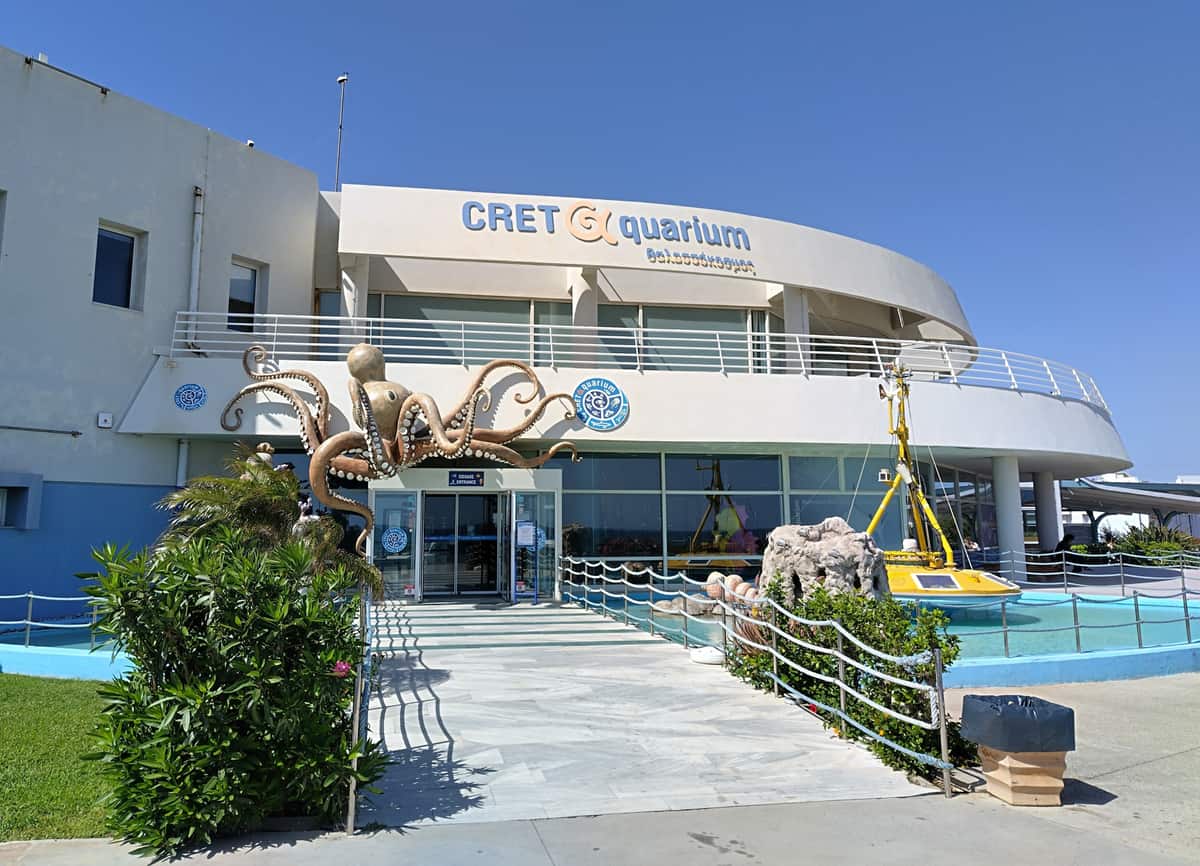
Cretaquarium tickets open the public aquarium at Gournes in Crete. This post covers what Cretaquarium tickets cover, the sea life on show, who runs the aquarium, the kinds of tickets, how to get there and the nearby sights that pair with the visit. More Greece tours are listed on the Greece VIP homepage.
Each section ends with a ticket or a tour that can be booked online.
What do Cretaquarium tickets cover?
Cretaquarium tickets cover entry to the public aquarium of Crete at Gournes, east of Heraklion. The route runs through five themed sections and 62 tanks holding 1,800,000 litres of seawater, home to 1,500 marine animals from 130 species found in the Mediterranean basin.
Cretaquarium, known in Greek as Enidrio Kritis, is the Aquarium of Crete. It forms part of the Hellenic Centre for Marine Research, and its official site ranks it among the largest modern aquariums in Europe. Cretaquarium tickets give access to the exhibition route, where designed habitats recreate the seabeds of Crete and the wider Mediterranean, while cameras watch the animals for studies of their life cycle and behaviour.
The official Identity page gives 62 tanks of different sizes, which together hold 1,800,000 litres of seawater. These tanks house 1,500 marine animals from 130 species of the Mediterranean basin. Other counts differ. The official History page lists 61 tanks, 2000 animals and 200 species, and Wikipedia gives 61 tanks and more than 2,500 animals. A major expansion in the winter of 2008–9 installed 25 new tanks.
Beyond the tanks, the official site lists a cafe-restaurant, a gift shop, educational programmes, event hosting, a virtual reality room and expert-led tours among its services. Audio commentary on headphones comes in 9 languages, and the virtual reality room admits visitors aged over 12. Holders of Cretaquarium tickets walk one path that takes the sections in a set order, from dim caves to tropical waters.
The public route is only part of the building. Support and preservation areas behind the scenes extend to 2600 square metres, with quarantine tanks, feed preparation, a pumping plant and filters. Natural seawater comes from a drilling 200 m deep, and each tank has its own purification system. The official site marks its behind-the-scenes visits as not available until further notice, so Cretaquarium tickets do not include a look at these areas for now.
- Included: Cretaquarium tickets cover the public route through five themed sections and the exhibition tanks.
- Collection: The official count stands at 62 tanks, 1,500 marine animals and 130 species.
- Extras: Audio commentary comes in 9 languages, and virtual reality admits visitors over 12.
- Not included now: Behind-the-scenes visits are marked as not available until further notice.
In short, Cretaquarium tickets buy a walk through a working aquarium. Staff prepare the diet of the animals each day from mussels, prawns, squid, fish and industrial feeds matched to each species, and they control how much each animal eats. This matters in tanks where large carnivorous predators, such as sharks, share space and compete for food.
What do visitors see with Cretaquarium tickets?
Cretaquarium tickets open a route through five sections of sea life: dark caves and deep water, the open sea with the two largest tanks, coastal habitats, shallow open tanks and a tropical zone that includes species which reached the Mediterranean through the Suez Canal.

With Cretaquarium tickets, the visit starts in Playing with the Light, a section kept in low light to copy caves, rock cracks and great depths. Wikipedia names the red scorpionfish, the common stingray and the dusky grouper here, and the official site adds red corals, gorgonians, crayfish and skates. Its species notes state that a stingray’s tail sting can reach 35 cm, and that a dusky grouper can grow to 1.5 m and live for 50 years.
The second section, Open Sea, shows life of the pelagic zone in the two largest tanks, which hold 600,000 and 400,000 litres of water. Their scenery copies the seabed at Vai and Matala. Sand tiger sharks, sandbar sharks, greater amberjacks and European seabass swim here. Loggerhead sea turtles are temporary guests: they arrive injured and return to the wild once treated, so Cretaquarium tickets do not promise a turtle sighting. Smaller tanks hold common octopuses and Mediterranean slipper lobsters.
Coastal Areas follows, with rocky and sandy bottoms and sea plants that form underwater meadows. Parrotfish, rainbow wrasses, anemones, crustaceans, echinoderms and the European spiny lobster live in these tanks. The Aquarium Beyond the Glass sets moon jellyfish and other animals in shallow open tanks, so holders of Cretaquarium tickets get a close view and a lesson in how tanks are built and run.
The route that Cretaquarium tickets open ends in Travelling to the Tropics, a section for tropical species and lessepsian migrants. These fish crossed from the Red Sea into the Mediterranean through the Suez Canal, and the name honours Ferdinand de Lesseps, who developed the canal. Clownfish and marbled spinefoots live here, along with the silver-cheeked toadfish, which appeared in the Mediterranean in 2003. The official notes warn that this pufferfish is poisonous if eaten, because it carries tetrodotoxin.
- Playing with the Light: Groupers, scorpionfish and stingrays live in dim tanks.
- Open Sea: Sharks and amberjacks swim in the two largest tanks.
- Coastal Areas: Spiny lobsters, anemones and parrotfish live in rocky and sandy habitats.
- Beyond the Glass: Moon jellyfish drift in shallow open tanks.
- Travelling to the Tropics: Clownfish and Suez Canal migrants close the route.
The species on show change over time. Injured turtles leave once treated, and the official site notes that new marine species keep joining the collection. One part of the route also deals with plankton, the life in seawater that only a microscope shows, and with the animals that feed on it, so Cretaquarium tickets cover the smallest sea life as well as sharks.
Where is the aquarium that Cretaquarium tickets open?
Cretaquarium tickets open an aquarium near the coastal village of Gournes, 15 km east of Heraklion in north-central Crete. It stands on the north-western part of the former American base, inside the municipality of Hersonissos and the Heraklion regional unit.
Gournes is a coastal village in the municipal unit of Gouves, which belongs to the municipality of Hersonissos. Wikipedia places it 15 km east of Heraklion, while the official aquarium site gives 14 km from the city. The official address names the former American base, Gournes, Chersonissos and Heraklion, and Chersonissos is another spelling of Hersonissos. Wikipedia also names Gournes as the seat of the Hersonissos local government unit.
The site was once Iraklion Air Station, a non-flying United States Air Force facility 16 km east of the city near Gournes. It began operations on 5 October 1954 and closed in 1994. Wikipedia describes the old station as abandoned after closure and taken over by weeds. Cretaquarium first opened on the site in December 2005, and a dinosaur park and an animal shelter now share the grounds. Holders of Cretaquarium tickets therefore enter former military ground.
Inside the old base, the aquarium and the research buildings of the Hellenic Centre for Marine Research together form Thalassokosmos, a marine science complex with a total area of 58,000 square metres. The complex also holds an amphitheatre for 150 people. The public spaces that Cretaquarium tickets open overlook the Cretan Sea, and treated water leaves the aquarium through a drain to the open sea 400 m from the shore.
Hersonissos municipality was formed in the 2011 local government reform by merging four former municipalities: Episkopi, Gouves, Hersonissos and Malia. It covers 272.17 square kilometres and belongs to the Heraklion regional unit. Heraklion itself is the largest city and administrative capital of Crete, and the fourth largest city in Greece. Cretaquarium tickets therefore lead to a coastal site east of the island’s capital, not to an address inside the city.
- Village: The aquarium lies near Gournes, a coastal village 15 km east of Heraklion.
- Former use: The grounds belonged to Iraklion Air Station, an American facility that closed in 1994.
- Municipality: Gournes sits in the Gouves municipal unit of the municipality of Hersonissos.
- Regional unit: Hersonissos is part of the Heraklion regional unit, whose capital is Heraklion city.
On the map, Cretaquarium tickets point to Gournes on the coast of north-central Crete, inside the Hersonissos municipality and 15 km east of Heraklion. The aquarium shares the former American base with research buildings, a dinosaur park and an animal shelter. Its address carries the names Gournes, Chersonissos and Heraklion, which match the village, the municipality and the regional unit.
Who runs the aquarium behind Cretaquarium tickets?
Cretaquarium tickets give entry to a public aquarium run by the Hellenic Centre for Marine Research (HCMR), a Greek state research body. The aquarium forms part of Thalassocosmos, the HCMR marine science complex at Gournes, together with the research institutes based on the same grounds.
The body behind Cretaquarium tickets is the Hellenic Centre for Marine Research, a Greek governmental research organisation for marine science. It took its present form on 3 June 2003, when the National Centre for Marine Research merged with the Institute of Marine Biology of Crete. That Cretan institute was founded in Heraklion in 1987. The roots of the centre go back to the Marine Hydrobiological Station, set up in 1914 at Palaio Faliro.
The centre is a public sector body under the General Secretariat for Research and Innovation of the Ministry of Development and Investments. Its three research institutes cover oceanography, marine biological resources and inland waters, and marine biology, biotechnology and aquaculture. The headquarters is the TRITON marine research park at Anavyssos in Attica. The fleet includes three research vessels and THETIS, a two-person submersible that can dive to 610 metres.
Thalassocosmos, a Greek name that means “sea world”, is the HCMR complex in Crete. It started operating in December 2005, the same month the aquarium first opened. The whole site covers 58,000 square metres. Research facilities and workshops take up 3,185 square metres, and the buildings also hold an amphitheatre for 150 people. The official aquarium site calls Thalassocosmos the largest centre for marine science in Greece.
The HCMR Institute of Marine Biology, Biotechnology and Aquaculture is based on the aquarium premises. Cameras constantly observe animals in the tanks, so researchers can study their life cycle and behaviour. Special attention goes to Lessepsian migrants, introduced fish whose impact on the Greek marine ecosystem is under study. The aquarium also cares for sick or wounded animals and returns them to the wild. For holders of Cretaquarium tickets, the halls are part of a working research site.
- Cretaquarium: HCMR describes the aquarium behind Cretaquarium tickets as one of the biggest aquariums in Europe.
- Aqualabs: This HCMR site is the largest facility for marine experimental tanks in the Mediterranean.
- Agios Kosmas: A two-storey HCMR building at Elliniko holds offices, laboratories and indoor and outdoor tanks.
- Research areas: HCMR work covers aquatic biodiversity, fisheries, aquaculture and marine forecasting systems in the Greek seas.
HCMR states that Cretaquarium and the Hydrobiological Station of Rhodes, its two aquaria, aim to spread knowledge about the marine environment, mainly in the Eastern Mediterranean. The aquarium’s own site says it was founded and operates as part of HCMR. Behind Cretaquarium tickets, then, stands the same public body that runs the research institutes on the Thalassocosmos grounds.
Which kinds of Cretaquarium tickets exist?
Cretaquarium tickets come as a general entrance ticket, separate tickets for children aged 5 to 17 and adults over 65, group and discount tickets, and add-ons: a virtual reality session, audio tour devices and tours led by trained aquarium staff.
The official fee table starts with the general entrance ticket. It has one rate for the summer season, from 1 April to 31 October, and another for the winter season, from 1 November to 31 March. Children up to four years old enter free. Children aged 5 to 17 and seniors over 65 have their own category. Cretaquarium tickets for organised groups of more than 20 people come at a per-person group rate.
Discounted Cretaquarium tickets cover students, members of the Hellenic Security Forces and holders of the European Youth Card in two age bands, 13 to 17 and 18 to 30. People with a disability enter free, and so do aquarium members. Membership comes with the KartAquarium club card. It gives free entrance for a whole calendar year, electronic news updates and discounts at the Aquashop souvenir store.
Two additional services can be added to Cretaquarium tickets. The virtual reality experience runs in a specially designed hall and is open to visitors over 12 years old. Its scenes include a 24-metre whale and manta rays leading a school of jellyfish through a coral reef. The audio tour uses small headphone devices with recorded explanations, offered in nine languages: Greek, English, French, German, Italian, Dutch, Polish, Russian and Czech.
Tours led by trained aquarium staff run in Greek and English and come in two forms. Scheduled tours follow set times in the aquarium programme and need a group of at least 10 people. Custom tours let a group of at least 20 people choose the day and time. Both carry a per-person charge on top of standard Cretaquarium tickets and are booked by phone. The scheduled times appear in a PDF on the official site.
- Behind the scenes: This tour shows feeding preparation, tank safety checks and quarantine areas, but is listed as not available at the moment.
- Little Explorers: This playful tour serves a group of small children and is booked for up to 20 children on top of their Cretaquarium tickets.
- e-Tour: This live online webcam tour serves schools, institutions and other groups in remote areas or abroad, and runs only on request.
Cretaquarium tickets therefore work in three layers: the entrance ticket, optional additional services and tours led by staff. Age and status decide the entrance category, while group size decides which staff-led tour fits. Tours are booked by phone, while the membership card can be issued at the customer service desk, by emailed form or by phone.
How do visitors reach the site with Cretaquarium tickets?
Cretaquarium tickets lead to a site 14 km from Heraklion and from Heraklion International Airport, according to the official site. Visitors arrive by car, motorcycle, taxi or bus, and the national road along the north coast links the aquarium with the main destinations of the area.
Heraklion International Airport, code HER, is the primary airport of Crete and the second busiest in Greece after Athens. It bears the name of Nikos Kazantzakis, the writer and philosopher born in Heraklion. The airport lies about 5 km east of the city centre, near Nea Alikarnassos, and shares its airfield with the 126th Combat Group of the Hellenic Air Force. It serves Heraklion and resorts such as Hersonissos, Malia, Stalida, Sisi and Elounda.
Heraklion is the largest city and the administrative capital of Crete, and the fourth largest city in Greece. Its port has ferries to islands such as Santorini, Mykonos and Rhodes, and daily ferries to Piraeus, the port of Athens. Inside the city, urban buses run on 39 routes, while intercity buses link Heraklion with destinations across Crete. Ferry passengers with Cretaquarium tickets can therefore continue by bus from the city.
East of Heraklion, the coastal road is Greek National Road 90, also called VOAK. It runs along the north coast of Crete from Kissamos in the west to Sitia in the east and forms part of European route E75. Its upgrade is the A90 motorway. In the Heraklion area, 35 km between Linoperamata and Hersonissos have four lanes and a central strip. The stretch from Gournes to Hersonissos crosses the Aposelemi Gorge on a viaduct.
Drivers and riders with Cretaquarium tickets follow the brown road signs that point to the aquarium along the road network of Crete. A free and spacious parking area sits at the aquarium. Motorway 90 also connects with Heraklion airport and with the port of Heraklion. A new airport for central Crete is under construction at Kasteli, 39 km south-east of the city, and Motorway 90 will connect to it as well.
- By bus from Heraklion: Buses link the city with the aquarium every 20 minutes in summer and every 30 minutes in winter.
- By bus from the east: Further routes connect the aquarium with the wider Malia and Hersonissos area.
- By taxi: Private taxi services from firms in the area carry visitors with Cretaquarium tickets to and from the aquarium.
The airport, the port and the city of Heraklion all connect to the coastal road that runs east to Gournes. Visitors with Cretaquarium tickets and no car use the buses from Heraklion or from the Malia and Hersonissos area. Drivers follow the brown signs to the free parking area. Taxis cover the same route for those who prefer a direct ride.
Which nearby sights pair with Cretaquarium tickets?
Cretaquarium tickets pair well with four sights in the Heraklion area of Crete: the palace site of Knossos, the Heraklion Archaeological Museum, the resort town of Hersonissos and the Minoan palace of Malia. Two lie west of the aquarium and two lie east.
Knossos lies on the southern edge of Heraklion, about 5 km south of the historic centre. People first settled on Kephala hill around 7000 BC, and the first palace rose there around 1900 BC. The Palace of Minos dominates the site, and later Greek tradition remembered its complex plan as the Labyrinth. Knossos belongs to the UNESCO World Heritage Site of Minoan Palatial Centres. Among Greek archaeological sites, only the Parthenon draws more visitors.
The Heraklion Archaeological Museum stands in the town centre and ranks among the largest museums in Greece. It keeps the bulk of the finds from the Knossos palace and from other Minoan sites on the island. The collection spans more than 5,500 years, from the Neolithic period to Roman times. Notable pieces include the Phaistos Disc, the Snake Goddess and the Malia Pendant. Holders of Cretaquarium tickets can set Mediterranean sea life and the Minoan past side by side in one day.
Hersonissos is a resort town on the north coast of Crete, about 25 km east of Heraklion. The aquarium sits near Gournes, the village that serves as the seat of the Hersonissos local government unit. Today’s harbour covers the remains of a Roman port, and a pyramid-shaped Roman fountain with fishing-scene mosaics stands on the seaside street. Ruins of an early Christian basilica with floor mosaics crown the rocky hill behind the port. Blue-flag beaches in the area include Potamos and Anissara.
The Minoan palace of Malia lies on the north coast, about 40 km east of Heraklion and about 3 km east of the modern village of Malia. Between 1700 and 1470 BC the site held the third largest Minoan palace. The palace was built around three courts and measured about 80 by 100 metres. The French School of Athens has worked at the site for over a century, and the honeybee pendant from its Chrysolakkos building sits in the Heraklion museum. Malia is a UNESCO World Heritage Site.
- West pairing: Cretaquarium tickets fit with Knossos and the Heraklion Archaeological Museum, which both lie west of the aquarium.
- East pairing: Hersonissos and the Malia palace both lie east of the aquarium on the north coast.
- Myth link: Knossos ties in with the myths of Minos, Ariadne, Theseus, Daedalus and the Minotaur.
- Port link: Hersonissos stands on the site of ancient Chersonesos, a seaport that served the city of Lyttos.
A two-stop plan keeps the day simple. Cretaquarium tickets go with one sight to the west or one to the east, not both. Knossos and the museum share the Minoan story, since the museum holds the bulk of the palace finds. Hersonissos and Malia share the coast east of the aquarium and add a beach or a palace site. Each pairing keeps travel inside the Heraklion area of Crete.
When is the best time to use Cretaquarium tickets?
Cretaquarium tickets suit any month on Crete, because the visit follows a route past sea-life tanks rather than an open site. They work well on hot summer afternoons and on wet winter days, and event days such as world days add extra activities.
Crete has a hot-summer Mediterranean climate on its low ground, while parts of the south and east lean toward a hot semi-arid type. Winters stay fairly mild, and the air near the sea can feel humid. Snow falls on the mountains between November and April but is rare at low levels. Crete also holds European records for the highest temperatures measured in October, November, January and February at WMO stations. With mild winters, Cretaquarium tickets suit trips outside the summer months as well.
Heraklion, the capital of Crete, has dry summers with clear skies, and seasonal breezes ease the hot days. Summer highs there seldom pass 28 to 30 °C, about 5 °C below the normal Athens maximum. Heatwaves do reach Greece, though the sea and the sea breeze keep them milder on the coast. On a hot afternoon, Cretaquarium tickets open a low-light first section and a tank route, a change from the open palace sites at Knossos and Malia.
Heraklion has mild winters with moderate rainfall. Across the Mediterranean climate zone of Greece, which takes in the low-lying parts of Crete, winters are wet and winter rain can be persistent. Summer rain, when it comes, falls as showers or thunderstorms. A wet day suits Cretaquarium tickets: the official site describes lit spaces between the tanks and a set route path from one section to the next. The Heraklion Archaeological Museum, which has air conditioning inside, makes a second covered stop on the same day.
Event days add a further reason to pick a date. The aquarium runs activities on world days, such as those for water and the environment, and on festive days such as Christmas. It also marks special events, such as a turtle release or the arrival of new species in the Mediterranean. These activities aim at all ages and focus on the health of the marine environment. The official site has an Events and Activities page to check before travel.
- Hot days: Cretaquarium tickets fill the afternoon, after a morning at Knossos or Malia.
- Wet days: The tank route and the air-conditioned Heraklion museum make a two-stop plan for rain.
- Cool months: Snow is rare on the low ground, and Heraklion winters bring only moderate rain.
- Event days: World days, Christmas and turtle releases bring extra activities to the aquarium.
No single month is the right one, so the weather on the day shapes the plan. Heat and rain both point toward the tank route, while mild, dry days favour the open palace sites first. Cretaquarium tickets then fill the later part of the day. A trip that lands on a world day or at Christmas also gains the extra activities the aquarium runs for all ages.
What do visitors ask about Cretaquarium tickets?
Cretaquarium tickets raise four common questions: whether small children enjoy the visit, whether Knossos fits into the same day, whether the shark tanks are part of the route, and where visitors can take a break. The short answers below cover each one.
Do Cretaquarium tickets suit small children?
Cretaquarium tickets suit families with small children. The official site lists a Children Area with games, activities and learning, a special tour for groups of small children, and children’s parties. A colouring app called Psaroneis brings sea characters to life on a phone or tablet. The virtual reality room is for visitors over 12 years old.
Can Cretaquarium tickets be combined with Knossos in one day?
Yes. Knossos sits about 5 km south of central Heraklion, and the aquarium sits 15 km east of the city, so the two stops share one base. Since Knossos ranks second only to the Parthenon in visitor numbers, a morning start there leaves the afternoon for Cretaquarium tickets.
Do Cretaquarium tickets include the shark tank?
A visit with Cretaquarium tickets follows a route path through each section, and sharks live in the second section, Open Sea. The aquarium’s two largest tanks sit there, holding 600,000 and 400,000 litres, and sand tiger sharks are among the residents. The official site offers a 360-degree video of a zebra shark in its tank.
Where can visitors with Cretaquarium tickets take a break?
The aquarium has a café-restaurant in its outdoor area. It serves coffee, soft drinks, snacks and lunch in a landscaped, cool setting with sea views. The official site also invites visitors to relax in areas that look out over the Cretan Sea. A break there splits the tank route from the trip to the next sight.
Featured photo: Tomisti, CC BY-SA 4.0, via Wikimedia Commons.