
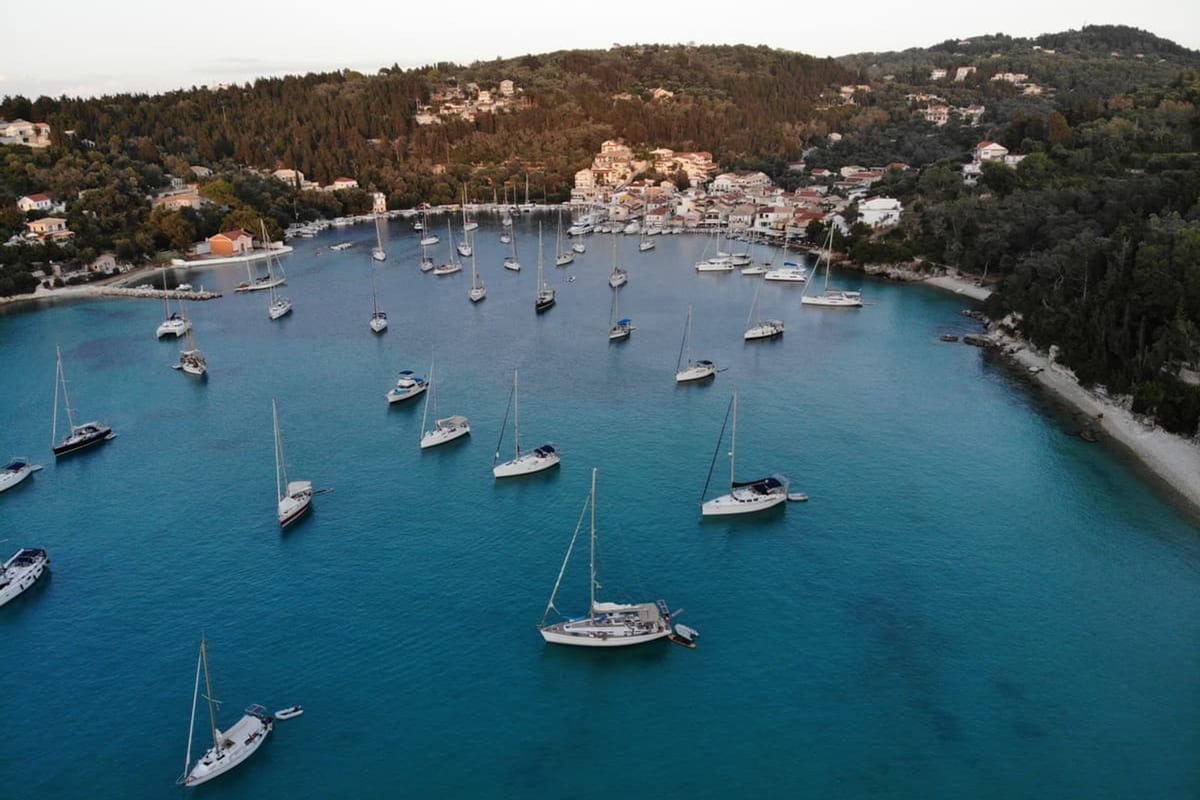
A Paxos Antipaxos cruise sails from Corfu or Parga to the two small Ionian islands south of Corfu, with their sea caves, harbours and clear bays. This post covers what a Paxos Antipaxos cruise includes, the departure ports, the caves, Gaios, Lakka and Loggos, Antipaxos, the history, the boats and the best season. It is one of the best tours in Greece on Greece VIP.
Each section ends with a cruise that can be booked online.
What does a Paxos Antipaxos cruise cover?
A Paxos Antipaxos cruise covers two small Ionian islands just south of Corfu: the sea caves under the white cliffs of the Paxos west coast, the harbour town of Gaios, and the sand and pebble beaches of Antipaxos, the smaller island to the south.
Paxos sits in the Ionian Sea, a short way south of Corfu. With its neighbour Antipaxos and the islets close to both, it also goes by the plural name Paxi or Paxoi. Of the seven main Ionian Islands, known together as the Heptanese, Paxos is the smallest, at 25.3 square kilometres. Both islands belong to the municipality of Paxoi, and a Paxos Antipaxos cruise visits each of them in one trip.
The island runs about 10 kilometres from northwest to southeast and measures up to 3 kilometres across. Olive groves cover much of its hilly ground, from Lakka in the north to Gaios. The two coasts differ: the east coast holds the main settlements, while the west coast is a line of steep cliffs cut by sea caves. The caves on a Paxos Antipaxos cruise all lie along that western shore.
Gaios, the main town of Paxos, also serves as the seat of the municipality. The island’s ferry lines end at Gaios, and sea-taxis cross from its port to Antipaxos. As a result, the town sits at the centre of sea travel around the two islands. A Paxos Antipaxos cruise treats Gaios as the link between Paxos and Antipaxos and as its main stop on land.
Antipaxos is the smaller island of the pair and lies just south of Paxos, with an area of 5 square kilometres. Vineyards cover much of its land. It has one harbour, Agrapidia, and three main beaches. Vrika has white sand, while Mesovrika and Voutoumi have pebbles. A Paxos Antipaxos cruise reaches these beaches by sea, the same way as the sea-taxis from Gaios.
- Paxos: The island is the smallest of the seven main Ionian Islands, with olive groves across its hills.
- Sea caves: The west coast of Paxos holds the sea caves known as the “blue caves”.
- Gaios: The main town links the ferry lines from Corfu and Igoumenitsa with the sea-taxis to Antipaxos.
- Antipaxos: The smaller island has the sand beach of Vrika and the pebble beaches of Mesovrika and Voutoumi.
Each part of a Paxos Antipaxos cruise shows a different side of the group. The west coast of Paxos brings cliffs and caves, Gaios brings the harbour and the town, and Antipaxos brings vineyards, sand and pebbles. Corfu’s regional unit stretches south to take in the Paxoi, so both islands belong to it, even though open sea separates them from Corfu itself.


Where does a Paxos Antipaxos cruise start?
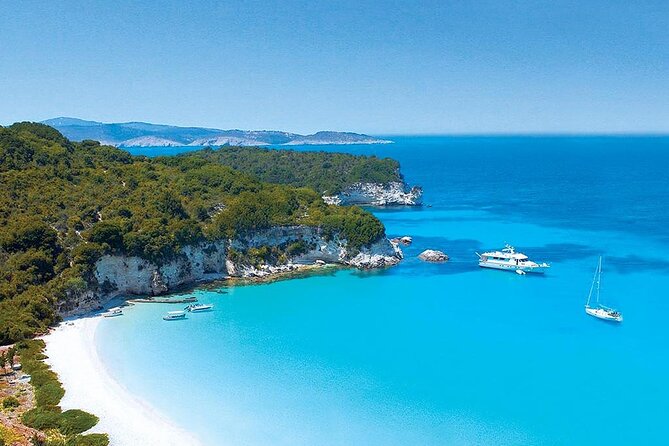
A Paxos Antipaxos cruise starts on Corfu or on the mainland. On Corfu, the trip leaves from Corfu town or from the south of the island, the part closest to Paxos. On the mainland, it leaves from Parga, about as far from Paxos as southern Corfu.
Corfu town is the capital and largest city of the regional unit of Corfu. Two castles enclose it, and the Greek government has declared it a kastropolis, or castle city. Ferries sail from Corfu to Gaios on Paxos, and in the tourist season hydrofoils, passenger ferries and sea-taxis join them. A Paxos Antipaxos cruise from Corfu town follows a sea route that these boats already serve.
Corfu town has two harbours. The road from Neo Limani, the New Port, into the city passes the fish market under the walls of the New Fortress, which the British built during their rule of the island. The old Venetian citadel sits at the tip of a peninsula, and the seawater moat that cuts it off, the Contrafossa, now serves as a marina.
The south of Corfu is the closest part of the island to Paxos, which lies about 15 km from its southern tip. This end of Corfu is low-lying, unlike the mountainous north. Lefkimmi stands at the southern tip, and its small port on Cape Kavos runs a ferry service to the mainland. The southern resort of Kavos also has tourist facilities, and buses link Corfu town with Lefkimmi. A Paxos Antipaxos cruise from the south therefore faces a shorter crossing.
Parga is a resort town in Epirus, set on the mainland’s Ionian shore between Igoumenitsa and Preveza. The town is built like an amphitheatre below a hilltop castle and carries the name “Bride of Epirus”. Its port already handles small boats, which link it with Sarakiniko beach, about 12 km from the town centre. In summer, tourists reach Parga by boat from Paxos, Antipaxos and Corfu, so a Paxos Antipaxos cruise from Parga runs the same sea link in reverse.
- Corfu town: The capital has ferries to Gaios, a New Port and a marina in the old Venetian moat.
- South Corfu: The southern tip lies about 15 km from Paxos, with the small port of Lefkimmi on Cape Kavos.
- Parga: The mainland resort lies about as far from Paxos as southern Corfu and receives boats from Paxos, Antipaxos and Corfu in summer.
- Airports: Corfu airport lies about three kilometres south of the city, while Parga draws on the Aktio, Ioannina and Corfu airports.
The choice of port for a Paxos Antipaxos cruise follows the place of stay. Corfu town suits visitors based in the capital. The south of Corfu suits those staying around Kavos and Lefkimmi. Parga suits visitors on the mainland, where suburban buses link the town with Igoumenitsa and Preveza. Whichever port a visitor picks, the boat ends up at the same two islands.
Which sea caves does a Paxos Antipaxos cruise visit?
A Paxos Antipaxos cruise visits the sea caves on the west coast of Paxos, known as the “blue caves”. Steep white, chalky cliffs line that shore, and the sea has worn them away at the waterline, which has opened the caves.
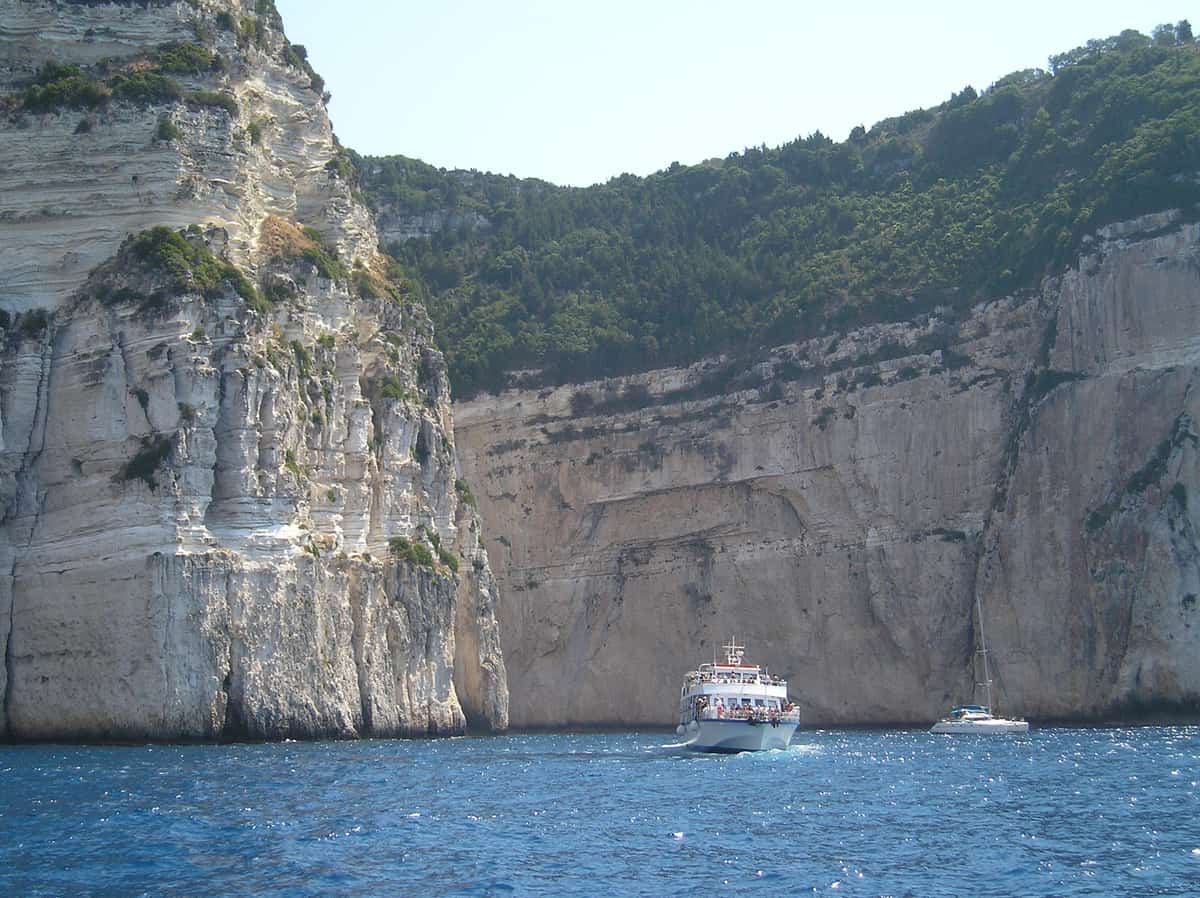
Along the west coast of Paxos, steep white cliffs rise from the sea. The caves open in a band of worn rock at the waterline, where the waves strike the base of the cliffs. Gaios, Lakka and Longos, the three main settlements, all lie on the east coast, so the caves line a stretch of shore with no main town. A Paxos Antipaxos cruise therefore sees them from the water rather than from land.
Sea caves are the work of waves, and erosion does the cutting. Every rocky coast wears down under the surf, but a cliff with a zone of weakness loses rock faster along that zone. Such a zone can be a fault, a split between layers of rock, or a contact between a hard layer and a softer one. As the sea reaches into these lines, it opens them into cracks and then into caves.
Inside a crack, the surf hits hard in a tight space. It drives sand and loose stones against the walls and squeezes the trapped air, which expands again as the wave falls back, so the crack grows wider and deeper. Partly flooded caves can blow out spray as waves retreat; these are blowholes. The large majority of sea caves consist of one passage or one chamber. On a Paxos Antipaxos cruise, the worn foot of the west-coast cliffs shows where this process is at work.
- Location: The caves sit on the west coast of Paxos, away from the three main settlements.
- Cliffs: Steep white, chalky cliffs rise above the caves and show heavy erosion at sea level.
- Formation: Waves cut sea caves by widening weak zones in the rock through erosion.
- Rainwater: Acids that rainwater draws from the soil can weaken the rock inside cracks.
Sea caves form on coasts across the world, and the Greek islands are known for the wide variety of their caves. On Paxos, the line of chalky cliffs along the west coast holds the island’s share of them. For a Paxos Antipaxos cruise, these caves form the main sight on the Paxos side of the trip, while Gaios supplies the harbour town and Antipaxos the beaches.
What does a Paxos Antipaxos cruise see in Gaios?
A Paxos Antipaxos cruise sees Gaios, the main town and main port of Paxos, on the east coast of the island. Two islets, Agios Nikolaos and Panagia, shelter its harbour, and rows of houses face the strait between the town and the islets.
Gaios is the seat of the municipality of Paxoi and the largest of the island’s settlements, ahead of Lakka and Longos. The Gaios community counted 1,396 residents in 2021. Ferry lines connect the port with Corfu and Igoumenitsa, so a Paxos Antipaxos cruise finds the island’s main ferry port, its seat of local government and its largest community in one place.
Two islets lie just off the town. The strait in front of Gaios wraps around Agios Nikolaos, also called St Nicolas islet. Panagia lies to the north and holds a monastery that shares its name. Together the two islets protect the harbour of Gaios. A Paxos Antipaxos cruise enters this strait to reach the quay, with the port and the main settlement spread along its centre and south.
From the deck, passengers see rows of houses facing the water as the boat moves through the strait. Ashore, Gaios has narrow streets and a town square, and both suit a walk before the next leg of the Paxos Antipaxos cruise. The town carries the name of a pupil of Paul the Apostle, also called Gaios, who brought Christianity to the island.
The harbour front also records a change in island life. Olive oil production, soap making and fishing once carried the local economy. In the mid-1960s tourism replaced them as the main industry, and a construction boom followed. That boom greatly altered the coastline around Gaios, the capital of the Paxiot community. Olive groves still cover much of the hilly land and run north from Gaios through Magazia to Lakka.
- Harbour: Gaios is the main port of Paxos and faces a strait sheltered by two islets.
- Agios Nikolaos: The strait in front of the town curves around this islet, also named St Nicolas islet.
- Panagia: The northern islet holds a monastery of the same name and helps protect the port.
- Town centre: Gaios offers narrow streets and a town square for a walk ashore.
A stop in Gaios gives a Paxos Antipaxos cruise its town visit. The approach through the strait shows the two islets and the rows of houses, and ashore the town offers narrow streets and a square. The same port sends sea-taxis south to Antipaxos, so Gaios ties together both islands named in the trip.
Which Paxos villages does a Paxos Antipaxos cruise reach?
A Paxos Antipaxos cruise reaches Lakka and Longos, the second and third largest settlements of Paxos after Gaios. Lakka sits on an almost round bay at the northern end of the island, while Longos keeps a small fishing harbour on the northeast coast.
Paxos has three main settlements, and all three stand on the east coast: Gaios, Lakka and Longos. Scattered hamlets fill the hilly interior of the island. A Paxos Antipaxos cruise that heads north from Gaios meets the two other harbour villages on the same coast, Longos first and Lakka at the northern end. Longos also appears as Loggos; the Greek name is Λογγός.
Lakka is the harbour village at the northern end of Paxos. It is a fishing village built around a natural, almost circular harbour. Two headlands close the bay and shelter it from the open sea, so a Paxos Antipaxos cruise enters a protected bay. Silver-green olive groves and cypress trees frame the village. Lakka draws visitors for yachting, windsurfing, snorkelling and swimming.
Two main beaches lie inside the bay: Kanoni, with white pebbles, and Harami, with sand. Both lead into a very clear turquoise sea. Just outside the bay, on the east coast, sit Monadendri, Orkos, Arkoudaki and Glyfada. Walkers and boats reach these beaches, while Monadendri alone also has car access and draws crowds. A Paxos Antipaxos cruise uses the sea route, one of the two ways in.
Longos is the smallest port on Paxoi. It lies on the northeast coast around a small fishing harbour with shops and bars. At one end of the harbour stands the tall chimney of an abandoned soap factory, a trace of the soap making that once supported the island. Shingle beaches lie close by. The Longos community also covers the villages of Anemogiannatika, Dendiatika, Kagkatika, Kontogiannatika and Koutsi.
- Lakka bay: Two headlands enclose this almost circular harbour at the northern end of Paxos.
- Kanoni and Harami: The two main beaches inside the bay offer white pebbles and sand.
- Longos harbour: The smallest port on the island combines a fishing harbour with shops and bars.
- Paxos Festival: The annual music festival, founded by John Gough and now run by the Guildhall School of Music and Drama in London, uses the disused school of Longos as its usual venue.
Lakka and Longos add two village harbours to a Paxos Antipaxos cruise beyond the main town. Lakka brings a protected round bay, clear water and a choice of beaches inside and outside the bay. Longos brings a small fishing port, its old soap factory chimney and shingle beaches nearby. Together with Gaios, the two villages complete the three main settlements of the east coast.
What does a Paxos Antipaxos cruise see on Antipaxos?
A Paxos Antipaxos cruise sees Antipaxos, a 5 square kilometre island about 3 kilometres south of Paxos. Vineyards cover much of its land, its three main beaches are Vrika, Mesovrika and Voutoumi, and the 2021 count recorded only 21 residents.
Antipaxos (Greek: Αντίπαξος) is the smaller of the two islands named in the cruise, at 5 square kilometres against 25.3 for Paxos. With Paxos and the nearby islets it forms the group known as Paxi or Paxoi. It belongs to the municipality of Paxoi in the Corfu regional unit of western Greece, the same local government seated in Gaios. A Paxos Antipaxos cruise visits both of its main islands.
The route south from Gaios passes Mongonisi and Kaltsonisi, two islets off the southeastern tip of Paxos, and Antipaxos lies beyond them. Sea-taxis make the crossing from the port of Gaios in a 15-minute ride, and a Paxos Antipaxos cruise covers the same stretch of sea on its way to the beaches. Antipaxos itself has one harbour, named Agrapidia, alongside its beaches.
The island has a string of beaches, and three of them stand out as the main ones. Vrika has white sand, while Mesovrika and Voutoumi are pebble beaches. A Paxos Antipaxos cruise stops off this shore so passengers can swim from the boat or go ashore. Water shoes help on the pebbles of Mesovrika and Voutoumi, while Vrika suits swimmers who prefer sand underfoot.
Vineyards cover much of Antipaxos. The island is home to a very small community: its resident population stood at 21 in 2021, against 2,466 people in the whole municipality of Paxoi, which also takes in Paxos. Published studies of its reptiles are scarce. Surveys of Paxos and Antipaxos confirmed five reptile species, among them Hemidactylus turcicus and Zamenis longissimus, and no amphibians have been reported on the islands.
- Vrika: The white sand beach of Vrika is one of the three main beaches of Antipaxos.
- Mesovrika: Mesovrika is a pebble beach and another of the three main beaches.
- Voutoumi: Voutoumi is a pebble beach that completes the trio of main beaches.
- Agrapidia: Agrapidia is the only harbour on the island.
- Vineyards: Vines cover much of the land on Antipaxos.
On a Paxos Antipaxos cruise, Antipaxos is the island of beaches and vines. White sand at Vrika, pebbles at Mesovrika and Voutoumi and vineyards across the land define its shore and interior. With 21 residents and a single harbour at Agrapidia, Antipaxos stays tied to Paxos through the sea-taxis that run from Gaios.
What is the history behind a Paxos Antipaxos cruise?
A Paxos Antipaxos cruise visits islands with a long recorded past. Greek myth says Poseidon formed Paxos with a strike of his trident. Romans, Crusaders, Venetians and the British later held the island before it passed to Greece in 1864.
Greek myth explains how Paxos was formed. Poseidon struck Corfu with his trident, and the blow created Paxos. In the myth, he wanted a calm retreat for himself and his wife Amphitrite. The sea around the islands has its own myth. Ancient Greeks called the water between Epirus and Italy Ionios, after Io, who swam across it. Every Paxos Antipaxos cruise sails on that sea.
People have lived on Paxos since prehistoric times. Tradition names the Phoenicians as the first settlers. One belief traces the name to Pax, a Phoenician word for trapezoidal. In 229 BC, in the First Illyrian War, Greek and Illyrian fleets fought the Battle of Paxos. Rule then passed to the Romans in the 2nd century BC, to pirates in Byzantine and medieval times, and to Crusaders.
Venice gained control of Paxos at the end of the 14th century. Centuries of Venetian rule kept the Ionian Islands outside Ottoman control and gave them a culture with Italian influences. No other part of the Greek-speaking world escaped Ottoman rule in this way. Government business ran in Venetian. In August 1571, after seizing Parga and Mourtos on the mainland, Ottoman forces attacked the Paxi islands and then landed on Corfu.
The Napoleonic Wars brought French and Russo-Turkish occupation to the Ionian Islands. Paxos gave itself up to HMS Apollo, a Royal Navy frigate, and 160 troops on 13 February 1814. British protection began in 1815 under a new state, the United States of the Ionian Islands. Under the British, communications improved, and modern schooling and courts arrived. In 1864 Paxos and the other Ionian Islands passed to Greece after the coronation of King George, who came from Denmark.
- Written record: The historian Polybius described the Battle of Paxos in The Histories.
- End of Venice: Venetian rule over the islands ended in 1797, when Napoleon conquered Venice.
- Brief self-rule: The Septinsular Republic of 1800–1807 gave Greeks limited self-government for the first time since 1453.
- British customs: Islanders under British protection took up afternoon tea and cricket.
Tourism replaced olive oil, soap making and fishing as the main industry of Paxos in the mid-1960s. Today a Paxos Antipaxos cruise links these layers in a single trip, from the myth of Poseidon to the surrender to HMS Apollo. Visitors who want this background on a Paxos Antipaxos cruise can ask the tour leader to tie each stop to a period of rule.
Which boats run a Paxos Antipaxos cruise?
A Paxos Antipaxos cruise runs on large cruise boats, small boats, speedboats or private charters. Each format trades space, speed and freedom in a different way. Scheduled ferries also link Gaios, the main port of Paxos, with Corfu and Igoumenitsa.
Large cruise boats carry the biggest groups. They give more deck space, more seats and more shade than smaller craft. A bigger hull also rides waves with less motion, which helps passengers who feel seasick. On this kind of Paxos Antipaxos cruise, the boat keeps to a set route and set stops. The trade-off is less freedom. A large boat stays clear of tight coves and narrow cave mouths.
Small boats carry smaller groups and run closer to the shore. They reach coves and cave mouths that a large boat passes by. Stops are less crowded, and swimmers get into the water faster. Speedboats cut the time spent in open water, which leaves more time at each stop. On a speedboat Paxos Antipaxos cruise, the ride feels bumpier in a rough sea. Passengers with back or neck trouble do better on a larger boat.
A private charter puts one group on its own boat with its own skipper. The group agrees the route, the stops and the pace before departure. Plans can change on the day, for example to stay longer at a quiet cove or to skip a crowded one. A private Paxos Antipaxos cruise also lets the group pick a speedboat, a motor yacht or a sailing boat. Groups with special needs, such as mobility limits, can ask about boarding steps and shade in advance.
- All-year ferry: Combined passenger and vehicle ferries sail from Igoumenitsa to Paxos all year.
- Seasonal Corfu link: Hydrofoils, passenger ferries and sea-taxis run from Corfu in the tourist season.
- Antipaxos access: Sea-taxis cross to Antipaxos from the port of Gaios.
- Parga arrivals: In summer, tourists reach Parga by boat from Paxos, Antipaxos and Corfu.
The choice of boat shapes the whole day. Visitors who want shade and a calm ride pick a large boat. Visitors who want swimming stops and quiet coves pick a small boat or a private charter. A speedboat suits a Paxos Antipaxos cruise with tight timing. Before booking any Paxos Antipaxos cruise, it helps to check the size of the boat, the number of passengers and the plan for bad weather.
When is the best season for a Paxos Antipaxos cruise?
A Paxos Antipaxos cruise fits best between June and September. In those months, the average high at Loggos on Paxos stays above 27 °C. Summer brings the least rain of the year, while winter brings heavy rain and thinner boat links.
Paxos and the other Ionian Islands have a Mediterranean climate. In summer, sunny and dry days are the norm. Rain comes as showers or thunderstorms, days are hot, and nights stay warm. Winters are wet, and winter rain tends to persist. West of the Pindus range, the climate is wetter than in the east. Corfu, just north of Paxos, has hot, dry summers and winters with far more rain than other Greek islands.
At Loggos on Paxos, the average high reaches 28.2 °C in June. July averages 31.1 °C, and August peaks at 31.4 °C. Rainfall drops to 7 mm in July and 18 mm in August. At the Corfu weather station, July has 3.3 rain days and 364.5 hours of sunshine on average. These numbers make high summer the driest window for a Paxos Antipaxos cruise.
The etesian winds, also known as meltemia, reach their peak frequency in July and August. They keep the Aegean Sea cooler than the Ionian Sea. Air over the Ionian side therefore stays warmer in high summer. Heatwaves do reach Greece, but on the coast the cooler sea and the sea breeze soften them. On a summer Paxos Antipaxos cruise, shade on deck, sun cream and water matter more than a jacket.
After summer, days cool and rain returns. At Loggos, September still averages a high of 27.6 °C, but rainfall climbs to 75 mm. October has an average high of 23.2 °C and 148 mm of rain. November and December are the wettest months, at 181 mm and 180 mm. In January the average high falls to 13.9 °C. Outside the tourist season, the hydrofoil to Paxos runs infrequently and depends on the weather. Winter visitors can face spells of isolation.
- Spring: April averages a high of 19.0 °C and 62 mm of rain at Loggos.
- Summer: Corfu averages 324.2 hours of sunshine in June and 332.8 in August.
- Autumn: Rain days at Corfu rise from 7.4 in September to 14.7 in November.
- Winter: The January low at Loggos averages 5.2 °C, and Corfu logs 16.5 rain days in December.
June to August brings the warmest air and the least rain at Loggos, and September stays warm but wetter. April and October offer milder days. Outside summer, a Paxos Antipaxos cruise depends on the sea state on the day. Visitors who plan a Paxos Antipaxos cruise in spring or autumn can keep a spare day in case boats stay in port.
Which Corfu sights combine with a Paxos Antipaxos cruise?
A Paxos Antipaxos cruise from Corfu pairs well with three sights on the main island: the Old Town of Corfu city, a UNESCO World Heritage Site; the Achilleion palace at Gastouri; and the bay of Paleokastritsa, with its cliffs, on the northwest coast.
Corfu city stands on the broad part of a peninsula, and its Old Town entered the UNESCO World Heritage List in 2007. Venice held Corfu from 1386 to 1797, and that period still shapes the old quarter, with multi-storey houses packed along narrow lanes. These cobbled lanes carry the local name kantounia, and parts of them are too narrow for cars. A walk here suits the evening after a Paxos Antipaxos cruise that starts and ends in Corfu city.
The centre of the Old Town is the Spianada, a large square split by a street into upper and lower parts. No square in South-Eastern Europe is bigger. The lower part hosts cricket matches, a sport brought in under British rule that has a following on Corfu and nowhere else in Greece. The Liston arcade, lined with restaurants and bistros, runs along its west side. The Old Fortress rises on a man-made islet, and a sea-filled moat named the Contrafossa, now a marina, separates it from the town.
The Achilleion stands at Gastouri, a village about ten kilometres south of Corfu city. Empress Elisabeth of Austria ordered the palace as a summer retreat after the death of her only son, Crown Prince Rudolf, in 1889. Italian architect Raffaele Caritto designed it in the Pompeian style, with Achilles as its theme. The centrepiece of the gardens is Dying Achilles, a statue by the German sculptor Ernst Herter. Kaiser Wilhelm II bought the palace in 1907 and added a bronze Achilles that looks north to the city.
Paleokastritsa, also spelled Palaiokastritsa, is a village on the northwest coast of Corfu, with tall cliffs and beaches close by. The name translates as Old Little Castle, a nod to Angelokastro, a Byzantine castle 305 metres up on a steep cliff above the sea. No attacker ever took that castle, even during three Ottoman sieges of Corfu. The village monastery dates from 1225 and holds a museum. The bay has been suggested as the place where Odysseus came ashore and first met Nausicaa.
- Old Town: Just north of the lower Spianada stands the Palace of St. Michael and St. George, built in 1815 of white Maltese stone.
- Achilleion: The EO25 national road heads south from Corfu city toward the palace, and city buses also run there.
- Paleokastritsa: The EO24 national road heads west from Corfu city toward the village, and island buses link the two.
- Cruise days: A Paxos Antipaxos cruise on one day and a sight on the next keep each day at an easy pace.
Travelers who stay in Corfu city reach all three sights by road. The Old Town lies on the doorstep, the Achilleion stands on a hill to the south, and Paleokastritsa sits on the west coast. A plan that sets the Paxos Antipaxos cruise in the middle of the stay leaves a buffer day if wind delays the boat. The Old Town, with its cafes and short walks, makes an easy rest day after a Paxos Antipaxos cruise.
How do families plan a Paxos Antipaxos cruise?
A Paxos Antipaxos cruise suits families who plan for three things: shade on deck, safe swim stops for children and the sea forecast for the day. Child-size life jackets, water, hats and a spare day in the holiday plan cover the rest.
Shade comes first on a summer day at sea. Corfu has hot, dry summers, and in Corfu city the daytime heat reaches 33 °C, with high humidity. Before booking, families can ask whether the boat has a covered deck or a canopy over the seats. Young children can rest in the shade between swims and stay in it through the hottest hours around midday. A Paxos Antipaxos cruise with a shaded deck keeps toddlers and grandparents comfortable alike.
Antipaxos, the small island to the south of Paxos, has three main beaches. On Antipaxos, Vrika is a sandy beach, and Mesovrika and Voutoumi have pebbles. Sand suits toddlers who like to dig and paddle at the water’s edge, and water shoes help on pebbles. For swim stops in deeper water, families can check that the boat carries child-size life jackets and a swim ladder. One adult in the water beside each young swimmer keeps every stop on a Paxos Antipaxos cruise calm.
Sea conditions shape the day. Paxos sits about 15 kilometres off the southern tip of Corfu, and the crossing runs through open water. Outside the tourist season, even the hydrofoil service to Paxos is weather dependent. Families can read the marine forecast the evening before and keep one spare day free in case the boat stays in port. Children who feel seasick can sit on the open deck and look at the horizon rather than stay inside the cabin.
Wildlife gives children a reason to watch the water. Common bottlenose dolphins, striped dolphins and Risso’s dolphins are among the cetaceans present in the sea around Corfu, and monk seals turn up now and then. On the island’s sandy beaches, loggerhead sea turtles lay their eggs. Sightings are never certain, so parents can treat them as a bonus, not a promise. Children can also learn to keep a distance from turtle nests and from any animal in the water.
- Sun kit: Hats, high-factor sun cream and light long-sleeved tops protect young skin on an open deck.
- Swim kit: Swimwear, masks and water shoes for each child cover sand, pebbles and deeper water.
- Food and water: A cool bag with water, fruit and snacks keeps young travelers fed between stops.
- Dry kit: A towel and a dry set of clothes for each child make the ride back after a Paxos Antipaxos cruise more comfortable.
With shade, water and swim gear on board, a Paxos Antipaxos cruise works for toddlers and older children alike. Parents of babies can ask before booking about cabin space, a toilet on board and a quiet corner for naps. A calm sea, a sandy beach such as Vrika and short swims close to the boat keep the day relaxed for every age.
What do travelers ask about a Paxos Antipaxos cruise?
A Paxos Antipaxos cruise raises four common questions: whether the day includes swim stops, whether boats can start from Parga, whether the trip fits a first visit to Corfu, and whether a private boat is worth the choice over a shared one.
Does a Paxos Antipaxos cruise include swim stops?
Swim stops depend on the boat, the route and the sea, so travelers can confirm the plan before booking. On Paxos, the beach of Mongonissi lies near the southern tip of the island, close to the islets of Mongonisi and Kaltsonisi. Non-swimmers can stay on deck or paddle at the shore when the boat stops at a beach.
Can a Paxos Antipaxos cruise start from Parga?
Yes. Parga is a resort town on the Ionian coast of Epirus, between Preveza and Igoumenitsa, and Paxos lies about 15 kilometres away. In summer, boats bring visitors to Parga from Paxos, Antipaxos and Corfu. A day in Parga can add its Venetian castle, which stands on a hill above the town.
Does a Paxos Antipaxos cruise suit a first visit to Corfu?
Yes. The Corfu regional unit reaches as far south as the Paxoi, the group of Paxos and Antipaxos, so the trip never leaves it. Ioannis Kapodistrias International Airport lies about three kilometres south of Corfu city. A first stay in the city keeps the airport, the port and the Old Town close together.
Is a private Paxos Antipaxos cruise worth it?
It depends on the group. A private boat lets one family or group set the pace, pick the swim stops and stay longer at a favourite bay. A shared boat suits couples and solo travelers who enjoy company on board. For groups with toddlers, older relatives or a celebration to mark, the private option brings the greater benefit.
Featured photo: Mathias Fege, Korfu, CC BY-SA 4.0, via Wikimedia Commons.