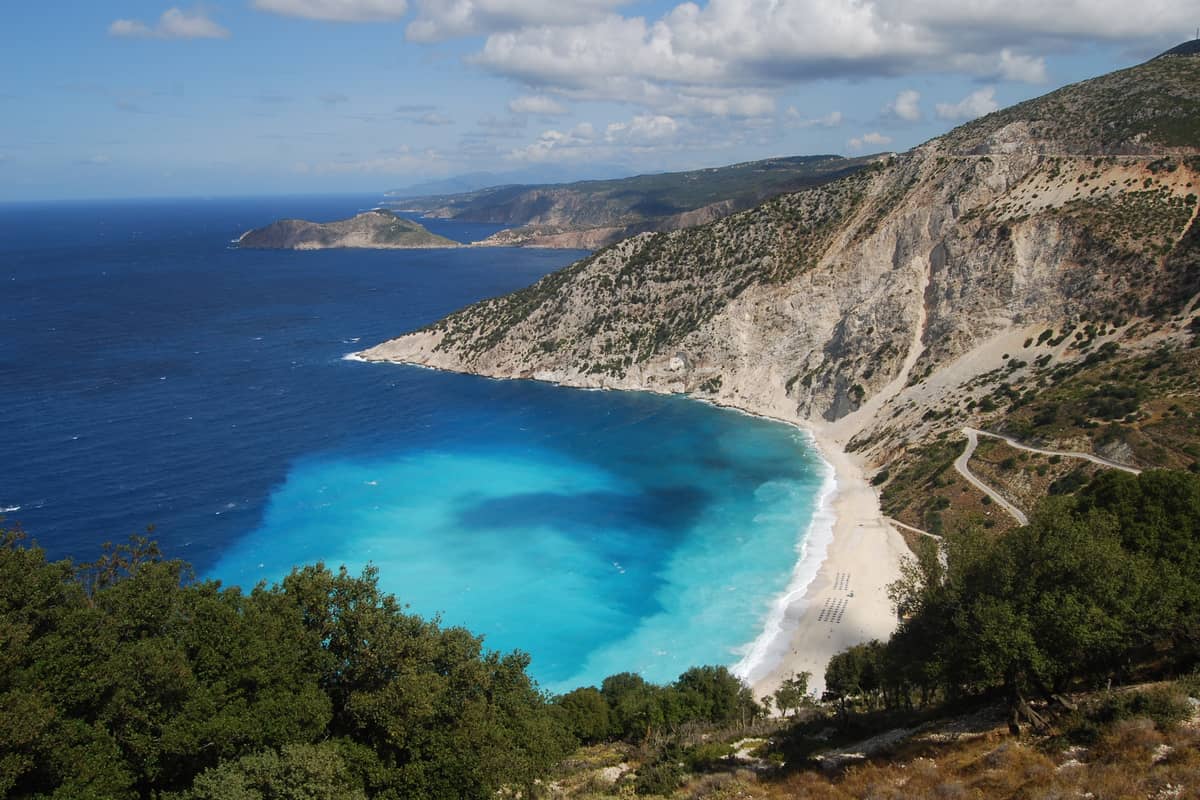
A Kefalonia food tour tastes the dishes, sweets, cheese, honey and olive oil of the Ionian island of Kefalonia, from Argostoli to the hill villages. It is one of the Greece tours on Greece VIP.
This post covers what a Kefalonia food tour includes, the local dishes and the sweets. It also covers the cheeses, the honey and the olive oils. Food history, the best season and common questions come last.
Each section ends with a Kefalonia food tour or a nearby tour that can be booked online.
What does a Kefalonia food tour include?
A Kefalonia food tour mixes Argostoli walks, village visits, farm stops and tavern meals. Walkers taste dishes, produce and homemade treats at family-run spots. Summer village festivals add meat pie nights. Meals end with fruit preserves and mandoles.
A Kefalonia food tour on foot meets at a square on Kosmas Etolos street, facing the municipal market. The municipality leases its stalls, Argostoli residents first.
Unlike boat tours around Kefalonia, a bike tasting route stays in Argostoli. It starts at a traditional bakery with Greek coffee and Kefalonian baked goods.
The same ride stops at a family pastry shop in Kampana Square for a pastry-making demonstration. Riders taste seasonal vegetables at a farmers’ market.
In Kourouklata, a local cook teaches riganada in the village’s oldest taverna. Organic farm visits add fruit jams, mandola tastings and live food demonstrations.
The village of Tzannata holds a meat pie festival every August, rooted in poor farm cooking.
At Agia Thekli, village women bake the pies for a summer kreatopita night.
- Bakeries: Village bakeries sell Kefalonian meat pie.
- Waterfront: One Argostoli walk serves appetisers by the water.
- Brewery: A local brewery offers tastings by appointment.
One Kefalonia food tour ends at an old family ice-cream workshop.


Which dishes does a Kefalonia food tour taste?
A Kefalonia food tour tastes tall pies of meat, salt cod or octopus. Riganada soaks sourdough in tomato juice and tops it with Kefalonia feta. Local aliada is spicy and built on potato. Chicken bakes slowly under a clay cover called a tserepa.
Farm families once filled the meat pie with goat, pork, mutton and rarely beef. Potato thickened the filling, and cinnamon became its key spice.
Lixouri cooks add plums, and northern villages flavour the pie with marjoram. Kefalonians serve it on Ascension Day and at Carnival and wedding tables.
Bakaliaropita starts with salt cod soaked for 24 hours in changing water. It suits the Palm Sunday table, and the pastry edges twist inward.
A Kefalonia food tour also tastes octopus pie with chopped octopus, grated tomato, rice and marjoram. Its hand-rolled dough mixes flour and olive oil.
- Aliada: Its name comes from Italian agliata.
- Tserepa: Cooks seal its rim with ash and embers.
- Riganada: Drops of vinegar dress the bread.
Tserepa chicken cooks with oregano, garlic, potatoes and tomatoes.
Which sweets does a Kefalonia food tour try?
A Kefalonia food tour tries mandoles, sugared almonds whose red colour comes from seaweed. Pastokydono is a quince paste mixed with almonds. Amygdalopita is a syrup-soaked almond pie. Kefalonian mandolato adds egg whites, beaten into a meringue, to its almonds.
Mandoles trace their roots to Venetian rule and are cooked in a copper cauldron. Traditional ones are pink, while a honey version turns brown.
Pastokydono uses wild quince from the Paliki peninsula, picked from early November. Cooks peel the fruit by hand, crush it and boil it with sugar.
Kefalonian amygdalopita uses unpeeled, finely chopped almonds and rusk crumbs. Its syrup boils with cinnamon and cloves, and summer servings add vanilla ice cream.
A Kefalonia food tour finds mandolato, once a treat for aristocrats under Venetian rule. Kefalonian pastry shops sell this white, hard sweet in slabs.
- Coffee: Pastokydono, also called konfeto, suits Greek coffee.
- Ionian: Mandola is found only in the Ionian Islands.
- Galaktompoureko: Island patisseries sell this syrupy sweet too.
Amygdalopita recipes vary by area across the island. Its name means almond pie.
Which cheeses does a Kefalonia food tour taste?
A Kefalonia food tour tastes barrel-aged feta, spicy kefalotyri, mizithra and manouromyzithra. Fourteen island dairies turn local sheep and goat milk into these cheeses. Feta leads at about 4,000 tons a year. Kefalotyri output stays near 50 tons.
The cheese on a Kefalonia food tour comes from 150,000 sheep and goats. Roughly 1,200 farming families supply about 45 tons of milk daily.
The Kefalonia sheep became a separate recorded breed in the 1990s. It numbers about 35,000 animals. Pure-bred flocks live mainly in the island’s north-east.
The protected feta zone leaves out Kefalonia, though the island traditionally makes feta. Cheese on food tours on Zakynthos falls outside it too.
The name finally registered for the island cheese is Kefalonia barrel cheese. Each kilo needs four kilos of milk, while kefalotyri needs 6.5 to 7.
- Kefalotyri: About a third of island dairies make it.
- Manouromyzithra: Dairies make about 10 tons yearly from kefalotyri.
- Mizithra: It uses leftovers from feta production.
Locally, hard feta makes up 90 percent of demand among island buyers.
Which honey does a Kefalonia food tour sample?
A Kefalonia food tour samples Ainos fir honeydew honey and thyme honey made in June and July. About 400 beekeepers make roughly 70 tons of honey a year. Each island hive yields 6 to 10 kilos of it.
The scale insect Physokermes hellenicus feeds on Kefalonian fir and supplies bees with honeydew. Researchers have recorded it on Mount Ainos, Menalon and Panachaiko.
Fir honeydew honey makes up 5 to 10 percent of Greek honey. On a Kefalonia food tour, it shows pearl-amber color and buttery flavor.
Mount Ainos National Park holds the only Kefalonian fir forest in the Ionian Islands. Its core spreads over two separate zones, Ainos and Roudi.
The native Kefalonian bee, a Carniolan type, no longer lives on the island. Local beekeepers also collect pollen and royal jelly from their hives.
- Scale: Half of beekeepers keep 50 to 100 hives.
- Gaps: Ainos honeydew fails about once in five years.
- Protection: The park is a European Biogenetic Reserve.
Greece’s only EU-registered fir honey comes from Menalon in the Peloponnese.
Which olive oils does a Kefalonia food tour try?
A Kefalonia food tour tries oil under the Kefalonia PGI, protected by the EU in 1996. The name covers virgin oil from Koroneiki, Agouromanako and Venetsianiki Ladolia olives. Koroneiki and Theiako lead the groves, ahead of Ntopia and Matolia.
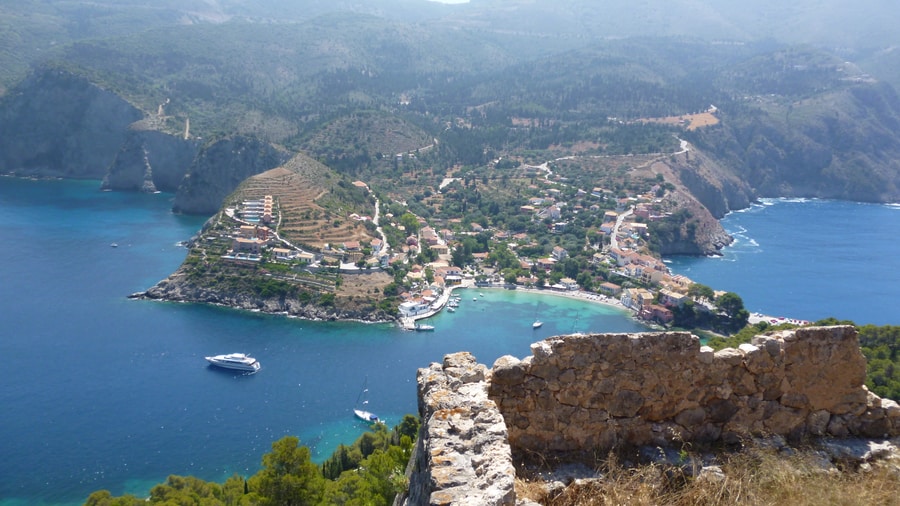
Oil on a Kefalonia food tour can carry a name Greece recognized on 14 January 1994. Kefalonia and Ithaca farm cooperatives applied for EU protection.
PGI rules allow hand or comb picking. Crates or sacks hold 30 to 50 kilos. Up to 5 percent of fruit can show fly damage.
On a Kefalonia food tour, PGI oil comes from olives milled within three days of picking. The paste must stay below 30°C throughout milling.
A 2021 study tested 26 Kefalonian Ntopia oils from 13 old and 13 recent trees. Oil from old trees held 261.5 mg/kg of oleocanthal.
- Recent trees: Their oil held 181.7 mg/kg of oleocanthal.
- Presses: Thirteen work today, against 200 before the 1953 quakes.
- Taste: PGI oil tastes sweet; bitterness fades with time.
Genetically, recent-tree Ntopia grouped with Lefkada’s Asprolia.
What history shaped a Kefalonia food tour?
A Kefalonia food tour meets the tomato, which Venetian rulers first brought to the island. Traditional Kefalonian dishes still carry names that sound Italian, from that long rule. Venetian taste also survives in spice blends and sweet and sour flavours.
Potatoes on a Kefalonia food tour plate date from French rule. The French introduced them to the Ionian Islands about thirty years before 1828.
In 1826, British regent Charles Napier settled about 300 Maltese farmers on Kefalonia. He planned small farms with low rents on Pronos, fertile land owned by monasteries.
The colony chaplain listed fishermen, bricklayers, butchers and shopkeepers among the Maltese settlers. When government support ended, they wandered the island begging for food.
Argostoli has been the island’s capital since 1757. People moved there from the old capital at Kastro to trade from its sheltered bay.
Near Agia Efimia, a Kefalonia food tour finds an olive museum in Makriotika. The village press fell in the 1953 earthquakes and was restored.
Four Israeli warships answered the island’s calls for help after the 1953 earthquakes.
- Isolation: Island isolation kept alive dishes lost elsewhere.
- Quake aid: Israeli navy sailors handed out food and water.
- Emigration: Quake emigrants left for Canada, America, Australia and Britain.
Venetian rule left no mark on island pasta or pizza, unlike its spice blends.
When is the best season for a Kefalonia food tour?
A Kefalonia food tour meets olive picking from late October to early December. Honey production on the island runs from June to September. On the eve of 15 August, village squares host feasts where people eat, drink and dance.
Families spread woven nets under the trees and coax olives down with light rakes. The olives can then reach a local press within hours.
A Kefalonia food tour in August overlaps the last month of Kefalonian fir honey production. Flower honey production on the island continues until September.
On Kefalonia, Clean Monday opens Lent with havara shells brought fresh from Preveza. Tables traditionally add broad beans and flaounes, a flat unfermented bread.
A Kefalonia food tour in Sami on 23 August meets the Panagia Agrillion monastery feast. A service comes first, then food, music and dancing.
- Salt cod: It appears on 25 March and Clean Monday.
- Good Friday: Islanders eat tahinosoupa or bean soup.
- Easter eggs: Locals dye them with shore seaweed.
Sami is a port for day trips to Ithaca. It handled 120,000 sea passengers in the third quarter of 2023.
Sami counted just 19,000 sea passengers in the first quarter of 2023.
What do travelers ask about a Kefalonia food tour?
A Kefalonia food tour in Argostoli walks a long, narrow town on the western side of its gulf. Vallianou Square, its largest square, holds dozens of tavernas, cafés and bars. Taxis leave from that square and from the seafront.
How does a Kefalonia food tour cross from Argostoli to Lixouri?
A Kefalonia food tour reaches Lixouri by car ferry across the Gulf of Argostoli. This gulf is Greece’s fourth largest natural harbour. In Argostoli, the ferry leaves from the far end of the harbour promenade. Passengers buy tickets on board.
How does a Kefalonia food tour get from the airport to Argostoli?
Kefalonia food tour visitors land 2 km west of Svoronata, a village 7 km southeast of Argostoli. Its taxis display fixed fares on a windshield chart.
Where does a Kefalonia food tour find the Argostoli market?
A Kefalonia food tour finds the fish and vegetable market north of the Drapano bridge. It stands on the busy waterfront, beside tavernas. A long promenade lined with palms begins north of it. Argostoli also holds a Saturday market.