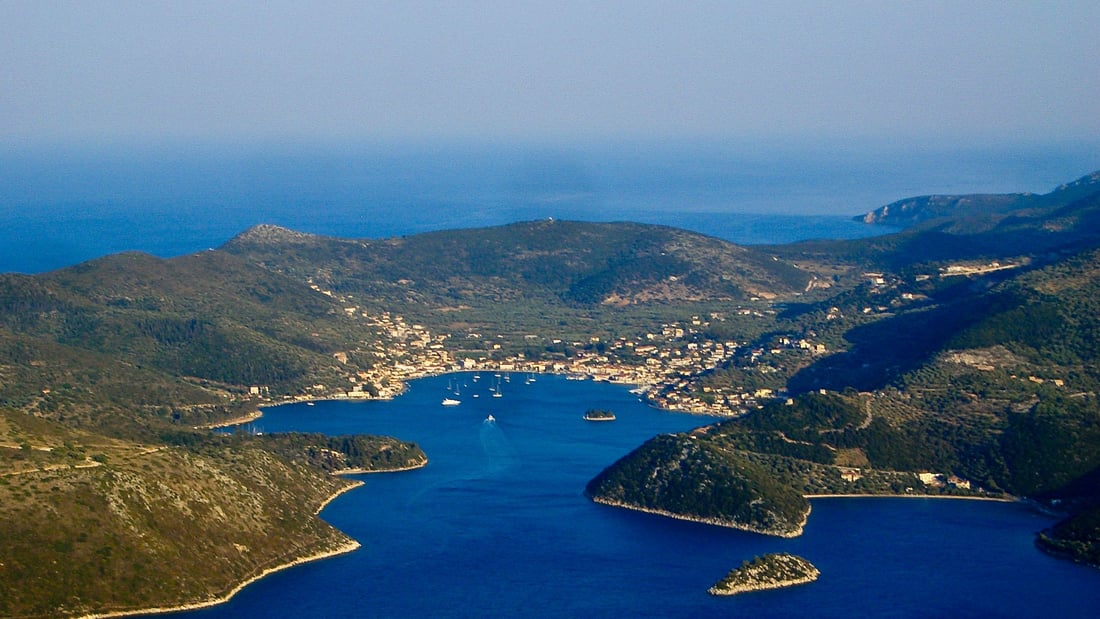
An Ithaca day trip crosses from Kefalonia or Lefkada to the small Ionian island long linked with Odysseus, the hero of Homer’s Odyssey, and drives from the deep bay of Vathy to the villages of the north. This post covers what an Ithaca day trip includes, how it reaches the island, Vathy, the villages, the sites tied to the Odyssey, the monasteries and churches, the beaches and the best season. It is one of the island day trips in Greece on Greece VIP.
Each section ends with an Ithaca day trip that can be booked online.
What does an Ithaca day trip include?
An Ithaca day trip covers the crossing, a drive from south to north, Vathy, the villages, the monasteries, the Homeric sites and a swim in the bays of a mountainous Ionian island, the home of Odysseus in the Odyssey.
Ithaca, also called Ithaki, is a Greek island in the Ionian Sea, off the northeast coast of Kefalonia and west of the mainland. The main island covers 96 square kilometres, and the 2021 count gave 2,862 residents. Only Paxi is smaller among the seven main Ionian Islands. An Ithaca day trip therefore fits a whole island into a single outing.
The island stretches 23 km from south to north and reaches a maximum width of 6 km. Two parts of about equal size make it up, and the narrow isthmus of Aetos, only 600 metres wide, joins them. The parts enclose the bay of Molos. An Ithaca day trip follows this long, thin shape, past rocky slopes with limited arable land.
An Ithaca day trip runs between Vathy in the south and Stavros, the second-largest village, in the north. Nirito, the tallest mountain, rises to 806 metres in the north, and Merovigli reaches 669 metres in the south. Kefalonia, the largest of the Ionian Islands, lies west of Ithaca, and a Kefalonia boat tour sails the coast of that larger neighbour.
- Coast: The regional unit has about 100 kilometres of coastline.
- Bays: Afales lies in the northwest and Sarakiniko in the southeast.
- Name: The Venetians called the island Val di Compare.
Ithaca forms its own regional unit in the Ionian Islands region, with one municipality, called Ithaca. The unit also holds the islets of Atokos, Arkoudi, Oxeia and Drakonera, but Ithaca is the only populated island in the municipality, so an Ithaca day trip lands on the main island of Ithaca.
![Full-Day Discover Ithaka (Ithaca) Bus Tour [from Kefalonia]](https://media.tacdn.com/media/attractions-splice-spp-674x446/0f/7e/06/08.jpg)


How does an Ithaca day trip reach the island?
An Ithaca day trip reaches the island by sea, across the strait between Ithaca and the northeast coast of Kefalonia. Sami and Fiskardo on Kefalonia and Vasiliki on Lefkada have ferries to Ithaca, and Frikes is a port on Ithaca.
Sami lies on the central east coast of Kefalonia and is a major port, with links to Patras and Ithaca. Patras is the capital and largest city of Western Greece, in the northern Peloponnese, 215 km west of Athens. Sami thus joins the mainland and the island. An Ithaca day trip from Sami starts on the east coast of Kefalonia.
Fiskardo stands on the north coast of Kefalonia, 24 km north of Sami and 32 km north of Argostoli. Its ferry routes lead to Frikes on Ithaca and to Lefkada. After 1479 pirates controlled the channel between Kefalonia and Ithaca, and the people who remained hid in the mountains. An Ithaca day trip from Fiskardo now crosses the same water.
Lefkada lies off the west coast of Greece and joins the mainland by a long causeway and a floating bridge. Regular car ferries sail from Lefkada to Kefalonia, Ithaca and Meganisi. Vasiliki, a windsurfing centre 20 km south of Nidri, has ferries to Kefalonia and Ithaca. Travellers from the mainland can therefore drive to Lefkada and sail on to Ithaca.
- Frikes: The port lies in the community of Platreithias.
- Echinades: These islets lie east of Ithaca, near the mainland.
- Patras: The city is the third-largest in Greece.
Each route starts on a different shore: Sami on the east coast of Kefalonia, Fiskardo at its northern end and Vasiliki in the south of Lefkada. Lefkada measures 35 km from north to south, so an Ithaca day trip from Vasiliki starts near the southern end of a long island.
What does an Ithaca day trip see in Vathy?
An Ithaca day trip sees Vathy, the capital and largest settlement, set in a deep natural harbour. The visit also takes in the Lazaretto islet at the harbour entrance, the buildings rebuilt after the 1953 earthquake, and the museums.
Vathy, in the south, has 1,693 residents in the 2021 census. Lazaretto Islet, also called the Island of the Saviour, guards the entrance to the bay. A chapel of the Transfiguration of the Savior, built in 1668, stands there with the remains of an old gaol. Since 1560 the islet served as a quarantine station for ships entering the harbour.
The 1953 Ionian earthquake struck on 12 August with a moment magnitude of 6.8 and killed between 445 and 800 people across the islands. It devastated Vathy and left only a handful of buildings standing. The town was rebuilt gradually in the original Venetian style, and an Ithaca day trip passes through that rebuilt harbour town of Venetian design.
Ithaca has an Archaeological Museum at Vathy. Sylvia Benton, a British archaeologist who dug on Ithaca from 1930, analysed her finds at the Vathy museum for years. They included 12 bronze tripod-lebetes of the 9th and 8th centuries BC and terracottas dedicated to the Nymphs and to Odysseus. After the earthquake she helped restore the museums at Vathy and Stavros.
- Origins: Vathy formed in the 16th century, when families left Palaiochora.
- Dockyard: The yard built over 200 ships in the 19th century.
- Law: A law of 1978 protects the architectural heritage.
Pirate raids in the Middle Ages had forced the islanders to build settlements inland. Wealth from shipbuilding, trade and fishing raised the population to about 5,000 under British rule. In the 1920s naval activity dwindled, and the economy of Vathy stagnated. The French built a fortress on Loutsa hill in 1807.
Which villages does an Ithaca day trip visit?
An Ithaca day trip through the villages links six places on the municipal list: Stavros, Kioni, Frikes, Anogi, Exogi and Perachori. Stavros, Kioni and Frikes lie in the north and northeast, while Exogi marks the island’s western tip.
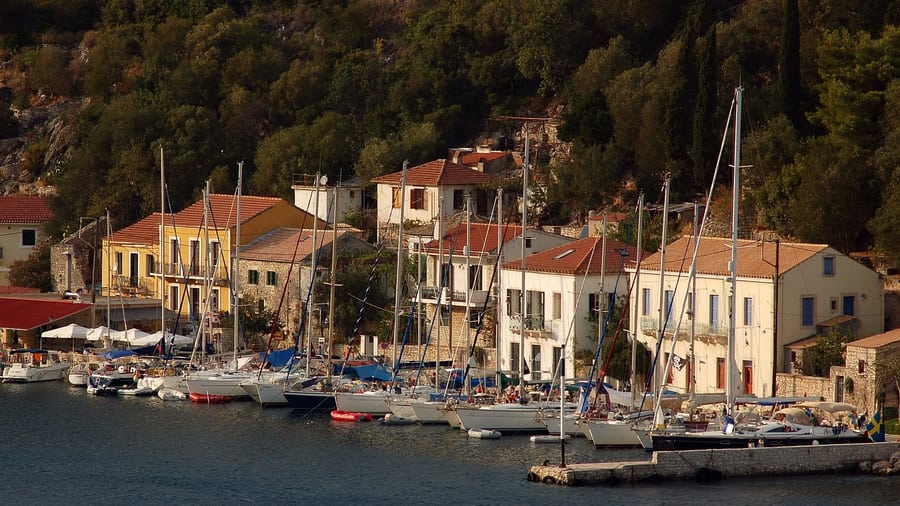
On an Ithaca day trip, Stavros is the village of the northern part of the island, set on the eastern shore of the Strait of Ithaca, which separates the island from Kefalonia. The village had 327 residents in 2021. The British archaeologist Walter Abel Heurtley dug on Ithaca between 1930 and 1932, published his finds and became an honorary citizen of Stavros.
On an Ithaca day trip, Kioni and Frikes lie on the northeast coast, each by its own bay. A road runs west from Kioni Bay to Frikes and the rest of the island. Kioni counts as a traditional settlement, so strict planning rules apply, and the bay has stayed free of major tourist development. Sailing boats make the bay a popular destination.
Anogi is an old village near Mount Neriton. The Galatis family, the only holders of noble privileges under the Tocco family and later the Venetians, lived there into the 20th century. Cape Exogi is the westernmost point of the island and also closes the Strait of Ithaca in the north. Perachori had 368 residents in 2021, against 131 in Kioni.
- Communities: Eight communities make up the municipality of Ithaca.
- Platreithias: Frikes belongs to this community of 221 residents.
- Nirito: The tallest mountain rises 806 metres in the north.
An Ithaca day trip shows two kinds of settlement. Frikes sits by the water. During the Middle Ages, continuous pirate raids forced islanders to settle in the mountains, and Anogi, near Mount Neriton, lies in that upland setting. A branch of the Galatis family later settled at the nearby village of Kioni.
How does an Ithaca day trip follow Homer’s Odyssey?
An Ithaca day trip follows Homer’s Odyssey by visiting the island that tradition names as the home of Odysseus, whose long return and wife Penelope fill the epic. Sites link to the poem, though scholars debate the places.
In the Odyssey, Odysseus is king of Ithaca, and his homecoming after the Trojan War forms the plot. Penelope, the mother of Telemachus, stays faithful while more than a hundred suitors court her. She pretends to weave a burial shroud for his father Laertes and undoes part of it every night for three years, until a slave reveals the trick.
On an Ithaca day trip, the link between poem and island is debated. Homer calls Ithaca low-lying, yet the island is mountainous, and Kefalonia lies to its west. Strabo read the poem as meaning close to the mainland. William Gell placed Homer’s Ithaca on the Aetos isthmus in 1807, and William Leake chose the coast near Polis Bay in 1835.
An Ithaca day trip reaches the Polis Cave near Stavros. Heinrich Schliemann identified it as the cave that Odysseus visited on his return, and book 13 of the Odyssey describes a cave of the nymphs on the island. Worship took place there from the Early Helladic period to Roman times. The swineherd Eumaeus tends pigs beside the fountain of Arethusa.
- School of Homer: Excavators concluded it is a Mycenaean citadel.
- Linear B: Possible inscriptions in this script came from the same site.
- Arethusa: A spring at Pera Pigadi is a speculative match.
The end of the epic belongs to the island. Phaeacian sailors land Odysseus at a hidden harbour. His old dog Argos recognises him. After Penelope sets an archery contest, he shoots through a row of axe heads and proves himself with the bed that he carved from an olive trunk.
Which monasteries and churches does an Ithaca day trip visit?
An Ithaca day trip to the monasteries and churches centres on Saint Joachim, who founded the monastery of Saint Barbara at Stavros, and on the church of the Saviour on Lazaretto Islet.
Saint Joachim of Ithaca was born in 1786 near Polyktoria. At the age of 17, he sailed to Mount Athos and joined the Monastery of Vatopaedi as a novice, and he soon became its steward. In later years he preached around Greece, re-founded monasteries, helped to organise schools and handed out Bibles. People knew him as Papoulakis, meaning little father.
After the Greeks secured the Peloponnese, Joachim retired to Ithaca. He lived as a hermit for five years in the forest of Afentikos Loggos, received visitors and organised relief for the poor. On an Ithaca day trip, the monastery of Saint Barbara at Stavros recalls this period. Beyond the churches that he founded across the island, he founded this monastery.
Joachim died at Vathy in 1867 and left a note requesting burial at Saint Barbara. Great crowds followed his relics across the island to the monastery. The abbot postponed the funeral to disperse them. Accounts claim that miracles took place there at the time and at his tomb ever since. An Ithaca day trip to Stavros reaches his burial place.
- Saviour: Lazaretto Islet also holds the remains of an old gaol.
- Mavronas: Joachim toured the island from Saint Nikolaos Mavronas Monastery.
- Canonisation: He was formally canonised in March 1998.
Saint Raphael of Therme, who died in 1463 and also came from Ithaca, is a patron of the island with Joachim. An Ithaca day trip to the churches follows two local saints. The British governor summoned Joachim over an accusation of sedition, then allowed him to preach wherever he pleased.
Which beaches does an Ithaca day trip stop at?
An Ithaca day trip stops at the bays of a rocky, mountainous island, among them Afales Bay, Frikes Bay, Kioni Bay and Sarakiniko Bay. The regional unit has about 100 kilometres of coastline on the Ionian Sea, west of the mainland.
Ithaca is mountainous and rocky, with limited arable land, so its shore is a string of bays and capes. The main island measures 23 km from north to south. Its two halves, of about equal size, meet at the isthmus of Aetos, which is only 600 metres wide. The halves enclose the bay of Molos, which opens to the east.
Kioni Bay lies on the northeastern shore, east of the village of Kioni. A road links it west to Frikes and the rest of the island. Kioni counts as a traditional settlement, so strict planning rules apply, and the bay has stayed relatively free of major tourist development. Sailing boats favour the bay, and the Nirito mountains dominate the southwest.
The island of Lefkada covers about 302 square kilometres and joins the mainland by a causeway and floating bridge. A Lefkada boat tour reaches Porto Katsiki, a beach on its west coast, while an Ithaca day trip follows the bays of the second-smallest of the seven main Ionian Islands. The Strait of Ithaca divides Ithaca from the northeast coast of Kefalonia.
- Afales Bay: Lies on the northwest side.
- Frikes Bay: Lies in the northeast, west of Kioni.
- Sarakiniko Bay: Lies in the southeast, beside Ormos Gulf.
An Ithaca day trip follows a coast where one name serves both land and water: Sarakiniko is a cape in the east and a bay in the southeast. Exogi is the westernmost cape, Melissa lies in the north and Agiou Andreou in the south. Mavronos and Agios Ilias lie to the east.
When is the best season for an Ithaca day trip?
An Ithaca day trip suits the dry summer months, when the Ionian Islands have sunny weather and a cooler sea moderates the heat. Winters are wet, and the land west of the Pindus range is wetter than the east.
Greece has a predominantly Mediterranean climate, and the Hellenic National Meteorological Service names the Mediterranean Csa type as the predominant climate of the country. The Ionian Islands lie within the areas of that type. Greece holds 11 climate types under the Köppen scheme, the highest number in Europe for its size. Its complex geography adds a wide range of micro-climates.
In summer the weather is frequently sunny and dry. The air is hot in the daytime and pleasantly warm at night. Heatwaves at the coast are quite mild, since a sea breeze and the relatively cooler water temper the heat. An Ithaca day trip in these months meets the hot summers of Kefalonia, which belongs to the same Csa type.
Winters in this climate are wet. Rain in winter is persistent, and snow is short-lived, above all on south-facing slopes. West of the Pindus range, the climate also has maritime features. Homer’s Odyssey describes Neriton, a mountain on Ithaca, as covered with waving forests. An Ithaca day trip in the wet months meets that rain on a mountainous and rocky island.
- Summer rain: Falls as showers or thunderstorms.
- Summer on Kefalonia: Days reach nearly 30 °C, nights around 21 °C.
- Winter on Kefalonia: Days average 14–15 °C, nights 8–9 °C.
Etesian winds, known as meltemia, begin in late spring and continue into October, and July and August bring the highest frequency. They keep the Aegean cooler than the Ionian Sea, so the Ionian Sea records higher temperatures. An Ithaca day trip in July or August meets the peak of the etesian season.
What do travelers ask about an Ithaca day trip?
An Ithaca day trip raises questions about the size of the island, the ports of departure, the name, the status and the islets nearby. Ithaca is a Greek island in the Ionian Sea, off the northeast coast of Kefalonia.
How large is the island of an Ithaca day trip?
Ithaca covers 96 square kilometres and had 2,862 residents in 2021. The main island is no wider than 6 km. Nirito, the tallest mountain, rises to 806 m in the north, and Merovigli reaches 669 m in the south.
Does an Ithaca day trip start from Kefalonia or Lefkada?
Either island is a starting point. On Kefalonia, Sami has links to Ithaca, and Fiskardo, in the north, has links to Lefkada and Ithaca. On Lefkada, Vasiliki has ferries to Kefalonia and Ithaca. The Strait of Ithaca separates Kefalonia from Ithaca.
Is Ithaki the island of an Ithaca day trip?
Yes. Ithaca, Ithaki and Ithaka are spellings of the name of one Greek island, written Ιθάκη in Greek. Older names include Val di Compare, from the Middle Ages, and Teaki, from the Venetian period. The island lies west of continental Greece.
Is the island of an Ithaca day trip part of Kefalonia?
No. Ithaca forms a regional unit of its own within the Ionian Islands region, with a single municipality, also named Ithaca. Under the Kallikratis plan of 2011, the former prefecture of Cephalonia was divided into the regional units of Cephalonia and Ithaca.
Which islets lie near an Ithaca day trip?
Arkoudi and Atokos lie near Cape Melissa, northeast of Ithaca. The Echinades group lies to the east, near the mainland, and its larger islets are Drakonera, Makri, Oxeia, Petalas and Vromonas.
Featured photo: auteur (Flickr), CC BY-SA 2.0, via Wikimedia Commons.