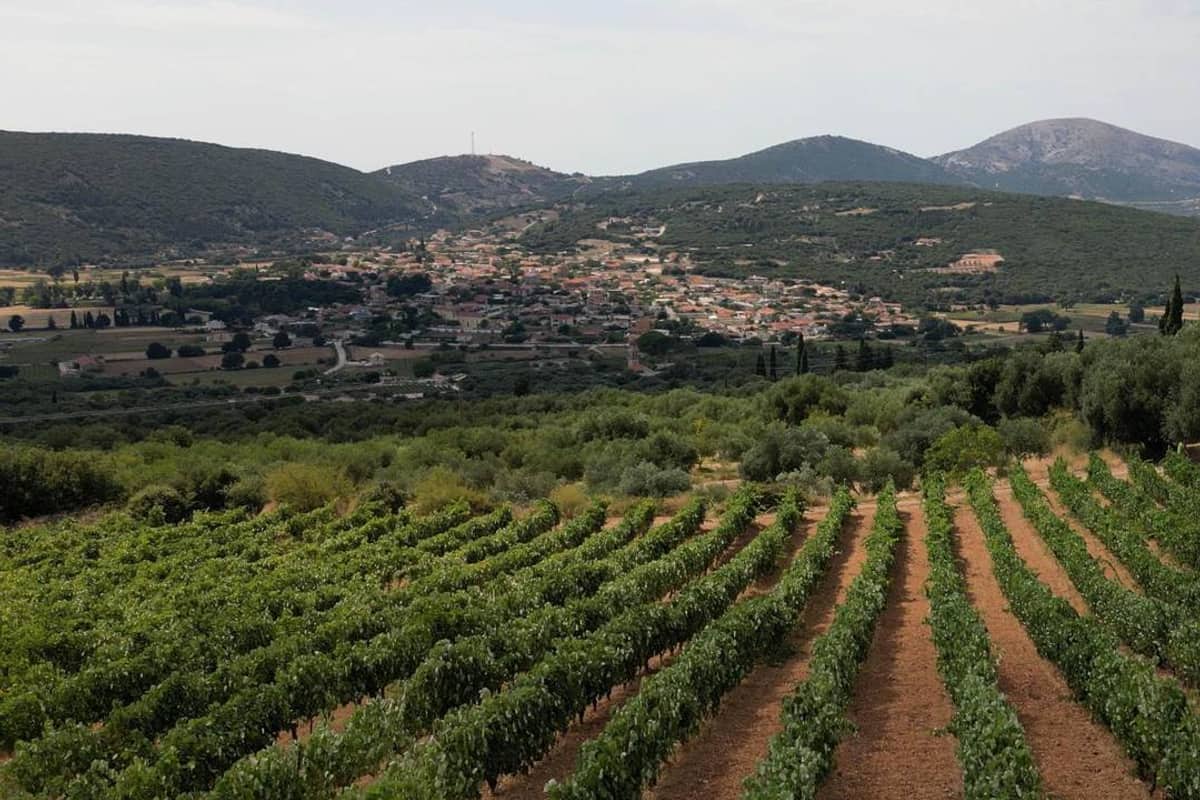
A Kefalonia wine tour visits the vineyards and wineries of the Ionian island of Kefalonia, from the Omala valley to the slopes of Mount Ainos. It is one of the Greek tours on Greece VIP.
This post covers what a Kefalonia wine tour includes, the grapes and the wine areas. It also covers wine history, the protected wines, and how soil and climate shape the vines. The harvest, the best season and common questions come last.
Each section ends with a Kefalonia wine tour or a nearby tour that can be booked online.
What does a Kefalonia wine tour include?
A Kefalonia wine tour includes winery visits, vineyard walks and cellar tastings. The island counts 11 wineries, and the majority of them welcome visitors. Glasses hold dry white Robola, sweet red Mavrodaphne and sweet white Muscat from island vines.
A Kefalonia wine tour joins special wine-tourism programmes that island wineries built as tourism grew. Six island wineries belong to the Kefalonia winemakers’ association.
An Omala valley growers’ cooperative of 300 members runs the island’s largest winery. It draws 70,000 to 80,000 visitors yearly for tours and tastings.
Robola of Kefalonia counts as the island’s best-known export product.
Organised vineyard excursions run apart from general tours of Kefalonia island. Staff present tastings in Greek and English; estates add French, German or Italian.
Beyond sweet wines, a Kefalonia wine tour finds rosé Mavrodaphne and dry Muscat. A Lixouri estate bottles Muscat, Vostilidi and Zakynthino as orange wines.
- Sweet red: Aged Mavrodaphne develops coffee and spice notes.
- Sweet white: Small-berried Muscat gives honeyed, strong wine.
- Rare sweet: One cellar makes Greece’s only sweet Zakynthino.
Robola accounts for the overwhelming share of island wine by quantity.


Which grapes does a Kefalonia wine tour taste?
A Kefalonia wine tour tastes six island grapes: Robola, Mavrodaphne, Muscat, Vostilidi, Zakynthino and Tsaousi. Vostilidi and Goustolidi are two names for one white grape. Other reds such as Thiako, Araklino and Korfiatiko also grow on the island.
Mavrodaphne, meaning black laurel, comes from Achaea. On a Kefalonia wine tour, it pours deep ruby, with high tannin, red fruit and herbal hints.
The Tsigkelo clone, rated higher in quality than Renio, dominates the island’s Mavrodaphne plantings. Like Muscat, Mavrodaphne grows at lower altitudes, including around Lixouri.
Gustav Clauss first produced sweet fortified Mavrodaphne around 1850.
A Kefalonia wine tour pours Vostilidi, a white grape grown mainly on Kefalonia and Zakynthos. Its orange and exotic fruit carries honeyed notes and low tannins.
Zakynthino wine shows ripe peach, a rich body and balanced acidity. Tsaousi, a productive white, adds aroma to blends and gives sweet citrus notes.
Thiako, a pale and rare red grape, grows at one Paliki winery.
- Robola names: Synonyms include Rombola, Robbola and Robola Kerini.
- Robola colour: The wine is greenish-white with golden-yellow highlights.
- Robola aromas: Citrus blossom, peach, quince and apple appear.
Island whites also include Skiadopoulo and Moschatela, both grown on Kefalonia.
Which wine areas does a Kefalonia wine tour visit?
A Kefalonia wine tour visits the Omala valley, Mount Ainos and the Paliki peninsula. Mantzavinata, a Paliki village, takes its name from Italian words for eating and wine. The island’s vineyards cover just 750 acres, about 300 hectares.
Omala covers 46.7 square kilometres and lies at 400 metres elevation. A Kefalonia wine tour finds its vineyards near Agios Eleftherios, Valsamata and Fragata.
Omala cooperative vineyards start at 450 metres, and the majority grow as low goblets. The cooperative’s range also adds Muscat, Tsaousi, Zakynthino and Skylopnichtis.
Vineyards climb the western and southwestern slopes of Mount Ainos. In the south, the Ainos range shapes the Elios-Pronnon plateau, where Zakynthino faces southwest.
A Kefalonia wine tour near Lixouri reaches Kechrionas, where ungrafted goblet vines average over 70 years old. They yield about 400 kilograms per stremma.
- Mantzavinata: The village sits on the Lixouri to Kounopetra road.
- Vouni: A Paliki winery ages wine underwater.
- Kladata: A Paliki estate grows Mavrodaphne, Muscat and Vostilidi.
At Thiramonas, old Mavrodaphne vines grow at 300 to 350 metres.
What history lies behind a Kefalonia wine tour?
A Kefalonia wine tour traces Robola to a 1520 church property inventory, its first modern written record. Venetian rulers later taxed island wines heavily. The 1953 earthquakes drove islanders abroad. Growers formed a cooperative in 1982 with 60 members.
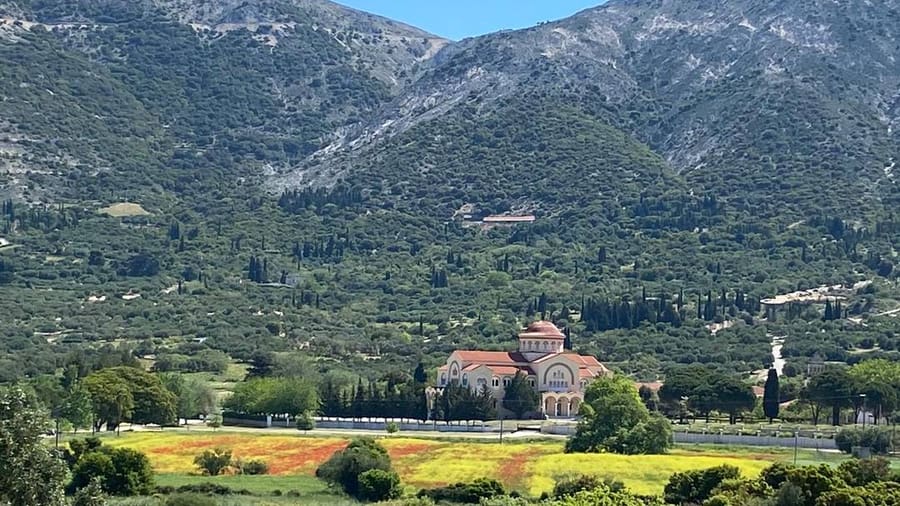
Robola appears in a 25 January 1544 letter to the island’s Latin bishop. In 1557, traveller Pellegrino Brocardi praised the grape and its wine.
One theory traces the name Robola to rhombos, Greek for a shape with ritual meaning. Another theory links it to rembi, Greek for daydreaming.
A Kefalonia wine tour includes white Muscat, which Venice made a forced export monopoly. An old saying called it the drink dearest to Venetian gluttons.
Within a decade of the 1953 quakes, the island economy began recovering. A local producer helped revive winemaking with native grapes in the 1960s.
- 1858: A new wine firm revived Muscat.
- 1872: An English merchant bought the firm.
- 1999: A local estate began developing native grapes.
Those Venetian taxes cut Muscat and Mavrodaphne growing on the island.
Which protected wines does a Kefalonia wine tour pour?
A Kefalonia wine tour pours three PDO wines: Robola of Kefalonia, Mavrodaphne of Kefalonia and Muscat of Kefalonia. Island PGI names are Slopes of Ainos, Mantzavinata and Metaxata. Robola rules also cap yields at 56 hectolitres per hectare.
PDO Robola vines must grow at least 50 metres above sea level. Yields cap at 8,000 kilos of grapes, or 56 hectolitres, per hectare.
Greece has 33 PDO wine names, yet wine tours on Corfu visit an island with none. PDO Robola bottles carry red control strips coded ΡΚ.
Mavrodaphne of Kefalonia grapes need 12.5% natural alcohol. The finished wine reaches 15 to 22% alcohol. Grape yields cannot exceed 12,000 kilos per hectare.
For sun-dried Muscat of Kefalonia, grapes need 14.8% natural alcohol before drying and 17.6% after. Grand Cru Muscat yields stop at 5,300 kilos per hectare.
- Reserve: Robola ages at least a year, half in oak.
- Grande Reserve: Robola needs two years, twelve months in oak.
- Metaxata: This PGI red uses Mavrodaphne grapes.
A Kefalonia wine tour can also pour semi-sparkling Slopes of Ainos whites.
How do soil and climate shape a Kefalonia wine tour?
A Kefalonia wine tour crosses vineyards where phylloxera appeared in 1988. Robola zone soils are barren, gravelly and sloping. About 1,000 millimetres of rain falls yearly, mainly October to March. Evening dews from Mount Ainos ease daytime heat stress.
After phylloxera appeared, growers began replanting with existing stocks proven resistant to it. One research vineyard at 464 metres grows Robola on 1103P rootstock.
A Kefalonia wine tour passes very old self-rooted vines on the slopes of Ainos. The growers’ cooperative says such own-rooted vineyards need urgent replanting.
Robola vineyards climb from 150 to 680 metres above sea level. Inside the zone, two tectonic sinkholes, called poljes, form the Omala and Troianata valleys.
Robola is drought-sensitive, yet vines get no irrigation after their first two years. Dry summers keep them as low goblets with four to five arms.
- Clay-sand: The Muscat zone has deep clay-sand soils.
- Sea winds: West-southwest winds bring humidity that eases ripening.
- Koutsouniama: Growers twist and tie shoots inward for shade.
In Paliki, a Kefalonia wine tour finds Mavrodaphne on marl soils.
What does the harvest bring to a Kefalonia wine tour?
A Kefalonia wine tour at harvest time meets three grapes and village wine feasts. Cooperative growers in the Robola zone start picking around 15 August on the slopes of Mount Ainos. They finish around 15 September on the plateau.
A Kefalonia wine tour can join the Robola festival, first held in 1978 to showcase the local grape. It now runs for two days each year.
Valsamata holds its own Robola feast over two August nights on the Plain of the 40 Wells. The island’s cooperative supplies the free Robola.
The Valsamata cultural association organised that Robola feast.
Mantzavinata holds a yearly wine festival in its old school courtyard, with one edition on 9 August. The local Kounopetra cultural association runs it.
Island winemakers held a public event called Kefalonia, a Hub for Wine, on 17 June 2023. Its talks covered new technologies in the vineyard.
- Muscat: Vatsa vines in Katogi are picked in early August.
- Mavrodaphne: Paliki zone vines are picked in early September.
- Late picking: One Mavrodaphne-led blend uses grapes picked after 20 September.
The winemakers’ association behind that event formed in 2021.
When is the best season for a Kefalonia wine tour?
A Kefalonia wine tour suits September best. Argostoli then averages a 26.9°C high and 46.5 mm of rain. October cools to a 23.2°C high with 94.7 mm. Airport passengers fell from 207,330 in August 2023 to 151,877 in September.
For a Kefalonia wine tour, Argostoli’s HNMS record gives April an 18.6°C high and an 11.3°C low. Rain reaches 51.6 mm over 9.0 days.
A Kefalonia wine tour in September meets nights averaging 19.0°C, with rain on 5.4 days. October nights average 16.1°C, and rain falls on 10.0 days.
HCAA counted 199,154 Kefalonia airport passengers in July 2023, second only to August. February was the quietest, with 2,904, and January came next with 3,226.
One estate near Minies receives visitors from Orthodox Easter to late October. Weekday buses to Karavomylos let a Kefalonia wine tour add Melissani cave tours.
- Shoulder months: April 2023 brought 13,558 passengers; October brought 41,104.
- Winter: The Omala cooperative winery still opens on weekdays.
- Yearly rain: Argostoli gets 812.3 mm on 99.8 rain days.
Across 2023, the airport counted 416,517 arrivals, and 361,933 came on international flights.
What do travelers ask about a Kefalonia wine tour?
Practical questions on a Kefalonia wine tour cover buses, port officials and hospital care. KTEL keeps bus ticket offices in Lixouri, Sami and Poros. The island’s general hospital adds a Mental Health Centre and a physical rehabilitation centre.
How does a Kefalonia wine tour reach the Omala valley by bus?
KTEL buses for a Kefalonia wine tour leave the station at 5 Antoni Tritsi Street, Argostoli. The Valsamata line serves the Omala valley from Monday to Friday. A Troianata line reaches the Robola area on the same weekdays.
Where is the port authority for a Kefalonia wine tour?
The port authority for a Kefalonia wine tour is the Hellenic Coast Guard’s Kefallinia Port Authority. Its office stands at 9 Ioanni Metaxa Street, Argostoli. Port sections work at Sami and Poros, and a port station covers Fiskardo.
Which hospital serves a Kefalonia wine tour?
The hospital for a Kefalonia wine tour is the General Hospital of Kefalonia, at 17 Souidias Street, Argostoli. Its departments include emergency, cardiology, surgery, orthopaedics, paediatrics, ophthalmology and urology. It also runs an artificial kidney unit for dialysis.