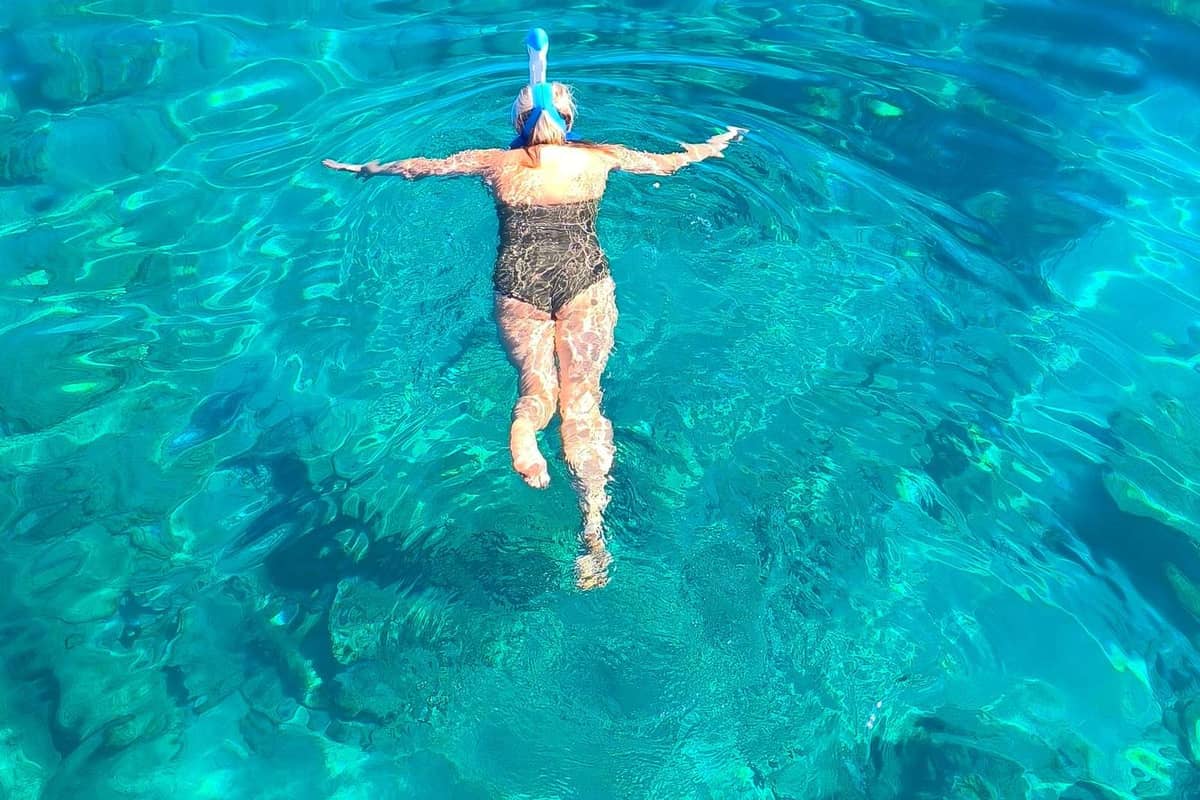
Heraklion snorkeling takes swimmers with a mask and fins over the reefs and bays of the north coast of Crete, from Agia Pelagia to Hersonissos and out to Dia. It is one of the Greece tours on Greece VIP.
This post covers what Heraklion snorkeling includes, where it starts and the spots it visits. It also covers the sea life, the island of Dia and the gear and safety rules. Sea conditions, the best season and common questions come last.
Each section ends with a Heraklion snorkeling trip or a nearby sea trip that can be booked online.
What does Heraklion snorkeling include?
Heraklion snorkeling covers beach lessons with instructors, boat trips, jet boat rides, sailing trips and private motorboats. Each trip supplies snorkel gear, and the jet boat and glass-bottom boat add life jackets. Hotel pickups reach resorts from Fodele to Malia. Sailing menus include vegan options.
Heraklion snorkeling for beginners starts at Agia Pelagia with a personal instructor. A safety briefing comes in the guest’s own language. The group then snorkels in Mononaftis bay. Lessons run in five languages.
This lesson runs two or three groups a day. Each group is capped at eight guests. Hotel transfers are shared, not private. Snorkelers are free to duck underwater for a dive.
Heraklion snorkeling with a seascooter helps weaker swimmers cover more distance. A mermaid course uses a tail with an integrated monofin. It takes three guests at a time, aged 12 or older.
A boat safari from Pantanassa port takes two to eight guests. Water, fruit and flotation aids come aboard. Guests can add scuba diving in Heraklion at the Agia Pelagia stop.
The jet boat for Heraklion snorkeling reaches up to 90 km/h, with optional 360° turns. It pauses at the secluded Saint George’s Bay for a swim. Babies under one and pregnant women cannot join.
- Glass-bottom boat: Six floor windows show the seabed, and guests feed fish.
- Sailing trips: Groups of 10 to 13 get paddleboards and fishing gear.
- Private motorboats: Boats take four or eight guests, with a skipper aboard.
The Malia motor yacht trip serves lunch, dessert, wine, soft drinks and water on board.


Where does Heraklion snorkeling start?
Heraklion snorkeling starts at beaches and harbours on both sides of the city. West of the city, trips use Agia Pelagia, Ligaria and the small port of Pantanassa. East of the city, boats leave from Hersonissos, Gouves and Malia.
Agia Pelagia beach fills a closed bay 450 m long and faces east. The Greek bathing register puts its capacity at 700 bathers. The Menopetra part of the beach holds a Blue Flag.
Heraklion snorkeling boats at Ligaria leave from a diving centre on the bay. The beach lines a closed bay 400 m long. Small pleasure boats anchor across the whole bay.
Pantanassa port sits close to Ammoudara. A tavern, a coffee shop and a small beach lie beside it. Ammoudara’s bathing stretch runs 3,200 m and faces north. Free transfers run from Heraklion and Ammoudara.
At Hersonissos, Heraklion snorkeling boats sail from the town’s harbour. A closed cove 100 m long lies east of it. Its seabed drops steeply to 5 m about 50 m out.
Catamaran trips from Gouves port have a toilet, a shower and shaded lounges. Malia’s port sends motor yachts west past Stalis and Hersonissos. Gouves and Analipsi each have a Blue Flag beach.
- Heraklion port: Sailing trips meet outside a café on Nearchou Avenue.
- Analipsi: Piers of 55 m and 110 m moor small boats.
- Hersonissos: Two beaches in the harbour town fly Blue Flags.
The Gouves catamaran trip lists 136 pickup points, from Kokkini Hani to Stalis.
Which spots does Heraklion snorkeling visit?
Heraklion snorkeling visits rocky coves and sandy bays on both sides of the city. Mononaftis, Psaromoura, Ligaria and the Sarantari coves are rated ideal for snorkeling. Fodele and Kokkini Hani have sandy seabeds, while Stalida and Potamos add rocky edges. Sarantari also flies a Blue Flag.
Heraklion snorkeling at Mononaftis centres on a rocky seabed below greenish water. The name Mononaftis belongs to a boulder about 50 m off the beach. Coarse sand and pebbles cover the shore.
Psaromoura faces east, out of the northwest winds. A large folded rock of local phyllite guards its north end from waves. Locals use it more than tourists do. Its name means fish cape.
Heraklion snorkeling at Ligaria finds beachrock on the seabed and rocky outcrops at its ends. Brown algae grow on the outcrops inside the sea. Depth reaches 5 m about 55 m from shore.
Fodele beach spans 400 m inside an open bay 1,500 m long. Its sandy floor stays shallow, reaching 5 m about 140 m out. A 40 m concrete pier stands at the west end.
Heraklion snorkeling at Sarantari starts from a cement dock on the rocky cape. The seabed below is rocky and good for snorkeling. A small sea cave cuts into white limestone at the cape beach.
- Kokkini Hani: Three boulder breakwaters, each about 50 m, line the beach.
- Stalida: A short rocky cape splits the sandy beach in two.
- Potamos, Malia: Freshwater springs lie in the sea off this beach.
The Pantanassa boat safari also visits a seal cave for photos when weather allows.
What sea life does Heraklion snorkeling show?
Heraklion snorkeling shows Mediterranean damselfish, ornate wrasse, saddled sea bream and salema over rocks and seagrass. Purple sea urchins live in Neptune grass meadows and graze algae and seagrass. Red sea stars, sea cucumbers and common octopus share the bottom.
The Mediterranean damselfish forms small shoals in midwater above rocky reefs, from 2 to 40 m deep. Adults are dark brown, while males turn pale violet. Males guard the sticky eggs laid in summer.
Heraklion snorkeling meets the ornate wrasse, whose tail fin is turquoise in both sexes. Females are greenish-brown with five bluish vertical stripes. At night this wrasse buries itself in sand by shaking its tail.
The saddled sea bream carries a large black spot with a white edge on its tail stalk. Its species name, melanurus, means black tail. This gregarious fish lives down to 30 m.
Heraklion snorkeling also shows the salema. Adults off Corsica fed mainly on Neptune grass. The salema starts life male and later turns female. Males reach 15 to 30 cm, and females 31 to 45 cm.
HCMR divers tracked an Indo-Pacific needle-spined urchin at Alykes, Agia Pelagia. A December 2023 die-off cut its density from 0.5 to 0.03 per m². Native purple and black urchins there seemed unaffected.
- Red sea star: Five slender orange-red arms span up to 20 cm.
- Cotton-spinner: This Mediterranean sea cucumber grows 20 to 45 cm long.
- Common octopus: It has three hearts and changes color to blend in.
The black sea urchin grips shallow rock firmly, from the surface down to 30 m.
What does Heraklion snorkeling see around Dia?
Heraklion snorkeling around Dia stops in bays such as Agrilia, Agios Georgios and Panagia. Agios Georgios and Panagia have shallow water over sand or large pebbles. Dia is listed as Natura 2000 site GR4310003. Its CORINE biotope code is A00010072.
Among Crete’s satellite islets, only Gavdos is larger than Dia. Listed boat trips from Heraklion drop anchor at Agios Georgios for snorkeling. Agrilia ranks among the island’s more secluded beaches.
Heraklion snorkeling at Agios Georgios starts at Dia’s only harbor, where two platforms take boats. By the church pontoon, depths rise quickly to 1.5 and 1 m. A sandy beach lies to the west.
Panagia bay lies about 2 km east of the Agios Georgios port. Steep rocky hills enclose it, and a small gorge drains onto its beach. Its anchorage holds 3 to 4 boats.
A University of Crete survey covered Dia, a Heraklion snorkeling stop. It recorded litter piles on the south shore at Agios Georgios and Panagia. It also noted salt in north-coast hollows near Platanias bay.
Since 1977, Dia has served as a refuge for the Cretan wild goat. Hybrids with farm goats led to culling from 1988. Pure-bred goats raised on Thodorou islet were meant to replace them.
- Lighthouse: Cape Apiri holds a lighthouse at 132 m elevation.
- Kapari: A forest service lodge sits on its northwest hill.
- Visits: Day trips are allowed, but camping is not.
Heraklion snorkeling at Dia explores parts of a coastline about 29 km long.
What gear and safety does Heraklion snorkeling need?
Heraklion snorkeling listings supply a mask, snorkel and fins, and one Dia trip adds life jackets. Sea urchin spines need prompt removal. Sunscreen needs at least SPF 30 and 4-star UVA cover. A summer port decision barred anchoring within 100 m of swim buoys.
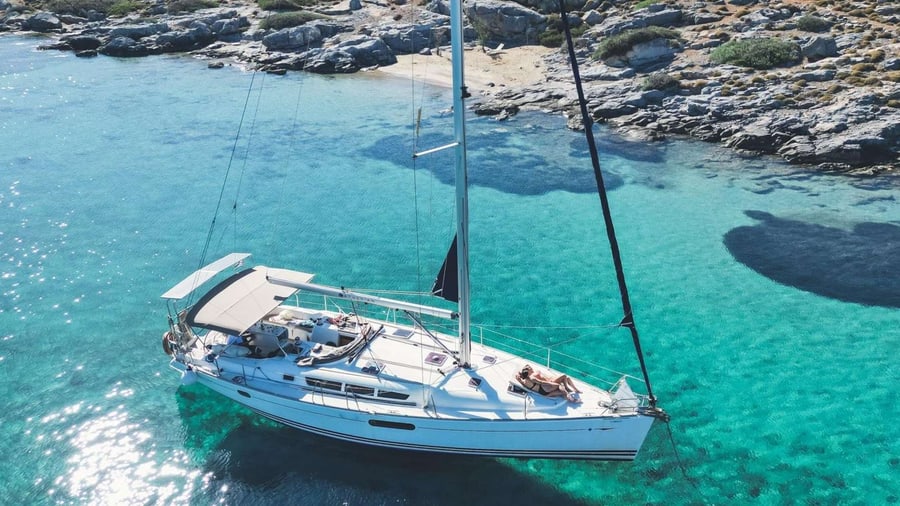
One Heraklion snorkeling listing at Agia Pelagia adds boots to its kit. A local activity page says wetsuits depend on the season. A private Dia trip also hands out flotation aids.
Heraklion snorkeling guests who wear glasses can bring a prescription mask on one Dia trip. Contact lens wearers are told to ask their optician. That trip’s guests need not swim well, but must float comfortably.
Sea urchin spines can break off in the skin and cause chronic pain and inflammation. Repeated vinegar soaks can dissolve spines that have not gone deep. Deeply embedded spines can need surgery.
The mauve stinger rises toward the surface at night and sinks deeper by day. In a lab study, vinegar made its stinging cells fire. Seawater was neutral, so the authors suggest a seawater rinse.
A port authority decision named Heraklion snorkeling beaches such as Agia Pelagia, Lygaria and Mononaftis. It banned fishing within 100 m of their buoys from sunrise to sunset. Coastal municipalities must place those buoys.
- Amount: Adults need 6 to 8 teaspoons for the whole body.
- After swimming: Reapply sunscreen straight away, even water-resistant types.
- Reflection: Water reflects UV rays, and its coolness can hide burning.
Britain’s health service says to lift out spines with tweezers or a bank card edge. It warns against ice, urine or covering the wound.
How do sea conditions shape Heraklion snorkeling?
Heraklion snorkeling meets a north wind, which dominated ten months last year at a Heraklion coast station. Agia Pelagia water dropped to a 12°C reading this February, the lowest in two years. Its June average then reached 22.4°C, per satellite readings.
Off the city, satellite readings averaged 19.9°C last December and 17.9°C this January. February then averaged 16.8°C. This July averaged 24.9°C, with a low reading of 23°C. Last October held 23.2°C on average.
The Heraklion coast station of the National Observatory of Athens sits 10 m above sea level. Last year, February averaged 22.1 km/h, its windiest month. October was calmest, at 8.4 km/h from the south-southeast.
Its top gust last year hit 106.2 km/h on 31 December, against June’s 59.5 km/h. Marine model data off Heraklion put last year’s February wave peak at 2.96 m. July peaked at 1.50 m.
Ammoudara, west of the city, carries a wavy-sea label, with intense winds all year. Windsurfers know it well. A rocky strip runs about 50 m offshore, parallel to the beach, along the ancient coastline.
Onshore wind builds chop; offshore wind flattens the water. Heraklion snorkeling listings state that the itinerary depends on the weather. On rough days, CRETAquarium tickets offer an indoor look at Cretan sea life instead.
- Buoy depth: A POSEIDON buoy floats over 175 m of water offshore.
- Buoy sensors: The buoy logs currents and water temperature 4 m down.
- Deep bay: Psaromoura has deep, blue-green water.
Psaromoura and Mononaftis near Agia Pelagia both carry calm-sea labels on beach-condition listings.
When is the best season for Heraklion snorkeling?
Heraklion snorkeling has its warm window from June to October, when monthly sea averages top 22°C. One sailing listing with snorkel gear runs daily departures from April to October. August of last year averaged 26.3°C, the warmest month in two years.
A Heraklion weather page labels January too cold for swimming. An island-wide calendar calls April seas swimmable only for the determined. The same calendar rates October still very swimmable. Beach tavernas start closing then.
Satellite data put Heraklion water at 25.5°C on average this September, above August’s 25.3°C. Agia Pelagia peaked this year at 25.6°C, also in September. For Heraklion snorkeling, October has so far averaged 24.9°C.
June brings about 15 hours of daylight a day in Heraklion. July offers 14 hours, with 12 hours of sunshine, or 86% of daylight. July’s top UV index reaches 11, rated extreme.
Heraklion airport handled 1,398,346 passengers in June of the latest full year, per Hellenic Civil Aviation Authority data. October still brought 1,172,709 passengers. December dropped to 181,392, under one-seventh of June.
The same island calendar marks July and August as peak crowd months. It says crowds drop sharply after the first week of September. At Ammoudara, the western end by the Xeropotamos dunes stays quieter.
- August UV: The top index reaches 10, rated very high.
- Busy bays: Psaromoura and Mononaftis both carry busy-crowd labels.
- June crowds: Crowds build in June but stay manageable, per the calendar.
The Heraklion coast station logged zero rain in June, July, September and October last year.
What do travelers ask about Heraklion snorkeling?
Heraklion snorkeling listings near Agia Pelagia allow free cancellation up to 24 hours before the start. One boat trip from Pantanassa needs at least two participants. Bad weather or a missed minimum brings a new date, another trip or a full refund.
Can non-swimmers join Heraklion snorkeling trips?
Snorkel listings around Agia Pelagia refuse non-swimmers and ask for basic swimming skills. Shore trips turn away children who rely on inflatable accessories. The Pantanassa boat trip welcomes non-swimming spectators, subject to availability. A second Pantanassa boat trip also excludes people prone to seasickness.
What is the minimum age for Heraklion snorkeling?
Boat snorkeling from Pantanassa starts at age 6, with an adult alongside. Shore snorkeling at Mononaftis accepts children from age 7. Seascooter and beginner trips at Agia Pelagia refuse children under 10. That beginner trip also excludes travelers over 65 and wheelchair users.
What do travelers pack for Heraklion snorkeling?
Listings ask for a swimsuit, a towel and sunscreen, and the Pantanassa boat trip adds a hat. Agia Pelagia trips add flip-flops and snacks. One sailing listing leaves out towels and sun cream, asking for a passport or ID photo. Shore trips supply water or juice.
Which buses reach Heraklion snorkeling beaches at Ammoudara and Agia Pelagia?
City bus line 6 runs from the airport terminus to Ammoudara. Intercity buses to Agia Pelagia use coded stops, such as A10 at Agia Pelagia Beach. That line runs every day. Mononaftis sits 2.3 km in a straight line from its nearest stop.
Are underwater photos offered on Heraklion snorkeling trips?
One beginner trip at Agia Pelagia includes photos and videos. A seascooter tour sells photos and videos as an optional package. A Mononaftis shore trip lets guests bring their own underwater camera. The Pantanassa boat trip lists photos and videos as included.