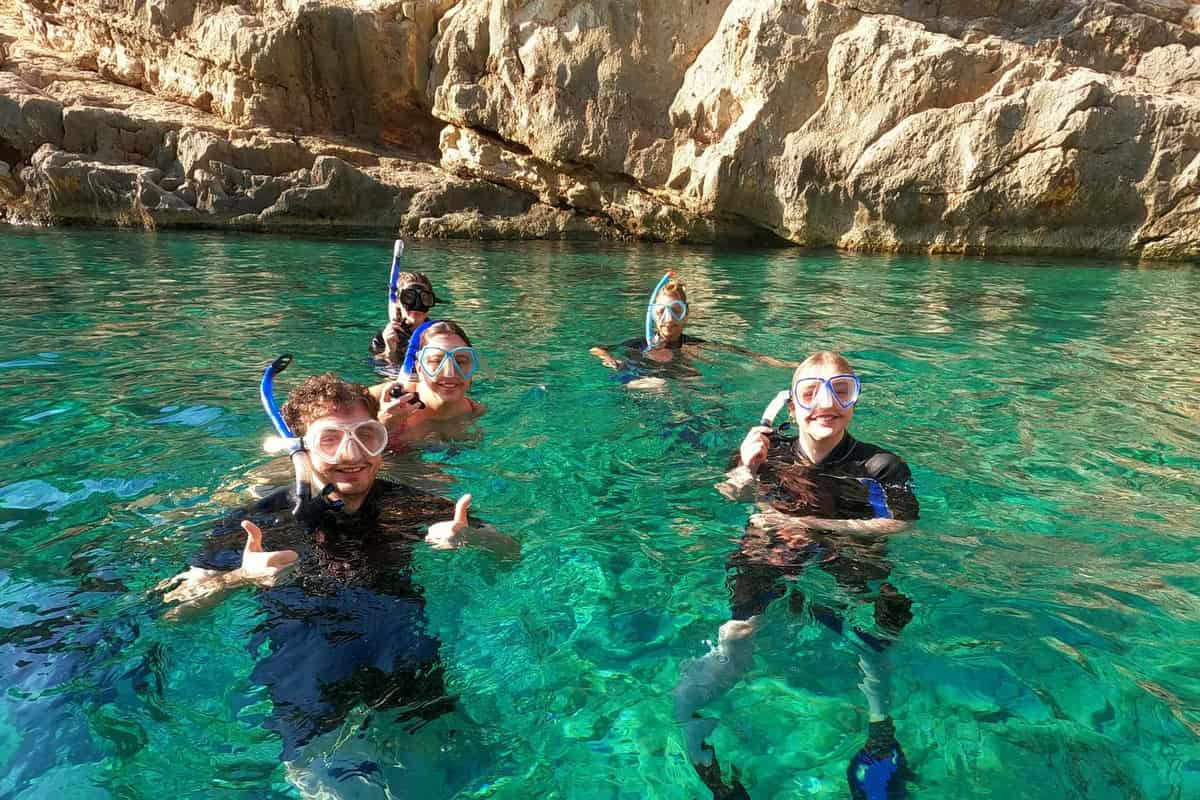
Chania snorkeling takes swimmers with a mask and fins over the bays, reefs and islets of western Crete, from the Akrotiri coves to the Rodopou peninsula. It is one of the Greek tours on Greece VIP.
This post covers what Chania snorkeling includes, where it starts and the spots it visits. It also covers the sea life, the islets and the gear and safety rules. Sea conditions, the best season and common questions come last.
Each section ends with a Chania snorkeling trip or a nearby sea trip that can be booked online.
What does Chania snorkeling include?
Chania snorkeling covers instructor-led boat trips and snorkeling with stand-up paddling. Sea-scooter tours run in Souda Bay; a Rodopou cruise visits Menies and Chironisia. Glass-bottom cruises add swim stops, and semi-submarines suit all ages. Beginner trips keep a crew member in the water.
On the Almyrida paddling trip, a fish book teaches Chania snorkeling guests the species names. Fresh fruit comes aboard too.
The Kalyves boat trip and Souda Bay scooter tour each cap groups at ten. The Almyrida beginner trip takes six. The scooter tour bars under-tens.
The Kalyves trip makes two snorkel stops and collects guests across the Chania region. The Almyrida paddling trip picks up only inside Chania city. Guests staying elsewhere drive to its start on Almyrida Beach.
- Photos: The paddling crew emails photos and a short video.
- Snacks: The beginner boat serves snack bars and Greek tea.
- Semi-submarine: Up to 12 passengers ride with one crew member.
Unlike Chania snorkeling trips that include fruit, the Rodopou cruise sells snacks.


Where does Chania snorkeling start?
Chania snorkeling starts at the old port and at dive centres in Kalyves and Almyrida. Small boats run from Platanias harbour to Menies. Kolymbari and Kissamos port serve the western coast. Pickups also reach Agia Marina, Souda and Kalathas.
Semi-submarine boat trips from Chania meet beside the Neoria in the old port. The bathing-water register places a fishing shelter and a nautical club in this harbour, east of Nea Chora.
Kalyves beach runs 600 m and faces north. A rock jetty of about 50 m splits the beach; a fishing shelter guards its east end. Neighbouring Maistrali beach flies a Blue Flag.
Platanias harbour beach is 120 m long and north-facing. Kolymbari’s beach stretches 3,300 m, with a harbour for fishing and pleasure boats to its west. Both hold Blue Flag sections.
- Agia Marina: Three Blue Flag sections line its beach.
- Almyrida: A 20 m boulder jetty shelters its Blue Flag beach.
- Kissamos: The Kamarianos river enters its 1,400 m east beach.
Koutalas, near Cape Drapano, has large round pebbles and draws scuba divers.
Which spots does Chania snorkeling visit?
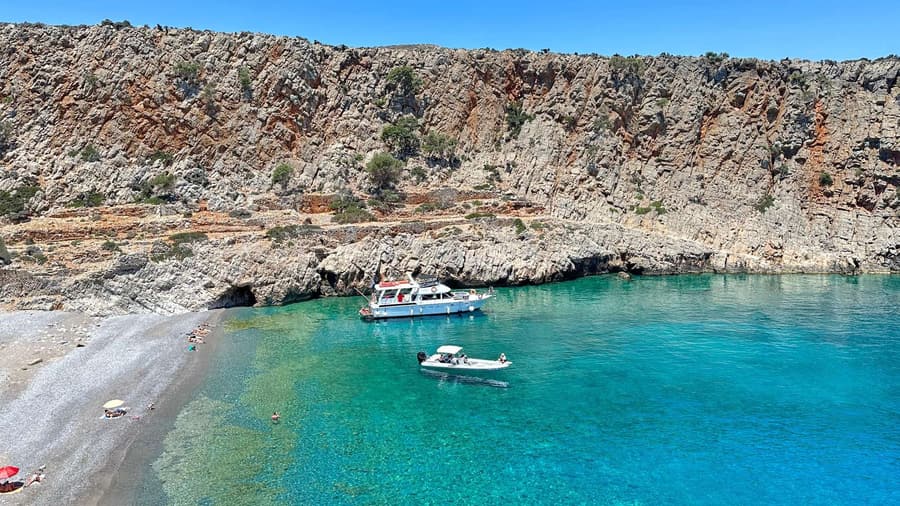
Chania snorkeling spots include the Blue Cave near Agios Onoufrios, plus Stavros, Kalathas and Tersanas on Akrotiri. Menies and Chironisia sit on Rodopou’s eastern shore. Almyrida boats explore sheltered reefs and rocky outcrops. South-coast Loutro has pebbles and deep water.
At Stavros, Chania snorkeling passes over a sandy seabed dotted with large smooth slabs. Depth reaches 5 m around 220 m from shore. The beginner boat swims into the Blue Cave at Agios Onoufrios, a Cape Akrotiri village.
Kalathas has a sandy floor, about 5 m deep at 130 m. Its islet sits 200 m west, within swimming reach. Tersanas lies in an enclosed, south-west-facing harbour of fine white sand.
Menies offers Chania snorkeling over pebbles and scattered rocks in deep blue water. Snorkelers look for a sunken Second World War gun and carriage. Chironisia has a rocky seabed and small caves.
- Koutalas: A large cave opens beside the beach.
- Kalyves: Caves and rocky drop-offs line the coast toward Georgioupolis.
- Agia Marina: Sand slopes gently to 5 m, 120 m out.
Chania snorkeling at Almyrida crosses sand and pebbles, with Karga islet opposite.
What sea life does Chania snorkeling show?
Chania snorkeling shows parrotfish, rainbow wrasse, white and two-banded seabream, rivulated rabbitfish and grey triggerfish. Research-grade citizen-science records within 30 km of the city list 94 fish species, freshwater ones included. Mediterranean slipper lobsters and bearded fireworms also appear in those records.
Mediterranean parrotfish reach 52 cm, yet 15 to 30 cm is common. They eat algae on rocks, using jaws adapted to that diet. Juveniles under 7 cm have yellowish heads.
Chania snorkeling meets primary-phase rainbow wrasse with an orange-brown back, whitish-yellow belly and black stripe. Secondary males turn bluish-grey with an orange zig-zag. The species forages in groups by day.
Chania snorkeling finds white seabream with nine dark and light vertical bars on silvery-grey bodies. Two-banded seabream wear one dark band at the nape and another at the tail base.
- Rivulated rabbitfish: Schools graze algae at depths under 15 m.
- Grey triggerfish: Males dig up to a dozen sand nests.
- Slipper lobster: It shelters in dens by day and feeds at night.
Chania snorkeling spots host rivulated rabbitfish, first recorded in the Mediterranean in 1927.
Which islets does Chania snorkeling reach?
Chania snorkeling trips reach Lazaretta, the Agioi Theodoroi islets and Imeri Gramvousa. Lazaretta has shallow water with rocks in places, and only boats reach it. Imeri Gramvousa’s seabed is rated ideal for snorkeling. High rocks make Agria Gramvousa hard to reach.
Lazaretta is named after Saint Lazarus, patron saint of lepers. Graves, apparently of patients, have been identified there. A local built a shrine of Saint Nicholas there in 1954.
Parts of Lazaretta hold metal fragments from German bombing exercises in the Second World War. Local schools for scuba diving on Crete visit the islet.
Agios Theodoros shows a large arched cave on its south side. Its single beach, also on the south, has sand, shallow light-blue water and the islets’ only small harbour.
- Imeri Gramvousa: A cement-laden ship ran aground there in January 1968.
- Souda islet: Greek naval forces planted its first trees in 1966.
- Pontikonisi: It sits about 10 km west of Gramvousa peninsula’s centre.
Chania snorkeling at Imeri Gramvousa uses its western cove, and overnight stays are banned.
What gear and safety does Chania snorkeling need?
Chania snorkeling listings supply masks, valve snorkels, fins, wetsuits or shorties and flotation aids. A Chania Port Authority notice makes lifeguard instructions mandatory. Adhesive tape lifts fireworm bristles. Toadfish bites need antiseptic, bleeding control and a sterile dressing.
One Chania snorkeling listing from Kalyves helps each guest pick gear for a comfortable fit. Its instructor explains safety procedures for each location. An Almyrida listing adds full face masks.
Under the same notice, a red flag strictly bans entering the sea. A yellow flag marks dangerous swimming conditions. Swimmers caught in rip currents swim parallel to shore.
Chania snorkeling waters hold the silver-cheeked toadfish, a Suez Canal arrival. Its sale is banned, and cooking does not fully destroy its toxin. HCMR places its highest densities in Crete and the Dodecanese.
- Lionfish: Hot water up to 45°C for 30–90 minutes eases stings.
- Sightings: HCMR’s Crete aquarium asks lionfish catchers to notify it.
- Wreck zone: Swimming is banned 200 m around the Drapanias wreck.
Fireworm bristles pierce skin and inject a neurotoxin, causing burning, nausea and dizziness.
How do sea conditions shape Chania snorkeling?
Chania snorkeling meets its coldest sea in February, when the water averages 15.9 °C. Platanias station winds averaged 11.4 km/h in January this year and 5.4 km/h in August. Daily peak waves off Chania averaged 0.85 m in July, half the January figure.
Chania snorkeling in June finds water averaging 22.8 °C, with readings from 21.2 °C to 24.5 °C. November still averages 20.4 °C. On 14 October this year, the sea read 22.6 °C.
February brought the strongest Platanias gust this year, at 82.1 km/h. July peaked at 41.8 km/h, with winds mainly from the northeast. Kissamos station winds averaged 6.1 km/h in July.
Waves off the Chania snorkeling coast peaked at 4.14 m in February this year. June peaked at 1.54 m. January had 19 days with peaks above 1.5 m; June had two.
- Stavros: Limestone cliffs enclose this north-facing bay on three sides.
- Kalathas: A low rocky headland partly shields its western edge.
- Agia Marina: Beach listings rate its sea as wavy.
When the meltemi blows hard, Kalathas water can turn choppy and less pleasant for swimming.
When is the best season for Chania snorkeling?
Chania snorkeling enjoys the warmest sea in August, at 26.1 °C on average. July and September follow at 25.6 °C and 25.4 °C. One Almyrida trip lists open dates until 31 October. A Kalyves trip lists dates in every month.
Among catamaran cruises from Chania, one Agioi Theodoroi trip shows no sailings left this year. A Menies snorkel cruise shows no dates before next spring. Both list daily sailings through next summer.
Chania snorkeling days run long, with 14.6 hours of daylight on 21 June. On 27 July this year, UV across Crete peaked at 8.2 to 8.5. Sunscreen needs reapplying every two hours.
Chania airport handled 660,777 passengers in June this year, 6.8% more than last June. August climbed to 776,425 passengers on 4,803 flights. Last October, traffic fell to 443,865 passengers.
- Stavros: Crowds peak from late June to late August.
- Kalathas: Crowds stay manageable outside August.
- Agia Marina: Its beach is rated as busy.
Chania snorkeling water reached 27.3 °C on 23 July this year, level with Heraklion.
What do travelers ask about Chania snorkeling?
Chania snorkeling needs no past experience, the Kalyves and Almyrida boat listings state. Children on the Almyrida trip join only with an adult. That listing advises against the trip for pregnant women. A Kalyves listing also excludes people with mobility impairments.
Can non-swimmers join Chania snorkeling trips?
A Kalyves boat listing names non-swimmers as unsuitable. Another listing for that trip asks for basic swimming skills. Unsure guests can stay on the boat.
What is the minimum age for Chania snorkeling?
One listing sets age 7 for a Kalyves Chania snorkeling trip. Another bars children under 5. Almyrida sea scooters take guests aged 12 and up.
What do travelers pack for Chania snorkeling?
Chania snorkeling listings ask for swimwear, a towel, sunscreen and a sun hat. A Kalyves listing adds sunglasses and dry clothes. A Kolymbari cruise adds comfortable shoes.
Which buses reach Chania snorkeling beaches?
The intercity line from Chania to Stavros serves Kalathas and Stavros. Agia Marina sits on the Kolymbari line. City bus routes 11 to 24 name none of these beaches.
What happens when weather cancels Chania snorkeling?
Chania snorkeling listings offer a new date or full refund after bad-weather cancellations. A Kalyves trip warns snorkel spots can change at the last minute for weather.