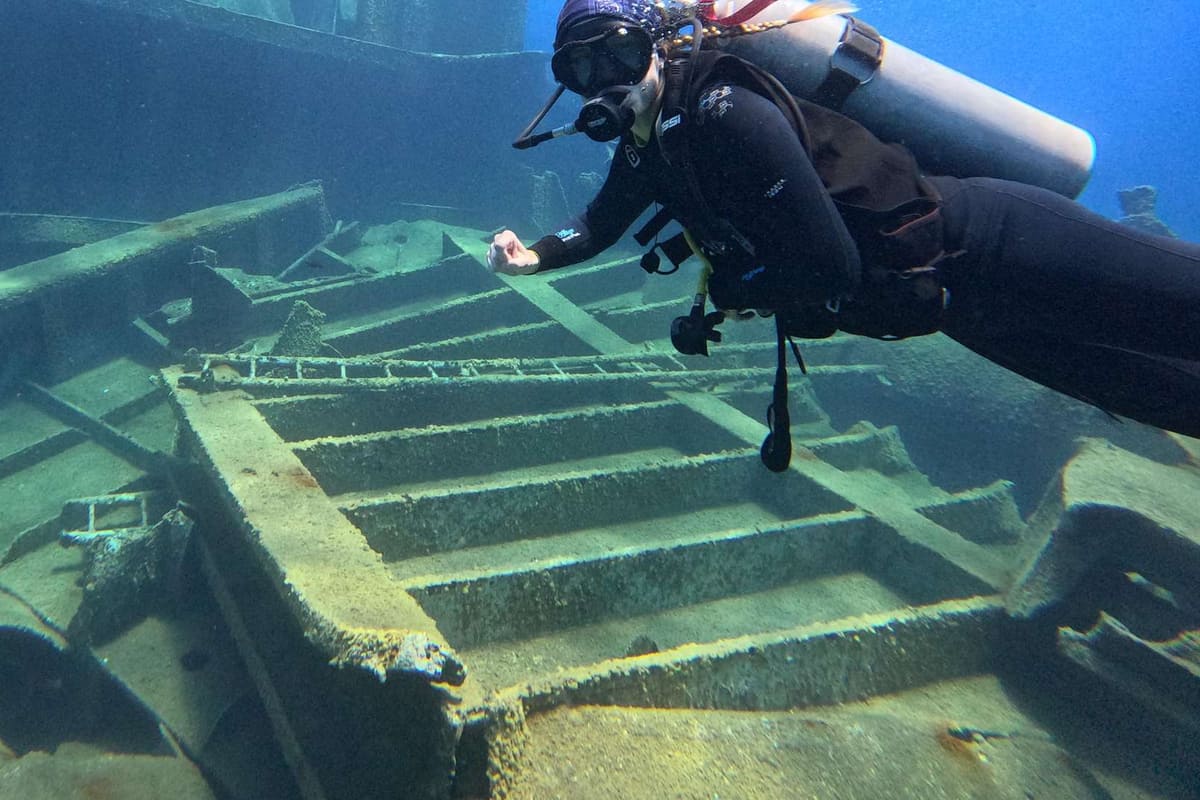
Heraklion scuba diving takes beginners and certified divers under the sea along the north coast of Crete, from Agia Pelagia to Hersonissos. It is one of the Greek tours on Greece VIP.
This post covers what Heraklion scuba diving includes, where it starts and the dive sites it visits. It also covers the sea life, the history under the water and the rules. Sea conditions, the best season and common questions come last.
Each section ends with a Heraklion scuba diving trip or a nearby sea activity that can be booked online.
What does Heraklion scuba diving include?
Heraklion scuba diving covers beach try dives, two-dive intros, courses, night dives and shore dives for certified divers. One certified-diver listing sets age 12 as the minimum. Its beach dives reach 22 m, and its night dives go to 18 m.
One Agia Pelagia try dive takes children from age 8 to a 6 m limit. Its kit covers mask, snorkel, fins, wetsuit, BCD, regulator, tank and weights. Diving insurance comes included.
Heraklion scuba diving also sells a two-dive intro at Mononaftis beach, where the second dive reaches 12 m. Divers split into groups of 4. Each diver receives a card at day’s end.
Mononaftis spots to 18 m need Open Water cards, and 30 m spots need Advanced Open Water. A check dive to 6 m serves divers idle for over a year.
Heraklion scuba diving courses at Mononaftis include four open-water dives for Open Water. Advanced Open Water adds deep and navigation dives plus three electives. Classes keep one instructor per two students.
- Transfers: Pickups run from Heraklion, Gouves, Hersonissos, Malia and Stalida.
- Photos: Two Agia Pelagia intro listings leave photos out.
- Children: PADI’s shallow-water kids’ programme keeps them shallower than 2 m.
One beginner listing in Agia Pelagia bay caps each group at seven participants.


Where does Heraklion scuba diving start?
Heraklion scuba diving starts from bays on both sides of the city. Agia Pelagia, Lygaria and Mononaftis lie to the west, in Malevizi. Eastern dive schools work from Kato Gouves, Hersonissos and Malia, with Stalida between the last two.
Agia Pelagia counted 277 permanent residents in the 2021 census. The village sits at the western inner end of its bay. Rock outcrops nearly encircle that bay.
Heraklion scuba diving bases also line Lygaria, just east of Agia Pelagia. The village had 35 residents in 2021. Its semi-enclosed bay is sheltered from strong north winds.
For scuba diving on Crete near the capital, dive schools favour the Achlada area west of Heraklion. Mononaftis, part of the Achlada community, had 28 residents in 2021.
Heraklion scuba diving in the east includes Kato Gouves, with 2,630 residents in 2021. Its shallow, fine-sand beach faces frequent north winds, and diving centres work along it.
- Ammoudara: Its fine sand starts 1 km west of central Heraklion.
- Hersonissos: The port settlement counted 2,469 residents in 2021.
- Stalida: Its 1,092 residents live 3 km east of Hersonissos.
Malia counted 3,522 residents in 2021; a chapel islet faces its Klotzani beach.
Which dive sites does Heraklion scuba diving visit?
Heraklion scuba diving visits caves and reefs near Agia Pelagia, a wall at Hersonissos and Dia island. Reefs off Agia Pelagia start at 3 m and reach 40 m, with canyons and slopes. Advanced divers also visit an aircraft wreck.
Mononaftis means the lonely sailor in Greek. Its reef averages 12 m, reaches 20 m and suits all levels. Deeper spots in the same area run from 18 m to 35 m.
Heraklion scuba diving at Agia Pelagia includes El Greco Cave, about 30 m long. Its entrance lies at 17 m. A vertical shaft inside rises to an air-filled chamber.
Near Lygaria, Bomb Reef circles a rock and drops to 30 m. Its east side holds boulders, a slope to sand and Second World War bombs. Coral Cave reaches 18 m.
Heraklion scuba diving at Hersonissos has six dive spots. The St George wall has caverns and inlets down to 19 m. Kori Reef, busy with local centres, reaches 13 m.
- Dias Rock: Boats from Agia Pelagia reach this 23 m site.
- Dia: Dive schools in Hersonissos and Malia run trips there.
- Paleokastro: Deep water meets rocky seabed 14 km west of Heraklion.
The aircraft wreck rests at 23 m, and its tail lies near 30 m.
What sea life does Heraklion scuba diving reveal?
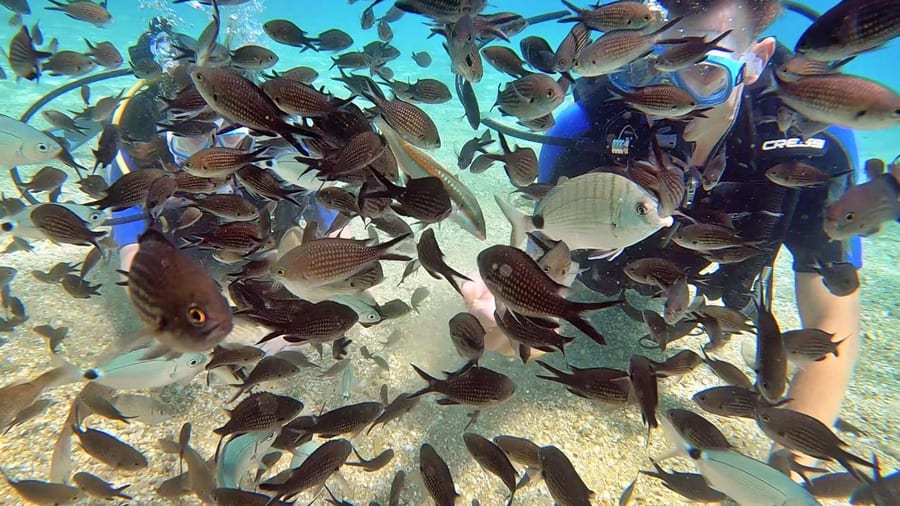
Heraklion scuba diving reveals parrotfish, dusky groupers, morays, octopus, nudibranchs and sponges on rocky reefs. Red Sea species that crossed the Suez Canal now live there. Scientists of the Hellenic Centre for Marine Research (HCMR) track these arrivals around Crete.
Linnaeus named the Mediterranean parrotfish Labrus cretensis in 1758. Females are red with a yellow-edged grey saddle. Males are grey with paler bellies. Both graze algae that coat rocks.
Dusky groupers start as females and turn male between ages 9 and 16. They live up to 50 years. Mediterranean morays reach 1.5 metres and hide in rock clefts by day.
Heraklion scuba diving now brings sightings of lionfish, first recorded in the Mediterranean off Israel in 1991. HCMR dates the first Cretan record to 2016, when the Aquarium of Crete announced a catch.
Rabbitfish came earlier: the marbled spinefoot reached Greek seas in 1925, the dusky spinefoot in 1964. The EU bans commercial sale of the silver-cheeked toadfish.
- Octopus: The common octopus lives only one to two years.
- Nudibranchs: Flabellina affinis feeds mainly on Eudendrium hydroids.
- Sponges: Mediterranean bath sponge numbers have fallen since the 1980s.
Heraklion scuba diving crosses Posidonia meadows; shallow ones flower in September and October.
What history does Heraklion scuba diving uncover?
Heraklion scuba diving uncovers Dia’s wrecks, whose cargoes the team of Jacques Cousteau and Greek archaeologists brought up. Minoan harbour sites at Amnissos and Nirou Chani lie partly under the sea. From the water, surviving Venetian shipyards mark the old harbour.
The Greek National Tourism Organisation invited Cousteau to explore Greek seas for his films. His ship anchored in Panagia bay on Dia, the island reached by boat trips from Heraklion.
A Roman wreck lay 30–33 metres deep off southern Dia. Divers raised about 350 Rhodian amphorae made around 100 AD. A 9th–11th century Byzantine cargo rested at 39–45 metres.
Heraklion scuba diving history includes Greece’s first harbour excavation, at Dia’s Agios Georgios bay in 1976. Its lowest layer held Minoan pottery. A breakwater of about 1000 AD lies underwater there.
At Amnissos the sea has risen about three metres since the Bronze Age. Nirou Chani’s sunken remains lie 730 metres west of its villa. Seismic and photo surveys mapped them in 2015.
- Venetian wreck: Two bronze cannons came up from about 52 metres.
- Arsenali Vecchi: Venice finished these four galley sheds in 1556.
- Koules: Its name comes from Turkish Su Kulesi, meaning water fortress.
Venetian builders left underwater openings in the north breakwater so the harbour cleaned itself.
What rules apply to Heraklion scuba diving?
Heraklion scuba diving comes under the Greek shipping ministry, which supervises recreational diving. A dive centre’s licence lasts five years. Divers must never dive alone, nor keep fishing gear or catch aboard their boat.
Heraklion scuba diving is banned in shipping lanes, ship anchorages and naval training areas. It is also banned within 100 metres of hire-craft launch points.
Heraklion scuba diving boats fly code flag A or the red diver flag. Divers beyond 50 metres from the boat show an orange buoy. Other vessels must stay over 100 metres away.
Night dives need written port authority permission, from one hour after sunset to one hour before sunrise. The port authority can also set local or time limits on providers.
Antiquities found during Heraklion scuba diving must be reported without delay. Reports go to the nearest archaeological, police or port authority. Stealing a high-value monument risks up to ten years in prison.
- Spearfishing: Spearfishers cannot even keep breathing sets aboard.
- Cables: Diving over undersea cables is also banned.
- Port patrols: In 2021, five Coast Guard craft patrolled Heraklion’s waters.
Spearfishers must stay 200 metres from bathers and within 50 metres of their buoy.
How do sea conditions shape Heraklion scuba diving?
Heraklion scuba diving depends on clarity, wind and waves. Visibility on the north-central coast near Heraklion runs 8 to 12 m. That is lower than in eastern or western Crete. Summer brings the clearest water, with peak clarity from July to September.
Off Agia Pelagia, the water starts warming in April. It can reach 27°C in August and hold that level until mid-September. In March, readings off Heraklion dip to 15.4°C.
Heraklion’s weather station lists northwest as the prevailing wind from June to September. South winds rule the other months. July and August average 9.1 knots, below February’s 10 knots.
The Dia wave buoy’s 2000 record peaked at 4.68 m in March. Waves above 3.5 m made up just 0.9% of readings.
Swell at that buoy averaged only 0.06 m. Local wind waves, not distant swell, shape the sea for divers and sailing tours from Heraklion. Mean wave period was 3.87 seconds.
- Summer visibility: Crete’s visibility regularly exceeds 15 m in summer.
- Flattest reading: The Dia buoy logged just 0.08 m in November.
- Shortest period: August had the shortest mean wave period, 3.46 seconds.
For Heraklion scuba diving, swell at the Dia buoy never topped 0.96 m that year.
When is the best season for Heraklion scuba diving?
Heraklion scuba diving has its main season from April to the start of November. One Agia Pelagia dive centre and its Ammoudara shop open in those months. A dive school in Heraklion city runs all year, adding a Hersonissos base in summer.
For Heraklion scuba diving, summers stay dry at the national weather station in Heraklion. July averages 0.8 mm of rain over 0.3 rain days. Its mean daily high is 28.9°C.
October averages 59.4 mm of rain at the same station. January is the wettest month, with 91.0 mm over 16 rain days. Daytime highs average just 15.3°C that month.
Heraklion scuba diving season spans the airport’s peak. August brought 1,850,719 passengers this year, and 1 August alone saw 68,818. January this year counted just 138,983 passengers.
Last year, hotels in the Heraklion regional unit logged 13,091,689 nights, ELSTAT reports. Non-residents spent 12,576,218 of them. Hotel arrivals reached 2,427,166, with 203,886 from residents of Greece.
- Fullest hotels: Malevizi hotels reached 61.9% bed occupancy, the unit’s highest.
- Coolest nights: February’s mean low at Heraklion station is 8.9°C.
- Year to date: Airport traffic reached 7,288,371 from January to August.
September, inside the Heraklion scuba diving season, averages 16.7 mm of rain at Heraklion station.
What do travelers ask about Heraklion scuba diving?
Heraklion scuba diving travelers ask about chambers, flights, medical forms and buses. The current diver medical form came from the Diver Medical Screen Committee, with DAN and the UHMS. It replaced an older form of 34 questions in June 2020.
Where is the nearest hyperbaric chamber for Heraklion scuba diving?
A Greek medical review lists no hyperbaric unit in Heraklion. The Hellenic Navy keeps a multiplace chamber at the Naval Hospital of Crete, in Souda near Chania. The national health system runs units at Agios Pavlos in Thessaloniki and at Vouvaleio on Kalymnos.
How long is the wait before flying after Heraklion scuba diving?
DAN sets at least 24 hours before flying after dives that need decompression stops. For Heraklion scuba diving, waiting 24 hours after any dive is the general advice. These intervals cover flights at cabin altitudes of 2,000 to 8,000 feet.
Which medical answers need a doctor before Heraklion scuba diving?
Ten “no” answers on the first page of the diver medical form need no evaluation. A “yes” on exercise limits, surgery within 12 months or prescription drugs needs a physician’s approval. Birth control and malaria drugs other than mefloquine do not count.
Which buses reach Hersonissos for Heraklion scuba diving?
Heraklion scuba diving trips east can take the intercity line from Heraklion to Hersonissos. It sits on one timetable with lines to Agios Nikolaos, Ierapetra and Sitia. Hersonissos also has its own departures timetable. A separate line links Arkalochori and Kastelli with Hersonissos.