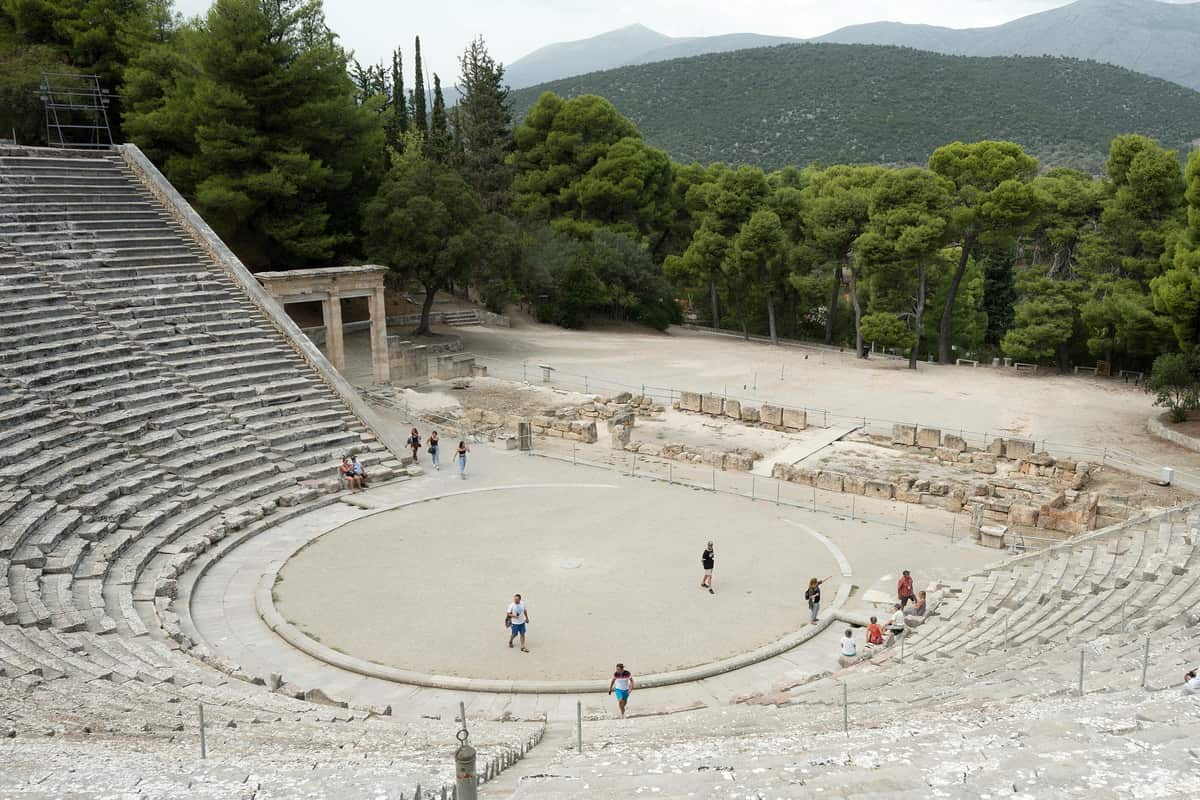
An Epidaurus tour visits the healing sanctuary of Asclepius in the Argolis and its ancient theatre, famous for its acoustics, then the site museum, the summer festival of ancient drama, the little theatre by the sea at Ancient Epidaurus and the nearby town of Nafplio. This post covers what an Epidaurus tour includes, the theatre, the sanctuary, the museum, the festival, the coast, combining Epidaurus with Nafplio and the best season. It is one of the history tours in Greece on Greece VIP.
Each section ends with an Epidaurus tour that can be booked online.
What does an Epidaurus tour include?
An Epidaurus tour visits the sanctuary of Asclepius, the ancient theatre and the museum in the Argolis. A licensed tour leader explains the monuments of the healing site that UNESCO placed on the World Heritage List in 1988 for its architecture and its role in healing.
The name Epidaurus comes from the hero Epidauros, a son of Apollo. Strabo records an older name, Epikaros, under the Carians, and a later one, Epitauros, under the Ionians. The Dorians who conquered the city gave it the form Epidauros. The city stayed independent of Argos and joined the Argolis only under the Romans. An Epidaurus tour begins with this history of a small city that held a large sanctuary.
The sanctuary prospered through the cult of Asclepius, and its wealth paid for civic monuments. These included the theatre, a banqueting hall called the hestiatoreion and a palaestra. After the Goths raided the sanctuary in AD 395, it was still known as a Christian healing centre in the middle of the fifth century. An Epidaurus tour places each ruin inside this long history.
An Epidaurus tour spends the whole visit on Epidaurus itself: the theatre, the sanctuary, the museum, the festival and the town by the sea. The Mycenae and Epidaurus day trip works differently, because that day splits between both sites and each site gets a share of the day. A tour focused on Epidaurus leaves room for the detail of each monument.
- Pilgrimage: The sanctuary drew pilgrims from the entire ancient world.
- Network: Over 300 healing temples of Asclepius have been found, and Epidaurus was the main one.
- First dig: The 1881 dig was the first large excavation of the Archaeological Society of Athens outside Athens.
UNESCO named two grounds for the listing: the exemplary architecture of the site and its importance in the development and spread of healing sanctuaries across the Greek and Roman worlds. An Epidaurus tour reads the ruins through both grounds. The theatre shows how the Greeks built for sound and sight, and the sanctuary shows how a healing cult grew into a network.


What does an Epidaurus tour show at the ancient theatre?
An Epidaurus tour shows the ancient theatre on the west side of Mount Cynortion, near Lygourio. Pausanias credits Polykleitos the Younger with building it at the end of the 4th century BC, and it holds up to 14,000 spectators. Its acoustics carry a long reputation.
The theatre rises at the south-east end of the sanctuary of Asclepius. Pausanias praised its symmetry and dated it between about 340 and 300 BC. Its maximum capacity ranged from 13,000 to 14,000 spectators. On an Epidaurus tour, the auditorium shows two unequal parts: a lower theatre with 12 sections and an upper epitheatre with 22. A corridor 1.82 metres wide separates them, and the lower rows held seats for important people.
An Epidaurus tour explains the design behind the acoustics: it rests on three marking centres, and through this layout the architects achieved optimal sound and better viewing. The limestone seat rows filter out low sounds such as the murmur of a crowd and strengthen high sounds from the stage. Measurements show that sounds can be noticed throughout the seating, yet clear speech is not guaranteed at every seat.
The stage building, the skene, went up in two phases, at the end of the 4th century BC and in the middle of the 2nd century BC. Excavation began in 1881, and restorations followed in 1907, from 1954 to 1963 and from 1988 to 2016. An Epidaurus tour therefore meets a theatre that stands almost entirely in its original form, except for the stage building.
- Healing role: Plays and music belonged to the worship of Asclepius and were believed to benefit health.
- Stage: Two ramps led to the roof of the proscenium, the logeion, where actors later played.
- Setting: The view of the landscape behind the skene is part of the theatre itself.
The theatre gives an Epidaurus tour three checkable facts: a builder named by Pausanias, a seating plan built on three centres and a structure restored almost to its original form. The stone rows, the orchestra and the remains of the skene let visitors compare the ancient design with the sound and the view around them.
What does an Epidaurus tour show at the Sanctuary of Asclepius?
An Epidaurus tour shows the Sanctuary of Asclepius, the main holy site of the god of medicine in the Classical and Hellenistic periods. The route passes the temple, the Tholos and the Abaton, where patients slept in the hope of a cure revealed in a dream.
Asclepius is the hero and god of medicine in ancient Greek religion and the son of Apollo. In Homer’s Iliad he is a man, a physician to wounded soldiers at Troy. By the time of Hippocrates he had become a god. His daughters include Hygieia and Panacea, and his staff wound with a snake remains a symbol of medicine. An Epidaurus tour visits the first place that worshipped him as a god.
The temple of Asclepius was Doric, with six columns at the front and eleven along the sides. An inscription found near it names Theodotus as the architect. Its pedimental sculptures and figural acroteria now fill a prominent room in the National Archaeological Museum at Athens. The gold and ivory cult statue, made by Thrasymedes of Paros, showed the god seated with a staff and a dog at his side. Only the foundations of the temple survive.
On an Epidaurus tour, the Abaton lies opposite the temple: the place where the suppliants of the god slept. Patients first took cleansing baths, then made an offering and slept in the holiest part of the sanctuary. A priest read their dreams and prescribed the cure. Near it stood the Tholos, a circular building of white marble. Three marble boards of about 350 BC preserve about 70 patients and their cures, including the opening of an abdominal abscess.
- Slabs: Pausanias saw six inscribed slabs in the enclosure, naming the healed, their diseases and the cures.
- Serpents: Snakes were sacred to Asclepius at the sanctuary and were tame with men.
- Sacred ground: No death or birth took place within the enclosure of the sacred grove.
Epidaurus was the main asclepieion, a healing temple where treatment centred on a healthy way of life and care for the spiritual needs of patients. An Epidaurus tour follows that sequence on site: the temple of the god, the Abaton for the night of sleep and the Tholos with the records of cures. Excavations by Kavvadias from 1881 and by Papadimitriou from 1948 to 1951 uncovered these buildings.
What does an Epidaurus tour show in the museum?
An Epidaurus tour shows the Archaeological Museum of Epidaurus, which displays artifacts unearthed at the ancient site. The museum is known for its inscriptions, its columns and its reconstructions of temples. It was established in 1902 and opened in 1909.
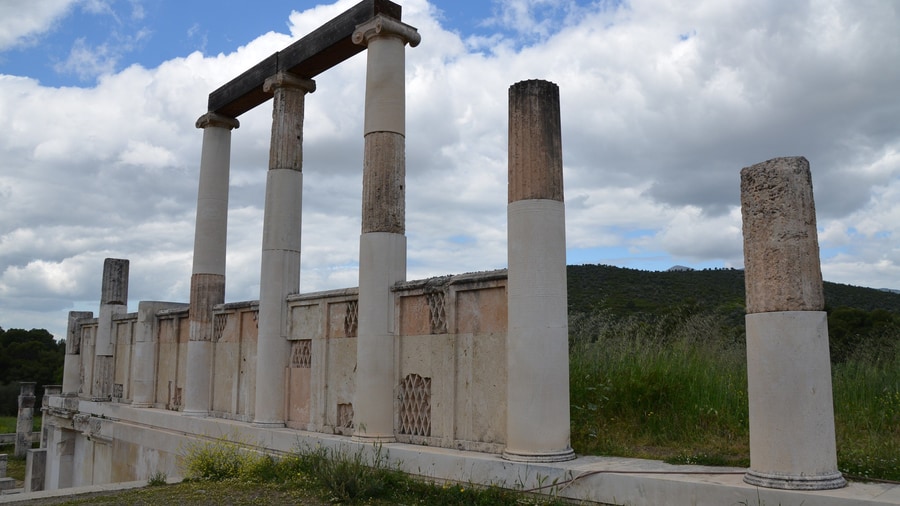
Panagiotis Kavvadias began the excavation at Epidaurus in the Argolis on 28 March 1881 for the Archaeological Society of Athens. It was the society’s first dig outside Athens, apart from minor rescue digs. His work at the sanctuary ran until 1928. The museum stands at the site, so an Epidaurus tour moves from the excavated ruins to the objects dug out of them.
On an Epidaurus tour, the Temple of Asclepius appears in its foundations only. Fragments of its upper structure, recovered in the excavation, are in the archaeological museum at the site. The temple was Doric, with six columns by eleven, and an inscription found near it names Theodotus as the architect. Its pedimental sculpture and figural acroteria, the work of master sculptors, are in the National Archaeological Museum in Athens.
The sanctuary also produced inscriptions that record healing, and an Epidaurus tour covers them. In 1881 the excavation uncovered two stone slabs, sometimes called the miracle inscriptions, from the late fourth or early third century BCE. They name at least twenty people and the means by which each was healed, such as miraculous dreams or visions. Pausanias saw six such slabs standing in his own time.
- First finds: Kavvadias uncovered the tholos and the Temple of Asclepius in 1882 and the abaton in 1883.
- Third slab: Kavvadias published part of the inscription on a third stele in 1903 and the full text in 1918.
- Drawings: Alphonse Defrasse drew lavish reconstructions in 1895, which later scholars considered largely erroneous.
Pausanias described the cult statue of Asclepius as ivory and gold, made by Thrasymedes, a Parian. The god sat with a staff in one hand and the other hand above the head of a serpent, and a dog lay at his side. The image was half the size of Zeus Olympios at Athens. On an Epidaurus tour, the fragments, the slabs and this account restore a temple that now stands only in its foundations.
Can an Epidaurus tour include a performance at the theatre?
An Epidaurus tour can include a performance at the ancient theatre during the Athens Epidaurus Festival. The festival stages plays there on Fridays and Saturdays in July and August, with tragedies by Aeschylus, Sophocles and Euripides and the surviving comedies of Aristophanes in the programme.
The festival that an Epidaurus tour can include, the Epidaurus Festival or Epidavria, was founded in 1955 at the same time as the Athens Festival. Georgios Rallis, then Minister of the Presidency and a future Prime Minister, led the effort. The opening night on 19 June 1955 offered Euripides’ Hecuba, directed by Alexis Minotis, with Katina Paxinou in the title role.
Ancient comedy joined the programme in 1957, when Alexis Solomos revived the plays of Aristophanes for the National Theatre, starting with Lysistrata. In 1959 Karolos Koun staged Birds, with music by Manos Hadjidakis and sets and costumes by Yannis Tsarouchis. The production drew both approval and opposition, and government intervention withdrew it. Maria Callas appeared at Epidaurus in Bellini’s Norma in 1960 and in Cherubini’s Medea in 1961.
During the Greek junta the festival stagnated. In 1975 companies from outside the National Theatre performed on the ancient stage for the first time, among them the Karolos Koun Art Theatre with Birds and the State Theatre of Northern Greece with Electra. In 1982 Peter Hall presented Aeschylus’ Oresteia with the Royal National Theatre and became the first foreign director to take part.
- Season: An Epidaurus tour that includes a play fits a festival that runs in Athens and Epidaurus until October.
- Management: Vangelis Theodoropoulos served as artistic director from 2016 to 2019, after Jan Fabre resigned.
- Music: In 1965 the Paris Opera and the Berlin Philharmonic Orchestra under Herbert von Karajan performed on the ancient stage.
The plays of the Epidaurus stage descend from the Dionysia, the festival of Athens that honoured the god Dionysus. Tragedy, comedy and the satyr play all emerged there. Each tragic playwright submitted three tragedies and a satyr play, and Aristotle credited Aeschylus with the second actor and Sophocles with the third. An Epidaurus tour with a performance therefore meets a form that began in Athens.
What does an Epidaurus tour show in Ancient Epidaurus by the sea?
An Epidaurus tour to the coast reaches Palaia Epidavros, a small town in the Argolis on the Saronic Gulf. The town stands where the ancient city of Epidauros stood, on a small peninsula between two bays, and its Small Theatre lies at the foot of the acropolis.
Palaia Epidavros is also called Archaia Epidauros. Its ancient predecessor was a small city, a polis, on the Argolid Peninsula. The city was independent of Argos and was not part of the Argolis until Roman times. Tradition named the city after the hero Epidauros, a son of Apollo. An Epidaurus tour on the coast therefore stands in the ancient city itself.
The Small Theatre lies about 10 km north-east of the more famous theatre at the Sanctuary of Asklepios, and the two are not to be confused. It was built in the middle of the 4th century BCE, in phases that ran from the Classical period into the Hellenistic period, with further changes in Roman times. The site was discovered in 1970, and organised archaeological excavation began in 1972.
On an Epidaurus tour, the semi-circular theatre shows an orchestra at its centre. The orchestra was circular at first and became semi-circular in the Roman period. Archaeologists have uncovered 18 rows of seats, divided into nine sections by vertical flights of steps. The capacity is estimated at no fewer than 2,000 spectators. The theatre is in a relatively good state of preservation, and restoration works continue.
- Earlier names: Strabo recorded Epikaros under the Carians, Epitauros under the Ionians and Epidauros after the Dorians conquered the city.
- Conservation: An Epidaurus tour can enter a theatre that is open to the public as part of a scheme that has mapped 140 ancient arenas across Greece.
- Events: Performances at the theatre began as solely musical and later became theatrical.
The prosperity that the Sanctuary of Asclepius brought let Epidaurus build civic monuments, among them the huge theatre, a banqueting hall called the hestiatoreion and a palaestra. The festival lists the Ancient Epidaurus Little Theatre among its venues, so an Epidaurus tour to the coast joins the city, its theatre and the summer programme.
Can an Epidaurus tour be combined with Nafplio?
An Epidaurus tour combines with Nafplio, because both lie in the Argolis in the northeast Peloponnese. Nafplio serves as the capital of the Argolis, and Lygourio, the seat of the Epidaurus municipality, stands near its middle. Highways E65 and National Roads 7 and 70 connect the area.
The two stops sit in separate municipalities of one regional unit. The local government reform of 2011 merged four municipal units into the municipality of Nafplio: Asini, Midea, Nea Tiryntha and Nafplio. It covers 390.241 km2. The same reform merged two units, Asklipieio and Epidavros, into the municipality of Epidaurus, which covers 340.442 km2. An Epidaurus tour that adds Nafplio therefore crosses a municipal border inside the Argolis.
A stop in Nafplio on an Epidaurus tour differs from a full day in the town, which a Nafplio day trip gives to the old town, the fortresses and the museums. A peninsula in the Argolic Gulf carries much of the old town. Five quarters make up Nafplio: Gyalós, Kourti, the old town, Psaromachalas and Prónoia, and Stamatis Voulgaris planned Prónoia.
Two places in the Argolis tell one story of the first Greek state. The First National Assembly of the Greeks met at Nea Epidavros, then called Piada, from 20 December 1821 to 16 January 1822, and a monument in the central square of the village recalls it. Nea Epidavros forms part of the municipality of Epidaurus. Nafplio then housed the provisional government, and it served as the official capital from 1829 to 1834.
- Mycenae: A secret passage under the citadel wall leads down 99 steps to a cistern cut from rock.
- Isthmus of Corinth: Strabo noted a stele on the 6.3 km wide land bridge, and its western inscription read “Here is Peloponnesus, not Ionia.”
- Nea Epidavros: A Byzantine castle crowns the village rock, and the 11th century church of Agios Ioannis Theologos stands inside it.
Nea Epidavros lies 40 km east of Nafplio. The village stands inland on a steep rock and cannot be seen from the sea, so its people were protected from pirates. The monastery of Agnountos stands near it, and its fortress-like style dates from the Byzantine era. An Epidaurus tour that adds Nafplio can therefore reach from a harbour town to a hidden village.
When is the best season for an Epidaurus tour?
An Epidaurus tour suits spring and autumn, the seasons that sit between the dry summer and the rainy winter. The east of the Peloponnese is significantly drier than the west coast, and the festival fills July and August. Winter visits stay possible, because Nafplio draws visitors all year.
The Climate Atlas of Greece, issued by the national weather service, places the eastern and southern low-lying areas of the Peloponnese in the Mediterranean zone coded Csa. Summer there is mostly sunny and dry, and the little rain that comes arrives from cumuliform clouds as showers or thunderstorms. The etesian winds blow in the warm season until October and peak in July and August.
The summer festival season shapes the calendar of the theatre. The Athens Epidaurus Festival runs in Athens and Epidaurus until October. On Fridays and Saturdays of July and August, the ancient theatre stages plays. The festival includes musical, theatrical and other cultural events. Lygourio draws visitors each summer for a performance, so an Epidaurus tour in those months shares the area with festival audiences.
Winters in this zone bring wet weather, and snow melts quickly, particularly on south-facing slopes. Rain in winter tends to persist. Nafplio keeps drawing visitors all year, and the marina of Porto Cheli, a summer resort on the Argolic Gulf, is a popular wintering port for pleasure vessels. A winter Epidaurus tour therefore plans for wet weather on an open site.
- Spring: The etesian season opens at the end of spring, before the dry summer.
- Summer: Festival plays and the peak of the etesian winds share July and August.
- Autumn: The etesian season and the festival both run to October.
- Winter: Wet weather and short-lived snow mark the season.
The same landscape works in every season. Lygourio stands at 370 metres at the foot of Mount Arachnaion, and its economy rests on agriculture and tourism. Nafplio draws visitors all year, and Porto Cheli serves as a summer resort and a wintering port. An Epidaurus tour in any month ties together an inland hill town, an open-air theatre and a coastal harbour.
What do travelers ask about an Epidaurus tour?
An Epidaurus tour centres on the ancient theatre and the sanctuary of Asclepius, which lie about 8 km from the town of Epidaurus. Polykleitos the Younger designed the theatre in the 4th century BC, and Roman builders added 21 rows to its original 34.
Does an Epidaurus tour test the acoustics of the theatre?
The theatre has long had a reputation for exceptional acoustics. The auditorium rests on three marking centres, which gave the architects both optimal acoustics and better viewing. The circular orchestra measures 20 m across, with a stone plate at its centre that marks the base of the altar, and a drainage pipeline 1.99 m wide runs around it.
Does an Epidaurus tour run as a day trip from Athens?
An Epidaurus tour from Athens takes the road over the Isthmus of Corinth, a land bridge 6.3 km wide that the Corinth Canal has cut since 1893. Palaia Epidavros lies 60 km south of Corinth on the Saronic Gulf coast, and the theatre lies roughly 10 km to the south-west of that town.
Can children join an Epidaurus tour?
Children can join an Epidaurus tour, because the monuments stand in the open air. The view over the landscape behind the stage belongs to the theatre, which stands on the western flank of Mount Cynortion. The sanctuary held a guest house of 160 rooms. The nearby town of Lygourio adds an important natural history museum.
Is a private or a group Epidaurus tour the better choice?
A group tour keeps to a fixed route, while a private tour sets its own stops. The Argolis offers side stops at different distances: Nafplio and Palaia Epidavros stand 34 km apart, Nea Epidavros lies 40 km east of Nafplio, and Kranidi lies 28 km south of Epidaurus. A private tour reaches these places without a fixed order.
What footwear suits an Epidaurus tour?
Closed shoes with a good grip suit the site. The seats are limestone rows, the lower part of the auditorium holds 12 sections and the upper part 22, and a corridor 1.82 m wide separates the two. The theatre lies at the south-eastern edge of the sanctuary of Asclepius.
Featured photo: Zde, CC BY-SA 4.0, via Wikimedia Commons.